You are currently logged-out. You can log-in or create an account to save favorites and more. more info
Embracing Wholeness in Celibate Life
Sexuality
The talk explores the comprehensive and complex nature of healthy integrated sexuality within religious life, particularly focusing on the need for improved education and open conversations about the topic. An outline of aspects of sexuality is provided, including primary sexuality (embodiment, gender identity, sexual orientation), genital sexuality (urges and expressions), and affective sexuality (intimacy and friendship), alongside discussions on issues like sexual abuse, boundaries, and cybersex. Emphasis is placed on speaking the truth without judgment, understanding individual significance, and the importance of being human and fully embracing one's sexual nature, alongside respecting celibate commitments.
Referenced Works:
- "Holy Longing" by Ron Rolheiser: This book is mentioned as a resource to understand the spiritual aspect of celibacy and sexuality, providing insight into navigating sexual needs and identity within religious commitments.
Mentioned Concepts:
- Pastores Dabo Vobis: Referenced as a document by recent Holy Fathers that emphasizes the human development of new priests, highlighting the importance of being fully human and integrating sexuality into one's identity.
This summary highlights the outlined complexity of human sexuality and the need for open, informed discussions within religious contexts.
AI Suggested Title: Embracing Sexuality in Religious Life


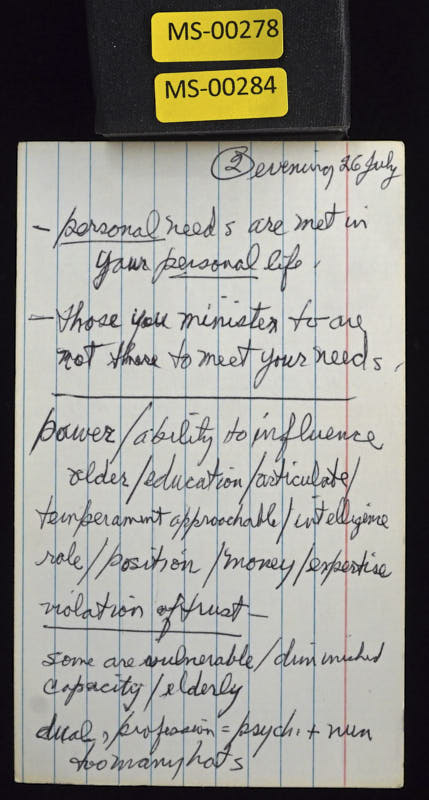




Side: 1
Speaker: Sr. Lynn Levo
Possible Title: Genital Sexuality
Additional text: Too Little: Low self-esteem, afraid of stirrings, urges, desire, physical arousal. Ignorant about and excusing the aspects of sexuality. Appropriate: High self-esteem, accepting, welcoming of gen as part of self. Exercising it appropriately. Too much: Low self-esteem, flaunt, exploit, seduce, needs to prove potency. Our culture admires immed. follow up of urges - mom and dad/baby/ the body responding to joy - pay attention, what are your present connections? an ideal. Three of. Keep relationships on track.
@AI-Vision_v003
I'm also a licensed psychologist and pretty much spent my current minister is as director of education so I pretty much spend most of my time these days doing presentations for priests, brothers, and sisters. You heard me mention the three monasteries that I took most recently in the last year. But also, I worked with the ISIS and some religious congregations of men and women. Pretty much in many areas, intimacy, community life. But I do a lot in the area of sexuality, pretty much almost all the time. I'm speaking in the area of sexuality. We just got back from Australia. We were in Australia for three weeks. doing the same kind of work, talking with priests, brothers, and sisters. We do a lot of work with people in formation.
[01:03]
In the United States right now, I teach in six of the big intercommunity divisions. So I'm meeting a lot of the younger members, or the newer members of congregations, as they come across the United States. So I get to talk with a lot of men, women, and women. and a lot of incoming men who are exploring religious life, and it's been a real joy for me. One of the things I've learned is that how poorly educated we are in this area, and especially the current members of Religious Life, you know, those of us who have been around a bit, you know, that really the education in this area is pretty poor, and it's really a pleasure to be able to comment, to do some input, do some sharing, And let me answer some questions because it's exactly what we need to do. And that's happening more and more in a lot of congregations. It's the kind of conversation we need to have. What I'd like to do tonight is just talk a little bit about the whole big area of healthy, integrated sexuality.
[02:11]
do an outline sort of what it looks like, the big topics, and then talk about the topics that we'll talk about. And I brought some cards with me because it would really help me, if you have any specific questions for areas that you want to make sure I talk about, we'll make a campaign by just giving me a little lonelier on these cards. And so we'll pass these out in a few minutes and just see if there's anything in particular. I'll show you the areas that we're going to talk about. I'd like to start, though, with... an invitation from Angela's area as a cultural anthropologist. And she says when you come together, she says there's fine invitations. And I like to use them when I come together with a new group because I think she's pretty wise. The first thing she says is show up. And you've all done that. So that's a test is cast. You know, you're here. But her second invitation is she said besides showing up, meaning getting your body here, she said you really need to be present. And what she says about being present is not just present to hearing what I say, which is hopefully, you know, you will be and it'll be helpful to you, but also being present to your own experience and your own, what might be happening to you as we talk about a topic.
[03:25]
You know, some of our own stories, you know, some of our maybe remembering something from the past or some current feelings. So, I think it's wise, you know, to not only just show up, but to be present, to try to be here. And, you know, you're busy, and I know you're going to be working and coming in from working and doing, and, you know, et cetera. But hopefully you'll be able to kind of leave whatever is out there out there, and we can be here together and be present. The third thing she says, which I really like, is she said, we need to speak the truth without blame or judgment. And I think that's a powerful invitation, especially in this area. Speak the truth without blame or judgment. And this is an area that is often filled with tremendously negative feelings. There's four big feelings that I deal with all the time, which is our anger, guilt, shame, and fear.
[04:28]
So we have this incredible divine energy that we're going to be talking about, this great energy that's called sexuality. And the major feelings that people have are guilt, shame, fear, and anger. You know, somebody said, what happened here? That this is how people feel when they think about their own sexuality or they think about their experiences. So I think your invitation, let's speak the truth without blame or judgment. your congregation, your community did the best it could in preparing you for a life of celibacy. But it wasn't a very good preparation, probably, because that was true for mine. They did the best they could. They did what they thought was right. But it really wasn't very aniquity. And so I think we don't need to blame them for that. We don't need to judge them. But we do need to speak the truth. And again, your questions would be a way of speaking your truth or your own comments. So we invite you to speak the truth, and I'll speak as much truth as we know, as I know.
[05:30]
And it's an emerging area. This is an area where we don't know all the answers. It's truly an emerging area, and we have to be open to being learners together. And I hope we can do that here, but we need to do that as a church. We need to be open to learning about what it means to be sexual, because it's an emerging thing. So her third thing is speak the truth. without judgment or without belief. The fourth thing is, know what has heart and meaning for you. Of all the things we talk about, there may be one thing that has real heart and meaning for you, a real invitation to you to understand your own sexuality better, to live more fully, to live a more joyful life as a sexual person. So again, she says, you have to pay attention to know what has heart and meaning for you. And usually, one of the things we know, one of the reasons, or one of the ways we can tell what has hearted meaning is when we feel some kind of feelings.
[06:33]
When feelings happen to us, we get stirred up. You might find yourself being angry. Or you might find yourself being frustrated. Or you might find yourself being really just saying, yes, I felt that. That's been my strength. I feel confirmed in that. So pay attention to your feelings. Because a lot of times, how do we know? what has hearted meaning for you. The interesting thing about feelings that men is you're usually not very good at. And there's reasons for that. We don't get not highly encouraged men to be what we call emotionally intelligent. We say that that's women's work. And so it wouldn't surprise me as good men that you might not be as aware of your feelings and the diversity of feelings and what they're trying to tell you. And that's a critical area that we're working on with men and et cetera. And there's some new research, new literature that says how important that is for men and how we need to start teaching our boys to be different because it's the way we treat boys that's the way they become men.
[07:39]
And so there's some really interesting new things that we need to change from dealing with raising boys and men because we're really handicapping you. And then, so that's her fourth one, you know, about to know what has heart meaning to you. And then her last one sounds a little, maybe a little paradoxical. She said, you know, let go. Let it go. Let go of what no longer has meaning or what no longer is helpful to you. Attitudes maybe or belief system. Let go and obviously hang on to what is good and helpful for you. And so I think there's a lot of wisdom in her journey. So I'll say them again, you know, and she says, you know, show up. Be present. Speak the truth without blame or judgment. Know what has hardened meaning for you. And it may not be what has hardened meaning for the guy next to you, you know. And then finally, let it go. Let go of what needs to be let go of. And we've got some poor attitudes and poor learnings. We need to let go of so that we can be present and live as fully as we can.
[08:40]
So I'd offer those invitations as an invitation for me to you through, really, my angels there and through me. What I thought I'd do now is just talk a little bit about the big picture and talk about how we might work together. And please feel free to interrupt at any time. It's not something I have to finish where I say it and then we can talk. If there's questions or comments, please offer them as we go along. I'd be happy to stop and we'll turn the tape off and we'll have a conversation. The thing I'd like to say is I think that one of the things that I'm very aware of right now is that I don't think we understand, we've understood, especially in our earlier training, that our first vocation is to be human. And that really is our first vocation, is to be a human being. And therefore, it means that we have to know what it means to be sexual, because that's habitual to who we are, is we're always sexual.
[09:43]
And we're never going to leave that behind, no matter what vows we take or what kind of life we live. And so being human is our first vocation and how to do that well. And even the current recent Holy Fathers in the last couple of years, I'm sure you've seen that or heard the document, which is on the training around a new priesthood center. And there's even more emphasis now on that. They talk about four different elements of this human development, the human side effects that we really have to help men who are becoming priests or men or religious, they need to be human and be fully human. And so that's why I say it's our first vocation. And so what does it mean to be human? We have to then explore what does it mean to be sexual. And we have to understand that. And so what I'd like to show you is the three aspects of sexuality. And these three aspects, this is just a way of showing you how complex
[10:45]
this topic is, and that's the one thing I've learned over the last 15 years where I've been really specializing in this area, is it's a very complex topic, very comprehensive, complex. There's nothing simple about it. And if anything, we want to be learners in this area. We want to approach it with humility, and really with real humility, that we are just trying to understand what it means to be sexual in a real healthy way. And the other thing, we have to be careful that we don't make absolute statements based on imperfect knowledge. I think we move sometimes very quickly to make absolute statements about things that are just emerging. What does it mean in certain things? So I'd invite us all to kind of be learners together, be careful about making absolute statements about things that we're just beginning to learn. But the three aspects, the first one is what we call primary sexuality. And under primary sexuality, there's three big issues, three main things that we're dealing with when we talk about primary sexuality.
[11:49]
The first one is embodiment. And that we have bodies, obviously, and that you have a male body and I have a female body and how it works and how to understand it and how it speaks to us. et cetera, and how to appreciate it and how to take care of it is all part of what it means to be sexual. And so embodiment is a big area. We could spend a day on embodiment. Obviously, we don't have time to do that. And what we're seeing is young people, for example, there's a lot of pressure on men and women to have certain types of bodies. You see them in the ads. And so we see a lot of, even young men, there's a lot of steroid use, not just in sports. But young men trying to sculpt their body, trying to have a body that the culture says, that the society says is healthy. So there's a lot of pressure on embodiment. And it's very important. And our own self-care. Sometimes we are not very good at being self-caring. And it really means to be sexual, means to care for, to love, appreciate, and understand our own bodies.
[12:54]
So that's just one piece when we talk about embodiment. The second big area under here has to do with gender identity. Gender identity, and it has to do with being a man or being a woman. And what does that mean? And I always say, it's not only am I a woman, but do I like being a woman? Do I appreciate that effect that I'm a woman and I like being a woman? The same thing with you. Not just that you're a man, but do you like being a man? And do you appreciate being a man, et cetera? And there's a lot of issues around gender, as you know. And with the women's movement, in the last 30-plus years, one of the things that's happened is a great expansion of women's roles. And therefore, it has shocked men into all trying to adapt. So women who have much greater roles, and as you know, many times don't want to stay home and just simply be a mother or a wife. And so what we see is changing roles, changing sex roles, and tension between men and women.
[13:57]
And so that's part of our journey. We're in a tense time right now. And gender relationships are not quite as good as they could be. They're not. So part of our role, I always say to men and women religious, what are we doing about being able to be in a relationship with each other in a better way to say something else is possible? Because there's no tension here. And there's clearly a tension in the church, as you know, with many women feeling that we just don't have anything to say in our own church. And so there's tensions here. with gender, but it has to do about being a man or being a woman. And then the third area is one where there's often lots of questions and issues, you know, it's a whole area of sexual orientations. And that's the question of to whom are we attracted? To whom are we attracted? Are we attracted to persons of the opposite sex, to the same sex, or to, you know, so the whole notion of orientations, and there's a lot of, Different opinions about orientations. There's certainly a lot of questions about orientations.
[15:00]
There's a lot of fear around orientations, so we will talk about that. I'll come back and tell you which ones I think we're going to talk about. You'll need to tell me if we're going to change that agenda. So when we talk about front nose, we haven't talked about doing anything yet. Because behaving has not happened here yet. We're not talking about having sex yet. We're talking about having a body. We're talking about being a man or a woman, and we're talking about having an orientation, an attraction pattern that fits with who we are. And then the second big area has to do with what is genital sexuality. Genital sexuality. And when we talk about genital sexuality, we're usually talking about two major things. The first one is a word that many times we tend not People don't know what this word means, and it's the word genitality. And what that means is the urges and stirrings and fantasies and feelings that are a part of every human person's life. And it doesn't matter if you're old or young. It doesn't matter if you're single or married or a monk or a sister or, you know, you have vows or not, that we have urges and stirrings and fantasies and feelings that are a part of our life.
[16:11]
And obviously, everyone's call. Remember, this is about being human. This isn't religious life. This is about human. So everybody's call is to integrate their genitality. What do you do with your urges and stories and fantasies and feelings in whatever life you choose? How do you integrate them? And so that becomes a critical question. And then we talk about the other big issue here, and this is very important for us, is sexual expression. And so we say, how is it that men and women who have vows, for example, how are we sexually expressive? Well, we're called to be sexually expressive, but what's it going to look like? Is it different from a person who's married, et cetera, or who has a partner? And the answer is yes, but we're still called to sexual expression. So what does that look like? And so this is an important area. And by the way, this is the area, when you ask people about sexuality, this is the only area people think of. They think of genital. sex with another person, oftentimes.
[17:14]
Or we might be talking about genital sex with oneself, which is masturbation. That's pretty much when we talk about sexuality, this is where people focus in on. They don't think about this, nor do they think about this area, which is the big one. This is a huge area right now, which is affective sexuality, which has to do with our relational life, has to do with whom are we in relationship. And the big areas here that we want to talk about are intimacy and friendship and how critical those are in every person's life. And when I work with the younger members or the newer members, I say this sentence, and it's an important one, I say to them, you know, celibacy is an option, meaning at some point you have to discern if that's your call. and whether you're going to live a celibate life. This is not optional.
[18:15]
Whether you're living a celibate life, or whether you're single, or whether you're married, or whatever, intimacy is not optional. It is a core human need that has to be addressed, and it must be addressed in our life, as men and women religious, just as it must be addressed in the life of a single person or a person who is married in a partnership. So this is not optional. Now, what does it look like? And how do we foster celibate intimacy is a really good question, and it's a prime question that we need to face. But these are the big topics, and then there's a few other ones that fit in here. One, I'm going to stick them in here, and one of them has to do with sexual abuse. And as you know, I don't need to tell you how much we're dealing with this in the church right now, but sexual abuse is a huge issue. what's happening in our church, which should not be happening. I mean, truly, the betrayal of trust by, you know, men and women religious and priests should not be happening.
[19:18]
It's a horrible thing that we're dealing with, and we're going to deal with it for a long time. The ramifications are huge. But sexual abuse is a huge issue in our culture, and it's happening all over the place, and so we need to be aware of it. sexual abuse and its consequence, and what it takes to heal. I'm a trained therapist, and I've had the privilege of walking with, as a therapist, about 25 survivors of the insets or molestation. Believe me, the journeys are unbelievable. But they can heal, and they can live a healthy life, at least some of them. And some of them have lived very broken lives most of their life. Why? Because even beforehand, there were things they're not like. You know, it always depends on The family system, et cetera. Sexual abuse happens to a person in a system. It doesn't happen without a whole bunch of other stuff. The other area that's deep in here that we do a lot of work on is boundaries. Boundaries.
[20:19]
And that's the difference between where I am and you begin. We have personal boundaries, each of us. And then we have professional or what we call ministerial boundaries. You know, somebody comes to you and wants to talk to you about their relationship with God or perhaps the struggle they're having in their relational life. That's going to be a professional or ministerial boundary that you keep. But we also have personal boundaries. But in the early stages of religious life, for example, basically that you had personal boundaries was not acknowledged. As a matter of fact, they were violated. You know, in Utherist Dentory, for example, all of our mail was red. You know, things like that. So they did things which they believed were white, you know, they thought were helpful. But in fact, they weren't able to have personal boundaries. You know, what you thought and felt didn't matter. A good sister was saying, Joseph, looked like everybody else. A good sister was saying, you know what I mean? You weren't supposed to have any individuality, you know.
[21:22]
So boundaries is an issue... I think we sometimes don't hit the personal boundaries, and I think that's why I think sometimes we cross it to cross families in a stereo way. The other big issue that's happening in the area of sexuality, these are the things that are happening in the area of sexuality, has to do with the internet and size or sex. It's a big issue in our culture. This is a new area of addiction where we have people addicted to sexual material on the Internet. It's one of the major things that's happening, and we're seeing a major thing that's happening is with clergy, not just with women Catholic clergy, but with clergy who are married across denominations. We see a big burgeoning issue here with the Internet side of sex, and, of course, the other word here is pornography, the use of pornography. What is cybersex?
[22:29]
Well, cybersex is the use of sexual material from the internet. So it's cyber meaning coming from the internet or emails, etc. So it would be, for example, and getting a pornography off the internet would be a way of being cybersex. But it could be a relationship, for example. Chat rooms. People are in chat rooms, you know, where they could be talking about sexual material, setting up liaisons. This is a huge area that's emerging. You're coming and you have people talking to you about having problems on the internet in the areas that marriages are ending. But as I said earlier, there's a big issue there with clergy, and there's a lot of this happening in the seminaries. I've already done my three seminaries, not three, but ten seminaries where I just talk about this topic, just to raise people's consciousness about how using the internet as a way of dealing with human issues, but it's not very helpful.
[23:32]
So I think those are the big areas that we usually talk about when we talk about sexuality. And I thought... One of the things that we could talk about, I mean, I thought we would do is, and then we talk about in general what is healthy sexuality. It includes all of this, but we talk about what does it mean to be sexual. So the plan would be tomorrow to start with just some words on celibacy and why celibacy needs to be more about yes than no, and what are we saying yes to, and moving right into what does it mean to be sexual, and looking at some words from James Nelson and Ron Rollheiser, And you might be familiar with the Holy Longing, Ron Rollheiser's book. So we'll share some things. And what I have, I'll bring them up tonight, are handouts. So when I show you some of the slides that we have, you know, that I'll be using from the PowerPoint projection, I'll give you the handouts so that you can have them. You can jot notes on them if you want, but you'll at least have a copy of a lot of what I'm showing you. And then I also brought some articles that you might want to look at
[24:37]
perhaps not during these days, but at other times, that touch on some of the same topics. So I thought what we'd probably do is to talk about, we'll talk about primary sexuality, we'll talk about orientations, we'll talk about something about boundaries, we'll talk about genital sexuality, we'll talk about intimacy, especially male intimacy, which is a little bit more challenging sometimes than female intimacy, and we'll do a little bit on the internet and cyber search. Those are the tablets that I thought we would look at while we're here. I mean, you know, we'll just do some input on everyone and see what kind of questions you have. But I'm perfectly willing to talk about the other topics because you want me to make some shifts here. You're just going to have to let me know. So I know you might not all have pens with you, but why don't we just, if everybody could take one, a card. This would help me a lot. And if there's a particular area that you want to make sure, and I can't hear if anybody wants to, but I don't know. If you want to, if there's an area that you'd like me to make sure I talk about, if you could just write it down, like say, be sure to talk about it, or if you have a specific question, and then these are just for me, I'm just going to look at them and just be able to kind of guide the conversation, you know, along the way, so I make sure I answer the questions.
[25:55]
Does that sound reasonable? And my understanding is we will have one you know, three times a day, three times, we'll do one tomorrow morning, we've got to be a little bit longer because we have a little bit more time because of the combination of lots and masks. So we have a little more time to get started, really kind of get started on what does it mean to be sexual? And you heard me say that really is divine energy. in us. That really is about connection. And that's the big word you want to keep in mind. It is about connection. But the thing it needs to be is about healthy connections and not just any kind of connection. And let me look at it from a celibate perspective. What does that mean? Because celibacy is a not ordinary way to live. Listen to the word. I didn't say it wasn't normal. It's not ordinary what we do. Most people are going to live a life in partnership. That's how most people try to do this human sexual thing.
[26:57]
They do it with another person in partnership. We don't do it that way. So therefore, we have to be very aware that we're still called to do all of this. But how do you do it when we live in a community, when we live with a vow of celibacy? So I think that's the challenge. And we need to do it, otherwise we're not human. As I said... Our first vocation is to be human. We're never not called to be that. So how do we do this? How do we put this together in a way that makes sense? Any questions or comments? We might want to just turn that off.
[27:39]
@Transcribed_UNK
@Text_v005
@Score_89.71