You are currently logged-out. You can log-in or create an account to save favorites and more. more info
Embracing Uncertainty for Creative Mindfulness
AI Suggested Keywords:
The talk explores the intersection of creativity and meditation, proposing that the "mind of don't know" nurtures both creativity and mindfulness. It discusses how the attitude of being open and responding in the moment without preconceived notions can enhance creative endeavors and mindfulness practices, illustrated by experiences in different natural settings and through meditation practices like the Korean Zen focus on repeating "don't know". It also emphasizes the importance of balancing traditional meditation techniques with the playfulness and observation found in creative practices, grounding this in both meditation and creativity as enriching parallel domains.
Referenced Works:
- The Power of Focusing by Ann Weiser Cornell: Discussed as a technique for developing a felt sense of one's inner experiences, aiding mindfulness.
- Focusing by Eugene Gendlin: Noted for contributing to the development of body-based awareness techniques, which are analogous to American mindfulness practices.
Referenced Concepts:
- Korean Zen Meditation Practice: Focus on repeating the phrase "don't know" to cultivate presence and openness in the moment.
- Shantideva's Teachings on Patience: The benefit of focusing on controllable aspects of one's mind rather than external factors beyond control.
- Metta Practice: Mentioned within the context of exploring kindness and gentleness towards oneself and others within Zen practice, often contrasting with the more austere approaches in traditional Japanese Zen.
AI Suggested Title: Embracing Uncertainty for Creative Mindfulness
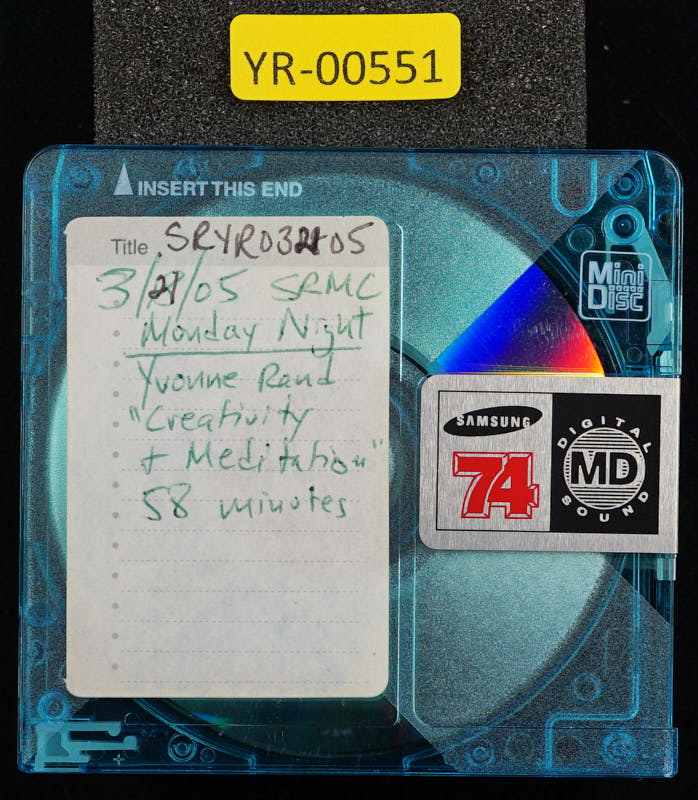
Speaker: Yvonne Rand
Possible Title: Creativity & Meditation
Additional text: Monday Night\n58 minutes
@AI-Vision_v003
MD74
Can you hear me? Okay, if that changes, wave your hand and carry on. Driving here up the coast through the woods and the rain, a verse arose for me which I would like to offer as we begin. Hard rains the rain on covered things. No rain rains hard on open things. So open the covered thing and no hard rain will rain on that. Of course the trick always is to figure out what the covered thing is. But that's what our work is. I'd like to talk with you this evening about the relationship between the mind in creativity and creative work and the mind in meditation, which I would propose is the same mind.
[01:15]
For any of you who have any engagement in creative work, which I actually imagine is all of us, we may not think of ourselves as artists per se, but creativity is part of what it means to be alive. So what I want us to consider together this evening is what is sometimes in the Buddhist meditation tradition described as the mind of don't know. Because of course in creative work, whatever it may be, whatever one's medium, the more I bring some freshness and not a lot of expectation or preconceived ideas about what it is I'm going to do or make, the more I have the possibility of responding in the moment to what is in front of me.
[02:23]
A blank piece of paper, a lump of clay, a stone, language as it arises in prose and poetry, sound. And it is that same characteristic of mind which we are cultivating in meditation. For those of you who have some experience with meditation, you know how easy it is to get lost in thinking about something. Arguing, reviewing, planning, none of which is meditating, it's thinking. And what a relief it is when we can stumble into, however briefly, the experience of being present, even if it's just for a moment.
[03:30]
What I sometimes call being accident-prone. That sitting down, being quiet, allowing the mind to settle, or walking, doing walking meditation, which is the quintessence of not going anywhere. What happens when we begin to taste the mind when it's settled? The experience of being present in the moment and the relief of that. is really about the cultivation of the mind of don't know. Particularly in the Korean Zen tradition, a traditional focus in meditation is to just say over and over and over and over again, on the inhalation and on the exhalation, don't know, [...]
[04:48]
And if you do that, particularly in the container of a retreat for a few hours or several days, what may happen is stumbling into how often don't know is actually the most accurate description of what's so in the moment. And what kind of trouble we get into when we think we know. When we think we know what's on somebody else's mind. When we think we know what tonight will be like or tomorrow morning or some event we're looking forward to. That whole realm of expectation and assumption which flourishes with the I know.
[05:54]
My experience is of a kind of relief when I remember the quality of don't know mind. And can be open to allowing whatever arises in the moment to arise in the moment. A few days ago, I was reading a bulletin that came from the Point Reyes Bird Observatory, talking about their new location at the mouth of the Petaluma River, where it opens into the bay. delicious description of the muddy intertidal area where there are all kinds of shorebirds poking around, feeding, et cetera.
[07:00]
And I thought, oh, the muddy intertidal flats of the mind. How often do I turn away from what may be muddy in the mind. That description that came from the PRBO bulletin has been popping up over the last couple of days as an example of the creativity and language based on our experience that may come from some realm other than meditation, but that can be useful, engaging in our training and developing our ability to observe and describe the mind. What I've discovered over the years is that along with studying the teachings of the Buddha Dharma in the classical language of the tradition, what seems to make a big difference in my own experience and in teaching and working with other people
[08:34]
is to not only pick up a particular practice or a particular description of the untrained versus the trained mind, is to find a way to take a particular practice or description and let it be shaped to this hand, to the arising of what I experienced with this mind, not trying to generalize about anybody else's mind. And for myself, I found that the world of creativity, the world of the natural sciences in particular, botany, birds, the natural sciences, it comes together with the language that comes to us from the Buddha Dharma. and that the more I can develop my capacity to be present in any given situation, the more I can develop my ability to observe and describe externally, the more I begin to have a capacity to observe and describe what arises in the mind as well.
[09:57]
and that if I get too locked into the so-called correct traditional language, I may miss some observing of what I'm experiencing in the moment that may be a surprise, maybe something I haven't noticed. A few weeks ago, My husband and I were down in Joshua Tree. For any of you who've been reading about the wildflower bloom in the desert, it's supposed to be quite extraordinary. More wildflowers in great abundance than we've seen in at least 50 years. We didn't make it to the Mojave or Death Valley, we got stuck in Joshua Tree.
[11:02]
And I found the experience of being in that landscape, which is to me quite strange, unfamiliar. took me a good 24 hours to just be able to settle with the unusual rock formations and the strange, but in their own way quite beautiful Joshua trees and their blooms. And one morning, I suspect partially because of the effect of being in that strange landscape and at some altitude I had what I call a kind of meltdown where I stumbled into the mind of two years old and for about an hour I visited the realm of suffering conditioned mind.
[12:10]
Thank goodness for meditation practice. At a certain point, I realized what would be appropriate in that situation where, um, I stumbled into some very early unhappy state of mind was to actually place attention somewhere other than with suffering in that moment. Not out of aversion, but out of some sense of there are times when it's useful to pick up one's attention and place it somewhere else. that there can be times when there can be too much attention placed on suffering, which of course turned out to be accurate. We went to an oasis where there was a quite extraordinary stand of palm trees.
[13:23]
I think this trip was the first time I've ever looked at palm trees and actually seen them. I've looked at them before but not seen them. And I realized later that there are times when it's useful to pay attention to what arises in the mind, especially what arises by way of suffering, but there are also times when it's useful to change the channel. There are times when what we see, we see more accurately with peripheral vision than like right here. What am I looking at? That experience that lasted for about an hour was for me an intersection between being out in the natural world
[14:27]
engaged in looking and seeing, being open to acknowledging and describing a state of mind that arises out of conditioning, and having some sense about how to step back and pause and rest. in order to be able to observe without a kind of pushing or striving. And I know that that combination of characteristics of the mind hold as well in any kind of creative work, no matter what the work itself is. If we're willing to cultivate our ability to observe and describe externally, in time, we begin to be able to observe and describe internally.
[15:39]
We begin to be able to describe accurately sensations in the body that accompany emotional states, patterns, and habits that arise in the mind that are best not lingered with too long. We begin to, out of the actual experience of meditation, begin to understand what happens when we sit down and are quiet and let the busyness of our lives settle. And with that settling, the mind settling as well. And the place that I get stuck and I imagine that I have a lot of company is when I get caught with expectations, when I get caught with assumptions about how things should be, how I thought they were going to be.
[16:46]
And of course, for any of us who knows something about creative work of one kind or another, having some expectation about how what it is one's engaged in creatively, how it's going to turn out, is often a kind of kiss of death for the creative enterprise. So what I want to invite you to consider is that the realm of creativity and the realm of studying the mind and training the mind, which is really what meditation practice is about, have much more in common than we may usually consider. And that part of what we can practice is developing more and more ease for resting with don't know.
[17:58]
And to begin to uncover how often don't know is a more accurate description than, oh, I know what's going to happen. I recently met with a couple who were planning on marrying, and I gave them some homework to do in terms of our working together on articulating the promises that they wanted to make to each other in their wedding ceremony. And at one point, one of the members of the couple said, well, I know what my promises are. I already know what they are. And I know what my intended promises are going to be also. And I thought, trouble.
[19:04]
How often do we get caught by thinking that we actually have some control over somebody else's mind? I think it particularly shows up in our coupling. The great ninth century monk and practitioner, Shantideva, has in his chapter on patience, this verse that goes, why be unhappy about what I can do something about? And why be unhappy about what I cannot do something about? That verse is a code for why be unhappy about minding somebody else's mind stream, which I cannot do. and why be unhappy about what I can do something about, namely, minding my own mindstream.
[20:16]
So what I'm proposing is that there's a kind of intersection, a fruitful intersection between the world of what we think of as being engaged with creativity, observing and studying the natural world externally and studying the mind. the more I can observe the world outside of myself, the more I'm developing a capacity for observing and describing that becomes critical in mind training, in meditation. But I also want to propose that a certain amount of playfulness and creativity is beneficial in meditation practice as well.
[21:32]
That there is enormous richness and benefit in the process of studying the mind if I can have resources, descriptive resources that fit what I'm experiencing in the moment even if it doesn't fit whatever book I'm reading about the mind. So, isn't it true that for most of us there are some days when we feel like our mind, our state of mind is like a intertidal mudflat? Failing to register the richness and food sources if I just had the right kind of bill for finding what's buried down there in the muck. I think that a certain amount of playfulness along with some imagination, some creativity is quite useful in studying the mind.
[22:50]
Particularly if the process of observing and describing doesn't lead to a kind of solidifying of the description. If what I observe and describe, I hold tentatively until I have more information or experience. Because of course, along with the weather, if I wait a minute, things change. What happens when we generalize about our state of mind is that we step back from the actual process of observing and describing in the moment. And we get caught in the kind of thinking that gets carried with sentences that have always and never in them. The richness of experience is in the particular moment, not in generalizing.
[24:20]
I sometimes work with the people I practice with in small study groups and one of the study groups met on Saturday and someone said, as you say so often, all the time, always, and I thought, oh dear, what might that be? But what my friend was bringing up was something I do bring up often, which is the importance of the cultivation of curiosity and interest. And I think certainly in this kind of intersection between the realm of creative work and meditation, interest and curiosity are critical qualities to bring to whatever it is we're engaged in. Interest and curiosity and the willingness to be surprised.
[25:37]
Anyway, that's what's on my mind this evening, and I'd be interested to know if any of what I have been bringing up resonates for you. And also, if there are some questions or things you'd like to talk about on this focus or not, I'd be happy to have some conversation with you. Yes, please. When I first sat down here, what came up for me was, before your talk, what came up for me was an insight about my many years of Zen practice and what struggle that was going on during those years. feels like I had the most accurate insight I've ever had about those years. My question sitting here about that was, where is the place for vulnerability?
[26:56]
in the practice. And I realized that I moved away from the intense practice that I was doing because my vulnerability was raising its head, so to speak, and really making a lot of noise, wanting space for the tender vulnerable part of my being. And what you were saying about the two-year-old heart really resonated. Would you talk about this a little bit? Well, you know, particularly in, well, I think it's true of the several schools of Zen. particularly coming from Japan. I think Japanese Zen, in particular, can sometimes be described as the samurai school of Zen practice, with a big emphasis on strictness and toughness and what happens then to that more vulnerable, young,
[28:12]
complex, not completely clear aspect of our experience. And perhaps if I describe something, it's a kind of response to what you're bringing up. One time when I was doing a retreat, I said at the beginning of the retreat, I don't want anybody to not move during our sitting meditation because you're worried about what I'm gonna think about you or what your neighbor is gonna think about you. I want you to take the power and authority about whether you move or not during formal sitting and take that back. So your sense about when it's appropriate to move or not comes from the inside out, not the outside in. I know lots of Zen places where you're actually invited to not come into the meditation room if you're not committed to sitting still without moving until the bell rings or else.
[29:22]
And that was not the tone for a practice environment that was particularly fruitful for me. It smacked too much of what I'd grown up with. So anyway, in this particular retreat, when I asked the people in the retreat with me to please take back whatever authority they might have about whether they would move or not and have that be their own. And we had the, without question, the most still retreat we'd ever had. and also what people reported was a significant degree of ease experientially in their meditation practice. In the end, the whole process of practice, whether it's in the Zen tradition or in the Theravadan tradition, in Vajrayana, we have to learn how to listen from the inside out
[30:32]
And what I've learned is that there is a graduated path for the cultivation of more and more strictness as that becomes appropriate. But we can get fixed on some description about the right way to practice and miss being present with whatever is arising in the moment which is not what was arising an hour ago or last week or the last retreat I sat, etc. And I do think that a regular, dedicated meditation practice helps us be what I call being accident-prone. That is, cultivating the ability to be present with whatever is arising even when it's not a thrill. I've been working with some of my students on Metta, which is, of course, absent from Japanese Zen.
[31:50]
Absent, I'm sorry to say. And we've been talking a lot about what is the possibility of kindness or gentleness with aversion arising in the mind. And I could kind of register a sort of jaw dropping as the people in the study group where I was having this conversation began to imagine the possibility of bringing the quality of kindness, of gentleness, of ease, of peacefulness with whatever arises in the mind and at the same time not feeding it with thinking. That's easier said than done, but it is what the practice is, in my experience. So if we have too much focus on strictness, the genius of Zen, in my experience, is an appreciation for form as the vehicle for mindfulness.
[33:04]
The hazard is when form becomes an end in itself. But if the forms allow me to begin to develop my capacity to be present with whatever arises, including that arising of two-year-old mind, of conditioning, that's what we get to develop the taste for being with. I like this, I don't like that. Well, we're not going to develop or uncover capacities we all have if there's a whole category of experience that's not allowed, including the soft underbelly, which we all have. I was teaching in Los Angeles, I guess it was,
[34:07]
last week, I'm not quite sure. I had an exchange with somebody, and I later realized, really with the help of the Discourse on Love and Kindness, which I sing several times a day, the line about one who is skilled in goodness is straightforward and gentle in speech. And what I realized was, in that exchange, what I was expressing was straightforward, but gentle was missing. Oh. And I think that those moments where we can recognize what was missing, what quality would have informed an exchange more harmoniously, means touching that part of ourselves that's not perfect, that part of ourselves where we go, oh, was I in some way an agent of less than kind or gentle?
[35:29]
And anything I close off within myself, I'm more likely to close off relationally with another person. Because, of course, the whole bottom line, I think, is about relationality, uncovering our relationship with ourselves and with all beings and things. And we can't do that if we are only coming forth with You know, the soft underbelly is very important. Tenderness, in my experience, is very important. Yeah, thank you for what you brought up. Please, yeah.
[36:39]
I'd like to ask a little bit of a clarification on being mindful and the richness of creativity in the moment. Is that synonymous with spontaneity? If you have an idea, I'm a designer and I have an idea and yet it may not end up to be the original idea that was conceived or that was preconceived. Would that be synonymous with this being in the moment and the richness of the moment in creativity? It depends on my relationship with the idea. I think it depends a lot on my relationship with thinking. And I think for us as Americans, because we're essentially a mind culture. So we have a tendency in our cultural conditioning, our social conditioning, to put a lot of energy into what we experience from the neck up.
[37:50]
And my experience with creativity is that the more my attention is more body-based, the more present I am with all the factors in the moment, whatever the medium is, whatever arises relationally as I am present with a piece of paper, a room, a garden, a stone, that what arises creatively comes out of that meeting, that coming together of all those different aspects. and that if I go to thinking about what I'm gonna do in a way that is a disconnect with more body-based experience, the creative process is hindered. I practice and have for a long time with a man who lives up in Juneau who has a quite remarkable relationship with stone.
[38:58]
And he suffers enormously in formal meditation practice because he goes to thinking, he goes to fantasy, he goes to all this busy mind stuff. And yet when he is engaged with some stone, he is completely present with, it's not that thinking isn't going on, but it's kind of out here, not right, Stage Center. So last summer he was at our place at Goat in the Road for a retreat and I had a pile of white river stones that I gathered years and years ago from the South Fork of the Yuba River. Just this big pile. And while he and I were talking, he got up and he took one stone and he put it down and We were just sitting together and then he did another stone.
[40:03]
Pretty soon what he had made was a big spiral of these stones. And afterwards I asked him about what had happened and he said, the stones told me what to do. And consistently what I've seen with this person and what arises out of his relationship with stone is more about presence, that he doesn't trust informal meditation, but that he has access to when he's with a piece of stone or a pile of stones. So for him, the whole world of meditation practice is somehow uncovered and revealed in the creative work that he does.
[41:04]
And out of that has begun to be more and more confidence on his part about what to just ignore, just let it come and go and come and go with the busyness of the mind. It's not that there's something wrong with an idea, it's that then we start thinking about the idea. Some friends of ours have a 1940s motel down in Desert Hot Springs, and they have T-shirts, and on the T-shirt it says, no thinking. If thinking, think nothing. It's not that, there's absolutely a place for thinking in meditation, there's a place for thinking in creative work, but we can get caught in thinking about rather than direct experience.
[42:09]
And the difference in my experience is crucial. I think that mostly what I was trying to get some sense of was that the thinking was the beginning of the spiral, which continued out. Well, actually, I don't think thinking was involved in his creation of the spiral. I think it really arose out of his going over and picking up one stone and putting it down. That was just kind of a visual metaphor. Uh-huh. Yeah. Thank you. Yes. Hello. Speak into it like it's a lollipop. It's an ice cream cone. Yeah, right. Is it? I don't think it's turned on.
[43:10]
Yes, it is. I can hear you. I would like. I'm curious about when you said sometimes it can be useful to pick up your attention and put it somewhere else. Right. Because how do you know when that's a useful strategy, so to speak, versus when you have a recurring obsessive thought or versus, you know, noting it, letting it go, being kind about it. I mean, when is that trying to go somewhere else helpful versus avoiding? Can you say something? Well, you're actually, if I'm hearing you, accurately bringing up several possibilities. Whenever I have a kind of obsessive loop, a tape loop, the antidote in my experience is to make a date.
[44:20]
Thursday morning at 10, for 10 minutes, I'll make a date with myself to think about this. And all the rest of the time, not now. Now, the not now doesn't work if I haven't made the date and keep it for when it's okay to sit down and think about it. In terms of the experience that I was referencing, Do you know The Power of Focusing by Anne Cornell Weiser? It's a book that she did based on a book called Focusing by Eugene Genlin. And I think it's a kind of American mindfulness practice. And the language that Genlin and Cornell Weiser use in this focusing technique is what's the felt sense of something? So it's very body-based.
[45:22]
And I think that particularly to the degree that for many of us, we're so used to going to thinking that we abandon or turn away from just checking in what's happening in the body. And if I ask myself, what's the felt sense of something, that was clearly what happened for me was a kind of felt sense of enough. I need to just take my attention and put it on something else because I'm just winding in an old conditioned track. Now, partially that may be the consequence of having practiced for a while. that growing confidence in the felt sense of what's appropriate to turn towards and when it's time to just put it aside and leave it alone, whatever the it is.
[46:25]
And I think for a lot of us, we know what's appropriate if we will listen, but we're not used to listening in the way that I'm suggesting. I don't have a lot of regard for thinking about things. I keep thinking I should go into a bumper sticker business. Don't believe everything you think. I have enormous confidence in the felt sense of something. And at the same time, I would say that there are times when thinking, when intellectual work as practice is totally valid and appropriate. But when we go to thinking habitually, it's more kind of default. Does that get at what you're bringing up?
[47:28]
How do you help yourself develop the felt sense? Well, for one thing, asking yourself, asking myself, in this moment, what's the felt sense in a body-based way in this situation? To speak, to not speak, to be quiet, to distract myself, whatever. I think, for me, the sense of the felt sense grows out of having done the focusing practice, which you can learn. It's quite simple to learn from the focusing book. But it's really, it's a Western formation for what we know, particularly in the Theravadan tradition, in terms of scanning for body sensation. The body doesn't lie.
[48:33]
Our interpretation of what we're experiencing may be off, but the direct experience is, I think, pretty reliable. You know, look at what happens to us when we sit together in silence and just allow the mind to settle. And the sense of connection that goes against all of our training about how to know another person. It's one of the things that makes some of us retreat junkies. That sense of connection underneath the busyness of the mind, so. Okay, anybody else have something you'd like to bring up, please? While you're talking about felt sense, I just wonder if it's the, for me, it feels like the spot where the neuroses kind of hides in the body. You know, not where I think, you know, the thinking's over here, but the body over here's giving me some pain or something.
[49:43]
And I'm wondering if your use of tuning into felt sense has uncovered places where you're holding and need to let go. Sure, absolutely. I mean, I'm quite interested in constriction. When is there some area of the body where I'm aware of constriction which may then that awareness of constriction in the stomach or the jaw is an access point to the quality of constriction in the breath, which is access to the quality of constriction in the state of mind. And observing the consequences of constriction over against ease or exhale. So one of my concerns about our labeling certain aspects of experience with pathological labeling is that it becomes a kind of generalizing.
[51:09]
So I'm not quite sure how to relate to what you were describing as neuroses. I'd be much more interested in the detail of what's in that suitcase. Unpack what you mean by neuroses. Are you perhaps referring to certain reactive patterns that keep showing up in the mind that have a component physically as well as mentally and emotionally? There's always a a resonating with what's arising with certain states of mind and certain emotional states and sensations in the body. And sometimes I may not know what I'm experiencing emotionally except through paying attention to sensations in the body. because they go together. There is this inextricable, inseparable packaging of body sensation, characteristics of breath, and characteristics of state of mind.
[52:21]
So I may not quite know what to do with certain states of mind, just as a meditation practitioner, have some sense about the benefits of shifting breath, extending breath to be deeper and slower, for example. Over against the states of mind that accompany breath that's rapid and up high in the chest, has a characteristic of roughness, et cetera. You know, sometimes when we do our thinking, we'll go, gee, I think I know that I don't know. And sometimes in the body, I definitely feel like there are no words. It's just something going on, and it's definitely a big don't know. Right. But I may have that sense of uh-oh and don't know that I know in a body-based way. Am I willing to just sit with that, or do I feel compelled to do something about it?
[53:25]
And how often, if I just sit with what's so, I come to some way of being that isn't always doing. Hard for us, because we're a culture of doers. It's what we are admired for in the world. But, you know, everything has an underbelly. Yes, please. And it's one thing to sit in meditation in a context that's supportive and open and somewhat solitary. And it's another thing to be in relation to someone else in an instant where one feels threatened and immediate. You know, they're an asshole way before you can even catch a breath. You know what I mean? Unfortunately, I do.
[54:28]
But so the judgments are flying long before one can scan the body. And the energies are just soaring. Well, and that's why, you know, the place to study the mind and train the mind is not in the trenches. is to start when there is a quieting of the external circumstances so that I begin to develop some capacity for feeling safe that isn't dependent upon somebody else doing it the way I want them to do it. But you know, we have this way of speaking, you made me angry, or you scared me, or even better, it scared me, the great it. And what's much more accurate is something happens and fear arises. Something happens and feeling safe arises.
[55:29]
when I begin to understand that something happens and then there's these arisings in the mind. And I can't, I have no control over what happens around me often. But what I do have some say about is what arises in the mind. Now initially, all of our habitual conditioned reactivity doesn't feel like something I have a say about. But that's where practice comes in. I begin to develop, oh, I actually do have a say about my state of mind. And it starts with not acting on what arises in the mind. So anger may arise, but what a difference when I don't act on it. That's the beginning of cultivation, the capacity to cultivate and train the mind. It's not quick, this path. But it's thorough, in my experience.
[56:35]
And you know, from the age of 20, retraining the mind over, say, 40 years, looks like, oh, that's too long. But by the time you get to be my age, you think, gosh, only 40 years. pretty good, better than not at all. So maybe on that cheery note, I will leave you with encouragement for patience and persistence and great kindness. Thank you very much.
[57:16]
@Text_v004
@Score_JJ