You are currently logged-out. You can log-in or create an account to save favorites and more. more info
Communal Harmony in Early Monasticism
The talk explores the structure and essence of communal and individual prayer in the Pacomian Koinonia, focusing on synaxis, individual scripture recitation, and the spiritual instruction provided by Pacomius and his successors. The discussion critiques Father DeVoguay's interpretation, suggesting that the Pacomian synaxis was more than a method to support personal prayer; it represented a communal living and spiritual practice deeply rooted in the early Christian communal life. The speaker also highlights the continuity of these practices into later monastic traditions, such as the Rule of St. Benedict, indicating an evolution from communal instruction to formalized monastic rules.
Referenced Texts and Authors:
-
Father DeVoguay's "Doctrinal and Spiritual Commentary on the Rule": The talk critiques DeVoguay's view that monastic office primarily supports personal prayer and serves as training for a hermitic life, contrasting with the Pacomian communal vision.
-
Rule of St. Benedict: This text is discussed in contrast to DeVoguay’s interpretation, showing a richer communal and spiritual dimension in monastic practices, allegedly influenced by Pacomian traditions.
-
Pacomian Texts and Rules: These serve as foundational documents, emphasizing the memorization and recitation of scripture as a core monastic practice, directly influencing the communal and individual spiritual life.
-
"The Life of Pacomius": Provides historical context and practices of the Koinonia, including the integration of communal prayer, work, and scriptural instruction, reflecting the initial stages of organized monastic life.
-
Scripture (New Testament, Psalter): Fundamental texts in the Pacomian community's spiritual instructions and daily practices, which all monks were expected to learn by heart.
-
Olivier Clément's (Book not specified): Discusses the ecclesial, liturgical, and Eucharistic quality of scripture reading, reinforcing the communal aspect of monastic prayer.
The discussion offers deep insight into the early Christian monastic tradition, emphasizing the significance of communal practices and their historical evolution.
AI Suggested Title: Communal Harmony in Early Monasticism
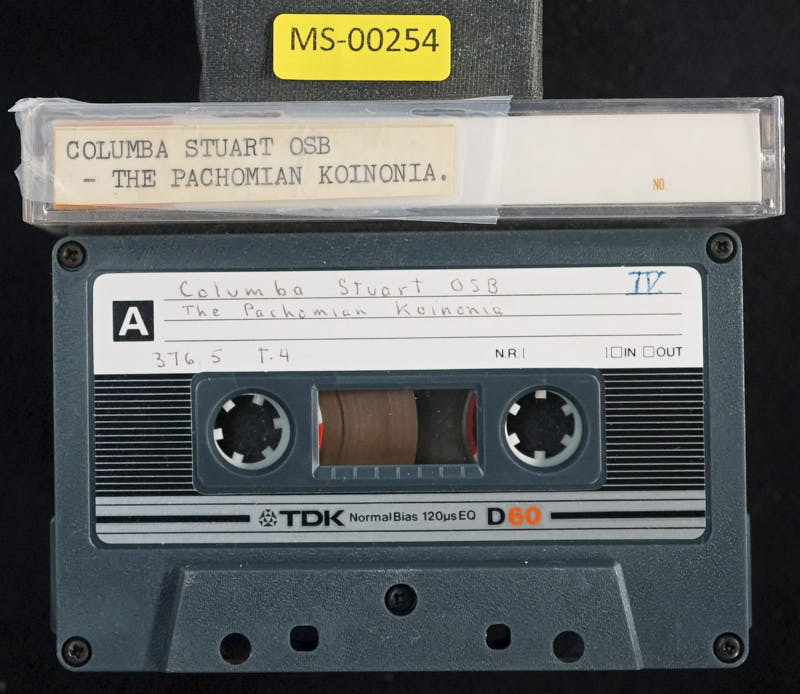
AI Vision - Possible Values from Photos:
Speaker: Columba Stuart OSB
Possible Title: The Pachomian Koinonia
Additional text: 376 5 T-4
@AI-Vision_v002
It's a perfect text to cite for what I want to talk about tonight, which is the details of the spiritual life of the Pachomian koinonia. Now, I huffed and puffed this morning to go through all of these six signs to give you a sense of the backdrop of the prayer life both of the individual monk and of the whole community. And I think we have to have this in place to understand the things that I want to talk about tonight, which are three. First of all, the synaxis, the communal prayer of the koinonia. Secondly, the individual prayer of the monk in his cell, reciting scripture and praying. And I'll talk about how they relate. And then third, the instruction in scripture and doctrine given to the community by the superior. And somehow all that is going to come together. As I think I mentioned this morning, the common prayer of the community, the Synaxis, was held twice a day.
[01:05]
Once in the morning at sunrise, once in the evening after the meal before retiring. This was the common Egyptian pattern, two hours of common prayer a day, rather than the seven or eightfold hours that we're familiar with, which seem to come from Basel and then through Palestine. So they met only twice a day. How they did it is interesting, and I think it's worth describing the setting and the structure of their common prayer, because we learn a lot about what it meant to them. Essentially, it consisted of reciting short passages from Scripture, and the thought is that it was probably 12 of them in the morning and 6 of them in the evening. Only on Sundays did it have to be psalms. And on Sundays, the psalms were chanted very much like we would. But on the other days, it would be other texts from Scripture which would be recited probably continually by different people appointed.
[02:14]
So somebody would stand up and just recite a chapter from Scripture from memory. So there's not a psalmody plus reading structure. like we're familiar with. This seems to have been a kind of later development of this two-fold, do your psalms, then have your readings. They had a whole different approach. These different recitations from Scripture were divided by periods of prayer, and that's where I think it gets very interesting. This is what they would do. Picture a big room, or even outdoors, and all the monks sitting around doing their handwork. much like Brother Pierre is doing now. They would all have a basket to weave or something that would occupy the hands during the time of prayer. Somebody would be appointed to stand and recite a text, which he would do, and when he was done, there'd be a signal, probably a knock, and everybody would get up.
[03:16]
They'd make the sign of the cross. They would then extend their arms in the form of a cross and say the Our Father allowed. together. Then they would prostrate themselves on the ground and have a period of silent prayer. Then they would stand again, make the sign of the cross, and sit down and be ready for another text from Scripture. Now, note the components of this prayer between the texts of Scripture. First of all, they had a common listening to the Word. They're all there together listening to the recitation, so they're sharing that. Then they've got these common gestures, sign of the cross, extending their arms, prostrating themselves, so on. They pray the Our Father aloud together, so that's a shared vocal prayer. And then when they have their individual silent prayer, they're still doing that together. So there's an interesting combination of shared prayer and movement and also private or individual silent prayer.
[04:28]
Now, it might be possible to interpret all of this as simply a way of supporting each monk's unceasing prayer. And that, of course, is Father DeVogway's interpretation. I want to read a couple of passages from his doctrinal and spiritual commentary on the rule, which many of you have probably looked at. As I was telling Father Martin when we were washing dishes, I had Father DeVogway autograph it for me when he visited our community in October, and I was very glad he did not turn the page where I realized to my chagrin as he was autographing it that the previous fall when I was reading it, I'd gotten angry with him, and it crossed out The Rule of St. Benedict, a doctrinal and spiritual commentary, and written The Rule of the Master. Oh, my God. Fortunately, he did not turn the page and autograph it here. He autographed it here. So my secret was safe. I wrote that.
[05:30]
I crossed out St. Benedict and wrote in Rule the Master because that's really what this is. Now, it is a remarkable book. I don't want to downplay his achievement. It's very impressive. But at times... his interpretation might be problematic to us. Let me read you a couple of lines. The only law for the monk as for the Christian of the first centuries was to pray without ceasing. The office was only a method for attaining this. The canonical hours should be seen as the pillars of a bridge thrown across the stream of time. The only purpose of these supports is to carry the road which will bestride the river and connect the two banks. Thus, the meaning of the hours of the office is to provide the underpinnings for continual prayer. Now, he says even more than that. He grants that some people might kind of think there's something beneficial about gathering to pray in common.
[06:37]
But he says that for monks especially, the point of the office... is to help each other, by dent of a common rule, to bear a personal obligation which each one feels too weak to discharge by himself. In this monastic perspective, the office of the Cenobite does not seem like something good in itself, but like a simple preparation for the prayer of the hermit, or as a more or less permanent substitute for it. Its meaning is no different from that which covers every synabitic observance, namely that of a school or a substitute for the properly monastic life, intimate converse with God. Now, I'm uncomfortable with this, as a lot of people are, although I respect his evidence. It seems to me that Pachomius has much more in mind
[07:39]
when he describes the Synaxis in his communities, than establishing a factory for ascetics. Given the development sketched in the early chapters of the life, summarized in the six signs that we've examined, also given the very name Koinonia, with its roots in the text from Acts, which speaks of the prayers shared by the first Christians in a clearly common way, and given the fact that nowhere is the koinonia presented as a form of life which people leave behind when they're done with their preparation and become the anchorite or perfect monk. I find it hard, therefore, not to think that Pachomius has something richer in mind when he talks about the Synaxis. And de Vogue really doesn't reckon with that. and I don't think he gives enough weight to the Pachomian tradition when he interprets the ruled Benedict.
[08:40]
All it takes is to go back and look at some of the language used to describe the koinonia, and I'll just quote a couple lines. Pachomius prays at one point in the life to God and says, You who have assembled this holy place, namely this holy koinonia, which was established from the beginning by our fathers, the holy apostles whom you have chosen and loved, and upon whom you later established us. Now, I think that kind of perspective is somewhat more than presenting the community as a training ground. There's kind of a whole historical and communal notion of the koinonia, which says, this in itself is a way of life, perfect life. and entire, not the only way, but certainly entire in itself. I don't think, therefore, that we can take a highly individualistic perspective on what the Synaxis is all about.
[09:48]
To look at it from another angle, the brothers do not serve one another simply to make life easier, either for themselves or for one another. there's also a spiritual imperative to their service, an imperative of charity, which places the mutual service of the koinonia on a wholly different plane than sheer utility. So I think, given their conception of service, I think we can also begin to relate that to their conception of communal prayer. Certainly, the Synaxis was supportive of each one's prayer. There's no doubt about that. But it was also a matter of this particular church. And remember the koinonia thinking of itself as a local church. Of this church being church by doing what the church does. Pray together. Christianity is essentially a communal faith.
[10:52]
As Weyer writes, the mystery of communion is the essence of the church. Powerful line. The mystery of communion is the essence of the church. And I think this has to find expression in communal prayer with its shared rituals, the gestures and so on, and also with the shared hearing of the word. And I think that's what the Pachomian Synaxis is all about. So I would say that the command to Christians to pray always is not only addressed to individuals. It's something a community can take up as a community. Well, that's enough to make my view about that clear. Let me move on to talking about the prayer of the individual. The interesting thing about Pachomian common prayer is although it is not identical with the prayer of the individual or private prayer, it is related to it in its basic elements.
[11:53]
Recitation of a text, prayer offered in response to or in dialogue with the text, Now, this should be no cause for surprise because how else do Christians pray? They hear the word and they somehow respond. And that's simply because Christianity is based on the assumption that God speaks to us and we to God. God to us in Scripture, we to God in supplication, adoration, thanksgiving, so on. So when we find a description in the life of a monk's individual prayer, It's very much like what the community does in common. This is in chapter 34, talking about Theodore, Pachomius' greatest disciple. One day, during his first year in the Koinonia, Theodore was sitting in his cell, plating ropes and reciting passages of the Holy Scriptures he had learned by heart.
[12:56]
And he would get up and pray, every time his heart urged him to do so. Now simply because Theodore's prayer in his cell reminds us very much of the prayer of the community doesn't mean that we have to say that the synaxis is just taking over the structure of individual prayer or vice versa. I think rather there's an interplay, a conversation, a dialogue, whatever word you want to use, to talk about the relationship between the monk in his cell or at his work or wherever, doing basically the same thing the community does as a whole. This recitation of Scripture, apart from the communal prayer, is emphasized again and again and again in the Pachomian text, which is usually a pretty good sign that not everybody was very good about it.
[13:58]
That's why they have to keep emphasizing it and emphasizing it. It's something that was done at work and common. People in the bakery or wherever would recite texts together. It was to be done on the way to the synaxis and to the refectory. The person who struck the signal to call people to the meals was to be reciting scripture as he did that. The person who had the job that I like so much of handing out the sweets after supper was supposed to be reciting scripture as he did that. And it was to be done in the cell. As Horzi Isios summarizes it, let us be wealthy in texts learned by heart. Now we brought up the question of monks who don't know how to read. And I said that the Pachomian situation was a little different. So to show you that they took this memorization business very seriously, since it was the underpinning for both the common prayer and amongst individual prayer, I'll read a couple of the chapters from the Rules, which tell you how they dealt with this problem.
[15:09]
Whoever enters the monastery uninstructed shall be taught first what he must observe. And when so taught, he has consented to it all. They shall give him twenty psalms, or two of the apostles' epistles, or some other part of the Scripture. If he is illiterate, he shall go at the first, third, and sixth hours to someone who can teach him and has been appointed for him. He shall stand before him and learn very studiously with all gratitude. Then the fundamentals of a syllable, the verbs, and nouns shall be written for him, and even if he does not want to, he shall be compelled to read. There shall be no one whatever in the monastery who does not learn to read and does not memorize something of the scriptures. And one should learn by heart at least the New Testament and the soldier. Now, where all this goes in later tradition is familiar to us, of course, because this is the basis of Lectio Divina.
[16:23]
This is the first kind of treatment of the subject. We need to go farther afield at this point, but I may come back to that when we talk about Benedict. Number three, the instructions. If we look back at Pachomius' third sign, the dew and honey of the night of his baptism, you remember that I interpreted that as foreshadowing his role as teacher or giver of the word. The dew condenses on him and turns into honey, which flows through his hand. and covers the earth. Regular conferences or instructions given by the superior and also by the housemaster were a vital part of the koinonia's life from its origins. In chapter 27, we read that Pachomius himself addressed the entire community every Saturday and twice on Sunday, and the individual housemasters instructed the monks in their house
[17:28]
on Wednesday and Friday, the fast days. Now this business of instructing, of speaking a word, is a refrain throughout the desert literature, but it's especially prominent in the life of Pachomius. Remember when his brother comes to him, it said, Pachomius spoke a word to him and made him a monk. That's kind of Pachomius' recruiting technique. Speak a word and people respond. and become a monk. In fact, Pachomius' eventual successor, Theodore, left his own monastery to come to the Koinonia because he heard that Pachomius gave these instructions, because apparently this form of instruction was distinctive to the Koinonia. There's a brief description of what this was like in the first Greek life. Pachomius would often sit to instruct the brothers, teaching them first of all to know blamelessly and without any ignorance the craftiness of the enemies and to oppose them with the Lord's power.
[18:42]
Then he would interpret for them the words of the divine scriptures, especially the deep and not easily comprehensible ones, and those about the Lord's incarnation, the cross, and the resurrection. And what follows here is an example of his explanation of Scripture. Although the housemasters gave them as well as Pachomius, it was the father's instructions which were primary. There's a description in here of Pachomius having a vision of Christ seated among the brothers teaching them. And from that point on, Pachomius always sat in the place where he saw Christ sit in his vision and when he taught the community, which gives you sort of another underlining of how significant he viewed this task. In fact, after Pachomius moved to the foundation of Febo, which was either down or up the river, I can't remember which direction, and left Theodore at the original foundation of Tabanese, Theodore would walk over to hear Pachomius' instructions, a hike of several miles,
[19:56]
so he could go back home and repeat them to the brothers. So these were a pretty significant, substantial part of the life of the koinonia. Now, how does this fit in? How does it all relate? The common tie is obviously the word of God, heard, meditated, reflected upon, and lived by the brothers who of the koinonia together, in their service of one another, in their common life, their sharing of Scripture, their common prayer. Olivier Clément, in a book that I brought last night but didn't bring tonight, writes this, All reading of Scripture, even solitary, is ecclesial with a quality that is liturgical, and Eucharistic. If we remember that the life of Pachomius begins with the line, the Word of God came to Abraham, and we begin to think about common prayer, listening to Scripture, individual recitation of Scripture, the superior explaining the Scripture and opening it up to the community, I think we begin to catch on to what underlies
[21:22]
the life of the koinonia. Not only did the word of God come to Abraham, but it came to Pachomius, through him to his koinonia, and it still comes to us because we live in the church, the body of Christ. Now what we'll do tomorrow is take up the same topic of Scripture, but looking at it from the perspective of John Cashin. So it'll be kind of a different angle on it. That's all I have formally to say about Pachomius. I think what I've said tonight can certainly generate some observations or questions. So I'll leave it at that and then just kind of react to what you have to say. There's a lot here. With regards to instructions, my impression is that
[22:24]
As soon as Petronius passes in the scene, nobody's able to follow his act, so to speak. Well, there's a crisis of succession right after his death. And they sort of go through a couple of administrations until they settle down. Petronius becomes the superior and then he dies. Horziusius becomes the superior, but... doesn't seem to be effective. Then Theodore takes over, and then he dies, and Horsesius comes back, but now experienced and effective. We have recordings or texts of the instructions given by Horsesius especially, and some of them are most impressive, but there does seem to have been a gap after the death of Pachomius when things were pretty much in chaos, and there didn't seem to be that teaching charism resting on anyone in the koinonia.
[23:25]
It can mean both. Usually in this text, it means the common prayer. Usually in other writings, it does mean Eucharist, because the word itself just means coming together. It's their own vocabulary. Well, other places didn't seem to have them, or at least in the same way. Certainly there was always the teaching of a disciple by a spiritual father about the scripture. But this idea of a whole community being gathered around as a regular part of its life to hear the word expounded and apparently applied very practically.
[24:41]
Because there's one point in the life where Pachomius has a vision of what's going to happen to people after they die. And it's this horrifying business of all these people being damned. So it says from that point on, he always began the instructions by talking about very practical matters of avoiding the demons and leading a good life, as well as commenting on Scripture. But I guess we can infer from the story of Theodore, who hears from another monk that this kind of thing is happening in the Koinonia and takes off from his own monastery to check it out, that this was considered distinctive, certainly in its formality, because they were happening five times a week, pretty substantial. But the content we don't have, except let's say maybe that was a spiteful monster or something like that, we don't have any examples, any... You know, like we have, let's say, Augustine and so on and so forth.
[25:44]
Well, there's some. There's an extended one preserved in the Greek life, and that comment I made about that quotation I read about what they were like was kind of the prelude to that. So that's in here. And in Volume 3 of this, there are some short ones preserved. There's the one that you mentioned, the Instruction Concerning a Spiteful Monk. And there's some instructions supposedly by Pachomius, maybe not, by Theodore and by Horzi Iesios. But it's pretty standard early Christian exegesis. I mean, it's the kind of thing that we would expect from other writers, although sometimes applied to a practical situation like the spiteful monk. Those are the interesting ones. You said that they came together twice a day for community prayer. Mm-hmm. You didn't look up with them. Whatever work they had. The work that we have described in here is apparently the bakery was a big operation.
[26:50]
So there were a number of them there. And the bakery seems to have been where there was always trouble. People who worked in the bakery liked to talk, I guess, rather than recite their texts. So it comes down hard on them. There certainly would have been agricultural labor too. But the usual things that keep a place going. But the idea was that as they did that... and whether they were working in common or individually, they were to keep going over these texts. And apparently also there was time in the cell, because there's that description of Theodore sitting in his cell and rising to pray. It doesn't say anything about a siesta, but you'd think that that would have been almost a necessity. Because this thing happened. Well, see, that's an interesting angle on it, because Pachomius recommends that the monk keep vigil, but you begin to wonder how it all fits.
[27:53]
You know, if he's two hours of prayer a day and then working all day long, and then he wants him to stay up during the night, there's kind of a downplay of that element, which was so rich in the desert tradition. I mean, the whole goal of desert life was to go without sleep. and to keep constant watch. But it does mention it every now and again, and you wonder how they were able to do it. But the weight certainly falls more on those two hours of common prayer. Oh, I don't know if they had to read. Depending on how you read it, it could be either six or twelve little recitations. I don't know, an hour. Like vigils. Vigils here, I would think. Because there would be, you know, the interval for prayer after each one. Probably not more than five or six minutes between each one to do all of that, getting up and down and saying the Our Father and having silent prayer.
[28:57]
They said the Our Father after every recitation. And they said that aloud together before their silent individual prayer. So whether there were six or twelve, after each one of those, they would have this communal Our Father and then this prostration for private silent prayer. Well, they may have taken their time. I don't know. That we don't know. That's one of those things lost to us. You know, it would be wonderful to have a videotape of Pocomian Synaxis. But we have to kind of piece it together from the clues. It's a lot of getting up and down, certainly.
[30:03]
It's an athletic office. While they sat, mm-hmm. Well, it talks about if they are together, they should be reciting together. And I don't know if that means they're saying the same thing aloud together or if somebody's reciting and they're listening. That part of it's unclear. But if you're with somebody, you're expected to do it together. and outside the synaxis gets pretty thin at that point, doesn't it? Exactly. So, I mean, that's kind of one of the points I've been making, that that sort of distinction gets very blurred when you look at this stuff. Which is not to say that the synaxis doesn't have its distinctive quality. It certainly does. But there is a kind of a wholeness.
[31:06]
It's like more ritual in the synaxis, maybe. Mm-hmm. When you say it's a structure, whereas the other parts, it isn't. Everybody with the synaxes would make these carpets, you know, these re-mats. But during the course of the day, most people wouldn't have been making mats without the part of the various other. What to wear when you came to church this morning, because there's a crisis
[32:09]
reported after Pachomius dies when the community gets a boat of its own. And the older people are saying, well, gosh, here it goes. First it's a boat, and then it's going to be this, and it's going to be that. And Theodore comes down very heavily on them when he becomes the superior at this new interest in possessions and comfort, which he considers to be decay. And the first thing he does when he comes in is sack all of the officials and all the heads of the foundations and sort of put in a new set of leadership because things apparently had gotten out of hand after Procomius' death. So it's interesting to look at this because you see maybe the first 50 years or so of this very explosive monastic phenomenon. It just grew like topsy. And you see all the problems that any other monastic community has in that sort of period of time. And then, of course, the whole thing just disappears at some point.
[33:11]
That seems to happen to monasteries, you know. It's interesting. Interesting. There was also the discussion periods back in the various houses, right? Mm-hmm. Did you say something about that? Because that was really important. Well, that... I don't know how tightly those were associated with the housemaster's instruction, if that was also a discussion as well. They certainly seem to have been freer than the superiors addressed to the whole group. Because we remember these communities were quite large. They say thousands in some of the texts. We could probably lop a zero off of it and say hundreds, because they were prone to exaggerate. But they were pretty big operations. Each one of these houses, I think, generally had 40 people in it. And you talk about a number of houses in each of the monasteries, it's quite an operation.
[34:17]
I'd have to go back and check that to see how that fits. I mean, after the presentation by the... I thought it was... I thought it was... Then they'd go home and talk about it. That sounds right. I'd have to track it down, but that sounds right. I guess the point to make in all of this that maybe I didn't make as clearly as I could have was that Scripture was not a private possession for these people. It was explained and discussed in a group. It was shared in the church. It was shared at their work. So this whole business of it simply being a way of kind of helping a monk get his obligation to unceasing prayer in, I don't think that's enough. I think that's part of it, but it's not enough.
[35:22]
They seem to remain quite orthodox because they had very good relations with Bishop Athanasius, and he's mentioned several times in the life. One time he comes down and tries to ordain Pocomius, but Pocomius hides in the bushes, so he doesn't get ordained. There are other times where Athanasius' festal letters, he would send out an Easter letter with important doctrinal pronouncements, were read in the monastery, and at one point it's referred to that Athanasius' letter assumed the place of law. It's talked about almost like it's scripture in the monastery. Now, granted, that could be a later writer trying to say we really are loyal to the church, but they seem to have been very much in line with Nicene orthodoxy and with Athanasius. There's later the whole originist controversy, which kind of wipes out Egyptian monasticism for a period, but these things were apparently composed before that.
[36:30]
Although occasionally you'll find a reference to Origen as being, of course, wicked. Do I understand you to say that the psalm was recited by one monk and the rest listened so that in the evening there would be six individuals. And then you said the Psalms, after they were finished, were followed by an instruction or by a sermon? Generally they would have, the instruction would be separate from the prayer service and would not be every day. So that was a separate business. On Sundays, they would chant the psalms, so there would be more involvement. But on other days, an individual would recite a text from Scripture, maybe not a psalm, maybe something else.
[37:39]
Is there any difference between, apparently in certain conferences they sat, and in certain conferences they stood, and have you picked up anything as to... Was there any logic to that? Not that I can remember. I mean, it's been a while since I've gone through them with a fine-tooth comb. It seems to me that there was that difference now that I think about it, but I can't remember if it was the day of the week or if it was the thing that was being discussed. That's another thing I'd have to track down. But again, that would show the importance of the common gesture. and that kind of reverence of posture, which points to something, I think. What would be some of the connections that we could say came from Bacomish to Benedict, or can you say anything? Well, I would say that one I mentioned was, I think we find the roots of Lectio Divina here.
[38:46]
Another thing would be the liturgical point, that I think Benedict's conception of the work of God, is much more like this Pachomian notion than it is what de Vogue way is arguing. In other words, I think it's pretty clear that Benedict isn't putting all this stuff together, you know, just to help the lazy monks get their obligation done. There's a much richer dimension to it. In general, I think that commentators who take a different perspective from de Vogue way look to Pachomius as the source of the whole horizontal dimension in the rule of Benedict, and then find the vertical dimension of abbot and disciple in Cassian and other writers, as de Vogueway would support. But I think anything that we find in Benedict, which talks about charity and service and mutual respect, and I think the communal dimension of the office, we look to Pachomius or Augustine or Basil as a source.
[39:51]
Theodore was able to, or outside people were able to come in on these instructions, what was the rule by which they accepted people? Mm-hmm. Were they already religious or monks or could anybody just walk in on these instructions? Well, Theodore came as a monk interested in the community. So he was already a monk. But if someone knocked on the door and said, I'm interested, the first question was, is the person a Christian? Because this still would have been at a time when that could not have been assumed. So very often, the period of training as a monk would coincide with the catechumenate, and the person would be baptized as part of monastic formation, which is real interesting to think about. Apparently, the only thing even remotely like our profession rite that they had was somebody would be clothed in a monastic garment and brought into the synaxis and given a place at the common prayer service.
[41:05]
And that was about as formal, apparently, as it got as far as recognizing that someone was a monk. Now, the period of training and testing was a little more complicated, and much of the stuff in the Rule of Benedict finds its origins in the Pachomian rules, the period of time and so on. The ordinary Christian Christian, like you just pointed out, that while those who became Christians were probably also people who took the risk. You know, Christianity, in those days, wasn't just like something today, you know, second nature, you know, being a Catholic or... But what I was thinking was if an outside person is allowed to sit in on the instruction, Are the instructions geared also to the outside person or what I thought was stretching out of this?
[42:09]
Then the superior ends up being the superior not only of his own community but also of whatever peripheral eplasia it turns out to be, is created by people. Well, I don't know if there's any mention in the life of somebody kind of wandering in from the village or off the street to listen. And I would be surprised by that. But I think your conclusion, though, there's something to that. And remember, Pocomius kind of sets up in this little village, and people start to move into the village because he's there and because the monks are there. And he builds them the church. And he goes to... to their Eucharist every Saturday evening, and he provides the bread and the wine for their offering. So there is a sort of ministry to the village, but as far as people going in and out of the Koinonia, I would doubt that. I think they were pretty restricted in that way.
[43:21]
He came back, he convinced this guy to, well, he didn't convince him. The guy still run along the shores. He was going back in the boat, so he said, OK, come on in the boat. When he came there, he called me and said, let me stay here. But the reason they give for not, later on, they let people, men guess, come to the Synaxis, as I understand. But the reason for not letting people in general come in was because they would become scandalized at the monks. Oh, sort of their demeanor. And so on. In the monasteries, there's many types of people, and remember his friend.
[44:24]
He has a friend who wants to come. Yeah, Placomus has a friend who wants to come, and he says, no, no. And the guy's really kind of put out by him. He said, well, the reason I don't want him to be coming in freely and all this is because you know, I want to be standardized, you know. But he said, he had nothing to do. Basil had that in his. The young are not supposed to be allowed when the fathers are accusing themselves of fault. Because they're not getting over it when they just get so discouraged at all. That it really doesn't work. Is it true that from these communities, people were called to the outside as bishops? I remember something like that. Which means that, indeed, there was some kind of a theological formation also.
[45:30]
There was some kind of an academic culture within these communities. There was a formation for a pastoral formation. A pastoral profession. Well, I think their theology and their formation came from Scripture because when we look at this period in the life of the church, what we would think of as theology as just beginning to get off the ground. And especially for someone to be a bishop, you know, academic skills were not necessarily foremost, but knowledge of Scripture and ability to preach, which certainly would have been cultivated by hearing a good preacher regularly, would have done it. But certainly these raids on monasteries you know, collect bishops and so on, was certainly going on. There was that old commonplace, which I'm sure you've heard about, the monk is always to avoid bishops and women, because they're both sources of temptation and trouble.
[46:32]
That certainly happened. Just to put a quick, I need to say something in... interest to somebody else's particular theory about prayer, or is this just something he, you know, recently? Well, that's a real hard question to answer. He says that all he's doing is reading the texts as they are. Now, I guess everybody says that, but he says that very explicitly. I think it's pretty evident from some of the comments he makes in this book, because this book is a little more free-ranging than the other volumes of the thing, which are very precise textual commentaries, that he does have some trouble with modern-day talk about community this, community that, and so on.
[47:35]
I think some of his comments are good, that we do have to be realistic, and maybe you can overdo the community bit. But he says that he's just working with the tradition. So, I can't really answer it. To what extent, also, would the faith deny any relation between the Eucharist and the office, but would that awareness for the, you know, ourselves as a body of Christ, I suppose, factored in that, that we're, it's out of our being that we're responding in prayer and being one in that sense. You know, that's the reason you come. to be together. It's expressive of the unity which we have. Well, there was regular Eucharistic practice here, which is new when we compare it to Antony or some of the others. There's even a line at one point in here that I came across today when I was going back through it, where it talks about when the Synaxis was held which had the offering,
[48:46]
In other words, when they had Eucharist, and they would use here that same word, but in this case it was Eucharist, which right away makes some kind of connection on the level of terminology. But I think in a community life where they were sharing meals, which was distinctive, where they were sharing their work, where they were sharing their prayer, and so on, that sharing Eucharist would fit right into that and would be very natural to them. And I would think quite significant. So whether you say that it's directly related to the office, I would say it's directly related to all of it. Apparently not. In the early days, the village priest would come over. It said that he would come over on Sunday for the monastery. But it does say that Pachomius did allow priests to join the koinonia. I guess he was... It says that he did not want monks to be ordained because that would cause problems of envy and so on.
[49:54]
But he would accept people who were already ordained into the community. Now, I presume that later that changed. But it's not like singling out someone and saying, you instead of you. I guess that was his point. You kind of take a given. Single, there's some evidence that they might have been double, but it was not a dormitory in the sense of the rule. Not that I know of.
[50:57]
Basil, there's a sense that in Basil there was, because in a In a letter of Basil where he talks about, I think it's in one of the letters, I'd have to check it, where he has a little description of the office, and it's a really important text for the early history of the office. And he talks about when people are awakened in the morning. And the sense seems to be that they are all in one place, where they can be awakened to get up for the morning office. So there seems to be that in Basil. But in Pachomius... you know, as I say, maybe two or three, but not the huge common dormitory of the rule. So I really don't know. That would be an interesting question. Well, I just think of it in terms of the, I wonder about the value placed on others, but it was also, in spite of the coin idea, the value placed on the solitude as well.
[52:00]
later on, there seemed to be a move, certainly by Benedict's time, you know, there's quite a move away from it. I guess the place to look would be in Devogway's commentary, because just look on his commentary on The Sleeping Arrangement of Monks and he would have that. It's one of those one million details that nobody else can remember that he has. Can you trace a clear lineage on how this goes from the commies and the later writers? There's nothing specifically like that in Benedict, is there? Like what? Like giving instruction to the monks on a regular basis? There's the... The abbot can offer words of comment or there can be questions about the table reading in Benedict, but that's certainly not the same thing. I really don't know.
[53:04]
I mean, the frustrating thing about all this Bacomian stuff, as I say, is that it just kind of disappears. The life sort of trails off, and sort of the post-history of it is just gone. Now, some of that, I think, has to do with the whole crisis in the Egyptian church with the Council of Chalcedon and the whole Monophysite thing and all of those sorts of doctrinal issues. But I couldn't tell you that. Although... I do think of this. There are Cassian's conferences. Now, they're not the same as the instructions in the Pachomian milieu, but they are a group of monastic disciples listening to a teacher go on at some length about a topic. So that might be a relation, but it is not the same thing as these formal scriptural instructions. It's a good question, but I don't know where it goes. such an important part of the tradition that it's one of those unnamed things like celibacy.
[54:15]
In other words, there are certain givens in the rule of medical, certain accepted norms to monastic, to what is monastic life. One of them was celibacy, to which there's no reference in the rule. And the other thing might be an instruction by the father of the community went and just gave them himself. No actual chapter was set aside detailing that responsibility. It's just a shock. I just wondered if that wasn't such a solid given. Because you see it over and over and over again. The teaching, the word, and all that from the father. To think that it was somehow neglected by a little bit of a full part of the school. Yeah, well, just from the succession struggle that the Comings went through, it's very obvious that they experienced a lot of the same sort of social patterns we do.
[55:21]
It sounds remarkably similar to what John Hammond, to John Hammond's description of the succession of priors at Weston. The first prior, I don't know the name of the people, but he said the first prior was very articulate. And everybody came in and oohed and aahed at his, fine presentations of teaching and doctrine, and everybody just went along with them, and things weren't fine. Now, apparently, the first prior vanished, and the next one couldn't speak worth a darn. And everybody was furious at it, because they wanted it to be like the first prior. And it's similar to the passing of Necomias, and it reflects a had sociologists talk about where in social movements, which monasteries are one, it often starts with somebody who can really explain things well and get across a vision to other people. For a long time, the group will sort of ride on the energy of that vision, of that explanation.
[56:23]
But as you get further along in history, you get more and more need for changes and adaptations. And you can ride less and less on the original energy. Oh, I see. But the problem is, groups very frequently don't produce a new teacher in the same quality. Things just sort of trail off like the koinonia. It seems that while they weren't equal to, it seems that the theater definitely had the teaching. with the charismatic father. And it was only because of his great fault that he didn't get in behind Petronius. It was because of that flaw that he was just put on the side and put in Petronius, this guy down the river, really threw a curve ball.
[57:28]
It was a big crisis. And he died, and then he puts Orsiacius in there who didn't have much self-confidence. But apparently, when Orsiacius did get in after Thiel or, you know, probably died, he was pretty powerful. They really make a point of saying that he had to command the scripture by then and all of this that he was, and that he was pretty powerful stuff. Mm-hmm. That would confirm what Brother Nathan said, that it very much depends on the personality. Two just very brief comments, because I know we're sort of pressed for time. First of all, Pachomius during his life is amazing because he's part of the community and doesn't assume a kind of above-it-all position, although he gives these instructions. But when you read the life, he's assumed this kind of saintly
[58:29]
and people even pray to him for assistance. So that begins to happen, which at the end of the life, you find, oh, Holy Father Pachomius, protect us and help us. So that really influences the thing. The second thing is you start to have rules written down. So kind of living custom and tradition, which can operate with the founder or even an immediate successor, in time begins to fossilize. And you have these rules which started off as occasional kind of oral policies. which get written down and frozen. And that in turn, I think, affects the way a community lives. So if you're talking about sociology, this is a wonderful example of various stages of growth in community life. Are you saying that you wonder if... This tradition of instruction is somehow evolves into a more of, evolves instead of being centering in one person to be brought out or spread out somehow.
[59:47]
Is that what you suggest? In other words, more people have to carry the ball of that, what has got met by that instruction. I was just sort of thinking about one of the great problems in the community is how you get your next generation of teachers. And one of the problems is really strong-willed teachers tend to like... There are certain types of really strong-willed teachers who can be marvelous teachers, but totally wrecked the ability of any of their disciples to be teachers. They produce a generation of listeners. A strong-willed teacher? That sounds too hard a word to use for it.
[60:53]
In other words, just a charismatic teacher, really just has it. It doesn't seem though that regular instruction was a part of the Not with the same structural prominence and formal prominence. I mean, there must have been something, obviously, but this was right at the core. I mean, as a regular expected thing, as part of that kind of triad of observances. He commanded the monks to be discussing this scripture.
[61:59]
I mean, somewhat like Thomas, I guess, they had to recite. At the table, he used to ask questions to catch the guys that they were sleeping or dreaming or hanging. But it doesn't seem the same. Not the same. No, no, no. Not that same. And the master gives rules for everything. So if instruction was part of the structure of the monastery, it would be mentioned. I'm sure you'd have mentioned it. But another thing is, by that point, we have rule, I think, assuming a lot of the place that instructions would have had. So that would be another interesting shift to look at. This whole concept of evolution of the notion of monastic rule, I find really interesting. And I'd love to do something with that someday. By the time you get to the Cistercian, many centuries later, the business of the superior teaching on Scripture is somehow formalized, isn't it? The Cistercians. They make a big thing.
[63:01]
They made a big thing of copying down goods. If somebody comes up with a really good sermon on something. And a series of homilies. I mean, you sort of start and do 50 homilies on one book or something. bylaws, but it was obviously some organization. It shows the custom. Transition to things that is the big transition in the, well, it's not necessarily, but it seems to be a pretty obvious transition from instruction, the rule. That's exactly the place to look for it. It's a very interesting exercise, and I've done this with classes before, to go through those four rules and to trace words. The term used for the superior, the term used to describe
[63:57]
@Transcribed_UNK
@Text_v005
@Score_90.81