You are currently logged-out. You can log-in or create an account to save favorites and more. more info
Charity Beyond Prejudice in Monastic Life
The talk explores the concept of fraternal charity within monastic communities, emphasizing the challenges and practical applications of this virtue against the backdrop of innate human prejudices. Drawing parallels with literature and historical contexts, the session addresses both spiritual and societal biases, highlighting how monastic life requires consistent self-examination to truly embody the ideals of equality and charity.
Referenced Works:
-
The Rule of St. Benedict: Specifically, Chapter 64, verse 19, which guides the organization of monastic communities to accommodate all members, both weak and strong.
-
The Old Man and the Sea by Ernest Hemingway: Used metaphorically to describe the struggle and gradual erosion of the ideal of fraternal charity against daily challenges.
-
The Varieties of Religious Experience by William James: Noted for its discussion on religious prejudices, particularly its critical view of Roman Catholicism and veneration practices.
-
Pastoral Care by Gregory the Great: Cited, particularly Chapter 16, in relation to the equality of all individuals regardless of their position in religious communities.
-
Ut Unum Sint by Pope John Paul II: Mentioned in the context of ecumenical openness and the acknowledgment of grace across Christian denominations.
-
Gospel of Luke, Chapter 16: Specifically the parable of the Pharisee and the Publican, illustrating spiritual pride and the call to humility.
AI Suggested Title: Charity Beyond Prejudice in Monastic Life
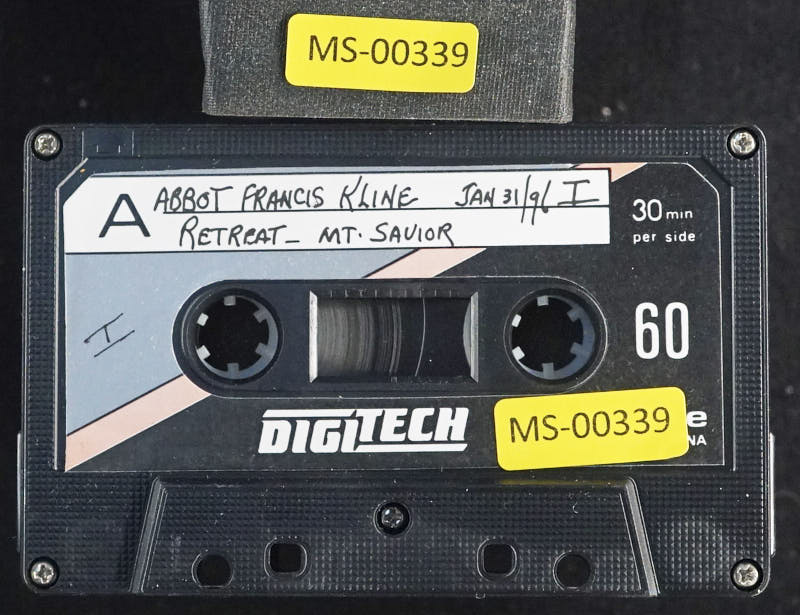

AI Vision - Possible Values from Photos:
Speaker: Abbot Francis Kline
Location: Mt. Saviour
Possible Title: Retreat
Additional text: 7:15 P.M.
@AI-Vision_v002
It's a pleasure to be with you all. Mount Savior has long been in my thoughts and fantasies in monastic life, because when I entered Gethsemane a long time ago, the aura of Dan Mrs. Vincent was still very much around. He died in 71. I remember the photograph in monastic studies, beautiful photograph in memoriam. And when I was a young monk, I was able to get hold of retreat conferences that Tom Damnesis had given at Gethsemane. He gave at least one, if not two, retreats there in the early 50s. And we still had the reel-to-reel tapes made on an old Wallensack tape recorder. And they were phenomenal, just wonderful. wonderful introduction into liturgical spirituality.
[01:04]
So, and I bring greetings to any of you who would remember Brother Edward Chivell, who spent some time at Chrysler in the desert, but then when he was taking care of his mother in a little town near Wilkes-Barre, PA, and had a brother in Binghamton, used to come up here from time to time. So can everyone hear me? I've got something wrong with my ear because of the planes, so I'm not sure I'm speaking loud enough. Without further ado, I told Fr. Martin that I have some new material that I want to present during this retreat. I've used the Mepkin community as guinea pigs, so to speak, so you're not the first to endure this. But it's not material that's real ripe. And so if I'm not correct in some things that I say, or if I'm not helpful, you might let me know that.
[02:06]
I'm not that confident about what I have to say. We in the Trappist world are preparing for a general chapter in 96. And I think we're in the same building. the month after the Congress of Abbotts. And so I hope the food is good. Anyway, our theme is the monastic community as a school of charity. And so we've been enduring or writing papers and physician papers and articles. on this theme, preparing for this chapter. And that has spurred my thinking. And so I want to spend the time that we have together on the concept of fraternal charity in the monastic community.
[03:09]
But I'm not just going to give a collection of the current thinking on fraternal charity. You may know of articles and books by Jean Vanier, for example, on community, the community of L'Arche. I'm sure some of you are familiar with that. And you may know of some of the work in communitarian theology, if I can even call it that, of André Louf, who's one of the Trappist abbots in France. He's written some very perceptive articles in Cistercian studies on community. I'm not going to use any of that material. I've been inspired by it, and I'm intrigued by it, but for me, there's a little bit more going on than even what they're talking about because I would question, in the case of L'Arche, just what is the philosophical and theological basis for a community of exceptional people being cared for
[04:18]
more or less, by healthy people. Maybe that's not even the right way to describe the large community, because they're all supposed to be community together. But whatever it is that Jean Bonnier is trying to get at, it has something to do with a new definition of humanity, a new perception of what makes people, what puts people on an equal basis, certainly not gifts, certainly not intellectual or physical gifts. I'm sure you could say that much about the L'Arche community. I'm not sure how much more you could say, but on a theoretical basis. He's certainly living the gospel, certainly pointing to fundamental issues raised in the gospel. But be that as it may, I'd like to start, you know where I'm going a little bit now, and I'd like to start with some perceptions of charity, just as we have it in the large society, like traffic courtesy, for example.
[05:27]
When I was a student in Rome, and I never drove in Rome because I was scared to death, but when I was a student and I used to be in a car with someone who was driving, they seemed to become... different people when they got behind the wheel of a car. These gentle monk-type people would get into a car and then start the arms and, why, what are you doing? They'd get in the wrong lane of traffic and then the arm would go out the window and, out of my way and all that. Just exaggerated gestures, horrible cuss words, and it just struck me as funny because Americans do that to a certain extent, but nothing like the Italians do it. And if you try that today, you might get shot in a city in the United States. It's happened. So I find myself, now that I'm driving a lot more than I ever did as a monk, I find myself getting pretty annoyed with people. and being very Italian about it.
[06:32]
When I know they've just cut me off and they're in front of me, and I know they can see me through the rear view mirror, I'll just do all sorts of things. I kind of can't believe I did that. But I do it, and I do it more and more frequently. I thought, well, gee, what is that? Back in the monastery, I'm thinking, you know, I don't treat the brothers like that. I'd never treat the brothers like that. And yet, it's in me. to be rather nasty on the state highway or the interstate or whatever. I know it's there. But when I see some poor old lady, you know, a mother type, an old grandmother type in the Lincoln continent, I'll always give her the right way. But when I see some, when I'm caught behind in kind of a herd of traffic on the interstate and I'm trying to get home for vespers and there's some old jalopy some old truck in front of me that shouldn't even be on the interstate that's leaking all sorts of debris and things, like he's carrying dirt or something, and it's coming right, and he's going 45 miles an hour, and he's blocking the lane.
[07:44]
And I know he's a black man. I know it. And I started to think, why did all these people on the road? The truck is falling apart. And I get rather annoyed. until I can finally pass and I pass it 90 miles an hour and turn around and look and give it, and it's some poor black man. But I have no sympathy for that at that moment. I just can't, I mean, I'm just mad that they would do it. And then you get all this crap all over my car, you know, and just no respect for other people. That's the way it hits me. So then I reflect after I've got my ire up, you know, as Evagrius is. I've lost it because I've become passion-filled. I'm thinking, my God, what is going on here? How deep does my fraternal journey run? Or I'm in Walmart. You see a nice young mother with two little kids in a stroller, and I'm in line and she's in line.
[08:45]
I don't care how long she takes at the cashier line, but then there's some shyster that gets in front of me, somebody, some hard-looking peroxide blonde, and I get very annoyed. I have no time for her whatsoever. And I see myself getting annoyed and I think, welfare, and I think, God, I'm a child of the 60s. I shouldn't be thinking rightist thoughts like that, you know? But I do. I get annoyed. But I don't get annoyed at everybody. I pick and choose who I'm going to get annoyed with. And I find on the airplane today, there was this sweet old lady. I was on the aisle. She was on the aisle. She was right across from me. And she ordered cranapple juice when the cart came out in the aisle. And she had the cranapple juice here, and she got out her little chocolates.
[09:48]
She wouldn't take the peanuts, and she's cutting these chocolates. She'd be very fussy, and I saw it. Rings all over, wrinkles. And at one point, she went to get into a purse, and she did. She dumped the whole tray, and crammed out the juice, went on the guy in front, and all over her pants. She had on these kind of suit pants. Well, she didn't then, in her purse, she couldn't find anything to mop it up. Well, I had this kind of big, sloppy... towel there, a paper towel. So my heart went out. About five minutes later, we're landing, and this arrogant, arrogant business person type behind, he comes shoving up, and he's got to get out first, and he's looking, he's got all his appurtenances and a computer and all. I said, well, I got up in front of him, and I put my rear end, and I got my jacket, and I thought, I'm going to show this guy, and I'm not going to let him buy it. And I had enough, my suit, my little briefcase was so full of books I knew I could stop it.
[10:54]
So I just shoved it. And he's trying to get over it. I gave him the look that would put him down. And I got out in the lobby and I'm thinking, I had absolutely no time for that man. Absolutely no time. I know this type and he's just going to have to wait. And yet, for the little old lady, had all sorts of time. I mean, this is, I'm, I'm, a victim of gross prejudice. I think a person who was able to live life on a deeper level, especially a monk, if I'm professing vows, that I would have just a broader vision, broader view. But I found myself, and I find myself more and more getting ticked off at certain types of people, not usually in the monastery, but outside. What I'm trying to say is, If I treat people outside the community like that, I'm sure I'm treating people inside the community like that, too.
[11:56]
I may cover it up. I may be so used to the monastic veneer that I would never admit to myself that I'm treating people like that in the community. But in point of fact, I probably am. Because these things irk me, they get me mad on the outside, and I don't, you know, I'm usually alone, so no one's eyeing me And so I'm kind of a Pharisee when it comes to fraternal charity. You know, it's just hard to love your neighbor as yourself all the time in every circumstance, inside the monastery and outside the monastery. And I find myself wondering how deep my monastic movement does go. Well, if I can question that, then I would come to the rule and I would say, what does the rule have to say? when the rule puts together all sorts of different people in a community, because we don't group together the smart in this community and the dumb in this community, and we don't put together the, you know, the Italians in this community, at least the waning that's over here, at least in this.
[13:03]
You know, we're such an amalgam in every monastic community, not only in the United States, everywhere. Monastic communities, even Solem or... Maria Lach, you know, as much as they try to be kind of pedigree, they've got all sorts of people. I'll never forget Solem going there one time. You know, of course they record chant. And right in the middle of the choir, now I know enough about music to know when someone's tone deaf. And right in the middle of the choir, they have for several years, they went there from 80 to 84, someone who's absolutely tone deaf. Absolutely. I mean, just sang on a recto tone of at least five steps above or below whatever the choir was doing. And there behind me was Dom Cardin, you know, the great master of chant, professor at Musica Sacre in Rome, home for the summer. And there's this kind of loony out there. It can be right in the community, in a cow, you know, probably been in the community for 30 years.
[14:06]
And that means they probably put up with that for 30 years. Tone deaf. Just... I thought, well, they can put up with it. I certainly can. That just taught me, don't go thinking that Solem is just a bunch of musicians because they're not. They're a monastic community, and so they learn how to live with all sorts of different people. So the rule has this adage, this saying, in chapter 64, verse 19, the abbot... has to arrange everything so that the weak have nothing to fear and the strong has something to strive for. So you have a community of all sorts of different people. And I'm sure you sitting around here now represent all sorts of different tastes and positions and prejudices and what have you. So then the question would be, how do we live
[15:07]
How do we live together in community? We know what we're supposed to do, but do we start to group ourselves along certain lines of taste? Do we allow certain brothers to annoy us and others not to annoy us because of some preconceived perception? I'm sure it doesn't happen here, but You know, maybe it does, and maybe some of you are laboring, as I do, under all sorts of little prejudices. The older I get, the worse they get, the more they come out. And when I know that nobody's looking or listening, I'll pair with a brother here or there in my own community, and I'll start to say, wasn't that awful? Did you see what so-and-so did? And I'll just start to pair with someone that I know feels the same way I do. I'm supposed to be the abbot.
[16:08]
And I'll do it because sometimes you just get so worn down by people's eccentricities and obsessiveness and their legion in any mess. Probably not here, but... So what I'm suggesting, what I'm saying is that most likely in your community, in my community, there are areas where we could stand to improve I mean, let's get real serious. And if during a retreat, we have never sinned there and we really are not at fault there ever, fine, then let's pray for sinners like me. But if I'm hitting home at any level, then I would say, follow me and let's examine this whole area and try to get it. to a deeper perspective that may shed some light so that we don't be too hard on ourselves and at the same time maybe find some deeper grace from Christ to live the gospel more in communion.
[17:29]
It's a little bit like the doctrine of fraternal charity where we're supposed to love our neighbor as ourselves. We love God with our whole heart, whole soul, heart, strength, etc. And we love our neighbor as ourselves. Or, which is the golden rule, do unto others as you in heaven do unto you. Or, Matthew 5, 5-7. They are all kind of the same. And the rule presupposes that there are going to be differences as I just quoted in chapter 64, verse 19, but the rule is implicitly appealing to a broader definition of humanity than we find in society. We have to go beyond education, beyond class, beyond reading, all those things. Those are quite explicit in the rule.
[18:29]
But what is not so explicit is what is the definition of humanity? What is the rule appealing to? In fact, you can ask the same question in the Judeo-Christian tradition in divine revelation. What does God say about human beings, about his creation? What is the definition of humanity? Who is my neighbor? Who are these people I'm supposed to treat as I would have myself treated? Is it the people who drive slow in a fast lane? Is it the people who, in the monastic community, drag the whole thing down? Am I supposed to love them, too, in the same way as I love a cooperative confrer? Those are questions that I think crop up every so often and ended on his mind. So I would offer that the doctrine of fraternal charity is something like, well, it's impossible.
[19:36]
We'll look at this a little bit tomorrow. And yet we're called to it. We're called to it absolutely by Christ our Savior. But in its impossibility, because we're always being called further, than, further than we can, than we can ever even conceive. We're always called a figure. It's a little bit like The Old Man and the Sea, you know, that story, that novelette by Ernest Hemingway, where the old man catches this, I'm leaving on a number of details, but the main line is the old man catches this huge fish, and he's going to kind of prove to everybody that he's really a great sailor and a great fisherman. He catches this huge fish. the patch of a lifetime, and he's way out in the deep, and he's going to get this thing back to port and show everybody that he's worth something, that he's not the failure that everybody thinks he has been. So I don't know what kind of it. This shit is a big tuna or something, but it just about sinks his boat, but not quite, and he straps it onto the side, and he's making his way back to port.
[20:47]
But of course what happens, not thinking, because he's so excited about the catch that he's made. It's one great big, huge fish. He's helpless to protect his catch. And the marauders, the marauding sharks, and the other kind of snip at it and bite at it all the way into port. You remember the story? So by the time he gets to the port, it's a ragged mess. There's nothing left. And for all the bystanders know, He could have just come on a corpse or a hulk of a fish and strapped in and said, look what I got, you know. The whole thing is ruined, and he's completely ashamed-faced when he gets it before. But you just see draining away his whole idea. Draining away as lifeblood ebbs out of a dying person. You just see this thing ending right before his eyes. He's helpless to do anything like that. Something, I think that's...
[21:47]
For me, anyway, that's what happens to my ideal of paternal charity. I wake up in the morning and go to vigils and do election divina, and I'm all set to go. By the end of the day, my ideal of paternal charity is worn down pretty long. I mean, if it's not this brother, it's that. If it's not that, it's not this. The stock market takes a credit. Money, blah, blah, blah. By the time, the day's over. You know, where's my ideal, my glorious ideal? Yeah, go back to Lectio, go back to prayer. But I find that that passage in Scripture from Syrac, there's no, whether the just man sins seven times every day, well, that's who I am. And I wonder if all of us are not saddled with that same kind of heartache We try.
[22:49]
The higher the stakes get with paternal charity, the worse of a failure we may see. And that's okay. I mean, because that's the way it is. God is going to challenge us constantly. Just when we think that we understand what love is in the community and we're going to apply it, we get the grace to do so, but not... to do it 100%. There's always going to be somebody who's going to trip us up and try our patience to the point where we have to fall on our face. I think it's a pretty common experience in any virtue in monastic life, but certainly with regard to paternal charity. Now, one of the things I want to examine is what are some of the pitfalls, what are some of these prejudices that get in the way? because it's not enough to just grit your teeth and say, by Jove, I'm going to conquer this, I'm going to have this virtue.
[23:51]
You have to be careful of that, because St. Basil, following the scriptures in the letter of James, says, you know, if you foul up on one virtue, you've fouled up on them all. It's one seamless garment, so to speak, the life of virtue. That's pretty depressing. And yet, We're not thereby prevented from applying every ounce of energy and brains and meditation to our life of virtue. We're supposed to do as best we can. And if we fall on our face, in a sense, that's God's problem. But we're going to try as much as we can. The tradition is certainly clear about that. When it comes to paternal charity, there are pages upon pages upon pages of how to and what to watch out for. from Cashion on to John Climacus, and you can read Dorotheus Abghazi, you can read page after page after page of all the things that happen in monastic. Well, I'd like to examine a few of those, not by looking so much at the warp and woof of a community, but by going a little further and looking at what some of our basic prejudices are
[25:10]
This baggage that we carry around with us is part of the human seeing, always has been, probably always will be. You get a kind of prejudice, I'll call it, and it works in things spiritual. There are two basic prejudices. One is, I would call it a spiritual prejudice, the other a societal prejudice, or an umbrella. These would be two basic umbrellas under which you have a lot of problems, but one One large umbrella is what we might call spiritual prejudice, and you can start to get what I mean if you look at it from the point of view of communities, monastic communities all over the world. When I was at San Anselmo, you know, your college, so to speak, there was a group starting up at La Rasse, the island of Marseille, And it was, it had been for a while a common observance community in the early part of this century.
[26:11]
It had, they had, those monks had gone back to Sinan. It failed. But there was starting up in the early 80s a new monastic community, as always happens in France. People red hot in the monastic ideal. But in this instance, also extremely to the right, extremely conservative. followers, more or less, of Archbishop Lefebvre. And they were invited to come to Rome, and we put them up at San Salvo, because I lived there. I not only went to school there, but I lived there as part of that community. And so these guys arrived, you know, all in their early 20s, head shaved and, you know, just super right, and obviously looked down their nose at everybody in the community. First of all, we shouldn't have been eating meat. and all that. It was really a hard weekend. They were there for Holy Week. And so they were given a whole wing in the guest house from us at the San Ensemble.
[27:14]
And the stares and the put-downs, I mean, I'll never forget it. And I thought, you know, it got all my, pushed all my buttons because I thought, you know, we try to live a pretty serious life and I'll bet you they'd look down their nose at Gethsemane too. You know, these people were brighter than God. And I thought, And what gives here? And it kind of got my bio up. And I thought, well, you know, is that the gospel? I mean, they're obviously looking down their nose at every benedictive monk that's here. And is that the gospel? So yeah, they might have a great observance going down there on that island in Lorest, but is it worth it? Now, I myself was tripped into what I would call kind of a sin because I'm projecting my righteous anger onto them. But how often do we do that? And I'll go so far as to say St. Bernie was a pretty nasty bloke in the 12th century against the Cluniacs. Is that the gospel?
[28:15]
I'm not so sure it is. We get into this kind of thinking of blue blood, the blue bloods in monastic tradition versus those slobs out there who had schools and parishes. You find these things right down the line in monastic circles. And we justify ourselves. When I was a monk there, we kind of looked down our nose and said, oh, a lot of other Trappist monks do poor things. And then I got sent to one of the poor outhouses. And I have felt it. They pass by, they never come. We're in the boonies, but nobody comes there, nobody cares. Poor Francis stuck out there in the South with a bunch of cotton pickers, you know. I mean, we'll never say it. You'll never say it. But in a hidden, you know, hidden kind of with two beers out the back, people will start to talk that way.
[29:20]
And I had, when I was, before I was sent to Mepkin, I said to him, the Abbot of Gethsemane, I want you to promise me that you will never, never arrange that I be sent to one of these piddly little foundations of Gethsemane. Never. Not one of the daughter of Gethsemane. I don't care how bad it gets, I'm going to stay here. Because it's a kind of blue blood stuff that you get going. Of course, Spencer, rivalry. Spencer, legendary. Was that the gospel? Was that what we're supposed to do? I mean, it's not. And yet... You know, it's always going to be there, I guess. But it's unfortunate. That's not the gospel. So I think even between monastic communities, you get this kind of nonsense. You get this kind of prejudice going. And it gets people angry. And it gets, you know, I've seen the holiest old monks start to get angry about some rival community. You know, they may be full of gushing charity.
[30:22]
For everybody in the world, but there's somebody out there that they're jealous of or that gets them mad. Somebody. We've all got it. And the holiest people I know, there's always an Achilles heel somewhere. There's somebody out there that makes them mad because they were offended or, you know. We have it with the common observance, the Trappists and the common observance Cistercians. This is kind of, it's very harsh sometimes, really acrimonious on occasion. On the level of general chapter, we have it within our order between myself and the Japanese nuns. We have this thing about the Japanese, about 300 Trappistines, Japanese. And they come to the chapter, and they say nothing. Just like this. And between myself and the Japanese nuns, we have this thing about the Japanese, and we have about 300 Trappistines, Japanese.
[31:33]
And they come to the chapter, and they say nothing. Just like this. But we know that behind... And behind closed doors, they're saying all sorts of things. And then it comes out in a hidden way in open sessions of the chapter. Well, the Americans say, well, then just get up and say it. Be forthright and say it. But that's not the Asian way. They will never, never do that. But we get a little tired of it. I want you to know. And so I was kind of deputed at the 92 chapter to get up and say, now, come on. Well, I did it. Whoa. Talking about cultural difficulties in an international body, I'm sure the same thing happened as in the Congress. You get the French feeding the Germans, there's always something happening. Is that the gospel? Aren't we supposed to go beyond that a little bit?
[32:35]
If it's there in business, it once wasn't so, as we all know. So in the late 19th century, William James wrote a book called The Varieties of Religious Experience. He had a grand time slamming Roman Catholicism, and the hordes of stupid, silly people that minrate statues and all this kind of thing. Now, he also admired the Roman Catholic tradition because some of the book is about St. Francis of Nisisi and Teresa of Avila and other such Roman Catholic figures. But he calls them religious geniuses. They're not part of that period. that Mediterranean heard of it. And so the really great noble people are these Americans, these great philosophical geniuses who had this warm, gushy feeling about their neighbor because their life has been good to them. And so they can make a difference in society. It's the ideal of the Gordon Allports. There's a real prejudice to it.
[33:37]
And yet that book is used in practically every seminary, Roman Catholic seminary reading list. It is a very important book, but there are some real serious prejudices going on. It's a great, great classic. Or you get Roman Catholics, now that we're kind of respectful and have this wonderful sacramental liturgical tradition, and we'll look down our nose at these poor Methodists and Baptists don't really have a prayer tradition. Poor thing. And you start to feel that. We're starting to get rather superior in certain circles. Or we start to talk about our numbers, our 55 million, whatever it is. And it's subtle, but I think it's there. Can we apply, in the same way that we once applied, this universalism where everyone's going to come back to us? in the ecumenical field.
[34:39]
Now, the President Polk is not saying that. If any of you have read Ut Munum Sint, JP II is surprisingly open about this and surprisingly bold, but he says it's no longer a question of everybody just coming back to Rome. There's got to be more truth than that. I mean, we can't... Are we going to deny grace and elusive meaning? deny grace in the Wesleyan community, deny grace in these ecclesial communities, where, according to the Vatican Council, we acknowledge the grace of Christ? You know, if you haven't read that encyclically, it's mind-blowing what it's saying in terms of breaking through these religious prejudices that we've operated on unthinkingly for centuries since the calendar of Reclamation. And it takes some funny twists now in late 20th century American scene when Roman Catholicism is suddenly so respectable.
[35:43]
To say nothing of world religions. Are we going to apply the same kind of universalism, Christian universalism that we once did? Apply Isaiah 66 to ourselves when everybody will be coming to Christianity? I... I think any serious Christian in late 20th century experience is going to have to look again at how we think about how many hundreds of names of Buddhists, of the Tibetan Buddhist tradition, of Hinduism. I'm not saying for a minute that there should be a kind of eclecticism and a kind of leveling out that all religions are the same. I'm not saying that at all. Theologically, that is absurd for us. But I am saying that we've got to recognize a grace and a presence of Christ, even if it would be like a logos chromaticus, like the Greek apologist once said, that God is working there too.
[36:46]
And who are we to look down on earth? Let us take the grace and the revelation that's been given to us and run with it as far as we can. But let us not use it to hit somebody else over the head. So I feel that that's a basic kind of spiritual prejudice that's going. We're right. You're wrong. We have the truth. You don't. Whether it be in monastic communities, whether it be in the ecumenical field, whether it be in world religions, whether it be in individuals. So we all know that the Pharisee and Republican, that parable, chapter 16, the Gospel of Luke, is aimed not at the Pharisees at Jesus' day, When we take that scripture passage and read it, whatever comes up in the U.S.C., Jesus is proclaiming that parable now. We believe in the Mysterium.
[37:48]
We come together to celebrate the Eucharist, and the scriptures are proclaimed in the context of the Eucharist. Those scriptures are being proclaimed now. The parable of the Pharisee and the Republican is meant for me and for you. So there must be, there must be the tendency, at least, to look down my nose, I know it's in need, to look down my nose spiritually at other people. Brother so-and-so doesn't do, so therefore he is not. Brother so-and-so doesn't keep this rule, so therefore he is. I do this all the time in my own life, and I'm not, I'm ashamed to admit it, but I'm not afraid to, I do it. I project my own spiritual desires onto other people, and when they don't conform to things that I'm trying to conform to, they're guilty, and I'm not. You do this all the time. Communities as a whole do this to one another, religions and ecclesial communities do this as a whole to one another, and individuals do it to one another.
[38:58]
We are constantly playing the Pharisee to somebody else's public in our lives. Let me pass on briefly to another kind of prejudice, societal prejudice. This gets very obvious in our late 20th century American society, but take, for example, well, passing over race and gender. That's obvious. And maybe not everyone agrees with some of the things connected with gender. I hope we're far enough along that we don't fall into the racetrack. But where I'm living now, it is still very operative. Very operative. And to the point where you wouldn't believe it. For people who are used to living in the northeast or the extreme west of the country, you can go down in places in Alabama, Georgia, and South Carolina today and leave you the... Racial prejudice is alive and well. And it's just so accepted now that no one even bothers.
[40:00]
It's a horrible, horrible truth. So there's race and gender. Then you get into the more subtle things of behavioral science, the IQs. If you start to look down at somebody who has a low IQ, you start to look down on somebody who is handicapped. The instinctive shrinking when you try to shake hands with somebody whose fist is clenched or there's a limb missing or something. You just instinctively pull that. To say nothing... what behavioral science has chosen. I know I have to watch myself in community. If somebody enters the community, somebody comes to apply, and you find out that they're manic, depressive, or schizophrenic.
[41:02]
Of course we wouldn't deal with those kind of people. But even in interviewing them, I find myself cringing a little bit. What's wrong with this person? To say nothing of someone, you find out that someone has actually tried to commit suicide at one point in their lives, and they didn't succeed, or it's a pattern, it's suicidal. My prejudices get going. Bad breeding, I say, or, you know, I'll never say that out loud. I start to feel there's something inside. You know, those who have dependent personality traits, usually with an obsessive compulsive wing going, That kind of person I almost feel sorry for and I find myself being patronizing a little bit. To say nothing of people with Down syndrome or people who have had cerebral palsy and even those who can disguise it a little bit or people who are having to deal with some kind of retardation.
[42:10]
Those are things that that we really, and I have to work on, because I know that I just, I don't treat them the same way. And this is what Jean Barnier is talking about in the large community. Who is the real, where is the real morally upright person in the large community? A lot of the time it's the exceptional person and the so-called retarded person that's able to help morally, the physically sound person, who's blinded, who's spiritually blinded. And that's the whole point, if I understand Jean Valier correctly. Of course, we are dealing with all sorts of prejudices with regard to like itself, the old versus the young and the beautiful, or the minorities who give birth to hundreds of kids who look down on people like that. The whole abortion, the right to life movement, which underlines some of our basic prejudices.
[43:16]
You remember the famous story about the two doctors discussing whether or not an abortion should be performed on certain cases where there's syphilis, where there's obvious genital... problems with either the father or the mother. They're going to pass these things on. In our day and age, it would be AIDS. Do you abort a fetus? Do you know the mother has AIDS? So the baby's going to have AIDS? You know, again, so these two doctors discussed this tremendously depressing situation where there was tuberculosis, syphilis, I don't know when, in the 18th century, it's this pregnant woman, would you have aborted the fetus doctor? One doctor says to me. And the doctor says, well, of course, there's absolutely no hope for a child like that. But the doctor says, well, you would have aborted Beethoven.
[44:19]
Beethoven, I mean, there was no way in the world that the child in Beethoven's mother's womb should have survived or been capable of doing anything. Every medical thing, every medical disease possible in that mother, and diseases that would have been passed on, he had. And yet, where would he be culturally without that? So, I mean, these are questions that we have a hard time answering today. Just look at... our cult of the young and the beautiful and the sound and the whole when it comes to education. Every school, almost every school is geared to the bright and the advanced and the fast-tracked. How often, even in Catholic education, will we defend Catholic schools that are kind of havens against public school education?
[45:26]
I'm not saying that's wrong. But it's certainly putting the accent on the talented and the middle class. Now, yes, we start scholarship funds so that lesser folks can go to those schools. But even so, the whole mentality, and it's not wrong, but you've got to be careful that you don't get caught in a trap where the people who are not fast and beautiful and talented, are they not human too? Or are they less human? That's what, that's... That's my whole point. That's what I'm getting at. When do you draw the line? What is our definition of humanity? In sports, we keep breaking records, Olympic records. We keep breeding perfect specimens and pushing them harder and harder and harder to break more and more records. The steroids get into it all just to break the record and to be the best, you know, and then after a while the sport is gone.
[46:29]
That question is being openly raised in Olympic competition. Is there any sport left? Competition is there. And then I would say, you know, I would say also when it comes to candidates in religious communities, if you're blind or crippled or something like that, do we take a serious look at you? You come to the community with some kind of illness. It says even in canon law there are supposed to be candidates for religious life rescues. You sound good-minded. Is that the best model that we should use? I'm not saying it's wrong. Obviously not. But I am saying we have to be careful of falling into a trap, a cult of the healthy, the supposedly healthy and the sound. What is really healthy? That leads me to one basic question. You know, in our Constitution and in the Gettysburg Address, we have this statement, and forgive me for putting it bluntly, as all men are created equal.
[47:37]
Well, when I said that in a napkin, some of the people who are a little bit on the left started to laugh and say, oh, men are created equal. What happened to women? But... Aside from that joke, let's look at that statement that was in our Constitution, implicit in our Bill of Rights, made immortal by Lincoln in the Gettysburg address. It's also in the Christian tradition. Gregory the Great has it in the pastoral care, chapter 16. He says, you know, people who are made abbot or bishop, people who are given the pastoral care of souls, they're not put... They're not blue bloods that are automatically put above the herd because we're all created equal. That's where he says it. He says, you've got authority, but that doesn't mean that you're involved with people over whom you have authority. You're no better or no worse than anyone in the community or anyone in the church that you supposedly rule because we're all created the same.
[48:45]
What did he mean by that? He doesn't go on to explain but we instinctively agree with him. Especially because it appeals to our democratic tendencies. Even in the remnants of the Roman Empire of the 6th century, it appeared. So, if this is a real part of our tradition, I would say in late 20th century America, it's in serious trouble. All are created. Because it's like the doctrine that we first started with about paternal charity. It's like the big fish strapped to the side of the boat. We proclaim it, but do we live it? Do we even live it in our religious communities? Or do we have to re-examine what is the basis of humanity? What makes a person human? Have we created a cult of the fittest? So is indeed in our culture, but there's no more justice left.
[49:49]
Now, that's an exaggerated statement, but the debates that are going on in our government would indicate that we've lost sight of something. And that translates very subtly into religious communities. It has to, because we're Americans. It has to, and it does, I think. Very subtle, but we start to be less sensitive to the less fortunate. We start to be less sensitive even to what we consider spiritually less fortunate. And we get into this Pharisee public attack. That's kind of an examine that I would offer. I hope it's not off track. I think there's something to it. If it can be of any help as we go on in this retreat, fine. If If you object and you feel that I'm not onto something, then I think you need to work that out yourself and just dismiss what I have to say.
[50:58]
But if it might point to something that's at least half true, because I don't think it's always true in our religious communities, I hope we're better than that, then it might be a source of... or deeper grace, perhaps, that we can see just what we're doing and how we operate, and what are some of the prejudices that we take into ourselves and don't examine carefully at night. I think every culture at every time has to dialogue prophetically with the divine revelation. And one of the most privileged aspects of that divine revelation is humanity itself, a redefinition. of what it is that makes the person human. Certainly not IQ. It has to be intelligence, self-consciousness, yes. But does it have to be super intelligence, super body, youth, and all that, the way we've made them such gods in our society?
[52:12]
That's all I need to, we'll go on. No, no, I won't. I promise. I thought, well, gee, what is that? Back in the monastery, I'm thinking, I don't treat the brothers like that. I'd never treat the brothers like that. And yet, it's in me to be rather nasty on the state highway or the interstate or whatever. I know it's there. But when I see some poor old lady, you know, a mother type,
[53:13]
an old grandmother type in the Lincoln Continental, I'll always give her the right way. But when I see some, when I'm caught behind in kind of a herd of traffic on the interstate, and I'm trying to get home for vespers, and there's some old jalopy, some old truck in front of me that shouldn't even be on the interstate that's leaking all sorts of... debris and things, like he's carrying dirt or something, or slain, and it's coming right at him. And he's going 45 miles an hour, and he's blocking the lane. And I know he's a black man. I know it this afternoon. And I started to think, why did they allow these people on the road? The truck is falling apart. And I get rather annoyed until I can finally pass, and I pass it 90 miles an hour, and turn around and look and give it, and it's some poor black man. But I have no... No sympathy for that at that moment. I just can't, I mean, I'm just mad that they would do it. And then you get all this crap all over my car, you know, and just no respect for other people.
[54:19]
That's the way it hits me. So then I reflect after I've got my ire up, you know, as Evagrius is, I've lost it because I've become passion-filled. And I'm thinking, my God, what is going on here? What kind of, how deep does my paternal charity run? Or I'm in Walmart, and you see a nice young mother with two little kids in a stroller. And I'm in line, and she's in line. I don't care how long she takes at the cashier line. But then there's some shyster that gets in front of me, some hard-looking peroxide blonde, and I get very annoyed. I have no time for her whatsoever. And I see myself getting on. welfare. And I think, God, I'm a child of the 60s. I shouldn't be thinking rightist thoughts like that, you know. But I do. I get annoyed.
[55:21]
But I don't get annoyed at everybody. I pick and choose who I'm going to get annoyed with. And I find on the airplane today, there was this sweet old lady. I was on the aisle. She was on the aisle. She was right across from me. And she... She ordered cran apple juice when the cart came out of the aisle. And she had the cran apple juice here, and she got out her little chocolates, and she wouldn't take the peanuts. She's cutting these chocolates. She's being very fussy, and I sort of just rings all over, wrinkles. And at one point, she went to get into a person, and she did... dumped the whole tray and crammed out the juice, went on the guy in front, and all over her pants. She had on these kind of suit pants. Well, she didn't then, in her purse, she couldn't find anything to mop it up. Well, I had this kind of big, sloppy towel there, a paper towel.
[56:22]
So my heart went out to complete that. And about five minutes later, we're landing, and this... arrogant, arrogant business person type behind. He comes shoving up and he's got to get up first and he's looking, he's got all these appurtenances and the computer and all. And I say, well, I got up at the front and I put my rear end and I've got my, because I thought, I'm going to show this guy and I'm not going to let him buy. And I had enough, my suit, my little briefcase was so full of books I knew I could stop it. So I just shoved it and he's trying to get over it. I gave him the look that would put him down. And I got out on the lobby and I'm thinking, I had absolutely no time for that man. Absolutely no time. I know this type, but he's just going to have to wait. And yet, for the little old lady, I had all sorts of time. I mean, this is... I'm a victim of gross prejudice. I think a person...
[57:25]
who was able to live life on a deeper level, especially a moniker by professing vows, that I would have just a broader vision, a broader view. But I found myself, and I find myself more and more getting ticked off at certain types of people, not usually in the monastery, but outside. What I'm trying to say is, if I treat people outside the community like that, I'm sure I'm treating people inside the community like that, too. I may cover it up. I may be so used to the monastic veneer that I would never admit to myself that I'm treating people like that in the community. But in point of fact, I probably am. Because these things irk me, they get me mad on the outside, and I don't, you know, I'm usually alone, so no one's eyeing me, and so I'm kind of a Pharisee when it comes to paternal charity. You know, it's just hard to love your neighbor as yourself all the time in every circumstance, inside the monastery and outside the monastery.
[58:35]
And I find myself wondering how deep my monastic movement does go. Well, if I can question that, then I would come to the rule and I would say, what does the rule have to say when the rule puts together all sorts of different people in a community? because we don't group together the smart in this community and the dumb in this community, and we don't put together the Italians in this community, at least the waning over here, at least in this. We're such an amalgam in every monastic community, not only in the United States, everywhere. Monastic communities, even Solem or Maria Lach, as much as they try to be pedigree, They've got all sorts of people there. I'll never forget Solem going there one time. You know, of course, they record chant. And right in the middle of the choir, now I know enough about music to know when someone's tone deaf, and right in the middle of the choir, they have, for several years, because they went there from 80 to 84, someone who's absolutely tone deaf.
[59:43]
Absolutely. I mean, just sang on a recto tone or at least five steps above or below whatever the choir was doing. And there behind me was... It was Dom Cardin, you know, the great master of chant, professor of music of soccer in Rome, home for the summer. And there's this kind of loony out there. It can be right in the community, in a cow. You know, probably been in the community for 30 years. And that means they probably put up with that for 30 years. Tone deaf. Just, you know. I thought, well, they can put up with it. I certainly can't. That just taught me, don't go thinking that Solem is just a bunch of musicians, because they're not. They're a monastic community, and so they learn how to live with all sorts of different people. So the rule has this adage, this saying, in chapter 64, verse 19, the abbot has to arrange everything so that the weak have nothing to fear, and the strong have something to strive for.
[60:46]
So you have a community of all sorts of different people, and I'm sure you sitting around here now represent all sorts of different tastes and positions and prejudices and what have you. So then the question would be, how do we live together in community? We know what we're supposed to do, but do we start to... group ourselves along certain lines of taste? Do we allow certain brothers to annoy us and others not to annoy us because of some preconceived perception? I'm sure it doesn't happen here, but maybe it does, and maybe some of you are laboring, as I do. under all sorts of little prejudices. The older I get, the worse they get, the more they come out.
[61:50]
And when I know that nobody's looking or listening, I'll pair with a brother here or there in my own community, and I'll start to say, wasn't that awful? Did you see what so-and-so did? And I'll just start to pair with someone that I know feels the same way I do, and I'm supposed to be the addict. And I'll do it because sometimes you just get so worn down by people's eccentricities and obsessiveness and their legion in any mess. Probably not here. So what I'm suggesting, what I'm saying is that most likely in your community, in my community, there are areas where we could stand to improve fraternal charity. I mean, let's get real serious. And during a retreat, we have never sinned there, and we really are not at fault there ever, fine. Let's pray for sinners like me.
[62:53]
But if I'm hitting home at any level, then I would say, follow me, and let's examine this whole area and try to get it. to a deeper perspective that may shed some light so that we don't be too hard on ourselves and at the same time maybe find some deeper grace from Christ to live more the gospel more in communion. It's a little bit like the doctrine of fraternal charity where we're supposed to love our neighbor as ourselves, love God with our whole heart, whole soul, heart, strength, et cetera, and we love our neighbor as ourselves. Or, which the golden rule, do unto others as you with heaven do unto you, or Matthew 5, 5 to 7, 7 among them out. They are all kind of the same.
[63:55]
And the rule presupposes that there are going to be differences as I just quoted in chapter 64 verse 19, but the rule is implicitly appealing to a broader definition of humanity than we find in society. We have to go beyond education, beyond class, beyond reading, all those things. Those are quite explicit in the rule. But what is not so explicit is what is the definition of humanity? What is the rule appealing to? In fact, you can ask the same question in the Judeo-Christian tradition in divine revelation. What does God say about human beings, about his creation? What is the definition of humanity? Who is my neighbor? Who are these people that I'm supposed to treat as I would have myself treated?
[65:01]
Is it the people who drive slow in a fast lane? Is it the people who in the monastic community drag the whole thing down? Am I supposed to love them too in the same way as I love a cooperative con prayer? Those are questions that I think crop up every so often in this month. So I would offer that the doctrine of fraternal charity is something like, well, it's impossible. We'll look at this a little bit tomorrow. And yet we're called to it. We're called to it absolutely by Christ our Savior. But in its impossibility, because we're always being called further than... further than we can ever even conceive. We're always called a figure. It's a little bit like The Old Man and the Sea, you know, that story, that novelette by Ernest Hemingway, where the old man catches this, I'm leaving a number of details, but the main line is the old man catches this huge fish, and he's going to kind of prove to everybody that he's really a great sailor and a great fisherman.
[66:18]
He catches this huge fish. It's the catch of a lifetime. And he's way out in the deep, and he's going to get this thing back to port and show everybody that he's worth something, that he's not the failure that everybody thinks he has been. So, I don't know what kind of it, this shit is a big tuna or something, but it just about sinks his boat, but not quite. And he straps it onto the side, and he's making his way back to port. But, of course, what happens, not thinking... because he's so excited about the catch that he's made as one great big, huge fish. He's helpless to protect his catch. And the marauders, the marauding sharks and other kind of snip at it and bite at it all the way into port. You remember the story? So by the time he gets to the port, it's a ragged mess. There's nothing left. And for all the bystanders know, He could have just come on a corpse or a hulk of a fish and strapped in and said, look what I got, you know.
[67:23]
So the whole thing is ruined, and he's completely ashamed-faced when he gets in the port. But you just see draining away his whole ideal. Draining away as lifeblood ebbs out of a dying person. You just see this thing ending right before his eyes. He's helpless to do anything like that. Something, I think that's... For me, anyway, that's what happens to my ideal of fraternal charity. I wake up in the morning and go to vigils and do elections and I'm all set to go. By the end of the day, my ideal of fraternal charity is worn down pretty far. I mean, you know, if it's not this brother, it's that. If it's not that, it's not this. The stock market takes a credit. Money, blah, blah, blah. By the time of the day, he said, what? You know, where's my ideal, my glorious ideal? You know, go back to Lectio, go back to prayer. But I find that that passage in Scripture from Syrac, there's a just man's sin seven times every day.
[68:34]
Well, that's who I am. And I wonder if all of us are not saddled with that same kind of heartache. We try. The higher the stakes get with fraternal charity, the worse of a failure we may see. And that's okay. I mean, because that's the way it is. God is going to challenge us constantly. Just when we think that we understand what love is in the community and we're going to apply it, we get the grace to do so, but not to do it 100%. There's always going to be somebody who's going to trip us up and try our patience to the point where we have to fall on our face. I think that's a pretty common experience in any virtue in monastic life, but certainly with regard to paternal charity. Now, one of the things I want to examine is what are some of the pitfalls, what are some of those prejudices that get in the way of paternal charity?
[69:41]
Because it's not enough to just grit your teeth and say, by Jove, we're going to I'm going to conquer this, I'm going to have this virtue. You have to be careful of that. St. Basil, following the scriptures in the letter of James, says, you know, if you foul up on one virtue, you're fouled up on them all. It's one seamless garment, so to speak, the life of virtue. That's pretty depressing. And yet, we're not thereby prevented from applying every ounce of energy in brains and meditation to our life for virtue. We're supposed to do as best we can. And if we fall on our face, in a sense, that's God's problem. But we're going to try as much as we can. The tradition is certainly clear about that. When it comes to fraternal charity, there are pages upon pages upon pages of how to and what to watch out for. From Cashin on to John Climacus, and you can read Dorotheus of Ghazi, you can read page after page after page.
[70:46]
of all the things that happened in monastic means. Well, I'd like to examine a few of those, not by looking so much at the warp and woof of a community, but by going a little further and looking at what some of our basic prejudices are, this baggage that we carry around with us, this part of the human seeing always has been, probably always will be. You get a kind of prejudice, I'll call it, and it works in things spiritual. There are two basic prejudices. One is, I would call it a spiritual prejudice, the other a societal prejudice, or an umbrella. These would be two basic umbrellas under which you have a lot of problems. But one large umbrella is what we might call spiritual prejudice, and you can start to get what I mean if you look at it from the point of view of communities, monastic communities all over the world.
[71:49]
When I was a San Anselmo, you know, your college, so to speak, there was a group starting up at Larasse, the island of Marseille, and it was, it had been for a while a common observance community in the early part of this century. It had, they had, those monks had gone back to Sananc and It failed. But they were starting up in the early 80s a new monastic community, as always happens in France. People red hot with the monastic ideal, but in this instance, also extremely to the right, extremely conservative followers, more or less, of Archbishop Le Pen. And they were invited to come to Rome, and we put them up at San Salvo, because I lived there. I not only went to school there, but I lived there. as part of that community. And so these guys arrived, you know, all in their early 20s, head shaved and, you know, just super right.
[72:55]
And obviously looked down their nose at everybody in the community. First of all, we shouldn't have been eating meat and all that. It was really a hard weekend. They were there for Holy Week. And so they were given a whole wing in the guest house at the San Ensemble. And the stares and the put-downs, I mean, I'll never forget it. And I thought, you know, it got all my, pushed all my buttons, because I thought, you know, we tried to live a pretty serious life, and I'll bet you they'd look down their nose at Gethsemane, too. You know, these people were writer than God. And I thought, what gives here? And it kind of got my bile up. And I thought, well, you know, is that the gospel? I mean, they're obviously looking down their nose at every benedictive monk that's either. And is that the gospel? So, yeah, they might have a great observance going down there on that island of the rest, but is it worth it? Now, I myself was tripped into what I would call a kind of a sin because I'm projecting my righteous anger onto them.
[74:04]
But how often do we do that? And I'll go so far as to say St. Bernard was a pretty nasty bloke in the 12th century against the Cluniacs. Is that the gospel? I'm not so sure it is. We get into this kind of thinking of blue blood, the blue bloods in monastic tradition, versus those slobs out there who have schools and parishes. You find this thing right down the line. in monastic circles. And we justify ourselves. When I was a monk there, we kind of looked down our nose and said, oh, a lot of other Trappist monks did poor things. And then I got sent to one of the poor outhouses. And I have felt it. They passed by. They never come. We're in the boonies. Nobody comes there. Nobody cares. Fort Francis stuck out there in the South with a bunch of cotton pickers, you know.
[75:08]
I mean, we'll never say it. You'll never say it. But in a hidden, you know, hidden kind of with two beers out the back, people will start to talk that way. And I had, when I was, before I was sent to an applicant, I said to the abbot of Gethsemane, I want you to promise me that you will never, never arrange that I be sent to one of these piddly little foundations. I don't care how bad it gets, I'm going to stay here. Because it's a kind of blue blood stuff that you're going. Of course, Spencer, the Bible, Spencer is legendary. Was that the gospel? Was that what we're supposed to do? I mean, it's not. And yet, you know, it's always going to be there, I guess. But it's unfortunate. That's not the gospel. So I think even between monastic communities, you get this kind of nonsense. You get this kind of prejudice going. And it gets people angry. And it gets, you know, I've seen the holiest old monks start to get angry about some rival community.
[76:16]
You know, they may be full of gushing charity for everybody in the world, but there's somebody that gets it good. There's somebody out there that they're jealous of or that gets them mad. Somewhat. We've all got it. And the holiest people that I know, there's always an Achilles heel somewhere. There's somebody out there that makes them, because they were offended or, you know. We have it with the common observance. There's Trappist and the common observance, Cistercians. This is kind of, it's very harsh sometimes. Really acrimonious on occasion. On the level of general chapters. We have it within our order between myself and the Japanese nuns. We have this thing about the Japanese nuns. There are about 300 travestones, Japanese. And they come to the chapter and they say nothing.
[77:18]
They're just like this. And between myself and the Japanese nuns. They're really, I mean... We have this thing about the Japanese, about 300 Trappistines, Japanese, and they come to the chapter and they say nothing. They're just like this. But we know that behind closed doors they're saying all sorts of things. And then it comes out in a hidden way in open sessions of the chapter. Well, the Americans say, well, then just get up and say it. Be forthright and say it. But that's not the Asian way. That's not the job. They will never, never do that. But we get a little tired of it. I want you to know. And so I was kind of deputed at the 90 to get up and say, now, come on. It was, well, I did it. Whoa. Talking about cultural difficulties in an international body, I'm sure the same thing happened as it becomes. You get the French hating the Germans.
[78:20]
You get the, you know, there's always something happening. Is that the gospel? You know, aren't we supposed to go beyond that a little bit? If it's their business, it once wasn't so, as we all know. In the late 19th century, William James wrote a book called The Varieties of Religious Experience. He had a grand time slamming Wilma Cabal and Susan. And the hordes of stupid, silly people... that venerate statues and all this kind of thing. Now, he also admired the Roman Catholic tradition because some of the book is about St. Vincent Ysisi and Teresa of Avila and other such Roman Catholic figures. But he calls them religious geniuses. They're not part of that period, that Mediterranean period. And so the really great noble people are these Americans, these great philosophical geniuses who had this warm, gushy feeling about their neighbor because they, you know...
[79:22]
Life has been good to them. And so they can make a difference in society. It's the ideal of the Gordon Allports. There's a real prejudice. And yet that book is used in practically every seminary, Roman Catholic seminary reading list. It is a very important book, but there are some real serious prejudices going on. It's a great, great classic. Or you get Roman Catholics now that we're kind of respectful and have this wonderful sacramental liturgical tradition and we'll look down our nose at these poor Methodists and Baptists don't really have a prayer tradition. And you start to feel that. We're starting to get rather superior in certain circles. Or we start to talk about our numbers, our 55 million, whatever it is. And it's subtle, but I think it's there.
[80:23]
Can we apply, in the same way that we once applied, this universalism where everyone's going to come back to us in the ecumenical feeling? Now, the present pope is not saying that. And if you have read Unum Sint, JP II is surprisingly open about this and surprisingly bold. It's no longer a question of everybody just coming back to Rome. There's got to be more true than that. Are we going to deny grace in the Lutheran communion, deny grace in the Wesleyan communion, deny grace in these ecclesial communities where, according to the Vatican Council, we acknowledge the grace of Christ? If you haven't read that encyclically, it's mind-blowing what it's saying. in terms of breaking through these religious prejudices that we've operated on unthinkingly for centuries since the Counter-Reclamation.
[81:31]
And it takes some funny twists now in late 20th century American scene when Roman Catholicism is suddenly so respectable to say nothing of world religions. Are we going to apply the same kind of universalism Christian universalism that we once did, apply Isaiah 66 to ourselves, when everybody will be coming to Christianity. I think any serious Christian in late 20th century experience is going to have to look again at how we think about however many hundreds of millions of Buddhists, of the Tibetan Buddhist tradition, of Hinduism. I'm not saying for a minute that there should be a kind of eclecticism and a kind of leveling out that all religions are the same. I'm not saying that at all. Theologically, that's absurd for us. But I am saying that we've got to recognize a grace and a presence of Christ, even if it can be like a logos spermaticos, like the Greek apologist once said, that God is working there too.
[82:43]
And who are we to look down on earth? Let us take the grace and the revelation that's been given to us and run with it as far as we turn. But let us not use it to hit somebody else over the head. So I feel that that's a basic kind of spiritual prejudice that's gone. We're right. You're wrong. We have the truth. You don't. Whether it be in monastic communities, whether it be in the ecumenical field, whether it be in world religions, whether it be an individual. So we all know that the Pharisee and the publican, that parable, chapter 16, the Gospel of Luke, is aimed not at the Pharisees of Jesus' day. When we take that scripture passage and read it, whenever it comes up and you see Jesus is proclaiming that parable now. We believe in the Mysterium,
[83:45]
when we come together to celebrate the Eucharist and the scriptures are proclaimed in the context of the Eucharist, those scriptures are being proclaimed now. The parable of the Pharisee and the Republican is meant for me and for you. So there must be, there must be the tendency, at least, to look down my nose, I know it's in me, to look down my nose spiritually at other people. Brother Salazar doesn't do, so therefore he is not. Brother so-and-so doesn't keep this rule, so therefore they're there, and therefore he is. I do this all the time in my own life, and I'm ashamed to admit it, but I'm not afraid to. I do it. I project my own spiritual desires onto other people, and when they don't conform to things that I'm trying to conform to, they're guilty, and I'm not. We do this all the time in the message. So it's... Communities as a whole do this to one another.
[84:48]
Religions and ecclesial communities do this as a whole to one another, and individuals do it to one another. We are constantly playing the Pharisee to somebody else's public in our lives. Let me pass on briefly to another kind of prejudice, societal prejudice. This gets very obvious in our late 20th century American society, but Take, for example, well, passing over race and gender. That's obvious. And maybe not everyone agrees with some of the things connected with gender. I hope we're far enough along that we don't fall into the race track. But where I'm living now, it is still very operative. To the point where you wouldn't believe it. For people who are used to living in the Northeast, or the extreme west of the country, even down in places in Alabama, Georgia, and South Carolina today, believe you the racial prejudice is alive and well.
[85:52]
And it's just so accepted now that no one even bothers. It's a horrible, horrible truth. So there's race and gender. Okay. Then you get into the more subtle things of behavioral science, you know, the... The IQs. If you start to look down at somebody who has a low IQ, you start to look down on somebody who is handicapped. The instinctive shrinking, when you try to shake hands with somebody whose fist is clenched, or if there's a limb missing, you just instinctively pull that. To say nothing... what behavioral science has chosen. I know I have to watch myself in community. Somebody enters the community, somebody comes to apply, and you find out that they're manic depressive or schizophrenic or something.
[86:58]
Of course we wouldn't deal with those kind of people. But even in interviewing them, I find myself cringing them on, what's wrong with this person? To say nothing of someone, you find out that someone has actually tried to commit suicide at one point in their lives, and they didn't succeed, or it's a pattern of suicidal pain. My prejudices get going. Bad breeding, I say, or, you know, I'll never say that out loud. I start to feel there's something inside. You know, those who have dependent personality traits, usually with an obsessive compulsive wing going, That kind of person I almost feel sorry for. And I find myself being patronizing a little bit. To say nothing of people with Down syndrome or people who have had cerebral palsy and even those who can disguise it a little bit. Or people who are having to deal with some kind of retardation.
[88:06]
Those are things that that I have to work on, because I know that I don't treat them the same way. And this is what Jean Barnier is talking about. Who is the real, where is the real morally upright person in a large community? A lot of the time, it's the exceptional person and the so-called retarded person that's able to help morally the physically sound person who's blinded, who's spiritually blinded. And that's the whole point, if I understand Jean Ramier correctly. Of course, we are dealing with all sorts of prejudices with regard to like itself. The old versus the young and the beautiful, or the minorities who give birth to hundreds of kids who look down on people like that. The whole abortion, the right to life movement, which...
[89:07]
underlines some of our basic prejudices. You remember the famous story about the two doctors discussing whether or not an abortion should be performed on certain cases where there's syphilis, where there's obvious genital problems with either the father or the mother. They're going to pass these things on. In our day and age, it would be AIDS. Do you abort a fetus? Do you know the mother has AIDS? Are the babies going to have AIDS? These two doctors discussed this tremendously depressing situation where there was tuberculosis, syphilis, on the one in the 18th century, this pregnant woman. Would you have aborted the fetus, doctor? One doctor says to me. And the doctor says, well, of course, there's absolutely no hope for a child like that.
[90:11]
But the doctor says, well, you would have a board and go to it.
[90:13]
@Transcribed_UNK
@Text_v005
@Score_90.11