You are currently logged-out. You can log-in or create an account to save favorites and more. more info
Chaos to Communion: Divine Order Manifested
AI Suggested Keywords:
The talk explores the creation narratives in Genesis and the Gospel of John, focusing on the theme of divine order emerging from chaos and the revelation of God through creation and the Word made flesh. The discussion emphasizes the monastic life as an embodiment of Christ’s love and revelation through community and humility, encouraging a deeper understanding of humanity’s role in manifesting divine love.
Referenced Works and Their Relevance:
- The Book of Genesis (The Bible): Utilized to discuss the initial creation narrative, illustrating how divine order emerges from chaos through God's spoken word.
- The Gospel of John (The New Testament): Its prologue highlights the role of the Word in creation, correlating with the Genesis narrative to reveal a theological foundation about divine creation and revelation.
- "Christ Stopped at Eboli" by Carlo Levi: Serves as a metaphor for the neglected areas of faith and divine message, highlighting the responsibility of humans to carry Christ’s message further.
- Works by Chaim Potok (e.g., "The Gift of Asher Lev"): Mentioned to highlight themes of identity, suffering, and the universal human connection through art and faith.
- St. Benedict's Rule (Chapter 7 on Humility): Discussed regarding the spiritual practice and ego management within monastic life, emphasizing humility as a path to serving others.
Key Themes:
- Divine Order from Chaos: The process of divine spoken order in Genesis correlates to the manifestation of God's love through the incarnation as depicted in the Gospel of John.
- Monastic Life & Community: Described as a living testament to Christ’s teachings, the talk stresses the importance of monastic community, humility, and mutual care as a tangible revelation of God's love.
- Universal Revelation of Divine Love: Discussed through historical and literary references, illustrating the role of faith communities in embodying and spreading divine love beyond specified boundaries.
AI Suggested Title: "Chaos to Communion: Divine Order Manifested"
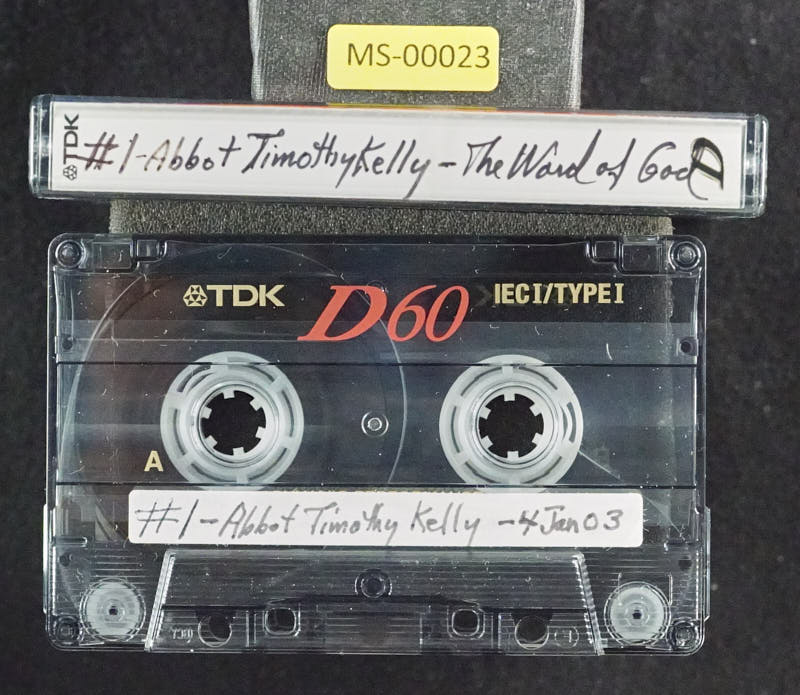
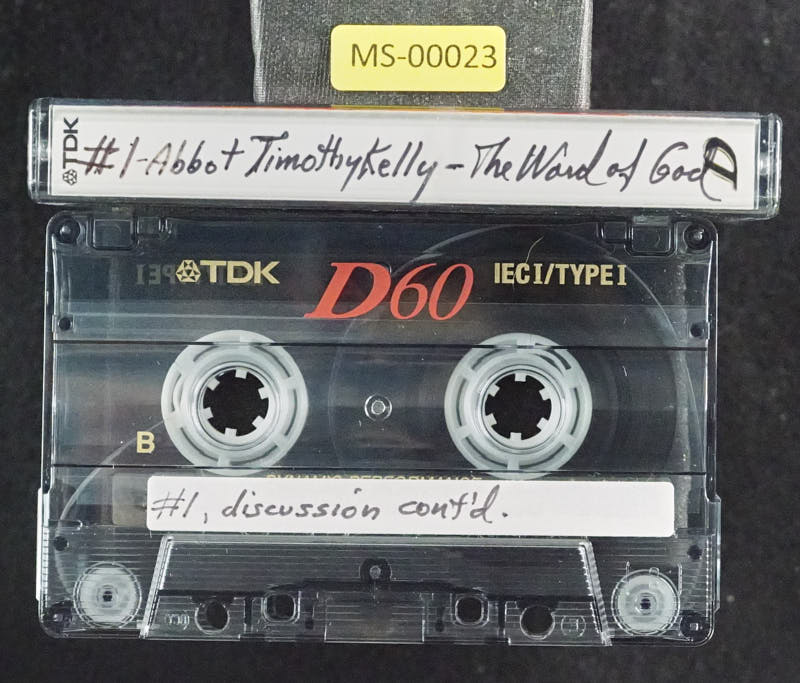
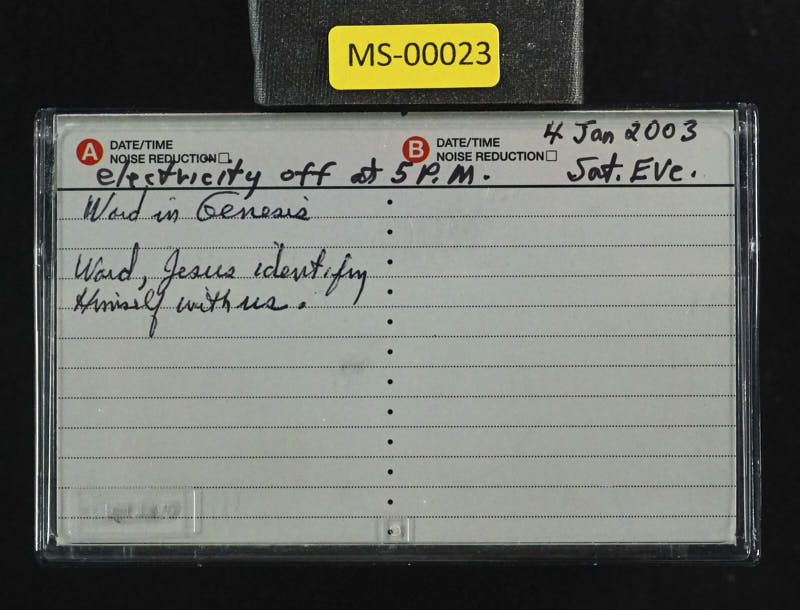
AI Vision - Possible Values from Photos:
Speaker: Abbot Timothy Kelly
Location: Abbey of Genesee
Possible Title: The Word of God
Additional text: #1, electricity off at 5 P.M. Sat. Eve., #1, discussion contd, Ward. Jesus identifying himself with us.
@AI-Vision_v002
Thank you. I have to admit I'm ten years late. I was supposed to give your community retreat in January of 1993, but I got elected Abbot at the end of November of 92 and had to cancel out. So I'm sorry to be 10 years late, but after you've made this retreat, maybe you will be happy I was 10 years late. I don't know. I think every retreat is a process of kind of working things through from one stage to the next, and I want to be doing that during this time.
[01:03]
I hope that you can think along with me and that I can think along with you. I think that any time that we are looking at what our life is all about, we're doing it in two ways. Number one, we're doing it by a very intellectual process. We take things and we try to make some kind of order and meaning out of them. But an awful lot of what we finally come up with is the second way, and that's through our intuition of bringing things together in ways that we hadn't anticipated bringing them together. And I think that if we could keep that in mind, perhaps some of what I hope to say during these conferences will have maybe more of an impact on all of us, myself included. Every time I have gone to a talk, or if I've heard a homily, or have sat down to talk with somebody, and they start out with the book of Genesis, I think, oh Lord, it's a long way to Revelation.
[02:15]
There are 72 books in the Bible, and I wonder if every one of these is going to go through, and 27 of those are in the New Testament, the rest of them in the Old Testament, and it's going to take a while. Well, I want to start with Genesis, but I'm not going to go through all of the prophets and the Psalms and all the rest of it, nor am I going to go through the entire New Testament. What I'm hoping to do is, particularly tonight, is to talk about kind of a comparison between the first few chapters of the book of Genesis and the prologue to St. John's Gospel, and throw in a few other things that just might come to my mind as we're going along. In the very first part of the book of Genesis, there's a rather interesting way that it is stated. It says, In the beginning God created heaven and earth. Now the earth was a formless void. There was darkness over the deep with a divine wind sweeping over the waters.
[03:20]
Now that formless void, when I was studying scripture from Father William Haidt, He referred to the Hebrew, the tohuwabohu, this chaos. You know, that's all there was there. We don't like to live in chaos. Chaos is a very uncomfortable thing for us. That's why I think that if we've ever watched a baby, you see that baby with these wide open eyes and reacting to every sound and to everything around him or her. and then you uh you you hear that child you know if it's a if it's a normal child they will they will start uttering sounds if you get into our abbey church at saint john's you'll find when they bring a little baby into the church all of a sudden the baby will go ah because it echoes and the baby is absolutely fascinated by that echo and they'll just do it over and over and over again especially when you're preaching and it just you know but there there's
[04:25]
There's something, there's a curiosity there that wants to bring some kind of order out of the chaotic numbers of things that are coming through the senses to this little baby. Well, that's kind of what I think Genesis is talking about. Here is this chaos, and some kind of order has to be made out of that chaotic condition. And so God comes along and says a number of different things. God said, let there be light, and there was light. We could use that tonight, you understand. It always reminds me of a retreat I gave to the Franciscan Sisters in Little Falls, Minnesota in the summer of 1978. And there was a big storm going on outside, and all of a sudden the lights went out. And we were in kind of a basement room where this retreat was taking place. And it was almost... Well, it was very difficult to see anything, so I asked the sisters, I said, all of you, raise your hands.
[05:28]
So everybody raised their hands like this. And all of a sudden the lights went on. And I said, many hands make light work. Awful. I've got a load of those, so I've done, you know, get used to it. Unfortunately, they went off again, so it's one of those things that it didn't work all that much, all that well. But God said, let there be light. And it says, God said, let there be a vault through the middle of the water to divide the waters in two. And so it was. And God said, let the waters under heaven come together into a single mass and let dry land appear. And God said, let the earth produce vegetation. And God said, let there be lights in the vault of heaven to divide day from night. God said, let the waters be alive with a swarm of living creatures and so on. God said, let the earth produce every kind of living creature of its own species. I'll come to that other one later. There's another one coming. But eight different times it said, God said, God said.
[06:33]
There's a word. There's something that is being said. There's something that is taking of this chaos and making it in some way an ordered thing so that we can live in it. And this is, of course, that's the next thing. God is going to say, let us make man in our own image. I'll come to that later on. But eight times, God said. And then you go into St. John's Gospel, that prologue to St. John's Gospel. And it says, in the beginning was the Word, and the Word was with God, and the Word was God. All things came to be by him, and nothing came to be except through him. word. The word. Everything in this creation that comes from God said, let this be, let that be, let this other thing be. Because every one of these things is not only a bringing order out of the chaos, but it says in the beginning God created all things.
[07:37]
All things. Nothing is left out. God created all things. And from our standpoint, It's the bringing of order out of this chaotic condition that speaks to us of what? That's our question. What is it saying to us? When God speaks and creates an order of some kind, it is speaking of God. It is a revelation of God. It is a manifestation of God. It's something that I think we all do. We look around this world and And it's really quite an amazing and marvelous thing. It's like the astronaut going out into space, looking back on Earth and having an epiphany. Having this marvelous experience of seeing the unity of this world and seeing that this is a world created in such a way that we are able to live with some kind, not only order, but isn't it amazing how all these things work together
[08:44]
to bring us the possibility of having life on this planet. Life doesn't exist on every planet, not in our way at least. But we exist. We've got, you know, here is an earth to stand on. That's nice. You know, at least, you know, we're not going to be flying off into space someplace unprotected. We have an earth to stand on. We've got water to drink. We've got oxygen to breathe. We can breathe. We've got food that comes off from that earth. We've got all of these things that will sustain our life. And all of that is there for the sake, for the purpose of sustaining, of giving life and of sustaining that life, of bringing that life in some way to completion. All of this is speaking to us, of faith at least, of a God who cares. We are not, except that all of these things are. They have to work together. They come together.
[09:45]
And God in the book of Genesis is saying to us, God, I'm the author of all this. I am the one who has arranged this. I am the one who has brought all of this together for you. It's for you, but it comes from me. St. John's Gospel and the prologue will say the same thing, basically. In the beginning was the Word, the Word's with God, and the Word was God. All things came to be through the Word. Genesis says, God said, God said, God said, eight times. And St. John's Gospel says, this is the Word that comes forth from God. And that Word is God. That Word is God. All things came to be, ourselves included, and all things that support our life. So, in some way, all of this creation... is meant to bring us back and to know more about God than we knew before. When we come out of this chaotic condition of no creation that makes sense to us, and God brings order out of this chaotic condition, it's there to make known the meaning of God's love for us.
[11:00]
Because if God doesn't love us, we're not. If God doesn't provide for us, we're not. Now, there's another thing that comes along with that. I'm kind of jumping ahead, in a sense, to the creation of humanity, but in some way or another, this explains the Word became flesh. Because when the Word became flesh, when Jesus Christ comes along, when he, the incarnate Word of God, is there in order to do exactly the same thing that God did in creation. to be a revelation of God, to make us know God in some way. So we have this Feast of the Epiphany. And in the Magnificat Antiphon tonight, there are three events that get mentioned in that Magnificat Antiphon. The worship of the Magi, who had a revelation through the star that they come to give honor, to give recognition
[12:03]
of this child who is born, who comes forth from God. We have a commemoration of the baptism of the Lord, which says something, because it's in the baptism of the Lord that the voice comes from heaven, this is my son, listen to him. And then there is the wedding feast at Cana, this magnificent love that God is showing through Christ for the need of this newly married couple that they had They're not going to be embarrassed, but even more important, the transformation of water into wine, the transformation of humanity into something that it has lost through sin. When you look at the coming of the Magi, what is God saying? That this salvation is for many, not for the few. That the chosen are there in order to make... the revelation of God known to all of humanity.
[13:08]
That nobody's going to be left out of this. Or in the baptism of the Lord. You know that in the early church, many of the sacred writers, the early writers of the church, were absolutely scandalized at the idea that Jesus would be baptized. A baptism of repentance for the forgiveness of sin. That was a scandal to them. To the extent that some of them said, That cannot really be part of Scripture at all. That got inserted by some of you who didn't know what they were talking about. So they denied it as part of Scripture. Some of them did. But it's a very real part of the Scripture. It's a very real part of the message of God. What is Jesus doing when he submits to the baptism of John? A baptism for the forgiveness of sins, a repentance for the forgiveness of sins. What is Jesus doing? In all of this, Jesus is saying to us, I have such an identification with you because I want you to be able to identify totally with me.
[14:21]
And that's something we have to learn over a period of time, I think. But Jesus has identified himself so completely and totally with our humanity so that we can completely identify with his divinity. So many of the Eastern Fathers, particularly, will talk about divinization, this whole process of recognizing who, in fact, we are. I'll talk more about that in a later conference. But the idea of God revealing God's own self to us is a magnificent thing through creation, through the Word made flesh, but also through us as followers of Christ. Now that, I think, is a terribly important thing for us to recognize. It's important for us to know who we are as monks, to know who we are as Christian monks, To know who we are as confreres with one another.
[15:26]
To know who we are as a part of the larger church around us. A people who are saying, we have a message not because we go out necessarily and preach and stand on a street corner in a soapbox and say this or say that, but simply because of the way we live together and give witness by our care for one another, and by our care for other people. 1986 I went to India and I visited, I think it was 19 Tibetan Buddhist monasteries that are in exile in India and three nunneries. I can remember one particular monastery of Tibetan monks in Deragun. And I found this in all of the monasteries, but this was really one particular place that I thought was just outstanding, where I knew that their hospitality was genuine when I saw how they loved one another.
[16:32]
And that's, it was so obvious. It was so obvious. And it's the sort of thing, I think, that we also, it isn't, you know, I go back and I've been in my own community for 48 years now, And I look at the people that had the most impact on me were not necessarily the ones who held high office in our community, but they were people who, by the simplicity and the love of their lives, made me understand what monastic life is about, but more importantly, what Christian life is all about. Because they were a living revelation. Well, God in Genesis is talking about creation as being a living revelation also of who God is because God cares. I mean, you know, a God will give us food and drink and oxygen and all the rest of it. Isn't that a God who loves us? Isn't it a God who loves us, who sends a son?
[17:33]
Isn't it a God making known God's own self in bringing the Magi from foreign lands not even from among the chosen, but others coming in. Isn't it a God who loves us, who can identify so much with all of humanity and our sinfulness so that we can be identified with Christ in his divinity? Isn't it a wonderful thing of a manifestation, an epiphany of God in the miracle at the wedding feast in Cana? Isn't that a marvelous, really a marvelous thing? And yet, we, a lot of us in our own lifetime, have seen a lot of people who have gone bereft of knowing the love of Christ because maybe people who are like us, who are professed Christians, haven't given the kind of an example or maybe something quite
[18:44]
opposite from a good example. There is a book that was written I don't even know how long ago it was. It goes back some time. A book by Carlo Levy entitled Christ Stopped at Eboli. Eboli I think is somewhere between Naples and Calabria in Italy. It's a whole beautiful area down there. I've been in that area. But he gives a wonderful, wonderful description of what happens to a people who are very, very poor and are just living day by day with nothing really on their minds except, are we going to have enough food to feed the children with today? Let me read something to you.
[19:46]
He says, Closed in a world apart, I am glad to travel in my memory to that other world, hedged in by custom and sorrow, cut off from history and the state, eternally patient to that land without comfort or solace, where the peasant lives out his motionless civilization and on barren ground, in remote poverty, and in the presence of death. We're not Christians, they say. Christ stopped short of here, at Ebole. We're not Christians. We're not human beings. We're not thought of as men, but simply as beasts, beasts of burden, or even less than beasts, mere creatures of the wild. Christ never came this far, nor did time, nor the individual soul, nor hope, nor the relation of cause to effect, nor reason, nor history.
[20:53]
No one has come to this land except as an enemy, a conqueror, or a visitor devoid of understanding. The seasons pass today over the toil of the peasants, just as they did three thousand years before Christ. No message, human or divine, has reached this stubborn poverty. The greatest travelers have not gone beyond the limits of their own world. They have trodden the paths of their own souls of good and evil, of morality and redemption. Christ descended into the underground hell of Hebrew moral principle in order to break down its doors in time and to seal them up into eternity. But to this shadowy land, that knows neither death, neither sin nor redemption from sin, where evil is not moral, but is only the pain residing forever in earthly things, Christ did not come. Christ stopped at Emily.
[21:57]
If you hear that as a condemnation of Christ not going far enough, that isn't what he's saying. It's that we didn't carry him far enough. And that's part of this whole idea of recognition of who we are. I don't know if you've ever read Chaim Poltok. He died this past year. He wrote some powerful novels. Jewish Man, who sort of incarnated the Jewish ethos. into a number of very wonderful books. The Chosen is one of them. I can't remember some of the other ones except the one I'm going to quote here called The Gift of Asher Lev. He had one that was called, before he was called My Name is Asher Lev.
[23:05]
Asher Lev was Jewish. And in order to try and find some meaning in the suffering that goes on or some image that would make known or manifest in some way the care and concern of God through human symbol, human story. Asher Lev is an artist and he paints a picture of the crucified Christ which really turns off his family because they're Jewish and they can't understand it except he's seeing this as as kind of a universal symbol of what happens when we care for other people. Later on, this next book was written probably 20 years later, and he calls it The Gift of Asher Lev. And again, he's still this artist, and he's still kind of at odds with his family. Well, one of the incidents in here is he's finding himself in a town, and he sees a scene
[24:12]
A scene which is taking place right after the Second World War. You might guess what it might be about. He sketches. Or later on doing a more formal picture perhaps. He says, I draw the face of the old woman on the stoop in the street. The dark, vacant eyes and thin, bloodless mouth and pointed nose, all her features like a foreshadowing of death. And the faces of two people, a man and a woman, walking past her, the flicker of shame, like the shame on the faces of those who were the first to liberate the death camps, and stared at the unutterable horror and then stood looking at the ground at their feet and the sky overhead, and were possessed suddenly of a profound humiliation at belonging to a species capable of such unspeakable acts.
[25:28]
And then the masks falling into place, for shame is among the most unindulable of sentiments. Yet it is our humanity that allowed what happened to happen. What is God saying in our life? What is God saying through creation? What is God saying through the Word made flesh? What is God saying to us tonight about the chaotic thoughts that we sometimes have of trying to find meaning in our life and trying to impress that meeting in such a way of life that others will come to know God, will come to know Christ, not because we're evangelists on the street corner, but because we're living the reality of what it means to be in Christ. What is that all about?
[26:31]
What does it mean to genuinely live the monastic life? so that our care and our concern, our forgiveness, our asking for forgiveness, our humble stance in the presence of each other, the meaning of mutual obedience, the meaning of good zeal, you know, all of these things. What does this have to say in terms of us being a sacrament of encounter with Christ, a revelation of God's love? That I think is the sort of thing that we need very much to bring into ourselves and allow ourselves to come to know. I want to go on with this tomorrow in some way bringing the kind of questioning into our own minds, into our own hearts
[27:34]
that will help us to develop over and over again a living into our vocation, first as Christian and second as monk, so that we do in fact become a revelation of Christ to each other and even to ourselves, but to anybody who will come by and will happen to notice it as well. Do you ever want to open these to... It's kind of questioning or discussion. Does anyone have any questions or additions or subtractions? Or reflections. Substractions, especially. I can't see you very well, so just speak up. The people translate the Hebrew a little differently. A member who got stuck with us, somebody who was teaching undergraduates, had a sabbatical.
[28:42]
He had taught undergraduates for 1,000 years. But he mentioned, just as an aside, that that first sentence is kind of like a noun. It is when God began, when God said. So the first action was God. in scripture with word is not said. Of course, there's ways of speaking. You know, when they tell the David of the Battle of Hastings, when this comes to me, you say nothing about yourself, but there are ways of speaking, which, for an adult, I love you, as he goes with me. But that's the way we give ourselves, and that's belief. And you can't believe it or you don't, but it's the way that an adult makes a gift of themselves to another. And this is the total gift of God to us by, not by being created, but by communicating.
[29:47]
That's good. You said that they were very bad, especially, you know, I didn't say love Christ, though I wouldn't deny that, but I'm not certain that they'd know that in that sense. How would they do it? I think by, you know, there's a word called toleration. Toleration for us has kind of a bad meaning. You know, well, I'll tolerate somebody who has bad breath or something like that. Toleration literally means to carry. to carry somebody, you know, and this is one of the ways, you know, it's like Father Flanagan in Boys Town, he ain't heavy, he's my brother, you know, he's tolerating his brother, he's carrying his brother. But when you see that among these monks, you know, one of the things that we frequently find when you get anything beyond, you know, two people or more together, ego starts getting in the way.
[30:57]
And part of why I think St. Benedict's, the heart of St. Benedict's spiritual doctrine is chapter 7 on humility. Because in a way that's kind of, you know, getting the ego out of the way so that we in fact can serve one another. And I think it was one of the things that I found in this particular monastery in Dehradun. These monks have an intuition that their kindness, their kindness, their giving, their smile and all the rest of it was genuine because they were doing it for one another as well. You know, sometimes in a monastery you can find, you know, people who will go out, they can welcome the guests out there and all the rest of it, they can give them the shirt off their back and all the rest of it, but they get back into the cloister and wow, you know, it's all altogether different. The one thing about guests, you know, you can You know that it's going to be limited. You can get rid of them after a while.
[31:58]
And so you can afford to be kind to a guest now and then. But we stayed there, you know, and we just saw this kind of thing going on. And I think that's, you know, that comes out of a solid spiritual background. ... I like that. I like that. I, [...] my things to that, to get close attention. What, what, [...]
[33:00]
It's not based on a well and fuzzy feeling. It's the day-to-day commitment to living together. I remember one of my confers, this is a good number of years ago, he was kind of a cantankerous sort of an individual to begin with, volatile, and he could explode. When he died, what is anybody going to say about him? because he could be so explosive and all the rest of it.
[34:02]
But I could remember when I was ordained in 1961, I was at home, and he had something repaired for me, but he didn't get it done before I went home for my first Mass, so he sent it to me. And... In the package that he sent was a letter. And here this cantankerous individual in this letter says, I know that I have been, not the word cantankerous, but it was kind of what he meant. I know I've been cantankerous, I've been explosive, I've blown up when I shouldn't have and all the rest of it, impatient. He said, if I've ever done that to you, I want to apologize. I thought, I mean, it was wonderful, because I think that said more about what was at the heart and the core of who he is or was than anything that he had ever done to make anybody angry.
[35:14]
It was really at the heart of who he was. A second thing that happened was that one of the brothers... had some kind of seizures now and then, and I was walking down a corridor behind him one day, and all of a sudden, bang, he collapsed right on, flat on the floor. And this other brother was nearby, so I went to him, and I said, Brother so-and-so, he fell down. He came out of his room. He looked at him. He kind of turned him over. He picked him up. The guy was a strong man. He picked him up, brought him to his room, put him on the bed, knew what the situation was with his health and all that, and that he had to, you know, he had to rest and get out of this. Came out, closed the door, he says, he'll be all right. But he was careful, you know, he cared. So, I mean, all these other things that went on, that, you know, blowing up and all the rest of it, I don't think was as...
[36:18]
as revelatory of the heart of the man as these two incidents. And I saw a lot of other ones as well. But, you know, the other things kind of overshadowed that for a lot of people. But I think if we look and we find this in people, you know, Christ shines forth in some very strange ways sometimes. That would strike us, that wonderful world. I think you had Gishi Lobsang the Younger and Kalsang Damdool? Yeah, yeah. I respect you, sure. Kalsang was one of those who came.
[37:38]
He was at our place also. Kalsang Dandu was our guide for six weeks when we were in India. And what a marvelous name. He is now a Gishi. Gishi means a kind of a doctor, like a Ph.D. kind of thing. But just, you know, their wonderful humor and openness just was really nice. There's a strange thing about how it exists as well. It is. Well, they're God, actually.
[38:38]
Where's God? It's not going to happen because it's a bit higher than it is. Yes. [...] We had a choice to go back to that.
[39:51]
We had a new. We'll get it. We'll just say that. We'll just get it. [...] Well, you know, you go back and you look at, like Cardinal Nevy says about this group of people, and they're in such poverty that they can't think of anything else. Why are they in such a state? Is it because there's such an unequal distribution of the gifts of the Lord among various peoples, various parts of the world, and so on? you know, is there an injustice in that? Why is that injustice there if there is? You know, is there a greed? I think we know the answer. Is there greed on the part of the powerful that can enslave the powerless who can't do anything to them in return?
[40:57]
And, you know, is there... Is there a desire in the part of people to find another people on whose faces and backs they can stand in order to be better than anybody else? Is there ego in this? And if you see this on a, or if we see it on kind of a universal level, are some of these things also part of us? We all have power. And power is a necessary thing. You have to have power. You must have power. You can't get out of bed in the morning without power. But we can also abuse that power. And other people can suffer as a result. Is it because we don't care or is it because we want more, we never have enough? A lot of these things that go on on a wide scale maybe are the same things that happen within ourselves.
[41:58]
If we know the love of God for us, do we have to be bent out of shape when somebody else doesn't love us the way we want? I'll get into that a little bit more tomorrow as well. It's good. So I put a schedule on the board of, it's kind of what we've done in the past, but in the morning it's kind of full and it's like mass and that's what I have.
[43:15]
So confidence in the afternoon I forgot whether to speak, [...] whether to speak. No. That's Monday. It's 3.30 or 3.30 in the afternoon. So there's some space between the afternoon. But I'm only going to last. So, Mother, you're going to tell us the good news, and it's about 5 o'clock tomorrow afternoon.
[44:17]
I'll have a light set. Bye. Oh, my. With these three candles, however, I feel like, you know, an actor in the spotlight, and you can't see the audience out there. Thank you. I thought I'd probably generate tea for an hour or something. Thank you.
[45:04]
@Transcribed_UNK
@Text_v005
@Score_78.44