You are currently logged-out. You can log-in or create an account to save favorites and more. more info
Cassian's Legacy in Monastic Wisdom
AI Suggested Keywords:
Colloquium
This talk delves into the monastic contributions of John Cassian, focusing on his life, travels, and significant writings, such as "The Institutes" and "The Conferences of the Fathers." It discusses his influence on monastic thought, his interaction with notable contemporaries like John Chrysostom and Jerome, and theological debates with Augustine. Cassian's categorization of vices and virtues, originally influenced by Evagrius of Pontus, and his exploration of themes such as humility and the origins of monasticism, are examined, as is his systematic classification of spiritual ascent and disciplines.
Referenced Works:
-
"Ecclesiastical Writers" by Gennadius: Provides historical context and biographical details about John Cassian, asserting his Scythian origin.
-
"The Institutes" by John Cassian: Comprising 12 books, it outlines monastic life, clothing symbolism, and the eight vices of monks, serving as a practical guide for monastic living.
-
"The Conferences of the Fathers" by John Cassian: Contains 24 spiritual dialogues purportedly from Egyptian monastic settings, addressing topics like purity, discretion, and the ascent to divine contemplation.
-
"The Rule of Saint Benedict": Influenced by Cassian, particularly in teachings about humility and discipline, drawing parallels with Cassian's presentation of moral and spiritual development.
-
"To Eulogius and Theophilius" by Evagrius Ponticus: Cassian's system of categorizing vices and virtues is largely derived from Evagrius's systematic approach to spirituality.
-
The Sayings of the Desert Fathers: Mentions Archbishop Theophilus's letter against anthropomorphites, reflecting the theological disputes of the monastic era, situating Cassian within the broader contemplative tradition.
-
The Acts of the Apostles: Cassian uses this biblical reference to support the origin theory of monasticism through apostolic tradition, suggesting an apostolic foundation for monastic practice.
AI Suggested Title: Cassian's Legacy in Monastic Wisdom
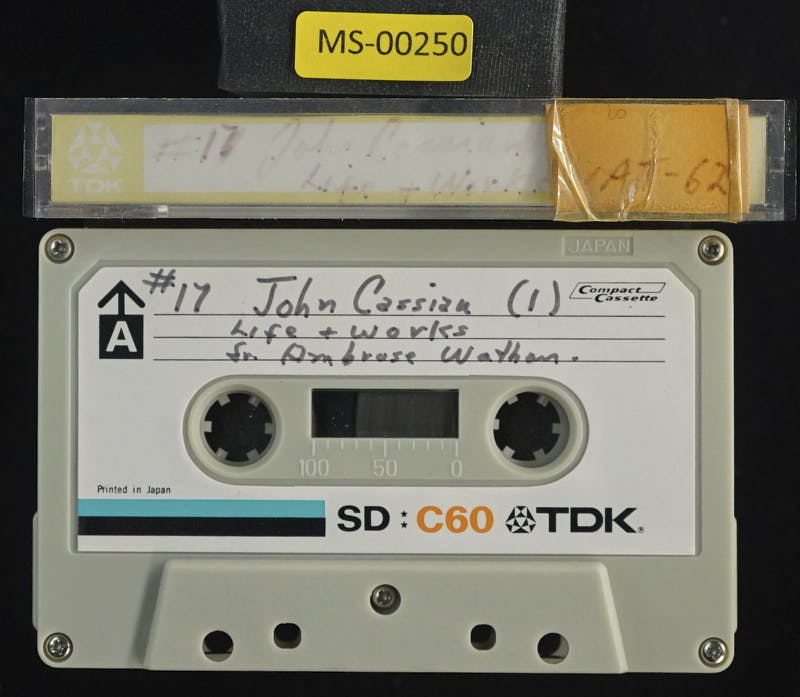

AI Vision - Possible Values from Photos:
Speaker: Fr. Ambrose Wathen
Possible Title: John Cassian Life & Works 1
Additional text:
446 16
C60
@AI-Vision_v002
Now we're ready to go into John Cashin, a great man in monastic tradition and one who greatly influenced a lot of our thinking, for better or for worse. With regard to his life, we don't know too much about him, and it's only fragmentary evidence, and that's from his own works. We're going to take a look at his monastic works. And then also there's an early writer by the name of Gennadius, who wrote a book called Ecclesiastical Writers. And in there, he gives some information about John Cashin. And Janadius wrote about 470. And as we'll see, that's within 40 years after Cashin died. He's called John in his two works, and people would speak to him, address him as John on two different occasions. Now, this may have been his baptismal name or his professional name, or it may have been a name that he assumed after his acquaintance with John Chrysostom after he left Egypt.
[01:11]
We're not sure where he got this name from. He was born around 360 or 365. So notice Anthony died in 356. So John Cashion, 10 years later, is born. There's a great dispute about his native land. This man Janadius says that he was a Scythian. Now, Scythia would be in present-day Romania. You have an idea where that is. What's the Adriatic Sea? Yeah, up in that old Yugoslavia over in the Baltic area there. Some people also say he was born in Syria or Palestine because of a manuscript reading of the text. But others argue for Gaul or Provence in southern France, because Cashion himself alludes to his homeland in a number of places, and it gives you the impression that he's talking about France.
[02:13]
But this is highly disputed where he's actually born. It's obvious that he had a good literary education, And this was also the cause for a lot of distraction in his prayer life, as he mentions in one of his writings. He says, a special hindrance to salvation is added by that knowledge of literature, which I seem already to have in slight measure attained, in which the efforts of my tutor on my attention to continual reading have so weakened me that now my mind is filled with those songs of the poets. so that even at the hour of prayer it is thinking about those trifling fables and the stories of battles with which from its earliest infancy it was stored by its childish lessons. This is very similar to a theme that you find in monastic literature and in Christian literature. What's the relationship of the arts, literature, to spirituality?
[03:15]
And many of the early fathers say that Well, it's a shame that we had to go into literary works because it's just a matter of distraction for him now. And here John Cash himself fits into that category. His family was well known for its piety, and his family seems to have been wealthy, as his classical education would indicate. Now, at an early age, probably around 17 or 18, he entered a monastic synobium in Bethlehem. And it states that it's at the very cave where the Lord Jesus was born. That's where the smoking was. This was probably before Jerome founded his monastery in Bethlehem, because Cashin makes no mention at the time of him being related to Jerome, though later he doesn't. He has a great admiration for Jerome. And it would almost seem that he wouldn't have left Bethlehem as he did if Jerome had been there. I think they've been so inspired.
[04:17]
Jerome founded his monastery in Bethlehem in 386. So we see that Cashion must have left Bethlehem, well he went to Bethlehem before Jerome got there and even left Bethlehem before Jerome got there. This was his first contact with Oriental monasticism and he's going to become quite acquainted with these certain aspects of Oriental monasticism. So how he got to Bethlehem and why he came to Bethlehem is sort of in the dark. But from Bethlehem he set out on a journey to Egypt to learn about monasticism there. He began his sojourn in the Nile Delta in northern Egypt around 385. Now that's the date that Theophilus became Bishop of Alexandria and maybe you recall in many of the Sayings of the Fathers and various other literature, Diopolis is mentioned rather frequently.
[05:19]
He's a famous Archbishop of Alexandria. He was quite a rascal in a way and very severe person. But he certainly went to the Nile after the death of the Emperor Valens. who died in 379. So somewhere between 379 and 385, he goes to the Nile Delta. And also another indication of the date is that while he was in the desert of Esquite, this Archbishop Theophilus wrote his letter condemning the anthropomorphites. I don't know if you recall that from the sayings of the fathers with these people who had an image of God as a man. And when the Archbishop wrote this letter and said, you can't have an image of a God, they were very because he said, you've taken my god away from me. But this seems to have been a difficulty among the monks in the desert.
[06:20]
Now, he didn't go to Egypt alone. He went with his companion, Germanus, who was, according to him, his spiritual brother. Vacation says in his first conference that Germanus was his closest companion in the Sinobium, and then in the desert. So they were apparently novices together and then took off on this trip together to Egypt. They were so close, Tashin says, that it was like a single heart and soul existing in two bodies. Tashin has some beautiful things to say about friendship, which I think tells us something about these early monks too, the respect they had for friendship. Now, why they went to Egypt A number of reasons. One, Cashin says they were seeking perfection, better perfection, as they found in Bethlehem, which sort of reminds me of a novitiate fervor type of person. Well, you get this much, well, we want to go much further.
[07:21]
Let's go to the desert, these famous people. But another reason was that in Bethlehem, at their monastery, one day while they were novices or young monks, there appeared an old man who just asked to be housed in the community and to work for the community. And so the community took him in. And then sometime later, some monks from Egypt came and discovered this old man and said, this is Abbot Penufius, who had run away from his Cenobium in Egypt to escape from, I guess, the responsibility, but more than that, just to get solitude and prayer. So he had run off to Bethlehem to hide in this monastery. And then the monks came and they took him home again. Well, this man had made so much of an impact upon these young monks that this may be another motivation for them going to Egypt to look up this Abbot Penufius. And there is a very beautiful section in the Institute's Book 4, Abbot Penufius' address to a young monk as he enters the Sinopia, which John Cashin has kept for us.
[08:27]
And it's a beautiful thing. I hope we have a chance to take a little look at it. But Penufius probably didn't influence too. He was a really inspiring man who in his humility had done this. These two men then were about ten years with the monks in Egypt, seven to ten years. After their sojourn in Egypt, John Taschen went on to Constantinople and there he became acquainted with John Chrysostom, the great archbishop of Constantinople, and he was ordained deacon by John Chrysostom. And then when John Chrysostom had his troubles with the emperor and the empress, especially the empress, Cashin went to Rome to defend the cause of John Chrysostom. So it shows that he was pretty much a friend of Chrysostom. And then while he was at Rome, he was ordained priest. And Vali was at Rome. This is the same time of Leo the Great. And he was invited by Leo the Great to write the third book, which we're not too concerned with, and that's on the incarnation.
[09:35]
If you recall, Leo's Great Concern and the, what is it, Council of Ephesus? Yeah, Council of Ephesus in 431 was all about the incarnation, the problem of... Who is Jesus Christ? Anyhow, John Cashin enters into that, and many people maintain that Leo's magnificent, what they call the tome, which he has written on the incarnation, the two natures and one person, two natures. This is basically John Cashin's theology. So he's not only important monastic-wise, but even in the development of dogma. Eventually, he went on to Marseille in France. Now, see, this may have been his original homeland, so he just went back home. Well, it may have been a new place. And he founded the monastery of Saint Victor, about 415, in France. He died around 430 or 435. Now, another date to note there is Augustine died in 430.
[10:41]
Augustine and John Cashin are contemporaries. And Augustine and John Cashin have a few little arguments because of the problem of the theology of grace. John Cashin is condemned to being what you call a semi-Pelagian. Of course, Augustine was out to get rid of all Pelagians and semi-Pelagians. But he enters into the scene there, too. But what we're interested in is because of his monastic works. And he's written two books. documents, very long documents that are of interest to us. Now, in Gaul itself, there were already monastic centers. For instance, Tour, where Martin had set up a monastic center, the island of Léron, off of the coast of Marseille, and then Marseille itself was already a monastic center, which John Cashin then sort of made more famous. Now, The two works that we're interested in are called The Institutes of the Synobium and The Conferences of the Fathers.
[11:47]
And we're going to take a brief look at both of these works. The Institutes of the Synobium. Now, the word institute at this particular time usually means something that we would call rule or legislation. When Rufinus translated the Greek rule of Basel, He called it the instituta. So this is a generic term. This is a term that Benedict uses about reading the institutes of the fathers. So he calls this first book the institutes. And the first book, now don't get confused by book-book stuff here, but the first book, I don't know what to call it, is in eight books, not chapters, because each book has chapters in it. But the Institutes is in eight books, are in two parts. The first part is the first four books, and that's how to become a monk, or how to make a monk.
[12:48]
And so this, in many ways, is like a monastic rule. And if you read it, in fact, later on somebody wrote what they called the Rule of John Cashin, and it's heavily drawn from the first four books of the Institutes. Part two of the Institutes, in eight books, is in eight vices of monks. And this has become famous. We have pictures in the Abbey Church about the eight vices plus one of the monks. Now the conferences, the other great work is 24 conferences of the fathers of Egypt. Now let's take a look first of all at the institutes, at the first four books. Are these conferences offended? Well, that's part of the problem. See, he pretends that these are the conferences given to him in Egypt. And probably they are based on what he heard in Egypt. But there's an awful lot of John Cashin in it, too.
[13:49]
And we'll get into that problem as we go along. This is one of the slippery areas of John Cashin. How true is he to the Egyptian scene? So let's take a look at the argument of the Institutes, that first work of his, which is in 12 books, two parts. So the first part, the first four books, this is the principal source of the life of the Egyptian monks. And so it's going to tell us about the external life of these monks. For instance, the first book of the Institutes has to do with the clothing of the monks and its symbolism. So if you're interested in the ancient monastic garb and what each piece meant, this is the classical place to go. For instance, the sanctuary, it seems to be the most important thing of the monastic garment because the monk is girded for war.
[14:55]
And this fits in, remember, to the whole concept of Anthony, the battle against the devil. Also, the clothing is against... nudity and coldness. So it also has a practical purpose. He also talks about the kukula or the kukuch in its meaning and then the tunic. So if you're interested in monastic clothing, this is one of the places to go. Now, the second and third books have to do with liturgical offices. I don't know, Mike, if you, if Father Patrick has gone through this section with you yet, you're starting it. But that's Book 2 and Book 3 of the Institutes. It's a good source place for liturgical material. It talks about prayer at night, prayer vigils, prayer at eventide, vespers, and prayers in the morning. And then it gets into this whole argument about what is the authentic tradition. As the Egyptians have it, 12 psalms in the morning and 12 psalms in the evening.
[15:57]
That's what it talks about in Book 3. two, and then he goes into book three. He says, well, the Syrians and the Mesopotamians have added to this. They've had terse sects and known. And then he says that this is not the ancient tradition. One of the things we find in here is that the procedure for prayer is that one person recites the songs while everybody else sits in silence and listens. We also have the custom of the song and then a period of silence. and prostration and prayer. Now, Father Patrick will go through more of the details about that, but that's sort of the general picture that you get. Now, I'd like to point out something very important in this section as a sideline, and that's the question of the foundation of monasticism or the origin of monasticism. In Book 2, in Chapter 5 of the Institute, Cashin states that
[16:59]
the evangelist Mark came to Alexandria. And this is an ancient tradition, of course, that the evangelist Mark went to Alexandria and he was the founder of the church in Alexandria. And then he says that Mark was also the founder of monasticism in Egypt. So notice he's got an apostolic origin for monasticism. He's answering the question, how did monks come to be in Egypt? He says it goes back to the evangelist Mark, who, of course, was one of the disciples of Christ. In chapter 5, he says, For in the early days of the faith, when only a few, and those the best of men, were known by the name of monks, who, as they received that note of life from the evangelist Mark of blessed memory, the first to preside over the church of Alexandria as bishop, Not only preserve those grand characteristics for which we read in the Acts of the Apostles that the church and multitude of believers in primitive times was famous.
[18:03]
And then he quotes from the Acts of the Apostles. The multitude of believers had one heart and one soul. Now did any of them say that any of the things which he possessed was his own? But they had all things in common. For as many as were owners of lands or houses sold them and brought the price of the things which they sold and laid it at the feet of the apostles. And distribution was made to every man as he had need. But they added to these characteristics others still more sublime. Now notice what he's done. He says, The best of men, known by the name of monks, following the apostolic tradition of the Acts of the Apostles, handed down through the evangelist mark. He continues. For withdrawing into more secluded spots outside the cities, they led a light marked by such rigorous abstinence that even to those of another creed, the exalted character of their life was a standing marvel. And then he says they gave themselves up to reading Holy Scripture, to prayers, to manual labor.
[19:05]
But notice what he's done with regard to the origins of monasticism. You see the point that he's making there. It... It's an apostolic origin through Mark in Alexandria. Egyptian monasticism is. Now, that's one of his so-called origin myths. You don't mind me using that term. He's trying to explain how monasticism got in Egypt. What are its origins? Just like Genesis tries to tell the origins of... of man and creation by telling the myth of Genesis, of the Garden of Eden. Well, this is sort of an explanation for how monasticism began in Egypt. But he has another myth or another story to tell in conference 18, chapter 5. And there it would seem that the origin of monasticism isn't in Egypt through Mark, but goes back to Palestine. Now, whether there's a contradiction you see between the two, I don't think so, because you could say, well, Mark came from Palestine and he brought the thing from Palestine.
[20:16]
But in chapter, or in book 8, conference 18, he doesn't say anything about Egyptian, but just the Palestinian origin. He says, the system of the Cenobites took its rise in the days of the preaching of the apostles. For such was all the multitude of believers in Jerusalem. which was thus described in the Acts of the Apostles. And then he quotes from the Acts of the Apostles those classical texts, the same one that he had up above, which has resonated in the Rule of Benedict and in a lot of monastic literature. And I think I've mentioned to you Don Germain Moran's little book, The Ideal of the Monastic Life in the Apostolic Age. It plays on these texts or reflects upon these texts. The whole church, I say, was then such as now are those few who can be found with difficulty in the Cenobia. Notice what it's saying, that everybody lived a monastic life that is now being lived in the Cenobian. But when at the death of the apostles, the multitude of believers began to wax cold, and especially that multitude which had come to the faith of Christ from diverse foreign nations, from whom the apostles, out of consideration for the infancy of their faith and their ingrained heathen habits,
[21:30]
required nothing more than that they should abstain from things sacrificed to idols and from fornication and from things strangled and from blood, and so that the liberty which was conceded to the Gentiles because of the weakness of their newly born faith had by degrees begun to mar the perfection of that church which existed at Jerusalem. Now, you see what he's doing? He's saying that the church became lax. This is a thesis, remember we've come up on it before, about monasticism as being a protest against the laxity of the church. And the fervor of that early faith cooled down owing to the daily increasing number of both natives and foreigners, and not only those who had accepted the faith of Christ, but even those who were the leaders of the church relaxed something of that strictness. But those... who still maintained the fervor of the apostles, mindful of that form of perfection, left their cities and intercourse with those who thought that carelessness and a laxer life was permissible to themselves and the church of God, and began to live in rural and more sequestered spots, and there in private and on their own account to practice those things which they had learned to have been ordered by the apostles throughout the whole body of the church in general.
[22:55]
So what he's saying is that monasticism is the pure, perfect expression of the apostolic church. Now, remember we saw that in Qumran when I mentioned to you that this is always a danger of monasticism. Now, in my opinion, what Gashen was doing is doing something that falls right into the hand of a lot of sociologists and a lot of people who interpret the history of monasticism. But my critical question is, where did he get that from? I haven't seen it, and I ask you, have you seen it anywhere yet in any of the texts that we've read? He comes along and says the Christian church is lax, the monks are the more perfect, and they are the ones who are carrying on the apostolic origin and carrying it on the tradition. Now, this is a very ancient theory.
[24:00]
But I don't see any resonance of this in Anthony. I don't see it in Pocomius. I see some of it. You know, the apostolic church, where we are the holy member, Theodore's saying about the holy koinonia. So I don't know how to take John Cash in here and say if this is the universal feeling of all the monks, or if this is something that developed later on, if this is sort of an elite mentality, if monasticism really is, in essence, a protest movement, I have to say that my own position is it's not. I have to say also that John Cashin gives you the impression that it is. Maybe he made it up? Well, that's why these things are called the myth of John Cashin's origins. Now, the whole question, see, I think, historically... Do you think that the Cenobium really was founded in the Cynical with the apostles on Pentecost?
[25:03]
That's what he's really postulating. I'm sorry. No, go ahead. I was going to ask. He said that the earliest Christians were monks. Well, he says that the earliest Christians were living the perfect life as all monks do now. See, everybody was... Monasticism is the... The continuity of the original Christian life. Everybody else has gone lax. I'm drawing a parallel in my mind to Syrian monasticism of the Syrian church, which seems to be monastic all the way... In origin, right. Everybody had to be a virgin or celibate. Only those people could... receive the Eucharist? Yes, there's something very similar to this. So, you see, there may be a foundation for this. Now, if it is, I don't like it. I have to admit that. But my out of this is that I don't see it in any other monastic text.
[26:03]
And I don't, for instance, see, at least, I don't see it in Benedict, this condemnation of Christians. And what it does, in my mind, is set up a double standard. And so, rightfully, Bonhoeffer who talks about this. I don't know if I've ever mentioned that to you before. But Bonhoeffer talking about the dual standard that is being set up in Christianity. That the monks have maintained the higher standard of morality, the more perfect Christian way of life, and the mass just go on and, well, if they get to heaven, it's okay. They're doing just what they have to do. But you see, here is a text which... I'm afraid, embarrasses us, and we have to admit that it's there. But there's also a certain discrepancy, I think, between the institutes and the conferences on the origins. And one of them is from Alexandria. It's the people in Alexandria who were given a Christian life, and then from there it originated, sort of as a protest movement.
[27:10]
The other is that it already began in Palestine. So there's already a slippery area there. From that last passage you read to us, it sounds like that Cash and me have started out as a Jew. As a Jew. Or a Phariseean Jew at that. Why? Where he talks about the relaxing of the original standards, the Gentiles. Yes, he started as a Jewish. Well, the fourth book... describes the material life of the monks, which is a life of renunciation. And in the fourth book, you find something which you could compare, for instance, to chapter 58 of the Rule of Benedict about the reception of novices because it talks about how to receive new members. They have to spend 10 days at the door. They have to renounce everything. Then they're accepted and are invested. They make an oral profession of obedience and total poverty. And then it is in that context that you have this beautiful allocution of Abbot Penufius in Book 4, Chapter 32 to 43.
[28:21]
It's an allocution that Abbot Penufius gives to a young monk on the day of his entrance into the monastery. I highly recommend it to your reading sometime and to your meditation. It's sort of analogous to the prologue of the rule of Benedict or to the... the liber orsiasis, you know, a testament and a very personal expression of a man's belief in what monasticism is about. And he has that beautiful statement that monastic renunciation is nothing other than the participation in the cross. And then how do we participate in the cross? And then he goes ahead and develops it. If I could prepare in time, I hope to, before we finish John Cashin, to give you that text, And we'll go through it because it is such a rich text. And in that context, he also speaks of the ten signs of humility, which is the source or the foundation of the twelve degrees of humility in the rule of the Master and in the rule of Benedict.
[29:30]
So that's where there's a source material for chapter seven of the rule of Benedict. So that ends the first part of the Institutes. And then we come to the second part, which is the next eight books, books five to twelve. And here we find the eight capital vices or sins of monks. So really what this whole collection is called is called the Institutes of the Sinobian and the Remedies for the Eight Principle Sins of Monks. So it has a very long title in the Latin text. talks about these eight capital sins. Now, this is a technique or a theme that you already find in Origen, the early Alexandrian theologian, and in Evagrius of Pontus. And here's where you see the connection between Evagrius and Cashin. Cashin used it. Evagrius was very systematic in his approach to spirituality, and John Cashin has been greatly influenced by him.
[30:33]
We find, first of all, well, there's three degrees of vices, and this is something John Cashin loves to do. He loves to systematize. There's three, three more, and then on each one of them, you sort of go onto a plateau. You go up three steps, you hit a plateau. You go up three more steps, you hit a plateau. You go up three more, and you hit the peak. And this is a constant technique in innovators and in John Cashin. So, for instance, with regard to the eight vices, he breaks them down into three categories. He's got the lower vices, The ones that are a little bit higher and then the highest of all the vices. Now, correspondingly, when he talks about virtues, he's going to have it just the opposite, you see. The lowest virtues that build up to the heights of perfection. Now, in book five, he talks about gastronomia or what we would call gluttony. That's the least of all the vices. And then in book six, he talks about fornication.
[31:39]
That's a little worse than glutton. But you see, it's still not so bad as far as vices go. And then in book seven, he talks about avarice. And that of the three is the worst of them. So that's the first three steps. And it seems like, well, let's look at it not going up, but going down. So you take a step and every step is a little bit worse than going down to the pit. The next three pertain to, well, those first three pertain to what he calls the concupiscible vices. They have to do with concupiscence. Now, the next three have to pertain to the irascible vices. And so you have anger or wrath, then sorrow, and then assidia. Now, we're going to take a look at assidia because that's a very interesting vice and something that... It's especially the sickness of hermits, but I think all monks suffer from it a little bit. Then you've gone the next three steps, and you're in the worst apartment now.
[32:42]
The next two, which are the worst or the highest, pertain to the intellect, and that's bainglory and pride. We say, well, you know, what's really the difference? I'm not prepared to show how cashing... defines it but he makes a distinction between being glory and pride but notice the culmination of vices is pride now that should tell you something about when you get to the virtues the culmination of virtues is going to be humility because it just goes the opposite way I'd like to take a look at that thing on the city I don't know if you're familiar with it or not that's in 10 of the institutes. It says, our sixth combat is what the Greeks call akadeia, which we may term weariness or distress of heart. This is akin to dejection. Now, that was the one right before dejection was.
[33:44]
And is especially trying to solitaries and a dangerous and frequent foe to dwellers in the desert. So notice, especially people in the desert, they're going to get, this thing's going to attack them. It's especially disturbing to a monk about the sixth hour, like some fever which seizes him at stated times, bringing the burning heat of its attacks on the sick man at usual and regular hours. Lastly, there are some of the elders who declare that this is the midday demon, the noonday devil, spoken of in the 90th Psalm, because it sort of hits you about noon every day. And then he's going to explain what this thing does. And when this has taken possession of some unhappy soul, it produces dislike of the place, disgust of the cell, and disdain and contempt of the brethren who dwell with him or at a little distance, as if they were careless or unspiritual. I think this is just brilliant with psychological overtones.
[34:48]
You know, you get... You get sick of a place where you're at. You don't like your cell. You can't stay in your cell. You don't like the people you're living with because they're careless and unspiritual. And then he continues, It also makes the man lazy and sluggish about all manner of work which has to be done within the enclosure of his dormitory. It doesn't feel like doing anything. It does not suffer him to stay in his cell or to take any pains about reading. And he often groans because he can do no good while he stays there. And complains and sighs because he can bear no spiritual fruit as long as he is joined to that society. So he can't sit in his cell. He doesn't want to read. And besides that, the people he's living with are all numbskulls. And he has never reached perfection with them. He complains that he has cut off from spiritual gain and it is of no use in the place. As if he were one who, though he could govern others and be useful to a great number of people,
[35:50]
yet he was edifying none, nor profiting anyone by his teaching and doctrine. He's just useless. He's not serving anybody. He's not doing any good, and he's got all of these talents, and he's not using them. So he cries up distant monasteries and those which are a long way off and describes such places as more profitable and better suited for salvation. Now, if I could just go to another monastery, I would find salvation. I would really live my perfection. And besides this, he paints the intercourse with the brethren there as sweet and full of spiritual light. I just think this thing is brilliant. On the other hand, he says that everything about him is rough, and not only that, there is nothing edifying among the brethren who are stopping there, and also that even food for the body cannot be procured without great difficulty. Lastly, he fancies that he will never be well while he stays in that place, unless he leaves his cell, in which he is sure to die if he stops in it any longer, and takes himself off from thence as quickly as possible.
[36:58]
Then the fifth or sixth hour brings him such bodily weariness and longing for food that he seems to himself worn out and worried as if with some long journey or some heavy work, or as if he had put off taking food during a fast of two or three days. Then besides this, he looks about anxiously this way and that and sighs that none of the brethren come to see him. Nobody's coming. He often goes in and out of his cell and he frequently gazes up at the sun as if it was too slow in setting. And so a kind of unreasonable confusion of mind takes possession of him like some foul darkness and makes him idle and useless for every spiritual work so that he imagines that no cure for so terrible an attack can be found in anything except visiting some of the brethren and in the solace of sleep alone. So you've got to do something. Well, go visit somebody. Let's talk it over you. Get it out of the system. Or at least go to sleep.
[38:01]
I mean, there's nothing else to do. Then the disease suggests that he ought to show courteous and friendly hospitalities to the brethren and pay visits to the sick, whether near at hand or far off. He talks too about some dutiful and religious officers. that those kinfolk ought to be inquired after, that he ought to go and see at them more often, that it would be a real work of piety to go more frequently to visit that religious woman devoted to the service of God, who is deprived of all support of kin. You know, this whole rationalization process has taken place because he just can't sit still in his cell. and that he ought piously to devote his time to these things instead of staying uselessly and with no profit in his cell. Now, of course, that has to be seen in light of a constant teaching of passion and desert monks, that you stay in your cell, and your cell will teach you everything you have to know.
[39:04]
I don't know if you recall this from the saying, the Father says, beautiful things on the cell, but don't move out of your cell, and your cell is going to be your temptation, your... Your hell as well as your paradise. You see, this guy, he just can't stand it any longer. And Kashin is saying, or the Egyptian monks are saying, that once you leave your cell, all is lost. And once you start running, you're going to be running all the time. And the best thing to do is just settle down and face it. Kashin sounds experience. To me, psychologically, I'm not being a psychologist, but a modern psychologist would take that. And I think that this whole rationalization process, well, I think it's what we experience too. I just can't stand this anymore. For instance, I frequently find it in prayer. Well, what am I doing here? I ought to be talking to somebody, doing something, reading something. This is just a waste of time.
[40:05]
And then you think about all the things that you should be doing. And I think it's a subtle temptation for monks. Now, apply this to a synobian. Why aren't we where the action is? What are we doing out here in the woods? And it's the same temptation. Have you ever read this text before? Yes. That one and the one on Everest I thought was really... I'm too familiar with that one. I thought he was going in the same direction because on Avarice, he's talking about how you start with a little bitty. Collecting little things. And the rationalization that's going on. And everything you grab and hoard, there's a definite reason that you rationalize. And then finally, you decide that you need a good woman to manage all your possessions. I think that John Cash is very good reading for us today.
[41:08]
Now, I think that a lot of things, well, I don't agree with him on, but he's got a real insight into human nature. And maybe this whole thing about one vice leading to the next until you're really degenerate. There's a certain truth to that. Is it proper to call Cash an abbot? Yes. And he's also known as St. John Cashin, but there's a lot of dispute whether he should be called saint or not. But some traditions call him St. Cashin. It seems like Scott wants to take Asha. Well, he's not in the Roman calendar. He's in the French calendar, I think he is. French? Yeah, because he was a French monk, you know, a Gallic monk. But there's also a martyr by the name of Clashman. So some people do take the name of Clashman, but I think that this is the man they take for a patron. But that's the whole problem of who's a saint now. So let's take a look now at the conferences.
[42:11]
See, that was all about the institutes, the 12 books of the institutes. Now we're talking about the 24 conferences of the fathers. Mike, you're doing studies in John Tucker. Yeah, that's that when Paul Domino guy go with a rule, he has me check on particular chapters for some kind of source or reference, but not anything that Waukesha would have to say about that particular chapter. Would you like to present that to us sometime? Well, it's been kind of a scattered... Could you get it together? I could try. You know, I just go through the rule, if you want to, chapter by chapter, and show what you think is a parallel to John Cashin. What are you using to give you the insight to whether it's John Cashin? Is this your own familiarity with Cashin? Well, usually, like in the, I'll check, say, the lot in his commentary, and sometimes he has, you know, references.
[43:15]
Right. And then I'll check the index on Cashin. Do you ever check Adalbert de Volgue? No. Because in the back of his rule. Well, Father Dominic, that particular one, I think, is in French. Right. And I don't read French. But sometimes when Father Dominic gets the main source that he uses. And he gives Dave Volgue and then I give Cashin. Then we'll look at Basil and a couple of other. But if there's something on Cashin, he'll give it to me. Well, if you can work it up so that you can present it. I know I'd be very interested in it. You might have something that I haven't seen before, and I'd like to know about it. See, of course, that chapter 7 of the Rule of Benedict on the degrees of humility, that in book 4 of the Institute, that's obviously a source, but according to Dave Oakway, through the Rule of the Master, Now, the whole question about how much did Benedict actually use Cashin as an immediate source is much discuter.
[44:20]
Now, we'll get, I think, a little bit more into that as we go along. These are spiritual conferences and of 24, well, they're not 24 followers because some of the conferences have two or three conferences of one or the other followers. But they were written by Cashin at Marseille. So after he had left Egypt, Cashin divides his journey with Germanus into three sections. And this division of his journey is also a division of the conferences. So, for instance, you have Conference 1 to 10, which took place in the desert of the Skeet, while Cashin was in the Skeet. Then you have Conference 11 to 17, which took place in the delta of Egypt. and then 18 to 24, which is again in the delta area. The thing which is characteristic about these conferences is that everything, again, is reduced to the scheme of ascent, according to origin and evatrix.
[45:28]
So the ascent of perfection, going up the steps of perfection. But Cashion subdivides and complicates what in origin is rather a simple scheme. So he makes it much more complicated. And he uses a great deal of Hellenistic philosophical terms, as Evabrius does too. And he often introduces what he would call a little excursus or distraction on a particular point. Let's take a look at least the first 10 conferences, just to give you an idea of what's there. The first conference is by Abbot Moses. And it's on the destination or goal or end of monks. But Cashion divides this up into two different things called what is the destination and what is the goal. I don't know what other words to use. What he's saying is that there is a proximate goal and a final goal for the monastic life.
[46:29]
And so he makes that distinction. The proximate goal of monastic life is purity of heart and love. And the final goal is the contemplation of God. So he makes a little difference there between the immediate goal and where this then is going to lead you finally to. He also talks about apathia. I think I mentioned to you again with regard to Pachomius. See, this is a term that Pachomius never uses. And he uses this term meaning purity of heart or state of tranquility. And that's a Hellenistic term. Apathia. Apathy. No... pothos, no passion. I think pothos is passion. When you first said it, I thought it might have been another habit. No, I forgot. He also talks a lot about solitude, and he uses the term, well, the Greek term, anachoresis. Now, that's a term, if you remember, from Anthony. Anthony, every time he withdrew, it was called, he was anachorating.
[47:31]
He was withdrawing, and that's why it's called an anchorite. So this is a term that he uses with regard to the goal and destination of a monk. To acquire purity of heart, he withdraws. The first conference shows the way of the ascent. He says there's an intellectual ascent and a moral ascent. Now, the intellectual ascent is signified by Mary in the gospel, and the moral ascent is signified by Martha in the gospel. So right away, you've got this thing that's come up in tradition, especially in the Middle Ages, the Martha-Mary relationship. Is that a legitimate use of that text? Yes. According to some scholars, that text is used according to rabbinic mentality and that it is a reference to a rabbinic story that the rabbi would teach the disciple who would sit at his feet.
[48:32]
And this was the more perfect disciple or the more blessed disciple. where the disciple or somebody else who was working for the rabbi on keeping his house was not the blessed disciple. But the blessedness is in being able to listen to the word of God. So in some ways it is legitimate, but I think it has been overdone a great deal. The second conference is also by Abbot Moses, and it's concerned with discretion. right away the problem of, well, if this is your goal in monastic life, then how do you get there? Well, you don't go too fast and you don't go too slow. You don't err to the right, you don't err to the left. And you're able to judge angels. Discretion means that you want to know the will of God here and now. Now, in that problem of discovering the will of God, you have the danger of the deception by the devils. That's why you need the gift of discernment.
[49:34]
This charism, then, of discernment or discretion is absolutely necessary for the hermit because, you see, he doesn't have anybody to guide him and to help him, where the Cenobite has his abbot as the discerner. So this is an absolutely necessary virtue for the hermit. Also, he talks about manifestation of heart to an elder, and this is necessary not only for the sake of humility, but just for good, healthy life, I suppose, to keep in contact with people. Is that the same thing, manifestation of heart? We call it manifestation of conscience. We would call it, yes, the same thing. That almost has a derogatory meaning to it, but it doesn't really in nature have that derogatory meaning. Is this what St. Benedict says when he says about spiritual father, the rock, was our spiritual father? Pressuring one's evil thoughts or... Well, he tells us, for instance, in a chapter on humility, that we should open everything to the abbot and tell him all the thoughts so that we can dash... Is he saying dash it upon the rock?
[50:44]
But he's got that theme also of dashing the thoughts on the rock of Christ, and that's two different texts, I think it is. I know this dashing on the rock of Christ is from... John Cashin? John Cashin. Is it from this conference? Do you know? I really don't remember which conference it's from, but I know that it was from Cashin that the thing started. Also, another point within this conference, I don't know if you've ever heard of the theory of synergism. You know, the whole problem of nature and grace. You get the Pelagian Heresy comes up and says that we don't need grace to begin a good act, but only to complete a good act, or a cynical agent and all of that. All throughout early Christianity, there was this problem of what is the relationship between nature and grace. And the Orientals have a position, what we would call synergism, that it takes the work of God and the work of man at the same time.
[51:51]
Neither one precedes the other. but it's almost always at the same time. Now, it's hard for us to understand this concept of synergism without getting complicated in our own controversies in the West about nature and grace. See, the charism of discretion, for instance, is not given without the cooperation of man. You just can't sit back and say, well, I hope I get discretion. But you've got to work for discretion, too. So it always presupposes the labor of the ascetic. And that's what ascetical discipline is about. Trying to bring to discretion. Now the hero of discretion, of course, is Anthony. When Margaret Cross, or the ruler of Benedict, calls it the mother of virtues. The third conference is by Abbot Nufius. And here we really see Cassian's mania for reducing everything to...
[52:52]
a threefold scheme because he's got the three renunciations of a vocation. So our vocation consists of three renunciations. First of all, the renunciation in which man is called by God through Scripture to just the call to turn away from yourself and come to God. And then he is called away from men, secondly. And then thirdly, he's called away from death. Now, these three renunciations, are analogous to the threefold call of Abraham from Ur of Chaldea. The first step was that Abraham had to renounce his land. The second step, he had to renounce his kinsfolk. And third, he had to renounce his home. And notice how he likes this threefold step arrangement. The first renunciation implies renunciation of material goods and corporality. The second renunciation demands rejection of moral vices, and this is the hard process of asceticism, which is accomplished in the monastic school.
[53:59]
The third renunciation is realized in pure prayer, contemplation, and in solitude. Martha is the symbol of the first and second renunciation, and Mary is the symbol of the third renunciation. Notice how he's playing with this three all the time, and I'm not so sure that logically all of these things fit together. And I don't think he's concerned about that either. Now, according to Origen, he had the same sort of theme of three renunciation. The first renunciation is expressed in the book of Proverbs. The second renunciation is expressed in the book of Ecclesiasticus. And the third renunciation in the Canticle of Canticles. If you study anything about the patristic interpretation of scripture. This theme comes up very frequently. And the tentacle of tentacles is the contemplative plane of life. The fourth conference is by Abbot Daniel.
[55:04]
It talks about spiritual and fleshy concupiscence. And there is another threefold scheme in this conference. You've got the carnal state, which is the inferior state, the animal state, which is a lower state, and a pneumatic state. He talks about all of these different, these three levels. The fifth conference is by Abbott Serapian, and it's the doctrine of the eight principal vices, the same thing that we find in the institutes, which would be interesting to compare exactly how it relates. But also a tendency of three can be noticed in this conference. And you have the theme, which comes up frequently in John Cashin, The theme of poverty expressed as the perfect nudity of Christ. He uses this theme very frequently with regard to poverty or detachment, the nudity of Christ. The sixth conference is by Abbot Theodore. He talks about the law of the saints.
[56:07]
He tries to explain the origin of evil and why this was done on the occasion of the martyrdom of certain monks by the Arabs. It says, God permits evil, first of all, for proving the just, secondly, for amending the evil, and thirdly, in punishment for sin. Notice again, a threefold reasoning thing. The seventh conference is, the seventh and the eighth conference are both by Abbot Serenus. Now, Serenus in Greek means peaceful or tranquil. And the first one is, or the seventh conference is on the mobility of the soul. How the soul should not be disturbed, even though it's undergoing temptation. So it fits right in with the name of the man, you know, Serenus. You think that's a play on the word? It's very possible. You see, this is maybe the only case where this comes out that's really noticeable. See, tranquility is opposed to mobility.
[57:08]
So here again you have the whole apathia concept again. which may be, in some ways, the foundation for the concept of stability, a certain tranquility. The eighth conference by Serenus again is on the principality, so all of the angels. We find this to be compared with the demonology of Anthony. The ninth and tenth conferences, which I highly recommend to your reading, are on prayer by Abbot Isaac. And these are two classical conferences and very famous throughout tradition because of their teaching on prayer. So I recommend those especially to you. I think we'll stop there today. Does anybody have any questions? We'll continue with John Cashin next week and maybe for a couple weeks.
[58:09]
I'm not sure exactly how it's going to be going. I haven't been able to prepare it like I wanted to. But I do have enough money to share with you for a couple of weeks. It may not be as tight as organized as I would like. Anything else?
[58:27]
@Transcribed_UNK
@Text_v005
@Score_92.38