You are currently logged-out. You can log-in or create an account to save favorites and more. more info
Cassian's Bridge to Monastic Wisdom
The talk focuses on John Cassian, a pivotal yet underappreciated figure in early monasticism, emphasizing how his Latin writings serve as a crucial bridge from Eastern monastic traditions. These writings, plagued by poor translations until recently, reveal Cassian's complex views on Cenobitic and Anchoritic life, influenced by his experiences in Greek and Latin-speaking monastic environments. Cassian's monastic writings, the "Institutes" and "Conferences," demonstrate his emphasis on the integration of scriptural meditation, unceasing prayer, and spiritual knowledge, highlighting how his teachings offer profound insights into monastic spirituality.
- Institutes by John Cassian
- Describes monastic rules and the origins and causes of principal faults.
-
Includes Cassian’s interpretation of monastic life, including practical life and ascesis.
-
Conferences by John Cassian
- Offers insights into both practical (cenobitic) and theoretical (anchoritic) monastic life.
-
Explores themes like purity of heart, prayer, and spiritual knowledge, often using allegorical interpretations of Scripture.
-
Evagrius Ponticus - Known for writings on prayer and spirituality.
-
Influenced Cassian, particularly on the subjects of prayer and apatheia.
-
Pachomius - Earlier discussed influential early monastic figure.
-
Cassian's works compare/contrast with Pachomian traditions regarding community and individual spiritual pursuits.
-
Origen of Alexandria - Early Christian scholar whose spiritualized interpretations influenced Cassian but also introduced controversy.
-
Cassian’s connections to Origenism complicated his relationships within monastic and ecclesiastical circles.
-
St. Augustine - Played a key role in the Pelagian controversy, addressing the role of grace.
- Contrasts with Cassian who emphasizes monastic works in achieving spiritual goals.
Cassian's writings are essential for understanding the evolution of monastic practices and spirituality, offering methodologies for integrating scripture, prayer, and monastic discipline.
AI Suggested Title: Cassian's Bridge to Monastic Wisdom
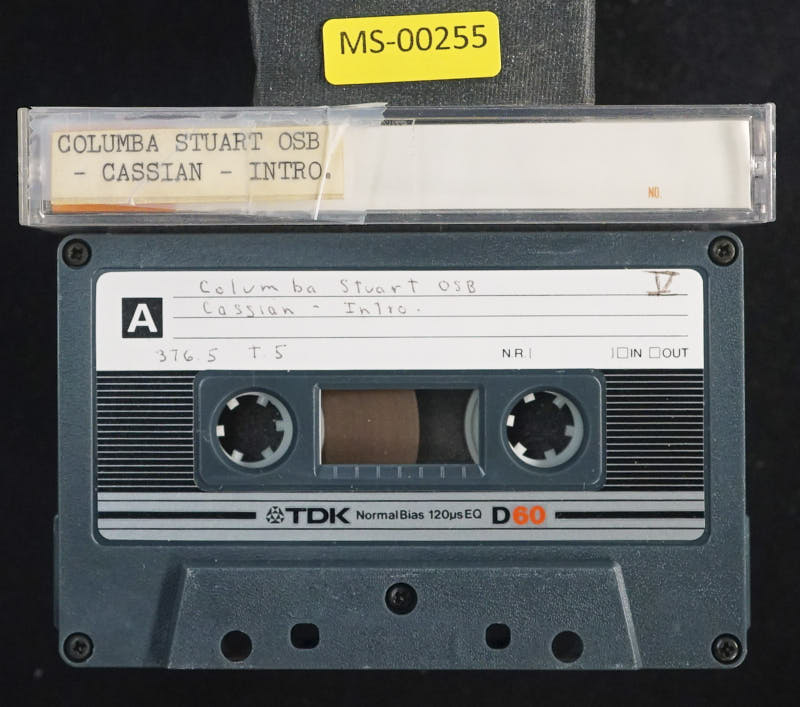
AI Vision - Possible Values from Photos:
Speaker: Columba Stuart OSB
Possible Title: Cassian - Intro.
Additional text: 376 S T 5
@AI-Vision_v002
Today I want to start talking about John Cashin, and as I looked through my notes this morning, I had the sneaking suspicion that this may take us through this morning, this evening, and also into tomorrow morning as well, but we'll see. I have a lot on Cashin, and I think he's deserving of attention, partly because despite his great importance, he is one of the least known of these early figures because we have such poor translations of his works. Related to that is the fact that in the near future, a series of new translations will be appearing that are now being done. One of them is completed of the Institutes, and another of the conferences is due any time. So I have a sneaking suspicion there's going to be a real fad of Cashin, like we had with Pachomius five years ago when those texts came out. So it's probably worth our while to refresh our memories about his life and the structure of his writings. and then look at what he has to teach us about Scripture and prayer.
[01:05]
So we'll end up dealing with many of the same themes we've addressed already and the other writers. But I'd like to give some background on the man himself, because his own monastic trajectory, progression through different stages, is as important for understanding his works as Bacomius' was for him. Unfortunately, we don't have the neat structure of the six signs like we had for Pachomius. Putting Cashin's biography together is a lot of detective spade work, but we have the basic outlines of it. The real issue with Cashin is this whole question of Cenobite and Anchorite, again, as it was with Pachomius. It seems, at first glance, that Cashin has only good words for the Anchorite, and regards the Cenobite as somewhat less than perfect. But if you read him carefully, it's not that simple.
[02:07]
So I'll say some words about that. But when we see his biography, I think we begin to understand better why he has some of these opinions, and why when he sets to explain things in a fuller manner, it gets a lot more confused than you first think. One significant thing, of course, about Cashin to start with is that he writes in Latin. So he's the first Western monastic figure that we have to deal with. And he's extremely important as a kind of bridge. He spends his entire monastic life in Palestine and in Egypt except for his period in Gaul at the end. So all of his formation is in a Greek-speaking monastic environment. And he takes all of that wisdom and formation and gives it to us in Latin texts. So he's very useful that way. We're not quite sure where he was born.
[03:09]
This raises interesting problems. Some people assume that he was born in Gaul, modern-day France, because he ended his monastic life there. Better evidence indicates that he was born in Scythia, which is present-day Romania. because that was a bilingual region in his day, both Greek and Latin-speaking, which would explain how he could sail off as a young man to the Holy Land and then to Egypt, and apparently deal very well with Greek-speaking monks, and then also come to Gaul and write with some facility these Latin monastic works. We suspect that he was born about the year 365, which means he's born about 20 years after Pachomius dies and about 10 years after Antony dies. So we're talking about really a next generation or maybe a generation and a half after those first two people we discussed.
[04:12]
He seems to have been raised in a wealthy and pious family and to have the benefit of a good education. which shows in the quality of his writing, which I think is rather good. A lot of people have complained over the years that Cashin's writing is very rambling and wordy and shows no structure, but I think closer analysis of it shows that he was very much in control of his monastic writings, and I'll try to prove some of that probably when we get to it tonight and tomorrow morning. At a young age, probably about 17 or 18, he decides to become a monk. And he does so by going to Palestine, to the Holy Land, with a companion. He visits the holy places and finds a Greek-speaking monastery in Bethlehem, apparently before St. Jerome was there, because we have no record of their ever meeting. While he was there, there was an Egyptian abbot who was kind of on the lam who had fled his own monastery because of the pressures of being a superior, and he was trying to seek blessed anonymity in Palestine at this monastery in Bethlehem.
[05:29]
At first, nobody knew who he was, but gradually they put it together, as they always seem to have done in these stories. And he's there long enough before he goes back home, after they've caught on to his identity, to tell the young Cassian and Germanus, his companion, about monastic life in Egypt. So he gets them all fired up, and three years after they arrive at this monastery in Bethlehem, they head off to Egypt. Now that is significant, because that is really the only solid period of synabitic formation in life that Cassian has until he goes to Gaul toward the end of his life. So whatever he writes about Cenobites is based on that limited amount of experience because most of his time will be with hermits or semi-hermits or semi-ancheritic communities in Egypt. So that's worth noting. He heads off to Egypt after receiving permission from his superior in Bethlehem to go on the condition that he return.
[06:40]
after a year or two of poking around. Well, he gets to Egypt, and it's like he's found the Promised Land. Everything he'd ever hoped for in monastic life is there, and he travels through the whole country. He starts up at the top, at the mouth of the Nile, visiting hermit communities in Zenobia, and works his way all the way down to the Thibayad, which is the region of Pachomius and his communities. So he sees a lot of it. and we rely on his writings for a lot of our evidence about these early communities. Well, when he gets to Egypt, he realizes that he's in a bit of trouble. First of all, he's delighted to realize that this is what he was looking for monastically, but he also realizes that if he goes home and tries to get permission to stay in Egypt, it will not be granted. So he's put into a crisis of conscience. What does he follow? this vision of monastic life he's found, or does he follow the vow made to his community?
[07:45]
Well, it's a number of years before he sorts this out. He decides for now to stay in Egypt, feeling that's the higher imperative. Later on, he does kind of put his tail between his legs and go back home. And at that point, his community is willing to bless his returning to Egypt. And he later writes a whole conference on making promises, which comes out of his own experience. But what is clear in that crisis is that Egypt has a powerful effect on the man, and he's to devote approximately the next 15 years of his life to learning everything he can about Egyptian monasticism, especially the tradition of the Anchorites. He ends up in Scatus, which he sees as kind of the ultimate monastic paradise. And as you know, that was a kind of a more or less communal form of the anchoritic or hermit life. And he attaches himself to Abba Paphnusius' congregation, which was known as being one of the most learned and intellectually aware, and therefore very much infected, according to some people, with the teachings of origin.
[09:04]
So we find right at the start, that Cassian is very much influenced by the kind of monastic tradition that produced Evagrius. And you've probably read Evagrius' treatise on prayer, or his chapters on prayer. Now, this attraction to that form of monasticism, anchoritic, but also very intellectual, makes sense for Cassian, because he's a well-educated young man. But it leads to trouble. because about 15 years after he arrives, in 399 and 400, is the great originist controversy, when there's kind of political shenanigans in Alexandria with the patriarch at first siding with those monks who felt that there should be a kind of spiritualized interpretation of Scripture against those monks who had a very simple kind of piety. The focus of their controversy
[10:08]
was how one conceived of God in prayer. One group of monks had a very human way of conceiving of God. Now, it's not a question of the humanity of Jesus. It's a question of having a picture of God, an image of God, that the monk would have in mind as he prayed. There was another group of monks, among whom were Evagrius and Cashin's superior, Abba Paphnutius. and presumably Cashin himself, who thought that was heresy. That God, of course, is formless and imageless, and you try to get away from that kind of material conception of God. Well, at first the patriarch sides with Cashin and his crowd, and then when the other group of monks virtually storms Alexandria in protest, he switches sides. And what happens is that the monks, like Cashin and Evagrius, get driven out of town because they end up on the losing side.
[11:09]
So at this point, Cashin has to leave Egypt, spend some time in Constantinople working with the church there until he gets into trouble there too and gets run out of town and ends up in Gaul. It is in Gaul that he establishes monastic communities at the request of local bishops And he writes his monastic works, the institutes, and conferences to guide them in their monastic life. So we find someone with three or four years of Cenobitic experience in Palestine and 15 years of experience of these semi-Anchoritic communities in Egypt ending up in Gaul setting up Cenobitic communities. Now, that should alert us to the fact that his perception of the relationship between those two forms of monastic life might be a bit muddy, and that, in fact, is what we'll find. One other thing that's worth mentioning about Cassian is his role in the Pelagian controversy, the whole fuss over grace with St.
[12:20]
Augustine. This is something you'll pick up when you read Cassian's monastic writings, and that he, like the entire monastic tradition, places a lot of stress. on the works of the praktike, ascasis, discipline. And a monk can accomplish a lot by doing those works, which put him in a position somewhat different from that of Augustine, who, of course, was arguing for the absolute priority of grace. Now, this is a dispute that to us today doesn't make a lot of sense because we see that they're both right and we have a way of putting it together. But Cashin was involved in that controversy. as well as in the controversy over origin. Just more of his personality to fill in. He dies probably around 435 or 430. We're not sure. He just disappears. Monastic writings of Keshun introduces another problem.
[13:21]
Apparently, he wrote nothing about his time in Egypt until the year 420. 420. and that's 20 years after he left Egypt. And he did so at the request of a bishop who wanted guidance for monasteries in his region, somewhat north of Marseille in modern-day France. Cashin accepted the invitation to write down his experiences in Egypt and envisioned a two-fold work. First of all, a set of what he called institutes, which he described as the institutions and rules of their monasteries, meaning Cenobia, and also the origins and causes of the principal faults, of which they reckon eight. These are the eight principal faults described by Vagrius, which ultimately become our seven deadly sins. So that was an important aspect of this kind of monastic theology and spirituality.
[14:27]
I'll say more about that in a minute. He also envisioned a series of conferences of the fathers, which he was going to present as kind of transcriptions of things that he heard from these various people in their evening conferences of discussions with a group of disciples. Now, we've got to be a little suspicious of that. Twenty-five years after the fact, he says he's going to sit down and write out what he heard. which lets us know that a lot of what we read is Cassian's understanding of the monastic life, much of it put into the mouth of these Egyptian Abbas whom he quotes, which is not to say it is inauthentic, but it is to say that we have to understand that what we're reading is John Cassian and not Abba so-and-so or Abba so-and-so or Abba so-and-so who are given credit for these various things in the writings.
[15:29]
Cashin himself distinguishes between these two works, institutes and conferences, in this way. The institutes are mainly taken up with what belongs to the outer man and the customs of the synovia. Yet those works, the conferences, will rather be concerned with the training of the inner man. the perfection of the heart, and the life and doctrine of the Anchorites. So that's what he plans. Now, the Institutes are very interesting, but I won't spend a lot of time on them today. Let me just briefly tell you what sorts of things you can find in them. You've probably all read them, but just as a refresher. His first book is on the dress of monks. and he has a highly symbolic interpretation of the Egyptian monastic habit. The second and third books are on the liturgical life of the monastery.
[16:36]
Book two on the Egyptian pattern of common prayer that we looked at last night with Pachomius, Morning and Evening. Book three on the customs of Palestine, Mesopotamia, and Asia Minor are which are the more familiar seven or eight hours of prayer a day. And he talks about both of them, although he prefers the Egyptian one. His reason for preferring the Egyptian pattern is that he says that is ideal because the monk just fills the whole rest of the day with his unceasing prayer. So de Vogue way finds a lot of comfort in Kashin because he seems to take that understanding of the communal prayer. It's just sort of two hinges. on which the day hangs, and the rest of it is filled with the monk's own prayer. The communal dimension, which I tried to emphasize in Pachomius, is not strong in Cassian. Book four of the Institutes is on renunciation, which means monastic formation, and in there we find a lot of discussion of how people were made monks in Egypt, much of which percolates down to us in the rule of Benedict.
[17:51]
Then books 5 to 12 are dealing with the principal faults, the eight deadly logismoi, or thoughts, which could occupy a monk's time, and which he was supposed to conquer through his escesis. But let's turn and look at the conferences. because it is there that we will find evidence of the most interest for us who want to understand what Cashin thought about Scripture and how Cashin approached monastic prayer. And here too we find an explanation of this difficult relationship between the Anchorite and the Cenobite and we find all of the muddied explanations which make Cashin very difficult to figure out on this question. we are still left with the question of why a monk who left a Cenobium for the sake of the Anchoritic life ends up in France writing works intended for Cenobites.
[19:00]
Thus the Conferences. These were apparently written between 426 and 428, so they are dating more than 25 years after his time in Egypt, whereas the Institutes were written probably around 420. The conferences are a lengthy and ungainly work which are very hard to read from start to finish. That's really not the best way to do it if you want to go back through them or pick them up for the first time. They're written in three different parts which I've indicated A, B, and C on the board. That should be 24, not 28. That's a mistake down there. He had originally intended only to write the first 10 and I'll say something later about why those ten hold together as a unit. But they were so popular, and there was such demand from his patrons, these bishops and so on, that he wrote two more sections, which I've marked B and C. We will be primarily interested in A and B, and within them, with Conference 1, which describes the goal of the monk, and 9 and 10, which talk about prayer, and then 14,
[20:18]
which is entitled On Spiritual Knowledge, but is really a treatise on scripture. If you're interested in the Cenobite anchorite business, you can look at Conferences 18 and 19, which discuss those issues. Conferences 1 to 10 are the most consistently anchoritic of the set. He does not intend in these conferences to give a travelogue or description of all of his experiences in Egypt, but rather he wants to give a clear discussion of the basic elements of monastic life as understood in the Egyptian desert tradition and as interpreted by Kashin. Therefore, he's concerned in the conferences to move from the practical life of the discipline the ascasis, to the life of theoria or contemplation.
[21:19]
So that's what the whole thing is predicated on, that you start out with this set of practical observances and you move to the state of what he calls higher prayer. Now my point is going to be when we get to conference 10 that it is not so smooth a progression as he indicates and that the monk who arrives at the higher prayer sustains his higher prayer and by doing exactly the same sorts of things that a monk does to get there in the first place. And that's an interesting little thing in Kashin. Big thing, it's not a little thing. I'll leave the Cenobite and Anchorite business to your own investigation, because that gets us involved in all kinds of details that it's not worth going through. I think rather the better thing to do would be to look at Conference 1. the goal of the monk, and to see how Cashin begins his exposition of the monastic life as understood in the desert. Now, all this stuff is probably familiar to you, Cashin's definition of the goal of the monk, but we'll look at it anyway.
[22:28]
The structure of these conferences, by the way, is that they're generally given in the form of, you have these disciples sitting around the teacher and they ask a question. And so there's a lengthy answer. And then there'll be another question or a request for clarification and a lengthy answer. Now, I think we can presume that these are literary things. So Cashin himself has asked the questions and provided the answers. But that's the structure we're dealing with. Conference 1 is attributed to an Abbot Moses, Abba Moses, in Scatus, which was Cassian's monastic paradise. When he is asked what the goal or the end of a monk's profession is, he says, the kingdom of God. An obvious answer. But like most of the persistent disciples in the conferences, the people who hear him say that aren't pleased with that.
[23:33]
I mean, we know that, of course. How do you get there? What's the method? So he says, well, all right, that's the ultimate goal. But the more immediate goal and the one that you can attain in your monastic life is what he calls purity of heart. Now, purity of heart is a phrase that recurs throughout Cassian's writings, and it's one that we found rooted in the life of Antony. Antony is written in Greek, and it really doesn't discuss purity of heart per se. But I mentioned to you that the Latin translations of the work describe this state of pure soul and pure understanding and tranquility as pure heart. So we're dealing with the same kind of thing. We're also dealing with what Evagrius calls apatheia. So if you read Evagrius and he talks about apatheia, purity of heart is really Cassian's code word for apatheia. Because by the time Cassian is writing,
[24:36]
Avagrius is suspect because of his connections with the originists, and Cashin covers his own tracks so that people can't label him. So he takes all of the spiritual teaching of somebody like Avagrius and gives it all different names and has kind words for someone like Jerome, who persecuted originists, all as a way of making himself appear to be quite respectable. which shows us that that controversy was really more a war of words than of ideas, because people just ate up Cashin's writings, not realizing that they were reading stuff, which was right out of the kind of works that had been condemned. A quirk of history. What is purity of heart? There are some definitions of it in this first conference, and they might be illuminating. because purity of heart can become such a puzzling phrase to us, because we hear words like purity of heart, and I think for many modern readers, it sounds kind of sweet and insipid, when it really isn't at all.
[25:43]
So when you see what other terms he uses in Conference 1, he talks about sanctification, or purity of heart is charity. Purity of heart is being free from all disturbances. purity of heart is being unharmed by all evil passions, those eight passions that he describes earlier. Or a summary statement in chapter 14, the kingdom of God is attained by the practice of virtue and purity of heart and spiritual knowledge. And he says that the greatest good for the monk is divine contemplation. which is possible if one has this purity of heart. So they press him again. Okay, how do we get there? You've told us that the way to reach the kingdom of heaven is to attain purity of heart, but how do you attain this purity of heart?
[26:47]
The answer is the work of the praktike, the practical life, the ascetical discipline we've seen in Antony, we've seen in Pachomius, and we find in Cassian in spades, because he talks about it constantly, both in the institutes and in the conferences. He says that everybody makes a progression from the practical works of this life to contemplation when they get to heaven. But he says the great thing about being a monk is you can do it now. and that is the intention of the monastic life, to realize in this life something which ordinarily would be the fruit of heaven. Now he concedes that it is hard to have this purity of heart constantly, but he says you can at least work toward it and can attain it in part.
[27:50]
If we want to try to pin Cashin down on what he means really by purity of heart and what he means really by the practical life which attains it, we have to go to Conference 14 on spiritual knowledge. Because remember, one of his definitions of the goal was the kingdom of God attained by virtue and purity of heart and spiritual knowledge. So we see what he has to say. about spiritual knowledge. And this is where we find Scripture coming in, and this is where we touch base with Pachomius. So far, we've seen the dedication of early monks to the reading, if they were able to read, and memorization of Scripture, even those who were unable to read. There have been countless references in the things that we've read simply with... Antony and Pachomius to the ideal of unceasing prayer, however that is understood.
[28:59]
And as we found out last night, that can certainly be understood in different ways. What has not been so clear, and I think it's even unclear in Pachomius, is just how the Scripture and the prayer fit together. We saw in Pachomius the recitation of a text and response in prayer. But if we want to try to integrate this business and put it together, we don't find Pacomius addressing that question. He describes what they do, but he doesn't set out a theoretical explanation of it. Cashin does, and that's why he's so interesting. What Cashin accomplishes for us is an integration of scriptural meditatio, unceasing prayer, and what he calls spiritual knowledge, in a complete exposition of the depth and breadth of monastic spirituality as he received it in the desert and reflected upon it during the years preceding the writing of the conferences.
[30:05]
And for us, who are always trying to understand what Lectio Divina is all about, Cassian's help is invaluable. Now, I want to start by saying a few words about Conference 14 on spiritual knowledge and then backtrack to Conferences 9 and 10. You said he integrated spiritual meditation. The other two were? Unceasing prayer and this notion of spiritual knowledge. Conference 14. I'll say a few words about that and then probably stop for now. If you open the book to Conference 14 on spiritual knowledge, you might be expecting some big abstract intellectualized treatise on contemplation. It sounds like a very kind of arcane thing, something which seems to have little to do with the practical life of a monk.
[31:11]
But in fact, this discussion of spiritual knowledge arises from the need of these disciples in the conference to understand the texts that they've been memorizing. They've been very faithfully taking their scriptural texts and learning them by heart, but they want to understand what it is that they're memorizing and reciting. So spiritual knowledge, right from the start, has to do with understanding scriptural texts. When the Abba is pressed to explain how one understands scripture, once again, He goes back to the praktike. He says, you do your vigils, you do your fasting, you do this, you do that, you look at the eight principal faults. It's the universal monastic prescription. But when they press him, sacred reading, until continual meditation fills your heart and fastens you, so to speak, after its own likeness, making of it, in a way, an arc of the testimony, which means that the monk's heart
[32:19]
in effect, become so totally identified with Scripture that they are one. That's kind of interesting. That seems a little bit more exalted than simply kind of running through your text that you've memorized and hoping that something happens in prayer. The text itself begins to assume a tremendous importance, and we'll find that that is, in fact, what happens in these conferences on prayer. Or another place, the pursuit of spiritual knowledge is why the whole series of the Holy Scriptures should be diligently committed to memory and ceaselessly repeated. Or in another place, it will come to pass that not only every purpose and thought of your heart, but also all the wanderings and rovings of your imagination, will become to you a holy and unceasing pondering of the divine law.
[33:21]
It's in this context that you begin to understand what Cashin's after when he gives this long-winded explanation in Conference 14 on the different interpretations of Scripture. And it's like that old medieval approach, which of course comes from Cashin and from Origen, of having the different senses of Scripture. that you can take one text and you can interpret it historically and you can interpret it allegorically and you can interpret it morally and you can interpret it in a spiritual or heavenly sense. That's what that's all about. And I won't go into the details of that. The point of this whole conference and the point of Cashin's treatise on exegesis, which is what that conference is, is that... the acquisition of spiritual knowledge, this great goal, this thing that seems so distant and hard to get, comes down simply to how well one knows Scripture by reading, memorizing, understanding, and assimilating the Word.
[34:32]
It's only with that background that we could turn to Conferences 9 and 10 on prayer. and join Cashin's teaching on prayer effectively to his teaching on Scripture, because prayer as contemplation of God is contemplation through Scripture, and contemplation of God leads one back to Scripture, as Cashin will tell us in Conference 10. I don't know if I should go on now, or we should discuss for a bit. It may not be worth starting Conference 9 and having to break off. What's your sense? Do you have enough to talk about, or should I go on? Okay.
[35:36]
Conference 1 starts out with Moses Ascetus asks, what is the goal of the monk? He says, kingdom of God. On a practical level, that means purity of heart. Well, problem with terminology. Practical level wouldn't be the best way to describe it, because that makes it sound like the practicae or escesis. What Moses says is that the kingdom of God is the ultimate goal, but the immediate goal of the monk, the one which the monk can realize in this life, is purity of heart, which is the essential thing for enjoying the kingdom of God. Maybe that's a little neater. Now, the practique is different in this three... This combination of three things you mentioned, which was the combination of scriptural meditation, constant prayer, and spiritual knowledge?
[36:43]
The praktike is the way to get there. To get there. Yeah. And then it's just meditating on the seven, or the eight, seven... Well, it's not just meditating on them, it's rooting them out. Because the point of his discussion in Conference 1 and in 14 is that one cannot really assimilate the scripture as he... wants the monk to do until the things which take up other space in the monk are gotten rid of. So he talks about the necessity to root out and tear down before one can build the virtues and so on and really fill oneself with divine wisdom. Very much. Very much. And Evagrius, too, which, of course, is more or less cash and source. Because Evagrius goes in great detail through each one of the eight and says, you've got to get rid of these things.
[37:46]
But again, that's more than just memory. That's the real, we say, vices or hang-ups in our day and so on and so forth. There's a whole psychological transformation that occurs by my action, interaction, and so on. So what was I think in life and my soul and all the rest? Would it be comparable to St. Paul's death, the death of the old Adam? I think that's a good way to put it. Within the rebirth in Christ, the new creation in Christ through the other way, the positive way of building up? That's a good way to look at it, I think. it's interesting they don't use that kind of imagery very much because they have their own system they don't because you have we talked about that before because they emphasize an ideal that is really based on Adam in other words that primarily they are optimists and they
[38:57]
They say, as you mentioned before, that it is like a dirty mirror or something that we need to climb. Here, this seems to be somewhat different, namely real death and real resurrection. the destruction of memory, which seems to disturb everybody. To me, it's not just the destruction of the memory, but all those things that hind my memory. That it did my memory to memorize the real thing, the binary thing. So I have to get rid of all those things in my memory. in order to free my memory, to memorize all of the scriptures, which is, as the Lord has said, that I, that I, to myself, will be just getting rid of all the things that I consider very important to memorize.
[40:11]
So the room, the space of my memory, is occupied by all the things that are probably in the Bible. He has some really interesting comments in Conference 1 on the things that causes trouble. He talks a lot about work and cares, how we get hung up on that. And he has one paragraph where he says, don't go messing around with trying to take care of convents of women. He says they're just more trouble than their work. You know, comments like that, which, where he talks about the very real thing, that, you know, we can't get hung up in this thing, in that thing, in that thing. And that's the kind of dangerous distraction. I want to ask you just a little question. Do you really emphasize the indulgence of the rumination or the creature?
[41:17]
Mm-hmm. Yes, the creature noise. really to have reading Jeff screeching, definitely. Because that's really all that they would have had at that point. But this is more, it's not simply memory, it's intellectual, it's really almost experience and how things got into our memory. Again, we don't just erase somebody saying, well, I forget that, but it's really a reworking of the thing so that I've reoriented this towards God, or forgiveness if it's necessary, or what all this other kind of thing is. So they don't disturb anymore. So it's not so much, you know, erasing the tape as, you know, if something really is causing an eruption of passion or distress or disturbance, then it's a problem. If it's not, it's okay. You make it sound more like the... When you mention Anthony's business of... destruction of memory, you said that we would be more inclined to talk of healing of memory.
[42:18]
And if you get a good spiritual writer, moderately, who talks about that, what essentially they're saying is that getting yourself to the part where you realize that your own personal history and story is, in fact, the same thing as the life of Christ. So they really mesh with real unity there. So you don't destroy it, but you just bring it into harmony with the revelation. Is that a legitimate way to understand Cashion, or is that just casting back on him on water? That's tricky for Cashion. In Conference 10, he says, well, Conference 9 as well, he says a good deal about the humanity of Christ. But his concern in this battle with the monks who were really emphasizing this kind of material conception of God and who probably therefore tended to put a lot of stress on the humanity of Christ and not as much stress on the glorified Christ, Cashin says, your concern should be with the glorified Christ.
[43:31]
Now, it's clear in what he says that he has great veneration for the humanity of Christ, but he doesn't want to make that the focus of his spirituality. So I suspect given the highly charged atmosphere of that controversy, he would not be entirely comfortable with saying what you're saying explicitly, and he doesn't, although I think he would recognize the validity of what you say. I mean, what you're talking about is something which comes much more to the fore in later spiritual tradition than it does in this monastic stuff. But, I mean, I like that. I like that approach myself. But I don't think he would start there. Can you see how the context in which all these things are is so terribly important in that sense we never can really settle down like God, because whatever you would say in a different context takes a different shade or meaning. It does take a lot of
[44:33]
pondering, as you say, to understand that. Because in a real way, you know, the biblical writers make with Matthew, it's not all, because here again, everybody's different too, but Matthew makes the life of Christ, historically, in every other way, the life of the Hebrew people, you know, with their temptations, with their failures, where he succeeds, and so forth. And humanity doesn't make this successful work. So there's a very strong let's say, earthly and human thing, and then it's the same humanity which is glorified. But if you catch it in the various ways in which you catch us and even ourselves, which is the good thing, I mean, you begin to see something quite different, which is the same thing, but you're enabled to get something that gets to you in a way that it didn't otherwise because you had the valves closed without realizing it. What's interesting, if you read Conferences 9 and 10, First of all, 9 is very long, and parts of it are kind of tedious, because there's a long exposition of the four kinds of prayer and of the Lord's Prayer, and that's pretty conventional stuff.
[45:43]
But Conference 9 ends with the disciples saying, you know, this was wonderful, but you still haven't told us how we can pray unceasingly. And the answer is, well, next time. So you pick up Conference 10, which is next time, and you expect it to start with, this is the method for unceasing prayer. And what you get is... two chapters describing this controversy that I told you about of the two groups of monks with a different conception of God. And you say, why the heck is that in there? You know, it just seems to interrupt so completely the flow of these things. And although Cashin doesn't make the connection as clearly as we might want to, we begin to understand that that is really important for understanding his conception of prayer. And it makes us reflect once again on the fact that you can never divorce prayer from doctrine. And I think that's not the most popular thing to say to some people these days, but I think it's really important. You have to know the God you're praying to.
[46:45]
And we can't know it completely, but we've got some guides. And Cashin is making precisely that point. He's saying you've got to wrestle with this question before you can talk about forms of prayer and methods of prayer. And I think that's kind of salutary. So that's why there's that apparent intrusion at the beginning of Conference 10. I'll say something about that when we get to it. There's, again, something with today, and I think we get it. At least it's coming to us through Eastern things. It isn't exactly what these things need to be so modified. get out of business, out of shape. But anyway, the notion, I think a lot of the people who had trouble or got into trouble visually are actually more oral people. They go by the word. The verbal thing is more resonance in them than the visual.
[47:49]
We had some Tibetan monks here. They're extremely visual. Incredibly so. I mean, really everything is pictured. And it's a valid, don't question me, a valid way. But you just realize that there's some of this mantra business, which is simply prayer. There is a sense dimension there. It's verbal. And it may not be visual, but you're not abstract at all. You're still very much rooted in the sensuality. You're rooted in the human senses. And again, the humanity of Christ and our humanity is what They just take out. But I think the verbal thing, of course, again, with the people meditating on Scripture in those days out loud, a lot of people were getting their, so to speak, they're being touched and led by that verbal dimension, and others more so with that. And there's a problem with both of them, actually.
[48:54]
But it just seems that that's, you know, And it was something that would be fitted into that, which they didn't expressly go after because, again, the fight was over the visual images of God. Can you start it from the ultimate God, you know, the main God, which is the kingdom of God, go down to reach, if you can reach the very beginning, you know, the first step of the kingdom of God. But in order to get there, the immediate goal would be purity of heart. But in order to get purity of heart, One has to get the knowledge of Scripture.
[49:59]
He seems to say that real perfect knowledge of the Scripture and purity of heart seem to be very similar. So the question is, how do I get that perfect knowledge of Scripture? Okay. That's how you get to the perfect knowledge of Scripture and purity of heart. The ascetical practices, the fasting, the vigils, the prayer, the recitation, the getting rid of the eight passions. or evil thoughts. Goodwill. You have to want to do it. Now, you know, the problem here, now let's be very clear about this, is, I mean, he's laying out what looks like a system.
[51:10]
And I think we've learned to be a little skeptical of systems, and I think rightly. And if you try to take everything that Cashin says and chart it out, in other words, if I were to write John Cashin's prescription for holiness on the board and list it one, two, three, four, five, so on, that would be hard to do because at times he seems to contradict himself. It's not so clear. So what he would say is that the issues you've got to look at would be the eight thoughts, these aspects of ascetical life, scripture, and so on. And it's not always clear. just how they line up. But I think the themes and ideas themselves have to be looked at. And we may put it together, you know, in different ways. The danger with a lot of this stuff is that as time goes on, they want it to become more and more systematized. I mean, in Antony, it's all very vague. And in Pachomius, they just kind of live it. But then you get to Vagrius, and he's got, I mean, he has a whole structure for the universe sorted out.
[52:16]
I think that gives us some difficulty. And even what you said, you have to want to. And even our wanting to gets changed. Until our willing or wanting becomes the same as God's willing or wanting, which wasn't what we started it, but always there is that being willing to. The word we use these days is open, which I think is a kind of... But it is always... It is my... very willing or inner core that has changed or transformed. And I think one of our tendencies too against is to want to quit. Like, I got farther than I thought I was going to get, which is fine for me. I can retire now on what I've got. But you really can't. We're always called until that. We also use to have too much of a control over the process. The whole thing is a gift to begin with. Yeah. No, like we want to go each step and We want to observe each step as it's happening and check that one off as we do it and move on to our next step and climb the ladder.
[53:22]
So we're kind of over-rationalizing of the whole process, again, which might be involved in the whole heresy, saying, if not, trust me and grace. That's what we start doing and relying on the grace of God to carry it through to the end, as St. Benedict was saying. over-focus on the process and are observing on the process that it happens. Exactly. Well, you know, in Avagrius, a little more so than Cashin, although Cashin does it too, he lists the eight faults or passions in order and says, you know, this is the easiest one to take care of. And then you go on to this one. I mean, imagine. It doesn't work that way. But, you know, again, they're just trying to pull it together. trusting in God's willingness and willingness to do the work along with us. You have to, either extremely, or just wrong, you have to get that target dominance once again of our cooperating in the grace of God and doing what we can, but trusting that God's going to come through with what we can't do.
[54:32]
And that's why the life of Antony becomes so important, because you have an example. I mean, that can help engender some confidence, because you see, well, it does happen. And that's That's important. Yes. So we can probably do it, too, if we keep at it and trust it. But it seems that there's a real progression in them. And I think his point is that gluttony is the first thing. That's the bait. And he has this. little thing with Egypt, you know, people wanted to go back to their good meat in Egypt, you know, instead of being in the desert with the manna, you know, they wanted to go back to their meat or something like that. But it seems that there is something important there that if you're not careful, you just go and do something worse and then
[55:42]
It goes worse again, and then it's really difficult to get back to step one because you're so used to your anger, used to your discouragement. I thought there was something very psychological there that he had before his psychological terms were used. I think what he does with explaining how they're related is very useful. I mean, I think it makes a lot of sense to me, especially when these people talk about pride and vainglory. I mean, they're right on target. I guess what I was saying a minute ago was that that would be different from saying you start with the easiest and get rid of that and work your way up. But when they do talk about how they're related, I think there is a lot to it. You know, gluttony is the most tangible, but it leads deeper and deeper and deeper and deeper, and pride is down there right at the center of it. It's well worth reading.
[56:44]
There's no doubt about that. A lot there. What was the date that he got to the Labyrinth Monastery? And then how long after it? Before it wrote the Institutes? Well, he turns up in Gaul probably around 408, 410, thereabouts. And he seems to be based in Marseille, not in Le Rens, but in Marseille. The whole connection between him and Le Rens is obscure. We're not quite sure how closely they were related. He writes the institutes in 420, and he writes the conferences 426 to 428. So there's a gap there. It's interesting. Benedict does a similar sort of thing, similar in a sense. Each, right, various times.
[57:46]
I knew if I come along, I think that there was a progression, you know, at 12 degrees of human. And then he has the chapter on obedience, and then he has the one that covers them all, chapter four. covers everything. A person can get from that, you know, well, if I just, you know, ran down all these things, I'd get purity of heart or I'd get to the heights of contemplation. The lack of fear of God in the 12th degree. And whereas, you know, it's a much bigger thing, you know. And I'm just wondering if But they did that for purposes of kind of instilling its people into certain agents. You know, your casting's listing date, which, of course, apparently was popular, too.
[58:54]
Mm-hmm. Which we're supposed to look at as a progression. Mm-hmm. Just as one that was a style, a way of instructing people. Footnote first, I'm sure you all realize this, but Benedict's degrees of humility come from Cassian. They're in Book 4 of the Institutes, by way of the Master, who does some rearrangement, and Benedict does. I think the interesting thing about Benedict is that he takes the material he gets from Cassian and the Master, who were so into systems, and Benedict does a different sort of thing with it, and I think makes it very clear that it's not just... so-and-so, so-and-so, and maybe when I talk about Benedict, I'll touch on that, because I have a good deal of interest in the twelfth step of humility. I think there's some good things there. I just was thinking about Cashion. He's got so many years under his belt as a superior, and then he starts out with listing a bunch of things.
[60:02]
In this case, it happens to be like eight vices. Well, it's unclear how many years he really has as a superior because he's not a superior in Palestine. He's not a superior in Egypt. He comes to Gaul and just when he sets up his own place is unclear. So he writes out of familiarity and having lived some of this kind of life, but there's a real dispute about his actual experiences as a superior, which is why he doesn't write a rule. I mean, there's that. Master was not traditionally in . He speaks of degrees, whereas the master changes it to . That's a good point. They're kind of traits or evidences.
[61:02]
But this is such a common tendency with us. I mean, I just think of what's his name, Erickson, about the stages of of child growth, you know, or even Cooper Ross business. Everybody comes out and slams on this, you know, construct about these numbers and then the authors themselves come back and say, I was not talking. I was trying to get it, put it down so you could deal with it, but I didn't intend that we go big, [...] big like that. We've seen for this, again, the control business and the security and to watch ourselves now, we seem to want to make those things, you know, rigid and hang on to them and get away from them. that give no money in the relation and the indicators and helps, but they aren't really, you can't just root it in some kind of structure that we've got to hold. Well, we take a descriptive statement and make it prescriptive, and that's the problem. We don't think.
[62:06]
We're not sure, but we don't think. Jerome comes to Bethlehem in 386 and oh no this is trying to put all this together his work his decision to retranslate from the original Hebrew is a decision he doesn't make immediately, because he starts piddling with translating again from Septuagint. As for an exact date, I would have to look it up. But I remember the whole description of his process in making that decision is fascinating. Do you know J. N. D. Kelly's biography of Jerome? Okay. He talks about that. I can't remember the date. I can't pull it out of the air, but he gives all that.
[63:08]
The canonical books of the Bible weren't fixed until the later date. Well, they were pretty much set by this point. There was still some dispute. In fact, there's a place in Cashin where he quotes a line from the Apocrypha, Apocryphal New Testament, Apocryphal saying of Jesus, which he seems to consider scripture. But it was more or less fixed. But presumably he would not have had Jerome's translation. would have been an old Latin version. Well, each of the Eastern churches has its own funny traditions. The Syriac church, for the longest time, would not consider the book of Revelation to be canonical. Oh, yeah. They accept everything we do, plus two extra books.
[64:17]
@Transcribed_UNK
@Text_v005
@Score_91.6