You are currently logged-out. You can log-in or create an account to save favorites and more. more info
Beyond Reason: Divine Interpersonal Journeys
AI Suggested Keywords:
4 Conferences
The talk explores the interplay between reason and the heart in spiritual understanding, emphasizing the limitations of abstraction in grasping the essence of a person or divine revelation. It delves into the "ear of the heart" concept, focusing on listening to God’s word to enter a deeper communion with divine will, drawing particularly on the teachings of St. Bernard. The Rule of St. Benedict is examined as a scriptural framework guiding monastic life, highlighting obedience and humility as core principles. The speaker suggests comparing monastic spirituality with biblical narratives to better understand divine economy and suggests its applicability in broader ecclesiastical and interfaith contexts.
Referenced Texts and Teachings:
- "Rule of St. Benedict"
- Offers a monastic framework that emphasizes obedience and humility, drawing connections to Scripture and guiding monks towards spiritual maturity.
- St. Bernard of Clairvaux’s Teachings
- Highlighted for articulating the role of the heart in listening to God’s word, emphasizing love as central to divine communication and revelation.
- Gregory the Great's "Dialogues"
- Referenced for illustrating monastic life's alignment with the divine economy through the life of St. Benedict.
- Concept of ‘Ear of the Heart’
- Stressed as a metaphor for intuitive spiritual listening beyond intellectual comprehension, crucial for understanding God’s word.
- St. Augustine’s Theology
- Implicit in the discussion of heart and reason, pointing towards the limitations of reason alone in spiritual matters.
Other Referenced Works and Figures:
- Auschulta O Fili (Hear, O Son) from the Rule of St. Benedict
- Emphasizes listening and obedience as foundational for spiritual growth.
- Rupertus of Deutz’s Commentary on the Rule of St. Benedict
- Cited to underscore the divine inspiration in composing the abbatial rule.
- Holy Scripture and the Parable of the Prodigal Son
- Used to illustrate the monastic path’s alignment with acts of repentance and humility.
- Ecumenical Initiatives in Monastic Contexts
- Discussed for fostering inter-religious dialogue and unity among Christian communities.
AI Suggested Title: Listening with the Ear of the Heart
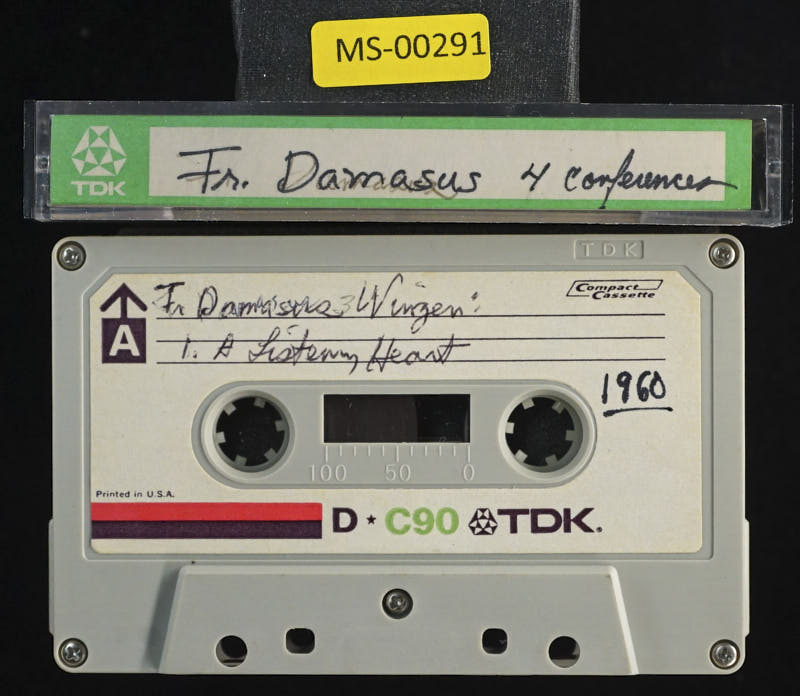
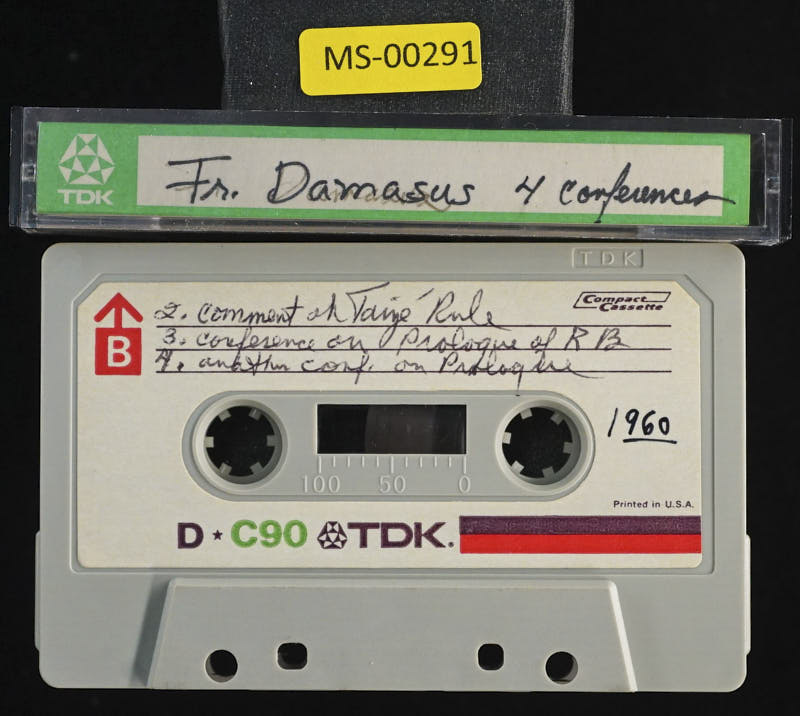
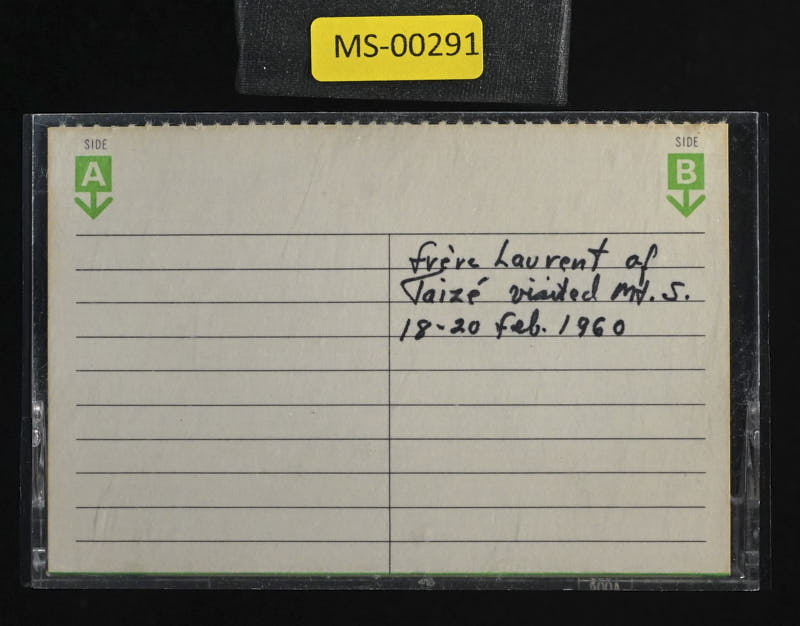
Side: A
Speaker: Fr. Damasus Winzen
Possible Title: A Listening Heart
Additional text: Fr\u00e8re Laurent af Taiz\u00e9 visited M.V.S. 18-20 Feb. 1960
Side: B
Speaker: Fr. Damasus Winzen
Possible Title: Comment on Taiz\u00e9 Rule; Conference on Prefiguration of R.B.; Another conf. on Prefiguration
Additional text: 1960
@AI-Vision_v003
It follows up the rule as a term that wanted to be expressionally clean out how they're encoded behind the ear of your heart. It's such an important expression. So, just in the context of our present liturgical week on the week of sectarianism of Sunday, to Lent the time of the listening, the hearing, the idea that the heart is, in our room, so to speak, an inner organ in which the sound and the way of God's Word may be received and may have deep and lasting resonance.
[01:19]
Such an important idea as the whole idea of the heart, as you know. They say that the Holy Scripture, the Word of God, being addressed to the heart of man because it is a word of love. It is a heart-to-heart talk. They're trying to play the essence of revelation. In the field of actual reason, there we have our template, and our senses receive objects, and receive these objects according to their internal manifestation, their shape, their size, their color, all these things, something neutral.
[02:21]
The reason, then, can go a step further and discover in some of these objects, which the senses present to us, is covered there, a deeper principle, spontaneity, what we call the soul. That means there are also various degrees of interiority in these objects. Vegetative, agreed to some kind of analyze what is right, to say, the interiority, you know, the inner depth, so to speak, of vegetative life, one can't define those things. And that one can't proceed in also seeing the animals, in another step, in another dimension, another depth, so to speak, is the appetitus, the appetite, the desire, the
[03:30]
going after an object which is then seen or known in some way. But then there is also, of course, then the last phenomenon is the phenomenon of man. And there too reason can analyze, you know, one can come to a certain philosophical idea of man as a person. autonomy the degree of his autonomy and his spontaneity and his intellect and will all these things from there on can then in an analogous way as they may also then certainly go still a step further to completely immaterial spiritual beings, or the first cause, creator, the act of spools, God.
[04:41]
But if we follow, you know, in the realm of reason, of our natural reason, what we can't see is somewhere always a, now let's call it a kind of a neutral scheme a pattern, you know, that we can't follow and that we can't think of the frameworks. But the real, the mystery of the person remains inaccessible to reason, to human reason, to abstract reason, abstraction. He gets there, he gets certain categories, these categories that we reveal us. of the essence. We always have even the inner feeling, the inner experience. They are not satisfied looking or analyzing a person with our intellect.
[05:48]
Soon as it comes to the person, deeper regions of our inner self come into motion. It is that we see the person and we begin to love the person, we begin to then to divine an inner secret of that person. The person is a mystery to us. So, in other words, reason can, let us say, kind of come to the threshold of the, let's call it the harm. But the heart of man still is and remains something that transcends all abstract thinking. Because abstract thinking is always something neutral.
[06:48]
And as soon as we deal with a person, abstraction does not bring about a meeting. And then in politics, if we're a person, if we are confronted with a person, then the decisive thing is to meet that person. It's even coming in the daily relations between human beings. What doesn't, if we meet a person, then the usual thing that the person God is that this person is being introduced to me. That the person is being introduced to me by mentioning to me or feeling to me the name of that person. And that name of that person stands for the unrepeatable, unique, inner, deep, the heart of that person.
[07:58]
And therefore then the way in which I meet that person is a handshake. You see, as soon as we go, you turn on, say, to other forms of soul life, like plants or animals, you are not introduced to a dog. Or if you are... that person, you know, makes something out of the dog and he isn't, you know, and it's a kind of degradation, you know. And what does the dog do with it? It blocks. And that weighs his teeth, you know. So, that doesn't lead us into great dip. But, uh, Well, it's good sometimes just to make that absolutely clear, you know, what happens.
[09:04]
We learn broadly, distinct from different. That's the way we are made. We penetrate the experimental thing by distinguishing. And sometimes the thing that prevents us from distinguishing are these implicit, you know, unreal and sentimental identifications. which, especially our time, is so prone to, which is always some kind of a masquerading, you know, some kind of escaping sometimes, but moving in a willful, you know, on a scene, which is what the theater says, you know, the true reality. So then the name, first, is to be introduced. The name is the Bieber. And I call that person by his name. And then I answer that being introduced by stretching out my hand, and then a handshake follows.
[10:11]
Now, that's much better if anything who couldn't, again, shake hands with the dog. A handshake then means that I put my hand into the other hand. And there is at the same time a surrender. It's an expression of trust. An expression of trust. It's a kind of entry into, I open up, I give life. And at the same time, I take a fold. That means I take, in a certain way, possession of that person. Those two things are there. And that is in the communication, at the meeting of two persons.
[11:16]
So, see, that's the same as another way in which two persons meet if they give one another the kick of peace. What is the kick of being? That's really interesting. Kicking is a communication, a sharing of one's internal life, of the breath. And that as a symbol of the inner, you know, again, we have to say a lot. So we see there, you know, that the heart is... something, the inner secret of a person, if we enter the scripture, if we enter into the field of revelation, I mean, not of the actual search of God with the means of reason, but if we enter in the realm of revelation, now then, revelation takes place by the word.
[12:24]
As that word is, of course, where we have to deal with the person of God, of the Creator, it is that he will be disnamed. The disnamed is his word. The word is the elimination of that inner secret of the heart of God. Therefore, in the whole realm of revelation, means that we have to hear with the ear of our heart. With the ear of our heart. Not with our senses, not with our intellect, but with the ear of our heart. That's according to that beautiful word that I mentioned, sometimes called, each
[13:26]
Learn the words of God. No, that's not the way. Listen to the words of God to learn the heart of God. That's the way St. Bernard Cromwell. Listen to the word of God to learn the heart of God. That's the form of revelation. That's why we have In addition to this created, visible world, we have the bird. The bird is the expression of the heart. So that the whole realm of revelation and listening to the word of God means to enter into the heart of God. But of course, we cannot enter into the heart of God without giving our own heart. It's the shaking of hell. I have to stretch around and say, here I am, only trusting that being in an absolute moment.
[14:41]
And then taking a hold into that personal conversation, intercourse, comedy. So therefore, everything depends then, as soon as it begins to grow up, on the relation that we hear the ears of our heart. The Father who speaks to the soul is the power of the Spirit. We hear it in the Spirit. It is, one can say, the Spirit is the room in which we hear the words of God. The Spirit is really fantastic. That is what we call the silence in the Christians. Silence in the Christians. That's the power of wisdom, soul discriminates. Because the gospel is the gospel that we constantly read.
[15:47]
That wants to lead us. Therefore, there's the word. There's the soul. the seed of the world. Therefore, the world is something living, something living, something that wants to unfold, you know. The interior of dreams, all these things are connected. You have words of eternal life. And then these words, and then, of course, our Lord explains the danger. That when we hear the words, and some people, the devil comes and takes it out. We hear it, and the devil. What is that? Now, that is, we know so well. Everything in hearing depends, do we, is the room of our heart really open or not? And how often it is. We hear, and still we only hear.
[16:50]
There is one temp. For the person who speaks to us, never takes out. For there is this inner, simply inner unwillingness of pride. I know it all, nobody has to care. Or there is that inner tendency to defeat the one who talks to me. Right from the beginning is that tendency, defeat Philip. For example, if somebody reads, you know, in Holy Scripture, the word of our Lord, all that's an entity, you are Peter, or you are rock, and upon this rock I build my church. Somebody reads that, how can he ever build this church on a person? That's a typical reaction, you know, where the word is earth,
[17:53]
And the devil takes it off. So there is the depth. The echo of the heart is not there because the heart isn't open. And we have all kinds of things, you know, our reason of which we are so proud, you know, and so on, our inner satisfaction, our eagerness, you know, to show our superiority because listening to somebody is always in some way submitting to him. And that's what he would want to do. Elphadelin, of course, has the field, you know, and takes away the field. Though there is the other way, which we also know so well, there is that kind of St. British financial temperament, you know. Maybe he doesn't have too much of his own convictions, And then his inner room is kind of filled with emotions, you know.
[18:59]
And there is that inner, there is that inner easy, you know, let's just say, readiness. Sometimes simply also dictated by vanity, that if somebody talks to me, I have to let him know that I understand him, that I'm all there, you know, and so on, and that's... And then, you know, you say something or you preach, you know, right away, they call the sacristy experience and talk about it with one word, just like honey, you know. And all that, you know. And it's that, you know, that emotional and that voluntary reaction makes a lot of noise. That is this disturbing, you know, growing up. You know, and there's no roots, you know, no depth. The heart is filled with all kinds of emotions. It doesn't have that puberty, the selflessness, you know.
[20:03]
The objectivity isn't there. There are people who, by temperament, see everything in a subjective life. We men always blame the women for it. And then it's another way, you know. It's another way. And then, you know, that one takes, that's another type, it's more serious, you know, maybe melancholic, you know. Therefore, everything he said, he takes it very seriously. But then he turns around, and then come other, the worries and the cares of the world, you know. And he gets all intangible. He always takes himself, and He's being attacked, you know, too seriously. He's drawn into the periphery, into the periphery of all the variety of cares and worries. Not trusting, you know, in God.
[21:05]
He doesn't have a liberty. He's not at the disposal of the world. But he's always thinking of his own schemes, what he has to do. But he has to, and without game literature, there's nothing working, you know, so on. So he's drawn into it, and then forgets. The word, you know, simply is then, as Holy Scripture says, so beautifully simply suffocated, you know, suffocated by all the weeds, you know, that grow up, these vertically And the more self-centered there is somebody else, the more you know these things grow in dimension and so forth. And therefore, the law then says, therefore, visit of those who call it monorectophthimo. How do you fear them? Recipion et fructum of impacientia.
[22:09]
There is the dimension of the whole. Oh, no, at all. We always, the wonderful thing, we speak of that in the secret of the person. The way we describe it, give it the adjective, the word of value. Goodness of heart. Goodness of heart. You say, a heart is good. Why it is good. The inner event, what makes, you know, a person with the inner value of the person. That's the heart, you know, the goodness of the heart. The heart is something tied back, the source of life, you know. All the whole garden of the person is irrigated from there, you see.
[23:10]
Fountain of the inner life. But something that goes then into the whole realm of a person. Nothing except the whole realm. Activity is all over the person. The whole life is penetrated, permeated by that. It's something productive. The good, how is something. Therefore, that's a father's heart. It's a mother's heart. We pray in a special way. So, that is, therefore, in Gila Hauret Gottes. We say that we are in the realm, really, of grace, of the Holy Spirit. So, as we say, you know, we have, in order to listen, we have to do the little steps, you know, make the steps,
[24:12]
And that means we have to get out of our mind the worries and cares of the world. We put it out of our hands. Then when we need to realize the superficiality of our nature, that mobility, that Curiosity, only superficial things which listen but don't listen in the depth are not deep enough to be a real resonancia. Now then, we simply have to turn to God's mercy and pray. Open our heart, they profundis, clamare via the dominus. That is the depth. Or if we are aware, you know, that the devil is there ready, you know, to prevent, you know, that inner willingness to listen at all, well, then we have to remember that baptism, you know, was the first thing that was done to us, you know, was that exorcism, really, the exorcism, the priest.
[25:35]
you know, takes out the spittle of his mouth, which is the symbol of divine wisdom, makes the cross on each one of our ears and says, Be open. Be open. So, those things we should tell you, they are of Very important to my blinders. Look, we are disciples, we are listeners. The monastery is where is the game, you know, where the lion hears the clear, small voice of your silence. in this country, in this country, together with another director of the Center of Ecumenical Studies in the state of Massachusetts, not far from Boston.
[26:58]
I had invited him to give me a call because I had heard so much of Chick-A and also the influence of that community, which is very near to the place of the old Abbey of Grinny. In fact, I wasn't able to go there to get any personal contact on this country, but then I was invited to a conference at this place where I was going to give this month in Boston, so it was intentional. And invite the community, they couldn't come here. at the, now we try to, you know, the council at the next week on the 18th to 20th of February. And then also another thing that we have to ask you to remember that in your prayers or to, you know, Thanksgiving because we,
[28:05]
finally succeeded to sell this house here in France. It's where it didn't be. It didn't say what it comes, really, because now the difficulties in the colonies, North African colonies, especially in Asia, was a cause where re-vigration of many directions into the metropolis. We serve that purpose of the house, which taken over by the organization of what they serve as a school. Um, I think that they get to be a very nice, very nice place to get the best labor conditions.
[29:15]
So, uh, yeah, they have a solution all the time. They have to pay for a gift that, uh, you know, it was, uh, sweet. Yeah. So, the, uh, And it was great, you know, but also often because the teacher, you know, we can't take them down here. But at least because we had to maintain the house the whole time. We had to maintain the, uh, back to, uh, to get there, [...] to get there. And from the job that you were, uh, I think we all remember with great gratitude that visitors of the two Protestants came here to visit to explain their approach to the problem of the union of the churches and also in the case of Laurent to explain the idea and the spirit of the
[30:37]
life, this community, they say, and now, out of that, Unitas Fraterna lived in an elastic circle, so then this serves as the concrete started going for an extension of that same charity, Pecatulis, of all men. This way, the thieves said, we hecumenical Catholic character and some people have asked me if they couldn't be supposed to be an evening to discuss these things a little among ourselves and I think that is very useful to us because it is also as well or explained it is where position that they start from another background and to use that to the best advantage really for the whole of the church, that is their idea, not to use their present situation as a
[31:59]
departing for an attack on other positions, but to use their position outside of the visible body of the church, the authority of the church, as not as an attack against the authority, but as a possibility in which for the prophets be of the whole, God willing, God is posing that way for the experience of the whole Christian body and a fresh approach may be made. Now, that is something that we all could also see in a man like that, of that sincerity, of that deep spiritual quality, that deep faith, in Christ, and long for Christ, which is there, and that gives faith that he was a lawyer before he entered the monastery.
[33:11]
We have no professional theological background, but that may help in the ways of God, in cases like that, to approach the things, the traditional things of the faith which are so, to which we are so used, which are so familiar to us, with new eyes, and also with new enthusiasm. And that may be a failure service for the whole, because we always suffer from the fact that maybe we are too familiar with the things, the good gifts that Christ has given. too familiar with the tradition of the church and with our own sect, the holy rule, so that we take too much for granted.
[34:13]
And therefore, the edge of our understanding becomes a little dirt. It becomes a little dirt. And we don't get the fresh color, the newness of it. That's very often that is the great grace for a convert that has not grown up within the church. He certainly sees these things with new eyes. And that is certainly here too. And the approach or the attempt is made for a new formula. for other words organized, which may have a greater or immediate and are easily accessible to modern man, who has an entirely different background, entirely different way of thinking, and also our thinking.
[35:21]
And all that is, therefore, an exemplary comparison between the rule of today and the rule of sentence, which, for us, I think, a very fruitful thing. I mean, I don't say that now for a conceptual reason. I think that the word I said that this would stand in comparison, and not very well in comparison, because I think that the basic idea that sits in The rule of Teixe expressed right in the beginning, nobody can take up the rule if not for the sake of the law of Jesus. For following him, to imitate him. It must be an instrument that we may mold it into that divine itch of the law.
[36:22]
That is also the principle of the rule of St. Benedict. And that is what we wanted to see into and make it clear to us. In one way, St. Benedict's rule is conceived exactly on those scriptural lines, the lines of the true, classical, exegistic, spiritual tradition. There's a word that I just found so beautiful, I think, in this connection. and very much apropos a conference, which really is the book of the Father Kalari, where he wrote Rupert Rupertus of Doris, who speaks about this character of the rule, such a beautiful thing. He says, it is fitting and proper for us
[37:23]
to say of the already mentioned rule of our Most Holy Father Saint Benedict, that the Holy Spirit with whom the saint was filled, disclosed it truly by his mind, and that he spoke by his mind, that the rule was built entirely upon the foundation laid down by God, the foundation of the evangelical authority upon which our builder, our writer, gave with the open eyes of his mind while he wrote. Such a beautiful sentence. I think that characterizes really the spirit and the attitude of St. Ben. He gave upon the fall, the fall, the way, which is the instruction, the Torah, the direction laid down by the evangelical authority.
[38:25]
We are Ducato evangelicals who, under the leadership, the guidance of the gospel, we, in a way, follow the way of perfection. And that is why, in the beginning of it, it is so beautifully expressed that the whole thing, right away, is followed. It is begun in a positive way, and right away followed into the center of the entire business, Asculta Ophelia, the one who is willing to listen to this instruction of the rule, is, by that very desire, already fearless. He is strong. He is critical, he is coming back, but he is strong. He is accepted by his father, Asculta Ophelia, the center registry. That you may return in obedience to the one whom you have left in the slough of bitter peace.
[39:31]
That is the basic scriptural situation there. The word of scripture about the fall of Adam, the first Adam, and the coming of the second Adam. That's basic teaching, gospel, the news of the scriptures, whatever it may be there. the starting point for the entire rule that follows. That is our situation. We are disobedient sons. Therefore, the way in which we return, what the rule is all about, is that we turn to God of Galatio, to Shuba, as we, as we say in Hebrew, and for that, we go back to here, through obedience. because he has left him in the scroll of disobedience. That is the key. Anybody who is willing to do that, anybody who sees himself as a writer's song, sees what is the obstacle to his union with God, that it is his client and his disobedience, and then opens the ear of his heart to the teaching,
[40:50]
of his loving father, he is right away taken into this living process of salvation. He becomes a member of the economy of salvation. He follows the ways of God. In him, scripture, the world of God, really and truly can be lived. And that is the meaning of the whole rule. So we really rejoice in that. It's a clear And in that classical way in which St. Benedict right away characterizes the situation, puts before us the setting in which our life develops, and the goal and need. And all that is the Holy Spirit addressing us that song. So that is, for example, something that, if you compare that with the of today, I must say that maybe there is a point, but I think that's a great, I mean, great education and not as to a kind of own friendly criticism, but maybe that there is a point where we do, you see, which is not as clear there as it is quite very clear in the, that is the typical gospel
[42:20]
situation, that the disobedient colleague or son returns to his father, and that the rule is the wife for that widow. That word humility may not, seems to me, doesn't play the role, the central role, which is just in the rule of St. Benedict. in the treatise of the Father Colatti, by the way, of the Commonwealth of Eights, and Peter Daniels, the greatfathers of the Commonwealth of Eights orders. A day to day also to remember the two foundations that have been made in this country recently, of the Italian Commonwealth of Eights. Now, in developing this
[43:24]
is seen that monastic spirituality is the spirituality of Scripture. The spirituality of Scripture is the divine economy or that dispensation through which our Heavenly Father leads mankind into the eschatological fullness of the life that he applies with Principle then, first, to monastic radiography shows how, in the vitae of the saints, this basic pattern of the divine economy is followed. Now, as we look at, for example, the dialogues of Gregory the Great, we see the description of the life of Saint Benedict Also, that of Saint Higuitzil, this abbot or monk who lived near Georgetown, in that lower future I've told you before, visited this fall.
[44:38]
They have a simple pattern, it's evidence, that the individual enters into that divine economy first, by following the call. That is the obedience here, following the call, listening to the call. That's the first act which God's doing, saving doings with their stuff. We have in all this scripture, we have evidently right in the first pages, two on the call is which the supernatural life I get the foothold in the soul is the creation of Adam, but then also the call of Abraham. These two things that we have seen in the past are always already by the rabbis, always put into power.
[45:45]
The call is directed to Abraham and the moment he follows it, That is, again, a new creation. So there is the creation of Adam being brought into paradise. That is Abraham leading to the night, following the call into the promised land. But then after the call follows the second and the decisive period, and that is the period of temptation. everyone who follows the divine call is first exposed to their testing, the temptation. And this temptation, in the case of Adam's third chapter of Genesis, in the case of Abraham, his offering Isaac, then after the period of temptation, when that is
[46:49]
successfully overcome, then comes the period in which the spirit has taken root, the period of stability or the period of spiritual fatherhood. And so this basic pattern that we can see developed in the lives of the saints, that is, the, say, the fine work in which the monastic spirituality evolves. It is interesting if we apply that principle to an understanding of the product of the rule of sanctity, because there we can immediately see how this, at least seems to be, about this pattern there is clearly following. If you look at the Prologue, maybe these dates and talking about these things would be good for you also to read it and think about it.
[47:58]
I think in the Prologue we can distinguish three, let us say, main thoughts. And I distinguish them merely, again, under this, our following, our basic thoughts. Now, there are three, it seems to me, paragraphs, because there are many ways which divide. I only suggest here one thing, then, is to take the first paragraph of the product, what we read on January 1st, a very external sign. You can see that there are, in that paragraph, no direct quotations from Holy Scripture.
[49:00]
But it is, are the words of St. Benedict himself. Then also, if you look at the end of the follow, Again, what we read in January 6th and January 7th. Again, you have a paragraph which consists exclusively, again, of the words of the book. But then, in between these two, you have a whole series of quotations. Of what is contained, one can say that in the central part of the Prologue is a mosaic. of quotations of Holy Scripture, one after the other, so that really the Word of God itself is introduced as speaking and as acting. And the message or the way in which the Word of God speaks to us in this central part, the heart of the product, is essentially, it seems to me,
[50:13]
follows the same pattern that I just briefly outlined. Because if you take what we read on January 2nd, there is that call. That is, in this way, the first stage of the call, which is arousing us from sleep. Wake up. That is always in all. We have seen that in the past, too, in every The education of the human heart, the first thing is the awakening, the rousing us from sleep. Up with us then and now. For the scripture, the rousing us, saying, now is the hour for us to watch from sleep. That is the third. And then comes in the second paragraph of this, after the arousing, after the trumpet crawl, after the bugle has been heard, comes then the vox invitant, the sweet invitation, to the one where a son wakes up, and now he is invited to seek after peace, and which is what is more sweet than the voice listening.
[51:40]
inviting voice of the Lord. So there is the keeper, first arousing, second inviting. And there is the call, and comes in the following paragraph, what we read on January 4th, that to me you stand and explain now, and you have followed the voice of the Lord who invites you and who promises you his presence, constant presence, then what is the law of life when you are in the tabernacle, in the kingdom, in that place where you now begin to live, and to live naturally again according to the will of God, according to the word. Yes, there is in that tabernacle, which we don't say in the thought, seems to me that there the e-word is released. that of temptation, because there is he that taketh the evil spirit that tempted him and casteth him at his temptation from the side of his heart, bringeth him to the Lord, that is evil to death as they arise, and that is the defeated on the rock that is Christ.
[53:00]
That is the, I can say, negative temptation, the basic temptation. The one who has followed the call and trickles down in the text of the kingdom he is first exposed to the desires of the flesh that is say the most primitive form of temptation but then is the other even more decisive more critical form of temptation that is that when he follows the perfect God he begins to become proud of his achievement, of his good observance, so that the second essential temptation is not that many more of carnal desires, but it is the temptation of pride, pride in our good works, the good observance. After these two essential temptations then comes the third, and that is,
[54:05]
The man builds his house. That is the wise architect. That is the stepfather. That is the one who has his house built on the firm ground. So, in this way, I just give that as a suggestion. It seems to me, as again, has said that because in a beautiful way, right from the beginning, following bit by bit, step by step, the word of Holy Scripture outlines the essence of the spiritual life of the monk according to that pattern which the divine economy shows in us. Now, I think we are already pleased that yesterday's report on the beginning of the Corbynese Now we must, in the day to follow, I hope that people will think about it, formulate what sort of objectives to it, or difficulties, which this scheme may raise, and that we must also consider the South-North approach, now that in that way it ain't common,
[55:35]
in which way we want to follow and we want to do it this way and formulate your things again on these features, on these cards which but that can put also into order and so I have been accessible to everyone. But you know, all these things, you know. So then that brings us back to the theme that we were talking about in these conferences on the body rule that building is one thing. It's an external thing. Here's the bodies to speak the visible body to the inner order of our life, but naturally the inner order, the order of the heart is the first thing, the monastery is being built in the hearts of the books.
[56:49]
The Vedic, by the way, is shown so clearly in the product of the world, as Benedict has addressed it to us, that point it out in the past and just repeat it to bring it again to mind so those maybe you haven't heard it or not aware of it that the product of the wool is couched in the form which belongs to a definite category of announcing the word, preaching the word, it is what we call the exoctatio, or the admonition, that kind of preaching which is intended to pierce the harps, to produce compunction, and in that way to
[58:03]
bring about it here in the first step of any spiritual life, in the step of the conversion, the change of mind, which is, you know, it is one of the others. Aquanizio leads then those who respond to it leads to the instruction. The instruction gives what we call catechetical teaching, gives and leads systematically into the elements of the Christian life and of the Christian faith, catechism, catechetical teaching.
[59:04]
to the new another step, another, let's say, dimension of Christian preaching, and that is the homily. The homily, which is the friendly intimate intercourse in which the individual that has followed the first admonition where has been instructed in the elementary elements of the faith, then penetrates, is led more deeply into the Internet knowledge, into what we call the diagnosis, the intimate knowledge, final knowledge, the intelligentsia of the things of the faith. And in the world,
[60:05]
The rule is addressed to the beginners. Therefore, the rule essentially moves, let us say, on the elementary level. To this elementary level belong these two things. The admonition, the exhortatio, the trumpet call, and the instructions in the simple elements of the, in our case here, of the molastic, that means of the perfect life, the striving after perfection. While the third-degree intimate conversation garnered the whole wide realm of what later action or what Cashman calls the Caritas field of the Agape, that is not explicitly treated in the rule.
[61:18]
But for that, Saint Benedict finds to, let's say, higher teachers than he is to Cashman, to Saint Basil, and so on. So, even though I'm going to say, secret, I may say, of the mystical life, of the, let us say, condensative life, in the stricter meaning, stricter meaning of the word, they are not contained in the regular. In fact, in some way, in a very deep sense, that realm, which is the realm of union, is not subject to a regular And that is beyond perfect, just as the hermitical life, not any more of the irregular. So these two stages where we are, as Saint Benedict is concerned, because he writes for those who begin.
[62:26]
And this is so beautiful that the Prologue is prefixed, too, because that's Keith Swann said forever the idea that, first of all, the rule is addressed to the individual. Every conversion, every type of perfection starts from the own personal sin, and that a principle which we have to consider every day and every day. It is the salvation of our sin. It is the person who is involved in this world. Without the total surrender of the old sin, the old person, without the heart, nothing can be achieved in the whole life of God.
[63:34]
And we must take that into account every day when we wake up and we start in the day. It is the own self which is confronted with the Thou, the Thou of the Father who meets us before and under whose eyes we have But at the same time, we also realize that the one in whom we meet is the father of school. Therefore, it's faith in matter of love. That's because the human heart is involved, engaged, one can say, essentially in things of love, not in things of external force violence so not external there is constriction but it is only the inner conviction and that inner conviction is brought about only by the vile law and therefore it is to father with restlessness and that is also so beautiful that here
[65:04]
every connection that the father addresses with someone, that this father maybe, and by the way, would feel healthy. But this is not a difficulty, but a wonderful dip in various dimensions again. The father will be St. Benedict, the author of the rule, who is our father, that addresses. And we are taken into that. We are part of that dialogue that St. Benedict, during his lifetime, was leading every one of his disciples. For this father is, as other commentators wanted, is Christ himself, who is our father, because he, through the power of his word, through his own sufferings, He has brought us to life.
[66:06]
But, of course, Christ is Father because he is the face of the Father. Behind him, as it were, we see, we are the first person of the Holy Trinity. So, right away, this first sentence of the Holy Who leads us into a living contact, into the inner conversatio of the Divine Persons, and therefore characterizes the beginning as well as the end of the perfect life, the Godic situation in the inner life of the Holy Trinity. Thank you.
[66:50]
@Transcribed_UNK
@Text_v005
@Score_86.5