You are not logged in. You can log in or create an account to save favorites and join collections. more info
Benefits of Meditation for Self and Others Serial 00003

The talk emphasizes the importance of maintaining commitment to daily meditation practices, intelligently adapting methods to personal circumstances while addressing the nature of meditation experiences. It highlights the necessity of avoiding attachment to transient experiences, known as "nyam," during meditation, and explores the dual nature of taking refuge in Buddha as both a transcendent guide and a personal aspiration towards enlightenment.
- Nyam: These are transient experiences during meditation that should be acknowledged but not clung to, as attachment can hinder progress toward enlightenment.
- Taking Refuge in Buddha: This is understood as both relying on a transcendent force for guidance and embracing the personal journey of becoming enlightened oneself.
AI Suggested Title: Beyond Nyam: Meditative Commitment Insights
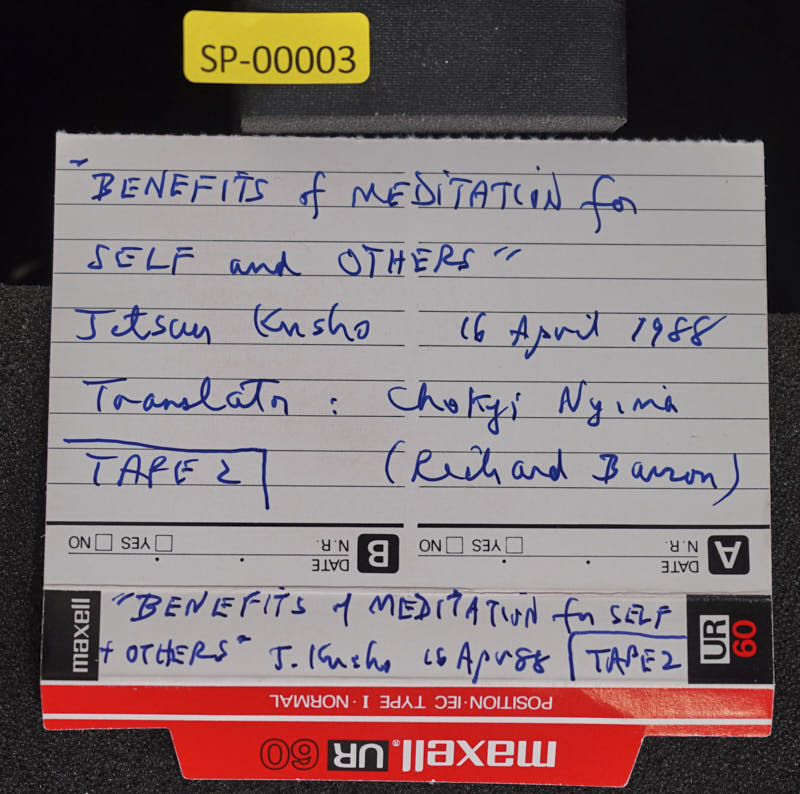

Benefits of Meditation for Self and Others
Taught by: Jetsun Kushok
Interpreted by: Richard Barron (Chokyi Nyima)
Minds are funny things and again as a fundamental general statement. It is something to encourage in yourself to live up to commitments that you've made. So if you've told yourself or if you've gone to a teacher and committed yourself to a certain amount of practice a day, it's definitely preferable to carry out that practice, even if you feel on a nominal level that you're not completely involved in the practice because you're tired or distracted or whatever. It's far better to at least make the attempt But you have to remember that skillful method is called for in this situation.
[01:05]
And this means that if you get up in the morning and you find that you don't wake up quickly and you're a little bit tired, drink a cup of coffee, throw some cold water on your face, do something to wake yourself up. Don't just sit there and think, oh, it doesn't work. Do something to make it work. Jennifer Kusher said on this note, she said, most people in the West think that coffee wakes you up and puts you to sleep. But there's always some need that can be found if a person's willing to look. It's a question of examining your own mind and determining what's needed in the situation. As a general rule, keeping your commitments is important. Whether it's a commitment to yourself or a commitment to one of your teachers, it's important to live up to those commitments. But you have to do it with intelligence and with a certain ingenuity, skill and means. to discover what is going to work for you in order to live up to that commitment. And so you shouldn't feel as though you're locked into a situation where something impossible is absolutely required.
[02:08]
Rather, it is finding the way in which you, as an individual, can adapt to fulfilling a specific request or a specific commitment that you've made or a request that's been made of you by one of your teachers. And as long as one is willing to continue to examine and critically appraise their own experience with intelligence and with commitment, then there's always a means. There's always some way that can be found. So you should never feel as though the situation is a hopeless one. There's always some way that will work. It's simply a question of being inquisitive and intelligent enough to find out what that way is. I have a question about... when you meditate and you start meditating and eventually sometimes the experience arrives whether they're good or bad you're always told to just stop them and I wonder that what purpose could the experience, what could they show what are known and why do they arrive and why do you ignore them?
[03:16]
So the question concerns the phenomena of unstable experiences which are called nyam in Tibet. It means a kind of flash or unstable moment of insight or experience of bliss or clarity or something like that, something that comes and goes, or something bad, something terrifying. You might have a sudden sense of total fear when you meditate. And the general injunction in the Buddhist teachings is that these are to be let go, just ignored in the sense that they arise, find, and then you don't cling to them, you don't deal with them in terms of wanting or not wanting. simply let them go. If that's the case, what's the purpose of them arising? What function do they serve if the only attitude towards them is one of equanimity, if not clinging to them at all? Is that right? What purpose? What benefit can be derived from those experiences, and why do they arise? .
[04:18]
When I was born, I was born. [...] She says, that's a big question. She says, It's a very difficult time.
[05:21]
It's a very difficult time. It's a very difficult time. It's a very difficult time. It's a [...] difficult time. Yes. Yes. Yes. I feel most comfortable by addressing the part of the question concerning the advice to avoid clinging to the experiences that arise.
[06:32]
In terms of where they come from, why do these arise? Why does practice cause these experiences? It says, I don't really know, in the sense that I don't have a really good answer for that one right now. As I said before, that if I didn't feel that I could give a good answer, I'd say so. Now I'm saying so. But in terms of how to deal with the experience, I think it is very important that we appreciate the value of the advice that teachers have given throughout the centuries of, regardless of the experience that arises, whether it's good or bad, nominal, whether we feel that it's a good experience, quote unquote, or a bad experience, quote unquote, The more we cling to that experience as either good or bad, the more obstacles we create in our practice. The more we're simply able to accept and let go of what arises in our practice, the more straightforward our progress to enlightenment will be. Because taking any particular experience to be the goal is a pitfall.
[07:39]
We have an experience of clarity or an experience of emptiness. or an experience of bliss, and we think, ah, this is it. This is what we're after. Then we have limited ourselves, because when we actually read of the goal state, if we could speak of such a thing, it is the simultaneous union of, for example, clarity and emptiness. It's not just an experience of clarity, a kind of mere flash of clarity, nor is it a mere glimpse of emptiness. It's a total simultaneous union of clarity and emptiness. And at the same time, it's neither clarity nor emptiness. We can't really pin it down. We can't really say it's this or it's that that we're looking for. So on our path to that ultimate state of realization, which is very difficult to describe, we will have all kinds of experiences, definite experiences, which could become problematic if we remain stuck.
[08:42]
in those experiences. So, as a general rule, the ability to develop a non-clinging attitude towards your meditation experience is very important. It guards against the possibility of any of those being obstacles. This relates to a previous question, but in my meditation I tend to give you a very blissful state I'm just wondering what my attitude toward that should be. I mean, should I feel bad about feeling good? I should have it sometime. Wait a minute. So the question concerns states of bliss or experiences of bliss that arise in meditation.
[09:56]
And this gentleman having heard and read that attachment to such or just indulging in the bliss in itself as the point of meditation could be a pitfall, be a trap. How does one best deal with it? Is there a, as I understood the question, is there a difference between clinging to the bliss and merely enjoying it, allowing it to happen but not becoming attached to it? Is that the sense? There are all kinds of people who are using it. They are using all kinds of people. [...]
[10:59]
They are using all kinds of people. They are using all kinds of people. Yeah, there is a difference between simply experiencing bliss as it arises and clinging to that. And on that note, the possibility you mentioned of actually being suspicious of the bliss is just as problematic. If you tell yourself, oh, I shouldn't be feeling this bliss, this is wrong to feel this bliss, there's as much clinging as if the person is totally wallowing in bliss and becoming very indulgent about it. So it's not a question of inhibiting the experience as it arises, trying to block it or being suspicious of it, but something allowing it to arise without the mental attitude that you want to hang on to it, that you want to maintain it or hang on to it, that as it arises, it is allowed to arise.
[12:01]
And if you simply rest in the nature of the experience without attempting to prolong, or intensify, or maintain it, then that should be sufficient. One more question, then we'll call a halt for the lady behind there. Yeah. I'm not sure it's actually more in the sense that you're going to try to be as much like human as you can. Or should we be able to do more if you're a savior of this force? OK, so the question concerns taking refuge in Buddha. Does one think of taking refuge in Buddha as the desire to emulate and become as much like Buddha or to become a Buddha, I guess? More self-effort. More self-effort. Or is it regarded as some kind of transcendent savior force that is going to bless one and save one? I don't know. I don't know.
[13:04]
I don't know. [...] We have to do it. We [...] have to do it. . [...]
[14:23]
In a certain sense, it's both. In the sense that where we're starting from now, Buddha is very different from what we are. We are not enlightened right now. And so there is a certain sense of appealing to something transcendent, to some force of power or source of blessing, that will provide a liberating influence in your life, in your experience. Ultimately, the point is that you become Buddha. Not the Buddha Shakti Muni, but you become enlightened. But that starts with a dualistic framework, where you feel in your own situation that there is some force, some state of enlightenment greater than you, which you can draw upon as a means to attain that state of enlightenment yourself. So it's really both. It's really both the dualistic framework, both the transcendence and an eminence in a sense, in that there's both the frame of reference for the beginner of Buddha as some external principle with the understanding that ultimately it is something that you experience personally, that you become identical with a person.
[15:49]
Thank you all very much for coming this morning, and we'll conclude with a formal prayer of dedication. Thank you.
[16:28]
@Transcribed_UNK
@Text_v005
@Score_49.25