You are currently logged-out. You can log-in or create an account to save favorites and more. more info
Benedictine Wisdom for Modern Living
AI Suggested Keywords:
The talk explores the enduring relevance of Saint Benedict's teachings for contemporary life, emphasizing the application of monastic principles of balance, moderation, and a gospel-centered existence to the diverse and complex challenges faced by individuals today. It outlines how Benedict's teachings encourage a holistic approach to spirituality that integrates personal and communal aspects of life, urging individuals to develop a balanced relationship with themselves, others, and the environment, based on deep-seated Christian values and the pursuit of God. Additionally, the talk advocates for ecumenical dialogue and environmental stewardship, informed by Benedict's Rule.
- The Rule of Saint Benedict
-
This seminal monastic text from the 6th century offers a framework for spiritual and communal living characterized by balance, moderation, and a gospel-centered approach. It serves as a practical guide for integrating Christian values into daily life, both for monastics and laypeople.
-
Benedict's Reinterpretation of Scripture
-
Benedict's rewriting of a verse from the Gospel of St. John is noted as an example of his bold interpretative approach, demonstrating his evangelical fervor and passion for bringing scripture to life in new contexts.
-
Wendell Berry's "The Gift of Good Land"
-
Berry's work is referenced to highlight the interconnectedness of environmental stewardship and social justice, underlining the importance of respecting both the earth and its inhabitants.
-
Gregory the Great's "Dialogues"
-
This text, particularly the second book which details the life of Benedict, is mentioned for an anecdote illustrating Benedict's approach to freeing individuals from oppression, symbolizing spiritual and social liberation.
-
Concept of Ecumenical Dialogue
- Benedict's advocacy for dialogue between different Christian traditions as a means to foster greater unity and mutual understanding is stressed, as reflected in an anecdote involving a symbolic Episcopal gathering.
The talk encourages exploration of how Benedict's Rule and associated spiritual principles can be adapted to modern challenges and advocates for applying these teachings toward cultivating peace, justice, and ecological responsibility.
AI Suggested Title: Benedictine Wisdom for Modern Living
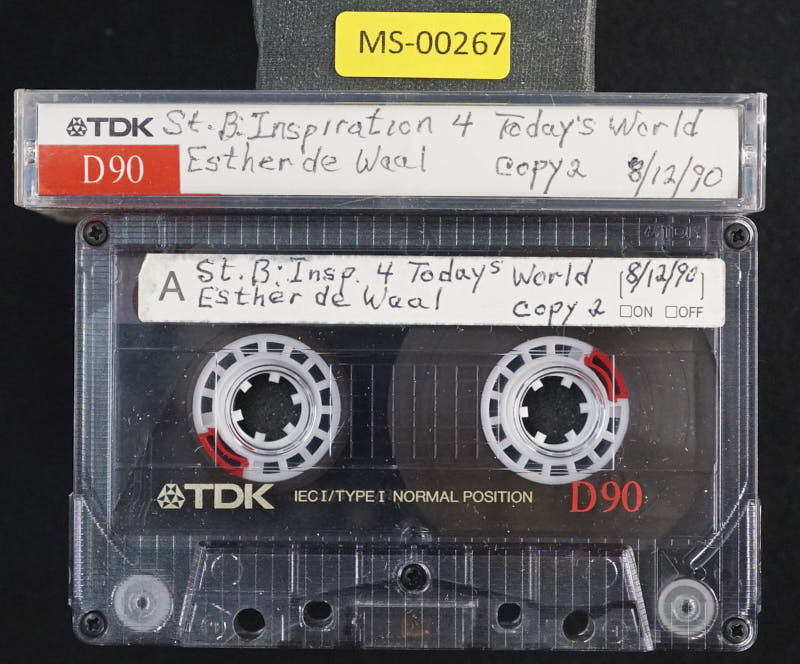
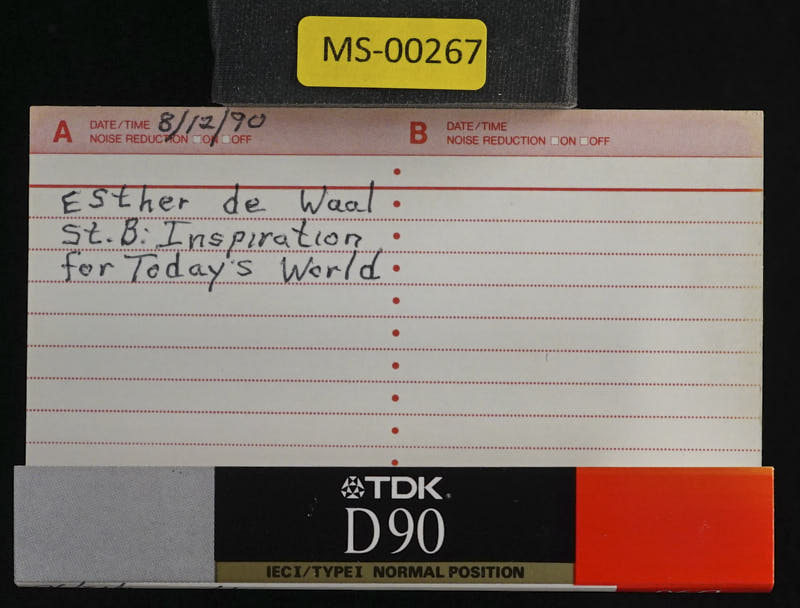
AI Vision - Possible Values from Photos:
Speaker: Esther de Waal
Possible Title: St. B. Inspiration for Todays World
Additional text: Copy 2
@AI-Vision_v002
Sunday, August 12th, 1990. Esther D. Wall. St. Benedict, inspiration for today's world. I think I still don't take it in favor of Roger that this small but nasty rule, repeatedly in the 6th century for men who did more of Italy, can have such an immediate vibe of relevance for all of us today, men and women, religious, and lay, struggling to work out on a personal commitment
[01:01]
Christ in our daily life at the beginning of the 20th century, in a highly sophisticated complex and the barbarous centuries we love today as well. And as we try to find some way forward to the church as it faces difficult questions, moving into a new era, a new century. this short document, knowing all the nine months of work, be a source and spring, to which it's possible to come time again to find guidance and insight to the beneficial work and challenge. I'd rather trust to share my own experience, as they will, Wife, mother, four sons, oh yes, and grandson of one, two-month-old grandson as well, who top-sheetly, half-African as in years, was first-made, period, 1884, perchance we were, second-made, Benedict.
[02:23]
How I heard of a chance to share I don't experience as a very ordinary version of what Benedict has meant to be over the top ten of the years that both picked up the world and what he promises to be for my picture. Now the world, of course, is the reflection of the man himself. He writes nothing except what he has himself experienced. He writes, though, they are corruptly parents. But because human beings are so well, because he has such a grasp of human psyche and sees it all in the life of the gospel, he, too, touches all our experience and our psyche. He writes out in the sense of who we are and where we are on our humanity,
[03:24]
in a way that our system identify with what he said, the touch is full of us. The trick story, because he begins, where we go, while we are reckless and our bulk of the action and our infusion. We are short because he knows that we are the vessels to be handled with the air. that we are back down and easily would be a degree down after now. But he's also pathetic. He believes in us and he challenges us. He would push us even further than we ever dared to think we might better. He is, of course, a man who is always helping to think together and telling us to do two things in one. He told us to stand still and move on. He himself also lived in the cave works of the arcade.
[04:29]
Knows that one has to learn to live with oneself. Then I want to see all people about that most blissful and wonderful living with other people. Just as two species and two traditions were then known in anastasis of the colonial image removal, so two species flowed into the text, as the last bits of colonial image are added in the landscape, are added in the drug. But while emphasizing this particular thing together, And there's one thing that we all know about benefits, which is that it's a life and balance moderation. It's also important, right, to start to establish that moderation and balance are not safe at the PDF time.
[05:32]
They say, choosing the difficult way of it's easy and out of the army. The other, the to the sense of urgency, the idea of world and love, which runs throughout the world to be some of its best competitive futures. Benedict actually has the objective to rewrite one of the verses of St. John's Gospel. War will do by birth for St. John, not for benefit, he writes it as the love. So, there are all the concepts of balance. And my lady here, the client is also passionate and charismatic. He is technically evangelical.
[06:34]
On this story, an observable writer instructor. This is the cry of a passionate preacher. The evangelical that's in the earth turned to Christ. Today and not tomorrow. This is the message for you. Hear it now. He is tentatively difficult. Right at the starting point, he spreads the scripture around him now. But more points in what might be on the salt of the gospel and time. At time and day, it is scripture which is a thoroughness source of dying. Scripture has authority. It's law. It's medicine. The whole of the rule is a mistake of quotations in Scripture one after another. Then it is that who is saved in the world. He's captured by the world. And the whole life to which the rule directs is it is served for God under the guidance of the gospel.
[07:40]
See how it is not the Lord Jesus is a good way of life. Let us step out then on this way with the gospel for our God. The rule is an aid that wants to get by the scriptures. For us lay people, it is simply a plan for living out the gospel, a practical garden to maintain the gospel demands a reality in our daily life. So the rule isn't a rule book or a code. It never dictates. It points away and the response that it's looking to for all of us isn't that a part of a rule unquestionably useful rule. It's the response of the product to a type TV way. But then it's the way in the game.
[08:43]
what family it is on foreigners. The rule is the word that one of the greatest dealers you saw in the moment. The rule is as fresh and ready, clear, simple and wise today, as where it was first written. I like those words so shant. The rule has the character of any great text. It comes since its age, so any period and any century can come to its breath, as we too can come to its breath at different points and different levels in our lives, making the rest of the world in this morning, asking new questions. The rulers have helped me with some of my, with extended value of my, and without the host family.
[09:45]
Then I think we ought to be aware, one that will make each live more fully and deeply and truly from the test of myself. How to be human? How to be more fully human? Surely that is what we all want. And the gods, it seems to me, in this undertaking, in this way of discovering and living out of humanity, for the sake of pride, the gods are the queens. They dictate their horizons which bear in us. They come to move with the disposition of the gods. And they dictate over those of the slave people who find the ruler of the world. Those people are not so much things or activities, but rather manners of perception, ways of seeing into which we grow, which will help us to encounter ourselves and encounter the world from a deeper end.
[11:10]
For what benefit to bring us if life is wonderful by? There's that wonderful image in the peril. There is the world in the marketplace calling out to chance the power. Does anyone be able to die? Desire to see good journeys. And it can stop with any hurry by the power. To listen to what he's saying is a way to die, which is simultaneously a way to the fullness of my own imagination, not the denial of it, thought of it, nor the oppression of it, but a way to the gods who we in fact indeed need to grow into that world, a physical person, made in the image of Christ, If I proud of God, I deeply glitched the fact.
[12:17]
And those three vowels, I do believe, touch the roots of our humanity and speak to basic deeds in each one of us. Listen. That's how the book starts. Then it's catching our attention. Listen. Listen carefully, my society. This is advice from a father. What a wonderful opening. It's a blessing to each one of us individually. A son or a daughter. And as in fact all the circumvent program is based on a technical server, preach the baptism, then it is in fact meant for all of us. as not for those of us find our way to drive outside the culture of our life, but in and to the parts that they may get that instant.
[13:22]
The rule, which is a tranvue for humility living, a practical guide to living without the evil, is yet addressed each one of us as in the victor. And we can have no doubts at all, we have. of the tenderness of the lovingness of the real care for each of us as individuals. The underlying meaning is that of the prodigal son. While Benedict is offering to us all is a chance to come clearly. The prodigal son was straight. It's low, has 50, comes to himself. Come to yourself. Open your ears and your eyes, disheartening at what it's on, or rather, and return. Just like a particle star returned home to the place where you were going, the place where you ought to be, that you want to be.
[14:29]
Here is a chance to reverse fall. Here is a chance to reverse evidence journey, and to make the return journey back to Christ. And we are in this kind of political song, which is each and every one of us receiving what lies at the heart of the speed that they can draw. We hear the voice of God in this poem in the beginning. We make that journey back to God by the love of on the thoughts here that we come home in the deeper sense of need and trying to get ourselves stability. We all need a place to stand. We all need a firm base with which to operate. We all need to be at a level of the meaning of that world.
[15:33]
We all need structural framework. We all need the sense of time and space and place. And that ultimately is what the rule is giving us. Helping us to establish the relationship with the theme. Be handled with reverence and respect. With time. All time is holy. to save the offices which bought the title of Daily Act, the phone of Stephen. Put your lady in cake with our swell, recognizing that we don't make up a body that mind can spit it, that each element of our soul must be perfectly, that each of theirs in the evidence's cabin that we will die. It can't always go.
[16:34]
The relationship is with people. The rule is the best practical handful that I know to give about love. The relationship is gone. All this is a job's order. That's a day, but so that my time has space and time and order in which I find God any week. God can find me. This, I think, is a particular gift of Benedict today. He speaks to things he needs in the fragmented and distracted world. But that is the song of Benedict, which is immensely attractive, telling us the balance of integration. telling us about a holistic way of living long before the secular world began to advance that.
[17:41]
Tell us our knowledge of our bodies, as well as its legs and spirits. That's good news. In August, be kind to ourselves. Here, as I said, let us start a man of moderation who is reassuring. Or is he? He is, of course, a master of powerhouse. So it is reassuring he's also challenging. While he accepts me as I am today in all my fragility and my vulnerability, he also wants to push me even further than I believe I prefer. Life, with the text of the rule for one style, is never going to be signing off to some closed safe system.
[18:45]
Rather, it lets me a series of continually opening doors. So, we must never be fooled by this map. I find that he gives me a message of Christian discomfort. I find that I have been forced to ask some very important questions. If I find Christ If everyone, and one of the great activists of the world, if we see crime, what am I actually doing about those who are tonight the right to live with world human dignity as a land that will be made in the image of Christ?
[19:56]
If I believe in respect, These can't be things for factable to be. I believe the brother's respect for material aliens and the stewardship of the general thing in my life and the Earth itself. What am I doing about living out my psychological concern, my permission to the environment? If, perhaps, Pete is a Benedictine watcher and Benedictines are peacemakers, am I committed to that? Peacemaking is by any unity in verbal disputes. If the moon comes from the undivided church, am I following the great big points?
[21:02]
Do I know how to meet my fellow customs on the basics of the common craft experience, using the Bible as benefit does with loving openness? And I committed to the ukrainable arts. And finally, if proud, is the basis of the mind, towards which they take over time, the opposite day, the word of God. What about prayer? Do I make it a priority, the one that's meant for reality in my body? Or do I read about prayer and talk about prayer at the end of it before? the hard work of prayer. It's prayer the base in which I live out of my commitment to the world.
[22:12]
Now, Benedict was a nightmare. We must never forget that. Benedict seemed like this for corporate and normal people in corporate situations. It is a lay movement to retake this seriously. As always, should we perhaps be aware of the tendency of a beautiful and hairy face and friendship with a community which can be immensely attractive, we mustn't forget that Benedict puts priests for the birthday in Paris. No special status for the priests. No exceptions. No one's to escape Washington.
[23:17]
We are all first white citizens. He believes in each one of us, in our individual freedom. in our ability to step on our own two feet, and as many people to take responsibility for our lives. So now let me go as one or two, or the way in which I believe that that it is possible as they act responsibly. First of all, the eukamedical situation. It gives us the agenda, as it were, for eukamedical dialogue rights at the end of the rule, timely, seemingly unimportant first.
[24:29]
It's actually chapter 73, the third verse. He's telling his marks to lead to two very different sources. And we must be inspired by what can seem like a smaller, smaller garment, finally, because it is in fact surprisingly important. He's citing two sources that are In fact, largely incompatible, or at least we might say, that they represent a polarisation of values. The erabitical, mechanified, the celibacy, the lunatic line. It is, as it were, initiating a conversation between these two sets of values. He's telling us to draw from both.
[25:31]
He's telling us to set up a dialectic by letting the both interact. Let them stimulate one another. So that we live with the tension of the two and so that the interaction can produce growth and will run forward. That both the view that two screens were dynamic, remain open to different, even, diverse aspects of one approach refused to be polarized. Our widely important thing is to focus on to that in today's church whether the atmosphere could be the left of the rocks.
[26:33]
Seeds they wanted in which, having reached a certain country, were separated from boredom, exhaustion, or perhaps even from that of parades. In 1982, I was entitled And I saw the previous mother being kept with people on one hand, the office of the country, head of the entire African Union, and on the other, the moderator of all the recorded chapters. And there, sharing of that small world and renewing them, there was this exchange. This is the faith of the church.
[27:35]
This is our faith. It was the full body of Christ that led it in the body of that church to show it that that was born. We must not let that son die. Sadly, today, it is on. It seems that that vision has been practiced. That if we're committed to the rule, we cannot lose sight of a text coming from the unrivaled nature and pointing us forward to the unrivaled nature. Benedict, as I say, is taking a script for it. as we would, wisdom literature not protects slavery, but a common problem on which we die.
[28:40]
And I think in this evening, the Church is a bit of prediction already, in my opinion, that we are in against the system, particularly that we have a common quality on which we feel. And it would be nice to think that both states will easily come to be drawn across the divide of the church. Each of us can reflect the song of tiny part. They keep the conversation alive. They keep the contact that brought us together as well. Each of us apparently, I did well like a candle. About two weeks ago, I returned to the banquet. I had a feeling that there were a couple of pirates as I'd sit to bed back.
[29:45]
I went down into the crypt chapel to see the chapel of Arleigh and the God, where there is a new section of Arleigh. made like a Benedictine prowl at Mother Concordia, placed in St. Anselmo's great 12-century brick by coming together on parts and a present. And I ask whether the celestial candle still continues. I'd begun it 50 years ago, Something said very simple, a Catholic girl who said that she wanted to pray for unity. I wondered what to do about it. We simply walked together with the people, found the face that had seen to us, the face, hairy face, and had simply begun by the healing.
[30:56]
Every Thursday afternoon kneeling on the floor of the crypt in front of the light he tangled, praying for unity as bright worlds, and when he dwells. There are a group of friends' deeds that can hold the life, so it's good friendship, to share power, a barbox of wrong and victory, It is possible to keep the panel going. Commitment to peace. The congressman that's been growing, when they met September 1984, I asked themselves what 20% Benedict thinks today. found four points which permitted us to work in the peace.
[31:59]
Firstly, in our peace, to persevere our impatience to making progress towards reconciling our own turmoil and conflict. May we look at the request and that within ourselves, Benedict knows about the fact that and then peace in our communities, by fostering mutual respect, but about all of our obedience to forgive. Forgiveness. Twice a day, the Lord's Prayer, it said, I will guide you with the people that pray, forgive us, and we forgive them. We are committed to renewing the covenant. to forgive each time and time ago. It's not easy.
[33:01]
And yet, forgiveness is the greatest factor for healing and for growth. So we must be peacemakers. In our family, parental community, and then looking at the hearts of fellow men and women, pushed to the margins of society in some way there. And then peace for material creation. Maria Verdecken, Benedict C. Lana Stanton, wrote recently, the forces that destroy peace all within the human thought, aggressiveness, exploitation, greed and struggle, blinding them, The habit of the ones ending short-term gains but good but all. We don't need some superpowers as far as we can destroy our civilization unneeded by giving these forces free fire.
[34:13]
And then, of course, find a piece of God for all these barriers that are going to be uncomfortable as we are prepared. made my peace with God. So let me see your question A. It's a biblical injunction, but we're faced with it early on in the book. I take particular further from thinking of the Latin word, perhaps, because then it stands before me, also, and without a shape. But they didn't let us serve such a contact to that nice, easygoing English word, peace. And I see my life, I, perhaps, written up on the belfry of the chapel in Johannesburg, Sir Benedict St.
[35:20]
Johannesburg. And that word on the chapel seen to the braids of black, on top of the floor, which surrounded the whole community. A statement there of how difficult, how tough, and how demanding is the job of peacemakers. But then it said, we shouldn't say, peace, peace. where there is naked. He tells us that peace is never said by putting truth in the sun. Did Mariela question? I know there's just a future relationship to that way. It's much better to look at the difference, admit where enemies face that, and work with it.
[36:20]
As always, talk ruthless honesty. We live in a world which lacks any vision of the sacredness of creation. We live in a world of greed, of ruthless exploitation of the balanced man who gets the sword. be dead in a world of wake, of the destruction of the empire. As Benedictine sisters tell us in that statement, who forgets, and if you dare to present it, you must go out and get it right away. The unforgives monastic spirit that we use, what we have been given for the approximating of culture, because creation is the world that we are its people.
[37:26]
We hold it on track. We must always remember that the earth is not so much inherited from our parents, as borrowed from our children. We owe a debt to a Mexican school. Benedictines do not grow. They try not to waste. They believe they have insufficient but not superpowers. They believe that by cooperating with the creators of thunder gifts, men will bring about on this planet a truly human life for all. The Benedictine is telling us that all these good things in our life are only on them. They're bound to us to put it, so that we can use them to their bullets, but return them.
[38:35]
Like the tools of the African-American side, a person will be dead. The planet is not going to be your planet. How do you handle the material that creates energy of itself with reference and with respect? We follow the way that we are to live sacramentally. We are to see ourselves as partners with God. It can be all the attributes to us, so that they can fulfill their purpose in serving the whole community. Again and again, if I point back to the fact that the spirituality isn't isolated, it's communal. It's shared spirituality. We have these things that they can be shared by the total value of God's people.
[39:42]
We're in a covenant relationship, a covenant to establish and to keep the community between people and the natural world. So we stand for God responsible or caring for inspiration and building a just society. The two interconnect. Our splendor very tells us that it is the gift of good life. The earth is what we all have in common. It is what we are made of and what we live for. And we cannot damage it without damaging the rule we share with. There is no coming to send. of the hatred toward each other and of the hatred towards each other.
[40:49]
But some religion perhaps before they recognize the willingness to exploit the world becomes the willingness to exploit the other. Exploitation is the better. Exploitation is the better. Exploitation is the better for people. What will that get into the whole of us of benefits, visually, to our responsibility to the whole dynamic way of life? There's a very nice episode in the dialogue, which is the light of benefits, which we try to come together and help us there by Gregory Quebec. which gives us a wonderful image about how David Nett treats people, how he gives them freedom, how he releases them from the bones, from the bones of all of the questions.
[42:01]
It's a story of how a cruel god named Zeran was man-feeting and taught him a full person Tying up with a great deal for him to benefit. Something was deadly for him to be hard. Just by raising his eyes in his home, and by his day, cords of the peasant's arms began to fall off, to unwind. so that in the twinkling of an eye, a better man will speak. What's the meaning, I think, that we can all take into ourselves? Freedom to be oppressed. All thought of that. Social, economic, religious, our challenge.
[43:07]
Because we are all equal. We are all one in Christ. So we don't judge, we don't dismiss, and that's how we find people. Fetting them, judging them, tying them up in courts with the way in which we label or denigrate them. Let all who come be received That's Christ, a favourite Benedictine aphelicism, simple to the whole character of what is empty. And we are bound to ask ourselves, do we actually protect that out? Not only by the hospitality of welcome to the person at the door,
[44:07]
Or what's often more difficult a person at the other end of the telephone. The hospitality of what? How we reach and further go up. Then it's scary that the person doesn't eat. And that meant to the people that we get to know. The costume's very good. The people that they speak. The very way you look at a person and help to perform. There's a nice, just a big tale. And over that I walked off these people from every tale where the might have ended and they have begun. Could it be, he asked, could it be our fellow student? When you can see an animal in the distance and see whether it's a tree or a dog? No, Aunt the rabbi.
[45:09]
Another question. Is it when you can look at a tree in the distance and tell whether it's a pig bee or a peach bee? No, Aunt the rabbi. Then when is it? It spookles the monkey. It is where you can look on the face of any man in the world that see that it is the face of your brother or sister. Because if you cannot do this, no matter what time it is, it is your life. There's a very general book that of the quarter, standing at the gate. And we shouldn't miss our welcome Benedict is helping us to live our life, not by a very wonderful end of all of the mind, but giving us a real life for great people, a real life portrait, on which to model ourselves.
[46:24]
It's a wonderful quarter, standing at the front of the threshold. as the brother of the woman to be, then looking at the brother of that side. And probably looks that that brother is with gentleness and more worth of love. A poor boy, the kid had a commitment to the world. Not a lady who wants to persuade this tale is unhelpful. And yet, she knows how to treat phonetically with crusades or pronouns, or in particular, phonetically. Who can think of myself? I know a little bit better. But they don't put me on the way, not be
[47:28]
I want to get to the school child for all the child of God. I pay you to the child child. So that they are not going to be. I want to do that, but I'm right. Then I think to me, just to say, by the law, to speak, by the law of [...] the law. That's the basic of freedom. We take our values. It is the basic of a mother, a small experience. They use some people that are open-text of the center. Come to my community, it's time to affect the community. It's the same. [...] on the right of the screen of the screen.
[48:30]
And then the screen of the screen are living, and there are the screens that aren't getting the fact that it's good. And if the screen can contact the screen with the visual driver, contemplation is the screen of the living room. to do this procedure to develop a public public public. Taking to a third of the day, I feel great. The point of the 17 is called 12. These are active groups. It brought back to the public. It all took up with the 1016 deterioration of the public. It is fair. It essentially becomes narrow. and barriers. We find the choice of effective law to the business, particularly in the federal school.
[49:37]
The concerns of the federal government can't help them get to the federal contract. There is the integrity of complications between that school. The contingency comes to the start That's the result of the particular existence of a point from time to [...] time These are the things in the face of the problem and constant in the face of the crisis. So that we begin to succeed the world of the future violence and violence, and can go up the world with a powerful fight.
[50:44]
Then we begin to succeed in the face of the crisis of the crisis, and we begin to succeed in the face of the crisis. by a commitment to the world. This report describes one of the world, depending on what comes with God, and forms that God's promise of commitment to a better entity than to the world. There is a perception where I will find the support of the deployed . [...]
[51:57]
It's only to reach the relationship between the two and get back to the problem. And yet, I finally feel that we shouldn't have tried to fit back our ideal goal, that we should never let the was struggled with the code and the truth together. The first that we talked about, the first that we come from love. That was what we did how I thought was daily about the first to come, the describe, practice, life, together, and let it be. This whole thing that had all of us that we held off in our family, It's pointless for us.
[52:58]
Yes, you can do it. When you're at the time, well, I've been in the same order. I should run that piece of the theory in the following seven-fifteen grads. Not taking away to the state of [...] the state. Robotic is a sensitive situation. We don't accept the world, but we try to see it properly. Finally, it is well to say properly, and quite quite a way to see that it is a type of a novel that's literally done all of the time. Because the liberty is first to be elected by the government, we are committed to our responsibility.
[54:01]
We face it. We are like women. The same is now. It's all the nasty model. And yet, from the past, [...] the past. I wonder if we treat ourselves as a representative for what we offer and treat our ability is right in the middle of work, and yet we don't question it. We're going to describe . [...]
[55:23]
from the state of [...] the state I think it's good, and the way it's applied to all which is perfect. We are being shared. How could it be that in my daily life, there's got no better music. We are giving some light, just as a very thoughtful way of making
[56:28]
of them against the pregnancy and the destruction of the P.C. bearing all over the world. There is a value to the level if there is a question of thought, of property, of personal relationships, and to credit what to do with saying. in the light of prayer upon the contemplative center. We hear about good sex and sin of society, which exploits great people and about all regard itself. The rule tells us that we can be simple, but we can respect The people and the bacteria in our lives are in the environment.
[57:33]
We're secure to this world, and that's why these share are in certain order. We think in a climate and individualistic environment, so I think that they constantly measure our opportunity. We can do the same background. We can try to make us a commitment to the state. Not if we can not in a place of the city of the city to break this around. We did in the world for the justice and victory page. Where people are denied to rights live with one another signal to you. A world divided by race is further on Trump.
[58:37]
It's a cue to live by citizens like this, or we try to find a state of rights before we see it. We did . [...] with true city trauma, and system media case protection, and the world of profit-taking, constantly, or seek the shelter. We would probably accept the crowd in this country, people.
[59:45]
This country, the world was under one floor. listening to the world's time. We gave him a part of this, and there it is, you can expect him. He is part of this world, and the world has gone directly, and the world has gone directly. So the three homes of the community in the Central Division, these are the point of those that is 50 and back this day they died, right? That was 75. All today's world. The world is given up, our children's father, family,
[60:50]
To be a darling and a shining light is a trip for 1,500 years. Look for your friends. On those of us gathered here today, there's a tradition. I'd be expecting today to be truly cool, by life, and sitting down to our different places and for you. This day, I'll speak to you. with a sense of difficulty and a sense of the impact that we made to do in our own embrace. Keep the light and inspirations of that way of our lives, for ourselves, for the church, for the world. We ask, please, for his many thoughts by Christ, to go slowly over part of the pandemic this time.
[61:56]
Master Dr. Professor White, Mother, and our friend, thank you very, very much. During the past many days, you have stolen the heart of 47, directed to Bob Lakes. And I suspect at this day, you have stolen the heart of another 50 or 60 new people in the heart. Father, we name our coordinator this year for all our resurrected bloodlates. Thank you for being with us. Thank you for being with us. Thank you. In the name of Father Dine and all the power of Monster Saint and Daddy, we thank you for being with us, living for a few days on the boundary. We hope that you will be seated, and light, and concerted with all your
[63:45]
traveled about the world, and we have an hour to thank St. Mary Godley, the group of very talented, and very persuasive, and energetic people, ,, originators, and creation of feeling rapid art. They have asked me to allow them to express their appreciation to the Father, who our guest has had to come quickly. And I am immediately from the table without pockets, at the door, who will find a feature such as David, if I'm not to speak on it, please pick one up. And if you like it, I would leave you in front of Father Arthur's hand. We can't let you face the monastery building to glance and see what happens to Sean.
[65:12]
and calling it the leader of the world of the world, and actually standing on the client at the site to put all of that alive on it. Showing it on it from the video, under the guides of the spirit that said that if you could rule the art, they had to be checked with the president. In order to select the text, We decided to write a book, which has then sort of made it to a Bible. What I was doing, like the one, it was weird. And it was something to start to write a book on the Bible. one of our very favorite quotes.
[66:15]
And I think that is what Esther talked about today, and trying to get the springs of contemplation in thorough contact with the experience of action. So, Sean, welcome. a brief recap for you. But before we go to that, I wish to, and my wife will take me on the back. I wish to invite you to come over back to the store, and we will give a little translation, short translation, of some of the page that I get to the word of the art, by a real name, a word of art, which is book, bookshelf, and narrative. I have to remember these words of your message.
[67:29]
The attention, which the physical setting of the monies need draw symbolic, the relationship between different parts of our lives, is something vital in people. Even in the smallest grasp of building in some space, rather small it might add to be, which could not affect the areas of our life for the world wouldn't trust us Christ. Simply, it makes a little pipe up, a picture of it, candle, and illuminate the sex, and make the statement that in an interrelated space of our dead, Christ went to place, along with everything else. I imagine that the words of the subject would see why this presentation would be such a lot to us. But most of it would be. I would deny what would be kind of new, as of this, as of this, as of this, you know, I just want to sell the last of these two kids.
[68:31]
So we have the monastery, and of our online director, and of our fellow online I believe I guess we have our Lord, Treasurer, who likes to present this claim, as a sign of the state that actually likes, is that he might be here. God bless you.
[69:49]
@Transcribed_UNK
@Text_v005
@Score_68.18