You are currently logged-out. You can log-in or create an account to save favorites and more. more info
Benedictine Pathways to Liturgical Renewal
This talk reflects on the experiences and contributions of Father Domicius and his colleagues, focusing on their early years in the United States, their involvement in the Benedictine monastic community, and their influence on liturgical reforms within the Catholic Church. It details their efforts to establish monastic life in New Jersey, their interactions with the local and academic communities, and the challenges faced in integrating their theological and liturgical vision within the broader church context.
Referenced Works:
- Symbols of Christ by Father Domicius: A publication reflecting Father Domicius' theological focus on Christological symbols in liturgy, informing his teaching and liturgical reforms.
- Orate Fratres journal: Founded by Virgil Michel, this periodical played a significant role in disseminating liturgical renewal ideas that Father Domicius and the Benedictine community supported.
- The Storm by Oliver La Farge: A novel mentioned in the context of historical events impacting the East Coast, illustrating the environment during Domicius' early years in the U.S.
- I Promessi Sposi by Manzoni: Used in language instruction at the seminary, highlighting the integration of cultural and linguistic education in clerical training.
Other Key Figures and Theological Influences Referenced:
- Prosper Guéranger, Lambert Baudouin, and Columba Marmion: Influential figures in the liturgical movement whose ideas helped shape the Benedictine liturgical renewal efforts.
- Bishop Joseph Schlamann: Known for catecheses aligning with the church year, exemplifying the changing approach to religious education.
- Virgil Michel: His contributions to liturgical theology and publishing efforts significantly influenced Catholic liturgical practices.
- Monsignor Joseph Morrison: Instrumental in organizing early liturgical conferences, which were formative in the spread of liturgical reform ideas embraced by Benedictines.
- Archbishop John Gregory Murray: Mentioned in relation to support for liturgical publications, indicative of episcopal influence on reform dissemination.
AI Suggested Title: Benedictine Pathways to Liturgical Renewal



AI Vision - Possible Values from Photos:
Speaker: Fr. Gerard Sloyan
Location: Wivenhoe
Possible Title: Whizen Lecture
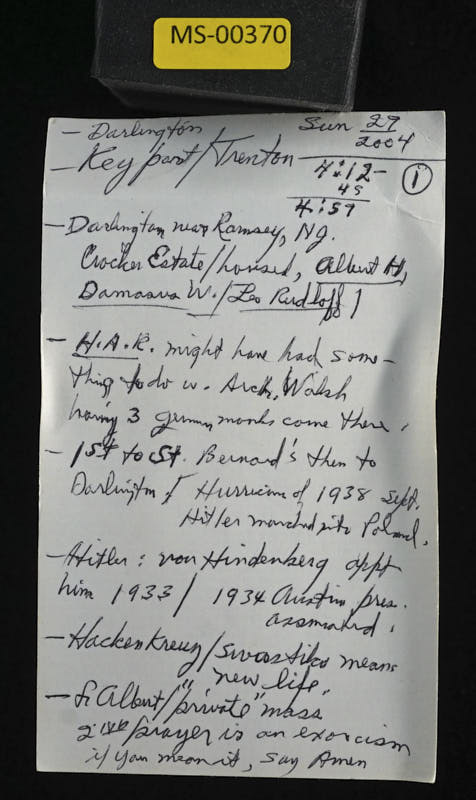
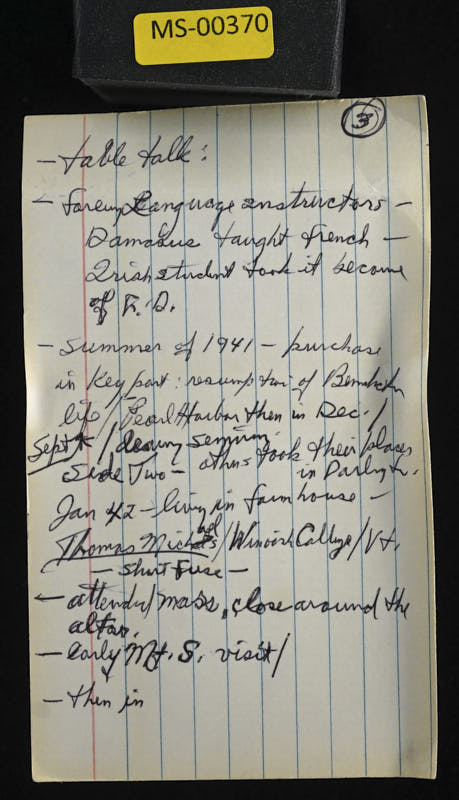
Additional text: Darlington, Key Barry Threlton, Sunday, June 27, 2004, 11:12-4:15, Darlington near Ramsay, WA, Cocka Estate, W/hurd, Abbot H, Damasus W. Pos. Rudloff, A/I/K/M/K might have had something to do with Lock Whur would marry 3 German monks then to Keyport SEE St. Bernard then to Darlington| Kirkum Sep 1935 after Hitler invaded Poland. Hilbert von&, Hackensack saw uncle man of Schultz means new life, 1st LIT Wk/Holy Name Cathedral in Chicago Virgil Michel, Sr. Mary of New Cald Herrbach from 1935 took servant/moss, 1934-38, Aristotlen, Red in common w/Modems, Christalom from 1941 furchas, Salesian.
@AI-Vision_v002
Jerome Hall, who met Father Damasus as a young boy here in Almira when the family lived here. He lived here until he was in high school and became a Jesuit, but anyway. Father Schroian met Father Damasus as a young student. The best introduction I ever heard to anybody was related to us by Father Demetrius, St. Vincent. He said he spoke to a group of friends, the Society of Friends. And he was in front of the microphone, and the man in charge of saying, look him square in the eye, and says, we're ready. Are you ready? Oh, no. Well, this line is ready. So I'd ask you also, if you can't hear, raise your hand. And we'll have you one more closer. Thank you. Well, I won't say with King Henry VIII,
[01:24]
With respect to his wives, I shan't keep you long. Catherine Howard survived him, remember? I will keep you long, at least an hour. I hope it's not too painful. And acting like a professor, as I seldom do, I always stand teaching, but not this afternoon. I can't tell you how pleased I am to be... your guest here of Father Martin and the Mount Savior community. My fear is that I may disappoint those among you who knew Father Damasus well in his twenty-some years here, as I reminisce about his first three years in this country. During the three years that followed his time at the Newark Archdiocesan Seminary in Darlington, New Jersey.
[02:36]
After he had left there, I was completing theological studies for the priesthood, and I was in touch with him only intermittently in those next three years. The seminary, like seminaries generally in this country, kept its students pretty well sealed off from the culture, including summers spent in the same place, on the same property. The only exception was our following the war in the Pacific and in Europe very intently by radio. There were no newspapers in this seminary. Following my ordination in the three years of graduate study that came immediately after, I was able to resume contact with this remarkable man, as he and Father Albertus Hommenstede and Leo von Rudloff
[03:50]
were well launched on the foundation of St. Paul's Priory in Keyport, New Jersey. It's in the Diocese of Trenton, to which I belong, and it's some six or seven miles north of my growing up place, Red Bank in Monmouth County, though I'm a native of the Bronx. Red Bank is the birthplace of two outstanding Americans, Count Basie, known as Edward to his parents, and Edmund Wilson, the literary critic. I wrote Wilson a letter once telling him that he and Basie were the only two names at the back end of the almanac, and he wrote back, he got the letter, a couple of months later from his publisher. And he said, I hadn't heard of Count Basie.
[04:54]
My wife told me who he was. They lived, they were about 15, 18 years apart in age. They lived six blocks from each other in a smallish town. Segregated America. Anyway, I had been a college student at Seton Hall from 1936 to 1938, deep in the Depression years. Some of you remember them well. My father's money from a small bequest from his father ran out after my sophomore year. Well, that was providential because it coincided with my desire to apply as a priesthood student for my diocese. The bishop at the time, a man named Moses Elias Kiley, he died as Archbishop of Milwaukee, accepted me as a candidate, and he directed me to report to St.
[06:04]
Bernard's Seminary in Rochester, which I dutifully did. The clerical culture of the East Coast called it the Rock, And that was not short for Rochester. No, it was named after an island in San Francisco Bay. Well, I had only 36 hours to experience the tender mercies of this institution. Because upon arrival, I checked in at... Well, as part of a long line at the rector's study, a man named Francis Goggin, only to be told by him that the sailing orders had been changed. He had received a telegram that very day from Trenton's vicar general that the Archbishop of Newark, a man named Thomas Joseph Walsh, native of Wellsboro,
[07:14]
Wellesville, near Buffalo. He was a Buffalo priest. As archbishop, he had indicated to Kiley that he'd be pleased if men from Trenton and the newly formed diocese of Camden were to be educated at his archdiocesan seminary in Darlington near Ramsey. It had a newly constructed dormitory building, quite imposing, and a chapel. So home I went by train to receive the word upon arrival that the new buildings were to be ready only after three weeks. Well, it wasn't easy to explain to the hometown folks that I really was going to study for the priesthood after send-off number one.
[08:15]
During that interval, Father Damasus Vinson, the prior Albertus Hommenstede, both of Maria Lach Abbey near Koblenz, Confluenciats, where the Rhine and the Moselle come together, Koblenz, that abbey, and another priest for the Leophon Rudloff of St. Joseph's abbey in Gerleve, were already installed in the mansion building of the Crocker estate that the archdiocese had bought. The seminary had been moved from the Seton Hall College campus in South Orange some nine years before. Who it was that interested in Archbishop Walsh
[09:18]
in the availability of these three German monks, I never learned. Years later, I deduced it was either some wealthy German-American Catholics in New York, New York, or perhaps it was a talented fixer like Father Hans Ansgar Reinhold, who's buried here in the cemetery at Mount Savior. He was a priest of the Diocese of Hamburg, which was Father Leo's native city. Father Leo's brother was an auxiliary bishop of that North German diocese. Reinhold had briefly been a monastic candidate at Maria Lach, and he... emigrated to New York, courtesy of Adolf Hitler, like the three Benedictine monks.
[10:24]
He was subsequently to become a priest of Seattle, attracted, I think, by the bishop there who was of the Marist congregation. He had written a dissertation at the Catholic University of America called, Has the Immigrant Kept the Faith? Anyway, Reinhold was accepted as a priest of that diocese, later of Yakima at its erection as a diocese, and he lived out his life in a parish in Sunnyside, Washington. It might even have been Henry O. Havemeyer. Perhaps you who know the art world know his collection in the Metropolitan Museum of Art. He could have made the suggestion to Archbishop Walsh.
[11:27]
His was the Jack Frost domino sugar fortune, and his property He and his family were adjacent to the seminary property with a private chapel in their mansion house. Nowadays, it's the site of Ramapo College of the State University System. Well, the seminary archives will contain the correspondence that brought these three monks to the Ramapo Mountains of northern New Jersey under the care of a newly made auxiliary bishop of Newark. He was rector of the seminary, William A. Griffin. Archbishop Walsh was no scholar, but he was a very effective businessman and administrator.
[12:35]
He had been bishop in the territorially much larger diocese of Trenton for ten years, 1918 to 28, before he came to Newark. He hired for his seminary faculty that same summer a Peoria priest named Joseph Patrick Christopher, a professor of Latin and Greek at the Catholic University of America, And Father Christopher returned to that faculty ten years later, transforming me, his student, to faculty colleague, but that's an unimportant detail. The main story is that the four men who arrived together in 1938 opened a wider window on the world than the Newark clergy with their Roman seminary, post-seminary educations and their Jesuit-based piety could ever do.
[13:53]
And in youth I was fortunate enough to look through the window at that wider world. Up to then I had never met a Benedictine monk. The first Benedictine habit I ever saw was on the New York stage. It was worn by Al Sheen of Gallagher and Sheen, brother to Minnie who married Marx and had six brothers, you know. What was Al Sheen doing, looking like a Benedictine monk? Well, the play was called Father Malachy's Miracle by a Scottish playwright. Later, as a seminary student, I produced it. But I had seen Franciscan habits, Dominican, Carmelite, First...
[15:02]
a Benedictine habit, and then three live monks. There were two events during my waiting period at home worth mentioning, a little bit of US history. One was a battering hurricane that hit the East Coast and New England particularly, of such magnitude that it yielded a novel by Oliver Lafarge. It was called simply The Storm. And the other event was of the dark clouds gathering of a quite different kind. Adolf Hitler's troops marched on Czechoslovakia in that three-week period in September. It was a country incapable of military resistance.
[16:06]
He did not declare it officially part of the Third Reich, but he would do so one year later with respect to Poland. 19... And that invasion, of course, triggered World War II. President Franklin Roosevelt did not lead us into the conflict until after Pearl Harbor two years later. although he had wished to do so, being an Anglophile and an admirer of Winston Churchill. That's how we got into that war. Hitler was named a Reich's consular by the president of the German Republic, General von Hindenburg, in 1933.
[17:16]
Not immediately after that Beer Hall push, but fairly shortly, when Hitler had enough votes in the Reichstag to have Hindenburg necessarily declare him Chancellor of the Reich. In 19... I was 14, shocked to learn that the Chancellor of Austria had been assassinated, Ingelbert Dollfuss. My parents knew of assassinations. I thought this is inconceivable that a head of state was done to death by a gunman. The summer of 36, I worked at the Boy Scout camp, as I had in 34, and twice that summer, busloads of us, anyone who volunteered, could be taken off to the Naval Air Station in Lakehurst, not far from the camp in Allaire, and on each of those occasions,
[18:44]
We went because it was the launching of the Graf Zeppelin, no, no, the von Hindenburg, the ship that exploded in 1937. But I'm in the summer of 36, early August and late August, and in each launching, it was a commercial flight. to the Bodensee, to Lake Konstant, and paid customers, you know, in a large gondola. Unfortunately, it was of hydrogen, not helium, and a spark sent it up in flames. Anyway, and the searchlights were trained on the tail fins, four of them, Not too visible. The Hakenkreutz, not the swastika of Hindu thought, the sign of returning life.
[19:58]
No, the crooked cross. But it meant life for Hitler. That's why he chose it. New life. or people of German-speaking lands. Oh well. To the Darlington Seminary. I was never taught by Father Albertus, Father Pryor, as we called him. Only the men in the four years of theology study were Not us students of philosophy, college juniors and seniors. But a rich treasure trove of anecdotes from his classes was relayed to us by the older men. My teachers were the younger two, both about 37 years of age.
[21:01]
Just one thing about father. Albert. In two years I served him more than once at a side altar in the custom of the times, the faculty priests celebrating mass while there was a community mass at the main altar. Martin Luther tried to put an end to that, the Second Vatican Council did. what were called private masses. There's no such thing as a private mass, but that's what they were called. Anyway, I remember once I must have given a weak signal in responding. Some of you will remember that the Salve Regina was said first after the last gospel, Hail Holy Queen, and then a prayer to the archangel Jesus, Michael defend us in battle against the malice and snares of the enemy.
[22:10]
We came into the sacristy afterward because I had given a weak signal. He said, that second player is an exorcism. If you mean it, say amen. I hadn't known that I... been exercising the devil from infancy up with that prayer. Fathers Damasus and Leo would both come back, well, no, that's not exactly it, before and after classes. They'd spend a few minutes before launching on the material in their respective courses, a telling of their adventures in America on Wednesday, their free day.
[23:13]
Invariably, they went to Manhattan. Quite early, Damasus, whose English was reasonably good upon arrival, would take a Sunday assignment in one Bergen County parish or another almost from the start. And he, like Leo, had Italian from his years of study in the International College of St. Anselmo in Rome. It was a plus for both. They could assist in Italian-American parishes. Leo had next to no English when he arrived on these shores. And so he lectured to us in a course in minor logic, Aristotelian logic via Thomas Aquinas.
[24:16]
We called it dialectics, and he lectured in fluent Latin. He came in very proud. He said, this is when he got more at home in English, yesterday I was in Trajectulum. So we said, where's that? Little Surrey, New Jersey. In second semester, he taught us major logic. Critica in Latin or Criteriology. Damas is lectured in English from the start with college seniors in a year-long course, first in cosmology, then in Aristotelian psychology. Years later,
[25:18]
by teaching some dozens of Muslim graduate students from around the world at Temple University, I learned that they were as aware of terms like the census communis. That was Aristotle. He thought there had to be in the brain some sense that directed incoming information from the five senses. called it the census communis. Well, I learned that these Muslim students had drunk of the same Aristotelian wells via medieval Arab philosophers, we through Thomas Aquinas. My Protestant colleagues at Temple hadn't a clue to this language or the philosophy it stood for. Their philosophical world began with Immanuel Kant, as their theological world had begun with Luther and Calvin and Zwingli.
[26:30]
And they would tell me that... All church history in their seminary education was contained in a one-volume work in English. Before long, Damasus had shared with us how he had come to be our teacher. The prior had some English, not much. He had been in the United States once before, I think. He needed at least one person to be his companion in this foreign land. Mind you, the National Socialist regime had been in power only five years in 1938, and some Germans thought at that early date that it was bound either to succeed tragically or to collapse. Those who had read Mein Kampf and who had experienced the military build-up and listened to Hitler in his five-hour rantings by radio were by no means sure of the outcome.
[27:51]
Many suspected that there would be a Nazi victory in greater Europe, supplanting Stalinist communism, Hitler's great enemy. So the two Maria Lach men and Pater Leo from Westphalia were not at all sure that they would return or could return to their homeland. Damas has told us at one point, going to America under monastic obedience, He was quite sure he didn't wish to have, as his sole German colleague, a man thirty years his senior, who had been his novice master and his prior, much as he respected him. So he prevailed on a good friend from their Saint-Anselmoor student days to ask his abbot leave to accompany him.
[28:59]
in this uncertain exile. Father Leo's specialty was systematic theology. He had already published one slim publication entitled Lion Dogmatique, Dogmatic Theology for the Laity. Father Thomas' specialty was the Bible and the church's public worship or liturgy as was that of the prior and his abbot, Ildefons Herwegen, and the Mariala community generally. He had already published numerous journal articles on those subjects in Germany, and one long piece that became his slim little book, Symbols of Christ. which he published in St.
[30:01]
Paul's Priory Keyport in 1984. What was Father Damasus like in the eyes of an 18 to 21 year old? Well, that's surely the question that those here who may have known him well in later life, or even those of you who are curious about what manner of man he was whose life we are celebrating. He was blue-eyed, with light, carrot-colored hair, quite a lot of it, since this younger man, both of them, had abandoned monastic tonsure, getting a little thin at the top, however, and his eyeglass frames matched his hair in color. He was deep-voiced as he lectured, but when he laughed, which was often, the laugh was light-voiced and melodious, almost a giggle.
[31:11]
Some of you remember me well. He had a keen wit and a sense of humor that could be called almost mischievous or mischievous, as we say in rural New Jersey. Both younger men had had as their professor of philosophy at St. Anselmo a monk named Joseph Gret, G-R-E-D-T, who had also written the Latin textbooks that they used. They would have used them in Darlington, but they were unavailable while the European war was on. And Damasus used to do a perfect imitation of Gret. as he would hunch over the desk and say, id quod nos interestac in questione precisamente das ding an sich ist. Das ding an sich.
[32:12]
Well, I thought you had Gret in the classroom. One day, before class, a couple of students told him they had caught Hitler giving a speech over the radio the previous afternoon. And Damasus said, he doesn't talk. He barks like an angry dog. And then he gave us a high-pitched imitation. Arr, arr, arr, arr, as in Hitler for five hours. He recognized any hand in class. He was alerted to student difficulties. He never put a student down. It was impossible not to deduce that this was a man of culture apart from his monastic culture, which is itself a culture. He was eager to learn anything he could learn from students about life in his new land.
[33:16]
so different in many ways from the one that had formed him. Quite unrelated to his contempt for the Nazi regime was his critical outlook on his homeland, which he surely loved and missed terribly. One day he spoke disparagingly of Stuttgart and its speech pattern, far to the south of Maria Lach, where he and the prior had to go to obtain exit visas. One had the feeling that natives of Hannover in Niedersachsen, which he was, were reputedly the best German is spoken. This man, son of Rhineland parents, had a poor view of everything Schwabisch in Baden-Württemberg.
[34:22]
At the same time, he never made fun of any aspect of U.S. culture, specifically its speech pattern in adjacent Bergen and Hudson counties. I was from central Jersey. I had to learn the local patois in seven years of study in North Jersey. Jersey City. They make fun of it. If you travel in Europe and say you're from New Jersey, somebody who has seen too many movies all over Europe will say, Jersey. Anyway, the main plaza in Jersey City is named for a newspaper, the Jersey Journal. And I learned how to say up the square, meaning up at Journal Square. What do you want, egg in your beer? I mean, it's a language, but all local speeches are a language, even in New York.
[35:24]
I never participated in the Sunday sung mass at which any of the three monks presided or preached because they did not. They were normally out on weekend parish assignment while the two younger men, not the prior. But in their first year there, they would be in the sanctuary at the community high mass, each in his kukula or choir gown, These four either felt comfortable enough in English to preach in it in Sunday supply in nearby parishes. They were unfailingly at Sunday vespers. Once after the High Mass, a student said to Donovan's father, Why is it that the other priests stay to make a Thanksgiving after Mass? You and Father Leo are up and out as soon as the Mass is over.
[36:30]
And he said, We have just participated in the Church's great act of Thanksgiving. Nothing more is necessary. In brief exchanges before and after classes, we learn much about the sacred liturgy, outside any situation of formal instruction while the prior was teaching nothing but to men in the four years of theology. I've never had the prior as a teacher. After two years at Darlington, he suffered a severe heart attack and went to St. Mynard's in Indiana To recover, he wasn't much to be seen in that third year. In 1947, this would be six years after their... Have I got that right?
[37:35]
It doesn't matter. Anyway, he returned to Maria Blach after six years. in that keyport priory. Leo and Donisus managed to convey a great deal to us young Jerseyites about Benedictine life, of which the daily Eucharist and the hours of the divine office are at the heart, the Opus Dei, the work of God of St. Benedict's rule. In the philosophy years, some priesthood candidates from St. Paul's Priory in Newton, New Jersey, and St. Mary's Abbey with its daughter house in Morristown, were our resident classmates. Well, those young men, and there were nine or ten of them from the two places, needed no such formation, but the rest of us did.
[38:46]
I remember reading through the imitation of Christ in my first month in the seminary. I was repelled by it. It seemed totally unreal as prescriptive for the life of the modern secular priest to which I aspired. And then the histrionics, I can call them that, What I later learned was the particular piety of a number of retreat and parish mission preachers from various congregations confirmed me in my desire not to be one of them. The diocesan priesthood looked better and better after their departure. Now, I'm only speaking of the men who gave these prayers. Diocesan missions, you know, fire eaters telling you what burning in hell would be like.
[39:52]
I'm not sure how they knew. But then Dante knew, so why shouldn't he? Six years of annual retreats by Sons of Loyola. inviting us to elect marching under the banner of Jesus Christ or Satan, left me unmoved. Then the Benedictine influence, as experienced up close, taught me that the Bible and the liturgy were the only dependable guides to living an adult Catholic life in or out of the priesthood. I began to be an avid reader of Orate Fraterin's journal that appeared six times a year from St.
[40:52]
John's Abbey, Collegeville, Minnesota. And I began to read liturgical arts. They were both displayed prominently in the seminary library. Well, that was a good thing because after Father Albert's departure, that large seminary body had no professor of liturgy. If you want to know something about a real clerical scandal of the 1940s, 50s, 60s, it is the empty chair in liturgical studies. And it was countrywide, not just in one place. As a deacon in the Theological College of the Catholic University of America in Washington, conducted by the Celtician Fathers, but classes were on the university campus, I had my first professor of liturgics.
[41:55]
He was a priest of Philadelphia, a highly cultured man, But I can still hear him responding more than once to a student dilemma. That situation is not contemplated in the rubrics. We dealt with all the situations that were. Like a pall over the chalice to keep the gnats and mosquitoes out. I understand the Paul is back by curial decree, not only where needed, but all over the Catholic West, including among the Inuit. Before I leave Father Damasus and the other two on the seminary scene, I have to make a point on how they fit into, what shall I call it?
[43:00]
U.S. clerical culture, or a clerical faculty. The short answer is with perfect ease. Not so the prior. The faculty dining room was in the old building, not in the new one, where we ate in company of one or two priest faculty. Breakfast was in silence. Deacons preached at us at lunch, and there were a lot of deacons and a lot of bad homilies. And a book was read at us for three quarters of the evening meal. But word reached us of how long the bulk of the faculty lingered at the supper table, which was new. It was a learning experience for the priests of Newark, you can be sure. to hear about the wider worlds of Europe and the national university in Washington.
[44:01]
Their own Roman studies had been conducted in Latin while they lived in English-speaking enclaves. The two young Benedictines in particular were not slow to share with us something of that tishredi, table talk that was sometimes serious banter, more often about Christian life in Europe and the threat to it by a pagan ideology. As part of the curriculum in all six years, Archbishop Bosch had instituted something with the grandiose title of the Master School of Modern Foreign Languages. What did that mean? Well, it meant that priests came to the seminary, Newark diocesan priests, every Monday afternoon to instruct in Polish, Lithuanian, Slovak, Hungarian, and Italian for purposes of preaching.
[45:13]
Few of the seminarians had come abreast of the language of their parents and grandparents, but they were to at least be able to hear confessions intelligently. Upon the arrival of the monks and the Illinois priests that I spoke of, the German-speaking Newark priest-instructor was replaced by Father Leo. French was added under Father Damasus. I read I Promessi Sposi Mazzoni in a room full of Irish-Americans from all six years of study from a fellow Irish-American. Father Christopher knew Italian very well. Well, there was no more than a handful of French-speaking penitents in that large archdiocese.
[46:15]
People down from Quebec, there was no ethnic education. French parish. But Irish Americans and others disunited could opt for French, and a handful did because Father Damasus taught it. That was their reason. In my first year of theology study, 1940-41, I again had Pater Leo as a teacher. this time in what was called moral principles, the fundamental moral act, mitigating circumstances like ignorance, coercion, doubt, and so on. The textbook was in Latin by two Germans, Nolgin and Schmidt. Father von Woodloff breathed considerable life into those uninspired, un-evangelical pages.
[47:19]
I wasn't taught by Father Damasus in that third year. He did not take over the liturgy course in deference to Father Albert's expected return, which in fact did not happen. The three men departed the seminary faculty on the best of terms. Their plans for a monastic foundation in this country were already a matter of public knowledge among us. In the summer of 1941, as the Mataleva Rourke book reports, that's a book, published here about Father Damasus. The book reports that plans had been laid over the previous years and they had been finalized in the summer of 1941 to purchase a farm property in New Jersey.
[48:28]
The town was called Keyport for the resumption of Benedictine life. Initial residence there by the monks followed that September, Pearl Harbor three months later. There is a complete report on that foundation and its demise, as complete as Ms. Rourke was able to piece together from its sketchy archival remains. I can add a few details supplementary to the account left by the monks themselves. ...then on our short winter and summer vacations. This was especially true of Henry, Burke, and me.
[49:28]
We were parishioners of nearby St. James Parish in Red Bank. John Rhys, A fellow K-12 schoolmate, later a bishop of Trenton, arrived in Darlington the September after the monks had departed. Burke and I were especially pleased to learn that the owner of the farm purchased by the Benedictines was the father of Hugo de Luca, who had been two years ahead of us in high school. We knew that his family had money because the year the annual school operetta was Victor Herbert's naughty Marietta, in which sophomores Bert and I were chorus boys, Hugo volunteered a donkey for a New Orleans market scene, three nights and a matinee.
[50:33]
Well, you have to have some cash to bring and return a beast on your own pickup farm truck. The DeLucas were comfortable. On those early visits to the farmhouse that became the Priory, starting in January of 1942, the first winter vacation when it was possible, we learn a number of things. First, that while Pater Albert was frequently off the scene, he was the prior of record, but largely in absentia, the resident monks were three in number. Damasus and Leo had recruited a colleague of Damasus from Maria Lach, Father Thomas Michels, M-I-C-H-E-L-S.
[51:37]
He had taught theology at Zavsburg before the Nazi government shut that faculty down. He was tall, imposing, in his forties like our two friends, little older, and he had been teaching in St. Edmund's College at Wienowski Park, Vermont. one by the Edmondite fathers. He was also not terribly at ease in having an influx of diocesan priesthood candidates as guests for the day. He gave evidence, I don't recall the incidence, Pluron, of having a short fuse, quite unlike the stereotype of the relaxed Austrian resident relative to the uptight German. His years in Salzburg had done little for him.
[52:41]
Thomas was Achtung all the way. In our second year of visits, I think it was, we encountered three candidates for monastic life, one of whom we well knew He was a Newark archdiocese student from class two years behind Burke and me. He had completed one year of theology study. The other two were older than the average seminary age at the time. Both had been students for the Diocese of Columbus. I suspected they might have been Benedictine postulants somewhere. more recently. Well, they struck us as more sophisticated, having an air of being on top of things, as contrasted with the New Jersey Garden Variety Seminarium, one of which I was poo.
[53:47]
Ms. Rourke's book quotes Father Leo describing them as I quote, not screened very carefully. She came on this in a written memorial from Leo to Damasus, which he later confirmed orally. I cannot imagine my young colleague Leo Boccage, a quiet-spoken, genial young man, as being in that category. In any case, None of these three continued for the priesthood, and some others later received, after the priory folded its tent. The extended passage in Roar from Father Leo speaks of the Keyport Foundation as almost our Waterloo. So it must have seemed at the times...
[54:53]
between being cut off from their monastic superiors, the economic stringencies of the war, and four men living very closely in a farmhouse. I quote Leo's letter. But the most destructive problem of all proved to be the inability to reach any real and sincere oneness of heart and mind." Many years later, he could say in retrospect, it was probably more a subiaco than a waterloo. Some of you well know that Benedict and his early monks did not get on well with the parish priest in Subiaco, birthplace of Gina Lolo Brigida, by the way.
[56:00]
They made a move to Monte Cassino, as all well know, familiar with... Benedictine history. You can be sure, though, that in our one-day visits as seminary students for the day, we picked up none of those tensions. As we gathered around the altar in the tiny house chapel, a first for all of us to be that close to the altar at Holy Mass, we perceived only the monastic ideal realized that the two men had spoken of so eloquently when they were among us. One thing I'm sure of is that the strong bond of friendship and common purpose between Damasus and Leo was badly strained, as Leo reports, but never severed through all these trials.
[57:04]
As to that with Father Albert, there are hints of its being more severely tested in the scanty archives of St. Paul's Priory. It was probably over the difference between Europe and North America, as the difference between 100-plus monks inquire. and the few reciting portions of the Divine Office on the occasions when all happened to be at St. Paul's Priory at the same time. Thomasus and Leo were taking teaching jobs for income. One rumor that reached us, which seemed entirely credible, was that Bishop Griffin gave up on his friendly patronage of the group.
[58:05]
He was full of holy zeal, but with a my way or the highway temperament that could not comprehend why the four monks would not assist in parishes at weekends. From St. Mary's Abbey, Newark, they always did. Many Trenton priests, as everywhere in the land, were off serving as military chaplains, but the case the monks made to the bishop was that they had to celebrate the Sunday Eucharist in common. The Supper of the Lord on the Lord's Day, then above all. Well, I saw little of my two friends between Keyport and Pine City and Weston, Vermont, respectively. Once while visiting my sister's sister at Georgian Court College, where she spent 45 years teaching mathematics and a term as its president, visiting my sister in nearby Lakewood, I met Father...
[59:22]
Father Leo at the small swimming pool on the campus. He was offering a cellar course there. It was a joyous reunion. Father Damasus was already situated as chaplain of Regina Laudis Benedictine convent in Bethlehem, Connecticut at the time. In any case, I didn't encounter Damasus until early Mount Savior days when, like many Darlington alumni, I made pilgrimage up the hill on the then Madigan Road. It was bleaker, not nearly so leafy as now. Anyway, needless to say, Father Damasus would give any of us the warmest of welcomes because his first three years in this country, not the next six, were filled with the happiest of memories.
[60:27]
He put me up in his own first lodging, a converted chicken coop with the scent of a century of chicken droppings still heavy within. He called it with a big grin on his face, the Casa Abatialis. I remember being well impressed with Gregory Borgstedt of Portsmouth Priory on an early visit. As I had been with Bede Schultz of Conception Abbey, briefly resident at Keyport, Schultz wasn't free to stay for the abortive foundation. Father Gregory most certainly was free to stay here, and did. Another man I was surprised to meet here was Bernard Burns of the Little Flower, later St.
[61:32]
Paul's Priory in Newton, New Jersey. He was a member of the huge Zankt-Ottilian missionary congregation out of Germany. He had been a year behind me in philosophy study at Darlington. I well remember his enthusiasm for monastic life. He was quite new at it, having been a minor seminarian for the Diocese of Rochester. I much later learned he had become a priest of that diocese, knowing nothing of the unpleasant interlude of his time here. which is fully chronicled in Father Damasus and the founding of Mount Savior. He must have been a difficult, perhaps a disturbed man. I think I returned here only once after a visit in the earliest days of this monastery.
[62:36]
The occasion was a meeting of some sort. I recall at it I met... Richard McBrien for the first time. He is a Hartford priest who was then teaching at the Pope John XXIII Seminary for so-called delayed vocations in Massachusetts. Well, you may know McBrien's name. He has since become a major figure on the U.S. theological and religious journalism scene. This was sometime in the 1960s. I will remember how attractive monastic life appeared from the outside on the occasion of that visit. But I went back to my university teaching. My final observation about Father Damasus, apart from experiencing profound regret upon learning of his death in 1971, was that I had kept in touch with him so poorly in my Washington years.
[63:56]
Father Martin was a link of sorts. And during his four years of theology study at the Catholic University of America, preparatory to ordination, during which he lived at nearby St. Anselm's Priory in Washington, you can be sure I asked him periodically about how things were going at Mount Sager. The important detail from Damasus' Immaculate Conception seminary days that I just spoke of was his, Damasus, appearing before a gathering of five or six Benedictine abbots in 1939, his first year in this country. And Adity urged them to band together
[65:00]
to study in depth the liturgical worship they were daily engaged in with a view to energizing U.S. pastoral life. The exhortation played an important part in the founding, shortly thereafter, of the Benedictine Liturgical Conference. It was, however, short-lived under that name because almost immediately, perhaps at the second gathering of the half-dozen or so abbots, the decision was taken to hand the torch to the diocesan clergy. If better modes of celebration of all the sacraments, with the Sunday Eucharist at their core, were to come about, it would be a reality in the parishes under the leadership of the bishops.
[66:08]
Either that or it would not happen. The Benedictine abbots proposed themselves as resource persons for any such movement, like that of French and German-speaking figures like Prosper de Angers, abbot of Solemme, Lambert Boudouin of St. André in Louvain, Belgium, and Columba Mormon of Laude Sioux, all three of them defectors from the diocesan clergy, what you could call it a happy defection. Notably, Ildefons Herwegen of Maria Lach, the movement had already launched in the United States, been launched by a publisher, the E. M. Lohmann Company of St.
[67:12]
Paul, which published the St. Andrew Daily Missal in the 1920s. Years ago, a St. Paul priest told me that Lohmann himself went to the Archbishop of St. Paul, John Gregory Murray, and asked him, he was an Easterner, Connecticut man, if he thought such a publication would fly. And Murray said, I don't think there'll be much call for it. The St. Andrew Daily Missile flooded the country. Many of you prayed from its aid in youth. And then there was Virgil Michel, pronounced Michael, of St.
[68:14]
John's Abbey Collegeville, a monk who, after a short visit to Germany to study sociology, but he moonlighted visiting every Benedictine Abbey he could, and he came home to found the journal Orate Fratres and a pamphlet series under the imprint of the liturgical press, as the abbot named it. Father Damasus had gone from Darlington to give a paper at the first liturgical week. It was held in Chicago at the Holy Name Cathedral in October of 1940. The rector there, Monsignor Joseph Morrison, convened the small gathering as he was invited to do.
[69:19]
I was deep In Darlington, it was as rural as this property. Students used to stamp on their eyeglasses just to get to see Patterson for the day. They had to see the optometrist. My first attendance at a liturgical week was in the Cathedral High School for Girls in Manhattan. That was Christmas week of 1944. I'd been ordained the previous June, and I was free to attend a liturgical week for the first time, and so I brought my mother and my sister Elizabeth just out of college along. Father Stubbs told me that shortly after his ordination,
[70:24]
He was at Betty's funeral, Sister Thomas Aquinas. But anyway, the three of us commuted from New Rochelle, where we then lived faithfully. The other laity in attendance were far and few between. The heaviest representation was of New York archdiocesan clergy. Bishop Griffin of Trenton had been elected president of the liturgical conference when it became known that he subscribed to the leaflet missile published by the Archdiocese of St. Paul for all the people in the Trenton parishes invoiced to the pastors unasked. The leaflet missile was edited by Paul Bossard a priest of the St. Paul Archdiocese, who, as a young priest, had spent some time at Malia Blach Abbey.
[71:33]
Bishop Griffith also sent a book to every pastor written by Bishop Joseph Schlarman of Peoria. It was a catechesis built on the church year. Well, in St. Patrick's Cathedral, I was proud to hear my bishop preach from the pulpit at the closing mass of those four days. But I remember observing mentally at the time that he had not grasped fully the spirit of the liturgy, hence of liturgical reform. He was still an old-style catechist wishing to teach about the Mass and the other six sacraments rather than forming Christians in them and from them. Like Abu Ben-Adam, his tribe increases.
[72:38]
But Father Damasus conveyed that spirit to the seminary students he taught in that brief period and to the nuns at Regina Laudis, to the abbots who paradoxically had not had that spirit in the Herwig and Causel, Beaudoin, Neuenhauser, More. Damasus conveyed that spirit above all to the monks of this foundation and the lay folk who came here thirsting at dry wells. Not here. Their thirst was slight. What Father Damasus represents is the centuries-old tradition of the black monks of the West going back to Benedict of Nursia, revivified in 19th century Europe and restored at the Second Council of the Vatican.
[73:55]
Through the energies of associations in a variety of countries, like the liturgical conference in the United States and Canada, the Holy Spirit through Bible and liturgy is once again being seen clearly as the source of our life in Christ. Largely through monastic influence abetted by secular and regular clergy in academic chairs, the Catholic West has begun to return to its patristic roots in its modes of sacramental celebration. The Constitution on the Sacred Liturgy of 1963 has emerged as the most important document of that council.
[75:03]
The three-year lectionary at mass with its Protestant daughter, the revised common lectionary that improves on it, nourishes millions where homilists preach from it. Active participation in all the sacramental rites has become a new possibility through people and priests praying publicly in the tongues that come naturally to their lips. The rite of Christian marriage can be constructed in all its parts by the participating pair save the publicly voiced promises of mutual lifetime fidelity, which is not an option. The funeral rites are no longer the doleful affair of the texts of the medieval West, although there is ample expression of grief and sorrow, joined to the solid hope of resurrection on the last day.
[76:21]
The baptism of infants and adults has become once again a communal celebration situated in the context of the Eucharist where baptism belongs. I was part of the celebration of 15 very well-behaved babies last Sunday in a Washington, D.C. church. It was very good liturgy. Penitents and confessors look at and hear each other, in a serious human exchange, however brief. General absolution in a right celebrated by hundreds at the same time that fosters repentance, which made a brief appearance and was quickly suppressed, will surely return.
[77:28]
Just as communal anointings of the sick are alive and well and growing in number. There is an axiom in philosophy that says, the first in intention is the last in execution. And so it is in the public worship life of the Western Church. anywhere where Sunday Mass is celebrated. Slowly, very slowly, it becomes as well communally celebrated as well as the other six sacraments
[78:32]
have come to be before it. You who are here are making it happen. A footnote that your Google search engine will reveal, that monks like Damasus Vincen, in the monasteries of the Catholic West. To mix a metaphor, jump-started it. Thank you. Thank you very much. Does anybody here have the slightest question or wonder about and they might push others farther deeper.
[79:36]
No wrong questions or you'll get a long answer. I have diminished hearing. As my father used to say when he refused to get a hearing aid, speak up, Gerard. I want to hear whoever speaks. Please. Father Damas has said, I was wondering that Albert really loved this country, but he couldn't take the lack of tradition. I think that explains it. The traditions he was even a little rid of. Exactly. Yes, I think even in St. Meimrens, which is a very good observance of the Swiss congregation, it wasn't like home. That needs to be said. Yes, please. Father, why do you believe that there will be a continuation or resurgence allowing the right of penance?
[80:45]
It seems to me that in what we're reading, we're getting thumbs down on it, particularly from Rome. Yeah, that's quite true. Why do I think it will happen? Popular demand. I mean, that's the way it will happen. As we know, John Paul is very committed to the revivification of individual confession and absolution. And maybe the next pope will have the same view. It doesn't matter who is the pope around the Catholic world. Bishops and priests, I won't say will discover, know already that when there are rites that include general absolution, with the codicil you report to a confessor at your early opportunity, if you have sinned grievously, they're the only people who need this sacrament.
[82:01]
In Chicago, toward the end of Joseph Bernardine's life, many parishes in Chicago were holding wildly successful rights of penance. When I say that, great numbers of people. And then the man who succeeded Bernardine, Francis George, not long in Chicago, tried to put the quietus on it because the Roman sea is against it. And it was a struggle between pastors and bishop. And you don't need that kind of struggle. But I think it will erupt.
[83:03]
It's already going on outside this country. It will erupt soon again. If you've been part, many of you have a right of penance in Lent or Advent. I've taken part in many. And a visitor is asked to give the homily. Well, clever as the man is, it's not easy to exhort to repentance or grievous sin in a church that isn't quite full. Or even in a church that is full. You get hundreds. It's the way we're made. in an auditorium, as the late Bishop of Nashville did.
[84:06]
Do I mean that? No, I don't. I see. One in Jackson, the other in Memphis. This is right after the Council. And Bishop Carol Dozier, of Virginia did it according to the book, because there was an instruction that said it could be done in three modes, and the third mode was General Absoyoshi, and he had a civic auditorium in each of the two cities, I think. I wasn't there, wasn't he? Well, what? You who live Longer into the 21st century, then, I will see changes of a pastoral kind, no matter who is the bishop of Rome, coming from the southern hemisphere more than from the northern.
[85:16]
That's where there is Catholic growth, as you know. Brazil is the largest Catholic country in the world. That was too long an answer, I'm sorry. It will happen. Your herd is here. Do you feel that in this atmosphere of, I don't know what to call it, You know, the reaction to the abuses has... What abuses are you speaking of? Well, you know, in the liturgy in the United States... Oh, I see. There's this... Laity groups have arisen who feel obligated to make sure everything is done properly and have complained, etc., etc. And we feel that's why we're having this resurgence of trying to...
[86:20]
put things back in order. In this kind of an atmosphere, I suppose it's going to be long term, it's difficult to see that things will arise, you know, from the people. Because... Well, the long arm of the world will be seen. Well, yes, and because people locally are watching. I mean, of course. So many, it's very divisive. I find it very discouraging. Well, Sister, I don't live where you live, so I haven't encountered what you're speaking of. In a recent instruction from the Congregation for Worship and Sacraments, that phrase occurred because of abuses. Order must be restored. I hear lots in Washington, D.C.
[87:26]
I haven't heard of liturgical abuse in the last five years. Now, everybody has heard of women gathering and one of them saying the consecratory words. I don't call that an abuse. That's just a you know, an odd occurrence. But that scene at the Holy Liturgy is thought to be an abuse, possibly. I think, Sister, what those Roman people who probably don't help out in parishes on weekends, I think. I think they have heard of terrible things happening in a country other than their own country.
[88:27]
You know, like the Chilean archbishop hearing what once happened in Holland 15 years ago. But maybe you do know of genuine abuses, and I'd like to speak to you after I mean that, to learn. Well, mostly what I get is just from reading, you know, because I'm a cloistered nun, so I mean... Okay. That's it, yeah. What you could call, what is a genuine abuse? Oh, they used to say, this is ancient history, after the Council, 40 years ago. You know, the Blessed Eucharist with... pizza and coke instead of bread and wine. Did it ever happen? I don't know. But it happened in print. I know that. But I think you raise a good question.
[89:31]
Ritual must be executed well. And ritual behavior is a familiar human conduct in gesture, movement, and voice that is always the same except for some differences on some occasions. That's the character of ritual behavior. We Americans are not very good at the same light except Or old things like the waves at the... We do have rituals. Or January 1st, what's it called, in Pasadena, the Rose Bowl. We do have some rituals.
[90:34]
We never got very good at right in this country. with two exceptions, namely the Roman Church and the Episcopal Church, those clergy of the Episcopal Church who continue to celebrate the Eucharist ritually and the Catholic clergy. Some bishops and priests came to be fully at ease in it. and they set the people at ease. But many who were chosen to be bishops of the priesthood were the worst candidates for ritual behavior. Like many men ever who have trouble looking you in the eye. I'm talking about it's learned behavior, how to celebrate ritually
[91:44]
And at this point, very 21st century, we have got in this country a start on it, and then from the road see all this discouraging exhortation. Do it the way. we europeans in central europe think it should be done i've been in papua new guinea for a month you cannot have holy mass in papua new guinea quite as you have it for the parish church so ritual that is observed universally is observed somewhat differently everywhere in the universe where it gets observed.
[92:48]
Well, do you think then there was too much variety after the Council? Could have been. And people were so unnerved. Could be. That they're seeking to go back again to everybody being exactly the same. Well, yeah. You're right. His mother could not go to the early meshes he celebrated because he looked up at her in the altar. Many people were unnerved, starting with the clergy. who were unnerved at presiding at Holy Mass. I'm not saying looking out at the people. They did it all, right? Eyes fixed on the missile, and it's still happening.
[93:54]
Let us pray. So it could be, or put briefly, anyone... who lived through it will tell you that there was not good instruction by bishops and clergy in the first ten years after the council. And in good part it was because there was not good instruction by bishops of their clergy. One of them came home in 1965 and sent a letter to all the priests of the diocese. Father, I don't like these changes any more than you do. They've got to be. But, yes, sister, I think you are right to say that any body of worshippers of any size
[94:58]
is going to respond to change of any sort variously. And some will be shocked to hear what's happening in parish X, 18 miles to the west, while other people from this same parish are flocking to Paris. I'm not getting tired, but you may be. Shall we have that reception? Thanks very much. Someone has said it's not so much to rubrics, it's a . How you say mass itself is missing. Yeah, yeah, yeah. So we would have vespers, and then we'll have a little reception.
[96:01]
Afterwards, we'll go to the chapel, and then you're all committed with our dining room. Good. Thank you very much.
[96:10]
@Transcribed_UNK
@Text_v005
@Score_97.62