You are currently logged-out. You can log-in or create an account to save favorites and more. more info
Balancing Tradition and Monastic Prayer
AI Suggested Keywords:
Talk at Mt. Saviour
The talk concerns the structure and practice of monastic prayer, focusing chiefly on the cycle of psalms in recitation and the potential modification of the orarium to enhance prayerfulness while considering the role of daily Eucharist. Concerns arise over the non-recitation of certain psalms and how the complete Psalter should be considered a spiritual unity indispensable to monastic life. There is a debate on whether to maintain daily Eucharist due to concerns about formality and over-scheduling, contrasting various perspectives on the necessity and frequency of such celebrations in monastic contexts. Furthermore, the talk explores flexible arrangements for minor hours and alternative practices to accommodate personal and community needs without compromising spiritual commitments.
Referenced Works and Concepts:
- The Psalterium: Discussed as a spiritual unity, with emphasis on the necessity to pray the entire Psalter rather than omitting certain psalms.
- Daily Eucharist: Debated in relation to its historical context, necessity, and practice within monastic settings, considering historical changes in frequency.
- Saint Augustine: Mentioned regarding differing traditions of Eucharist frequency, highlighting flexibility in practices between daily and weekly celebrations.
- John Chrysostom: Cited in context to emphasize the historical origin of celebrating the Eucharist on Sundays and feast days.
- Saint Benedict's Tradition: Referenced to guide the division and recitation of psalms, particularly in the context of arranging the psalms and minor hours.
- Roman Office and Roman Missal: Discussed in relation to the historical and contemporary structuring of monastic liturgical practices.
- Rudolf Kassel: Mentioned as a monastic leader advocating for flexible Eucharistic practice within community settings.
These references provide insights into the theological and historical underpinning of the monastic prayer schedule and the broader implications of adapting these traditions in contemporary practice.
AI Suggested Title: "Balancing Tradition and Monastic Prayer"
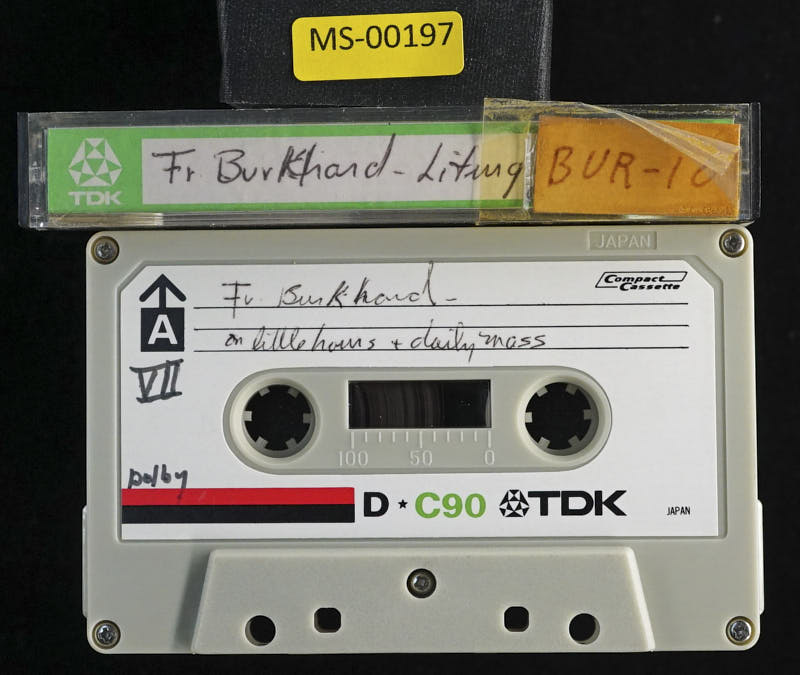
AI Vision - Possible Values from Photos:
Speaker: Fr. Burkhard
Possible Title: Liturgy on little hours & daily mass
Additional text: VII
Possible Title: Blank
Additional text: 38.7
@AI-Vision_v002
which could be the bones the skeletons of our discussion we did not yet speak about a memorandum of him suggestions for the little hours perhaps we have already spoken about it a little bit hmm One wants to avoid so far as possible big changes in the present distribution of psalms. Summer 74, two weeks visual cycle. At the same time, one hears that several of the community regret not using in the public office psalms assigned on our inserts to tears. And I think that is very light. Presently, Given our horarium, which includes daily Eucharist, I do not see any good time or a great need for thirst, and therefore would recommend dropping it.
[01:03]
In other notes, I have suggested the possibility of thirst before Mass, but this would really make for too frequent and too crowded offices, a situation not, I think, conducive to prayerfulness. We have already discussed that, therefore, better to drop the thirst. But... You must say the psalms. What do you think? I find it awful that you, for so many weeks, don't say certain psalms. Because, from my opinion, the Psalterium is a spiritual unity. It is in its totality the voice of Christ, and we must bring this voice of Christ. Somebody today of the theologians of the exegetes says there are bad plans, not so important, not every psalm is the masterpiece. It may be true, but it does not matter. I think we must pray the entire psalter.
[02:06]
It is possible perhaps not to say a psalm which is really a double duplication. Repeated, yes. One or two are repeated. That is possible, but every sound, also the cursing sounds, and also the not so important sounds must be said. Therefore, especially because you are omitting splendid sounds, 180. The first four, or the first, not the first four, the sounds assigned to the stars. And therefore, it would be necessary to arrange this... so that without changing the entire cycle you are able to to say this entire Psalter therefore he brings possibility if only if third, sixth and known are all celebrated as now on our printed insert it's evident but you don't do it therefore if only sixth and known are celebrated use the two weeks cycle as follows then he brings
[03:19]
For example, so, first week, nothing else than a division of 118. In 16, known. And he makes it so. And Sunday, in the sixth, 118, first part. Known, second part. I'm not sure for what we're saying. Aleph, Bid, Gimel, one section. And he makes the note, there is no reason why a little hour comprising opening hymn, psalm, reading, Lord, have mercy, and our Father should be unsubstantial simply because it has but one or two psalms. And I think that is right. Therefore, if you have on Sunday, it would be a little bit for Sunday Q. Nevertheless, it's possible. You are beginning with the hymn and then only the first section. Chapter. Lord have mercy and our Father.
[04:22]
And then so on. Monday, 3 and 4 and 5 and 6. Tuesday, 7 and the noon, 8. Wednesday, 9 and 10 and 11 and 12 and Thursday, 13, 14 and Friday, 15, 16 and and 17-18, and Saturday, 19-20, and 21-22. That was in certain days only one section, in other days two sections, very short. I would not have any difficulty. It would be quite possible. And then the second week, in the sixth, very long, not very long, but so long as formerly in the old texts, all six, 119, 20, 21, and so on, all the gradual sums until 128, 129, and 132, taken from the vespers, the last, from the known.
[05:25]
What do you think about this division? I don't want to get off that completely, but it just seems to me that they're talking about terse and whether we should have it or not is one question. The other question is, should we just take the Psalms and put it from somewhere else? But the underlying question, I'm not sure how much we've touched on it, is the question of whether or not we should have the daily Eucharist. See, if we did not have the Eucharist, well, then I don't think there would be a problem with the Terps. But since we have... Therefore, you are thinking the underlying problem is daily Eucharist. Yes. What do you mean? Okay. Well, the way I understand it, from some, anyway, they would prefer... Who? Some, yeah. Some would tell me, Fr. Gregory told me himself last Sunday, that Fr. Damasus was of mind, and we shouldn't celebrate the university. Also, I would ask, do you really believe a monastery could do that?
[06:37]
I personally don't. I feel that the Mass is very important. Also I. I don't think you can make a choice between Mass and Tears. And also, I think you could not go against the tendency of the universal church since at least thousand years to say everyday Mass, what does not mean every day Receive Holy Communion for Everyone. During the Middle Ages, monks did not receive every day the Holy Communion, but it was not very ideal. I would say it would not be an obligation for everyone to come to the Mass. But the monastery as a community, you must think to the faithful, to the guests, could you renounce to the celebration of the Eucharist, where the entire Church is doing it and insisting, recommending it, in the last centuries. Perhaps you are right, sometimes too much.
[07:39]
But you can say it is not possible for the individual to come every day. For example, outside from this ideal, sometimes after Pius X, we were insisting to good Christian people, married people, come every day to Mass. It's too much. And I remember very well, 10 years ago perhaps, in a union of militant Christians, adult Christians in Maria Lark, I was speaking so. I would not say that it is an ideal to say to people come every day to Mass because it's better that the wife is making a good breakfast for husband and children instead to put a cold coffee and let them eat alone and go to the Mass. The first duty is to make the breakfast with the family, to stay together, and so on. And then a very pious, but an excellent, how do you call it in English, Schulrat, higher counselor of education, very learned man, very pious man, with a great family, said, no, father, you are not right.
[08:50]
In my family, we can arrange things so far as possible, also he did not exaggerate, are going every day to Mass, and we are enjoying it, can we, when the situation is so, excellent, Catholic, pious, active laypeople is insisting in every day Mass, and the popes, and the bishops, and the council, and so on, I insist, can you, merely as community, renounce to daily Mass? I know, the lambs... I don't think, personally, myself, I... where I am at the moment myself, I'm opting for a daily mass. You are happy. But, you know, I don't think it's fair to compare it to the active layman, the layperson, you know, because... They have nothing. You know, we're coming together for vigils, and so on and so forth. So our day is really, you know, I mean, it could be seen as a day of...
[09:55]
I'm more interested in... I don't think that the people who are someone like Father Davises, who would say that perhaps it would be better if we did not celebrate the Eucharist every day. The Eucharist is... Well, I mean, what would be his good reason for saying that? The reason is, in a certain way, it is too much. It is too strong, too great. The danger of, how do you say, mechanism, formalism, and so on. But nevertheless, he never made a practical conclusion in discussing. There is a problem, but there would be another solution, as they are doing it in Hersteller. one of the successors of Kodo Kassel, a younger father, but a good father.
[10:59]
It's also a problem. Nevertheless, he did it so. He suggested and the community was accepting it. One day in the week, there is now high mass. In the old steel, Latin, we've enjoyed it, which is great solemnity. But the community is sleeping in the morning. The sisters. The sisters are in different situations. They are much more... taken together as a herd of sheep. They need some relaxation sometimes. They have a very disclosured sister, a very difficult life. Therefore, one day they can sleep until, let me say, seven o'clock, and then they have laws. No, very, yeah, laws. No, no. And then, who, there is in the choir, but in a very simple way, not on the high altar, but in the special altar between the stars of the sisters, Missa Recitata, nothing else.
[12:03]
And nobody is obliged to come, but you can come. And sisters and guests are staying together around the altar, outside of their normal places. And they are saying a simple high mass, perhaps with a German canticle in the beginning and the end. And then after that, for all the community at eight o'clock loads, Therefore, a certain relaxation day. And it seems to be a good thing. All the people who need Eucharist every day and the guests have here a wonderful, very intimate celebration. And you could do the same. Renounce in one day to your high mass in the choir. And if you did it sometimes already, go downstairs in the crypta without any obligation. You don't sing. No canto is necessary. You say the mass only as with a small group of five or 10 people or 20 guests up there to say mass. To relax. I sometimes think it's more of a scandal to the guests if they come to a mass and there's only five monks there than if there was no mass at all.
[13:11]
No. I don't think so. This little nervosity is more our nervosity. How else they are. But the lay people say they have to do the work, all that. This little scandal, we must bear it. For myself, as a monk living in a monastery, I don't know as I would have the mass every day, but considering the whole monastery, and especially, you know, the needs of the guests that come in at some point, I think there should be a mass every day. But I would say that I've found myself over the years in practice not always coming. I think here would be the solution. But the thing is, if there is the mass and it is for
[14:17]
solemnly and yes, then it should really, you know, have a little, it should be something that's just kind of put down. It should say some solemnity. Yeah. Some formality. Yeah, some formality. Some formality, yes. Some formality. Yes, but I think so, if you wish to discuss this problem, this simple mass in the crypt, in this small order where you say reals, set together round the altar, let me see, five monks and five guests, ten, round the altar, with a certain formality, would be a marvelous thing, like our old crypto mess in Maria Lark, where we were enthusiastic, and for our brothers, who until ten years ago, until the council, had every morning crypto mess, No, after that we have no more private messes, only con celebration, also the provost come every day to the high mess, and they are suffering.
[15:24]
The cryptomess, this intimity in this smaller chapel, you have seen it, was satisfying. But the mess in the upper church is too cold. It's too official, too formal. I don't agree with this judgment, but they are thinking so. And also here, I could say, to avoid the difficulty, only five monks, this is awful, and they are not able to sing the Mass. Do it with these five monks in a certain form which you can establish, but not in the choir, but in the upper church, in the down church, in the crypto. Oh. Nevertheless, it would be possible. I, for my person, I don't know if that is the idea. You know, you said, and this is all maybe a question of vocabulary, you know, you said with solemnity and so on, and then you mentioned words with enthusiasm.
[16:24]
And for me, that, that would be, you know, if it's done, it needs to be, and so at the months that are the Oh, yes, yes, yes, yes. They come freely and they could say, here a certain spontaneity would be possible, but a certain spontaneity. You could not say your Eucharistic prayer as you like to, you must take the prescribed form. But nevertheless, there are some possibilities, and the intimacy would create a certain enthusiasm where you stay around the altar, really, celebrate the Eucharist. And it would be a certain need, a certain preparation for the next day where you're in the greater solemnity, in a greater solemnity, in the greater community, with a greater solemnity, in a greater difficulty, nevertheless are succeeding to do it well. It would be worthy to discuss this problem. Also, I must say again, I don't know if I would wish for my monastery in Maria Lark to have a day where we would not
[17:31]
come solemnly to the high altar to say Mass. Every day here the Eucharistic sacrifice. That is an ideal. But I know already St. Augustine says there are two ideals. Every day and in other churches, every week. Both these traditions are good. But our Latin tradition in the last century has been every day. And I don't know if we... Just historically, how did that come about? The idea of the daily... Some people would say to you, and I don't know, I have no idea, that one of the reasons that we started celebrating Mass every day was more a matter of stipends. No, no, no, no, no. You are right. The stipend today is also a very important question. But the origin is not there. What is the origin? The origin is, let me say, first of all, the celebration of Feasts of Saints.
[18:43]
John Chrysostom says explicitly, when we come together to hear St. Paul on Sundays and on the Feast of the Martyrs, He did not know about the MS, it's quite evident. But these saints, the martyrs, were multiplicated. Our eucharistic devotion in a very strong way is related to the veneration to the saints. And the calendar is always growing, always growing, always growing. And then you have a sense, at least two, three, four days in the week. And the second possibility, the second element is the celebration of Mass in distinguished times of the ecclesiastical year is Lent. And in Lent, until Gregory II, I think, until the 8th century, you did not have every day the Mass, but all the days without Thursday. And only then, also Thursday was added. And you can see
[19:45]
still in the old Roman Missal, also the, how do you say, the levels. First of all, in Lent, you had Wednesday, Friday, Saturday night. Then, Monday. And finally, Tuesday. And only centuries later, Thursday too. Therefore, after the eighth century, you had every day in Lent a holy sacrifice. So also in the Easter week. perhaps also during Easter time sometimes. Then the solemnities and the feasts, the commemoration of the saints. And then the Jews of the monasteries who must have a mass for the Sikhs, for the students, for guests, and so on. And then not money, but the private intention of the faithful. Oh, my mother, my cow, say a mass. And only in our difficult times today, we are also very much related to stipends, and our Father Albert Basil, when we were discussing these questions in the 50th, before the Council, he said sometimes, if we would renounce to the stipends of 40 fathers, we could no more receive, we could not live without the stipend.
[21:13]
And also for you, if you would not have stipends... But the question is, okay, who serves to the altar must also live on the altar. Therefore, today you are right, the question is also related and connected with the stipend, but it's not the real reason. If we... Well, it seems then, Father, that even our calendar is... It's overcrowded, yes. Well, it's becoming more simple now. Okay, you're right. No, I wish to say, here was the origin. And with time, therefore, with all these motifs, land, saints, private intentions, more or less, you had ever delayed a mass. And now, from this situation, in the last centuries, we have made the, how do you say, the theology to say mass... Also, not only every Sunday, but every day is a certain rhythmic way to repeat the Eucharist sacrifice of Eucharist.
[22:20]
Therefore, let us do so always, theoretically. Every day, once the Mass, but not twice. Until the last years, the Church was always against venation. It was until the Council formally forbidden. to say twice the Mass during the week. Only on Sunday was allowed. And then, again, the necessities of the pastoral life. The intention of faithfuls, Marius, Requiem Masses. Again, first it's the pastors to, without any permission, to say twice, three times the Mass, also during weekdays, and notice allowed the pastoral reasons, because the priests are so few. But it always is a bad thing to say mess twice today. It's not good, also for spiritual life. But we are, in this evolution, during the centuries, accustomed to see, to say, and to see, not only every Sunday, not only in the feast day, but for certain reasons, every day to pray.
[23:24]
No, again, there is a certain reaction. And you are right, and many are insisting, see the problem also, I must say. Yes, some people don't know it. Is our day really so overcrowded, so difficult if we, for example, know instead of terms, same as, I don't know. But nevertheless... You are not obliged to do it. And until the last time when we were preparing this Eucharistic instruction of 67, insisting it would be convenient to say Mass every day, it would be convenient to invite a priest to celebrate, but you are not obliged to have said to do it. There is no obligation. You cannot oblige people. There is no commandment to say Mass every day. I am against the suppression of the daily mess only if, as in St. Anselmo, people like to speak against the daily mess because they are too lazy.
[24:33]
They don't wish to go to visuals to sleep because they wish to see television at night. Or for materialistic reasons. But if these reasons are not there, if you are ready to come to visuals, and if you have a good health and so on. And then I could understand that somebody says it's too much for me. But then in this case, I would say you are not obliged. You can be free. It would be reasonable to do so. But the community as such, at least in a smaller form, must say every day the mass. My experience has been, you know, over the years, as I worked on the farm, and in the summertime, especially when I worked in the fields all day, in the morning, then when I went vigils and lords, and then I have to come, you know, to the mass, you know. At the same time, I felt that, you know, if the mass was, and it was something with the community and, I guess, and with enthusiasm,
[25:42]
then I would feel that I wouldn't have to go every day. But because maybe, you know, part of the community feels the burden of the everyday mass, it doesn't mean that the whole community either has to go to mass or doesn't. But to have the flexibility. For instance, like if there's a feast, you know for every apostrophe and so on you could establish a certain rule for that nevertheless on another side you could not give too much flexibility because you cannot say a good mass in the church here if you have only four monks therefore normally I would say the community must agree we come all to the mass but with certain reasons for farm work and so on, as you did it already, is allowed. It's not illegitimate not to come. And perhaps also a certain day where you are formally renouncing to the mass in the chapel and go downstairs in a smaller way.
[26:55]
But you did it already so during winter. I think sometimes you have said mass. But then perhaps insisting also in this liberty. But again, it may be allowed to say a day without any Eucharistic celebration seems to me to become a scandal for the faithful. And also, I don't think that the major superiors, therefore, the upper primate would agree with that. I'm not sure, because the primate surely says the problem. Perhaps it's... I think we have now discussed the problem. We cannot give the decision here. Before you take the last decision, it would be necessary to see well the things. But nevertheless, you have seen there are different possibilities to help the people who say a little bit is too much to have a daily Eucharist. Also, on the other side, I would say again, I believe it is possible to do it so that a daily mess is not too much.
[28:01]
The danger, nevertheless, is it becomes formalistic. We are repeating it because we must do it, we must pay, we must receive the stipend and so on. But we can say the same thing about the whole divine office. Oh, yeah. In the last days, sometimes this word was already said. It is too much. Not here, perhaps in the entire order. Too much seven times a day. Oh, no. No. Then you can say, for example, there was made a marvelous prayer book in Germany for lay people 15, 20 years ago, Instrumentarium of the Daily Prayer, where they said, for the modern man, it is impossible to pray in morning and evening. Therefore, you are beginning in the morning, in a rush hour, and quickly, show about breakfast, to your office, work the entire day, and at four o'clock, five o'clock, you come back tired, you are refreshing, taking your meal, you are sitting down, you have one, two hours liberty before you go to your evening work, to theater, to concerts, to meetings, and in these two hours where you are relaxing, after having relaxed, after having eaten, you sit down for your daily prayer.
[29:24]
Psalm, hymn, psalm, reading, prayer, and then marvelous disposition. That may be good for some lay people, but not for monks. Impossible, impossible. And also for lay people, morning or evening prayer. From the first time, from the old Jewish times, no, it's not the solution. And therefore, for monks, not only morning or evening prayer, but vigils too, and minor hours. In the first church, first century perhaps they did not have minor hours but already in the second century we have them and I think this is a good thing not 20 hours of prayer as perhaps the medieval monks did it but at least 7 or 6 hours 5 hours and so therefore you could say it is too much no it's not too much and no if you drop thirds where the hours are so short so short I think it would be possible to have six hours and a mass.
[30:29]
Nevertheless, there are these both sides. Okay. But let me speak a little bit about the disposition of Psalms. Do you believe really it would be good to take one week with 118 and the next week with the graduate Psalms? And also in the second week, you have 119 on Sunday. On Monday, Wednesday and Friday, you have 119. And on Tuesday, on Thursday, on Saturday, you have 125. Therefore, you are repeating on three days, it sounds. And therefore, in one week, the gradual sounds repeated in certain days. And in the first week, only 118 disposed so that in certain days you have only one section. But I think it should be mixed.
[31:31]
Mixed, yes. And I would say, for example... I would say again, according to the tradition of St. Benedict, take for 118 three sections. And then you are free for certain days, also in the first week, to take the gradual psalms, because they are so short. And also he is right, you can say a little hour with one psalm only, with one section, but why not? Two or three, a certain wave. Then I must say too, these minor hours could be said sometimes in a certain informality in Genesis. also have difficulties with this minor. Therefore, I have not seen, never the tells. I never know. Later on I heard, they are seeing it, saying it here, when they are, in the morning, coming together for the chapter, very informally, the tells.
[32:36]
And the same, after dinner, yes, the known, I think. Now, on Sunday, Yes, on Sunday, we had a dinner, in this informal way, but with reading, and then they were dividing little booklets, and also a capsule, a gift for the monks. I took it, and then in the refectory, immediately after dinner, after the short prayer, they said, the known, staying, and they were free to wrestle a little bit. I would not say that you must do so, but I have seen there the possibility, if you have difficulties with the minor hours, you can say them here, perhaps, after chapter.
[33:36]
It's also a possibility. We have already spoken about that. But perhaps for you, it's not necessary. We omit cells. We have no, and we have only one daily minor hours. Six during a week and no in Sundays. But we are dividing psalms so that we are saying every psalm. In two weeks or what? In two weeks and vigils in three, in four, and vespers in three. But you can repeat many psalms. And we hope it could be allowed so. So that would be in the little hours. And he has still another possibility, but I think for you it's excluded. If sixth only, midday prayer, is celebrated, then he has devised in the first week, 118, in three sections. In the second week, the gradual psalms, and in certain days, only two sections.
[34:37]
But I think it's not necessary. And then here, make an addendum. At Christ in the desert, we sung the Beatitudes after the last psalm. Really? In the minor hours? Followed immediately by our father. Why? They had only one little hour. Just midday prayer. Yes. Midday prayer was followed by five minutes of silent prayer in community. And Beatitudes before the silent prayer. How did you find it? Why did they say the Beatitudinus? Why did they? I don't know. In Genesis, I heard it too. But they had a very strange custom. They had a strange law. Two psalms, reading, a laudato psalm, or instead of the laudato psalm, the vertitudes. Or another canticle of the New Testament. Here, I would say, if it is too much to pray, I would not add to our
[35:46]
traditional psalterium, new canticles. I would reserve the canticles to the third nocturne of the greater solemnities in the vigils. Because if you have two psalms, and the beatitudinous is already known. And you see, sometimes we cannot pray so much. The midday prayer was never too long. It wasn't. There was no reading. No reading. No chapter. Ah. That was the New Testament. Yeah. Always the same. No, no. But they were singing in Beatitudes. Yes. Well, the cantor would sing the first part, and then the community would answer the second. Here I would say, although here it would be better to follow the old rule after psalms, with melody. A real reading.
[36:49]
It could be short and not so long as in, where was it? Here? No, in Genesis. They had very long readings for the minor hours. Entire chapter of the letters to Ephesians. It's not right. Or at least half a chapter. Very long, so long. So, Father, just to... Yes. About three questions. Just concerning structure. What is the structure of the Jews? It's invitatory. I would say the structure is... How do you say it? Invitatory. Invitatory. Invitatory. And then, according to the entire tradition and according to the scheme seen in Rome, hymn. And then psalms... reading and prayer psalms we said when we were preparing the new office for the Roman office we said somebody said the visuals are normal visuals only hora lectionis hour for readings therefore no psalms only reading we protested no every hour must have psalms at least one or two psalms
[38:16]
and the readings, and monks, not only one, two, but more, more or less six, as you have it, at least six or two, the number does not matter, but at least a good part of psalms, and then readings. Here you are free. You are not obliged, according to the actual situation, to take a definite number of psalms. You are not obliged to take a definite kind of readings, but you must have, after him, psalms, readings, or reading, and the prayer. And I would say, you know, the disposition of the Holy Scripture, and you must find a way to do it, and perhaps according to this wonderful model of the Roman office, this patristic reading. In Rome, we are, in St. Anselmo, we are changing. We read the Holy Scripture in the visual, No, we are reading the Father in the morning office and Holy Scripture at night in the Vespers.
[39:25]
I don't know. You don't read. Have you patristic readings in the Vespa? No, Holy Scripture. But you could dispose things so that Holy Scripture is taken in the Vespa. and some offer in the visuals. Did you say we could only read the Gospel at vigils? Every day? I would not do so. No, I don't mean every day. But when we do read the Gospel, it's only at vigils and not at vigils? According to the nation, yes, it's not right to read the Gospel in the minor halls or in the festivals. You can do that. You can read always the Gospel. But in our office at home, in the Benedictine office, the Gospel was always reserved to the visuals. Only for the Benedictines. The Roman never had the gospel. Only in the mass. As the old Roman office has never left our father. Only in the mass. In the minor ors, in silence. In silence.
[40:32]
But in silence. Oh, that was private edition. Terrible. Only in silence. You cannot count that. You are right, Pata Adi created before the visuals. Pata Adi before every hour. But... No, no, no. That's not what I mean. But the Gospel, the reading of the Gospel. Yes. In the Roman readings... Was never. No, no. Where? In the nocturnes, the readings, before Augustine. You would have a little... No, no, no, no, no, no. In the Old Preview? Only Old Testament and St. Paul. Never the Gospel. Father, before the Sermon... Only this short initial, but never the gospel itself. It was a commentary to the gospel, which was not right. Do you remember that? You had it here? No, no more.
[41:32]
Two lines? Two lines? I always thought that they're kind of sure. No, no, no, no, no, no, no. I think it was an imitation of the Benedictine office where you had this homily only on Sundays, and therefore, no, every Sunday, where you had these homilies, and here you, it was taken only the initial, remembering the gospel, to be said in the Mass, and so the Romans did it. No, I don't think, I never heard about that there was, no, no, no, it's impossible. They did not have it. They had the, in the beginning, you know, they would say something about the gospel. How about the structure of lods and vespers? Here, our benediction structure would be perhaps an invitatorium psalm, but it's not so necessary. And then psalms, A morning psalm, a canticle, a laudate psalm.
[42:38]
That would be the classic structure. What is it? A morning psalm, a canticle of the Old Testament, laudate psalm. Not only the last three, but from 145 to 146 until the end. And then a reading of Eventually him and the canticle of Zacharias. Our father and the prayer. And today there is a certain liberty you could take instead to say the canticle of Zacharias or Zacharias? Zacharias. Zacharias. You could take another canticle but I'm against that. German form used in many also outside, many monasteries outside Germany of is every day another canticle. For example, Philippa II, Philippians II.
[43:45]
Then for Vespers. Vespers? No, we must say the tendency in the modern Roman office, new Roman office, and also the tendency to impose it to us is to begin with the hymn. Psalms, reading, and so on. Not after reading. But for the moment, you are free. And for the Vespers, again, Psalms, reading, hymn, Magnificat, Our Father, and prayer. And the Romans now have Psalms and the Canticle of the New Testament reading. It's Does the psalm have to include an evening prayer? Or would that be more common? No, no, no, no, no, no. No, I think so. But some, for example, no, no, no. Because there is nothing about evening. You can say, you can take the psalm, what is this number? I don't remember. I understand that.
[44:55]
So, 137, I don't know. But nevertheless, there are certain psalms which are said in the festivals. 190, not because it is an evening psalm, but because he is speaking about the parousia. 190, and then also all the psalms between gradual psalms and 145 or 148 psalms. Psalms, yeah. And then the structure of the little hours? Of the? The little hours. Little hours. Hymn, psalm, reading, prayer. No hour, Father? Ah. As you are doing, it is surely one possibility. Instead, the Horatio, Pater Nostro. Not... I don't know.
[45:57]
In a new Roman office, we did not do it. We have only a prayer and not the paternoster. Because for the old Roman office, the old Romans had only once a day suddenly the Our Father in the Mass. And not in the hours, only in silence. We had it always in Vespers and Lords. And no, the Romans took our...
[46:18]
@Transcribed_UNK
@Text_v005
@Score_90.4