You are currently logged-out. You can log-in or create an account to save favorites and more. more info
Agape: Transformative Love in Conversion
AI Suggested Keywords:
Conference to Deacons
The talk discusses the concept of conversion from a theological perspective, focusing particularly on the differences between Eros and Agape as representations of human and divine love, respectively. It emphasizes the transformative power of conversion through personal encounter with Christ, rooted in the Agape spirit as a key to the future of the Church. The conversation also ventures into the tension between institutional and personal spirituality, drawing on biblical narratives like those of St. Peter as a journey of conversion and repentance.
Referenced Works:
- Gospel of Saint John: Discussed in the context of conversion and the revelation of divine love as central to the Christian faith.
- Book of Genesis and Acts of the Apostles: Employed to contrast human ambition (Tower of Babel) and divine inspiration (Pentecost) as representations of Eros and Agape.
- Symposium by Plato: Used to exemplify Eros, it is compared to the Last Supper to highlight differences between philosophical and Christian understandings of love.
- Writings of Saint Paul: Referenced for the definition of Agape and his emphasis on being servants of joy rather than masters of faith.
- Phenomenology of Religion by Pandaloy: Mentioned in relation to understanding religious power dynamics and conversion.
- Concepts from Eastern Orthodox Christianity: Discussed, particularly catechesis and the role of the Holy Spirit, as parallels to the Western Christian understanding of conversion.
The talk integrates these references to explore how personal transformation aligns with broader theological themes and historical church practices.
AI Suggested Title: Agape: Transformative Love in Conversion
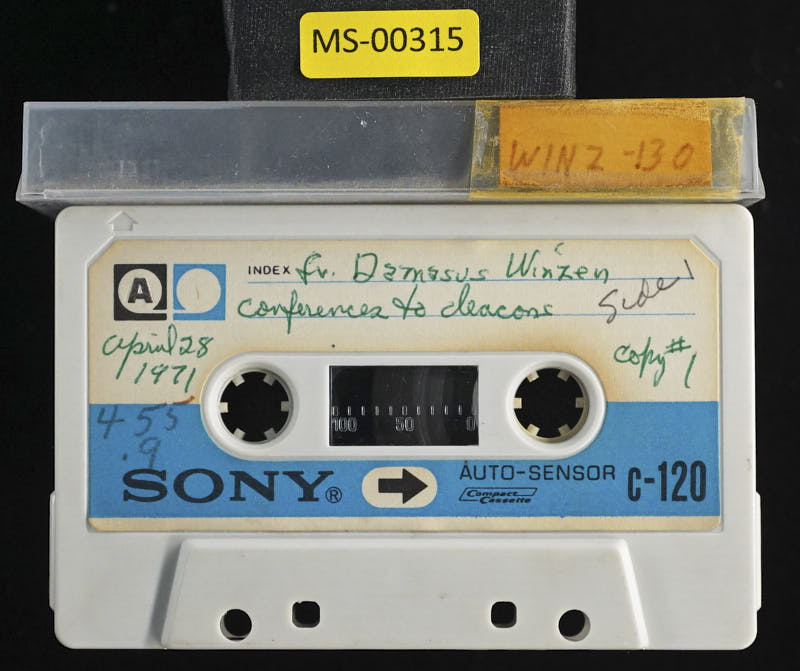
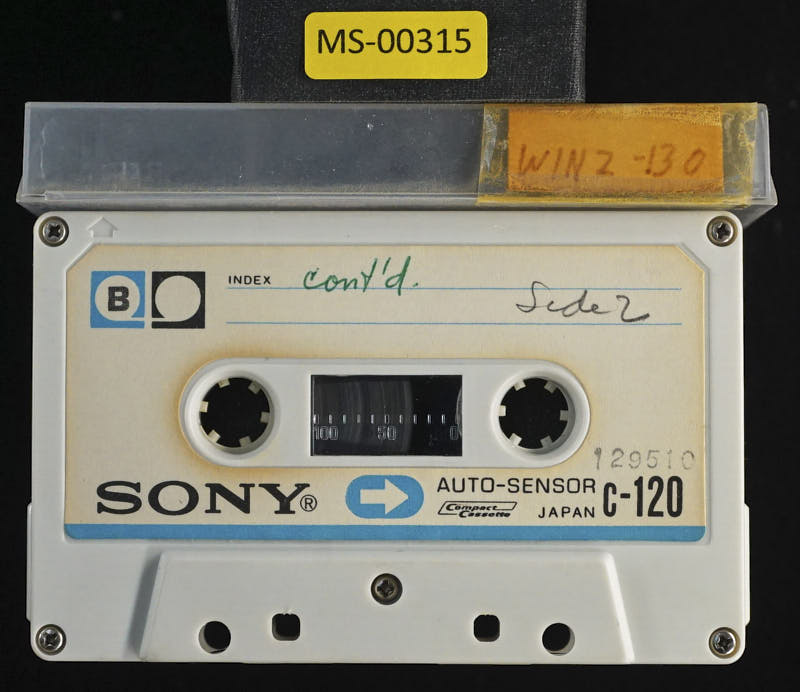
AI Vision - Possible Values from Photos:
Speaker: Fr. Damasus Winzen
Possible Title: Conference to deacons
Additional text: Copy 1, Sides 1 & 2, MS-00315, WINZ-130, 4.55
@AI-Vision_v002
I wanted to warn you, first of all, you know, that I'm a terrific talker, you know, and once I start, it's just hopeless. So the time is limited too at the moment, you know, this morning until we have to finish before 12 o'clock, otherwise you lose your lunch in the general context of our table is not, it's an irreparable loss. At once that marvelous, you know, you should pray for him. Tom Carroll, you know, Tom Carroll in Boston, who founded the guild there for the blind, you know, gave his life for it. He just died. on Sunday, and that's by Father Martin, isn't here to attend his funeral because he's being buried in the Benedictine habit, was our brother, Pascasius Rugbertus.
[01:09]
And in the early days of the liturgical movement, he was the secretary. And then he prevailed on Bishop Wright was at the time in Worcester to have a liturgical week there. Very difficult to find Bishop to sponsor one, you know, at that time. And so at the end, you know, Bishop Wright, who is always the manor of a grand seigneur, you know, gave us a tremendous dinner for the priest exclusively. And we came into this room there with these tables just, you know, kind of, what does one say? Groaning. Groaning, groaning under the weight of all the lobster and the various seafood, you know, that was spilt there in great plentifulness.
[02:17]
And I was standing at the other end, and Father... Carol standing at the other end, he shouted over the whole table and said, Damasus, I haven't seen that much food since I was at Mount Xavier. That was in the days when our mainstay of our meals were the mint tea that we found here in the ditches. But things, I think things have changed a little for the better since then. So what I wanted to do this morning, first of all, I wanted to just throw in a prospect of continuing this afternoon or evening because the weather isn't very inviting. You will sit in St. Joseph's not knowing what you're going to do.
[03:22]
And so one could kind of fill this blessed emptiness maybe with a conversation, see? And then I would kind of feel more free, you know, really to, you know, let go this morning, so to speak. So I hope you survive. So let us start from some, just from the concrete situation as you have experienced it in these days. Let us start, for example, our table reading. You know, it's one of the elements of our daily life by Father Johnston of the Society of Jesus, but one doesn't add that in our times anymore. On Zen, you see? On Zen and Satori, you know, and Moo Moo, you know.
[04:30]
It reminded me of an incident, you know, at the Oktoberfest. You know the Oktoberfest in Munich? There was an American and he got the idea that he would have milk. you know, on the October 5th. So he called the waitress and he wanted milk and she asked, what do you want? Say it again. Milk, he said. I wanted a glass of milk. So she disappeared, you know, and after a while she appeared again and she had on her hand, you know, she was kind of, you know, she came in with this tray, you know, dancing and on this tray was this one glass of milk. She went up to the podium, you see, and she shouted into the whole thing, the man who ordered this glass of milk may stand up, you know.
[05:35]
So up went this American, you see, she spoke English, you know. And when the other companies saw it, you know, they all broke out into a... moo, moo, you know, to express their extreme disgust, you know, about a man who was causing milk in Munich on the October Feast. So this table reading in some way is interesting, also on the background of some experience that we had here. Now, don't get the impression I'm a priori against Zen, you know, but it is really something to reflect about. We had a Japanese here for more than a year, wasn't it? Peter Tumosi. And he had an aversion against Zen because of his sudden discovery in Jesus, of Jesus.
[06:47]
and of the church as the communion of those who have received Jesus. In fact, the other day, about two weeks ago, I got a letter from Korea. It was interesting because it gave us an idea of the competition, so the Greek and Southern Korea at the moment, between Christian monks and Buddhist monks. And the Buddhist monks, kind of being so close to the Christian monks, suddenly realizing and complaining about the emptiness of their own prospects and of their own waiting for a very dubious, you know, sattori feeling this waiting, empty waiting, replaced among the Christian monks by the Adventists, the idea of the coming, that Christ had come, that in the essence of the Eucharist is a making present again of that what has happened in Jesus, and then all the joy and the inner security
[08:16]
that follows from the celebrity of such a memorial, which is of course outside of the reach of Zen. I just wanted to call your attention to it. I could complete the list by mentioning a group friend of ours who came here regularly, and that was Professor Shiva Ranam from India, from the What is the university there where he walks in? Benares. Benares is right. Benares. And he, attending our Easter services and being deeply impressed by it, later on came to me and we went out into one of these hermitages and we spent the whole day in explaining. He asked me, please let us read together. the Gospel of St. John.
[09:17]
And so we did, at the end he said, now one thing that we do not have in India is the church. The church. And that's a very important thing, also considering Buddhism and Zen. Now all these are just two little or three little incidents which happened at a moment. when the rest is about to throw off the whole institution into the ash cap, doubtlessly overreacting against an institution that in fact has lost its personal face and had become impersonal. Now, I think that's what the reaction is against. And that is completely in harmony with my own impression which I received in 1938 when Albert Leo and I first came here to this country concerning American Catholicism.
[10:28]
But this is not a thing which is limited to Catholicism, only to American Catholicism. The only thing is that in Europe, you know, probably by divine providence, you know. I did not, being living in a monastery, I did not have too much to do with the chanceries and the diocese and the rectories, let's call that too, you see. So, but I was very much, how would I say, astounded in seeing the workings of the American church as it was at the time. I used to, and our Archbishop in Newark, Archbishop Walsh, put great emphasis on our need, and I think he was absolutely right, of equating ourselves to the workings of the American church.
[11:40]
in the rectories and in the parishes. So we had to go every weekend to help out in parishes, and I must say it was a liberal education. And once, you know, in fact I remember this only because the other Sunday was Low Sunday, you know, and this last Sunday was the Sunday of the Good Shepherd, you know, and still We have some relics of the idea left in the new readings, thank God. And where was, you know, the idea of the Good Shepherd, and it's that mass, if you remember, started with the words, plena estera misericordiaeus. The earth is full of his mercy. So I went up to the Prohibit and I gave a little sermon on the idea of the earth is full of his mercy.
[12:46]
I illustrated it with the example of a magnolia tree or two magnolia trees. I gave a little picture of an American Catholic who on a Sunday morning wakes up. and how his inner, his heart, his thoughts might be moving. The sun is there. A new day is born. It's a free day. It's a feast day, which is not an everyday matter in American life and in human life. So when he decides and grows with his family to mass, thank God, About 80% of all the people in Bloomfield were going to Mass at that time. And then passing by these two magnolia trees, you know, in front of the church. I had never seen any magnolia trees, not in that abundance, you know.
[13:52]
It was just one sea of flowers, you know, let's say two fountains of flowers, you know. The thing was covered with flowers. You couldn't see the leaves, you know. And this is just a symbol, you know, an incarnation of the fullness, you know, of the grace with which the church in Europe is filled, you know, so that it is beautiful. You know, the whole dimension of beauty transcending the practical, you know. From purpose to meaning. And so, later on, I went back, you know, into the sacristy, and people came in and said, oh, Father, what a sermon. You have never heard this kind of thing before.
[14:52]
So I was very pleased with myself. First, I went into the rectory and found the Monsignor. I saw that something was wrong in his face, you know. I mean, he couldn't look like prudence at all. He said, you know, he said, Father, in this church we preach catechism. That was the end of my triumph, you know. Later on, we were sitting together counting the money, which is one on Easter Sunday afternoon. So I was turning these various wheels, you know, to get the, what is it, the quarter separated from the dimes, you know, and so on. And he was looming, it was just the Sunday where we had the, to take, it was up to the people to take the oath of
[15:55]
a legion to the legion of decency, you know. It was always a big Sunday. And I was always surprised, you know, all these people were jumping up, you know, checking that all of your trips that required, you know, see. But they also had, in order to make it really to seal the whole process, you know, they had to write little cards, you know, these cards. They had something, you know, they had to sign their names. Now, he had jumped at these cards and was reading these cards. And then I heard this grunt, you know, behind me. And I looked around and there he sat, you know, his face again, you know, kind of, how could I say, you know, not pleased, let's say. And I said, what happened? What happened, Monsignor? What's the matter? So he showed me this card and I read on it, nuts to you.
[16:58]
And that was one of those moments where I learned a little about the future. There was fender in the distance, you know, the young generation. You know, carefully trained on Catholic colleges and coming home with a certain spirit of sophistication, you know, not being too happy with the meager, you know, diet that was proposed to them in the palaces. Kind of made a little kind of protest. But it was greeted with a grunt of helplessness at Britain, you know. We certainly, you know, there was a need to personalize the institution, doubtlessly. But at the same time also, I think, the necessity and the need to imbue true community spirit into the, what we may call, individuals, you know, equally come persons.
[18:11]
I think those are questions that are very basic to the entire Western situation. And the states are part and an important part, maybe the most important part at the present time of the Western, what we call the Western solution. Now, it seems to my mind that's what I wanted to kind of bring before you, you know, for your own thinking. Seems that The solution of this problem, you see, we certainly are faced with the problem how to personalize the institution and how to, let us say, communionize the individual. It's always the Western problem. The solution of this problem seems to me is the only solution is conversion, very real personal conversion, you know. in absolute personal freedom and in personal encounter with the person of Christ in the Holy Spirit who is also in the Christian idea, thank God, a person.
[19:26]
So this, you know, this conversion to the agape spirit, that seems to me is the key, the only key to the future of the church not only in the United States but all over the place. Now you know very well what agape is. The New Testament understands the word agape. So Paul in the fifth chapter to the Romans kind of brings a definition of what agape is when he says, yes, maybe one would die for a good friend. See, that is still in the realm of the antiquity. You know, there you have Patroclus, who is the friend, you know, and Achilles whom he adores, so to speak, and for whom he is ready to die.
[20:29]
A good man dying for a friend. A better man, let's just say, you know. I would say that is still in the line of the arrows, you know, what we call arrows, because arrows is this tendency in which the individual wants to rise, you know, in a spirit, how can one say, aggrandizement, you know. Plato, who preached the arrows and is the classical master of the arrows in his symposium, significantly he calls that work in which he explains this a symposium, and one always has compared the symposium of Plato to the servants of our Lord at the last supper. You know, that is a classical parallel. Plato's meal and the Lord's meal.
[21:34]
Plato's meal is spent in vino veritas, not only because of the food, because of the drink. In the wine, there is two. So for Plato, a symposium was the place for conversation, for assuring not only of material food, but of the food of the Spirit. A very logical thing, because man, after all, is endowed with the logos, the world. And that makes him different from the animal. Then you have on the other side, you have the Last Supper, which is the Christian counterpart, to my mind, absolutely deliberately, in the Greek context of the... of the pedagogy, you know, the pedagogic art of the Father, or let us say the economy of salvation.
[22:40]
And the other thing there in this context is the Last Supper. Where our Lord, what does he do? When he starts the Last Supper, then he rises first from the table and he takes off The garment is upper garment, because this always indicates the status of man, you know, in the antiquity. If you are a senator, you have a different upper garment from when you are a laborer. The difference is in this, that you have a toga, and toga is a long, you know, ample garment, you know, on the line, let's say, of a Christian priestly chasuble. in opposition to the hall, you know, which is the undershirt, really. That would give rise to some, you know, remarks about more recent customs.
[23:44]
But we leave these little accidental things aside, you know, otherwise we get lost, you know, in the illustrated little digressions. But, for example, the laborer, what would he have as his upper garment? He would have this kind that we still wear in Mexico, which all the poor people wear, which is at the same time a protection against rain, a protection against the cold, and has a hood to replace the umbrella because the laborer doesn't have the slaves who carry the umbrella. over her lord, their lords. That was the custom of the antiquity. We still have that, you remember, when we carried the umbrella over the blessed sacrament. That's one of the relics of that thing. So no umbrellas for the poor or no toga for the poor, and our lord takes off the upper garment.
[24:52]
And you know, at the Palm Sunday when he enters, Jerusalem, as a poor one riding on an ass, it's not exactly following the royal pipes, you know. People take up their upper garments and spread it, you know, so that he may have, let us say, he may walk on them, you know, which is a terrific, spontaneous manifestation For heaven's sake, let us get rid, you know, of the old standards, not perfection. So that is, I just say that. I would personally regret, by the way, if we would ever dispense, you know, from this procession, provided we understand this procession, not a triumphalist manifestation, which it really isn't. So, but today we are very sensitive to triumphalism and maybe sometimes our zeal, you know, is a little, not always backed up by good judgment.
[26:03]
So what I would see is here that our Lord opens the Last Supper in this way that he takes up his upper garment, he rises, you know, and then of course he puts up puts on what they call an apron. And then he kneels down and he comes to Peter, you know, this marvelous man, tremendously a heart of gold, you know, but at the same time also conscious of him. So he kneels down, you know. And he wants to wash Peter's feet, you know. And Peter said, oh, my Lord, no. How can you do this? You know, he had not yet taken up his upper garment. So he says, no, you really, you do something that is just not, you know, I mean, on your level, you know.
[27:10]
Remember, you are a king, and you really endanger not only your own glorious future, you see, but also ours. We put all our cards on you, you know, and we don't want you to, you know, kneel down and wash our feet. That would really kind of, you know, block your political future. Now, our Lord says, if I don't want you to wash your feet, Peter, you just can have no part in me. See, that's the whole agape process. That's the conversion. That's the conversion. The Lord kneeling before us and saying, please, in order to have part in me, just allow me to wash your feet. This is a little against all Western standards, you know.
[28:14]
This is, if you understand it, it means really a revolution. I leave that to your thinking. And that is, of course, is one of the things, you know, that is very difficult in this whole, let us call it, the question of our conversion of heart our surrendering into the realm of the divine alchemy. Because if you do that in some way, you have to take a deep breath, you know, a breath that goes into your heart, in such a depth that you don't care about your upper garments anymore. That means, in English, I think we could call it the social image, you know. I see, you understand.
[29:15]
But I'm not referring to Monsignor. Not deliberately. Well, the little kind of purple belongs to the upper garment in the realm of the Western Church, at least. So, then we come, you know, to the question, you see, which is so terrifically, and we have to be conscious of it, because this country, too, is a country of progress, you know. In other ways, we are thinking on dynamic lines, you know, on dynamic lines. That's the emphasis of the West. Not this I am, which we met this morning, you see. That's the difficulty. I'm grateful to Father Augustine that he pointed it out.
[30:21]
I am the bread of life, you see. That we don't quite. We are much more by nature, you know, let us be honest about it, on the lines of the Jews, you know. And I think it's in the same sixth chapter of St. John, where our Lord said, labor not for the meat which perishes. It is difficult to swallow for the Western man. And then they said to him, now, what shall we do? What shall we do? That's the question of the West. That's the question here. When we came to this country as a monastic community, the first question they asked, what are you going to do? School? Parishes?
[31:22]
Then we both said, no schools and no parishes. What are you going to do? And then came the other question, how are you going to make ends meet? See, this very... Back as your question is, sometimes the answer is, what are you going to do? So, and then our Lord says, Jesus answered them and said unto them, see here, the Jews say this, what shall we do that we might work the works of God? That's quite, you know, that's quite an order. And Jesus answered and said unto them, This is the work of God. Now, you listen. What's the work of God? That you believe in him whom he has sent. That's a new word, you know.
[32:26]
To believe in him whom he has sent. By the way, I'm not, you know, fooling. This is the verse 28 of chapter 6 of St. John. John 29. So, believe, you know, the work of God is believing. Yeah, that's, of course, the work of God that our Lord asked him, and he said, now please allow me to kneel down and wash your feet. I would say that is an act of faith. But what is the essence of faith? In this new, let us say, the new concept, the new horizon that I have in mind, you know, thinking about the future of the church, you know, and I'm full of hope for the future of the church, of the church too, the church, not only individuals, man-loving individuals, but the church.
[33:33]
And it seems to me, you know, that that that really this is part of the future of the church, that we, and especially for you, you know, as deacons and expecting to be ordained, so you are becoming teachers, you know. But please don't forget the word of St. Paul who says, who said, and that's so beautiful on the line, see if you understand it in the line of the agape, you know, St. Paul says, We, apostles, priests, don't want to rule it over your faith. But what we want to be is to be the servants of your joy. It's a different story. You see, I only say these words that somehow the agape horizon kind of open up. I'm sure you are... They cranied me these things, and I'm just carrying owls to Athens.
[34:38]
Owls, isn't it? Owls, yeah. It's the birth they liked in Athens. Because it had big eyes, you know, to see in the dark, you know, which is a symbol of what we would call the contemplative dimension. The practical people have to see, you know, what it's all about, just as the Jews, you know, we're not satisfied with our Lord's answer about this believing business. And he said, now show us what we can believe. That would be the typical Western thing. I don't want these digressions. It's awful, you know. I can't do anything about it, you know. I hope you don't get completely confused with it.
[35:41]
I do. I took on your point. So, you see, this is one of the, I would say, is the dynamic approach of the West, you know, to the real problem of salvation, you see. Salvation is very easily, especially in our days, let us say, synonymous. Now, what can we do for people? In other words, it's synonymous with what we call today relevancy. I don't have to explain to you what one means by being relevant. But, of course, one of the sad features of the present situation is that so many priests feel irrelevant, you know, because they are not social workers in that sense.
[36:42]
The same, by the way, with the sisters. And then, of course, the whole virginity thing presents great problems. So it is, you know, here, it's the, I would say, the other difficulty for the West, besides the dynamic thing, which, by the way, also is always then closely associated with the quantitative dimension, you see, because two Our Fathers are more than one, and three Our Fathers are more than two, you know, see. So we end up, I wouldn't say, with the Rosary. But... With our brothers, when I first came to my life in the Benedictine Abbey, you know, they said 150, 150 Our Fathers instead of the 150 Psalms, because that was more considered more adapt to their level.
[37:46]
So then we have the other, the other thing which is the question of, which is, of personalism, or I would say individualism. The West, besides lacking in some way the contemplative dimension, also is lacking somehow the personalist dimension. Those two things, to my mind, are very closely connected. The person in the, let us say, original, shall I say the hated word, scholastic concept of the person. The person is one what we call in scholastic terms a pure perfection. See, that's our whole difficulty with the East, and that's the whole difficulty why the East, you know, confuses.
[38:50]
But I think we have induced them to make this confusion. But it confuses, as we do, the person with the individual. The individual is a unity which is shielded towards the outside world, you know, with a shell. You know, see, it has the form of a grain. You know, is that the right word, the grain, which means the, you know, this what is on a, what is an air, you know, this thing that grows on top of the wheat, you know, it has a thing that our Lord speaks about to the Greeks, you know, not without reason. He says the grain has to fall into the earth and it has to die.
[39:53]
See, that brain, a new dimension comes out. The same thing with St. Augustine. Oh my God, you see, I'm not half true. And already the thing is, is, is, so the hopeless situation is quite hopeless at this point. But I mean, it's this way, you know, that the grain Is this, is what the shifts. And Augustine says always, why do we have to vote for the Eucharist? And then he explains it, as you know, certainly, I mean, in a very pastoral way, that we have to see, the grain, in order to become bread, has to be gathered from all the fields, you know, on one big heap, you know, so that's the gathering, the ingathering. process of ingathering, which is one step out of isolation. And then comes the other one, and then it goes then closer to the individual skin.
[40:58]
And that means that the grain has to be ground, you know, into flour. It has to be ground to the flour, which means the kind of destruction of the shell so that the inner marrow may come out. And then, you see, really dominate, let's say, the whole, in the end, the whole dough, provided you add the waters, as St. Augustine would immediately say, of baptism to this kind of breast, you know, that has been gathered there. And that then, if you add the fire of the Holy Spirit, that means the oven, it makes bread. So that is the essence of the Eucharist, easily understood as a sign. But of course as a sign that simply transcends the individual. Where this kind of grinding process, gathering process and grinding process, all processes of course, let us say, of which the divine charity, the agape, induces, you know,
[42:11]
the individuals out of the isolation, get them together and so on, and then grind them. We call that the process of conversion or repentance, add the water that you get called eons, that is the sacrament and that is baptism, and then put the whole thing into the oven because the The dough alone isn't quite sufficient, you know. What has to be added is the Holy Spirit, thank God. And so it's a simple symbol. But this seems to me is of great importance. Also that we, you know, in our present day and age, where this deep personalizing process has for far progressed, you know, to a point where with all the shouting about individual freedom, you see, a terrific amount of conformism simply dominates society.
[43:15]
What one man says, we all repeat. Let us say the degree of originality in our days of renewal is really a minimum. But that maybe we could discuss later on. So this is, you know, for the West, you know, the other big thing. And of course, as you know, the West, you know, is in some way the discovery of the individual. I would, for example, say in the Renaissance, it has always been. From the first beginnings, when the West began to... You know, to drift off from the East, you know. What do we have? Pelagianism. Who was Pelagius? An Englishman. What did St. Jerome say about Pelagius? His whole mistake was he started the day by eating too much porridge.
[44:17]
You know? You can't think about that one too. He ended up by putting the emphasis on the will. you know, as later on in the Middle Ages, the tremendous unending controversy between Morlinism and Thomism, you know. Now, in our days, I would say again, it seems to me that through John XXIII and through the whole Agape Prospect, you know, that he opened up and then also was opened up by a more serious study of Holy Scripture, you know, that this whole agape thing, you know, is a way of transcending this business, you know, of the Christian of grace and what is first, the will of grace, and all this kind of thing. Therefore, also, when I came to this country, and this is still the case, you know, one of the greatest problems was, now, what is really, you know, contributing
[45:29]
to Christian civilization. Prayer? Very questionable. You asked, you know, many of the sisters community today, prayer? No. Work is prayer. See, that is a kind of height of religionism. But again, I just give that to you for, for answering. So then, you see, what is then another question which is very, very, you see, that one understands the individual, you know, as the affirmation of self, you know, the affirmation of self, you know, the finding of self. Now, if one approaches the agape complex, then, of course, the question rises about the self-emptying. For example, just listen to St. Dr. St. Father Augustine this morning. How do we get now into this whole thing, you know, where the food is presented to us, you know, where we invited to eat, not to work, but to eat, you know.
[46:39]
It's different. Yeah, there comes, of course, Anja, the way to do it is self-empty. I ask myself always how in the people in the West, you know, we understand this self-empty How do we empty ourselves? It's a big question. For example, I would say, if you are presented with a phrase like that, and I'm sure that in your seminary days you have come across this thing. Self-emptying. Now, there comes again a different, to my mind, basic agape concept. The self-emptying. can take place only by the fact that you believe in God's love for you. In God's love for you. In the fact that, yes, you're in Jesus Christ. And the fact that our Lord Jesus Christ said, I am the bread of life.
[47:46]
By the way, who could say that? Which human being? On end, he means the greatest anthropo, how do you call it, anthropo? You know, anthropo, how do you say, anthropophilia, you know, philanthropist, you know, as the greatest philanthropist of these, oh, blessed days, who would ever get the idea, you see, this is my flesh, eat it. I don't think that any philanthropist would ever, you know, put any such challenge before the rest of mankind. You see what I mean? Impossible. He would say, how can anybody live on eating my flesh? So that is in itself a pronouncement which is completely beyond all philanthropy.
[48:52]
I would say, on top of it, it is completely beyond the human dimension. This is not humanism. No humanist would ever say, eat my flesh and drink my blood. No. This is only possible, to my right, in the context of the divine agape, if you understand that this divine agape is the third manifestation of the Father's absolutely irrevocable will, you know, to, you know, one can say, divinize man, you see, to divinize man, to lift up man. I mean, that kind of love which knows no reservations, which is absolutely willing to share divinity with man, the divine life with man.
[49:56]
Outside of this context, all that doesn't make, just doesn't make sense. So I would say it's not a question of self-emptying in this way, you see, that I have to be empty of self. I just personally can't know. I can understand how somebody, you see, would kind of forget about self when he knows that he is being loved unto the end. Then I would say yes. I think he would be able to start this kind of self-emptying. To my mind, the big problem for Zen and the Buddhism is that they try the self-emptying without the agape. You better think about this, but we finished this now. We have to... Please, two together.
[51:22]
Here, whoever wants the job, please. Take it, put it before you have a shower. I didn't want it so much talk. Here, ask the question, but why don't you put it on there? I just wondered what your reflections were on the sacrament of penance and ourselves. as persons. I hesitate a little because I think that's a it's certainly a part of this role, you know. But I would say it's only a part. We might get into some kind of I say, you might somehow blur the thing at this moment, just a personal thing.
[52:31]
I mean, it's not rejection of your question, but just, is it tactically good, you know, at this moment to answer that? But if you think it is, I would... How you respond to that seems to suggest that you have a statement or an understanding of it. order of things. Why don't you just go in your own order? Uh-huh. You know, in some way that's true. I mean, it's, I was at this moment, you know, I would be eager to have from you any kind of reaction to what I said this morning. You see? Because this might move us in a direction which later offers us a good jumping upward for the whole question of repentance. That was kind of, that's the scheme I had in mind.
[53:32]
But I didn't want to squelch this question, then again get into another eruption of talk. It may last until five o'clock. That means certain technical difficulties concerning my heartbeat. But if you agree to this thing here, then all right, you know. But if you have any kind of thing that you understood what we said this morning, so on, about the agape and about the difference between eros and agape, is that clear? The agape concept itself. Is it clear that that is the heart of Christianity?
[54:38]
Are you ready to embark on the hourly course? Well, I'd like to see, if you would, in a little bit more detail on the university's conversion, the conversion that must take place in a personal treatment. Yeah. Now, that might be a suggestion which would link up to two things, you see? Now, maybe we do that, but I don't... Then please, Mother, will I push it over here? There we are again. It's terrific. I think on the whole, you know, to get into this, to make the agape a kind of scheme for your life, you know, And do we have it? Do we have it? It's good to kind of maybe connect it with a certain visual picture first.
[55:46]
And one that seems to me is in this way, is in this line, always very easy, you know, to grasp and to keep and also to convert to other people, you know. Because I would like, of course, that when you believe here that you kind of interiorly are convinced that you're being ordained priest would first of all mean that you announce the glad tidings of the agape, you know, because that's what you are being ordained for. Today we always say, oh yes, of course, to serve, to serve, you know. He to me says, go to the masses, and then serve and love the God, the Lord, something like that. It's always serve, serve, serve. But then still, the manner of serving here and there seems to be quite clear to me.
[56:46]
But I just put before you as a kind of visual reminder to think that you might not so easily forget. In itself, very simple parallel or contrast between Genesis 11 and the Acts of the Apostles concerning the descent of the Holy Spirit. I think that's an old vision. I know years ago with our dear father, Odo Castle, God bless Miss Mallory, who died in the Easter night, 1948, celebrating it one year too early. Not yet, wasn't yet allowed.
[57:49]
Then we went out to a place called Edenson, which is near Hanover. That's my hometown. My hometown, Hanover, and there is this Edenson on the Steinruder Meer, as they call it, a little lake, and they call it Meer. Ocean. Ocean. And... And there was a church which had been whitewashed under the Protestant regime, but it had been built by one of the bishops of Munden at around, I would say, in the 12th century. It was the beginning of the 12th century. And this had been, you know, the principle laws and these old kind of principle of church iconography.
[58:54]
The whole church had been made, the inside of it, one reflection of the economy of salvation, just as in the Eastern churches do that. But we have lost that in the West. And there was this vault, and the vault was used in order to kind of have the Old Testament and the New Testament meet. See, the New Testament is hidden in the Old Testament. The Old Testament is manifested in the New Testament. And the first pair of contrast pictures were taken from one side. There was Genesis 11. You know that. It's the story of the building of the Tower of Labor. Now the building of the Tower of Babel. And on the other hand, the descent of the Holy Spirit, you know. And it was easy to do, and one could easily keep it in memory.
[59:59]
And there was the Tower of Babel, which was being built up. The ladders, the whole picture consists in ladders going up, you know. And people carrying their... their... How do you call these things? They are... They are building a building. You see, then the masons go up with this kind of... They are scaffold, you know, and they were carrying this mortar, you see, in these, you know, in these... And climbing up the fences, you know, down here. But, you know, pearls appeared on their faces, and they were working terribly, and evidently in a kind of a grim spirit. The sense of humor had left them, which is always important, you know.
[61:00]
And they were building this thing, you see, layer of brick upon layer of brick. Brick is essentially dirt burned, you know. The first of the inventions. And then there it rose. The whole thing was rising. See, the whole thing was rising. The people were climbing. They were rising and climbing. Then from above descended, you know, the one who is the habitat in Altissimese, you know, the one who lives in the heights. And he descended, you know, and the idea was that, hi, what are we doing down there? Just let us descend, you know, to take a better look at what they have done. And they, of course, from looking from downstairs up, they thought they were about to reach the sky, you know, and scrape it. But the one who was on high descended with his angels and said, now let's look at this thing.
[62:09]
And, of course, we know from the text of Genesis 11, if I would read it to you, it's easy. You know, they said to one another, see, they found a plain, the land of Shinar, and they said to one another, go to, let us make, go to, let us make brick, burn them thoroughly, and they that, Brick for... Yes. And slime had they for mortar. And they said, now this is kind of an old-fashioned translation. And they said, go, let us build a city and a tower, whose top may reach unto heaven, and let us make us innate. lest we be scattered abroad upon the face of the whole earth.
[63:15]
And then the Lord descended to see the city and the tower which the children of men were building. And then of course the Lord said, behold, the people is one and they have all one language and this they begin to do. And now nothing will be restrained from them, no restraining. When the day of Pentecost was fully come, they were all with one accord in one place. See, unity is always the kind of keynote. In one way, it's the unity of an organized mass of people. who want to build a tower to make a name for themselves. I think the intention is pretty clear. I don't have to explain that. But in Pentecost too, they were all with one accord in one place, which was the place of the Last Supper.
[64:24]
And certainly there came a sound from heaven as a rushing mighty wind and it filled all the house where they were sitting. And there appeared unto them cloven tongues like as a fire, and it descended upon each of them. And they were all filled with the Holy Spirit and began to speak with other tongues as the Spirit gave them utterance. And they were dwelling at Jerusalem Jews, devout men of every nation under heaven. Now when this was noted abroad, the multitude came together. The multitude were confounded because that every man heard them speak in his own language. And they were all amazed and marveled, saying one to another, Behold, are not all these which speak Galileans.
[65:28]
And how hear we every man in his own tongue when we were born! Papians and Medes and Elamites and dwellers in Mesopotamia and Judea, Cappadocia, in Pontus and Asia, Phrygia and Pamphylia, in Egypt and the parts of Lilia, Cyrene and strangers of Rome, Jews and proselytes, Cretes and Arabians, We do hear them speak in our tongues the wonderful works of God. They were all amazed and were in doubt, saying one to another, what means this? Another mocking said, these men are full of new wine. But then Peter, that was the first kind of dogmatic declaration of St. Peter, if you want, was a kind of A very kind of promising start. Standing up with the eleven lifted up his voice and said unto them, Ye men of Judea and all ye that dwell at Jerusalem, be this known unto you and hearken to my words, for these are not drunken as you suppose, seeing it is but the third hour of the day.
[66:51]
Yes. But this is that which was spoken by the prophet Joel, and it shall come to pass in the last days, says God, I will pour out my spirit upon all flesh. And your sons and your daughters shall prophesy, and your young men see visions, and your old men shall dream dreams. And even on my servants and my handmaid, I will pour out in those days of my spirit, and they shall prophesy. Now, those are the two things. And they are, I think, you pretty much have the idea, you know, of the two things. You see right away, this is an attitude. You see, two different attitudes. One that climbs, you know, and evidently is out, you know, to... Now, to make a record of some court, you know, a record achievement of some court, of some sort, out on the broad basis of a mass organization, which is together to make a name for themselves.
[68:06]
This is what we call, broadly speaking, what we call Eros. That means it ascends from below and tries to reach heaven. See? whatever means. It's, in that word, kind of an insufficient means. You take a break, you know, but I mean that's it. And then God descends and looks at him. And then you have, on the other hand, you have a different attitude. Already these people are not working like the Dickens, their faces are not, you know, kind of this way, and they don't sweat, you know, in their effort, but they sit. a kind of provocative posture for today's man. And what do they do? They lift up their hands to heaven and they'll pray, you know, as it was said just in the chapter before. And in this praying attitude, they are waiting, was the first novena.
[69:13]
So in this attitude what happens you know the spirit descends upon you know and each one of them becomes and that's in itself is a beautiful idea becomes a mount sinai you know right but in himself where the word of god heard you know just this on mount sinai The flame, you know, the fire, the sign of the divine presence descended on the top of the mountain, and Moses, you know, was seeing it and hearing the voice from the top of the mountain and telling it to the people. Now listen, but the people said, oh, for heaven's sake, stop. It's really too much we can't bear. But in the New Testament, it's a little different. Sinai happens again. The fire descends, but it descends upon every individual person.
[70:22]
It doesn't descend upon, let's say, a neutral mountain. And there is no fence around the mountain either, as in the Old Testament, that man may not at this sublime moment touch the mountain and may be killed. That's a little different thing. You see that right away. And then behind the fence, the people listening in the Old Testament and Mount Sinai to the voice that says, do this, don't do that. If you do it dying, you shall die. That's that. And then in the New Testament, it is the fire descending upon each individual person. This person is, let us say, caught. in the spirit of prayer, which is still different from that of achievement. And St.
[71:22]
Peter explains the whole thing authoritatively and says, now don't be mistaken, these people are not drunk, you know, no marijuana in the picture. But this is what Joel has said always, you know, The day, when the day comes, the last, this was what happened in the last days, that means in the messianic age, the new age, the messianic age, that they will all then speak, you know, in the spirit, the great deeds of God, proclaim the great deeds of God. You see the difference between the attitudes. So the one, I would say, is the Aarhus attitude, the other. One is the Agape attitude. See, and there you can see that very clearly. Now, for this, of course, you need to get into this and to make this transition from one to the other, you need a conversion.
[72:27]
You need a conversion. The person in whom this conversion is again for you kind of absolutely clearly shown, most clearly shown, seems to me always is St. Peter. St. Peter is important for you because you belong, as they told me in the seminary in Darlington, you know all right, if you belong to the Order of St. Benedict, we belong to the Order of St. Peter. So listen, What your founder said, Alex. And what he went through, you know. St. Peter went in various stages. There came that stage where, first of all, he said, and was right there when Andrew, his older brother, said, we have found the Messiah. And, of course, Byzantium very much insists, you know, that it was St.
[73:30]
Andrew. who got St. Peter around, you know, to listen to the law, and that St. Andrew had really his home in Byzantium, not in Rome, until on the Gregory I, you know, Rome finally got the head of St. Andrew and then made St. Andrew the fourth patron of the city of Rome. so that the balance was restored, shall we say, the balance of power. But there it was, you know, now St. Peter said, yes, of course, I mean, immediately, you know, because that's what we have been waiting for. And St. Peter indeed was waiting for the Messiah. The Messiah was for him a very clear picture. And this picture was shared by the majority of the Jewish people at the time of Jesus, that the Messiah was the one who would come as a king.
[74:35]
And as you just have heard the other day, when our Lord acted really like the Messiah and did exactly what the Jews expected, namely that he could feed the poor by turning stones into bread. That was one of the commonly expected features of the Messiah. The other one that he was able to change water into wine. But then after he had done that, the first immediate reaction of the people was, let us make him the king. He is the Messianic. He will establish a new kingdom of Israel, and then our Lord withdrew, because it was too evident, They were launching out on the arrows line instead of understanding the agape line. And so it was also with St. Peter. You know, St. Peter expected the Lord in the terms in which he had learned it.
[75:38]
That the Messiah would come and this Messiah would establish the kingdom of Israel. That is, as you know, still was still the last question which the disciples had left. when the Lord was about to ascend into heaven. That means to lead them, you see, the last of his appearances. When will you establish the kingdom in Israel? So then our St. Peter, of course, acting on this whole line, you know, that he would be a loyal soldier and supporter of the new messianic king, Then when the time came and the Lord caught the fishes on the lake, the fish on the lake Tiberius, then St. Peter saw suddenly this kind of manifestation of the power of the messianic king.
[76:41]
And of course at that moment his reaction was And I think that was in its sale. Now, in some way, it's a good reaction, in some way, doubtful. It's an epivalent reaction. He said, Lord, withdraw, no, because I am a sinful man. Now, I would say that if St. Peter had really understood, you know, the Lord, he would probably have said, Lord, come, because I am a sinful man, right? difference. There is, therefore, in St. Peter, there is very clearly expressed one of the most crucial aspects of the, let us say, of the, how we can say, of religious eros thinking, and that is that idea of the sacred, you know, that the sacred, that God is the highest of all gods, that he is, let us say, complete.
[77:48]
and pure holiness, that the characteristic of holiness is that it is separate from the unclean, you know, and from the unholy, that there is an absolute abyss, that if the holy comes too close to the unholy, it is just too bad for the unholy. Nobody can't see God and live. Through here too, Saint Peter says, Lord, just withdraw, because I'm a sinful man. We are sinful men. So that's, you see, that's the holy and the religious fear, let's say, the spiritual fear. Fear understood in terms, let's say, of height and of holiness. And holiness, again, understood in terms of power, as we know, that it has been understood that way all over the world.
[78:49]
Just read, what is the man, Vandaloy, you know, on the history, on the phenomenology of religion, and you see he builds the whole description of religion on the concept of mana, and mana means the hidden power. So, then, of course, later on, you know, this whole thing developed, And then finally, send our Lord in order to, because the critical moment is drawing near, the real manifestation of the Messiah is coming up. And in order to prepare the understanding, let's say, of the apostles for that, our Lord chose his glory on Mount Tabor. There then, Moses is present, and Elias is present, and Moses has spoken about the manifestation of God on Mount Sinai in power and in fire and in lightning and in thunder, you see, in thunder.
[80:06]
And Elias, he has manifested himself on the same old poem. as the still small voice of silence, you know, which admonished, you know, the very, one can say, choleric or choleric, is it choleric or choleric? Choleric temperament of Elias, saying now here, the Lord is not in the earthquake, so, and alerted the Lord is not in the storm, lightning and thunder, And the Lord is not the wind that smashes the rocks, but it is the still small voice of silence. So these two are the witnesses of our Lord now, and the three talk about our Lord's, what they call the Exodus from Jerusalem. That means his, I would want to translate that, is, you know, in some way you could say his Pascha, his, his leaving, you see, his leaving Jerusalem.
[81:12]
leaving Jerusalem. And then St. Peter says, not understanding what is happening, and see he says, oh Lord, this is it, you know. Now, here let us be hud. He didn't understand what the hud meant either, because that's the tabernacle hud, and that means the dwelling place of the one who lives in a complete faith, you know, in the love of Javi, who surrounds him like a shield so that he doesn't have to build more wards, you know, as protection against the neighbor. The little putt, you know, of twigs, the tabernacle, doesn't afford that kind of protection. It has no roof, but it leaves open the eyes to see the stars. So then, you know, St. Peter does... And then the Lord vanishes at this moment, and they didn't see anybody else but Jesus, that means the man, Jesus alone.
[82:24]
So that was in some way, probably for St. Peter, there was quite a, how would I say, anticlimax, you know. And then they go descend from the mountain. And then finally the Lord again declares, now the Son of Man has to go up to Jerusalem, and there he has to be spit upon, and there he will be delivered into the hands of his enemies. Then St. Peter, always faithful to his line, says, Lord, never, never go there. This would be a major, even a fatal mistake now. then our Lord says very clearly to him, Peter, get out of my way. He didn't say Peter. Get out of my way, Satan. Which is a clearly indication that if you don't pass, and of course that's directed to us, it's directed to you. See, if you don't pass to this needle's eye, you know,
[83:31]
to this needle's eye, leaving all your bags behind, and coming out at the other side as the one who believes, you know, that the Messiah's mission is, not like Harold, to shed the blood of others, and especially of children, to kind of fortify his throne, but his mission is to give his blood, you know, for his enemies. God chose his love for you, as St. Paul says, when Christ died at a time when we were still his enemies. Very clear. And that's what St. Peter didn't understand. He followed the Lord, shaking his head, you know, but he was said, I think I have to keep here and keep close to him just when it comes to one of the worst comes to
[84:33]
you know, what he said to us, then I'm there and maybe I'm able to save the situation. So he went and didn't leave the Lord. Then he came to this critical scene, first, of course, on Gethsemane, you know, where, you know, first to the Last Supper. We have spoken already about that. Blue Lord, you want to wash my feet? You never should wash my feet. The Lord said, now what I tell you, I shall take leave. But this, then they all said, now where are you going? The Lord says, what I do now, where I go now, you shall not understand. But the time will come when you will understand. Then Peter says, no, Lord, I want to understand it right now because I want to work with you right now.
[85:37]
I am ready. But then he said, dear Peter, before the clock crows, you know, three times, you will have denied me. Now, St. Peter didn't scarcely believe that. Well, I mean, things took their course and he was arrested. On the Mount of Olad, St. Peter slept, you know, at the decisive moment, and our Lord said, now the flesh is weak, you know. But he said, the Spirit, you know, is awake. So he opened the realm, the whole perspective, to the realm of the Spirit. He said, this here, what you are doing now, Sleeping at the moment, you know, when your Lord is looking for someone to understand him, as it was said already in the psalm. Well, I don't know which psalm it is. And then the psalm brought a friend, you know, a false friend.
[86:43]
You know, I was looking for somebody to console me, and there was nobody. And so our Lord was there, and... He said, Father, if this chalice can pass, then let it pass. If I have to drink it, I'll drink it. So this is, that is the complete kind of inner servant. This is the taking on of this, this solemn, I would say, taking on of this thing. You see, there he manifests himself and he is what we call the Lamb of God, you know, the one that St. John the Baptist had already shown. Behold the Lamb of God, you know. The Lamb, there is a difference between the Lion and the Lamb, you know. The Lion is the one who is aggressiveness in corporate, you know, and there is the Lamb who is just the opposite, you know.
[87:52]
is being brought to the slaughter and doesn't give a sound and silently enters into it. That is simply the symbol of the agape. And that is drawn through the apocalypse until we finally see the messianic kingdom in its true nature and the lamb on the throne. That is then finally the messianic kingdom. Of course, that is an eschatological future. And then around that lamb, we see the elders, and we see the four animals, you know, and we see the angels, and we see those who are washed in the blood, you know, which is evidently an agape theme and an agape thought, you know, and with the palm wraps and so on. So that's what we call the triumphant church.
[88:55]
And then St. Peter further, you'll see, then follows. After the arrest, you know, where our Lord is kissed by Judas, kissing is usually a sign of love. In this case, it was turned into a lie. But the Lord, as it were, understood, and he said to Judas at this moment of betrayal, he said, friend, for what purpose have you come? He didn't mean that just as a nice word, you know, as a kind of a, what could it be, you know, a conventional kind of thing, friend, you know. No, it was meant that way. It was the last kind of offering on the part of the divine agape. And so then we went into the high priest's court and the kind of general temperature was very low.
[90:07]
I think it was winter. And there was Peter and Peter poor man, you know, tried to get warm at the fire that these soldiers had kindled, which wasn't quite the right place either. Then came things to do, and then, but all this here is just filled, you know, I mean, to the brim with the whole Agape story, when only one enters into it and leaves this whole thing as it is from one step to the other. Then comes A woman, like usual, in those cases, you know, where man is bragging, the woman gives a little push, and he flattens like a balloon, you know. He is flicked, you know. All the bragging is gone. So in this case, Peter said, no, I don't know him. And of course, he was right. He didn't know a messiah who would be delivered into the hands of the police, you know, powers.
[91:12]
and would be, in that way, be proclaimed by the authority of the people as a criminal. See, these are all categories completely out of his grasp, you know. And they are, as you know very well, with most of the people up to this day. So then, our Lord, And the cockroach, you know, he gave it three times. The cockroach, he remembered, you know, what has happened. At this moment when he remembers, then the Lord turns around, which I will say here is a conversion, decisive conversion. But I would say this is the conversion, which in the economy of the Christian conversion is the basic. And it is, one can say, God's conversion.
[92:16]
The Lord turned around to Peter and only had to look at him. He didn't look at Peter, of course, with a terrific nod, and I told you and now you are finished, you see. No, not that. The Lord looked at Peter just as he had looked at Judas. There are two different categories, of course, but a little, you know, to a certain extent in the same boat. And he looked at him, and this was enough for Peter to remind him that he has taken me on. At this moment where I'm flat, you see, where I have absolutely nothing to support me, You know, that's the important thing. I have nothing to lean on. I'm just here poorly before him as dust and ashes. I mean, I'm sure you understand, don't you?
[93:20]
It's so evident, you see, this whole thing. And then our Lord looks at him, and then what happens? Peter went out. That's his own exodus. He went out. He left. And he went into solitude. And there he wept bitterly. He wept bitterly. What does weeping mean? What do tears mean? You see, I'm always a human being. It's an animal, which is very significant. Same way as man is able, and only man is able to smile, so only man is able to weep. These are the two poles of the agape. And because, and when does it happen? Always, if something enters your life, that is completely overwhelming. You see, that kind of throws you completely out of here.
[94:22]
Really overwhelms you. Either joy or sorrow. In this case, it definitely was sorrow. This was Peter's real conversion. I would say it was his second conversion. And the second conversion is always the definite one. The conversion grows in various steps. It was this decisive conversion. This is the turning point of Islam. And, of course, you know that this is absolutely no invention of exegetes who kind of unscientifically, you know, wallow in allegory. But this is simply from the results from the text of Holy Scripture. But the Lord asks him later, after it, when he meets him as the risen Savior,
[95:28]
He says, Peter, do you love me? Peter, do you love me? And then St. Peter at that time says, Lord, you know that I love you. See, he isn't so completely sure. This answer that St. Peter gives here is an answer which is now given really and truly in faith. You know that I love you simply means in other terms, you know, you know my heart better than I do. Why do you know my heart better than I do? Because you are the Agape. And therefore, St. Peter says this, asked to say this three times, and he was sad over it. And that I would say is the third. you know, in the process of conversion.
[96:30]
And I would say here we have the very core of what repentance is. It's right here. In steps. One, conversion from, let's say, fishing, you know, and so on, and being busy about the things. Two, actively join the forces of the Messiah. you know, under terms. And to say, I would say in my own life, I can see that absolutely clearly when I first entered. And many people, you know, today, for example, enter an order. You see, they enter the order, especially if it's an elite order, to really do something for the church. And so St. Peter, too. But then comes the moment where you come to the point where you can see You can't do anything for Him, see? Because what has to take place first is a recreation, see?
[97:35]
You have to enter into a completely different realm of being, you see? This realm of being that our Lord had already indicated in the third chapter of St. John very clearly, where He said, you know, You are from below, but I am from above. And Peter, of course, in this eagerness to say, Lord, I want to live with you right now. I'm ready to fight for you. And of course, when he was really critical, he drew, he had two swords. It wasn't too much in the circumstances, but in any other two swords. And our Lord says, oh, This thing is finished, you know. He says, sufficient, you know. Finished. Put your swords into the, what is it, 100th couple.
[98:38]
Yeah. And then Peter, you know, drew the sword. He got the lobe of the ear of one of the servants of the high truth. It wasn't decisive of great strategic help in this battle. But anyhow, you know, I mean, in this way, one very often confutes oneself, you know. That's good. So St. Peter was really in this, at this moment of his denial, he was flat. He knew that the only way out was that Christ should die for him. That's what he knew. It kind of dawned on him. Why does the Lord go to the cross, you know, see? Why did he say that, you know, that the Son of Man, this is my blood, drink it. This is my flesh, eat it. All these things began, you know, that of dawn in St.
[99:42]
Peter at that moment. But I mean, you should not forget on the day of your ordination, I think, you know, it's a good thing to think about it, that the condition under which the Lord said, go and pasture my sheep, you see, and feed my sheep, you see, was, do you love? And not with this kind, yes, I like the Lord, you know, something like this, but loving the Lord, that means loving him with the Lord's love. That is the important thing, entering into the agar. Because if you enter into the agape of the one who died for all, then you are able to feed the lamb. That's an evident connection between the two, isn't it? And that is so important that at this moment where, as the theologians say, you see our Peter was
[100:49]
let us say, in store, you know, as the prince of the apostles, you know. And at this moment, the Lord asked him three times, and Saint Peter was sad, you know, and said, Lord, you know that I love you. You see, this is what we call the attitude of the Spirit and in the Spirit. And in this spirit, not in this bombastic spirit of here, I'm not all you, I'll tell everybody who bumps him like that, no. But this inner humility, see, which is so clear there, you know. You know that I love you, see. Not, you know, I'm all right, you know, and so on. I'm in a state of grace, you know, and so on. Therefore, I can go to town, so to speak, you know. Not this business, you know, which is so often, you see, so evidently as one of the cancers of the inner life of the church.
[101:56]
This kind of, you know, you recall it, how you say, attitude. But no, he was the opposite of them. This was the position of a man who at this very moment, against all his expectations, receives a mission which he knows is absolutely beyond. But you can see, you know, how difficult that these things, you know, and these big, deep, even these deep conversions, you know, still need a tremendous time, you know. Now this kind of... What is the stuff that makes the fermentation? The yeast, you know, this yeast has to, takes a long time for this yeast to penetrate the whole person.
[102:59]
And it never does, as long as we live on this earth completely. That's for sure. That's one thing I've learned in 70 years. But this... You know, therefore one isn't surprised, you know, at the end, you know, St. Peter comes again, you know, with this kind of crucial question as, you know, he and St. John the Evangelist were close friends. St. John the Evangelist clung to, you know, really was clean to him like this, you know, the Lord who was, he was devoted. Peter and John are inseparable after the resurrection of Christ as they were before the resurrection of Christ. But after the resurrection of Christ, you know, Peter still says, you know, now, oh, what about him, you know?
[104:01]
If I have to do all these things, what about John? Then says, the Lord says, don't mind, Peter. He's all right the way he is. But you follow me, see. And then he says and sums up the whole thing of St. Peter. When you were young, you wanted to go where you wanted to go. But now somebody else, you know, puts the girdle around you and leads you where you do not want to go. Now that is the agape. That's the agape. And therefore he seals this agape with being crucified, you know, his head down and his feet up. So a complete turnover. That's what we call a conversion. It's also evident.
[105:04]
If you really look at it, heaven's sake, who could ever forget it? So I would say this is the source and the essence of the whole conversion. Now we have, as you know, we have in the history of the church, this whole complex, one can say, of conversion has received kind of three means according to the three languages, you know, that were on the cross, you know, the Hebrew and the Greek and the Latin. Now, in the Hebrew, it's called Teshuba. Teshuba, we usually translate with conversion. It's a change of direction, a change of direction. As in the old baptismal rites, you know, especially in the east, it was simply indicated this way that at the beginning of the baptismal rites, the neophyte looks towards the west.
[106:11]
Then towards the west, he has to renounce Satan. And that's kind of sealed by spitting in that direction. And then comes a complete turn and the Neopite looks towards the east, you know, and looking towards the east, he professes his allegiance to the wizard's father, the son. So that's the conversion. See, in that way, baptism is the basic sacrament of conversion. And this renunciation and this profession is, of course, the end, and that's important too, of a long process, you know, of several years for the individual pagan who was called by the spirit, called out of the world into the realm of the ecclesia, of the communion of those who are called out,
[107:21]
And that is the catechumenate, you know, the catechumenate. St. Augustine always considered the catechumenate as the visible and as the practical realization of what we call the via purificativa, purification. And, of course, conversion belongs into the realm of the purification. Or what we call later on in the technical term, we call that in monastic terms because monasticism had revived all these categories. We cut a cumulate, you know, in the novitiate. Why? Because already in the fourth century infant baptism had become more or less the rule and all the problems that infant baptism brings with it, you know, were there too. See, so monasticism was a movement, one can say a Pentecostal movement, which tried to restore the old idea of the baptism in the spirit, of the spirit, you know.
[108:32]
And there is this kind of, I would say, slight tension, you know, between the spirit and the sacramental life, you know. But maybe we speak about that too in connection with this because that is a tension which considers which has been brought into and has developed within the realm of the royal penance, you know, the sacrament of penance. So then in the monastics idea, you know, it was this way, take Procomius, and this is brother Procomius, and one of the reasons why he is Procomius is just this, you know. was the one who restored and introduced into the monastic life the idea of the catechumenate. And every who became a monk had to be reborn in the Holy Spirit, and that is really the meaning of the novitiate. Of course, in our times that has become problematic, you know, because especially when activity takes over in the various religious communities, then the
[109:46]
Novitiate is the contemplative stage, you know, and then comes the active stage, and many novices come then to the realization that it was all fine in the novitiate, but now our life is completely different ever since we have made profession. And we have this kind of thing, too, that once somebody has made profession, he feels securely established within monastic society. And then the first zero is kind of vanishing and what is going on, you know, on the, how would I say, on community esteem or what should I say, society esteem maybe. So the, this is, you know, this is one of the aspects, you know, the monastic life, the essence of the monastic life is not going into the desert, but the essence of monastic life is conversion. And conversion takes place through the catechumenate.
[110:47]
That means the initiation. We call this the active life, you know. The monks call that the active life. The active life is the time of, let us say, struggle against the vices, you know. Then later on that is followed. You know, of course, all these things go together and one cannot say up to this moment I'm active life and then I'm the other life. Then comes the illuminative stage, however, and in this illuminative stage, then truly, the Logos takes over. And then, of course, man is capable through the baptism of what we call Logike Thesia. That means the offering of the Logike Thesia. It means of the sacrifice, which takes place in and through the Logos, make man, the Logitechusia.
[111:48]
Now, that's the Eucharist. Eucharist is Logitechusia because it's essentially the proclamation of the Eucharistia, you know, which contains the whole economy of salvation, Father, Son, and Holy Spirit. have it pretty clearly now also in the various camps. In this way then, the via purificativa turns into via unitiva. This via unitiva, the unitive way, is the way of the agape in full one can say possession, all of the agape in full possession, then, I can say, is proclaimed, what we call in the Greek thing, the homily.
[112:54]
See, the homily. You are, of course, called, you know, as priests, you know, to, to preach. Now, the three categories of Christian preaching, The one is the admonition. We call it today mission preaching. Not too much is being done about that anymore. And that is the waking up or the penetrating. If St. Peter says in the Acts of the Apostles, and you have killed him. Now that is mission preaching. See, that's mission preaching. That's not mincing any words. And that is, as the Acts of the Apostles say, their hearts were pierced. You see? That's it. That's the beginning, the piercing of the heart. There is conversion again. That's the conversion. There it starts.
[113:56]
And then this conversion develops, you know, and it develops in the Illuminativa and this stage of illumination is really represented in what we call today catechesis. You see, the catechesis. That you will take part in that too. The catechesis is, I can say, the systematic introduction of the Neopite into the whole context of the saving truth. And the whole means and the point of the catechesis is, you know, presented to the people for heaven's sake, not as an abstract system, but that starts, you know, let us say, with the Trinity or something like that, or with the proposition of the proof of the existence of God, you know, as it usually does in the West, and then goes to the Trinity, and then from then,
[115:00]
tapers out, you know, slowly. But this is, you know, this catechesis, as for example, you know, in Alexandria was the big university of catechesis. And Origenes, you know, Clement of Alexandria were teaching there. What they were teaching was certainly not the Trinity. But it started, you know, as it should start, with the natural kind of epic feelings and so on that our life, you know, and every human person has a distinction between good and evil. From that it starts. When it goes into what? Into the introduction, introduce the people into the mystery of the agape. The agape is the inner center because the intention of all revelation is the agape. You see, why is Christianity a religion of revelation?
[116:02]
What is revelation? Revelation is not a kind of chance talking to people and telling them a little more about God. But revelation is the inner revealing of one's heart as the bridegroom towards the bride in order to make known that The drip of his heart, you know, this kind of in a silent voice, you know, is really speaking. He declares himself, you know. He declares himself. So, what is the meaning of Holy Scripture? Why is Holy Scripture there as a written word? Because this is the word. in which the bridegroom declares himself in front of his bride. You know, in the Old Testament it's Israel, and in the New Testament it's the ecclesia.
[117:04]
But this can't be done, you know, by people taking their microscopes or taking their, how are the other scopes, you know, and telescopes. A telescope would be even more apt, you know, because it's far away, you know, And we kind of get, try to get our telescope focused, you know, on the highest one, you know, on the altissimus, you know, the God who is beyond the clouds, you know. That is not, that's not the meaning of the catechesis, you know, but it is the declaration. It is not in that way finding God, you know, or kind of exploring God. something like that, as the words today are being used. But it is a kind of communication, see. If I love somebody, if one person loves another person, this can only be done by the loving person telling.
[118:08]
This is the essence of the word, you know. This is why man speaks. In the animal world, all these things, because they are instincts, you see, are being kind of transferred by the way of instinct or the waves of instinct through certain unarticulate noises. But when it comes to Maryland, it is manifested, you know, out through the word, you know, because... Out of the abyss of the father's agape, the son is born. And that is the decisive process of the agape. And this is the thing into which we as Christians have to enter. We are reborn in that way through the word. Why? Not in the intellectual sense, you know.
[119:09]
but in the sense of the heart, you know, that word which reveals that we are being loved. That's the decisive and saving word, you know. And that is therefore the essence of the whole Vita Illuminativa, and that is the reason when you come into an Orthodox Church, you know, you are surrounded with all these pictures. And that is why in Edinson, when you go into the church, you look up, the first thing you see, oh, yes, there are all these people climbing, and there are all these people sitting and just praying, you know. And then you make the connection and the transition from one to the other yourself, and that's your illumination. That, I would say, is the Christian Sartori, see. I would say it's all right, you know. So then you go further, you see? And you see, to this Illumina Tina, as I say, concerning you and your own operative, I wouldn't say that that's your exclusive domain.
[120:18]
It isn't. Thank God we have catechists, at least in the missions. And then you go further, you know, and you come then to, and there is, of course, one must say, there is your kind of domain, you know, but I wouldn't take that in an exclusive sense. Then it comes to the homily, see? See, the homily is a completely different thing. It's completely different from the, from the, uh, mission preaching and is different from Catholicism. That's what the dear Monsignor in Bloomfield didn't realize at the time, you know. And what you say at mass, is not what you say in the classroom in school. There are two different things. What you say at the orator corresponds to the orator. The orator is the sign not of divine distances, you know, and not, you know, of the God who dwells, you know, above the skies, you know, but the orator is the God with us, the Emmanuel.
[121:32]
That's why we have the cross on the orator. And that is, of course, the place where the priest, you know, preaches the hominy. What is hominy is, as every lexicon can tell you, it is friendly intercourse. Friendly intercourse. Friendly. So that means what our Lord did at the Last Supper, you know, when he told them, I don't call you slaves anymore, I call you friends, that's a hobby. See, that's a hobby. See, the real business fits into a complete, perfect scheme, you know. The things of God in themselves are, to my mind, very clear. See, therefore we say, light of Christ, thanks be to God. So, in this, you know, I just wanted to make that clear, you know. concerning again, you know, concerning the word penance, and that's where I stopped, you know, there.
[122:37]
This is, we have three words for it. I mean, in the context of Western theology, there's the word teshubah, and that means the change of direction, you see. As the baptized Christian, change of direction. From the West to the East. You see, for example, in a church like Mariella, built in the 12th century. See, the 12th century. When you enter there, you enter from the West. Now, what does the West, you know, represent? First, the church from the West looks like a fortress. That was not only, but also against the Archbishop of Cologne and his soldier. And it was meant to pour some hot oil upon them. But that is, as we say, incidental. It's not really the meaning.
[123:38]
And it was innocent enough, comparing to the atom bomb. And then comes the other. the other one, you see, then you enter. And then what do you see there? The first you see at the outside, you see, on one side you see a little, well, yeah, and what is there, there is, there is, evidently you can see it's the devil, you see. What does the devil do? He writes, you know, into his book, Peccata Populi, the sins of the people. And then you see at the other side you get a little taste of the sins of the people because you see two figures getting into one another's hair. Now, literally. It's very nice. There you go. You go a little further and you come to the entrance, you know, into the church and there you look up and then you see in one of the capitals, very beautifully represented, you see Eve.
[124:50]
riding, you know, on the back of the serpent. And Adam going kind of... But she is kind of quite installed, you know, like the, you know, it reminds of the apocalypse, you know. And then what is said about Babylon. And then we come to the inside, you know, And then we'll get the view is free towards the east. And what do you see in the east? You see the kurios. The kurios. That the kurios means the Lord who has risen and now is Lord of the Spirit. And he doesn't leave us orphans, but he sends us another consoler or parak. That's the spear. Now, that's that all realm, then, of the power of the missionary kingdom.
[125:55]
And therefore, there you...
[125:56]
@Transcribed_UNK
@Text_v005
@Score_92.34