You are currently logged-out. You can log-in or create an account to save favorites and more. more info
Agape: The Heart of Christian Unity
AI Suggested Keywords:
The talk explores the essence of Christian preaching centered around Agape, arguing that the true vitality and unity of Christian teaching derive from the understanding of the Divine Love ("Agape") as revealed through God’s incarnation. It stresses an interconnected relationship between doctrinal propositions, emphasizing life and unity through the Agape, and contrasts this with scientific propositions, which allow for contradiction. The discussion covers the significance of Agape in understanding theological concepts such as the Trinity, Christian priesthood, and the sacraments, positioning these within a framework of divine love and community life.
- The Apocalypse (Revelation)
-
References the concept of the Lamb as the Light of the Heavenly Jerusalem, emphasizing Agape as the incarnation of divine love.
-
Philippians (Biblical Text)
-
Illustrates Agape through the incarnation and humility of Christ, presenting divine love as an active life mystery rather than a mere proposition.
-
Saint John's Writings
-
Discusses the revelation of God through Christ, emphasizing the language and experience of Agape as the core of Christian truth.
-
Sigmund Mowinckel's Theories
-
Reference to the "abyss of the Agape" reflecting the depth of divine love with the Father as the principle that gives rise to the Son and the Spirit.
-
St. Peter's Acts in the Bible
-
Cites the outpouring of the Holy Spirit, portraying equal priesthood under the Agape, transcending social distinctions.
-
Heidegger's Philosophy
-
Mentions existential themes, such as living with anxiety, as analogous to the loss of Christ's peace, advocating a life centered on divine love.
-
Ignatius of Loyola's Spiritual Exercises
-
Presents as a method for engaging deeply with Agape through spiritual discipline and prayer.
-
Spanish Mysticism (St. Teresa of Ávila)
- Highlights the experiential depth in Christian spirituality, emphasizing degrees of immateriality and union within Agape.
The talk provides thematic connections between Christian doctrinal tenets and reiterates the strength and impact of Agape as foundational to understanding Christianity's core teachings and its existential implications.
AI Suggested Title: Agape: The Heart of Christian Unity
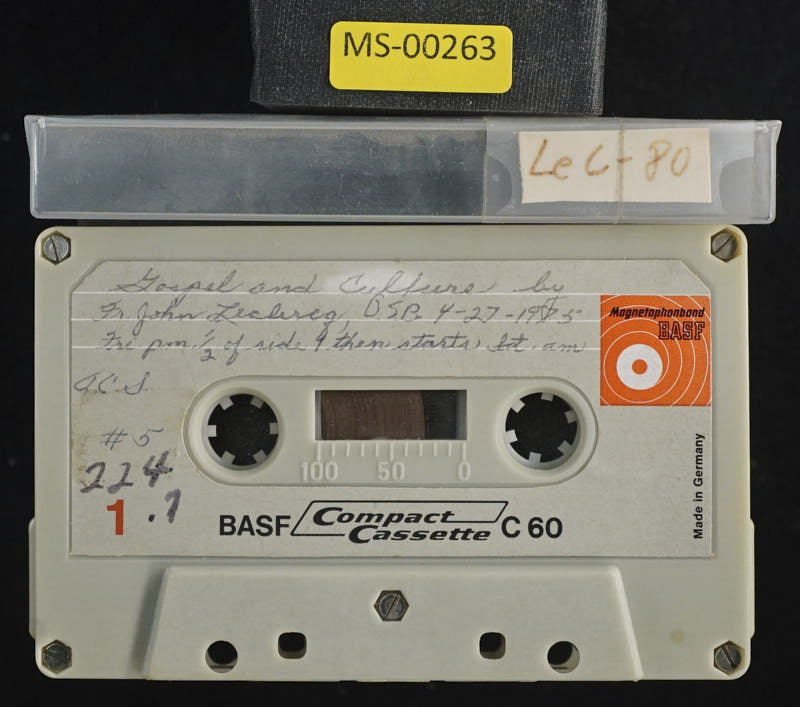
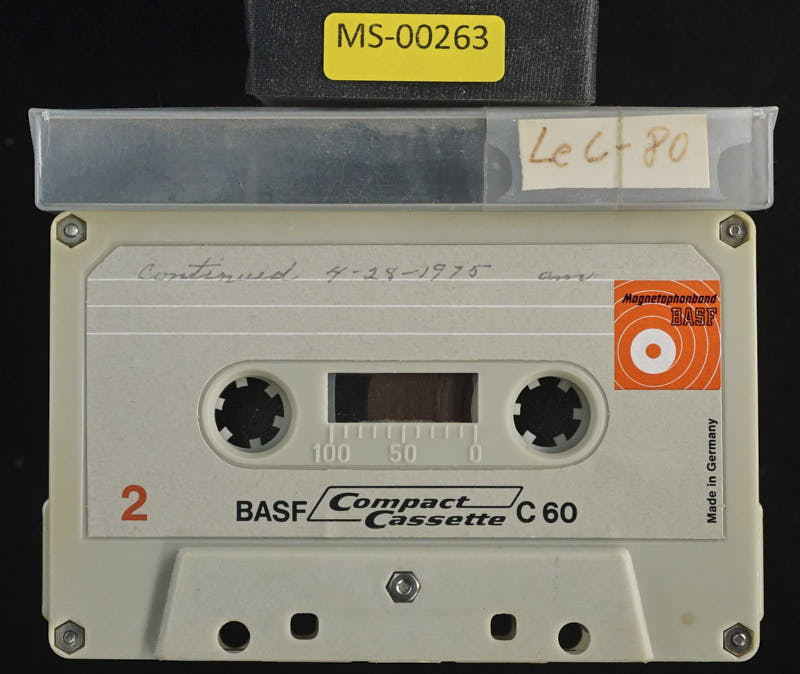
AI Vision - Possible Values from Photos:
Side: A
Speaker: Fr. John Eudes
Possible Title: Eternal Christmas
Additional text: bs.
Side: B
Additional text: Continued
@AI-Vision_v002
Now, there are, of course, now several ways, you know, of how to continue this, so complete it and so on. One is, you know, that we still maybe continue to, maybe in this whole agape business, to present two things. One is that the agape is that inner organic unity which is apt to give to our teaching is certain, how would I say, vitality, one can say simplicity, together with the possibility of really sowing the seed into the souls, you know, so that the souls themselves then can begin to think and to develop, to grow in this Christian truth. The Lamb is the light of the heavenly Jerusalem, as the apocalypse says.
[01:08]
The Lamb is the incarnation of the divine agape. Our Christian kerygma, our Christian preaching, has to have this inner coherence. It cannot be simply in order to be able to pierce and to transform the hearts of men. And that simply is not the case as long as the Christian message is presented as a series of various propositions, whose interdependence does not come into view. Especially at the present time, it looks as if one after the other of the truth. of Christianity is being laid open to attack, either by new discoveries, let's say, about man's evolution, or by new attitudes, freedom of conscience, progress, overcoming of tribal ways.
[02:16]
Every time a new threat appears at the horizon, the apologists jump into the breach. a procedure which becomes increasingly questionable as this growing experience of history, people begin to realize that at least a great number of the propositions which have been defended with the heaviest guns available in the fortress, been out in the end. So that, of course, is not apt to foster an attitude say, of inner strength. It rather fosters an attitude of wait and see instead of shoot and kill. The most important aspect is, of course, this, that this kind of situation leaves the initiative constantly to the end.
[03:22]
And that, in the end, may lead to defeat by sheer exhaustion. The way to victory is not moaning or defense, but the attack with an Alleluia. We have in English history an important turning point. It's called the Battle of the Alleluia. And I would say that is about the office of the Christian preacher, in our case, in our times. As the famous, meantime famous preacher, you know, in Holland on Christmas Eve, you know, went up the pulpit and said, I am not come to resent you with another problem, but to renounce to new tidings of great joy. So the suggestion would be center on the agape.
[04:26]
Try to focus things. And there, of course, it's true, you know, it's evident, the agape can only come to us through a revelation, a declaration. There's, of course, the inner line. This is a little too much agape. Too much hallelujah. Of the inner life of God. Nobody, as Saint John says, has ever seen God. But he who was in the Father's bosom, he has made him known to us. It's all the language of the agape. He who was in the Father's bosom. He has made him known to us. And there it is clear, you know, that, let us say, the inner light of the Christian message, the soul of the Christian message, that what makes it living, is the infinite desire of the Father to communicate himself and do this completely without reservation.
[05:49]
descend, become one of us, be with us in tribulation. Therefore, not that of a philosopher, you know, that's not truth, to announce to a master who has to introduce his disciples into a method, you know, then or something, but this is a completely different proposition. But one cannot understand. For example, the other day, I was in Ithaca, and a friend of mine, who is a teacher there, professor, presented me with a proposition which, it's another professor, linguistics, had proposed, and he said, the distinction, this was his formulation. The distinction between theology and science lies in this.
[06:51]
Theology makes statements which broke no contradiction. Science makes statements which broke contradiction. I think it's a terribly primitive form of putting it. And of course, if it's taken out of the context, what kind of statements are made, you know, in Christianity, in announcing the glad tidings, it's taken out of the concept of agape, of love, it simply becomes a kind of mental tyranny. At least it looks at it. Theology makes statements, it's no contradiction, but this is not the historical truth, but I mean it's... Interesting that for an outsider, that's the way it looks. Therefore, theology dictates, you know, either you eat this or you die.
[07:53]
But I can't change. This is it. Finish. Plus. But science, loving, you know, very humble, you see. Yes, perhaps this way. I don't know why they speak about physical laws, but I mean. And then let all books contradict. So, this is, of course, true, you see, this kind of infallibility, if you look at infallibility as separate from the agape, it's absolutely immortal. And therefore it's so important, you know, that we see all these Christian truths as really various aspects of one declaration. this declaration of the divine agenda. I love you first. I am with you in tribulation.
[08:55]
That's the underlying basic proposition. And you can apply this if you want to all the various fields of theology. Take the whole doctrine about the Trinity. The usual reaction on the part of science, with all the, you know, reservations about broken contradiction, is that one cannot be three, nor can three be one. Again, you know, as soon as this, let's say, the message of three in one and one in three, is taken separate, you know, as a logical proposition, philosophical proposition, not as a manifestation in a revelation, let us say what we may call the mystery of the inner life of God.
[09:57]
We are just finished. Cannot hope, you know, for any kind of an acceptance. But of course, in the concrete life of the church, that has never been the case. God, Son, and Spirit. Christ's baptism, this is my beloved Son, in whom I am well pleased. So that is, let us say, that's the essence, you know, the inner divinness, then we like to come. But then, there is the Father, the Principium, the Abyss. of the agape, as St. Ignatius calls it. Him, the abyss of the agape. The principium, the principle. The sun, the image being engendered by this abyss of the agape.
[11:01]
But, of course, as its perfect, absolute image. Equal in essence. The complete communication. Father giving himself in that way, completely, totally to the Son. And then the Son giving himself totally, completely to the Father. And the bond which results a person, the Spirit. Not a neutral power, an energy, but a person. All these are agape terms. The Son is sent to make the Father known to us. The Word has become flesh and we have seen His glory. That's, of course, not an intellectual communication. This is not a proposition of making proposition, let's say, that broke no contradiction.
[12:05]
This is in itself is a life mystery living communication. Philippians, he did not think it equal with robbery to be equal to God, but he emptied himself and he became man, one of us, a slave, and died for the death of the cross. And there comes the whole asset, you know, the resurrection. That is, again, you know, can be understood only on the terms and in the light of the specific divine agape, this new thing that God communicates and which He says, and not only says, but does, you know, creates us.
[13:10]
By dying for us, that means by loving us until the end. And this, of course, this love until the end, God is charity. He is charity. He doesn't preach charity as a ritual, but he is charity. It's not a kind of a sentence which is said, you know, with the power of an abstract statement. It's a living word. Therefore it immediately asks a response. And there is, of course, this response, everything, this depends on the response.
[14:17]
And this in Paul's sense, you know, if somebody gives all he has for the poor, and he does not have agape. And if he uses life. And if he's burned today, he doesn't have agape, nothing. So that immediately makes, you know, brings the agape into focus, you know, as something that is interiorly essentially different from any kind of mere anthropophilia human law absolutely different and of course who understands you know this agape in that way is not simply if I give all that I have to the poor and still have no agape so the agape not identical
[15:42]
You know, this kind of suicide, so to speak, or self-giving oneself, maybe in a general milieu of hatred. It's absolutely possible. That's not the agape. So this agape, which is in itself, does not seek its own being. decisively does not see its own. If this agape dies, then this death is not the end of this agape, because death is always the killing of the self, the self or the ego, what we call the ego. This is something different. So therefore, when this agape dies, it's evident that this agape is stronger than death. and therefore the resurrection, therefore the Pascha, therefore the whole history and celebration of the Passion as something which is filled, you know, we have seen His glory.
[17:01]
The death on the cross is an exaltation, an exaltation, and as such it is glorification of the Father. and the Father glorifies me. That's how the Lord says. The result of this Pascha, which is again understandable only in the general context of this agape, does not seek itself. The result of it is not an ethical association, but it is the body of Christ. Vine and the branches. That means same life, if you want physically, we say spiritually, Neumann. But how is this constituted, this completely new kind of unity, essentially different from anything the prophet brings about, anything a philosopher brings about?
[18:07]
is then constituted as clamorous and quiet, as it were, for the sacraments as the center of this life. Eat. This is my body. Eat it. This is my blood. Drink it. No prophet and no philosopher would ever say anything like that without having the feel that he might poison But Eucharist, you know, that is a gross thing. If you look at the Eucharist as the making present again among us of this Pascha Domina, of this transition, of this transformation, of this victory of the Agape, of this power of the Agape, stronger than death, It seems to me it's very interiorly, shall I say, logical to have in this inner center of the life of the church Christ as the host.
[19:28]
That means Christ not as something simply one among many, but is the host, so that the Eucharist really can be the sacrament of unity, community. And that again depends, of course, on our willingness, all of those who are Christians, that they recognize that we are nothing but branches on the vine, that we live through him. It seems to me that, looking at it from this point of view, the priesthood, Christian priesthood, I would say, in the light of the divine agape. And at the same time, during this time of our pilgrimage, we are not yet at the end. But we are in the messianic, one can say, in between.
[20:33]
Let us say history and eternity, let's put it that way. that in this stage that we have two things, one which belongs absolutely to the fullness of divine communication in the agape, and that is the general priesthood of all the Christians. St. Peter's first dogmatic statement, you know, that he made as head of the church, to say, now don't be mistaken, This is not any kind of drunkenness, you know, because it's about nine o'clock in the morning. But this is what Joel said, and this isn't, this is, I say, what did I say? It's a statement. And in that way, infallible statement. This is what Joel said, that the spirit really poured out, you know, over women,
[21:39]
and men, old men, and young men, and slaves and lords. It's about all social distinctions that you can put it on a shorter formula. In Christ, therefore, in the Spirit, in this fullness of the will be all equal. But at the same time, there is this universal priesthood of all the Christians. is an absolute fact in inner coherence with the absolute love unto the end that we receive in the outpouring of the Holy Spirit. And that doesn't know any by itself, doesn't know any distinctions, but is universal for all on the part of the one who sins, who is the abyss the principle of the Agape, but that's also the special priesthood.
[22:46]
For what is special priesthood? Because the Agape simply demands as its framework that we really and truly receive, that we don't conceive of ourselves as essentially giving. but as receiving. Therefore, that our agape, the reality of our agape, includes, for example, obedience, you know, this obedience, get out of yourself to listen what love has to say to you. That's what we call obedience. So in that way, there is certainly We had once, in that context always comes to my mind, we had a kind of, we had a symposium, you know, of Catholic and Protestant theologians on the various propositions and so on, especially we had, especially looking on the liturgy, and it came in the end, it came to this, that our Protestant brother said, yeah, tell us not absolutely frankly, you know,
[24:05]
can, according to your teaching at the Catholic Church, the priest, can he do something that a layman cannot do? You see, as soon as you put it on, Ms. Creighton, the whole horizon of the agape disappears and it becomes a proposition of power, equality of power. Somebody could do something that somebody else cannot do. This is a mortal sin. I would say that's not even true in heaven. But let us come then to the other part. I just indicate, you know, these various things, because there is... These are, I think, today one of the main reasons for our crisis, you know. is the neglect, is the forgetting, that Christianity is essentially, one can say, the mysterium, and that means here, the manifestation to us, and that means the actual communication to us of the divine energy.
[25:23]
If I don't realize that, then I could say, as a priest, I'm not relevant because mumbling some words, you know, this is my body, this is my blood, you know, and so on, that's not relevant to people today. Hence, you know, in which, what is your background, what is your world? Do you live in the world of arrows, you know, and that means bigger and better things, you know, that means social progress, you know, I'm not against it. But I mean, if I see that as the quintessence, you know, of life, if that is the one relevant thing, maybe, but of course, then I miss the point. And I miss the point, I think, in a thing which really and truly is tremendously relevant. I'm personally absolutely convinced that why we have to do, to try everything to make, you know,
[26:29]
to have everybody share in the pie, so to speak. That was always been Catholic to our doctrine. That's reason, you know, there's always been Catholic doctrine that you can steal. That means stealing, take, you know, what you need in order to live, if nobody wants to give it to you. If you want to call that revolution, yeah, then Christianity is indeed very revolutionary. but of course always in the context of this divine agape. And that means that in last analysis, even if you have the best social circumstances and the best, let's say, distributive justice, system of distributive justice that anybody could ever imagine, and if the whole world, you know, will all the time, you know, come to the point where we live in a constant condition.
[27:30]
of boom, prosperity. And still, mankind would not be satisfied. People would not be in that peace. Because it is said, if you give all that you have to the poor and you don't have the agape, it's just nothing. And that is, of course, the important thing. And this agape can be received only in faith. Let us maybe just, you know, still say a few words then about the individual application. As soon as we realize that the Christian preaching, declaration, glad tiding, are the glad tidings of divine agape, then it is absolutely essential that we find our own personal contact with.
[28:39]
Agape can only be lived. That's the essence of all love, all love. And there are just a few things. I would say that on the whole and seen in the context, you know, of the this communication, revelation of God's absolute love unto the end for us, for all of us. And in this context of this divine agape, I would say a method of keeping in contact, of growing in this agape, is absolutely not against the nature of the agape. Some people say that under these circumstances, then, Christianity can never be a question of method.
[29:40]
I wouldn't say that, but I would not say that our method would be, let us say, these constants, you know, as we have it in the East, not that I think we could somewhere you see these, let us say, absorb these things, but that it is essentially bound up with a process of Zen techniques which aim at the emptying of your mind, at letting all desires die. and that this is only possible by concentration, a concentration on an object which in his service, as the Japanese say, move. I wouldn't say that that is really this kind of really what in the Christian context is.
[30:46]
And it's very interesting, you see, maybe there are things that we don't even ever hear because we are at the present moment in this thing, which I think is very beautiful, that we have this in our openness, but let us not, you know, indiscriminate, you know, but the East has the real solution. And the West has been, the Christian West has been on the wrong line all the time. It's very interesting, South Korea is about the only place at the present time where still there is a kind of juxtaposition or living, at least close to one another, of Buddhist monasticism and of Christian monasticism. And it's very interesting to see that when Buddhist monasticism really comes in contact with Christian monasticism, and this Christian monasticism is understood on the lines of the Divine Agape, the Buddha says, oh my, no, here, really, there he is.
[31:52]
the advantage, the fulfillment, you know, somehow, the reality is there. First, it's always something that we are never quite sure of. If it is there, if it is not there, and if it is there, what it is. It's a constant waiting, in fact. It's a constant waiting. It's in some way a kind of getting lost in the void. Some people say, I'm not an expert in these things, that that is really the essence of nirvana. But that is, of course, not the essence of Christianity, I think. Christianity, in that way, is essentially a meeting, an encounter. And an encounter between creature and creator. between created person and the person of the creator and the redeemer.
[33:00]
But both the soul of creation and of redemption is agape, not the divine wrath and all that. You see, if you sinned against me, you have to do penance for it or something like that. You have to be punished. It's not the essence. But the essence is this inner is union. And this union is, as we call it, beatific vision. Of course, we have no other terms. Of course, the term vision, at the same time, emphasizes the fact that this is not a kind of fusion into an indistinct kind of physical union. But it's the person of meeting. The I, I myself, come to myself, to the real self, by being loved by the self.
[34:07]
That's my going on. That is the abiding reality. That is for which the house has been built. That's why we have a church, and by no other religion, the entire world has a church. To my mind, this is... And if you speak to the Indians, and you speak to the Japanese about it, seriously, say, this is the big difference that we see, and in some way we envy you for the church. At the same time, now at the West, we kind of tear down. Fatal mistakes. But the personal, you know, this inner, let's just say, this whole Communication of the Divine demands of us, you know, is certain, I would say, a certain method. I think one of the things in which the West really has kind of failed, you know, is either, you know, offer an infinite variety of methods.
[35:15]
Let's say, one says the exercise of the indignation. That's it. Personally, I would say that the exercise of sending natives are, if one takes them really in their inner, essential inner meanings, are a tremendous school of the Divine Adam. And that's probably true of other way. Of course, there you have the Spanish mystics, you know, and in the Spanish mythology you have St. Teresa has many castles, And there are many stories, you know, and of course it comes to stories. It's then, the question is, what is deeper and what makes the difference between the lower and the higher? And if one then comes to, for example, to the conclusion that the difference between the lower and the higher would be the degree of immateriality, that means the degree of spirituality,
[36:18]
and then understand spirituality in a psychological sense that says, therefore, oral prayer is essentially lower than mental prayer, then I would say, now let's be very careful, and look at it in the light of the Divine Aga. Well, community prayer is usually oral prayer. But this has been said, where two or three are gathered together in my name, I am in their midst. So in that way there is, I would say, a method, you know, possible, but this method again should be oriented, directed, you know, by the very structure of the Divine Agape. And then in explaining this kind of thing, I would say certainly that the beginning of entering into the agape is in some way an act of letting go, of entering into the West, of a primordial trust, not a blind primordial trust, but as a response to a total divine invitation.
[37:45]
Let me carry your burden. That is the whole meaning of the love, carries the sins of the world. Let me carry your burden. Of course, there it is very important for us that we don't say, ah, that's all right, you know, but I mean, it's a little exaggerated. Maybe I have my own burden and I have to carry my own burden. In some way, maybe I want to carry my own burden. Many people have told me that I'm staying speaking about the divine agape, I said, oh, you should never, you know, receive something that you have not looked for. Difficult proposition, especially if it goes about the divine agape, you know. How does one work for the divine agape? I would say that is simply, you know, there is The beginning of the whole, and one can say, at the end of our original life, the everyday life, the every minute life, no moment in our life is completely free of anxieties and fears.
[39:00]
No moment of our life here on earth is so absolute clarity that I wouldn't search for further clarity. So there is always darkness in various degrees, in various situations. There are always dilemmas in which I find. I can't make up my mind, what do I do with that? Decisions have to be made all the time and decisions are not always easy for man. But if one gets here, if one realizes that our daily life Our whole existence, as Heidegger puts it, is kind of hanging over the abyss of nothingness. It's a typical German picture too, I see. A little exacerbation, I see. But they have to live, you know. As my teacher always said to me in Rome, you see, Thomas is just typical.
[40:09]
Bottomless profundity, isn't it? So, that is true, you know, that's something to it. But we can bring, you know, this whole, let us say, anxiety, it's a wonderful word, everybody uses it today. This whole anxiety, it can always be brought to this, on this simple formula, for us Christians, what is this anxiety? Simply, if you want to define it, say, I lost the peace of Christ. That's a formula, I think, which is absolutely valid. I lost the peace of Christ. Except for the thing, you see, that, of course, the statement, oh, I'm anxious, I don't know, I'm in a state of doubt, confused. If you say that and then
[41:10]
say, oh yes, it's true, I'm confused. And then you stare at your confusion, you become more confused. And that is, you know, another one. You drill yourself into the whole of your own confusion. And there is, of course, the difference if you put it in this way, in the light of Divine Agape, instead of centering on yourself and saying, I'm confused. and anxious. I feel my insecurity. And then, of course, sometimes, of course, the answer is, oh, yes, of course, you should feel it. This whole business about the agape is just, you know, flight into the womb. What's wrong with the womb, I would say. There's an answer to that. But I mean, there it is. Now, if you take it in the context of your own baptism, it has happened to you and there it is, then of course you would say, yes, I lost the peace of Christ.
[42:19]
Baptism meant my rebirth into the peace of Christ. Eucharist means rebirth in the peace of Christ. Union and life in the peace of Christ. Communion. What is peace? Peace is communion. In that way, all around communion. Now, if you say, if you define it and you say to yourself, I have lost the peace of Christ, then immediately the very statement evokes in your mind this conclusion. I have to get back into the peace of Christ. You see? They are immediately a perspective open, a direction open. What is the peace of Christ? The peace of Christ is essentially my realization of being loved absolutely by Christ, being accepted by Him in this way that He died for me.
[43:29]
He carries now my burdens. If I make that clear to me, now in every human being and human person's life, there will be a realization that he or she is being loved. There is one who loves me. Gives a tremendous inner liberty. Gives, evokes this what we call primordial trust. which is stated then also on our side also in the realm of human law, in superlative, we forever is immediately in our tongue as soon as we realize there is the one who loves me for better and for better, for poorer and for richer. That's true, you see.
[44:30]
Now, if this, if I take Christianity, let us say, at its face value, so to speak, then I realized that the one big, let us say, desire of the Father, of the abyss of the agape was, I want to get through to man with this message. It's an appeal, you know, to open up and to trust. and to trust God, and that means absolute trust, and that means mercy forever. Now, if I see that, you see, and then I realize that, and I, let us say, evoke in myself, you know, the analogies and the associations that I have experienced in any human contact, although it's certainly
[45:32]
in any contact of friendship, of true friendship. And there, I would say, there I must confess that I have, you know, changed in some way my own view. It is not right, it seems to me, to put the agape immediately into absolute opposition to what we call the arrows. natural striving or natural blossom of the inner
[46:06]
@Transcribed_UNK
@Text_v005
@Score_90.38