You are currently logged-out. You can log-in or create an account to save favorites and more. more info
Transforming Christianity in a Modern World
AI Suggested Keywords:
The talk centers on the evolution and challenges of Christianity in the modern world, reflecting on its historical transformations and the current state of religious practice. It discusses the role of secularization, the changing geographical center of Christianity, and the impact of modern societal issues on religious identity. The talk also delves into theological discussions around concepts like non-violence, original sin, and the necessity for a new religious education paradigm. It references the role of media and cultural forces in shaping desires and perceptions and critiques the institutional Church's responses to contemporary issues, advocating for restorative justice and a reexamination of religious doctrines.
- Margaret Barker: Influential in exegetical work connecting early Christianity with ancient rituals. Her insights are utilized by modern theologians like James Allison to reinterpret doctrines like original sin.
- René Girard: His theories on mimetic desire and violence profoundly influence modern theological discourse, impacting thinkers like James Allison and Rowan Williams.
- James Allison: Discussed for his work integrating Barker's exegesis and Girardian thought to teach non-violence and reevaluate Christian teachings.
- "The Next Christianity" by Philip Jenkins: Notes the demographic shift in Christianity's center to the Southern Hemisphere, indicating a transformation in global Christian dynamics.
- "Resurrection" by Rowan Williams: Recommended for its integration of Girardian thought, challenging theological assumptions about the effects of Christ's redemptive act.
- "Dare We Hope ‘That All Men Be Saved’?" by Hans Urs von Balthasar: Explores controversial theological notions of universal salvation, challenging traditional perspectives on hell.
- Restorative Justice: Highlighted as a pivotal, yet underutilized Christian principle, urging a shift away from retributive models towards reconciliation.
- Discussion on Media Influence: Examined through its role in fostering mimetic desires and shaping cultural and religious landscapes.
AI Suggested Title: Transforming Christianity in a Modern World
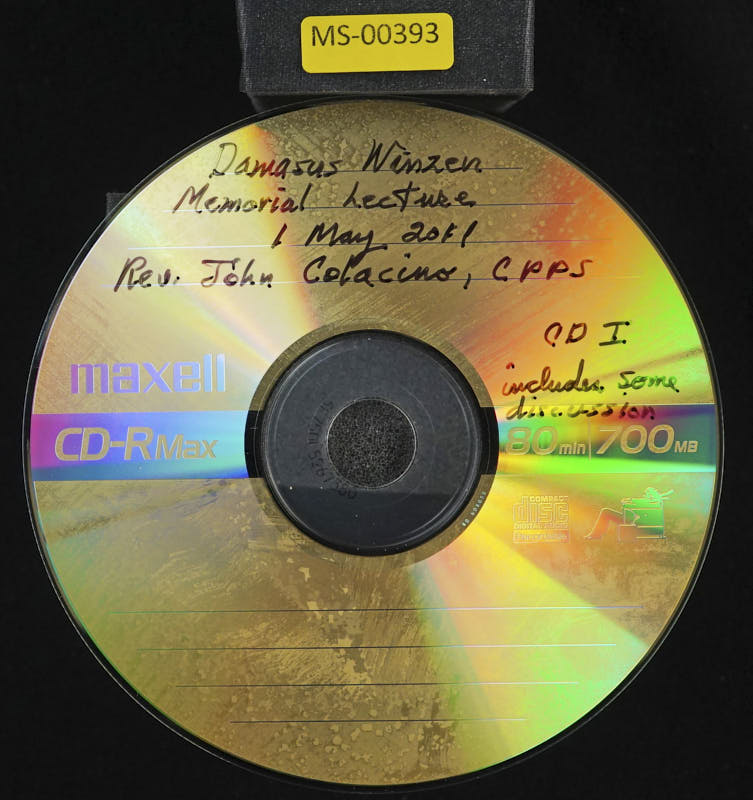
AI Vision - Possible Values from Photos:
Side: A
Speaker: Rev. John Colacino, CPPS
Possible Title: Damasus Winzen Memorial Lecture
Additional text: CD 1, includes some discussion
@AI-Vision_v002
CD contained 9 m4a files
I'm going to pass in my mind. Some of you are interested in reading a little bit of Mark and Park, and this is probably the most accessible introduction. You can pass it. Yes, I'll start with the question. I found myself saying, oh, well, a year ago, someone Christianity is spread across people about what has changed. We have, and I've heard little English in here talk about what, I guess, what hasn't changed yet and where Christianity has kind of gotten off the path.
[01:01]
So any thoughts on where that started? It's just a feeling that just came over me. Well, you've heard Chuck Stevens famous say, it's not that Christianity has been trying and wanting it, but it's never been trying at all. It's a great job. Well, you know, of course, people like to put the blame into the voice that Constantine, when he regularized Christianity, and then became the official imperial religion. And so then gets bound up inevitably with the political and economic concern. So it's kind of snowballing. We're living, however, in a time because of secularization, de-Christianization, the steady erosion of people's, what's the word, excessive attachment to the institutional forms of Christianity.
[02:12]
It's a new day, I think, in Christian history, for many reasons. But Imperial Christianity was probably one, Christian. is a fine mark, and it's lost to the park. What it will become as it morphs in this third millennium? I mean, a socialist by the name of Jenkins has written a book called The Next Christianity, and believes that the whole of the Christian world, for one thing, is shifted now to the Southern Hemisphere as the major axis. It's no longer Western European. So who knows? But one thing is for sure. Christian is because the city and church and all of us different aspects there are a lot of people who like it to be resurrected by the way but I don't think that's right now the Lord has changed to me that's not an answer with those it's a yeah that's a long term discussion well just that one little thing can you read it
[03:24]
I see it completely different. She's done incredible. You mentioned James Allison. How does he fit into this? James Allison. I met Barker and Gerard through James Allison. James Allison's recent work realized heavily on Margaret Barker's exegesis. And of course, he's always been a Gerard. And when he wrote his doctoral dissertation, it was basically a reading, conceiving of the document of original sin through Gerard. You talked about nonviolence.
[04:26]
Do you think it can be taught... Can you think nonviolence can be taught, say, beginning with child development? James Allison, his next book, to be public, is a cataclysmic, which tries to, as you say, teach nonviolence. He has come up with a... program, let's call it, a religious education that takes all of this material and tries to make it accessible and instructive. And in terms of human development? Yes, the whole thing. Very exciting, actually. Because, you see, these problems all start in religious education classes, right? And then we give these impressions about the God who's French or violent. We don't draw these. Yeah, it's true. What?
[05:27]
I've been students, you know, I've been students in Los Angeles. You know, they look at the person and say, it's not a guy. But then I've seen it. Right. See, they're seeing it this other way. It's a tragedy. It's a tragedy because this is a compelling lesson. This is a, this is the, excuse my language, the true thing. But, I mean, this is it. It's the most exciting thing in the world. Why do you think it was called good news? But so often it's come across as mediocre or grand news. So what do you say to your students then? Can you say what they said today then? Don't try it. You know, they're already glad. I'm not sure. Go ahead. But that's that. You know, I'll tell you something.
[06:29]
There isn't the hostility or the difference even toward religion that there might have been perhaps in their parents or their grandparents. There's simply a vacuum. Vacuum is, of course, nature always. Something always. That business tries to be the dog, you know, the dog. These are very long of the kids, I mean, don't they? They ask, when I was the same boy that I was in teach graduate theology, I figured they'd say to me, what would you do there? I got a little bit of a step down in my life. And I said, excuse me, they're soldiers. And they are more receptive than you might think. I think it's important to be the first one to start coming back.
[07:37]
It's a race. So this might be an unfair question, but in the magisterium of the church, do we see any message, I mean, any message coming from the magisterium that takes this new way of thinking as you put it, begin with that. Well, first of all, you have to be really careful because the magisterium does not have any kind of official doctrinal redemption. There are theories, theological theories, but there is no, surprisingly, there is no defined way to understand this.
[08:47]
The new creed is very simple, right, for us and for our salvation. So there's a tremendous leeway, actually, here to do all the things to reflect. You're definitely going to be too much trouble in this particular analogy, as you might mean other . But, well, did my nurse have received a huge push on the magistrate of at least John Fulton II. But I look at the insurgents of that, and not so much the magisterium as the sense of the faith, the sense of stability. This has captured, captivated people. Do you want to know who the first person I want? I know who told me that he praised the chapel of the Divine Mercy every day, using his iPod and his car on the way to look. And he pissed him out and laid him. Well, that tells you that this is reaching much closer than you might think.
[09:53]
But I consider this to be a segment of the notion of the sacred part that being so popular in the 18th century. It converges first, I think, from a part to the Christian people, then the Manchester United States. I think that's what's happened. So I'm struggling to make a connection between the Bolshevik took by adversity that people are having and at least the insight that I just, that I just got. I mean, the core, the core, you can leave aside all the devotional practices. Those are all mis-seccable. The core of this is that mercy is the highest attribute of God. That's the core. And this mercy, has been ritualized among the people of the first, especially in these ancient rituals of atonement.
[10:59]
Christianity, early Christianity seems to have been part of a anti-temple center, put it that way. He began to interpret the death of Christ in light of these atonement rituals. Well, I bring out the emphasis on Christ as the, instead of, unless you see, as the essence of what is, the ritual was undertaken by God himself. See, that is this about the identification of the high priest with the Lord. This is something new. A new insight that he brought up. but brought forward from it. Right, so again, it's not appeasement. It's about, you know, it's not appeasement. That's the thing that's a great, that notion that God needs to be, to lose, like what? I'm so, I mean, I'm so, what Mark was saying is that the early difficult, some of you have received that
[12:12]
insight, that understanding of God, of God, is mercy. As you said, and then it's kind of very common with the Dr. Taun. I mean, still in the Hebrew Bible, in so far, it's God's highest attribute in the Hebrew Bible, as I've said, that that could be translated to mercy or mercy as well. John, to contribute to recent Time Magazine, The cover talks about how by a Bob Bell, I believe it is. I don't know. He has 7,000 people every Sunday in this congregation. It's basically the old real ritual taking place. We have a discussion on various topics. He has put out a book about God's love and questions the existence of hell. Oh, he's the evangelical. He doesn't have a great career. He's got himself in a certain amount of trouble, hasn't he? He was on Good Morning America, and, you know, among the evangelicals, he's Satan.
[13:19]
Right. But he's challenging one's thinking about hell, and I see some sort of a connection with what you're saying, with thinking about vengeance, and how we hold hell over people's heads from the time we started going to rape school. You know who this Catholic counterpart is? It's from Balthazar, one of the great, one of the two great Catholic theologians of the 20th century. But he wrote this book. See, for a long time, Balthazar was sort of the poster boy of a more conservative kind of football. When he wrote this book, Dare We Hope, that all people are saved. People were normally very sympathetic to him, just like these evangelicals, who said, all right, we're going to get rid of hell. So when he said that, he said, there we hope.
[14:21]
But then he has this very profound theology of Holy Saturday, that the descent into hell is part of the Paschal mystery. Holy Saturday is not something to be skipped over from Friday to Sunday. Then from all desires, there is words. Hell, as a consequence, is a Christological place. So that even into whatever hell means theologically, the effects of Christ's saving mystery have now penetrated their truth. And what that means. But let the... I have to think about that. Do you not care? In thinking with... with some evangelicals, you know, would you be surprised if you went to heaven and found Hitler and Stalin was sitting across? Now, a lot of strong Catholics for thinking is they're in hell for sure. Well, let the Roman Catholics, by the way, remind people that we have another little wrinkle in this picture called Persia.
[15:31]
And Hitler and Stalin purified in whatever that means. I'm not talking about planes. But whatever this process of purification means, that they could potentially have experience. It's part of this process. you know, you know, you're up or you're down. We have a understanding of the post-mortem process. By the way, if you want to read, you know, you all saw yesterday marry William and Kat. Okay. One of the top five theology is alive at the moment. And he thinks very much of Gerardian parents.
[16:34]
The role of what I recommended to you for your Easter reading is called Resurrection. He saw Gerardian that he accused of plagiarism. When it was published, he had done read through it. And he writes this quote, that's like, oh, sure. Yeah, but in a substitute edition, we sort of have to say, you know, I'm sorry. I didn't put insurance on that. But anyway, really, because you see there are sections in there, a lot of aspects of the poor living thing. And the image of God is not very famous, even by the most angst. And so you want to talk about a challenge to Christian spirituality in point when rubber meets the road and these ways of thinking? You have to see the angel coming up. As startling as they visually repulsed them as that may strike you. That's when you take it to that extreme, and then it's easier to look at being an absolute name.
[17:45]
But if you read Robert Williams, that is a Marvel school book. You'll get Gerard in other words. And he talks about, you know, the channel system, which can only, you know, the victims of victimizers, you know, and all of them. I have a friend who got a master's degree at Harvard Divinity School on writing a paper on your storage of justice. And it was with a woman. That is the way you go. Our world doesn't think that. We think in terms of friendship. We think vengeance. The word you listen to, I want justice, what they mean, and I want vengeance.
[18:51]
Right. This movement of restorative justice is so thoroughly Christian. Whether it's done by Christians, you are not. It is a way of capacity to attack. I think I tried to go away, to very well. I'm Christian, I want to think I'll follow you. And you're having the power to show you. Yes, yes, yes, yes, yes, yes, yes. And our church where we were casted stones to prickly, you know, outside. We live in a very thin, play-class house, folks. At the recent events, . What's your events when you're talking to them? The old priest, you know, the whole victim, Frederick, you know, we continue all day, and people will plan.
[19:59]
You can look at the old, it's in the middle of that. Often. Well, let's put it as a, it is now restored and adjusted in the current way. It is not himself. And there's not the Trinity we have as a church. to show the world the things that we talk about, like healing, forgiveness, reconciliation, restoration, whatever these wonderful words you want to use might be. You have an instrument to show the world a different world. Are you taking it? No, no, no. connected with what you said, and they hadn't lied through it, where that desire is created things, not in it.
[21:19]
That's our, yeah, that's our modern culture. Somebody told them, this is the passion for the year, this is the truth to him, this is the thing to do, this is the place to go, this is the church to belong to, and we have to take our own clues from the Lord, and not from I can't imagine what would happen if the media stopped creating our desires. It would be no media. The media is fueled by other times. That's right. But I think that do we want to watch that in our lives? No. What do I want because somebody else has said I shouldn't want it? No, I just finished teaching a course called Church and Culture. And this had come up a lot, the consumerism, et cetera, et cetera. But again, these kids, I mean, they certainly recognize that they are, you know, toys in the advertising industry.
[22:24]
And they understand that, you know, the latest iPad or whatever they can do, they have to have, you know. So there's a lot of people who resist it. But there's certainly no answer that they're revealing us. That is unhelpful. created . That's what's going on. They seem to recognize it. I don't know that they didn't resist it, but they didn't recognize it. That's the first step. Well, I think there was some other hand up in the back. Well, it's going to pretend to pick up on your application of restored justice written on a telephone to the dynamics in light of the correlations is the kind of community that functions as a facilitated agent to be able to, use your quote from Damascus, I guess, bridge the gap between victim
[23:39]
almost as if to say there is no outside. And that's a very different group relations dynamic that breaks open the typical paradigm of collusion, which is very difficult to track when it's unconscious. Collusion might be. And that the leadership of the church can't get that. They didn't get that. The ones that they were on a radar screen that I saw were seeking. It's mind-locking. How do you read the Parasites of Jesus? It's mind-boggling to me that the church and its leaders could not see there were other ways to handle evict them.
[24:52]
That other outcome than, as you said, treating all class and outsider on both sides, the priests and . It's mind-boggling. It breaks my time. Like Christianity, we have to request to be. That's the thing to work. But it can work. It doesn't seem. Because I don't know what we have to do. Well, I don't know what it is. But we can't see if we are adherents of another point. Last weekend, the press finally kind of did some articles about church, like Christmas and Easter. Yeah. And talking about how numbers of decangelicals are packing their audience volumes for congregations.
[25:55]
I forget the person's name, but he has four services on a Sunday, packs them into a total of about 30,000 people. Thank you. That's right. And his message is, you know, to kind of give him a comforting, wonderful message. The thing is, I'm sure there's tons of Roman Catholics attending those. It's got the modern this, the modern that, and the family orientation. And, of course, our Roman Catholicism and our ritual is boring to a lot of people, you know, all that sort of stuff. So, with dealing, when you talk about religion and culture, culture is definitely working out. even amongst evangelicals, you know, give them a nice talk, pat them on the back, and with 30,000 people, boy, what a great collection, they gave a buck a piece, you know. Well, I think he rakes in a million bucks a week. Yeah, but I'm sure that, you know. But it gives a commentary of they're growing leaps and bounds, why, and even amongst the so-called institutional churches, there's fewer and fewer, you know, free to look at the question,
[27:07]
Meanwhile, the Vatican is just talking about revising the Roman Missal come the first Sunday of Advent because our translation should be more literal. We're dealing with this larger issue. Dealing with the issue of what I just said, what's going on around the world now. That's rather a sad comment. It was a precedent between the Roman Romans, right? You know, in the latest statistics, it was one in three adults who were raised in the Catholic Church, no longer, not just don't practice, don't identify as Catholics. One in ten adults in the United States with a former Catholic, but some description, whether they're going to another church or dropped out altogether. This is not, by the way, the non-practicing. Yes, and they are talking about, I'm not going to say on important things, but migrants, we are.
[28:17]
Thank you. Maybe it's necessary. I don't know. I mean, the whole church needs to be rebooted by the computer. Get the program to run again without dividing. I don't know. But it's an amazing situation. I think, Brother Gabriel, would you think we're going up next? Yeah, no, it was the question, you know, about the church and not responding to to what the opportunity at the time. But the bishop, they were so scared of the media and the lawyer that when you say, you know, zero tolerance, very forgiveness. The worst that you talked about, I think,
[29:26]
It's a more profound thing for us to counter than the Catholic church bones alone or any other member group. Religion may be the oldest form or among the oldest forms of that behavior, but it may be our structure of consciousness itself. The mimetic desire wasn't created by the ad industry. It's amplified by the ad industry. It's who we are and how we are. given to ourselves through others. So the project that you indicated by beginning with your humility and saying, leaving behind our accustomed ways of human thinking is a very substantial problem. It requires a discipline, reflective of the Benedictine community up here.
[30:14]
@Transcribed_UNK
@Text_v005
@Score_80.94