You are currently logged-out. You can log-in or create an account to save favorites and more. more info
Redefining Sacrifice in Divine Mercy
AI Suggested Keywords:
The talk centers on an exploration of the Divine Mercy devotion, framed within a theological and liturgical context, with specific reference to Margaret Barker's and René Girard's scholarly works to understand the intersection of atonement, sacrifice, and the Paschal mystery. The discussion examines early Christian interpretations of Christ's atonement through Jewish temple rites, particularly the Day of Atonement, and critiques traditional views of sacrifice rooted in Anselm's satisfaction theory, proposing instead a non-violent understanding of redemption through Christ. The role of the Eucharist and its symbolism in the tradition of sacrificial rites is also highlighted, emphasizing its unique position in contrasting archaic sacrificial systems.
Referenced Works and Authors:
- "Diary of St. Faustina Kowalska" - A key text central to understanding the theological underpinnings of the Divine Mercy devotion.
- James Allison - Acknowledged for introducing the speaker to critical scholars impacting the lecture's direction.
- Margaret Barker - Noted for her analysis of early Christianity's ties to First Temple rituals and her thesis on the Paschal mystery as linked with Yom Kippur themes.
- René Girard - Discussed for his mimetic theory and critique of sacrificial system origins in human culture and its impact on understanding the atonement.
- Letter to the Hebrews - Biblical text used to explore the theological implications of Christ’s death in relation to ancient atonement rites.
- "Secrets of the Temple" (Hypothetical title based on content) - Barker’s detailed reconstruction of temple rituals, emphasizing how early Christian worship practices drew from these traditions.
- Andrew Marr - Concludes the discussion by summarizing the material shared, particularly on the non-violent essence of Christ's sacrifice and the freedom it provides from cyclical violence.
These references serve to connect early interpretations of the divine mysteries with modern scholarship, offering an evolved understanding of key Christian doctrines.
AI Suggested Title: Redefining Sacrifice in Divine Mercy
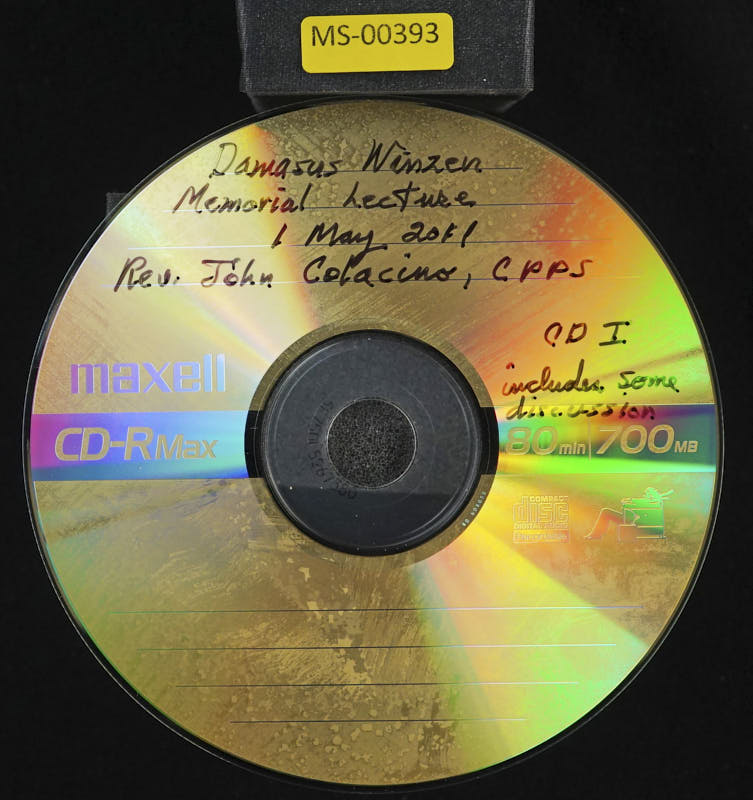
AI Vision - Possible Values from Photos:
Side: A
Speaker: Rev. John Colacino, CPPS
Possible Title: Damasus Winzen Memorial Lecture
Additional text: CD 1, includes some discussion
@AI-Vision_v002
CD contained 9 m4a files
insights into the mysteries which we have just celebrated during the set of the trip. There is, moreover, another happy coincidence, given the liturgical occasion we are celebrating this very day. Something, by the way, that required upon me an act of humility, in the spirit of Father Damasus, quoted the something which I believe has led me precisely to leave behind some accustomed worries of thinking, in the effort to come to a more faithful understanding of the divine realities handed down to us in the Word of God and in the Church's tradition. I return to this lecture being given not merely on the second Sunday of Easter, as we conclude the Paschal October, But I'd love the third typical edition of the Roman Missal also called, rather modestly, and in smaller print, to meet its major title, or of Divine Mercy.
[01:17]
As you might know, devotion to the divine mercy has achieved a remarkable notoriety and a reception among Christ's faithful, as propagated by an otherwise obscure Polish nun, St. Faustina Kowalska, whom Pope, now arrested, John Paul II, canonized as the first saint of the third Christian millennium. His death on the vigil of Divine Mercy Sunday in 2005 and his beatification today only served to raise the profile of this popular devotion. Now, here's the act that you know. For a long time, I found this devotion frankly repugnant. For years, I had a copy of Sister Christina's diary on my bookshelf which contained a record of her inner life, and which was focused entirely on divine mercy in her soul.
[02:26]
Writings replete with interior messages and visions, advocating forms of piety that seemed to me antiquated, to say the least. Every time I attempted to read Campastina's work, I could not get beyond a few lines. Part of the reason was my accustomed way of human thinking, an instigated suspicion me theologians have of private revelations, and another part was the language of the diary that I found and with the author's author. I've had, however, to record that my original reservations regarding the devotion to divine mercy placed me in some very good comfort. one example of surprising. That is Dr. Faustina's army virtual director, Father Sokol.
[03:28]
Among his initial reservations was the somewhat obvious one concerning Faustina herself. He was a person of very simple background, and yet who would cause him one day to remark in the following words, I was amazed that Steve A sinful nun, with hardly any education, ended up the time to read ascetic works, could speak so knowledgeably of theological matters, and such difficult ones as the mystery of the whole eternity, or the divine mercy, and other attributes of God, with the expertise of a consummate theologian. It is true. When I was finally able to delve into the diary, I remember my own astonishment that some things would be like a virtual treat of spiritual theology, with all the earmarks of theological learning and acquaintance with the masters of the tradition.
[04:42]
And so the diary of St. Justine finally compelled me for reasons once again given in her spiritual directors on the road. There are truths of the faith, which we are supposed to know and which we frequently refer to, but we do not understand them very well, nor do we live by them. It was so with me concerning the divine mercy. I applauded this truth many times in meditation, especially during retreats. I had spoken of it so often in sermons and repeated it in the liturgical prayers. But I had not gone with the core of its substance and its significance for the spiritual life. In particular, I had not understood, and for the moment I could not even agree, that the divine mercy is the highest attribute of God.
[05:46]
the Creator, Redeemer, and Saint. It was only when I encountered a simple, holy soul who was in close communion with God, who, as I believe, with divine inspiration, told me that she impelled me to read, research, and reflect on the soul. Let me move now from the mystological and liturgical context for this lecture to several populations, the first of which is a deeper appreciation of the very mystery of the Lord's death and resurrection we celebrated during the Paschal Trigger. And in what follows, I would like to acknowledge my indebtedness to theologian James Allison for introducing me to the two scholars whose work influences the remainder of this lecture, mainly the British exegete and philologist Margaret Barker, and cultural and the politics and literary crepe, Grenier Shebaugh.
[07:00]
To you, then, is the first level correlation I would like to make between the divine mercy and the Eastern mystery. The way into which is the identification we find in the New Testament between Christ and the mercy seat of the ancient temple in Jerusalem. What's called the delisteria in Greek and the paphora in Hebrew. And the important texts are Romans 3.25. God put Christ Jesus forward as a sacrifice of atonement for his blood. And Hebrews 9.5. Above the octave of the covenant were the charathom of glory overshadowing the mercies. Notice how the same word, igre, is translated in euthysm.
[08:06]
In the case of Romans, translators render hilasterion, It reckons to the atoning work of Christ, sometimes as propitiation. Whereas Hebrews refers to deceit, or conquest, over the pearl-like structure plagued by cherubim, the uttered portion of the Ark of the Covenant that existed in the Holy Apollies during the period of the First Temple, that is, in Solomon. However, translated, both passages have to do with God's eternal chesed for humanity. This Hebrew word being the defining attribute of God in the Old Testament, translated in the Septuagint, the Greek Old Testament, as eleison, and the Latin of Saint Jerome as misericord.
[09:09]
Both words are generally translated into English as mercy. But where do we find the link between the kidasteria and the hoppera for the mercy seat and the hafsaid, the emesos, and the ricordia of God to make our first correlation between divine mercy and Easter secure? For this return, to the astounding philological, historical, and exegetical work of Margaret Barker, and her reconstruction of the annual ritual of making the Divine Mercy effectual for Israel on the Day of Atonement, Yom Kippur. Barker's central and controversial pieces can be stated as follows. Early Christianity.
[10:11]
Now, what do I mean by early Christianity? Well, a particular form of first-century Palestinian Judaism. This early Christianity was rooted in pre-Puteronomic, that is to say, pre-exilic, first temple of Israel's religion. And while we cannot go into detail about how this differed, from Second Temple of Israelite religion, the temple standing in the time of Jesus. But our sectarian Judaic groups differentiated themselves from Second Temple practices and its priesthood, most notably at Puma. What follows is the related pieces relevant to our purposes, namely that the theology and rituals of the Day of Atonement from the First Temple period inform Christian understandings of Christ's death and resurrection, as well as the practice of Christian worship from the very beginnings of the Christian movement.
[11:23]
In this regard, perhaps, the most important thing Barker does for us is point out what we call the taskmaster. He is, in fact, a conflation. of not only the meanings associated with the Jewish Passover, that's clear enough, but those of Yom Kippur as well. In other words, the New Testament does not interpret the death and resurrection of Christ only against the backdrop of Passover, but also in light of atonement, most notably in the ninth and tenth chapters of the Letter to the People. In recovering the centrality of atonement themes for Christian religion, Christian origin, and Christian worship, Barker wants us to hearken back, as I've said, to the rite as performed in the first temple, when the talk of the covenant, and hence the mercies, were still present in the holy, but hope they seem to have been lost at the time of the Babylonian exile.
[12:32]
She wants us also to grasp, above all, the meaning attached to the word atone. This is all important, since for many of us this word and its cognates, such as propitiation, expiation, appeasement, are associated with the Anselmian substitutionary theories, which so feasibly conjure notions of a god, who could only be appeased by the offering of his son's blood in sacrifice. In other words, the understanding is still prevalent in the evangelical circles, and I dare say, many capital ones as well. Before attempting a re-visioning of such notions, let me briefly present Barper's interpretation of the pre-exilic ritual. essential to which is her painstaking reconstruction of the whole temple apparatus, from its personnel, its physical layouts, and its rituals, as a system of representation, where each earthly item in the temple had its heavenly comfort.
[13:59]
She said the traditions say that it was an exact replica of the service of heaven. This was especially true of the high priest, who was understood to represent the Lord, that is, Yahweh, whose name he wore on his forehead, on his mic. The subject of the atonement rite was therefore God himself, acting in the person of his earthly conqueror, the high priest. She summarizes it as follows. The key figure in the rite of atonement was the high priest, who was in the visible presence of the Lord, that is, Yahweh, on earth. And just as the Lord had ordered the creation at the beginning, so he recreated it on the day of atonement, at the New Year.
[14:59]
We recall that the Jewish High Holidays begin with Rosh Hashanah, the Jewish New Year, and conclude with Yom Kippurah, the Day of John. The original itself, as reconstructed by Parker, runs lots in art. I have a couple of them now. Here to give you some visuals of the Holy of Holies, also called the Tabernacle, and then the ancient temple. And you can pass deeper than that. Oh, it's the soil. I mean, visualize all of this. On the day of atonement, this eternal covenant was renewed. and blood was sprinkled and snared to remove the effects of sin and to heal.
[16:01]
The high priest took the blood of a goat into the Boleapolites, where he sprinkled the Helasterion, over which the Lord was thought to be a problem. And when he emerged, he snared and sprinkled it on various parts of the temple. Eternal symbolism, this was new light, brought from heaven to renew the earth. Since for the Hebrews, light was in the blood. This was meant to restore the community of all creation, which had been broken by sin. The blood which renewed the creation was new light from the Lord. Then he placed both his hands on another rope, a scapegoat, loaded the animal with the sins of the people and sent it into the desert. Translated in the temple terms, this means the Lord in the person of the high priest.
[17:11]
Emerged from heaven, carrying life, which was then given to all parts of the creative order as the effects of sin were absorbed to and wounds healed. Since the high priest himself represented the Lord, wearing the sacred name on his forehead, we have near a ritual in which the Lord was both the high priest and the victim in the act of atonement. By the way, he heard as much in the concluding clip this morning at the Lamb's High Peace. To the blood rituals of atonement were that essentially creation rituals. Rituals of healing and restoring the created order ruptured by sin, the order conscribed by the creator. These recreation rituals were also restorative under the covenant in its cosmic dimension.
[18:18]
Hence Barper tells us, the role of the night priest, the Lord, was to remove the damaging effect of sin from the community and the creation, and thus to restore the bonds which held together the community and the church. By the way, our English word here is very helpful. We can catch the meaning without too much further translation. Act 1. So Barker's insights help us to appreciate, I think, more the several New Testament allusions to atonement. Say now, maybe this perspective. For example, the letter to the Inuits mentioned earlier. When Christ came as high priest of the good thing that have come to me, have seen through the greater and more perfect tabernacle, not made by hand.
[19:19]
that is, not belonging to this creation. He entered once for all into the sanctuary, not with the blood of goats and calves, but with his own blood, thus obtained eternal redemption. Let me pass now to the second level correlation linking the Easter mystery, Goodbye and Mercy, the atonement had now sacrificed. Here I would like to draw on the insight that René Girard, who has helped me to recognize Christianity for what it is, and just as importantly, of what it is not. The anthropological and theological insights on native violence have altered up for me new vistas on the meeting of the pascal atomic mystery.
[20:22]
One of Girard's central insights is the mythic theory concerning the nature of human desire. Not the desire arising from games, but from culture. What Girard's study of human beings discussed was how human desire is something more In the beginning, pick up a room full of toys to not fulfill a nursery for children. As soon as one child chooses a toy, all the rest are forgotten, and pretty soon there's a competition that had the one desire, the one. In other words, human desire is, as he says, according to the other. where someone else is always a desirable object for someone else, creating desire. And it's not hard to see how the convergence of desire on one object by several subjects becomes the source for much human rivalry, conflict, and violence.
[21:43]
Right, I understand. Another central picture of Erard's thought that concerns the scapegoat mechanism, whereby human beings demonstrate a need to create the victim who absorbs the scapegoat, the rising tension created by rivalry and conflicting desire. The scapegoat becomes the convenient third, whose death releases the tension and permits culture to form and develop in the absence of the vital ways that would destroy it. The victim, in turn, is often rewarded with elevation to a quasi-divine status, as the memory of the founding murderers covered over and lost in the midst of human origin. One has only to take care of the murder of people by his daughter King.
[22:43]
originators of agricultural and urban life perspective, and how the scapegoat abel's blood is taught to speak with an eloquence prefiguring the blood of the victim and all victims, our great high priest, Jesus Christ. Like Barker, Girard also requires us to think what Christians mean by atonement. And especially what place Saturn, bound up in the history of religion with the depth of scapegoats, could possibly have been a religion whose founder has permanently interrupted the mechanisms of victim. We are, in other words, confronted with the central problem in theology of soteriology, that is, the meaning of Christ's death. The first thing to note is that this is the death of the innocent victim, who is consciously and publicly proclaimed as such.
[23:59]
As the first letter Peter puts it, of a spotless, unblemished land. This is crucial, because the victim-aging mechanisms of religion normally operate uncount. But what the death of Christ does for Girard is to expose the lie. Being Keatings is the foundation of the work, as the title of his major work on religion and violence puts it. No longer after the death of this victim can the community remain convinced of its innocence in murdering the scapegoat. The tension of rising magnetic desire and rivalry discharged through his sacrifice. Gerard puts it, he, Christ, exposes all the myths of scapegoats and shows that the victims were innocent and the community was good.
[25:06]
At the same time, Christ returns to those responsible for his death, beginning with the disciples who abandoned him Not to exact vengeance, but to offer the Easter gift of shalom, the mechanism of scapegoating and sacrificing victims, isn't it? Moreover, it is the deity who is the subject of the final sacrifice, the very Son of God, and not a victim as in religion elsewhere offered to propitiate a deity. This forgiving victim, after offering himself through non-resistance to violence, will have no more of sacrifice understood as propitiation. Hence, the traditional soteriology is indebted to Anselm's substitutionary and satisfaction theory of atonement are falsified.
[26:14]
as he himself says, when you understand Christianity correctly, in its closeness and distance from archaic religion, it is the same structure, the scapegoat phenomenon, that Jesus is victim of. Yet the text, the scripture, is intended to destroy your belief in the scapegoat phenomenon, instead of using it in order to have yet more sacrifice. I hope the correlation between Girard of Barclay, as well as through Gister and Divine Nurse of Sunday. Atonement has little to do with sacrifice, as practiced and understood by ancient religions, and I dare say much in Christian theology and spirituality.
[27:19]
On the contrary, atonement and renewal of the cosmic covenant of shalom by a God who becomes the forgiving victim for us interrupts, as I said, all the mechanisms of rivalrous desire leading to violence and transposes all notions of sacrifice. This transposition relativizes all human notions of justice by exposing them to the revolution interjected into given history by the one who never sees them, does not look for further victims, and who makes merciful forgiveness the primary transaction to be sought in all human relationships. All at which we close back full circle
[28:20]
One reason this devotion, now its liturgical observance, is so popular among so many people, is the promise purportedly made to St. Pashto in one of her interior to a push. And I quote. And this is Jesus speaking. I met Debbie. The very depths of my tender mercy are open. I pour up a whole ocean of graces upon those souls who approach the fountain of my mercy. The soul that will do reconfession and receive Holy Communion shall obtain complete forgiveness of sins and punishment. On that day are opened all the floodgates to which graces flow.
[29:22]
Let no soul fear to draw near to me, even though its sins be as scarlet. My mercy is so great that no mind, be it of man or angel, will be able to fathom it throughout all eternity. Everything that exists has come forth from the very depths of my most tender mercy. Every soul in its relation to me will contemplate my love and mercy throughout eternity. The feast of mercy emerged from my very depths of tenderness. It is my desire that it be solemnly celebrated on the first Sunday after Easter. Mankind will not have peace. until it turns to the top of my verse. Now, Catholics of a certain vintage, and I think there are a few of the Jews in my opinion, will recognize this as the grant of a cleanery vote.
[30:36]
And indeed, the Vatican has officially regularized this aspect of the devotion. But here again, I could put some interior reservation, yet for no other reason than the dangers of our works to righteousness or mechanistic approach to grace that could be lurking. I had also noticed, among Sunday, the phase of the divine mercy, what seems to be a greater importance attached to these devotional exercises than to the sacred true itself. And I'm a man who would not miss the donation today, but can't provide one of these two videos because it's so long. Having said that, it also strikes me as evidently appropriate for theological, spiritual, and geopolitical reasons that the conclusion of the Easter podcast
[31:43]
me and me, with a potent reminder that we have just celebrated the plenary indulgence of a God who has assumed the mantle of God, priest and victim, in order to win for us so great a salvation to the offering of Christ once for all, such that we may approach the throne of divine mercy The one who has become in his own person, the Kilisteria, defined with confidence, after grace, which means. All of us, you know, summarized in that greeting of Shalom. But it was Shalom, I assume, when he first uttered it in his own language, Easter Sunday Eve, and then again on the Ark. the greeting of shalom that the Lord gave his disciples.
[32:46]
But further reminder, by the way, while the Jews are anticipating in your homily this morning, but further reminder, known to the ancients, that every Sunday is at the same time the first and the eighth day, signifying the new order brought about by the resurrection of Christ. And that will be completed when the high priest of our confessional The Alpha and the Omega comes forth again from the heavenly realm to consummate with creation. Now, it would to us, by the way, a little bit merely to highlight these underrepresented beings of Easter, but without suggesting some important liturgical and spiritual implications that won't do this. And here, others, there must warned us of something in the work I cited at the beginning, and I quote him once again.
[33:51]
Whatever our immediate political future may be, the final outcome of the present struggle depends on the degree in which the given reality of our redemption through crime transforms our personal life. This transformation will not come about so long as the power of Christ's death and resurrection contained in the mysteries of the year of the Lord is shackled by a false objectivity which considers the liturgy of the church either as a decorative series of ceremonies of only aesthetic value or as a collection of regulations appointed by the hierarchy to be carried out in the performance of the sacred rites, or, and this is perhaps the greatest savior, as an objective sacramental power which would render our personal cooperation superfluous.
[35:02]
The Feast of the Lord's Year, the sacred texts with which the Church adorned their celebrations, are intended, here's the bold and precious, to bridge the gap between sacramental grace and ourselves. Here you tell us who lie there decisively. To his rewind on, allow me to suggest just one item that might help bridge the gap between liturgy and ourselves. which I think is of considerable importance in light of the material I've shared with you. It is something, I think, by the way, that has steadily eroded in the post-sacillary period, and which, frankly, is something the recent restoration of the traditional rites, the extraordinary form of the mass, reminds us of.
[36:03]
A reminder of which we, I think, have sore need. I refer. to the sacrificial character of the Eucharist. Anyone observing the former Reich has no doubt that they are primarily there to participate in the holy sacrifice of the Mass. That is, the offering of the innocent victim by a priest acting in persona priestly. The only difference between Calvary and the Mass being the unbloody manner of the latter's offering. of the body and blood of the Lord. Little emphasis is given, as I'm sure some of you remember, to the Eucharist of the former light as a paternal meal shared by an assembled community, at least by contrast with most celebrations of the ordinary form of the world. Let me return here for a moment to my report. The third reconstruction of the ancient temple ritual of atonement
[37:08]
and its relation to the Christian liturgy. She observes how we are privileged. The original context of the Deuteronomy should be sought in the Day of Atonement, when the high priest took the blood into the Holy of Holies, but then they turned to complete the rite of atonement under the North. In particular, she notes the relation between the Divisaria and the Christian altar. that the ancient high priest sprinkled the mercy seat with blood, blood for the Jews carrying the divine power over life, so in the bloodless sacrifice of the Christian, the wine was substituted for the blood of the goat. But the same process was believed to take place. The Christian altar, derived from the copyright and the Holy of Holies, the place where the atonement blood was transformed, and the law was present.
[38:18]
And why would this be a part of retrieval for both the church and society at the present planet, not merely part of their dog with preaching about it? Because of the right of distance, that it is the definitive status of Christ as final and all-sufficient victim that frees us from the cycles of violence, which create endless skid books upon which to vent the tense building of human desire at right. As Gerard notes, these statements to violence in the hand of those with the power to unleash destruction on a massive scale now put the whole of humanity at risk. And it is the genius of Christianity to show the way to short-circuit these spirals through its proclamation of the one whose blood has been shed once for all in a sacrifice unlike all others in the history of culture and religion.
[39:24]
Moreover, the Eucharist, in Gerard Longworth's, brings the sacrificial pattern into the open. so that it can be overcome. The Eucharist brings the sacrificial pattern into the open so that it can be overcome. And here one finds the heart of Gerard's view of Christian life and spirituality. The claims made by the gospel on its inheritance. The commitment to nonviolence. Since there is no longer warrant of any kind to seek out scapegoats, victims, or the sacrificial violence to which they did rise. And the sacrifice of the mass is the continual sign of that truth to many who would venture to observe this ritual message.
[40:32]
and embrace its call to live nonviolently as a partaker in Christ. And so I close, appropriately, with the words of yet another Benedictine, Andrew Mond, who I think nicely sums up the material I have shared with you. Much of the anxiety that inclines us to sacrifice other people before they sacrifice us. It comes from the fear that our sacrifices will have no end. But in Christ, our sacrifices participate in the one final and complete sacrifice. The sacrifice to end all stuff. The divine love of the crucified one frees us. from the need to sacrifice any of the human beings for whom Christ died.
[41:35]
Perhaps we are tempted to draw back in the fear that we will remain victims if we become victims in Christ. But that is not what happened. Just as Jesus moved from death to new life, so we also will experience the movement to new life. Be Christ, we gain the courage to face the reality of our own pain as victims and the pain of others. Because our risen Lord allows that pain to unfold into his body as an Easter little blue.
[42:17]
@Transcribed_UNK
@Text_v005
@Score_92.36