You are currently logged-out. You can log-in or create an account to save favorites and more. more info
Monasticism's Christian Foundations and Misconceptions
Monastic History Seminar
The talk explores the criticisms and origins of Christian monasticism. It argues that despite modern critiques labeling monasticism as non-Christian or dualistic, early monks perceived their practices as deeply Christian and found a scriptural basis for their lives. Monasticism is viewed as an enduring human phenomenon rooted in the possibility of divine union, with examples from early Christian communities showcasing a blend of ascetic and mystical elements. The "Life of St. Anthony" by Athanasius is highlighted as a seminal text for understanding Christian monastic history and spirituality, presenting themes such as the ascetic life as continuous martyrdom and the notion of apatheia, or inner calm, crucial to monastic spirituality and discernment.
Referenced Works:
- "Life of St. Anthony” by Athanasius: Describes early monastic life and themes like asceticism, spiritual discernment, and apatheia. Presents St. Anthony as a pioneer of Christian monasticism.
- "Confessions" by Augustine: Book 8, Chapter 6 references how Augustine encountered "Life of St. Anthony," illustrating its early influence on Christian thought.
- "Sayings of the Desert Fathers" (Alphabetical and Anonymous Collections): A corpus of wisdom literature offering spiritual guidance and illustrating the day-to-day practices and ideals of monastic life.
- "Classics of Western Spirituality: Life of Antony and Letter to Marcellinus" by Robert C. Gregg: Contains a modern translation of Athanasius's work, essential for understanding early Christian asceticism.
- "The Desert: An Anthology for Lent and Easter" (publication of selections like "Derwash City: The Deserted City"): Provides insights into the diverse ethnic and social composition of early monastic communities in the Egyptian desert.
Key Figures:
- Evagrius Ponticus: Advocated for apatheia as part of the contemplative life, linking emotional control with spiritual growth.
- St. Cyprian and St. Ambrose: Addressed early Christian ascetics, emphasizing the community's recognition and spiritual direction.
The talk underscores that monastic practices are part of a broader spiritual orientation transcending Christianity, demonstrating a historical interplay between Greek philosophy and Christian spirituality.
AI Suggested Title: Monasticism's Christian Foundations and Misconceptions
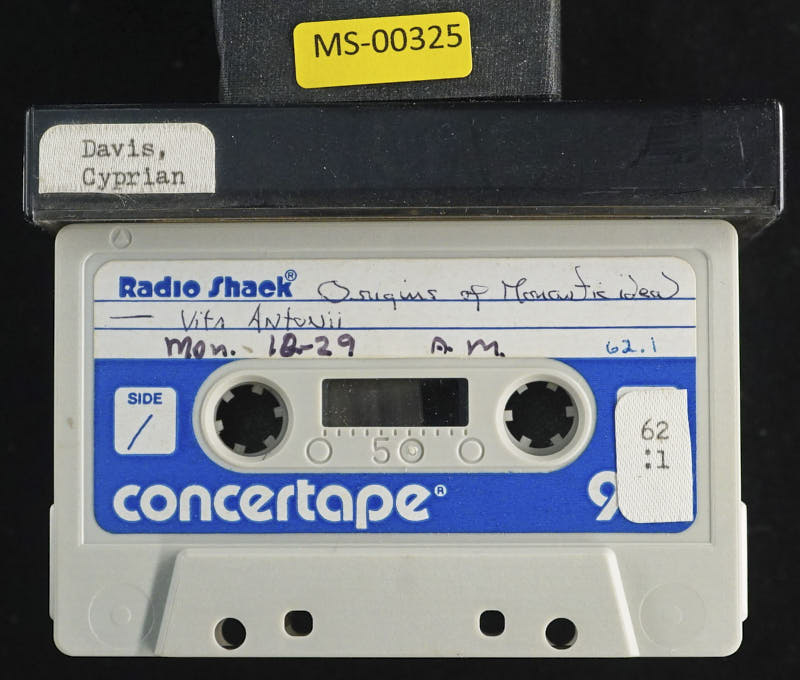
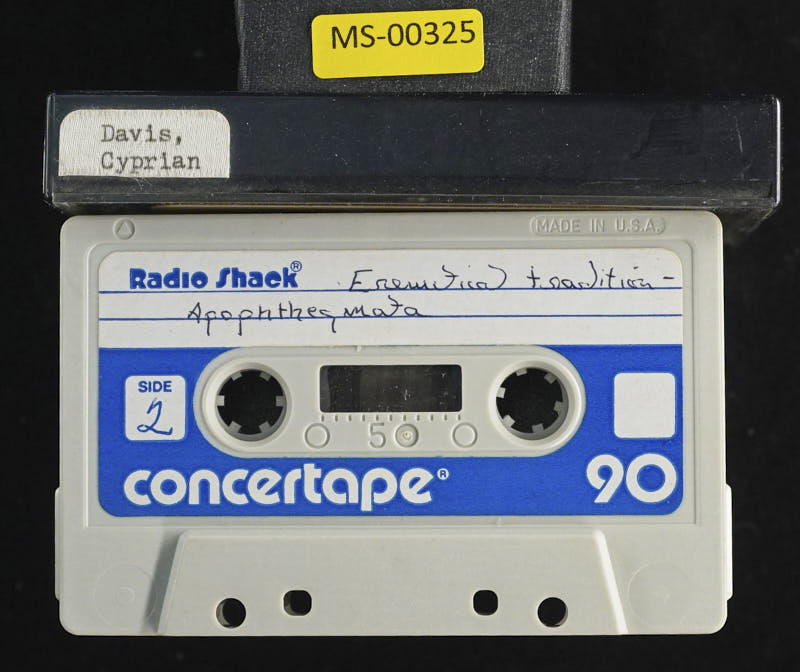
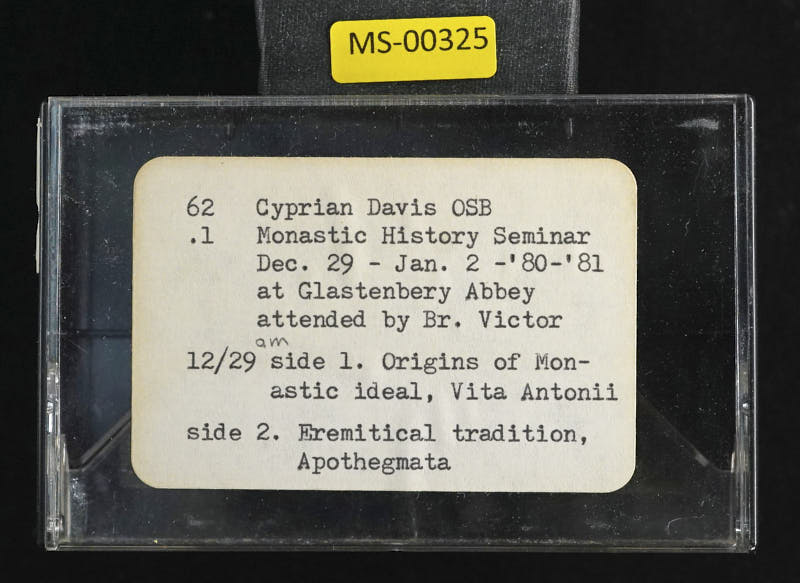
AI Vision - Possible Values from Photos:
Speaker: Cyprian Davis
Location: Glastenbery Abbey
Possible Title: Origins of monastic ideal
Additional text: Vita Antonii
Speaker: Cyprian Davis
Location: Glastenbery Abbey
Possible Title: Eremitical tradition, Apothegmata
Additional text:
@AI-Vision_v002
In the recent years, it has become rather fashionable to criticize monasticism as being, first of all, non-scriptural, second, dualistic, third, Gnostic, and finally, actually being rather non-Christian. To a certain extent, I think monasticism can plead guilty on all these counts. What is true, however, is that in terms of the self-perception of the early months, they would not have had the slightest idea or comprehension of what these charges meant. The early monks had already found a scriptural basis for their form of life.
[01:09]
As far as they were concerned in their own self-perception, they were profoundly Christian. And in terms of whether they were Gnostic or not, they were as Gnostic as was the rest of the various Christian communities that were to be found in that period. In terms of dualism, they had the same dualistic tendencies as the rest of Christian society as it evolved. Finally, or ultimately, the reason why these charges can be leveled against monasticism is simply this. Monasticism is not something fundamentally basically rooted in Christianity. It is rooted in humanity as such.
[02:15]
Monasticism ultimately is a manifestation of the basic religious orientation of humankind. Brother John's confrere at Mont Xavier, Brother David Stendhal Rust, gave a conundrum one time when I heard him speak, which has always fascinated me, which I think is very true. It goes like this, among monks we are Christians, among Christians we are monks. that in terms of that small minority of Christians which style themselves as monks, they have one sort of existence. We are recognized to be one sort of thing, but in terms of the totality of monks in the world, we are Christian monks. In other words, monasticism is not a Christian phenomenon.
[03:19]
Monasticism is a phenomenon that antedates Christianity. And this phenomenon that antidext Christianity is rooted in the notion that it is possible for a human person to have some kind of being with God, some kind of experience of God. And more than this, that there is a kind of a universal desire that becomes more or less refined, more or less profound, a universal desire for this experience of God to deepen, to become more and more intense. In other words, we would give this name to it, but it also not a recognized name, but it really didn't come to it until about six centuries or so, but give the name to it of the mystical element.
[04:21]
And this mystical element in religion is not precisely Christian or wider. But it is certainly to be found in the very beginnings of Christianity. And once we mention the mystical element of Christianity, then we've got to mention the means whereby we can achieve this mystical element or whereby we can somehow or rather predispose ourselves for this mystical experience or this element or this... intense union with God or this experience of God, namely there must be some kind of a discipline. And therefore the other side of Anastasism, the ascetical element, is already there, the discipline. The notion that there must be a discipline, of course, is not at all Christian. In all religious movements there is a disciplining, a desire to curtail certain aspects of our human desires and a desire to deepen certain other practices so as to predispose ourselves for an intensity of a religious experience.
[05:35]
All of this, all of this is the basic framework in which the monastic phenomenon develops. And hence monasticism as such wears all kinds of trappings and comes in all kinds of guidance, some of which will have the trappings of a great deal of Gnosticism, a great deal of Greek notions and ideas. Others will come bearing the trappings of more Far Eastern elements and so forth. None of that should surprise us. And none of that should serve as a reproach to monotheism. The important thing, however, is that it also took root in Christianity. Here again, the historian and those who are students in history must beware of a certain
[06:44]
a certain chimera, a certain desire to look for origins, to look at, say, ah, here's where it began. Here's where it starts. This sort of looking for origins, in the end, is a kind of an illusion. Where can we say that something starts that has not been there before? Or where can we really say that there is a gradual evolution, a gradual change, a gradual shift, a gradual development? And this, again, is probably the way monasticism as a Christian phenomenon arrives in our history. That very gradually, something that was to be found in the early Christian communities takes on a caste and a coloring. But we will turn monastic.
[07:48]
Not at all. Not as in any case in the street. Divorced from surrounding environment, surrounding influences. What is this element that has already been found in early Christianity, namely the element of the Assyrians? We know that from very early in the Christian communities, wherever they were to be found disparate, parts of the Roman Empire, there was the ascetical element, the existence of men and of women who termed themselves, as far as the men were concerned, the continenters, the covenant, the women who bear the title of the virginers, the virgins. That very early, already by the beginning of the second century, we find them living in groups apart, recognized, already having a certain status. virgins, veiled, living in communities, occupying a particular position within the Christian community.
[08:55]
The continent there is, the men, who are, their distinguishing characteristic, they do not marry, they are continent. They also, living in various places, sometimes on the margin of the Christian community. But already their existence is there. Already they are receiving letters. St. Cyprian writes to the virgins, St. Ambrose, others addressing treatises to the virgins, to that member of the Christian community already, who are marked by a certain ascetical caste, a certain ascetical element. And already there is a kind of spirituality, a certain notion of of their experience of God, a certain definite spiritual orientation that has taken place. Yet, if we want to give the Christian phenomenon of monasticism a birthplace and a birth certificate, we must start with one text.
[10:15]
a text which can be considered as the first Christian monastic text, which it does not at all mean that it began with this text and the person described in this text. In fact, most historians today would say that the monastic element in Christianity was something that arose practically at in several places about the same time, which is usually the case, historically, the historical movements. But usually the movements or various movements start at around the same period and in various places and presumably independent one of another, or that at least connections, a connection cause, effect, connection, is sometimes very difficult, sometimes very, very difficult.
[11:23]
But what is this birth certificate? What is this birthplace that we can say here is where prismanastism began? It is with a book that was a bestseller, a runway bestseller of his time, a book that Augustine talks about in his Confessions, in Book 8, Chapter 6 of the Confessions. St. Augustine, in recounting now how he found God and how God led him to himself, recounts an experience that he had in meeting a certain Potizianus in Milan. And Potizianus, in coming in and noticing that Augustine was reading the Gospels, says, oh, we are reading this. And then he recounts, a book that he had encountered when he was with the Imperial Service, being one of the members of the Imperial Secret Police, when he was in Schreier, wasn't they, Germany.
[12:31]
And when they were walking around the outer ramparts of the city, they came into a small cabin, me and a friend. And the place was empty. But on the table was a book, and they picked up the book and began to read it and were enthralled by it. And the book they happened to pick up was The Life of Synatomy by Athanasius, who at that time was in exile, or in exile, so every time it was four or five times during his lifetime, and Athanasius, the patriarch of Alexandria. That work is the earliest Christian text dealing with monasticism. St. Anthony's life lived in Egypt, Lower Egypt, whose dates were not exactly sure of the time of his birth.
[13:44]
probably around the year 250, and we know he dies somewhere around the year 355. And that Athanasius writes his life about the year 357, during the time of his third exile, which he spent in the desert, being driven out of the city of Alexandria, out of his sea. Athanasius, of course, we know, especially at this time of the year, is the great defender of the Nicene faith, the great defender of the incarnation of Christ, of Christ being truly the Son of God and divine against Arianism. Athanasius, who takes on all comers, Athanasius, the great theologian, but the polemicist, and who goes into exile, a tremendous figure, a giant of his age.
[14:46]
And importantly, of course, in terms of monastic history, is that not only is he the first person to publicize monastic history, the monastic phenomenon, but Athanasius, in his life of St. Anthony, gives, I think, the basic themes, the basic themes, the basic orientation of monasticism, monastic spirituality, or the monastic ideas. His life of Saint Anthony is not a life in the modern sense of the way we write a biography. It is a life, more or less, in the style, because Anthony was an Egyptian, but he belonged to Greek culture, Greek background. It is a life written in style of a Greek life of a hero. It's an encomium. And in it, he arranges his material in a very orderly fashion, with a very definite literary type.
[15:57]
Arranging his material in an orderly fashion, he presents then to you this person, this hero, who emerges then from his text, endowed with all sorts of wonderful qualities. But he's a hero. He's a champion. And at the same time, he is able then to arrange around him the basic things and ideas. Athanasius was acquainted with the monks precisely because he was driven out of his sea several times and found refuge among them. In other words, what Athanasius is describing is something that was already in existence when he comes upon the scene, when he finds that. And he picks out one individual who was more or less the leader type and makes him then, in a certain sense, gives him a kind of a myth, mythical quality. He says that he is the founder of this way of life, which probably was not. How would I find him? But the man who emerges is the man who at the time was the leader.
[17:01]
And he gives him his tremendous quality. So that Anthony emerges here, he emerges in terms of our history as the father of monasticity the father really the father of christianness because you're dealing with the phenomenon that's already several thousand years old or at least uh... well at least till a thousand thousand two thousand years old probably as far as the indian subcontinent is concerned the ideal of ascetics wandering ascetics and settling down What Athanasius then does, he's drawing this picture of his hero and then setting out a kind of a doctrine. He gives us a monastic doctrine, a doctrine of monastic spirituality. He sets the course in a remarkable way down to our own day.
[18:05]
as measured emerges and as the protector of the monks, which is precisely what the Patriarch of Alexandria was throughout the period of the early church and even later on, even when Alexandria was opened to Pentecism. Remember that the Patriarchate of Alexandria is the second Patriarchate in the whole notion of the Pentarchy, the notion of the five-fold jurisdictional centers for the early church, Rome, and then Alexandria, and then Antioch. And so later, as part of the ongoing controversy, so that the leader of the second seat is the one who gives his blessings. to this monastic phenomenon and give it a certain order.
[19:07]
And the patriarch of Alexandria will remain, throughout the period when Alexandria is a flourishing sign, will remain as the leader of monks to be found all over Egypt. Wherever they were, even in other dioceses, he was, in certain sense, had personal jurisdiction. This work that he writes But the year 357 is almost immediately translated into several different languages. It takes the Christian world, which by this time is really the Mediterranean world in general, it takes it by storm. There are at least two Latin translations of the life of St. Antony. They're written originally in Greek. This is a man of Greek culture, a Greek philosophical background. It is written originally in Greek. It translated into Latin, two separate translations, into Coptic, which would be the language of the Egyptian peasants, to Syriac, to Arabic, and to Ethiopian and Georgian, and so forth.
[20:18]
Tremendous, tremendous success. The basic themes that it contains, or the basic spiritual monastic themes are the notion of asceticism as a wrestling as a combat modification. Anthony is the champion, strips down and enters into hand-to-hand combat with the devil. The very demonology, constant, constant appearance throughout the pages of the life of St. Anthony, disconcerting for us in the 20th century. The aspect of the demonology that is there, the description of the devil and so forth, extremely interesting. And which puts us off as we read it and say, how can this really be a spiritual book that's going to give us kind of spiritual desire for union with God and all this terrible preoccupation with devils.
[21:19]
Athanasius is a man of his time. He's writing for people of his time. He's writing out of a neoplatonic thought frame. There is lurking always around the sides, in this period of church history, the Manichean romance, can you put it? Manichean romance. Monasticism as martyrdom, extremely important, and it is right there. the notion of spiritual life of progress. I want to come back to that. That is extremely important. Apothea, the notion of spiritual paternity, which again, in my own mind, I hope that I won't become too subjective, but listening to me to spiritual paternity is one of the most important themes in terms of domestic spirituality. The idea of withdrawal and return, withdrawal from mankind, return to mankind.
[22:25]
a coming, a going away and a coming back. These things, this is already there. But if there is a flight from the world, there is always a return to it. And that is, uh, stepping into the life of smashmen. The notion of spiritual discernment. We're, uh, we're always besieged these days by, uh, everybody's having going around discernment and so forth and, uh, and, uh, Well, for me to give a certain bias on Mark Park, one always has the impression that discernment never started until Ignatius arrived on the scene with the spiritual exercises that other than Jesuits have given us this discernment. Well, discernment is a constant theme in all of Christian spirituality, and it didn't start with St. Ignatius, and it doesn't really need St. Ignatius. It's an exercise, or either. that the notion of spiritual discernment is already varying with Anthony.
[23:30]
Of course, in the life of Anthony, the fundamental thing you want to discern, first of all, is whether it's demonic or whether it is a god. Your basic question is whether this is from the devil or whether it is from God. which remains ultimately the same thing for Ignatius. So when you have people, or especially sisters who are not of the monastic tradition, who keep telling me they're going to go into discernment now, then remind them this is something very basic to monastic spirituality, to know whether it is our God that we are looking for. and we don't necessarily, and that the rules that Ignatius applies have their basis in the tradition of Anastasia Spirituality. I'd like to, if you will permit me, say a word about apatheia and a word about the notion of spiritual paternity and martyrdom.
[24:42]
I want to write on the board. Apatheia, again, in my own opinion, is rather important in the notion of monastic spirituality. Apatheia is one of those words that are, not only does it, it's not only a cold word, and it is definitely a cold word, but it is also a fighting word. It is also a word about which we spill blood, or have spilled blood. since you think it wouldn't be, because it's exactly the opposite. But it's definitely a word of which is extremely controversial and raises up phantoms that will be also lurking in the history of monastic spirituality all along. There's a text in the light. Remember, I suppose most of you are aware of the light, isn't it? You want to be, unlike
[25:49]
From time to time, I'll try to mention some books. I didn't want to come in with a big bibliographical list, probably because I haven't had time to compile it all off. But I think from time to time, maybe mention some work that might be germane to what we are discussing in the morning at Asmune might be very good. The new translation of the life of Antony is in the Spiritual Classics, Classics of Western Spirituality, put out by Paulus Press, 1980, Robert C. Gregg, St. Athanasius, The Life of Antony, along with The Letter to Marcellinus. There's an earlier translation that would be found in the Ancient Christian Writers' Series, done by a guy named Meyer, which is very well done. In brief, the life of Antony starts where Antony, the man coming from a peasant Egyptian family of some, not extremely poor, definitely not extremely poor, but he's orphaned at a young age, and he hears the words of the liturgy, and he is told, if you want to follow Christ, go so as you have and get to the court, come follow me.
[27:15]
And he determines him to do that. He puts his sister with the virgins. He disposes of a property, he settles some property on her, and then joins the ascetics. Not at all, he is first in the notion of living ascetic life. He lives in a Christian community, already in the direction towards the south of Egypt, and there he joins the ascetics in this Christian community. But what the life tells us is a gradual progression which is an important theme in the spiritual life, a gradual progression whereby he moves from the ascetics on the margin of the community into the desert and gradually farther and farther into the desert until it begins to live the Arametic life. There is a chapter, a description, where Athanasius...
[28:19]
describes the scene after this first stage has occurred. Anthony has moved into living a life of solitude in an abandoned fort. He stays there for twenty years, which is a nice round number, a secret number. Twenty years is a holy number in a way. At the end of this period, Anthony is changed. So it's a very capital... In the life of Anthony, in the turning point of his ascetical development, it's very, very important what happens after this 20 years of solitude within the fort. Now, he was given food and so forth by the people that gave him bread. And he did a very long dissertation, importance of bread, but anyway, out of which he survived and so forth during this time. He was in solitude in this fort. But what is important is how Athanasius describes his emergence from this experience.
[29:25]
It's in chapter 14. Nearly 20 years he spent in this manner pursuing the ascetic life by himself, not venturing out, and only occasionally being seen by anyone. After this, when many possessed the desire and will to emulate his asceticism, and some of his friends came and tore down and forcefully removed the fortress door, Anthony came forth as though from some shrine, having been led into divine mysteries and inspired by God. This was the first time he appeared from the fortress for those who came out to him. And when they beheld him, they were amazed to see that his body had maintained its former condition, neither fat from lack of exercise, nor initiated from fasting and combat with demons.
[30:26]
But was just as they had known him prior to his withdrawal. The state of his soul was one of purity, for it was not constricted by grief, nor relaxed by pleasure, nor affected by either laughter or dejection. Moreover, when he saw the crowd, he was not annoyed any more than he was elated at being embraced by so many people. He maintained utter equilibrium, like one guided by reason and steadfast in that which accords with nature. Through him the Lord healed many of those present who suffered from bodily ailments, others he purged of demons, and to Anthony who gave grace in speech. Thus he consoled many who mourned, and others hostile to each other he reconciled in friendship, urging everyone to prepare nothing in the world about the love of Christ.
[31:27]
And when he spoke and urged them to keep in mind the future goods and the affection which we are held by God, who did not spare his own son but gave him up for us all, he persuaded many to take up the solitary light, And so from then on there were monasteries in the mountains and the desert was made a city by monks who left their own people and registered themselves for the citizenship in the heavens. In chapter 15 he describes why I want to read chapter 15. Bear with me. Once he had to cross the canal of Arsinoe, his invitation of the brothers was a cause, and the canal was full of of crocodiles, and after simply praying, he and those in his company entered it and passed through unharmed. Returning to his cell, he carried on the same holy and active labors. Through regular conversation, he strengthened the resolve of those who were already monks and stirred most of the others to a desire for the discipline.
[32:29]
And before long, by the attraction of his speech, a great many monasteries came into being, and like a father, he guided them all. At the very end of the work, in chapter 67, Athanasius again returns to this same theme. Furthermore, Anthony was tolerant in disposition and humble a soul. For the sort of man he was, he honored the ruler of the church with extreme care. Remember that Athanasius is deficient. So as he writes this, he's ascribing the man the way he sees perfection should be. And he wanted every cleric to be held in high regard than himself. Remember that Anthony was not a cleric, early monks, so not. He is a layman. He wanted every cleric to be held in a higher regard in himself. He felt no shame of God in the head to the bishops and priests. Even a deacon came to him for assistance to discuss the things that are beneficial. Now, that's a good thing that Acnace is describing in his own terms for this great leader of polyness. What is important is he goes on. His face had a great and marvelous grace and this spiritual favor he had from the Savior.
[33:34]
For if he was present with a great number of monks and someone who had not formally met him wished to see him immediately on arriving, This person would pass by the others and run to him as they were drawn by his eyes. It was not his physical dimensions that distinguished him from the rest, but the stability of character and the purity of the soul. His soul being free of confusion, he yelled, his other senses also undisturbed, so that from the soul's joy, his face was cheerful as well. From the movements of the body, it was possible to sense and perceive the stable condition of the soul, as it is written. when the heart rejoices, the confidence is cheerful, and so on. What Athanasius is describing there, or he does not use the word, is apathe. Apathe, which of course gives us our English word apathe, but which is not at all the idea, it is to be without passions. Without passions, the primitive eight, to be without passions,
[34:37]
to be without any sort of, to be, in other words, imperturbable. It is a stoic notion. It is a notion dear to stoic philosophers. It is the stoic ideal to be without any sort of passions, to be imperturbable, to be unmoved and unmovable. It is not Athanasius who invents this idea. It is already Clement of Alexandria in the second century who, in talking about the true Gnostic, the Gnostic, the true Christian in his perfection, the real Christian is one who has apothea. Now remember Clement of Alexandria, or Reising Alexandria as a Greek. He's really the man who brings the dare upon nascent Christian Intellectual development really brings to bear upon it the Greek philosophy, the Greek framework.
[35:43]
Clement of Alexandria, in other words, the predecessor of origin really, in a certain sense, introduces Christianity into the Greek intellectual world and introduces the Greek intellectual world into Christianity. But he is also one of the followers of our spiritual tradition. There's no way of saying that. And no way of throwing your hands up and saying, well, I learned the scripture. Well, of course, the Greek philosophical world oriented in the scripture, which people always . And the Greek scripture was free of Greek influence or Greek philosophical influence. But this is a concept which is already here in the beginning of Christian monasticism. is a concept which will become dearer and dearer to a certain school, a certain development of the Nittanyansky spiritual tradition.
[36:47]
I don't think, because I'm sort of partisan of the notion of what I like, and also like those who are carriers of this tradition. And in my way of thinking, and this would be highly controversial if you're to go like Amber and Watson, you'd scream and holler if I were to say it. In my way, I think this is precisely part out of which the tradition of the planet counts. But the thing I think must be brought in mind is that in the Christian tradition, as this notion of epithere develops, it is, to a large extent, This shares much of the stoic element that would be objectionable and can be interpreted in a really Christian manner. In other words, the ideal is not to remain rock-like before suffering, to have no compassion, to have no humanity, but it is rather the ideal, as Athmation presents, of an inner common, an inner peace,
[37:58]
an inner balance, an equilibrium of the soul because one has arrived at a certain maturity. Or to point it, to use an expression that we use on the streets about five years or so ago, maybe they have it all together. To have it all together means then to have it all together within oneself, and then to be in a harmony within oneself. And this, I think, is really the Christian notion of apothea. Now, those who attack apothea will be precisely because, not so much because they're aponecious, but the German idea is definitely an aponecious, but those who come after and follow in this tradition of their own medical monastic life from Egypt names whom I would like to mention.
[38:59]
I'll come back from the break. But the upper there becomes part and parcel then of a controversy. Jerome hates the word. Hates the people who use it. Because it's precisely because of people who use it. But it enters in to the monastic spirituality nonetheless. And it will be found here. The ideal of Anthony is, as Athanasius says, pictures him, is the one who has this inner calm, inner peace, inner harmony. And that it is at this precise moment that he is then ready, that he is then ready to proceed as spiritual father. It is at this precise moment when he has arrived in an inner calm, inner harmony, inner wholeness, that he is then to become father for others. I think it is extremely important that dealing with spiritual paternity in the monistic life. It has nothing to do with priesthood, nothing to do with sacramental orders.
[40:05]
It has the title of Abba, which comes very well to be given to the material monk. It's precisely that title, dealing with the monk who has arrived at his spiritual a certain spiritual level, which in terms of this tradition would be that having acquired a certain apothea is never quite altogether. Anthony is a hero. He does. He's our champion. But when you acquire a certain apothea, then you can teach others and direct others. That's exactly what Anthony emerged. His whole life is then as bringing the father to others, as guiding others. becomes any movement in the desert precisely because he is a spiritual father. There are several other things that are here. How much more time do you? Right. Several other things, and one of the most important ones, again, is martyrdom. Remember that the monk, in a certain sense, continues the whole mystique of martyrdom in the early church.
[41:15]
The... And this is, again, one of the themes that Athanasius brings out. Going into the desert, into the Egyptian desert, was dropping out of society. It was to leave the society. In the Roman world of the fourth century, the period of the later Roman Empire, there were many readings inspired an individual within the Roman Empire who want to leave the world, not the least to put it, was the sort of, not just the chaotic condition of the empire, because there was chaos that we developed, but there wasn't so much chaotic at this time, fourth century, but precisely because life had become very regimented. It was an empire, the Roman Empire itself, it was a tremendous miracle, a tremendous thing. But in this period now of the reorganization of the Diocletian, 286, very centric, was centric, and so forth, it had to keep the creature edifice together.
[42:29]
This edifice which was so quarry with age, and yet was so tremendous. So it created a tremendous civilization in the way it saved the world. But to keep this thing together, this massive empire we know it, some very draconian measures have to be taken in terms of social reality. Namely, you have to pay taxes. Not everyone obviously will pay taxes when you have a large portion of your memories of the empire. You are not citizens of the members of the empire. You are slaves, therefore you will not pay taxes. Or freedmen, therefore you will not pay taxes. But you have them, and then the aristocracy you've got. Then you have the large group, the so-called the Korean, those who would be, to be a little anachronistic, the metal pilots, who must pay the taxes in their local municipalities, who had the burden of the public services.
[43:30]
But the economy was in terrible chaos. It was the economic situation on the late Roman Empire was terrible, dreadful. So the, yeah, there was inflation, but of course, you know, you didn't have paid or money, you actually had a lot of money. But the basement of the money and so forth. But the whole weight, then, of the public service weighed upon a certain class. And many of them found no way, no other possible, except to get out, to leave, to drop out of that society. So they tried to be dead. The Egyptian desert, as far as the place of Alexandria was concerned, while then the place where you went when you wanted to get away from it all. It was also the place, not only there would be decent, upstanding folk who decided then to drop out and who went to the enemy, but it would be also those who weren't living alive without loans or bandits. And it was the repair of the land provided in a world which had soldiers and had the various kinds of difficult position on social people.
[44:37]
So going to the desert, and this was the case in another wilderness area in the world, going to the desert with an obvious place to escape to. So that the notion then for the ascetic to practice this withdrawal, the anachronesis, to become an anchorite, to relieve the life of the anchorite, was then a normal thing for those who are withdrawing them from society. a society that had its common, mythical. But the story of this withdrawal, already in the first Christian text on the North season, is that it's never complete. It's never told. There is always a return. Several different times, at least on three occasions, Anthony goes back till again. to it when he goes back in order to become it. He fails.
[45:41]
He puts himself right in foreview, hoping that he'll be taken. This is the last, the last persecution, the persecution of Maxim and Daya, Daya, that just occurred just shortly before the Peace of Constantine on 311, 311 and 312. But it's one of the last persecutions. He wants to be, he wants to become a martyr. And Athanasius then describes in going back to the desert and leading then really what was the daily martyrdom of the monastic life. So the thinking of the daily martyrdom of the monastic life was already a theme that you have in Athanasius. Remember, martyrdom is not just something that was a kind of a nice experience for the early church. There's a whole mystique. of modernism. It is a kind of a mystical, mystical experience. Anthony represents the aromatical tradition of monathism.
[46:52]
In other words, he may not be the prototype, as we call him the father, must believe the prototype, especially of the limits. That is important. When we ended up looking at the development of monastery in Egypt in Porcelain Creek, the college will talk this afternoon about the centipidic development, which was really contemporary, where they were not really that great of change. The leader of that movement is a contemporary of Ankeny. But it is important to keep in mind that there are two developments of the monastic tradition in Egypt. At the same time, this is going on in Egypt, something is going on in Syria, where it is, ah, and strange. But in Egypt, the Arametical tradition was to be found geographically in the area not too far from an example. Then what is still upper Egypt in the day, it is in this area that Antony lived.
[47:57]
and lives in this area of a large settlement. Now, I think there are four things that I want to mention to you in terms of the Arametic tradition in Egyptian monasticity. Clearly, in our terms of understanding, Kermits, in fact, Kermits all throughout the history of the church were almost never cut off on social You know, you have the stories about helmets and one of the other helmets living where they were and never seeing another individual. There may be apocryphal or if they are reality helmets. They are almost a minute case. Helmets were never cut all from social contact. And that is true of the early church as well as the medieval helmets. Helmets...
[48:58]
represented the hero for the other Christian community. There's several studies where we've been talking about the holy man as hero, the holy man as hero in the later Roman Empire, almost as a type of individual who has a tremendous influence on the ordinary people, on the local habitation. Hamid, the Egyptian Hamid especially, is somewhat of this type. He becomes very much a hero for the ordinary people, for the Ronald Mill population. And for that reason, their influence was considerable. My only thing that should be borne in mind is that the hermit always remains there. All throughout Christian history, the hermits are with the people. They are part of a popular movement, and an extraordinary thing.
[50:02]
And Henry is very, very close to me. You know, you'll get people who don't know how about Henry says that they're anti-social. Whether they were anti-social or not, they were very much socially involved, always socially involved. And tremendous social movements, they spark tremendous social media. And, in fact, that is the very thing that I want you to keep in mind, how much to represent throughout Christian history, or radical and Christian. They are dangerous folk. Monks you can deal with, too. But them are very dangerous. And in a certain sense, you have all of these elements in the early, in the early, um, early monasticity in the United States. This, this influence of the If you forgive me, there are at least, I would like to mention one other source of the monastic history and monastic spirituality that I think should not be overlooked.
[51:16]
And that is a body of literature that comes precisely from the era medical Egyptian monastic tradition. A body of literature that has a tremendous influence on subsequent Christian spirituality. In the East, in the West, not only in the Montcarni, we do in Montcarni, but they're kind in the way of the, almost at the foot of our, of our Christian tutors. And that is the saints of the Deadly Fathers, or they are the saints of the vervice of the earth of the apothecary. Now the apple pigmata come out of the Arimatical Egyptian tradition in general. The most recent translation of them is by the Anglican Benedictine nun, a very fine historian.
[52:29]
Sister Benedict of War of England, to Tudish and to Tudaya, which she started with. The sayings of the desert fathers, which is a publication of the alphabetical collection, and the wisdom of the desert, which is a publication of the anonymous collection. The alphabetical that is a theory of a tall saying, a denominative type of literature. Here is similar in respect to the in the Jewish tradition or to the Quran in the tradition. Extremely important because these sayings, I'll give you some examples in a moment, had a purpose within the
[53:29]
desert tradition. Namely, they were a form of catechesis. It is what the disciple, the young monk, the young poet, was to learn. And learning it, you also learn a moral, a teaching, an attitude. It was something, it would be a solid meditation because they are, they are normal things. In other words, they are not, they, they are, there's moral to that. than just what is on the surface. They are something that must be masticated as you have been into it, masticated, and then finally after ferro-turing you can arrive at the inner core and see what is there. And therefore the subject of meditation. But they are also a model for spiritual direction. kind of notion of spiritual direction. Remember spiritual direction has very little to do with whether you are a priest or not.
[54:33]
That's in terms of penance. There's public penance, of course, and is that part of the jurisdictional aspect of the bishop. Spiritual direction is for the spiritual father or spiritual mother, because they're women and women. And we're individually not. For us, they are important because they inculcate ideals, spiritual ideals, that are operative even again to our dead. Jean-Claude Guy, who is a French historian who has studied the Apoplegmata, developed a theory that You could divide these things into three major groups, one being more the primitive aspect, the other being a more highly developed, the third being sort of a literary, almost a literary poem.
[55:42]
One just being the one-liner, the other being a kind of extended one-liner, and the third being the anecdote. Other is dispute this and say you cannot say that there was this kind of development in the literary form, that you're not dealing with something that can so easily be defined in this way. Be that as it may, one can speak about the one-liner, which is the more, certainly the more, the one is very much like with Venkoan. Namely, was it always the answer to the question of what must I do to be saved? Ah, do you need a good word? What must I really say in the end of my life? There are examples of this. One asked an old man, how must a monk be? And he answered, in my opinion, alone before the alone. One asked an old man, what is the work of a monk?
[56:45]
He replied, the same. The old man used to say, prayer is the mirror of the monk. An old man said, if a monk only prays when he stands for prayer, he never prays. And so, in other words, various pity sayings, very short, concise, and containing a great deal that will have to take time to reflect on. The extended kind of statement, longer, but also rather important, one attributed to the Abba Joseph. The old man, of course, is the Abba, the one who has arrived of spiritual maturity, a spiritual father, who has attained a certain degree, and that is very, very important for the early monks. Namely, one had to go through a period of probation, one had to go through a period of formation, and
[57:52]
or learn them from an elder. But it's extremely important in this monasticism that we find described in the life of Anthony and in the amphitheism that were more or less due to the character and importance of century. Although the amphitheism that's probably going to become gathered together into a compilation of a lot in another fifth century, and then that translated into the epithelium, made for conditional, horrible, horrendous. But there are several different collections in the collection from there, trying to very, very, very walk with a mark on the 90s, and so you can't yet unravel with no, you can't have any critical text yet, because you can find out with, with, with, with early Christian, or very advanced literature. And, uh, the obviously, the public, and so forth. But, uh, what, what are we going to, the picture that you get when you leave these people? But now some of you heard of Hamilton's New York Rutgers. There was one just writing a very old man who was going to let him go.
[58:55]
Some of them were homosexuals. There were all kinds of problems. There were all kinds of problems around the desert like anywhere he felt. But also a picture of everything in the yard. The young monk who must go to an old man. And he fought. And then when he arrived, he turned that at the discretion. and lift them to each other. A lot of weight, dear, in case, through the Abba. Bring an example of this. The Abba Lot went to the Abba Joseph, and he said to him, Father, I have made myself a little rule in proportion to my strength. A little fasting, a little prayer, a little meditation, and a little repose. And I apply myself as I can in order to get rid of my thoughts that he is dealing with. What more is there left for me to do?
[59:57]
And the old man got up, stretched Porter's hands toward the heavens, and his fingers became as so many little flames. And he said to the other lot, if you wish, you can become entirely like fire. Another example of this kind of extended, the Abba Joseph asked the Abba Pastor, tell me how to become a monk. The old man replied, if you wish to find repose in this world and in the next, on every occasion, ask yourself this question, who am I? And never judge another person. More interesting... from our point of view, because of the kind of information it gives us, is the anecdote. And, of course, they're more colorful. I mean, these lovely stories, which involve historical personality, which tells a great deal about the day-to-day living in this monastic world.
[61:06]
And always have, of course, a teaching. Always have a teaching at the end. Because remember, this is a form. This is the way you give formation, a teaching which becomes then part of the construct of our whole monastic spirituality. The other Papinusius did not willingly drink wine. Once, however, when he was on the road, he fell among a band of robbers. Remember that robbers are part of the daily life of the Egyptian desert. They have much right to be there as their homes. He fell upon the robbers, and he found them in the process of drinking. The robber chief recognized him, and he knew that he did not drink wine. But seeing him worn out by his many maid groups, he filled a cup with wine, and holding him the other hand and naked sword, he said to the old man, If you do not drink, I will kill you.
[62:12]
The old man understood that this man wished to perform an act of charity towards him. In order to gain him, he took the cup and he drank. The robber chief then made a metanoia, which is a constant prostration, made a metanoia before him and said, Father, forgive me, for I have caused you pain. And the old man replied, I know that my God will show you mercy in this world and in the next because of this cup. And the robber chiefs replied, and I, I have confidence that from now on, thanks to God, I shall no longer do evil to anyone. And the old man won this whole band of robbers because he renounced his own will of not for God. Remember the profound spiritual teaching that is part and parcel of the anecdote. Another one which I find extremely beautiful
[63:13]
Here's another kind of anecdote. Two brothers went to the town. Many of these are gathered together on the subject. The one I just read to you is in the Alphabetical Collection of Charity. This one is on the subject but impurity. Two brothers went to the town in order to sell what they had made. Remember that the Hermes did not necessarily live alone. At times, they would live two or three in a house that they usually constructed themselves, and always within a certain distance of another. Even if they lived alone, within a certain distance. And on Saturday and Sunday, they came together for synaptic. Well, they do priesthood service on Saturday and on Sunday, and for the saying of the psalms, which always said, should you not see on the floor for a solo monk solo, reading down the verse of the psalm, stopping, I forgot ten words of solo, a sweet silent prayer, prostration, and then continuing the reading.
[64:23]
In other words, this was the ending with a meal, the ayah and agape are together. At this meeting on Saturday and Sunday, any other kind of business and putting disciplinary action would take place on the jurisdiction of the priest. Very often, the priests were not monks. Later on, more and more of them are. The priest would not ordain the priest, or the hammer ordain the priest, because it's still a rare phenomenon. Fine lives, it's a late community, a late group. They go to the town to sell what they have made, because they get their living, out of the work of their hands. Remember, it's not a simple job to leave baskets. No, they're not doing something like this. It's not, they're not putting away their time. It is labor. It is hard and difficult. It is smelly. It is painful. And it is, it is a pain. We must never get any notion of the Egyptian monks playing at what they were doing, because they lived a very hard life. Not too hard for the life of the ordinary Egyptian peasants, but it was still a tough life.
[65:26]
It was still a tough life. So they go and sell what they made in terms of buying the necessary things, which would be especially the produce that they would need. Many of the stories take place in the atmosphere of a small town to which they must go. Two brothers go to the town in order to sell what they had made. In town, they separate. And one of them falls into impurity. A little later, the other brother comes back and says to him, my brother, let us now go back into our cell. Nope, I'm not going back, replied the first one. Why not, my brother? Well, when you left me, he said, I was tempted and I fell into impurity. But his brother, wishing to gain him, sat about and said to him, you know, the same thing happened to me.
[66:29]
After leaving you, I too fell into impurity. Let us both go back and let us both do penance with all our strength. And God will pardon us the sinners that we are. When they had returned to their cell, they recounted to the old men, which was normal. You tell your innermost thoughts to your father. There's nothing to do with sacramental confession, because you tell your innermost thoughts to your father, as you'll have the innermost thoughts, you have to repeat yourself. When they were back to the old men, they recounted what had happened to them. And these latter prescribed to them the manner in which they should do come. One of them, however, dependence not for himself, but for his brother. And if he had sinned himself, he. And God, seeing the trouble that he took out of love, revealed several days later to one of the old men that he had forgiven the one who had fallen into infurity on account of the great charity of the other who had not sinned.
[67:37]
And at the end, now, he said, this is the spiritual message. You see what it means? to give one's life for one's problem. I think it's very interesting, because I think the moral conclusion is not so much. Well, it's sin. I mean, clearly. But what does it really mean to lay down one's life for himself? Which I think is the interesting thing about the example of Feynman, really, in real time, is that they reveal a spirituality which is very nonverbal. which has certain extremes to it. That's why if one is going to read the upper thing about, read them all, balance them one against the other. It's like the saying to Jesus, he must balance them one against the other. Don't just take one as an example. Because they tend to contradict each other. And they're supposed to be. They're not learning treatises giving you the whys and the wherefores and developing a full-blown theology.
[68:42]
They are tentative examples of truth. And they must be balanced once again to the other. But the remarkable thing about them is the insight, a kind of a spiritual insight that they reveal. And one of them is an extraordinary notion of person, we think extraordinarily modern, but it is a very much of a personal relationship. The whole notion of spiritual connection is a very personal relationship. And the whole approach to sin. And living out is back to God. And of understanding. It's extremely modern. Extremely modern. In psychological terms. That being the psychological insight of the early monastic father is an extraordinary one. But we don't have time to do that. I'd like to read you one last one, but I want to read two of those because one is a friend of mine.
[69:47]
The second one I want to read really is the basic story of a Greek novel. One day, a brother went to an old man. He said, Father, my brother wants to leave me, and I don't know where you are, and I'm suffering because it will be. The old man encouraged him. My brother, support this, he said, without growing irritated. And God, who sees all the patience that you place in this world, will bring your brother back to you. You know well that severity and harshness do not easily change the idea of someone. For it is not the demon which will chase out the demon. You will bring him back rather by kindness. Our God himself draws souls to himself through persuasion. And then he recounted to him this story. The story will end the story before I know it right on. Two brothers were living in Nathibia. Nathibia is in the region of the province of Upper Egypt, around Yves, where again, a settlement, a colony of hermits would keep out.
[70:57]
Two brothers were living in Nathibia. One of them, tempted by inferiority, said to the other, I'm going back into the world. The latter replied to it, weeping. My brother, I don't want to see you lose your virginity and the truth of all your labors. But the first one said, I do not want to remain here. I'm going back. You can either do two things. Either you can come with me and then I shall return with you. Or let me go and I shall stay in the world. Our brother therefore went to a great old man and he said to him, all of you is going to happen. The old man said, go with him. And God, on account of the pain that you take, or not let him be lost. The two brothers, therefore, went into the world, and at the moment in which they arrived in the village, God, who saw all the trouble that the brother who was accompanying his other brother was taking out of love and out of necessity, took away the desire, the evil desire from the heart of the first brother.
[72:03]
So he says to him, Brother, let's go back to the dead. Suppose I did sing with a woman. What would that do? What good would that do? And so they both return on time into their self. That, in a way, I think, is the basis for one of the great novels of Western Civilization, which I'm sure you could, whether the man, I think the man may well have been familiar, because it wasn't thought of it as a religious tradition. It was out of the story of the Megath, in, uh, and where it's correction. Can you, can [...] you think of what that's wrong with you? The Marvel? I'm sure we did it. Yeah. Okay, let's start. Yeah, no, I'm not talking to you, but you lost the rescue, you can see the Brothers Karamanso.
[73:03]
Okay, remember the Brothers Karamanso stars there in the monastery, and, and, and the Starretts tell us, which Starretts means, the older man. tells the younger brother that he must go out now and save his brothers. To accompany him, he must go and accompany them in a certain sense. Which is a very modern approach. The other one I wanted to mention, because he was always very dear to me, you must not think that in the Egyptian desert But you must not think that the Egyptian desert is true. It was a thing.
[74:05]
In fact, that's the name of the book, another book that you might want to look at sometime. is Derwas Chidi, the Desiree City, Custerwood, New York, St. Vladimir Seminary Press in 1966, which is a very popular, very young woman. But don't think that you're a Derwas. Don't ever think an English historian, dead man, prisoner. Don't ever think that you're just dealing here with just Egyptians. There were all kinds of ethnic groups in Egyptians, as in New Orleans, and races as well. And don't think either that everything was just hunky-dory and everyone lived in peace and in harmony. They did not. That's another story. But among those were blacks. in the desert, and that's why I'm very much attached to this man, because, uh, Moses the Black sort of typifies, first of all, he was a robber, a murderer, he started off with a slave, and a slave master was fired up with a guy who was a big, huge giant of a character, he, uh, uh, just wasn't saved to have him around, and decided, uh, to let him go, and so Moses ends up in the Egyptian desert, like so many other robbers, and there's a place to go, and drop off the subject.
[75:34]
And he was a robber chieftain, and robbed and stole, and probably did a lot of other things. And we don't know how or what the circumstances, but Moses is converted. And he becomes a hermit. And he figures in quite a lot of the epiphanies. There's a whole cycle. There are a lot of cycles around these various individuals, like Abba Pastor, and Joseph, and... and the carriers and so forth, and women, like Sarah and Synclectica, and, um, uh, uh, well, poor women, pastoral sanctuaries, poor women as a reform, uh, and so forth. There was one of the women, I can't think of my name, uh, it'll escape me. Anyway, Moses also has his cycle, about four years so up, on the Moses cycle because he eventually, he is one of those who was ordained a priest. Why don't you go a little bit more on that.
[76:37]
His term in the history is Moses the Black. Why don't you go a little bit more on that because there's a whole question of this use of the term black and the other thing that's not a long story. But Moses, but one of the important things I think to keep in mind is that you have people that come from Nubia And probably later on in the Middle Ages from Ethiopia would also be found, part of also the desert monastic tradition, as well as Greeks, and as well as Arabs and so forth, and the Romans, and the Egyptians themselves, who did not always live in harmony. In fact, the whole thing blows up. There's the Apple thing, one of the Apple things about the Emma Moses is like this. I kind of like it, you know. and the other thing will lose. A brother of Skeet, the desert of Skeet is about 40 miles or so to the south or west I think it would like, India, committed a quarrel.
[77:39]
The old men held a council and they sent and asked the other voters to come. Normally this disciplinary council would take place in the Saturday and Sunday with the meeting of old Hammers. They sent to the Abba Moses and asked him to come, but he refused. The priest in charge, and this would be the local parish priest, who normally often was not alone. In this case, he's not alone. The priest in charge then sent to him and said, Come, for all the brothers are with you. And so the Abba Moses, he brought his time, of course, in the late night. The Abba Moses arose and took a basket that had a hole in it. And he killed it with silence. And he came then, carrying it on his back. The brothers going out to meet him said to him, What's that, father? And the old man replied, My feelings run behind me, and I do not see them.
[78:44]
And today I am come to judge the sin, do you know it? Hearing this, the brethren no longer said nothing more, and they believe his guilty brother. Again, it is the anecdote and then the teaching, the spiritual teaching that is there. There are two names that I would like or should be mentioned. I'll mention them briefly and, well, let's see, how much more time do I have? Well, before I mention them, I'll mention myself a minute now. Before I mention them, I'll ask you any question. I talked a lot. Where did he go?
[79:46]
He's prior, so I can speak prayer. I don't know. Another word which I didn't mention, because rest and repose would really be in terms of Hezekiah. And I don't think you should confuse the Hezekiah and apotheos. As a key, of course, is again a great theme in working in the apotheos. And, of course, what it basically means is the contemplative light is a light with contemplation of prayer. And it means that as it clearly means being seated, to be seated to be, and therefore, in a prayerful position.
[80:51]
I think it's extremely important to understand that for the early desert fatherly, the early monks, your physical posture is important in terms of prayer. Just as it is for the non-Christian mind. It is both pursuing the Lord's deletion and so forth, the deletion of, the physical deletion of prayer. So that in account of being seated predisposed along them for prayer. And that is a, that the whole notion of inner, inner repose, inner prayer, and the, Hezekiah, that means then the contemplative rush, the light of class, which, of course, already introduces you into a Greek world. But Hezekiah whole idea of the heterocastic movement moves out of this, that Hezekiah is the work of the monk, and that's why he should keep his cell, and his manual labor of predisposing then for this interior plan.
[81:54]
So there's a great deal about Hezekiah and the Apophagmata, but it's a notion that develops and grows until with it you have the whole rich spiritual tradition that develops amongst the Eastern Church to use the Jesus prayer with and reading and so forth, reading technique, and then the inner light which comes with Gregory Columos and so forth. But all that comes along with Hezekiah tradition. Now, Apophagmata is to be seen as something that precedes this. The man who uses, they'll turn him up up there, the man who I was going to talk about is a guy named Ivegrius. Ivegrius Aponte. And Ivegrius is one of those names that when you bring him up, I'll break this. Ivegrius It's an enigma.
[82:57]
He became a non-person. He's one of those people who almost became a non-person. But fortunately, historians are like you dead days, and we are treaters of those persons. And really, in the last 50 years or so, he basically said he nourished from the murky shadows a billion. to assume now a personality and also to take like a collection of the work. It mapped it. It continued, but under other name, because it is dangerous. Now, Vigris is... Well, I'll mention Vigris this afternoon. Vigris is the author Ah, the notion of apatheia, I mean, it doesn't start with him. Clementine Andrew already has it.
[83:59]
But he's the one who really popularizes it. And for him, the apatheia is the entranceway to contemplative life. The entranceway and the contemplative life. It's how you get, when you arrive at apatheia, you can really like the kind of poetry. And hezekiah is the fruit of charity. You didn't mention it specifically, but on one point, how, if at all, the opera chair includes the civil careers that comes from the early white age program. Well, I believe the collection that was made, if I'm not mistaken, based on the early collection, was originally made in Greek, and they are translated in the Western Latinx.
[85:09]
This collection is where the collection, I'm not sure when the Greek collection was made. It's a kind of a collection of various qualities. As a historical word, we know that you don't always have the text out of the written father. There are textual problems with this collection. But it comes out of the New Year on those who are in the anti-Captic condition, because if the whole purpose of the writings is to teach you the method of prayer, of inner prayer, which is the use of the Jesus prayer And all of that goes with the use of the Jeebus prayer, the technique will guide you now then to having it and with your experience. But what it supports then is to give you the earliest warning of the father, going Dr. Origen and so forth, and get that tradition.
[86:11]
Now, it is possible because the note, the technique, the breathing technique, the use of a monological prayer, is already found with a deadly problem. No question about it. They have a lot, in a certain sense, is referring to it. But there is another, uh, other path. Use a single phrase. Now, of course, the man that makes sense known is caching. Well, I would also like to mention that, you know, because you can't mention caching where I mention you vaguely. You know, with that, you should have a whole problem in mind. But the, um, the use of this is part of, of a, of a, I'm going to have to be true. And the localea, it turns to color these things. Apothea, if I'm not, I'm not exactly sure that I'm ready without my interview. I don't think that Apothea, as a church comes into it, is more of the key.
[87:12]
I don't think that Apothea is going to be wrong. Well, I think in terms of understanding in our own language today, that we have some value. And in that sense, there's a process that integrates. We think about have our psychological integrity. and emotions and so forth, and control. I think all of that is there. I think when the ancients used it, they didn't use it in the old old gods in mind. We didn't have that sort of practice. But yeah, I think so. I think that even our notion of peace is also based upon the notion of what they are.
[88:23]
What the criticism of people for it, and it's a correct criticism, it's a correct criticism, is that if you're going to be without emotions, then you really are, you are not really human, you are stoned. But if you don't care about people, you show, and so forth. And so on some way, we're describing only that. Those who were to tell about that, I would say, well, we're lucky now. One can never teach a ship, but I would see. Well, the idea is to have a balance. And they, you know, so much a complete inner control, but as to have arrived in a harmony, and so forth.
[89:31]
And I think that always there are going to be tendencies, either to overdo one side or the other. I think the notion about despair comes out of a certain spiritual world that at its extreme Don't be non-Christian. Once you be very human and be able to run the hammer of the mission, you could also be non-Christian or eclectic of the world. But I think you would probably have to come from both behind and turn you along the spiritual out, and so forth. But, as in everything, being very great is subject to certain parts. and how to put that notion of an affair that's going to be an important part. So we can remember a kind of spirituality we may have learned and picked up where you aren't supposed to get upset about it.
[90:36]
We're not supposed to be interested in people, we're not supposed to be upset about them, it's just what. And that, I think, was in the end would be a kind of prophecy on a very, on a very, I don't know, a Christian idea, a romantic idea of, you know, how's it going in a home and in a tree. You don't have to be slave of the machine. That's where we would go over them. 11-15. Fine, fine.
[91:19]
@Transcribed_UNK
@Text_v005
@Score_86.33