You are currently logged-out. You can log-in or create an account to save favorites and more. more info
Charity: Pathway to Divine Vision
AI Suggested Keywords:
Talks at Mt. Saviour
The talk explores the theology of Saint Bernard regarding the vision of God, equating it to charity, which is achievable through a gradual process of loving God. This connects to Saint Hilary's work, emphasizing charity as the soul's progress. It discusses the medieval Cistercian interpretation of memory, intelligence, and love as integral to experiencing the divine, rooted in Augustinian and Platonic thought. The notion of experience is examined, differentiating between seeking and experiencing God, reinforced by Saint Bernard and others advocating that love enables true understanding and happiness.
Texts and Works Referenced:
- Commentary of Saint Bernard on the verse from Saint John, defining vision as charity, illustrating the school's emphasis on progressing in likeness to God through love.
- "Mirror of Charity" by Saint Aelred of Rievaulx, emphasizing charity's role in spiritual growth and the poetic imagery relating to contemplation.
- Saint Hilary’s "De Trinitate", exploring the nature of trinity within humanity's soul and its purpose, connecting to Saint Augustine's thoughts on Trinity and analogies.
- Rule of Saint Benedict and the experiences described by Ernest de Vogüé, analyzing the Benedictine experience of seeking God rather than mystical experiences.
- Doctrine of faculties by Saint Augustine, exploring memory, intelligence, and love, drawing connections to the collective unconscious theorized by Jung.
- Cistercian and Origen’s views on the deterioration and restoration of man's divine image through love and charity, tying into concepts of memory and divine presence.
- "Jesu Dulcis Memoria," attributed to Aelred of Rievaulx, reflecting on the relationship between memory and divine love as a central Cistercian belief.
- Neoplatonist influence on the imagery of spiritual ascent, underscoring the transformative power of love and charity within spiritual tradition.
AI Suggested Title: Charity: Pathway to Divine Vision


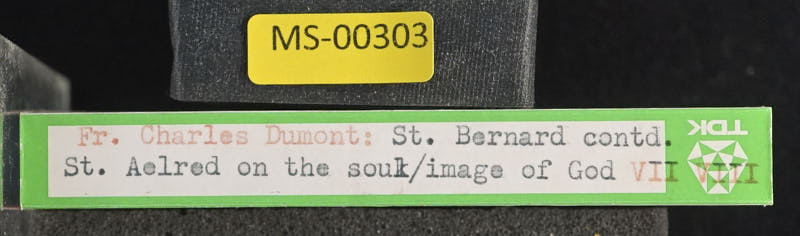
AI Vision - Possible Values from Photos:
Side: A
Speaker: Fr. Charles Dumont
Possible Title: St. Bernard contd., St. Aelred on the soul/image of God
Additional Text: VII
Side: B
Speaker: Fr. Charles Dumont
Possible Title: St. Bernard contd., St. Aelred on the soul/image of God
Additional Text: VIII
@AI-Vision_v002
Yesterday we end by this commentary, the short commentary of St. Bernard on the St. John verse. When we shall see him, we shall be like him. And we shall be like him because we shall be seeking him. And then we end it by saying, this vision, this vision This likeness is charity. This is very typical of the school of St. Bernard. This vision is charity and therefore this vision is not only for the heaven but as we have seen by degrees we become more and more like him. Therefore, we bear degrees enter in this vision, this knowledge, true charity, true love, which grows in our heart.
[01:14]
Now, reading the same doctrine on the image in St. Elred, we shall even see even more clearly our charity is really this progress of the soul. And if you read immediately, start immediately on page 57. Page 57 is the opening of the Mural Charity, chapter 1, the first book. And it is a very beautiful text. It's almost a lyrical text. It's an opening which is very poetical. I shall not read the whole of this text, but sometimes I wish that it would be read in church because it's very beautiful. Like a tent, O Lord, you stretched out your heavens and placed in its stars to light this dark night.
[02:26]
in which forest creatures roam and lion caps roar after they pray. His image is taken from the psalm, stretch your heavens like a tent, and the idea is skin, a tent of skin, and most probably this is This image came to the mind of Elred because when you start to write a book in the 12th century, you stretch the skin. It's the parchment of the skin in which you are going to write. It was stretching. This came before writing on the manuscript.
[03:29]
So, let your voice sound in my ear, my ear, good Jesus, my heart, my soul, the very inner parts of me. Teach them to love you. Then, the bottom of the page there, it is... Palace of the heart. There is a palace on the heart. Savoring you who are sweet. Savor. Savor. Sapor. Sapientia. It's all doctrine of wisdom that you taste. You know, the doctrine of the five senses. The five senses has been applied by origin to the spiritual world. And each sense has his own function and has his own dignity. But for the situation, St.
[04:33]
Bernard, St. Elred, this taste, the sense of taste, is really the expression of the realization of the spiritual spirit in you or the union in you. with God. The eye seeing you who are good. The place able to capture you who are most high. He who loves you captures you. Captures you as much as he loves you. For your love itself, for your charity. Doctrine. very clear. It captures as much as you love. The next page. Let me experience the least foretaste of that longed fall of that desired heaven.
[05:43]
The heaven for which I pant in this the pilgrimage of my soul. Let my very anger be that foretaste, my very thirst be that quenching. So the experience, we have been talking very much of experience this last time, as much as the Benedictine chapter, the experience of God, and we are preparing the chapter in Rome, that during three weeks you shall try to have this experience of God. Hope some habits will have the experience of God. But you never know. It can happen. Anyway, a lot of talking in many, many directions have been going on in many meetings and so on. And the notion of experience, as we realize, has been extremely confused. Everybody has tried to clarify this notion of experience, and the confusion increased.
[06:52]
So, in the text of the conference, written before the Congresso of the Benedictine Abbots in Rome, which has been published by Monastic Studies, in English, noticed two very good articles by Juan Esteveau Gué, who says that in the rule of St. Benedict, there is no experience of God, mystical experience. The experience is to seek God. And Father Nossant, Don Nossant of Maretsu, in his article has one line goes like this, The very experience of the monk is the seeking. And you have it here. Let my very anger be that foretaste, and that is the experience of the monk. Though we can have some kind of experience, the very experience of the monk or the Christian is the seeking, knowing it.
[08:06]
based on St. Bernard's famous word which has been repeated by Pascal I would not seek you if I had not already found you so St. Herod says well this immense sweetness revealed to those who love you even for those who fear you then that inestimable craving shall be satisfied fully in heaven Interim, meanwhile, I shall seek you, my Lord, and I shall seek you by loving you, since he who grows in love of you truly seeks you, and he who loves you perfectly, Lord, he it is who has already found you. And what is more, just that than that one of your creatures should love you.
[09:09]
One of these creatures who has received from you the power to love you yourself. Other creatures are insensible, irrational, cannot love you. It is not in their nature. The nature of man is to love God. To be sure, they have their own nature, their own form, their ways, but this gives them no happiness nor can they love you. Now, you are the Augustinian basic doctrine that love and happiness is really union with God. It's the doctrine of happiness. The beauty, good, and well-ordered ways which proceed from you are to the glory of those who are capable of happiness. Man is capable of happiness, therefore capable of God, because they are capable of loving you.
[10:14]
So the equivalence of the attitude, happiness, and love. Now, after this, St. Elric goes on to Trinity, or Trinity of the image in men which is borrowed from or taken from the De Trinitate the treatise on the Trinity by Saint Hilary nature appearance or forma and purpose nature beauty and usefulness now God has distributed among his creatures three things in common nature Nature, appearance, form, beauty, and purpose. Nature, by which they are good, everything which is, is good, that's St. Augustine, and therefore evil doesn't exist, there is no real being in evil, because everything which is, is good.
[11:22]
Appearance, by which they are beautiful, and purpose, by which they will do a particular ordained thing. He who made things to be also made them to be good, beautiful, and well-ordered. Now, we shall read, if you have time today, another sermon where he develops this Trinity. But immediately we shall go to the Augustinian system, which he develops here in the beginning of the Trinity. Treatise on the Mirror of Charity. Page 60. He repeats there, in creating the universe, God gave man not only being, nor as with others, simply to be good, beautiful, and well-ordered. Above this, he gave them a capacity for happiness. But has no creator the cause of its own being.
[12:23]
That's good. God is the beauty of all the beautiful and cause all being. So no one is the cause of his own happiness but receives such from him who is happiness and through this the happiness of all the blessed. Only the rational being is capable of this happiness because it is created in the image of his creator. The soul is capable of adhering to him whose image is It is clearly the doctrine of adherence. And if you remember, this adherence is precisely the consciousness that you are in a dynamic relation with your model, with your exemplar, to adhere to the model, to the exemplar. This is the only good for the rational creature, as David says, but it is good for me to adhere to God.
[13:32]
Bonomi adere deo. Clearly, this is not a thing of the flesh, but of the spirit, that is, a union through those three qualities which the author of nature gave to the soul. Now, the nature has three qualities, which is the three faculties of the soul. and which allow it to partake of divine eternity, to share his wisdom, and to taste its sweetness. These three faculties are memory, intelligence, and love, or will. These three qualities, which form the nature of the soul, the three faculties of the soul, we lost one on this faculty, due to the scholastic and St. Thomas, who just dropped memory. And this is very regrettable, because memory is a very, very important faculty, and modern philosophers are slowly now discovering the importance of this memory under different names, on different systems.
[14:51]
Professor Gilleson, Etienne Gilleson was the first to point out that Memoria in St. Augustine and the Cistercian theologians was corresponding almost very closely to what we all today call subconscious or unconscious. which is the imprint of God in the soul. In this context of St. Augustine, it is a Platonician idea that we were contemplating God before, or that our soul was or is in the mind of God, you see, before we are, for the soul animates the body.
[15:56]
Anyway, this imprint of God in man, or in humanity, is rediscovered by Jung, for instance, with all the archetypes of the collective unconscious and all that sort of thing. Well, this is memoria. And it's a very important part of the consciousness of man. And of course, all these theories is built, all these theories is built on the image of the Trinity now in the soul. Since man is created that the image of God, what Sanochristian says, we must find a Trinity in man, since God is Trinity. These three faculties are memory, intelligence, and love.
[16:57]
Through memory, man can contain the eternal. Through intelligence, he can grasp wisdom, and through love, he can experience sweetness. Now, St. Melred will put the emphasis on his experience. Through these three attributes man was made in the likeness of the Trinity. His memory retained God without forgetting the beginning. And you see very well all the process of the ascesis, the reformation of the mind, of the soul of a monk all is directed toward this restoration of this memory which eventually, more or less, or progressively, by degree, recover this faculty of retaining God without forgetting.
[18:04]
God will be more and more in the soul or in the consciousness of man, of the monk. And seizing prayer, is that the word? Seizing prayer. The ideal of the monk, having God present all the time in his memory. Remember God. His intelligence knew him without error. And his love embraced him free from the desire for any other thing or to prefer another thing. There was no conflict. There were no concupiscences. No greed. This is happiness. If happiness is therefore truly acquired through these three faculties mentioned above, it is through the third, love, that man is able to taste this happiness.
[19:09]
It's very clear now. Scholastic would not say that. St. Thomas would never say that. St. Thomas would lead the soul through the intelligence. And then you say, well, intelligence unlike the mind, and therefore the mind can follow and love this realized truth. And Elred says, it's through the third that man is able to taste happiness. Our miserability is therefore to seek happiness in evil, and there is neither sweetness or joy to be found, for there is no love whatsoever. there is no happiness. Where there is no nerve, there is no happiness. Therefore, the greater the love for the supreme good, the greater the delight and the greater the happiness. And then he explained, let the memory bring forth many long hidden concepts and knowledge capture the deepest of notions. But there is no happiness unless the will itself does not turn toward these concepts and notions.
[20:17]
There's no real knowledge of Torah. They are real grasping on the truth and reality if there is no love, if you don't love something, if you don't taste it. That's a very common experience. You can accumulate knowledge and notions. And students do that. They accumulate knowledge and But they don't always love this knowledge. Accumulate knowledge to pass an exam, for instance. It's not much pleasure. Only truths which are tasted, which are loved, are really understood, are really realized. They're really making one with you. You come. in you and form you and give you happiness.
[21:20]
And this happiness is the reformation of this faculty of love and the restoration of love in us. Then he will again take again the history of what happened with the grace of God our Father Adam and though his free will in loving God forever, could be happy in his memory, in his intelligence, and could have joy forever. But he could also focus this love of his on some less object, and thus, in drawing himself back from the love of God, grow cold and do himself to misery. To prefer something less than God, was to grow cold. Now, grow cold has a long history. His expression of growing cold has a long history in patristic literature and behind that in... No, no, actually, it goes back to origin.
[22:36]
It's based on a play on world. It's... for me to just refer to this little detail, but it's interesting to see, to point out these things, which, well, if you read that quote, it doesn't mean much. It has very traditional meaning. It's an expression of precisely the soul turning away from the fire of God, the fire of the love of God. And it's a doctrine of origin, which he gives in the Periarchon, on the first thing, the Principis, book, the second chapter, the 8th. Now it's in Latin here and in Greek, that doesn't help much. So the idea is based on, play on word, on psuche, psuche, which is soul,
[23:41]
the animal soul, the soul which animates the body, and sucro, or succo, to grow cold. It's two words. The verb, succo, is to grow cold, and suke is the soul. Therefore, Origins say, the mind was the noose, the spirit, contemplating the fire from God, But then when the mind turns away from God to seek its own, it becomes suke. The nose becomes suke and then enter the body according to Plato. Origin is a bit vague there. Although he held the preexistence of the soul. That's one of his heresy. The mens, mens in Latin is equivalent of the noose, the mens falling from its dignity becomes soul, animating a body and cold.
[25:02]
But if the soul is restored, if this suke is restored, it will become Nus again. Spirit again. That is the doctrine of this grow cold. So you have to get warm again. And that's the only way is to return to the fire, the divine fire, by charity. Therefore, for the rational being, just as the only happiness is to be firmly attached to God, so the only misery... consists in being estranged from God. Then he takes again this, man being in honor does not understand all this thing we have seen in St. Bernard yesterday. Man did not understand that he who in an ungodly way debauched himself by pride, suffered in folly, and that he who through pillage disturbed the affinity to God become as desperate as a cattle.
[26:10]
I don't know if the cattle is desperate, but anyway. Therefore, using his free will badly, man turned his love away from the unchangeable God, unchangeable good, that's the Platonic or Augustinian idea of God, the unchangeable good, and blinded by an inordinate love of self, see, inordinate love of self, focused it on some lesser object. See, the holy's love is now directed to a lesser object than God. Withdrawing from the true good and defecting to that which was not good in itself, he chased after gain but found only loss. Having loved himself falsely, see, He lost both himself and God. It's the same doctrine as St.
[27:11]
Bernard. It's very, very deep. He lost himself and God. Because he loved himself falsely. He should have loved himself rightly. It was a very good, it was a very just punishment for him who against God longed to be like God, that by his passion he should be dissimilar to God as he had wished to be similar by his analytic curiosity. Curiosity, that's again. He wants to be God by himself. It's curiosity. Trying to find by himself, that's curiosity. Instead of being God, who wanted him to be divine, wanted him to be like God, like himself. But he wanted to do it a lot, to do it a lot, to do it by himself, which is typical of men and of modern men. Exactly, I think.
[28:14]
Speaking of Sartre and Nietzsche and all these people, they just want to do that. They want to be God by themselves and to realize it by themselves. Because man is capable, I think, by his reason, to be self-sufficient. That's exactly the sin of paradise, the sin of paradise, to do it by themselves and not according to the will of God, not according to the love of God. The image of God in him was therefore damaged, but it was not completely ruined. He still has memory, but it is tainted with forgetfulness. He has intelligence, but it is subject to error, and he still has love, but it is inclined to covetousness. However, miserable it may be, the human soul keeps through this trifle faculty an imprint of the Blessed Trinity, which is engraved in its very substance.
[29:23]
Then he quotes literally St. Augustine in the De Trinitatis, or the Cinesis at Lutheran, where St. Augustine, after having tried so many, so many images of the Trinity in the soul, in man, I think he tried 35, 35 system. Anyway, he was very, very keen on that, to find some three things in man. But he eventually, reach this very beautiful, perhaps the most perfect man can have of the Trinity. Because Trinity, as we have been taught in the Catechism, one is three and three is one, is simply absurdity. It's not...
[30:27]
Trinity is something else than one is three and three in one. The office of the blessed Trinity in the Gregorian, I don't know if you are the same, but we are repeating that for one hour and a half. We try to find, and then man, human mind tries to understand human mind is bound to images, spatial temporal images. Even its most abstract ideas are rooted in the space and time. And you cannot get rid of images. Anyway, Cappadocian tries several images. One of the most very well known is the rainbow, which one light and various colors, which is material.
[31:31]
Now, St. Augustine here says that there are three faculties of the soul, and these three faculties of the soul are one. One is I. And these three faculties of the soul are interpenetrating or transparent. See, the activity of my soul... is spiritual, and therefore is one. And when I remember, soul remembers, knows, and loves. And it remembers, knows, and loves its memory. It loves, knows, and remembers its intelligence, and so on. Or you can say, I remember that I love and know. I know that I love and remember. He said, And I love to know. And it's one activity. And it's a very beautiful symbol.
[32:35]
I mean, probably not that, but something very close to an idea or approaching the, or at least some kind of a bit more subtle idea of the Trinity. Therefore, In these three operations, which we have mentioned, there is to be further unity of substance. That's all. That's a commentary on the sound there. And a long note from this young translator, very naive. Everybody knows that it's not in Hebrew and all that. It's absolutely useless to put all that. Anyway. Now, to the coming of the Savior, chapter 5, page 62, then through the man, Jesus Christ.
[33:35]
Now, let's remember that the restoration for a Christian is not, again, possible, but by the mediator. Through the man, Jesus Christ, the one mediator between God and man, put into himself the loneliness of human nature, and so on, the principalities and the powers to which divine justice has condemned us were despoliated, and God the Father, being appeased by this one victim on the cross, which is the Anselmian doctrine, very unfortunate, but it's very rare that it appears in the Cistercian, but it appears here, the appeasing of Roads of God by the victim. Anyway, it comes here, but it's exceptional. Memory was at least restored to the works of sacred scripture. I don't know if that's a good translation.
[34:37]
Somebody suggested the words. Anyway, in the Latin it's the documentum by the text. So the memory is restored by sacred scripture. It is very interesting that. Sacred scriptures reveal to us this imprint of God in the soul by the revelation. Revelation is simply explaining to men what is in him, what was God imprinted in him. Intelligence through the mystery of faith means the doctrine of the Holy Church, the creed, And love is restored through the daily increase of charity. This increase of charity, it's a process of increase. And again, growing in charity until the fullness of charity will be realized.
[35:40]
So the restoration of divine likeness will be complete if forgetfulness does not dull the memory Error cast a cloud over intelligence and covetousness disturb love. But where and when this will take place, this peace, this tranquility, this joy is to be expected in the Fatherland. Where and so on. O eternal and true charity that is Augustine. So the canticle. Here is rest, here peace, joyful peace, peaceful joy and all that. So the next page Meanwhile, interim, Lord Jesus, that's paragraph 55 there or something. No, middle of the page. Meanwhile, page 63. Lord Jesus, in the nest of your discipline, I wish my soul be feathered to fill out its wing, to rest in the caves of rock or image of the canticle
[36:50]
in the hollow enclosures. Meanwhile, let my soul embrace you, you crucified. Well, to see that the memory of God, memoria dei, which were the expression of St. Augustine, becomes quite clearly now memoria of Jesus. Memory of Jesus. According to the... Devotion of Cistercian to the humanity of Christ, of which we shall speak tonight. It's Christ now which attracts the memory. And you have the beautiful hymns. Unfortunately, we don't sing it anymore in Latin. Jesu Dulcis Memoria. Dulcis Jesu Memoria, which most probably, according to Don Wilmer, has been composed by Elred of Rivo.
[37:55]
It's almost certain. So Elred of Rivo was a composer of the Dolchis Jesu Memoria. It's almost certain. Of course, it's not certain because a hymn, they were not signing hymns. But you cannot find a signature on it. But all the manuscripts which remains are around Rivo. You see, all the manuscripts now. Extant manuscripts are around Rivo, and it's quite numerous. So it's certainly in England, in the north of England, near Rivo. Conclusion is obvious. It must be Elred of Rivo. Only he would have been capable of doing that. And we know also that he was writing verses. It was forbidden for monks to write verses. the text of the general chapter, very early, in 11th, 50 or 53, to forbid monks to, I forgot the Latin expression, anyway, to write verses.
[39:04]
That was simply to forbid monks to write curtly verses. Which they were selling, I suppose. So they were also still allowed to write pious poetry. In one of his historians who speak of a letter of Riveau, he says that he was known to have written a poem on St. Cuthbert. And he even... This historian goes even further and says that he finished it because he was held up on the other side of the channel in France when he was going back to England. So he had three or four days there to wait the favorable winds.
[40:08]
He finished this poem. But Dulcis Jesu Memoria is really an expression of all this doctrine. The dialectic of presence and memory. The memory longing to the presence. All this dialectic is going through St. Bernard and St. Elred. There are sometimes texts which are very shocking for many various souls St. Bernard is saying that we are not satisfied with the Eucharist. The full presence is not yet realized. People say, does he believe in the real presence? Because he does. But it's not complete. It's not the fullness of the presence of Christ.
[41:10]
It's still in sacrament. It's still a memorial. It's still a memorial. We remember that we are longing for the full presence. And it's always there. There are only the foretaste. Even the Eucharist is a foretaste. To let my memory be filled with your sweet remembrance and may oblivion never darken it. Other than that of my Lord and of his cross, let me know nothing. Away from this strong faith, let no vain error sway my intelligence. May your most marvelous love to all my affection lay claim, and may no worldly passion distract it. Oh, and this is beautiful too, because now, it's very modern too, he remembers his fellow man.
[42:14]
Oh, but do I want those things for myself alone? Let the words of the prophet be fulfilled. All the ends of the world shall remember and turn unto the Lord. He says, shall remember. And he means the following. That remembrance of God is hidden, but not forever buried in the mind of man. So that it is less a new encounter than an old truth which is restored in us. It is completely unnatural, unnatural, that wherever there is the least flickering of the human spirit toward the remembrance of God, the fool would say in his heart, there is no God. That can be applied, hopefully, to so many people today who say there is no God, even in saying that. People are saying to Sartre, they say, but why do you keep
[43:18]
Speaking of God. You speak of God all the time. You see, he doesn't exist. But why do you still speak of him if he doesn't exist? There's a play, his famous play, Le Diable Le Bon Dieu, which is a very blasphemous and scandalous play. There's always a question of God. There's a man coming on the stage... At one time I forgot who he was. And he said, Hallelujah, I announce you God doesn't exist. And that's the summit of the play. Rejoice. If it is evident, and I do not think I am mistaken, that it is not physically, but through an inclination of the soul, that withdrawing himself from the supreme good and human pride festering in him, man tarnished the image of God in himself.
[44:33]
Likewise, it is by an inclination of the soul, human humility consenting to God, that there shall be renewal in him, the image of him who is his creator. This sentence is very beautiful. Human humility consenting to God. In Latin, mentis affectus, this inclination, the affectus. The affectus is a beautiful word, untranslatable in any modern language, I think. It's the to be affected, to taste, to be, it's almost happiness to enjoy, this joy, this very intimate and profound joy which inclines, which tends, which attracts the soul.
[45:44]
human humility, the access to God through this human humility. Then the apostles say, and be renewed in the spirit of your mind that you put on the new man which after God is created. But how will this renewal take place, again, if not in the new precept of love, of which the Savior spoke, a new commandment I give to you. Accordingly, if the soul covers itself perfectly with this love, there will surely be renewed in it those two faculties which we say have been dulled. It's gained by the faculty of love that the two other the two others will be healed, will be renewed, namely memory and knowledge.
[46:49]
It is therefore more profitable for us to find in this one precept joined together the shedding of the old man, a renewal of the soul, and a restoration of the divine image. Our faculty of love, Infected with the venom of covetousness and miserably ensnared in the net of our passion, by its own weight, constancy pulls us down from one vice to another. Charity, on the other hand, inspired from above and dissolving in its own heat, our natural topper surged toward the heights and shedding the old in dance the new. And then the image of the wings and of Solomon and all that. The image here is borrowed from the, again, from the Neoplatonist. It's the image of a bird who is...
[47:50]
@Transcribed_UNK
@Text_v005
@Score_94.04