You are currently logged-out. You can log-in or create an account to save favorites and more. more info
Divine Image: Humanity's Theological Journey
AI Suggested Keywords:
Talks at Mt. Saviour
The talk critically examines the theological understanding of human nature and the concept of being created in the image of God, emphasizing a patristic doctrine reflected throughout history. The discussion contrasts various theological perspectives, from the optimism of human potential in St. Bernard’s allegorical interpretations to the more pessimistic view of original sin by Augustine, with particular focus on the debate between literal and allegorical scriptural readings and the implications of these interpretations for understanding man's relationship with God.
- Saint Bernard and the Bible by Pierre Dumontier: This work explores St. Bernard's intimate and allegorical approach to reading the Bible, treating it as personal communication or "love letters" from God, crucial in understanding his spiritual and mystical theology.
- Exegesis Medieval: Les Quatre Sens de l'Écriture by Henri de Lubac: This monumental work covers the traditional medieval method of interpreting scripture through the four senses: literal, allegorical, moral, and anagogical, serving as a guide for interpreting theological teachings and doctrines.
- The Glory of God is Man Fully Alive by Irenaeus: Often cited to discuss the doctrine of man's creation and potential, this text emphasizes the developmental aspects of spiritual growth towards eventual divine perfection.
- Demonstration of Apostolic Preaching and Adversus Haereses by Irenaeus: These texts provide foundational insights into Irenaeus' view of human nature and original sin, contrasting Augustine's more negative view and offering a progressive understanding of spiritual maturation.
- Max Weber on Calvinism and Capitalism: Referenced to highlight the Calvinist perspective on human nature's corruption, this work provides context for understanding the historical and theological divergence between Protestant and Catholic views on human trust and sociability.
AI Suggested Title: Divine Image: Humanity's Theological Journey
AI Vision - Possible Values from Photos:
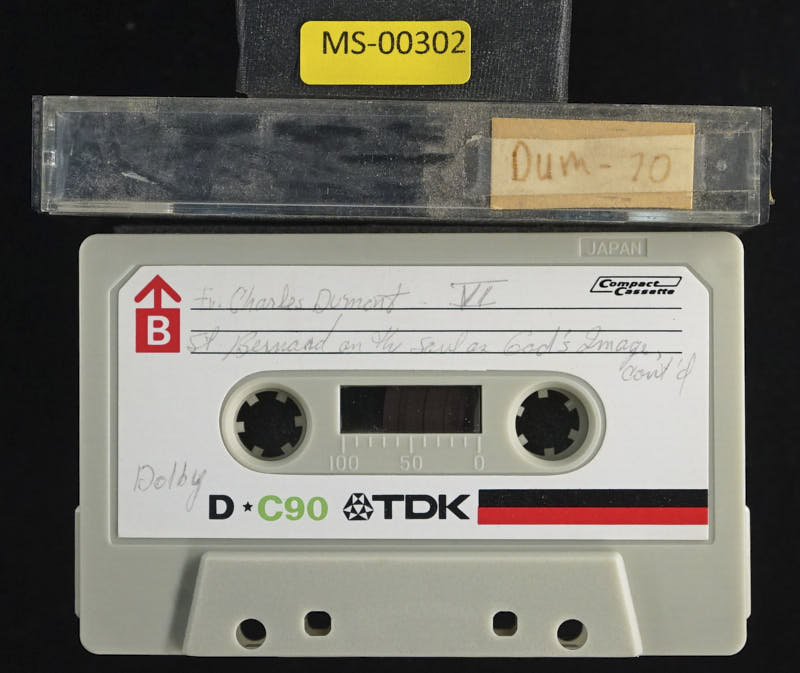
Side: B
Speaker: Fr. Charles Dumont
Possible Title: St. Bernard on the Soul as Gods Image
Additional text: Dolby
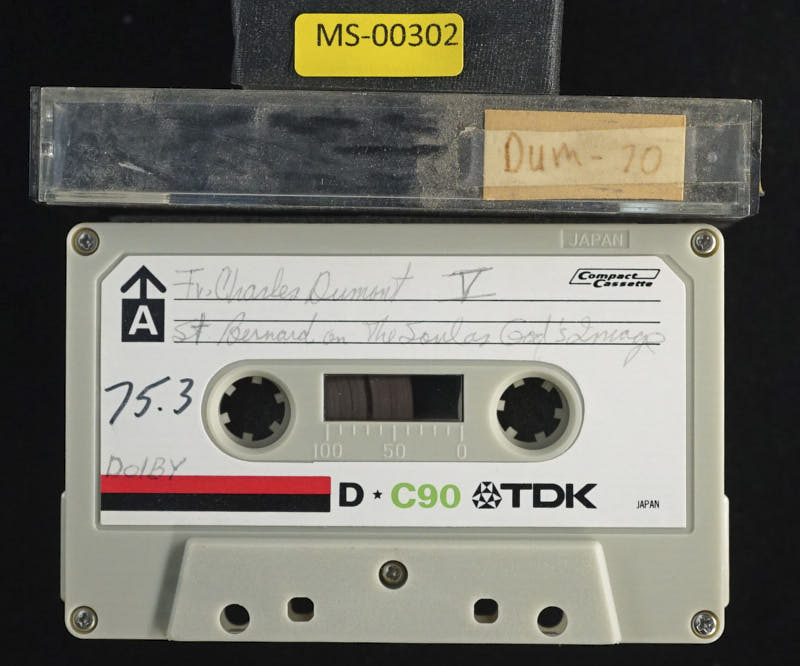
Side: A
Speaker: Fr. Charles Dumont
Possible Title: St. Bernard on the Soul as Gods Image
Additional text: 75.3 Dolby
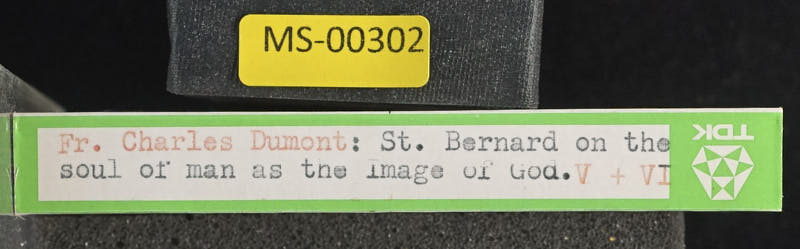
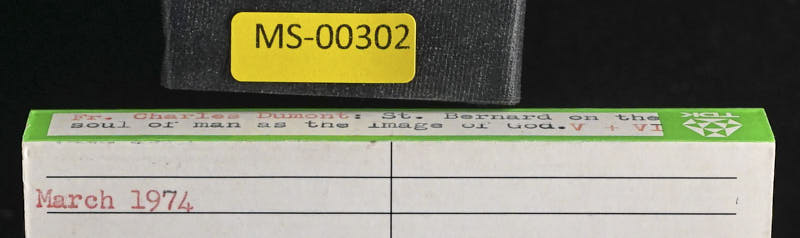
Speaker: Fr. Charles Dumont
Possible Title: St. Bernard on the Soul of Man as the Image of God V + VI
Additional text:
@AI-Vision_v002
I've been speaking these days on the idea of love, incestation, or they trust this dynamic power in men, or trust the value of love, any kind of love, even the love of self, to direct men and to lead men as a natural power to his destiny to God, return to God. Now, this trust, this optimism of human nature is based on the theological doctrine of man created the image of God. It is a patristic doctrine which goes back to very beginning, Saint Irenaeus used already the image which is taken from the Genesis and his commentary or an allegorical commentary on the Genesis.
[01:19]
The book of Genesis says God created man in his image and likeness. In his image, he created him. Now, the critical exegetes of all time don't believe very much that there is a distinction between image and likeness, and most probably there isn't. But the father never pretended, never maintained that there was one. They use this distinction, well, just for... using it because I found it very interesting to use them, use this distinction for their theological reflection. We are always to be prudent when you read even fathers and especially the medieval authors not to ask from them what they don't want to tell you and not to require from them so scientific statement. They don't pretend to be scientific in the way we pretend to be scientific.
[02:27]
I think it's a pretension. There's as many diversity and variation in the scientific literal sense than there is in the allegorical sense. It changes every year. And it's always the last statement. Next year there's another system. So they use scripture in a very familiar way. There's an article being published, I saw in the library, just an article published by Jesuit, on a book written by Maurice Dumontier, who was one of my colleagues in Scourmont. He lived 20 years, last year of his life in my monastery. And he wrote a book, St. Bernard et la Bible, which where he shows very well St.
[03:32]
Bernard uses the Bible. He uses the Bible as something given to him by God, sort of love letters given to him by God. And he used this text as sort of intimate confidence or revelation from God. This text belongs to him. belongs to the Christian faithful, belongs to us. And we can read that as a family letter. And since we have also the same spirit who inspired the author of the text, when we read the text, the same spirit inspires us. We have to be extremely free and just be led by the spirit. And it is a completely different approach from the modern approach.
[04:36]
Obviously, we cannot be monks or priests today without a certain amount of critical knowledge of the Bible. And we have to certainly know how to reach textual, critical, valuable text. But that's only the beginning. And certainly, many people just remain all their life on this critical business. And there is a beautiful page in his book on contemplative prayer, prayer. on this danger for a contemplative or monk to let himself too much in his critical studies.
[05:41]
Eventually he cannot hear the word of the scripture in an open soul, with an open heart. I was in Paris two months ago coming here and I heard some friend there who studies in the Sorbonne, and I heard everybody everywhere speaking now, after years of hypercritical studies and teaching, everybody speaks now of lecture naive, a naive reading of the Bible. That's where we are now. We reach this. After all this critical thing, let us read the Bible naively, as it was written. There is something of that in St. Bernard. And all this great liberty, these allegorical fancies, comes from that. St. Bernard reads the Bible as words of God, words of Christ, spoken to him directly, personally.
[06:52]
He finds in the Bible all the feelings, emotions, experiences of religious souls. Old personages, old people of the Old Testament and the New, he finds himself in these people. When he recites the psalm, he is himself involved, his own life. And he speaks all the time of tasting, the sense of taste. You have to taste what it means. Taste. And that's savor, sapientia, what it tastes. And if you have not that, well, you cannot read the Bible. Because the Bible remains a closed book for you. You have notions, truths, but it never become part of yourself and never enter in your own life. So that's the way
[07:53]
the Bible for him is a direct message from God. Now, this way of reading the scripture is traditional. And it becomes more alive today since we have this reading in church in our own language. Because the Bible should be spoken should be said, read to the people. So you have many examples in the past, and most obvious is the vocation of St. Anthony. Anthony comes in the church, and he was late for Mass. He just arrived when the priest was reading the Gospel of the Deacon. And it was the passage of the Gospel saying, give everything to the poor, and follow me.
[08:54]
And Antonesius said, yes, yes, I'm going to follow you. And that's the message. And Antonesius says, God told him, see, directly. And he said, yes, it's told to me. So this direct message of the Lord to you personally is the way they were listening to the scripture. You can well see, or critically, mentality, just to get notion, truth, doctrine, is an obstacle to this free, open-heart listening to the word of God. You cannot be there and say, well, perhaps there's another meaning, there's another version, or perhaps the Vulgatas, this Texan, the Greeks, mean something else. There's a sort of, again, suspicious mentality. which is the scientific, technical mentality, which is to be avoided.
[09:56]
After you have done the normal study, and the ancients were very keen also to have a literal, exact text. But the very first exegete, Origen, spent a lot of time and a lot of money to have his examples. See? Bible English. six versions, six columns, the one by pachygraphs, and he spent a lot of money to these people to put that and have a text, a really critical text. So we had the first Cistercian. St. Stephen Harding was the third habit of Cito, spent a lot of money and going to Dijon by night to consult rabbi. That was extraordinary for the time because rabbi was the devil. But he went to consult the rabbi and gave him, of course, some gold, because that's dealing with rabbi, to know the version.
[11:09]
And I tried to have an exact version of the Bible, which is the Bible of St. Stephen, which is the known. So they were really conscious and trying to have the literal sense. But that was only the beginning. When you are what is in the text, it's only a starting point. Now, you just start on that. Only because the beginning of the Sermon 18 On page 29, on the Song of Songs, St. Bernard clearly said, some of you, my brothers, as it appears, are feeling disappointed because for several days past, I have given myself exclusively to the delight of studying with wonder and admiration the mystical meanings of this speech of the spouse,
[12:12]
that my sermon have been seasoned with few moral application, even at all, where you are there in the distinction between mystical meanings and moral application. That certainly is not in accordance with my usual practice. It's not very true, but anyway. But I want your permission now to go over again what has been treated already, And so on. And then... that goes back to Sermon 75.
[13:18]
He spends five sermons on the mystical meaning of this verse, which is the love of the church and Christ. That's the mystical thing. Now, perhaps it's interesting to point out what means this distinction between the allegorical sense or mystical sense and the tropology, or moral reflection. Père de Lubeck has written a wonderful book, I think the book of his life, which is four volumes, you probably have this book, four volumes, called Exégeses Medievales, and you have, I mean, told a resume of that in a book called The Sources of Revelation. because they're probably not the courage to translate these four volumes.
[14:19]
In these four volumes, you have 10 or 12,000 notes, footnotes. It's the courage to produce that. It's an enormous thing. It covers the whole tradition from origin to Erasmus on this precise topic of the four senses of the scripture. Now, what are the four senses of the scripture? as the Lübeck shows very well, it has been the way of teaching the doctrine of the Church from the very beginning. For 16th century, 1600 years, that has been a method of the Church. That has been lost in the Reformation debate, where everybody was trying to have a literal text and fight. on literal text. But even Luther and Erasmus were still using the four senses of the scripture as a method.
[15:25]
Thomas uses it and everybody since the very beginning. The advantage of this method is that it is unified. It's a unified teaching from one text. You start with the text. You start with the scripture. You start with the revelation. After that, after the 16th century, the first treatises, as we know them, as we have known them, the treatises of theology, these treatises were built upon profane knowledge. I mean, moral theology was built on the ethic of Tunicamac. The treaties of the church was built on the politics of Aristotle. What is a church? What is a perfect society? What is a hierarchical and monarchical society? You define all these principles as political signs, and then you say, is the church dead?
[16:31]
Yes, of course, Matthew 28, and so on. That was the way of... You see, which is the reverse, you see, very well. Instead of starting with the revelation, we start with all sorts of knowledge, and they say, well, the church answered this definition. And even in the manuscript, you can see the progress of that. Beginning, it was the text of the Bible and a few lines between the lines or in the margins. And the text progressively with the centuries The text were reduced more and more and the commentary took more place until the commentary was in the full page and the text in the footnotes. That's how it's been. You can trace that. It's very important to see that it was a system of the ancient. It is very curious to see that there is a renewal of that
[17:36]
And I was told recently that a structuralist, people who are trying to study the Bible by structural principle, this famous philosophy of structuralism, we try to explain some patterns of our mind, found again that these four senses are really a structure of the mind, normal, natural structure of the mind. And I have a school in Brussels, so Louvain, Jesuit, who are teaching theology, now modern theology, giving a degree in theology to their own scholastics and lay people. And it's based on the four senses. The whole course is based on four senses. It's very, very popular, very great success. The traditional method, modernized and giving more importance to the literal sense, but it's the idea.
[18:39]
See, the idea is to center, concentrate, all the teaching on one text. And naturally, first of all, what is the doctrine in this text? What is the relation between Christ and the Church? That is dogma, or ecclesiology, Christology. Then on that, based on the moral, morality, Christian morality. Christian ethic has to be built on the sense, the allegorical sense, or the Christian sense of the scripture. And then after that, normally, you develop this moral sense and allegorical sense in mystical and spiritual developments. It's a normal way of reading the Bible. or reflecting and commenting on the Bible. And that was the way they were doing, more or less strictly. Here you have this way.
[19:40]
So once St. Bernard said they are frustrated from moral application, that means that was because obviously the monk preferred much more the moral application. It was a bit more personal, more direct. daily life than the mystical meanings, where it's somehow some time with both their heads, chiefly when it was in the morning in the chapter before breakfast. So they always complain that St. Bernard did not give moral application. I mean, he was always speculating in trilogy. Let us therefore go back to seek for moral interpretation. I do not be afraid, nor the work shall prove very sum to me, provided it is profitable to you. The most convenient plan will be to endeavor to apply to the world and the individual soul what I have already said concerning Christ the Church.
[20:48]
So, the moral application now is... relation between the word and the soul. And it will be on the same line, parallel, of what he has said about the relation between church and Christ. Since, obviously, in St. Bernard, the soul has no relation to the word but in the church. Anyway, he will try to now... show the application of this union of the soul and the word. But here I may be met with the objection, why do you join these together? What is there in common between the word of God and the soul of man? I answer much in every way. For in the first place,
[21:52]
There is a close natural affinity between them since the word is the image of God and the soul is made according to this image. The soul is the image of the image. You see, from the very starting point, there is a close affinity, natural close affinity between the word and the soul because it is the image. Now this theory of the image, as I said, goes back to the very origin of the Christian theology. Irenae has been the first to deal with it and then origin and so on and so forth. Now, under this topic of the image, adoption of the image, lies the whole anthropology or theological anthropology of the Christian fathers and of the medieval authors.
[22:58]
And it's extremely important for us, all of us, in sometimes very immediately, very sometimes immediately, to know what is man, or what can he hope? What is he? Especially, is there in men some waiting place, waiting stone for grace, for the revelation of God, for God giving himself to him? Is there something longing for that in men? All theology is there, at least starting point. So... So as so much, the famous question of the desiderium naturally within the, the natural desire for the beatific vision.
[24:00]
Is there a natural desire in men for a beatific vision? You know, all this controversy in which Father de Lubac has been nearly been condemned. The whole fight is there, but it's extremely important. Is there natural insertion in men for the revelation of God, for salvation, for supernatural life. It's very difficult. The problem is, as you know, the problem is very difficult since grace is gratuitous. Revelation is gratuitous. Therefore, you cannot have an exigency in men. There is, of course, natural tendency in men. Man is incomplete. without God, without the definition of God. Just to avoid this problem now, but just to see how important it is. And in practical dealing with people and souls and moral problems today, it always comes back to that.
[25:09]
What is man? Is he good? Is he bad? Is he completely good or completely bad? Is he naturally perfect, or is he naturally completely corrupted? Or is it somehow good and bad, or something happened? What? We have the doctrine of the original sin, which is for us the doctrine of the revelation, but most people who think a bit say that if we are not that, we should invent, have to invent something. Because obviously you cannot explain presence of evil in men without finding some kind of solution. Or you become a Manichean and you say there are two gods, one god of good and one god of evil, fighting on the battlefield of men. And men is purely there, a battlefield.
[26:14]
But this notion of the original sin, that man is being created good by a good God, but by an accident, something happened that he distorted some of this goodness, and there's a mixture. Something happened, this wound. Now, we have this theory from St. Augustine. St. Augustine has a very pessimistic idea of the original sin. and it passed in the traditional doctrine of the Church. Everything St. Augustine said has been canonized by the Church. But before him, there was a very interesting doctrine of St. Irenaeus, which is being studied. I spent some days here before the symposium to read some good books you have here on St. Irenaeus' doctrine of the original sin and of the image of God. Irenaeus... had an idea that man was not perfect.
[27:22]
So the idea of Saint Augustine is man was perfect, he has a lot of virtues and extraordinary capacities of extraordinary power, superhuman, and he lost all that in the sin, and he is what he is now. Now, Irenaeus says, man was not completely fully developed in paradise. And so he was an adolescent or even a child. Adam and Eve was two children. It's a very beautiful description of Adam and Eve playing in the garden as children. And then a snake came, and the snake was much more intelligent than these poor little children. And he fooled them very easily, and they sinned. irresponsibly, almost. It's very interesting. It's in the demonstration of the Apostolic Truth.
[28:26]
And it also, in ,, it takes the same doctrine. This doctrine, of course, is very tempting for people, or people who see the evolution of men, to be prudent. But it's really very tempting. The idea of Tyroneus is a beautiful idea of man, which is an idea of evolution. Man grows slowly, and he will only be perfected in the resurrection of his body and soul. That is his goal. He will only be man there before he's growing. And the whole history of humanity is the same as the growing of a man. very continuous progress of the history of salvation. As a long, you say, melody. Melody goes and reaches eventually its perfection in heaven.
[29:31]
So you have to understand the famous text which is quoted again and again and misquoted, of course, today. The glory of God is man fully alive or something like that. Gloria de vivens homo. But then you have to follow on to the next line and see that. And human life is the vision of God. Don't put that on stadium and hospital. See, the two stages. First, the glory of God is to create a man. A living. That... That's only the starting point. Instead of having this mortal spirit, which is his soul, he has received the Holy Spirit, which will give him immortality. And he will only reach his full stage of man, realization of his full humanity in the vision of God.
[30:42]
The life of man is the vision of God. And slowly he learned this vision of God in trying to restore in himself the image of God. When I was teaching, when I was speaking of Centurion, I was saying that he was the only one who had these ideas. Somebody told me that origin, that I was in Buryville and some Among this, theologian told me that Origen had his idea. The second time, to show how the ancient was attentive to the text. You see, the first time in Genesis, it said, God created man to his image and likeness. And the second time, he said, only to his image.
[31:42]
No, second time he said to his likeness. So he says that that is an indication that in the first condition it's only the image and the likeness will be only in the consummation. Same idea as Irenaeus, that we shall be perfectly like God only in the consummation. But if you read a bit further in the text, this consummation, Origins say, is to restore what was given before the fall. So, Origins has the classic idea, which is in Augustine. It's only Irenaeus, who has this idea of a progress, slow progress, and therefore... the original scene being a sort of almost a mistake.
[32:45]
So, St. Bernard in his sermon 18, we shall not read the whole sermon, distinguish two things. At the bottom of the page, you see, it distinguish between the word which is truth, the word is wisdom, and the word is justice. Under each of these respects, it is an image. An image of what? an image of justice, an image of wisdom, and so on. For the word as an image is justice of justice, wisdom of wisdom, truth of truth, light of light.
[33:50]
He is in God, he is God, God of God. But the soul is known of these things because she is not the image. Nevertheless, she is capable of them and is desirous of them too And perhaps it is with respect to this capacity and this desire that she said to be made according to the image. Capacity, the desire for divine perfection. Capacity. She's a noble creature. Forget these things St. Bernard said, although he said we are vile and wretched. You can also say that man is a noble creature whose greatness is revealed in the fact of the soul that she possesses in herself such a capacity for participating in the perfection of the world.
[34:56]
And in her yearning for the same, she gives proof of her righteousness. And then there are two characteristics here where St. Bernard will deal with in all his sermons. righteousness and greatness, or greatness and righteousness, magnitudo and rectitudo. We read in Ecclesiastes that God made man right, and that he made him great also is clear, as I have said, from his capacity for greatness. And what happened... Yes, if you like to take it, pass it because time is running. Page 31. Greatness and righteousness, as everybody knows, differ from each other in their proper natures.
[36:05]
Nevertheless, they are one in the image. What is more, they are one with the image. For image, not alone is it the same thing to be great as to be righteous, and so on. Because in God, everything is one. Such, however, is not the case with the soul. Greatness and righteousness in her are both distinct from her substance and distinct from each other. For is, as they have already pointed out, the soul is great, in that she is desirous of things divine and eternal. It follows that a soul which neither seeks nor releases the things above, but the things that are upon the earth, can no longer be called righteous, but rather curved. Although she does not cease thereby to be great, since she still retains a natural capacity for eternal glory.
[37:06]
This is one theory of... what St. Bernard will repeat in various images and theories and doctrines of what happened. See, kova, anima kova. Indeed, it is not possible that you should at any time be without this capacity, even though it is destined never to be realized. See, the idea is that man is great and righteousness. So this erecta position, the position of man, which is from antiquity, man is the only animal who looks to heaven, who is straight. Now, when he looks to things on earth, and forget that things divine and eternal, his soul is curved. And that's what happened in the original scene. But he kept, it's always the same theology.
[38:09]
Theology, he kept his greatness. Something has been lost and something he retained, which is extremely important because if man remains great, no matter if he's curved, he can be strengthened again. Kept his same dimension of greatness. And then he commented, it's a passage of Psalm 39, 6, which is taken from the Vulgate, of course, and probably have nothing to do with this idea in the Hebrew text. He has a true idea there. Men continue in the image... in spite of the fact that he's been troubled, contubatu, troubled.
[39:16]
But it's always the same idea, which is very important, and theologically, the basis of our confidence in human nature. This is perhaps enough for today. Tomorrow we shall read the Sermon 81 and 82 where St. Bernard will change completely his symbolism or theology and he will take three properties, simplicity, immortality and freedom and he will try to see These three properties, these three qualities are realized in the world and are realized in the soul.
[40:16]
And what happened in the soul since she is the image of God and why she is not altogether and completely and perfectly the image of God. What happened to the image? This theory is... very important. When you have this idea in mind, you can see the difference in theology, in many theologies. For instance, the theology of inspiration of the Reformation, especially Calvin, Luther and Calvin, have something to do with that. And you can even, in modern authors, of course, modern authors are very, very close now to Catholics. There's no more Protestant, and there is probably no more Catholics anymore, but we come very much closer.
[41:19]
The idea of Calvin was precisely the complete corruption of human nature. So the image was completely lost, not only the likeness, but the image. Human nature was completely destroyed, all dignity, all duty, of human nature was destroyed, utterly destroyed, with no hope. And even in the salvation, in the redemption, human nature is not restored. It is covered by the grace of Christ and sin is forgiven, but human nature is not changed. It's still there, completely deformed. and utterly corrupted. And in the system, after all, the Calvin system of, of the, well, this dreadful theory of, you know, predestination, you have there the logical consequence of that.
[42:29]
Predestination is purely capricious will of God. And man cannot even, you know, even wish it in its own nature. And it's very hard doctrine, but it's based on this complete corruption of men. There is no hope for men. Simply complete relying on the will of God, the good will of God. It's very far from the patristic doctrine. And we always find this distinction. You'll find, for instance, the Greek theology much more tendency to divinization. Divinization is based on the fact that man is capable, capex dei, is still capable of divinization in his very nature. But it's very hard for a good Protestant to believe in divinization. It's almost unbelievable.
[43:31]
It's sort of blasphemy. I was speaking one day in Switzerland with a Calvinist, very intelligent man who was publishing some commentary on St. Paul in the French part of Switzerland. I was there in a resting home and I was visiting this minister very often. And one day we were speaking of that, and just casually I spoke of the divinization of the Christian. And he's chairman. And he said, what? What are you speaking about? Very curious for a man who has very culture in theology not to be able to grasp this idea. You will see that in this distinction very clearly. Recently I was giving a talk in Kalamazoo, to the medieval conference last year, and giving something on the Elred's Doctrine on Friendship.
[44:36]
And I didn't know very much what to say. And when I seen the plane going there, a friend of mine gave me a book of Max Weber. Max Weber was one of the first sociologists And it was his first book on the first thesis on the Protestant idea and the capitalist state or something like that. It is very much with the Calvinist idea of the first settler in America. And Calvin, he gives a beautiful text of Calvin who says you cannot trust your friend. It's not a lord. You cannot trust his friend. You can only trust God. Because human nature is completely corrupted. He clearly said it. There is no possibility of trusting human nature because it's corrupted.
[45:42]
Even your best friend, you cannot trust him. It is just the opposite of what St. Bernard will say. He'll try to do the more possible for him to bring human nature closer to grace as it can. You will see his effort for that. It's very interesting to see. This affinity, this close affinity will try to make it the closest as possible in order to show that really man and God are of the same nature. Same nature and that This is the base of the love of God, the love by which God loves man and desires man, because man is like him, and he seeks to like. It is the basis. And we'll say that if man loves God, he can presume that he's loved by God.
[46:50]
It's always based on this similitude, affinity, of nature.
[46:56]
@Transcribed_UNK
@Text_v005
@Score_94.37