You are currently logged-out. You can log-in or create an account to save favorites and more. more info
Celibacy as Connection and Communion
AI Suggested Keywords:
Sexuality
This talk explores the concepts of celibacy and sexuality from a spiritual perspective, emphasizing the integration of love and service into one's life as key elements of the gospel message. The discussion critiques traditional views of celibacy, presenting it instead as an affirmative expression of relational capacity and deep connection, beyond a mere denial of sexual relations. The talk incorporates insights from various authors on how celibate individuals can cultivate healthy relationships and self-awareness, aiming to foster authenticity and integration of sexuality within a broader spiritual framework.
- "Becoming Human" by Hafiz (13th Century Sufi Poet): This poem introduces the notion that spiritual visions and humanity's beauty are validated by actions that promote kindness and connection with all life forms.
- The Gospel Teachings of Jesus: Referenced in the context of embodying love and service as central to human happiness and fulfillment.
- Books by Sandra Schneiders: Comment on celibacy as a unique value specific to religious life, differentiating it from poverty and obedience, which are universal calls.
- "The Holy Longing" by Ron Rolheiser: Describes sexuality as a divine energy within us, driving the pursuit of unity and communion with others.
- James Nelson's Writings: Emphasizes sexuality as a physical, psychological, and spiritual expression that seeks authentic humanness through connection.
- Dan Omerku: Suggests redefining celibacy as a "vow for relatedness," proposing a non-violent alternative to traditional perspectives that resist worldly influences.
- Martin C. Pable, OFM Cap: His article on skills needed for celibacy highlights the importance of intrapersonal and interpersonal skills for developing healthy relationships and self-awareness.
AI Suggested Title: Celibacy as Connection and Communion
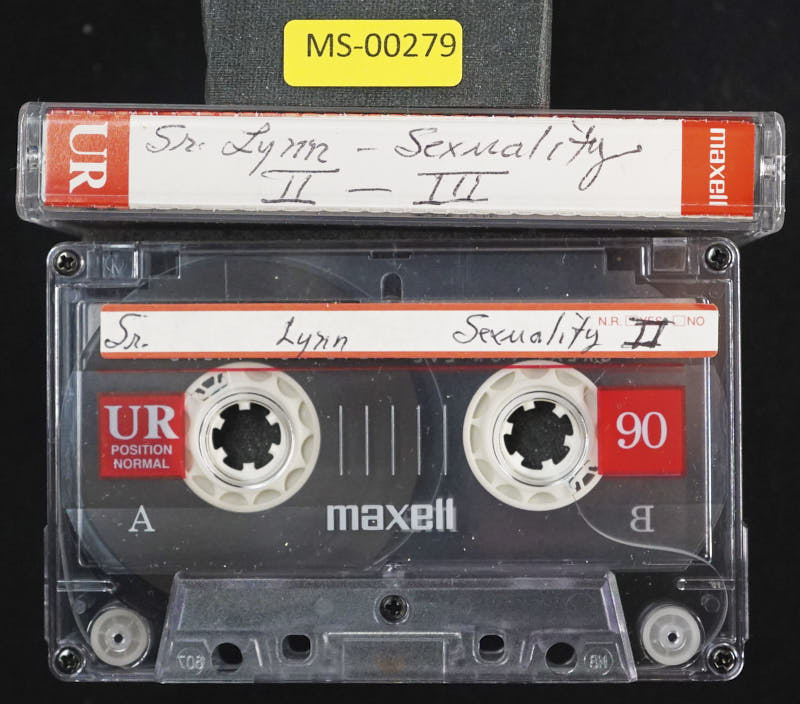
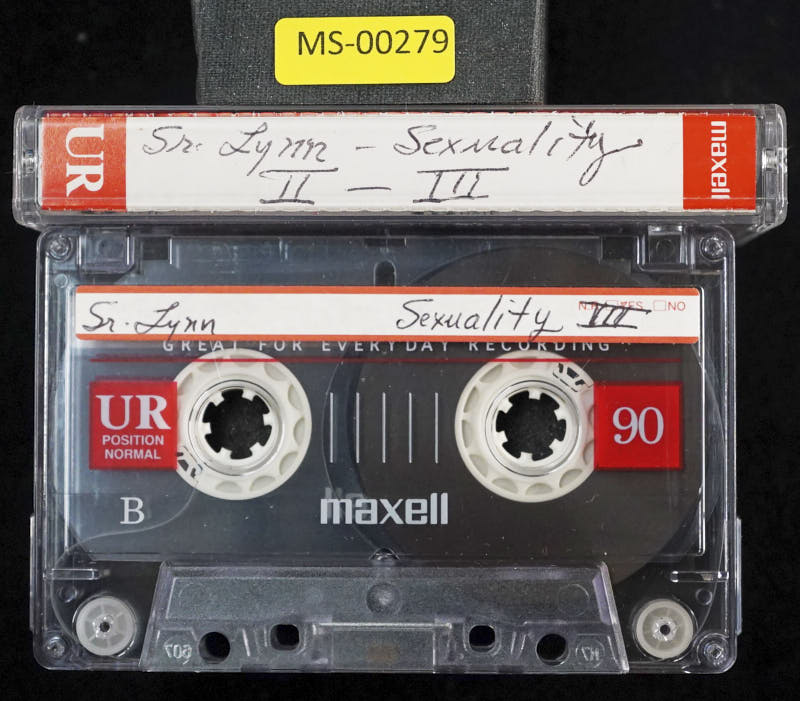
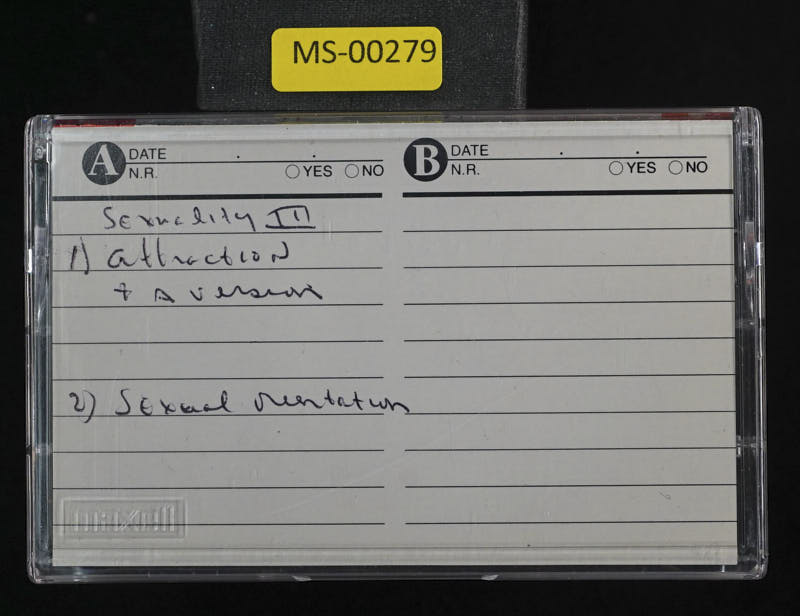
AI Vision - Possible Values from Photos:
Side: A
Speaker: Sr. Lynn
Possible Title: Sexuality II
Additional text:
Side: B
Speaker: Sr. Lynn
Possible Title: Sexuality III
Additional text: Attraction & Aversion, Sexual Orientation
@AI-Vision_v002
Yeah, I booked the signs in the bookstore downstairs. There's two of them, the Vinyl Angelo one. I'm still learning. And then the other one down there that says, that's about poetry. That, I forget how it was. It's a beautiful little thing, you know. So I thought I'd start with a piece of poetry. Because the poets speak to us, I think, in many levels. So I thought I'd introduce some poetry as we go along here in this age, you know. But this one is called, this is from Hafiz, the 13th century Sufi, and he says it's called Becoming Human. And so he says this to us. Once a man came to me and spoke for hours about his great visions of God. He asked me for confirmation, saying, are these wondrous dreams true? I replied, How many, and I'm not going to take some liberty, the real poem says goats, but we're going to change it to sheep. How many sheep do you have?
[01:02]
He looked surprised and said, I'm speaking of sublime visions and he waves me about sheep. And I spoke to him again saying, yes, brother, how many do you have? Well, hot bees, I have 62. And how many ones do you have? And again he looked surprised, and he said, well, four. And how many rose bushes in your garden? How many children? Are your parents still alive? Do you feed the birds in winter? And to all he answered, then I said, you asked me if I thought your visions were true. I would say they were if they'd make you more human. More kind to every creature and plant that you know. A little bit of wisdom from our brother Hafiz from the 13th century. I just wanted to start with that notion of human again.
[02:06]
We're going to talk this morning a little bit about being selfless. It needs to be more God yes than no, although it has no's in it. And then we're going to talk about sexuality. What does it mean to be sexual? And we'll see what kind of questions you have. And if anybody has questions, you can just give them to me. When we talk about human, really, a simple way to talk about human is to say it's really about two things. And this is our first vocation. Remember, it's really about two things. It's about love and work. Now. That sounds really simple, but I think it really is profoundly true. And I think it is also in the gospel, what Jesus came to tell us about. It's about love, and it's about loving and being loved. It's a two-way street here. It's not just we're called to love others, and we don't have to get anything in return. That's not how it goes. The gospel is about loving and being loved. And then it's about work, and what I like to define work as giving our gifts in service to others. giving our gifts in service to others.
[03:09]
And so I think that really is... the gospel message introduced for all persons, that we love and be loved, and that we give our gifts in service to others. And I think that's when people are happiest, when somehow we're in this loving relationship with ourselves, others, and that, and we're giving our gifts in service to others. Now, some people are going to get remunerated, get paid for that, and sometimes big money, and that's okay. But it's really a notion of service, I think, that really helps people really be happy and use their gifts in the best way. So I think we're going to say, in this context of loving and being loved, then we're going to say, well, what does that fit for us? What does that call us to? And I think it caused us to be sexual and to be fully human persons. And so that's why we're going to talk about that. What I'd like to do is say, in this context of being human, I'd like to talk about celibacy because there's a lot of, as you know, there's a lot of controversy or a lot of conversation around celibacy, turn my machine around here, and a lot of, can you, These things here, these three articles here, I'm just going to leave here, and there's copies for everyone.
[04:15]
If you would like a copy, please take them. Those are articles that you might want to look at. These are the handouts that we'll use. So if you want to take one of these, and then you'll be able to follow along on the USL to see conversation. And so we'd like to talk a little bit about celibacy. So I'd like to just talk a little bit about celibacy. It needs to be more about yes than no. And I'd like to just talk about our history here for a little bit. about our preparation for celibacy. And it doesn't matter what community you belong to, whether you're monks in the Benedictine tradition or whether you're in my own community.
[05:18]
When we talk about preparation for celibacy, in the past, it was really seldom the focus of attention. In a lot of ways, you got it with the package. You came to be a monk and it sort of, well, celibacy comes with the package. We didn't do much about helping people understand that it's a call, it's an invitation, it's a way of living. And it primarily was, for women, a matter of modesty. So they talked to us about, if they did talk to us about solvency, it was about being modest and being careful how you dress. And also, in the old days, it was about a habit on, so you didn't have to cover everything up. You didn't have to worry too much about modesty. And women are often considered dangerous to men, so be careful of women. And you'd hear some of that conversation. Thank goodness that most of that is gone. But you would hear that in the past. extreme reserve and expression of affection. And really, it had a lot to do with reserve with the whole feeling dimension. The whole feeling dimension was not important, not considered important. And so we never taught people what to do with their feeling life. And you certainly were to be reserved.
[06:19]
Don't be outwardly expressed and watch what you're doing with your own feelings, even with your own family. And we had visiting days. There were 55 in my class. When we entered, 55 of us, and most of us were 18. And so when our parents came, you know, we had brothers and sisters, younger brothers and sisters and everything, and we were to be as reserved as you could be. We were not to be anywhere emotionally, even any hint that we were glad to see them. We were supposed to just be calm and cool and walk down. And it was all part of this. That was as much as we got about being in relationship, which is what sexuality is all about. undertaken as a part of the life form rather than a specific charism it was just you got it with the package in there and it really wasn't considered did you have this call and then finally there's little education regarding sexuality or even biology in little or no effective education which is the feeling side of us you know so we so In a lot of ways, we're not prepared very well. Remember what we said, we're not going to try to blame or judge.
[07:21]
That isn't the point here. We're just trying to name the truth of most of our experience. It probably looks like this. If it wasn't, if you've got some more education here, more opportunities around sexuality, then consider yourself lucky. Because most of us, this is what the preparation was. I'm going to skip the next one, because right now we're talking about, well, let's take a look here. It's really... Currently, there's more education about healthy integrated sexuality, the importance of feelings and intimacy. This is happening in congregations more than that. Religious life, we'll talk about it's a claim on our whole life. The third point is very important and one that men and women religious, at least they add to words, are struggling with. It's a choice of who and how to love. And it's really, it is about our loving relationship with one another and with God and with others, and that it's not simply we're here to work. And that's a shift that people are really struggling with. We've had a lot of ministry focus, which is fine.
[08:22]
It's a perfectly good thing, especially for the Southwaters. That's where we belong in ministry. But our relationship with each other is sometimes poor. And so we're struggling. Many congregations are struggling to include our relationship with each other as part of our call and to really work on that. And then celibacy. This is Sandra Schneider's. I'm sure you've seen some of her books, Finding the Treasure and Losing on I Think of this. She says it's the only value unique to religious life. A very interesting comment because she says we're all called to poverty, the right use of resources, and we're all called to be obedient to God's call to discover our vocation. and give our gifts and service. And so she said, Solvice is the only one that really makes this life unique. You might not agree, but it's an interesting perspective. And then the current motivation for some new members is they are seeking community. And they are. You hear them say, I'm interested in connection.
[09:22]
I want to be involved with people who do similar things, who have a mission. But we have to be careful that we're also asking, do you really feel called to celibacy? Because right now, it's a challenging question. So this is some of the new stuff. I'd like to just highlight this for a minute, and then we'll look at the slides that you have. And this is simply, it sets criteria in choosing celibacy, but it really is criteria in living celibacy in a healthy way. Notice the first one. And I can't say this enough, this self-knowledge, that we really need to be aware of who we are and what our... And self-knowledge always includes two parts. It includes our past, and it includes our present life. And so when we talk about self-awareness or self-knowledge, we really talk about what's your personal story? What's your personal story with regard to... And we're only talking about sexuality now. So what's your personal story with regard to sexuality? How did your family deal with sexuality?
[10:23]
What kind of information were you given or not given? A critical one, did anything ever happen along the way? Did anything ever happen that was inappropriate? Did someone speak to you in a way that was inappropriate? Did someone touch you in a way that was inappropriate? And what we're seeing is that many of us, and I'll say us, you know, as women and men religious, we have some part of our history where something happened that shouldn't have happened. and it depends on how you deal with that and how you process that. It may still be impacting your current life. So, and by the way, if it's not us and maybe just life, it's the people who come here. This is the whole notion of, you know, sexual abuse, and there's a lot of it, and it doesn't have to be that you were raped to have had something happen to you. Some things, the way you were talked to sometimes, the way things, you may have been touched in a certain way. So this self-knowledge about what's happened in the past How is it impacting the present? And then the critical one is, what's happening to you right now?
[11:26]
What are you thinking and feeling now? How do you deal with your own sexuality now? And so it's always past and present coming together. The failed conviction, this is one sentence that I think is so critical, and I make sure the young people hear it, is to live a healthy celibate life, you have to be convinced that this is the best way for you to love and be loved. That's the conviction. This is the best way for you to love and be loved. And that has to be fundamental to a healthy approach to celibacy. And so it isn't about giving up. It isn't about saying no. It's about yes, and it's about loving. And so we have to be convinced that this is the best way for us. Now, what's interesting is for most people, it's not the best way. This is not ordinary. So for most people, it's not the best way. We're not going to have flocks of people coming to say, oh, yeah, I'll come and join the monks at Mount Seat.
[12:30]
But for some of us, strange as it may seem, it is the best way. But we have to be aware of it's the best way for me to love and be loved. Then it needs to be freedom. The whole sentence, that's true. You have to be free to lead to be free to stay. You know, it can't be bound here or living a celibate life because you don't think you have another option. That's not the issue here. It's freedom here, and it's freedom to accept our life as enough. By the way, that's a sentence I would say to married couples. This partner is enough, you know, and they're not sometimes. And just like our life isn't enough sometimes. Sometimes you wake up, and at certain periods of your life, you may be very challenged. I remember when my brother and sister-in-law had their first baby. It was very challenging for me as a single woman, as a celibate person, to know that I would never have that experience. And so when we experience life along the way, we feel the challenges, and we have to say, this is still enough.
[13:32]
And so it's not enough. We don't live a risk-free life. Jesus didn't say, come and be comfortable. He said, come and see. And so the risking we take, you know, with one another, in community, by being open and vulnerable, this is not a risk-free life. It meant we've got to fail, and we fail with each other. We disappoint each other. We hurt each other in community sometimes. We, you know, we get... We get accustomed to one another, you know, and we don't pay attention to one another sometimes. So we're going to make some mistakes. We're going to fail, and we'll fail others, too, not just in community. But then we have to get back up and do it again. So couples fail each other. This is human stuff we're talking. And then I think we need to practice being celibate, you know, and that simply means, you know, remembering who we are. We're not single. We're committed men and women. We have to practice. We have to remember who we are and be that for others. as we go along. And then, of course, the intimate relationship with dogmothers.
[14:33]
If we don't have that, it's going to be all the less possible to live this life. Intimacy is, you can't live, we're not called to live isolated, disconnected lives. That's not what it means to be human, and that's not what we're called to do. Let's do some criteria. I'm going to skip a couple slides here. You have these quotes, I think, on the second page. Show you these ones from Saver Strengths. Do you have these? Yeah, okay. And all it says is, what she's trying to highlight here, I'm just going to highlight one part of it because you've had the quote. It says it's really a choice, not simply a choice of a kind of community or ministry, but a choice of our relational capacity. It's a choice of who and how to love. That's what we're doing. That's what's all about. It's about loving. It's about a choice of who and how to love. That you say you're going to love one another in this community. and love others, but you have a commitment to one another, and to the men in this room, as I would have a commitment to the women in my congregation.
[15:35]
So it is about loving, and it's about service. It's not simply either or, and I think that's what Sanders tried to put out there. And then Omerco, do you know his work, dear Omerco? He's an Irish social psychologist, I think he is. He does an interesting thing here. He says... You know, he talks about, let's change the names. Let's talk about the, he's a language person. So he says, you know, we keep talking about vows of celibacy, and that comes from an older notion of the world isn't such a good place, so we're going to take a vow that keeps us, that, you know, helps us be other than what the world promotes, you know. And he says it's a negative thing. His thing is a nonviolent approach to the vows. That's his book that he's talking about. But notice what he says. What if we said, we took a vow for relatedness. What if celibacy is really a vow for relatedness? And that very much fits with the understanding of sexuality that we're going to talk about.
[16:35]
Then we're not talking about a vow of not getting married, a vow of not having sex, a vow of, we're going to talk about a vow for relatedness, but a very special kind of relatedness, a way of being in relationship that fits with the gospel, you know, and that's not exclusive. So you have these slides here. So what if so, let's say we're more about yes than no. And I think we have to say, what are we inviting people to say yes to? If we look here at this, in the past, I think we saw all the vows. I mean, maybe we still do see the vows as looking at perverse, the basic and human energies are perverse. That in other words, if you let humans be humans, they'll get into possessions, power, and passion. And they won't do it in a good way. That's an old view of the world. What we're seeing is a lot of corruption that does fit with this. People are very much into things over people. We're into a very own more, have more, and you'll be happy, which isn't true.
[17:39]
So some of that's true. We're into power, as you know. Even our own government is behaving in a way that says we're in charge and misusing power. And then, of course, we're talking about passion. And we're talking here about the misuse of sexuality, all of the dis-ease. So some of this is true. But what he says, what I'd like to say here is that it's really not about we're going to have vows that are against those perversions, but really we're talking about trying to foster positive forces of transformation and work in our times. And there are positive forces of transformation. So Notice what is happening in and around sexuality often gone astray and abusive, no doubt about it. I mean, I know you're in tune with the world, what's happening, et cetera, but it is really that area of sexuality is extraordinarily, I don't know, messy at this point. We are really, it's a huge area of disease and disorderliness.
[18:41]
But underneath it, there is a real legitimate desire on the part of many, many people for loving connection, reaching beyond themselves, tenderness, pleasure, and affirming of life itself. There really is this great hunger in the people of God and among us to have these things matter. And I think, this is what I think celibacy has to be thought of today, is that it's really about, when we live our celibate life, we need to talk about a deep desire for connection, that we try to be connected ourselves, And we foster this kind of connection among ourselves and others. That it's about liberating from stereotypic roles. So we're not going to say men are and leave men in a very stereotypic, rigid way. Or women are. Or lesbian women are. Or gay men are. We're going to try to get rid of the stereotypes about people and let people be individuals and deal with the diversity. that we're going to talk about sexual minorities have rights, you know, and we're going to be promoters of those.
[19:45]
We're going to talk about equal rights for women. And then finally, I think this last piece, that we want to promote a country, a society, a world that is characterized by respect, respect, mutuality, intimacy, and equality. I mean, I think that's what I say to the women and men I work with. I say, is that how we would describe our congregation? What we say, would you describe yourself? here as respectful, responsibly mutual, intimate, and equal. Is that how you deal with one another? Is that what people would experience here when they came to visit? That's what we're trying to say, that celibacy has to be looked at in those terms. So this is the point of this introduction is to say, yes, there are some values. It is about we don't have partners. We don't have genital sexual relationships. We're not in exclusive relationships with people. Those are the no's. Those are part of what it means to be celibate. But are we saying yes to something?
[20:48]
And are we trying to say to people that these are possible? And I think that's one of the profound lines of one of the women in my own congregation. She said, religious life exists to say certain things are possible in every era. So my question is, what are we saying is possible now in the area of sexuality? And is it some of these things? We could add some other things to the list. But what are we saying is possible by our life? Our life is supposed to say something is possible with regard to sexuality, with regard to celibacy. And celibacy is the way we're trying to say it. Does that make some sense? I mean, at least let's talk about are we saying yes to something at least raises the question. Does it raise the question for you? And it's not saying you never thought of that before. I'm just simply saying I don't think it's too thrilling. I don't know about you. I don't think it's too thrilling to say come and join us and say no for the rest of your life. It's not simply about no.
[21:50]
I think it has to be about something yes. And so I think as you consider new members or people are interested, you know, And if they come and seek it out, are they all to come to realize they're going to say some yeses, not simply a no in the area of sexuality? What are we talking about sexuality now? Okay? Any comments or questions? Would you like to comment on that? I'm going to switch some slides here for that. And so we continue to look at sexuality. What do you think about that? Any stories about that kind of conversation about self-esteem even more about yes than no? Yes, it is a petition to be freeing, of course, so that's what happens. Thank you. Freeing to be available for men in many areas, not just for God, but I think that we have to, we're trying to be discreet.
[22:53]
and humble about saying these things, but in fact, isn't that our background that it's of treating rather than a denial of perhaps. Yes, I think that's true. I think what we're trying to do here is, I absolutely agree with you, is to put some words on what are we moving toward? What are we saying yes to? Not just simply, it is a great thing, but we're saying yes to, I think, with regard to sexuality, I think we're trying to say yes to some of these. very specific things about insects, but yes, I think that's true. It doesn't work the way you do it.
[24:01]
They're great wool machines when they work the way you do it. Give me nothing but a get up. It's okay. But we didn't look at it. We didn't look at it.
[25:07]
We didn't look at it. [...] Part of that sexuality is saying, well, what is it? And I think it's important to take a look. What do you mean by the word sexuality? This is the root word. This is the Latin word. And it's interesting, the root word. And I first looked at this myself when I was, you know, kind of doing, getting preparation. I'm thinking, this sounds strange. The root comes to the word Latin sexist, which means to cut or to divide. And so you might say to yourself, what in the world does Zen have to do with sexuality? Well, if you think about it in these terms, what it really means is that we are incomplete seeking wholeness.
[26:08]
That's really what the fundamental word is about, that we are incomplete seeking wholeness, and that really we're about connection. And that's really what the sexual energy is about. So therefore, if you look at this, if you have this slide here, if you notice what it says, it says that it's the energy in us. Sexuality is our energy. It's energy that's in us that declines us or moves us into relationship with other people. It moves us into relationship with other people. Now, I'm sure if you think about the last few weeks, Have you thought about any one of these experiences? Have you thought about somebody in the last couple of weeks that you say, I wonder how Joe is, or I wonder how my sister is, or I wonder how somebody is, you know? And you might have thought, gee, I haven't heard from somebody in a while. I wonder how they're doing. And it seems to happen, you know, as you're working along, maybe you might just get reminded of someone and you wonder how they're doing. That happens.
[27:08]
That's part of this. And the question is, what do you do with the reminder? Do you drop them a note or if you have a chance to do an email or whatever? The point here is that when we do remember somebody or we have a sense of, well, I wonder how they're doing. That's this energy. When we feel quite energy here, we're not talking about the energy we have sex only. Although when you have an erotic feeling, and that is about wanting to be with one another, be with a person, not just in mind and heart, but in body. That's pretty ordinary, you know, to have a sense of wanting to be one with. But it's that little vague notion, too, about I wonder how they're doing. Or if you receive a card from somebody, do you feel kind of joyful? Do you feel connected to the person, you know, when somebody remembers you, you know? So it's that sense of connection, that that's what this energy is about. And then notice what the second one, and by the way, the second quote is from James Nelson. I'm not sure if you have any of his material, but James Nelson is a... He's a Methodist minister psychologist who does a lot of work in the area of sexuality. This is from, I think it's a book called The Secret Garden, or Between Two Gardens, which is sexuality and spirituality.
[28:17]
He tries to kind of put those two energies together. But what he says here... It is physiological, sometimes, the grounding of our capacity. In other words, our bodies are involved. We feel connected to people. We feel energy in us. We can feel connected, especially if we like somebody. We want to be with them. We feel that energy. But he says it's also psychological. And I like this next sentence. He said it expresses God's intention that we find our authentic humanness not in isolation but in connection. And I think that's fundamentally what we're talking about when we talk about what is sexual energy. It moves us to connect with other people because that's how we become fully human. There's no way you and I become fully human without each other, without being in relationship. And we need members of the community to be in relationship with. We're in relationship with our families, although sometimes our families... are either small or can't respond.
[29:17]
So sometimes we can't rely on family, you know, talking about connection. And notice what it says. So it applies to everybody. It doesn't matter what your orientation is. It doesn't matter whether you're a genitally active or a celibate person or a man or a woman or aged or young or able-bodied or disabled. With regard to everybody that we're talking about, this connection. Now, this next slide, I don't think I... I'm not sure if I gave you this. I don't think I... This is from Ron Rollheiser. from the book The Holy Longing. So if you have that, you might want to take a look at the chapter on sexuality and spirituality. But Ron Roheiser says this, and notice how he picks right up on the definition, because I think a lot of us are beginning to see the same kind of insights. He says, sexuality is a beautiful, good, extremely powerful, sacred energy, or divine energy, whatever you want to call it, given us by God, experienced in every cell of our being,
[30:28]
Notice, there's the irrepressible urge to overcome our incompleteness. Here it is right there. To overcome our incompleteness and to move toward unity and consummation with what is beyond us. To move to some kind of blindness with other people. Now, As celibate persons, we're going to be able to be one in some mind and heart, and we don't have one in mind and heart and body. That belongs in a monogamous, committed relationship. So we're not talking about having sex. We're not talking about having a physical sexual relationship with people. But we are talking about being connected to them. We are talking about being able to be connected to others and be with other people in both personal relationships, but then also in the broader sense of being in one with the world, you know, as you pray for the world and peace and all those things. It's that sense of other people matter, you know. And then also he says, it's the pulse in us to celebrate and give and receive delight.
[31:28]
Isn't that a wonderful way to think about our sexuality, that we're called to celebrate life and to give and receive delight. One other way of looking at sexuality is... is to say that we are called to give life and bless it every day. Called to give life and bless it every day. And that's a really good question. How today will you give life and bless it? Now, most of us, although I knew people do enter, we have been married and have had children, most of us will not have physical children. That's not our route. But we're not off the hook about giving life and blessing it. So how are we giving life and blessing it today? And that's part of what it needs to be celibate. And I think we need to be more conscious of that. Notice what he says here. This is also around. And he says, sexuality is overcoming centeredness. And here he uses. by giving light and blessing it. But then notice all the ways he talks about being sexual.
[32:29]
And I think this is important for us to look at. These are ways of being or opportunities to be sexual in the broadest sense that we're talking about. Not doing what our culture says, be sexual equals having sex. So look at this. When we give ourselves to community, when you give yourself to this community, you're being sexual. When you give yourself over to friendship, some of you may be friends with one another. You know, you can be friends with another community. That's not real. But we do have to have a relationship with each other. But it may not be a friendship. But some of you may be friends. Or you have friends with other folks, you know, outside of the community, which is part of what happened. When we give ourselves over to family, sometimes that works. My family is very small. My parents died by the time I was 23. I haven't had a relationship with parents for a long time because they died when I was so young.
[33:31]
But I do have a brother and a niece and nephew, so my family is quite small. And so a lot of my relationships will happen outside of my family because my family is very small. So when we give ourselves to service... of one another. That's a way of being sexual. It's a way of being human. And notice, I like what Rod does. I'm not sure he did this on purpose, but notice where he puts service. He puts it in the middle of not at the first thing, because why? We're called to be of relationship and to be of service. And then notice, when we're creative, I think when we look at issues, you know, I'm sure you're dealing with, as a community, questions, decisions you have to make, you know, when we come at it and You know, say, well, what if? We try to be as creative as possible. It's a way of using our sexual energy to promote life. Or when we come at it, the old, you know, we come in and say, well, we always do it this way here. You know, it limits how we can live our own life. And so, again, how creative are we encouraging one another to be about creativity, to be about humor?
[34:35]
One of the things we need to do is we need to laugh a little more, you know. Now, the one thing that happens sometimes with men, I don't know, I think usually with, my experience with monks is your much general group, but a lot of men use sarcasm. Now, sarcasm is veiled anger. It's not humor. And so when we see a lot of sarcasm, it's really anger being, you know, dished out in indirect ways. And it's not helpful. So we're not talking about being sarcastic. We're talking about humor where we can laugh at you. We say, you know, we're a little strange, so funny things happen to us. You know, we can laugh at ourselves and laugh with others, you know. The light, the light of life, you know. And then it says, Margaret, I'm not helpful. That will not be our choice, but it might be happening to us. And then so with that, we can bring new life to the world. Sexuality is an all-encompassing energy. Just say it again. It's the drive in us for what we want to walk. We want to be in communion. Interestingly, the Holy Father not too long ago talked about priests need to be men of communion.
[35:42]
Men of communion. Well, what does that mean? It's simply not persons who are, you know, who give the Eucharist, who, you know, provide the Eucharist, but that they be in relationship, that they need to be connected with one another. And they need to be connected with the laity, need to be connected with priests, other priests, you know. So it's a real call. And then for us, it calls a community, a friendship. And then there's the word affection in there, you know, that we're called to be affectionate people. Now, what kind of affection? How do we express affection so that you're not crossing boundaries? You know, what's appropriate for us to be affectionate? What's appropriate for us? What works, you know? Those are all critical questions. And then notice it goes on and says, you know, joy and delight and humor and that we put behind ourselves. You know, this is, again, part of this great energy in us. It's not just about me. It's about me and you, this great sexual energy that we have. This piece is very important, and you probably already know this, but I think this is so important for ladies that don't know this sometimes.
[36:44]
It says, if her energy, sexual energy, is flowing and functioning in a way, it will move us to two different places. At times, we will move to solitude. We'll need to be away from. We'll need to... not have noise or not have, you know, not have conversation, you know. We'll need that contemplative time, that time for a relationship with our deepest self and with God. So a healthy sexuality will move sometimes people to say, I just need some space. And I'm sure you find men in particular who come here, but men and women who come looking for that space. space and really the world is hungering for the solitude for some space because we live in an anti-solitude culture it's do more be more you don't have more that's what the culture says so so solitude is a very important thing that a lot of people don't have a search for and then notice if our energies function it will also move us to intimacy connection with our deepest self with one of the living with god so those are going to be hallmarks
[37:46]
Solitude and intimacy. Trying to balance those out. Connection with others. Time away. Those are going to be critical to live a healthy, solid life. How are you doing? I mean, I think that's the real question. How do you do about your own solitude times? How are you doing about your own being able to be intimate? What does that look like? We're going to talk about intimacy tomorrow. And then if our energy is not functioning well, it takes us to isolation. And if you remember, sexual energy is about connection. Therefore, if we are in isolation, we are living contrary to the divine energy in us. The divine energy in us is about connection. Now, it doesn't mean healthy connection, and it means solitude, and it means a variety of things, but it is about connection. And that's what it is. So I think, again, how is your sexual energy leading you to healthy connections? Let us do this. We'll do just two more pieces, and then we'll see what kind of thoughts you have or questions you might have. The first one says, when we talk about healthy psychosexual development, we're talking about developing across six areas.
[38:53]
Six areas of development. And the first one is the physical area, and that means our own bodies, taking care of our own bodies, understanding how our bodies respond, you know, Paying attention to your own physical sexual responses. And so physical is understanding how the human body works, how your body works, and really being able to take care of your body is part of what it means to be sexual and to develop as a healthy male. Cognitivity has to do with your own thinking. You know, what do you think about sexuality? And that's part of what this conversation hopefully is about. Will you think about sexuality in the same way after we talk for these couple of days? Will your thoughts change in a way that helps you to be the fully human being that God asks you to be? So what do you think about? What attitudes do you have about sexuality? So attitudes and beliefs are critical. And if you believe sexuality is something you just tolerate, then that's how you're going to deal with your body.
[39:59]
If you think that sexuality is this great energy about connection, you're going to be paying attention to what kind of connections you make or don't make. Emotionally, this has to do with your feeling life. We've said this like three times already, but what are your feelings trying to tell you? And that's what they are. Feelings are messengers. So, for example, if you find yourself sad, it's telling you there's some loss in your life. Sadness is always about loss of some kind. Right? Anger is usually about some kind of injustice or an unmet expectation. Now, one of the things that I find true is a lot of men in particular get mad because it's easier to be mad than sad. So you'll find some people quite angry. You may find some men who come and visit you. They'll talk about anger. If you can get underneath, underneath the anger is some great sadness. Because it's much harder for us to be sad than mad.
[41:01]
You know, mad pushes people away and gets us out of it, you know. But the sadness is dealing with loss and the struggle sometimes. Okay? So, again, what is your feeling like telling you we need to be emotionally connected with ourselves and with one another. And sometimes we've divorced ourselves from our feeling life. Socially, how do you be in a relationship without being self-conscious? I think that's the best way I can say it. That you can be you without being self-conscious. And morally, it has to do with living with integrity. Living with integrity. Is the person I say I am how I live? That means especially with sexuality. Am I being sexual in a way that fits with being a monk? with being a brother here in this community? Is that how I'm living my sexual life? And if not, then we have to raise some moral questions. It's about integrity, morality here.
[42:03]
And then the last one is your spiritual life. Do you see your sexual energy as really divinely given? It's part of your spiritual life. It's not something divorced from your spiritual life. And how are you integrating it? And what is God inviting you to with your sexual energy? If you're feeling your sexuality, Do you know that God is there? Sometimes we say God is not there. We have God in the chapel, but we don't have God in our own sexual energy. So this is, again, keeping God connected to our divine energy that's in it. And we'll do this last slide, and then we'll see what kind of conversation we have. And the last one says there are really four qualities that we need to be healthy sexually and to develop a healthy sexuality. We need to pay attention to four qualities. And I invite you to think about these. How are these in your own life? And let's look at the first one, emerging self-awareness. And don't you like that I-N-G word? I like those words that end up I-N-G because it tells us we're not finished. And this is a lifelong task to be self-aware.
[43:06]
How am I feeling today? And it doesn't matter what age or stage of life you're in. It's where am I at today with regard to this great divine energy about connection. How am I giving life and blessing it today? Or am I stuck? Or am I frightened? Or am I struggling? Or am I attracted to someone and I don't know what to do with my attraction? Or somebody attracted to me and I don't know how to handle them because they keep showing up. They keep showing up in my life. So we're talking here about self-awareness. It's an emerging thing that's part of our life that will never go away. And it's a lifelong thing about understanding yourself as a man, as a sexual person who's trying to live a healthy, solid life. The second one is responsible freedom. And notice, nice balance of words. We're called to be free. We need to be free, the relationship of abuse, and the free way. But we need to be responsible. We're not single people, and I know you know that.
[44:07]
You're not single, you're committed men, living in terms of a healthy communal and relational life. So how do we do that? And we need to be responsibly free. We need to take some risks in relationship. We need to be more vulnerable with one another. We're not vulnerable with one another a lot of times in the community. You don't talk about the struggles that you face with one another. You just keep it broad. A lot of times we think I'm the only one struggling here. What if we talk to each other? So this means really being more vulnerable with one another, but choosing to do that, you know. The third one says that developing creativity, and it really is about can we look at things differently? Can you look at your life differently? Can we say, you know, where are we called to together today? And can we try some different things? And it doesn't mean there's no order. And it doesn't mean there's no horarium. You know, we'd be all crazy if there wasn't some kind of schedule. But why don't we really be called to it, especially if we're called to loving relationships. Might you make some different choices at a given time because you're saying, it's important that we do this because, you know, some of this creativity of being in a relationship.
[45:16]
And then the last one, the deepening capacity for intimacy. I always like having a few more gray hairs because I'm convinced that, you know, in their 20s, it's not possible to really be intimate in their 20s. There's too many other agendas. You know, you're trying to figure out who you are and what you're going to do for a life's work. So you have to have lived a little to be able to talk about intimacy. So we're really trying for living a more intimate life. But we have to know that intimacy is important. And we have to choose it and we have to know how to get there. And it's so the men and women. And I think that's the real challenge, you know, is to look at intimacy as a real call in our life. Whereas in the past, I don't know about you, but when I entered, they did not talk to me about living in my life. That was not on the agenda. But it is on the agenda now. And so I think we have to say what would be called to. So these are very important qualities that you might want to say to yourself, how am I doing? That'd be a good question you might want to say. How am I doing?
[46:17]
How am I with my own self-awareness? How am I with being responsibly free if that needs to be in a relationship and take some risks in the community and outside that? Am I, to attempt to be a little creative, am I willing to take a look at things differently or is it always the same, you know? And then the last one is, do I really feel what I'm called intimacy? And we'll take a look at what that means. And one of the articles, by the way, here, Martin Powell's article, is called Skills Needed for Celibacy. And Martin's a conventional orphan, conventional, you know. And the thing that he talks about, he talks about skills in two different ways. He says there's intrapersonal skills, skills within us as persons, and intrap skills between us. And he says we've got to be better with our skill with ourself, And that's, he talks about reflection, self-awareness. We've got to get better with our skills with one another because we won't connect with ourselves or with one another unless we do.
[47:20]
So there's a little article that really talks about being more skillful. And we don't have to feel so guilty because we didn't learn some of these things before. So maybe we can... You know, we can just take just a minute here and say, so what do you think? I mean, you know, these are just a lot of words. I realize early in the morning, you know, you've got other things to think about. But what do you think, if you think about what does it mean to be sexual? Does this help when we talk a look, take a look at some of the words that role guys are using this? Remember, we're starting here. It's about doing this, and this is what it means that there's great energy in us for connection. What do you think?
[47:58]
@Transcribed_UNK
@Text_v005
@Score_84.12