You are currently logged-out. You can log-in or create an account to save favorites and more. more info
Spiritual Renewal Through Monastic Labor
Talk at Mt. Saviour
The talk emphasizes the theme of spiritual labor on Labor Day, focusing on the intersection of liturgical and monastic life as influenced by Maria Lack Abbey under Abbot Ildefons Herwegen. The speaker reflects on the liturgical renewal provided by the modern movement inspired by Lambert Beauduin, critiques by Louis Bouyer, and the theological developments by Otto Casel on the mystery of Christ. It also discusses the cultural and historical context of Maria Laach's influence in Europe and the United States, noting the shift to finding a middle path between monastic and Trappist traditions, exemplified by developments at St. Anselmo in Rome and the Vatican II Council.
Referenced Works
- Pater Spruch und Mönchsregel by Herbert Herwegen: Examines the integration of patristic teachings with monastic rules, highlighting the challenges of maintaining spiritual vibrancy within structured religious life.
- Otto Casel's Mysterientheologie: Explores the theology of the mystery of Christ, suggesting a dynamic interpretation blend of tradition and renewal in religious life.
- Vatican II Documents: Discussed as a culmination of prior liturgical movements, focusing on unity, scripture, and the adaptation of monastic life to contemporary needs (e.g., Sacrosanctum Concilium, Lumen Gentium).
Mentioned Figures
- Abbot Ildefons Herwegen: Known for leading the theological and liturgical renewal at Maria Laach Abbey, integrating old traditions with new dynamic forms.
- Lambert Beauduin: Credited with sparking modern liturgical renewal, marking a shift toward vibrant engagement in worship practices.
- Louis Bouyer: Critic of traditional monastic views, offering needed perspective on reforms post-Solemn.
- Albert Hammenstede: Played a key role in American Benedictine foundations, fostering collaboration across cultural and ecclesiastical lines.
- Virgil Michel: Highlighted for contributions to liturgical studies and monastic life in the United States, bridging European and American liturgical traditions.
AI Suggested Title: Spiritual Renewal Through Monastic Labor
AI Vision - Possible Values from Photos:
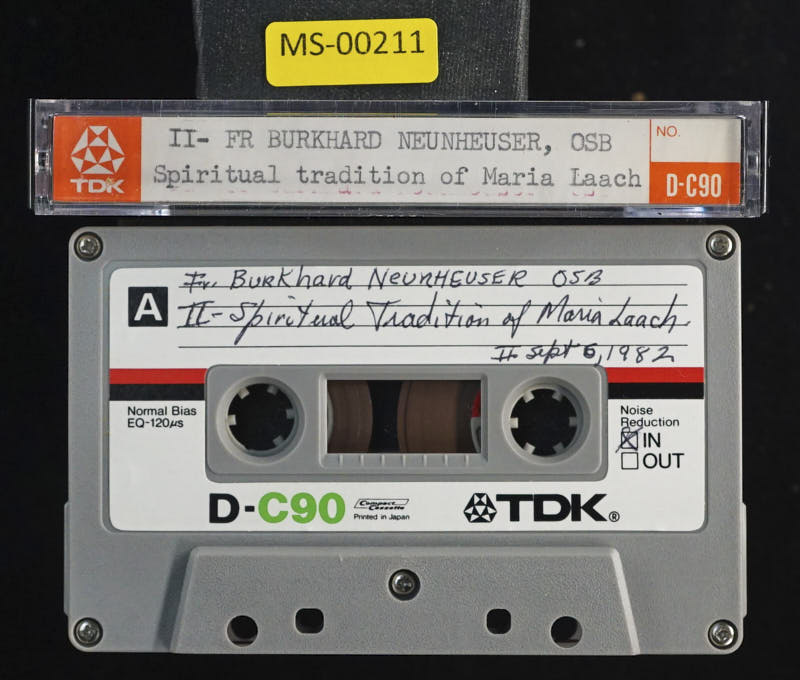
Speaker: Fr. Burkhard Neunheuser, OSB
Possible Title: Spiritual tradition of Maria Laach
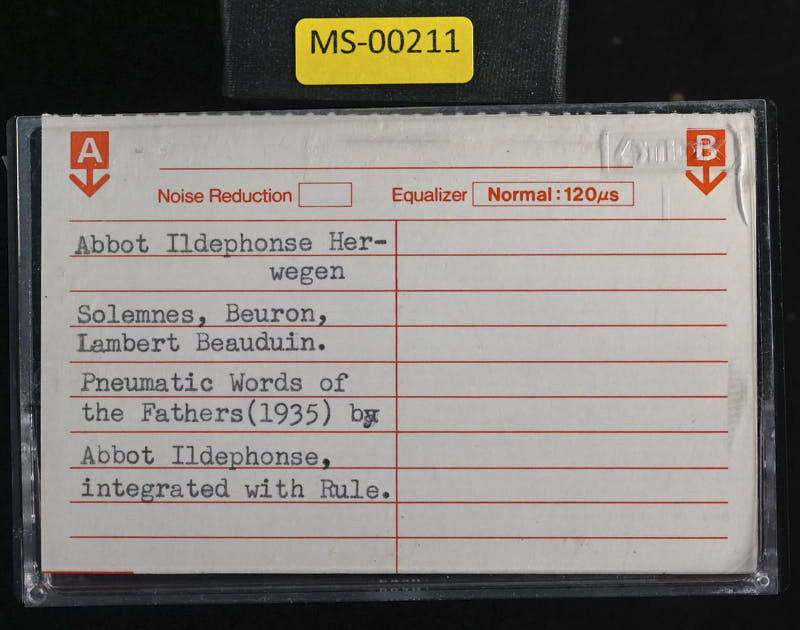
Additional text: Abbot Ildephonse Herwegen, Solemnes, Beuron, Lambert Beauduin. Pneumatic Words of the Fathers 1935 by Abbot Ildephonse, integrated with Rule.
@AI-Vision_v002
Today is labor day. And your labor today, spiritual labor, is your retreat day. And we are willing to reflect about our vocation, our situation before God. What is to be done? And where do we stay? reflecting on the sources of your tradition here. One of these sources has been the spiritual world from which Father Damasus came. Therefore, the spiritual world of Maria Lark, Abbey, under the Abed Ildefonsherwig, between the two worlds. And the spiritual world of this Abbey can be characterized by two elements.
[01:04]
Liturgic life, a source of all our spirituality, and monastic life is the concrete form in which we are together as the local church. Liturgy, but liturgy is, how do we say in English, plenumatically. I don't, we prefer normally this Greek word instead to say Spiritually, it's too few, too poor. No more is more. Holy Spirit, Spirit of God, Spirit of Christ, who dwells in our hearts. Therefore, liturgy dramatically renewed in the modern liturgical movement after Lambert Boudouin in Belgium. And monasticism renewed also in the vitalization... of the old-fashioned tradition of Soleim and Beuron. And here, I would say, also we are, with Father Damasus, criticizing this terrible judgment of Louis Bouyer against Soleim.
[02:12]
Nevertheless, he is right when he says after Soleim and Beuron. Maria Lark, that's not our merit, but it's a factum, a reality, was giving with After Lambert Baudouin, therefore Lambert Baudouin in Belgium, and after him, Maria Lach, have given a new vitality to these wonderful elements given by Solène and Geronji, and the old Beuron. It is very important, it seems to me, to see this special accent in which the spiritual world of Maria Lach must be seen. Liturgical Renovation. but in this dynamic evolution given by Herwegen and Otto Kassel's Mystery Theology, Theology of the Mystery of Christ. We must speak about it later, still in more detail. The physical renovation in this dynamic evolution given by Herwegen and Otto Kassel's Theology of Mystery.
[03:14]
Monastic life, again, in this dynamic evolution given by Herwegen and his entire monastery, as the It is expressed in this wonderful study of Arbeiterwegen, which is called, published more or less in 35, Täterspruch und Mönchsregel. It's difficult for me to translate it in English. Täterspruch, Apophtegma, of the fathers, words of the old fathers in the desert, spiritual words, dramatic words of the old father, old monks' father, Vaterspruch, A Postigma of the Fathers, and Rule. And in the foreword to this little study, published in 1935, Father Abba Terwegen gives thanks in a special way to Father Damasus, who was helping him already in the last reduction of this book. And Father Damasus himself has said to me, it was a very important contribution.
[04:22]
which I could give to this little booklet. Therefore, they were both together in this vision. We stay in our spiritual world between the liberty and the greediness and this vigorous expression of the old patristic apothegma of these old fathers in the desert of Egypt and the necessities and the narrow limits of a monastic rule. to which we must obey. We cannot stay only in these old words. We cannot stay only in the limits of a rule, but we must combine both together. And here is the difficulty of our spiritual life, also of the idea of that time. But in, Father Abad Herbegin has seen already this dramatic spiritual orientation of monastic life according to a rule in that time. And he tried to realize it in his Abbey, in his Abbey so far it was possible.
[05:25]
And then Abad Ildefons Herzwegen has concentrated these two elements in the foundation of the so-called Benedictine Academy of Maria Lach in 31, where he wished to combine, to bring together all the efforts of his monks for a deeper, a more profound study of liturgical and monastic institutions and life. And he was preparing for that, giving possibility to his monks to study, to prepare themselves. And so he could bring together a very distinguished group of learned and spiritual men, he himself, his prior Albert Hammelstede, and the fathers Basil Ebel, the later Albert, Urban Bomm, the later Albert, Thomas Winston, the founder of your monastery, Stephan Hilpisch, the man who has written this big book about the history of benedicten monarchism, and his smaller books translated also in English the history of benedicten monks and sisters, Hieronymus Frank,
[06:46]
the learned man of the history of the church and of the sacraments, and Odolo Heiming, the great man who still today is working in the theology edition of sacramentaries and of the Oriental and Ambrosian liturgy. And then in the background, but he was never teaching in Maria Lark, Odo Castle. With the exception of Odo Castle, who was in Hersteller. And I came in 22, and I've seen him for a fortnight in Maria Lark, and then he went away to become Chaplain in Hersteller, where he was forming this terrible convent of sisters of perpetual adoration in an excellent abbey of real sisters, to say so. Wonderful work. And he succeeded to... transformed this little, small, insignificant convent to the most flourishing sisters' abbey in Germany, still today in a certain way.
[07:52]
But nevertheless, the theological work given by Kassel was the background of all these monks. this elected group of marvelous men who were working together. I myself was too young to teach in the real academy, only in the first years of the war I could come to give some classes there. Nevertheless, this wonderful institution, with this marvelous program, also I must say still, he was inviting to this academy young monks from the entire Order of St. Benedict. It was a little bit too much. One Abbey, perhaps important, yes, inviting the monks of the Order of St. Benedict in the entire world of America and of Europe to come to Mariela. We never succeeded to have more than five or ten students. Then all this activity of all this meant for these five, four, six, seven students from
[09:03]
Some monasteries in Europe, Bavaria, Switzerland, from the Bavaria congregation, nearly nobody. Because they knew it already. It's a belief to know it. And the United States, St. John's. Some American diathesian priests. I forgot the name of this man. for example, Gottfried Diekmann, who was there an entire year. And then also from Italy, Clavatura Massilli, the most important man in St. Anselmo. And filled both, more or less filled with the spirit of these times. So, but nevertheless, it was too much. And finally, the war... has finished every activity.
[10:05]
We were continuing in the first years of the war until the last professor was called to the army or, as I, called to be pastor and we were free from the army. And from this entire world, characterised therefore by this academy, which is two elements of to study more profoundly liturgy and monasticism, from this spiritual world came Father Damasus, convinced about the dynamic greatness of these theological, liturgical, and monastic conception. Convinced from it. But at the same time, clearly realizing the limits of it is very important, it seems to me, to see that. And... The proof, which is my assertion, is especially that I was not present at the time. I was expelled from Germany because I was a great friend to Hitler.
[11:10]
I must go away from him, not to be taken by the Gestapo, by the secret police, to Italy. I was, in my case, in Italy when I was called to become professor in Rome. That was my salvation. Instead then to go back to prepare me in Maria Lark, I must remain in Italy. I could never go back until the mentality of Hitler was a bit changed in 1939. And I can't... I was not present, but it was told to me. This last conference, and I wish to tell about it, this last conference to the younger monks, he was prefect of the young clerics in our monastery. The last conference has been a conference, nearly a revelation to all these younger monks, criticizing the concrete form in which we have realized this spiritual world in these years between the two worlds. And the fundamental principles of his critique have been we need a greater simplicity.
[12:14]
Smaller communities, not these big armies of communities. We had 150, 170 monks. Wonderful, yes, in a certain way, especially with this wonderful group of learned people. And all our hundred laborers in a certain way was the necessary fundament that you could work with. No, Damasus speaks. Damasus speaks. In his last conference before, he was sent to the States to seek us a place of refuge for the case that Hitler would suppress us. Greater simplicity, smaller communities, and especially not a romantic continuation of medieval forms. In a certain way, also, Fr. Abedil von Herben has seen this wonderful dynamic of world of liturgy and monastic life nevertheless our liturgy has been too pompous I would say too much imitation of this wonderful papal liturgy in the Ordo Romanus Primus this is a very important point marvelous from the times of Gregory the Great but nevertheless too much for our days
[13:39]
Therefore, not a romantic continuation of the Middle Age as it was done in Solheim, as it was done in Beuron, as it was done also in Maria Lack. But in Maria Lack, this tendency to make it more dynamic. That is our greatness more than for Beuron and Solheim. Also, Beuron and Solheim in a certain way did it marvelously. also seeing, especially Geronji, the first generation of Solem has seen also this profound vitality only the second generation in Solem but the lot have not been from the same greatness little more Klein format, small mentality also with their merits But the renovation is necessary in the sense of the more authentic old tradition of the old monastic times.
[14:47]
And so with this mentality, therefore, again, weaning, receiving, and confirming this wonderful spiritual world of Maria Lark, in the same time realizing its limits, he came to the States. And the first father who came, Albert Hammelstede, the prior, Damasus and Leo von Rutloff of Gerleben, these three only, were beginning in a very difficult time, you know, that perhaps from the tales of the talks of Father Damasus in Darlington, teaching in the seminary of the Archdiocese of Newark in Delbarten, where today is the Abbey of Morristown. And Abbot President Martin Bern still... last week has told me today still the souvenir, the memory of this first classes, of this man, conferences too in the diocese, the seminary, is not yet forgotten.
[15:49]
So great has been the impression of this new doctrine, of this new vitality, of this new spirituality which they have given. So he has told me he had no reason to say so. But he said it. And so, with this new vision, when they heard the notice of the suppression of Maria Lach, which was not true, but never they heard it so, by the BBC of London, then they founded St. Paul's Priory in Keyport, New Jersey. But so far as I see, it's not very clear for me, there was a certain compromise. The vision of that... which was necessary, was different in Albert Hammelstede, the old prior, and Damasus, the young monk. And therefore, it was necessary to make a compromise. And this compromise is visible in the nomination of the prior of this monastery. It was not Albert Hammelstede, who per se would have been the man to be the prior, and not Damasus, the spiritual heart, but Thomas Michels,
[17:01]
who was professor in Salzburg, expelled by the Nazi in their Anschluss, in their conquest of Austria in 38. And then he came to the States, also a very excellent man, but no more character perhaps. And he became player. And then when the war was finished, we in Lach, Maria Lach, we had no more any intention to continue. Therefore, the priori was suppressed, and the title was later on given to Newton, then Paul's abbey. Fr. Albert Hamelstede immediately after the war came back to Maria Lach. He was too old to stay in the States forever. And his opinion, therefore I brought this book, of Colman Barry about the history of St. John's Abbey. His opinion, his vision is given in a letter written by him to Abad Alcuin Deutsch of Colesville in 43, already in 43.
[18:11]
This letter is given also in this wonderful new book down in the refectory monastic life in transition and in tradition in transition. Joe Rippinger is giving a citation with a certain proudness. He says... No, Albert Hammelstede. I skip the citation of this letter to give his opinion about the situation. And he has written so to Albert Alcuin. I have learned a great deal about the true monastic spirit since I came to America. And my respect for the American Benedictines has been increased enormously. Here at Mount Angel Abbey, it's also very interesting that he says it in Mount Angel, in the Swiss congregation and not so much in the Cousinese congregation. Here at Mount Angel Abbey, for instance, I feel very much edified by the perfect harmony in which the clerics of the two American Benedictine congregations are living together.
[19:19]
that shows that they had got a very good monastic education. Ten points. I am very sorry that I don't know what he was saying in these following points. I don't have the letter. Then he continues. It is my conviction that also after the war, a foundation of the Byronese congregation in America will be absolutely useless. Here is the point. Only people who have never lived in American monasteries can dream of such a foolish thing. The two great Benedictine American congregations offer all desirable possibilities and varieties for young Americans who wish to become Benedictines. Again points. There is so much goodwill just among the young American monks that our holy order will soon become most flourishing in this country.
[20:25]
The Byronese novices and clerics had never to work so hard as the American clerics and American clerics. And nevertheless, the latter are always cheerful and happy and about all very grateful. And so on. It's wonderful, this... in appreciation of the American Benedictines. And he is right also saying the old-fashioned Byronese congregation has no sense here in the United States. And nevertheless, I have the impression that it's not enough, as he said. The opinion of Father Damasus and Father Leo has been quite different. Father Damasus, so far as I know, and so far you know, and so far as he told me, has seen the great possibilities for Benedictine life in the States to remain here outside of the big American abbeys.
[21:30]
To seek a middle way, so he very often has said to me, and you know that better than I, a middle way between the great and perhaps too great American abbeys, with their schools and parishes, and we could continue and say a little bit between also Maria L'Arc Abbey, this great Abbey, and the minutiae of the Trappists. And saying so, there is nothing against the relative greatness of the American Abbey, which have done a wonderful work, and looking to this book, one is very impressed by these excellent works they have done in 100 years and more. And also in the Trappist monasteries, there is excellent life. But in already after the minutiae in 74, when I think by the influence of Father Damasus, things already were changed also in these terrible Trappist observations.
[22:43]
After all times, when I came in this monastery since 1974, with a certain proudness, they told me, today we have changed from our common sleeping room dormitory to an individual room for everyone. And we were no more talking with fingers, with our mouth, if we must speak. If we don't speak, that is wonderful. If we don't speak, then with the mouth, not with fingers. Also, it's a marvelous possibility to speak with the fingers. And so also, in a certain way, Father Leo von Rudloff was speaking. I met him, I was told it perhaps already, in 1948 in Gerlewey. I think in the more later, yeah, 1948 more or less. And then I asked him, would you like to go back to the States? And he answered me immediately, Nobody who has been in the States can ever forget them.
[23:46]
And then the next occasion he came, and with certain difficulties, finally founding Western Cridery. Therefore, these fathers both have seen possibilities, and especially new possibilities, not only the great Benedictine Abbes, not only Trappists, but a new way. And this way... for a new realization now has been taken at in Maria Lark, at in Mount Xavier. And first it would be convenient to speak about still in the new way also in Maria Lark after the war and after the death of Abad Hildefons-Herdegen. We continued under Abad Basil Abel with magnanimity, if you can say. We were... Realizing this possibility, especially Abbot Basel could see it, no one can do the same as Abbot Ildefon. He died, we must cry our way.
[24:48]
And partly we did it going on the old way of a romantic medieval form, with wonderful liturgy, glorious liturgy. In a big abbey, growing again after the war, more or less to 150 and more. Partly then vigorously trying to find the authentic form of the older tradition, already under Basil Ebel. For example, we tried, and he did all what was possible in that time to do it, to say all our hours in right time. Seven hours a day, no more. prima, tercia, sexta, in the morning all together, but every hour in its time, sixth, for noon, or before dinner, noon in the early afternoon, vespas in the evening, complete beginning of the night.
[25:54]
And it was too much, and therefore he got the permission from Rome to suppress the prime. He has been one of the first to do it by abimus privilegium. We have the privilege to do it. We got this permission from Rome to do it. Mariela, we, in our monastery. Abbas Abel was fighting. He was a man of tradition, and he said, it's too much. We have no time to do it. We must walk still, we must pray too, and so on. And so also in many other forms, we did the same. We continued, and you were... readiness of our scientific work in the foundation of the so-called Abarth-Herwegen Institute, the institute in which all our forces have been brought together to study more profoundly liturgy and monastic life. With the additions again, the renovation of the old liturgie, wissenschaftlichen Quellen and Forschung under Odilo Heiming, the
[27:01]
resources and researches of the science of liturgy. With the publication of the Archive for Liturgy, Archive for Liturgy Wissenschaft, the continuation of the work of Oder Kassel, Jahrbuch für Liturgy Wissenschaft, yearbook of the science of liturgy, the addition of all these good little numbers of liturgy and monastic life, all these two points. And again, in all this, we were growing also in numbers with excellent young people. In the same time, when we were trying to do so, renouncing also to the Benedictine Academy of Abadherwegen, because it was too much for one monastery. It's impossible for one monastery only. In the same time, when we were... going our way in study and in work and in prayer and in liturgy and trying to realize our monastic life in authentic form, the intention of Abbot Ildefons Herwegen has been taken by St.
[28:11]
Anselmo in Rome. And here the entire order was working, not only one monastery. And in the foundations of two institutes in St. Anselmo, besides the normal theological faculties, The Monastic Institute, where many excellent workers were working, especially under the direction of Basil Steitle of the Abbey of Beuron, but with many other fathers from the entire world, also Americans today, and Ambrose Wassen and others. And the Turgical Institute, founded by the initiative of Augustinus Meyer, Secretary of the Religious Congregation, Cipriano Vagaggini, and Salvatore Massili. And they made an excellent work there in both to tell you only the names of these American students who have received their formation this year in St.
[29:23]
Anselmo. In the Monastic Institute, and in the liturgical institute together, Armand Veilleux. And I could direct his dissertation, which he was beginning under Basil Steitle, this wonderful book, The Liturgy of the Pacomian Monks in the 4th century. Armand Veilleux. the later abbot in Canada, Mississini. Well, I was going to ask about the institute. It's a monastic institute in Rome. And then, again, under my direction, I can't tell that, Gabriel, I forgot the name of his family, Gabriel... No, no, Gabriel of Morristown.
[30:26]
But he did not publish this book about Mysterium et Sacramentum, the specific topic of Otocasal in the Old Sacramentaries. A good study. And then another study of a monk of St. John's, Alan Boulay, from Formula to freedom. And again, you see here the problem of Abaterwegen, Apothekma, in liberty, and the rule to which we must obey. Freedom in the beginning when the Eucharistic prayer could be pronounced freely, spontaneously, under the inspiration of the Holy Spirit, by a holy man, a great bishop. And then, today, where we have formula which we must follow. We are not allowed to make every day a new Eucharistic prayer as some people in Holland and in Germany and in France and in England and in Rome are doing.
[31:33]
It's not allowed to do so. I don't know the situation in the United States. But according to your minister, you have only four or five or six Eucharistic prayers from freedom to formula. And You see here in these three names that also the United States were receiving all these ideas of Abarth-Herrwegian, you could say, but realized on this wider fundament in Rome, helped by the entire Order of St. Benedict. And the coronation of all that in a certain way, you can say, has been the Vatican Council. Hmm... In this little booklet, which I have given to Father Martin, with the conferences in the solemnity of the 100th birthday of Abad Herwegen, the Professor Bartelser Fischer of Trier, of Treve, has said, alas, unjustly, unjustly, unjustly, nobody of Maria Lark was called to prepare and to participate in the Vatican Council.
[32:47]
It's true. we were preparing one of the most important streams to prepare this liturgical movement, all these ideas. And then, because there were certain difficulties and diffidencies, diffidencies, yes, we were excluded. Only, and also Fischer says this, in the realization of the ideas of this wonderful council, I could participate. I was a consultant in the... in this council to realize the liturgical reform and also Father Theodore Buclo and Father Raphael Hombach have been, at least in a second way, counselors in this concilium. In every way, notwithstanding that we have not been called, all these priests and all these consulters who have prepared, Bungini, Joseph-Andreas Jungmann, the Jesuits, and so many of us, Shobliano Vagaggini and many of the French people, who was inspired also by our liturgical ideas in the Centre de Pastoral Liturgique de Paris,
[34:09]
In this liturgical pastoral center of Paris, the Dominican clergy, the secular priest Junel, and especially Marty Moore, all these people were enthusiasts about the ideas of Odo Castle, and they were preparing this wonderful work of the liturgical constitution, Sarcosanctum Concilium. At the same time, other theologists, as Congar and many others, have prepared the text of Lumen Gentium, this wonderful vision of the church as the body and the people of God, body of Christ and people of God. And then the excellent constitution about the Holy Scripture. There is only one unique source of our tradition, of our theology of today, of our life today. Scripture and tradition together. Not two, as sometimes we were learned to say. The Verbum. Then this wonderful, great, last constitution, Gaudium Espace, about the necessity to realize all our theological ideas in the world of today, in adaptation.
[35:14]
Unitatis Redi Integratio, therefore, this tendency to a communical dialogue and unity. Nostra etate, our vision for the known Christian religions, where in a certain way also the ideas of Odo Castle have been approved. It is possible to see some truth also in these known Christian ways. It's not necessary to condemn them all. And in the Etate Sulmane, where the American bishops were so much involved about the dignity and the freedom of human beings, And also, I forgot the title, this invitation to the religious others for a renovation in the spirit of their founders, also in new adaptation. So, in a certain way, this wonderful spiritual world from which Father Damasus came with all this dynamic power,
[36:25]
These certain limits have been continued by our Abbey, in the preparation of the Vatican Council, and also realized in an excellent way in St. Anselmo in Rome. But then, after that, we have seen, we have experienced this enormous crisis. What do you say, crisis or crisis? Crisis, crisis, crisis. You know... And also, Martin Bern told me, there is no religious house in the States, in Europe, in the world, which did not lose many. And so we lost more or less more than 20 of all these wonderful young men who came after the war to us. Why? It's difficult to say. So far as I can explain it, they have not understood the liberty reached by the council.
[37:26]
We are children of God living in the liberty of the gospel. Yes, that's true. And nevertheless, we are invited to obey. We are living in the liberty of the wars of the fathers, and at the same time, they must obey to a rule. Finding the good middle way is very difficult. And they did not realize, did not succeed in it. And on the other side, there have been some good men, excellent men, learned men, to whom we did not go on too enough. We did not reform ourselves so as they wished it. They could not wait. They had not been patient, and they left us. Also, in every case, they did it. And now, we hope that this... crisis is finished and we go on more or less the crisis is surmounted the difficulties are surmounted and nevertheless we can do only our duty or we have done our duty we are no more the men the pioneers which are announcing you wonderful things to the world because everyone knows it
[38:50]
Our ideas have obtained to victory. They stay there for the entire Church after the Vatican Council. And we are in significant, small, modest monastery with its difficulties. Nevertheless, we must continue to realize our ideas. To realize this in many years, with many difficulties, never losing the confidence, persevere, realize, actualize. This is our duty in the hope that The Lord will not let us alone. And in the same way, it may be allowed to me to see also your situation with Father Damasus here. Therefore, he came with this entire world of Maria Lark, criticizing it in its limits, trying to show this new way between the work too great of the great Benedictine Abbes and the minutiae of the Trappists. founding one's savior.
[39:51]
Therefore, trying to find a way in simplicity and authenticity. And I would say, today, when I, from a foreign country, come to the States, from a big abyss still, we are still 80. We have young monks too, growing again. surmounting our difficulties I come here, you are few only 12, 13, 14 make a great impression you know that that you are a place which still is well a source of spirituality of realized, of active of vital liturgy some difficulties and you must persevere as everyone must do it today and you are doing it also So far as I see, and I would say here, you could go in the tradition of Father Damasus in this spiritual world of Maria, lack of the theology of mystery.
[40:57]
Therefore, celebrating liturgy, worship, we are in the presence of God, in the presence of the walk of redemption, in the presence of Christ, his heaven resurrection of his paschal mystery, to share in it, to die with him, to rise up with him, to live in him. that all our work, our labor, may be done in and through and with Christ, but do it every day. It is difficult to persevere, also when somebody is going away and so on. Overcoming every difficulty as a witness of Christ. And all this, in his new spirit, and this diplomatic spirit of renovation, and this charismatic vocation in the liberty of the gospel, in evangelical liberty, and at the same time, in obedience to the rule, in obedience to the norms of the church, from freedom to formula, I would say.
[42:08]
Not disabusing the liberty given to us in the council, but remaining in the strict or good way of our rule, of our observance, of our monastic obedience, and so on. And also in this book of St. John's in the refectory, the monastic life in tradition and transition, the say with a certain insistence, wonderful possibilities of American monastic life. They are realizing that America is somewhat of its own, not only imitation of Europe, of old-fashioned Europe. They say how many good forms we have between the wonderful liturgical performances of St.
[43:08]
Meinrad Abbey and Concepcion Abbey, until Western Priory, the two extremes. I think you stay in a good middle way. But it's difficult to see this way and to go this way. And I would therefore insist again in these three concepts, simplicity, and authenticity, trying to find the right forms of old monastic vocation, not medieval imitations of the old monastic times. But also here not romantically imitate the old times, it's impossible, but adapted it to the actual situation in the United States of America. In your way, not in European way, but in your way. But nevertheless, this old spirit. And do it in the view of this wonderful theology of the mystery of Christ.
[44:17]
And here again, not repeating rigidly the words, the letters, of the theology of Odor Castle, but try to find the spirit of the mystery of Christ, revealed from all the eternity in God, by part in the wonderful deeds in the Old Testament, fulfilled in the fullness of time in Christ Jesus, in his doctrine, in his gospel, in his preaching, in his wonderful deeds, in his death and his resurrection, given to us in the mystery of the, in the sacraments of the church, that we could be the church, the people of God, in this eschatological hope of the last eternal fulfillment in the kingdom of God's eternity, therefore in this vision, and therefore at the same time taken by the reality of this wonderful truth in your worship.
[45:20]
I would say it is not necessary to do the exaggerations of a certain charistematical renewal. But celebrate liturgy so that everyone is feeling you are taken by it. You are realizing the life of Christ, the death of him, his resurrection, giving witness to him in the world of today. Basically that's witness in the celebration of the worship, in your actual daily life according again to this instruction into a community of 64 64 where the concilium therefore Bongini and we the consultors and the bishops the cardinals we have said I can't say we the intention of the historical reform is not to in the first line and only that
[46:28]
to change texts and forms, but to obtain such a liturgical action where liturgy is the highest point, and the funds, the source of all the activity of the church. So that the Pascal mystery, death and resurrection, in vital celebration, and in a life, a monastic life, corresponding to it every day, in humility and in obedience and in fraternal charity. So I hope we could do our duty as monks of the 20th century, everyone in his country, in Europe or in America. finish to continue another time with other ideas.
[47:54]
He was one of the great men who were beginning the same life in America, in the United States, in Cornishville. And also here, again, in the same page, He gives a notice about the relations between Kodeshwil and Maria Lark. In a certain way, Alkowin Deutsch, the great abbot of Kodeshwil, wishes to do the same thing which was doing Hilde von Herwegen in Maria Lark, with a certain romantic renovation of medieval forms, a powerful great abbot. But nevertheless, in the same times in the
[48:55]
powerful vitality of the liturgical movement. Michael was the man who was beginning with Orate Fratres and with great difficulties. And here he says, Albert Alcuin often stated during these years that there was a close relation between Maria Larkens and Jan's. This German benedictine center of liturgical study and life was a constant source of ideas on liturgical, monastic, artistic matters. Several St. John's monks studied at the Maria Lach Liturgical Academy. God forbid one. And when prior Albert Hammelstede of Maria Lach led a small group of monks in the United States in the late 1930s, therefore in 1938, to prepare the way for possible refuge in case Hitler's government confiscated their monastery, Abbot Alcuin assisted the group in every way possible. He did it, but also the other Abbes, Newark and Albertan and Minowat and Concepcion, Montaigne and so on.
[50:05]
Good work. And therefore, in both the countries we were going on and with a certain right you can say in this book that you are reading in the repository that today you don't need any more In a certain way, you, America itself, is trying to find its way. And you could say, after the renovations of Montsevia and of Weston, all the great abbeys are trying to overcome difficulties of these great abbeys, sometimes to become smaller groups. And the monks in Getimony have told to me, you know that, that in a certain period, they tried to finish this great, super great abbeys after they were growing so wonderfully after the war. And you know, they were exploding the abbeys.
[51:06]
They founded the abbeys for 20, for 50, and at the same time, they became 100. They must find it again. With the big difficulties later on, when they were forming trying to find smaller groups. And they told me, these smaller groups very often exploded, not exploded in men, but exploded in catastrophes. Forbidden by the bishops, because they were doing terrible things. When I came in 1974, and again, we are now synobics, wishing to stay together. Not in groups to two or three or four, where everyone can do what he likes to do, but in Abbeys which are able to stay together. Therefore, I wish to say only all these great abbeys had their big difficulties overcoming it, trying authentically ways, more authentically according to the rule, and also through certain necessities of this country. So, therefore, there's also the success of your inspirations you have given to the entire American Benedictine world.
[52:14]
And this process is not just finished. Well, maybe this evening, at this moment, let's say we come back for a little discussion this evening, if that was best. I'm not quite sure, but I am quite sure that it was told to me this last conference was
[53:18]
a little bit scandal. Scandalous. He was criticizing, and to know the belief, we have everything, doesn't need any reformation. Let's see. He's criticizing who? Please. Criticizing what? What was he criticizing? We must try to find a greater simplicity, greater authenticity in smaller communities, especially this. We are all convinced by the way. If it's too big, it's not more than 100. It's still perhaps possible. Especially for us, we are in our good times with 100 problems. We had a big problem. And to can administer, to can digest it, we need marks. If we had only 20, we could not exist. Here you are in quite a difficult situation with 60, with 40, can't exist.
[54:24]
20 would be nice. But not 50. No, no, no, no, no. And so, for example, here, such a possibility to stay together with such a little group. If we come together for all the deliberations sometimes, for today also, 40, 50 at least, many out of there are outside, so 60-something. We grew up 66, that's because everyone can speak. As we have seen Saturday night, from our English. That was it. One of the great difficulties about a large community is that, I mean, as it was before, was that there were so many priests.
[55:26]
I mean, you know, a very surplus of priesthood. So many priests are always in temptation to go out, to do it once. Therefore, we are fighting this one of our great menace. Yeah, we were some years ago fighting with our bishop. We have no priests now. The bishop said, when the pastor is done, you must take this parish to your neighbor. He said, no, bishop, you don't. Our duty is another. We must stay in our house. We are ready if the pastor, the next pastor, must take two or three parishes. We are ready to help him Saturday night and Sunday morning. But we don't just minister. We don't take our ministry. He wants to be pleased in the parish house, as I must do during the war. For better to stay in the parish house. Stay with you. Or they kill a man of three friends. It's good.
[56:30]
And the bishop knows what he has. But he tried to find help. He helped also, yes. I have a couple of technical questions. People came to various states. The name is . And then Thomas Michels. Thomas Michels was . Very long, man. Sometimes too long. Literature also. teaching the history of the church, and so on. And then there was a poet who wasn't really working with them. Gilbert Rahm. He was living through the entire world, which is India, and was taken by the war.
[57:42]
And there are also some of Newton. And Lee Rudolf was not from Borealock. No, because Borealock wished to have a privilege here. And he was a part of a man of his own. He has written good books before he came to the state. Then, you know, he came back, which was again in St. Yernembe, and then was in the Jerusalem side. It was impossible for this Borealock's abbey on the mountain side to take a job. After the war.
[58:42]
To get German in the new state of Israel, they wouldn't stand for a true culture. Of course of a German. And he was an American citizen. And he became a member of the Mount Zion. And because there were no hope of German novices, he thought, I'll bring American novices. And he followed the West with a true vision of monastic life. And they came to the old family community of... What are the questions? I'm not sure what it is. The old Benedictine Academy of the Real Archdiocese. No, the only wish to continue because it was too much. Too heavy, too great. And what Abby cannot do this work for the entire opera. It was a little bit too idealistic. No, no, no, no. In the same time, the ideas, too, there is no critical contact.
[59:48]
In the same time, the ideas were growing, and in Rome, they could do, and they didn't find this monastic institute, which is one of the possibilities. There's many books, also in the Sudia Zenyana, and the Turkish Institute. Also, I was called to teach their history of liturgy in the way in which Albert Helbigin was doing in my yard. So I was in my yard. And only no teaching, but studying. I insist to do something. He was a Jesuit. He was a what? A Jesuit. Yeah, I know. I mean... He was a good man. Excellent. Did he have... He was working for a program of menagerie?
[60:49]
Yes, yes. I mean, it was mainly a history. Yeah, but also with a very profound vision of the theological assets of literature. And he was a great friend in the Jesuit congregation to us. It was the friendlier sometimes. When his confers were good and reasonable. When his confers had been good at adversaries. Okay, so. Thank you very much.
[61:28]
@Transcribed_UNK
@Text_v005
@Score_93.78