You are currently logged-out. You can log-in or create an account to save favorites and more. more info
Echoes of Simplicity in Liturgy
AI Suggested Keywords:
Talk at Mt. Saviour
The talk discusses reflections on monastic liturgy, emphasizing the importance of simplicity, openness, and adaptation to contemporary contexts while maintaining monastic identity. It highlights the significance of structured liturgical practices like hymns, psalms, and prayers and their communal and individual resonances, referencing Vatican II reforms. The need for balance in maintaining traditional elements such as antiphons and acclamations to avoid liturgical impoverishment is stressed, advocating for thoughtful integration into the daily life of a monastic community.
-
Referencing Vatican II Reforms: The talk underscores the importance of adhering to reforms introduced by the Second Vatican Council, focusing on revitalizing monastic liturgy in line with the Council's spirit while respecting monastic traditions.
-
Letter to the Ephesians: The text from Ephesians about singing hymns and psalms is mentioned to illustrate the spiritual significance of liturgical music in fostering community and personal devotion.
-
St. Benedict's Rule: The Rule of St. Benedict's guideline of "seven times a day and once a night" for prayer is acknowledged, discussing its flexibility to suit modern monastic practices.
-
Liturgia Horarum and the Thesaurus Liturgia Horare Monastice: These are referenced as important resources and outcomes of post-Vatican II liturgical reforms, providing guidelines on maintaining the depth and richness of monastic prayer.
-
Abbot Emanuel Heufelder's Principle: "Minus oretur ut melius oretur" (less is more) is cited to support balancing fewer, more meaningful liturgical hours against the demands of monastic life.
-
Romano Guardini and "The Spirit of the Liturgy": Guardini's work is cited in reference to embodying the spiritual depth and joy in liturgical practice, emphasizing a vibrant and spiritually engaged worship.
AI Suggested Title: Echoes of Simplicity in Liturgy
AI Vision - Possible Values from Photos:
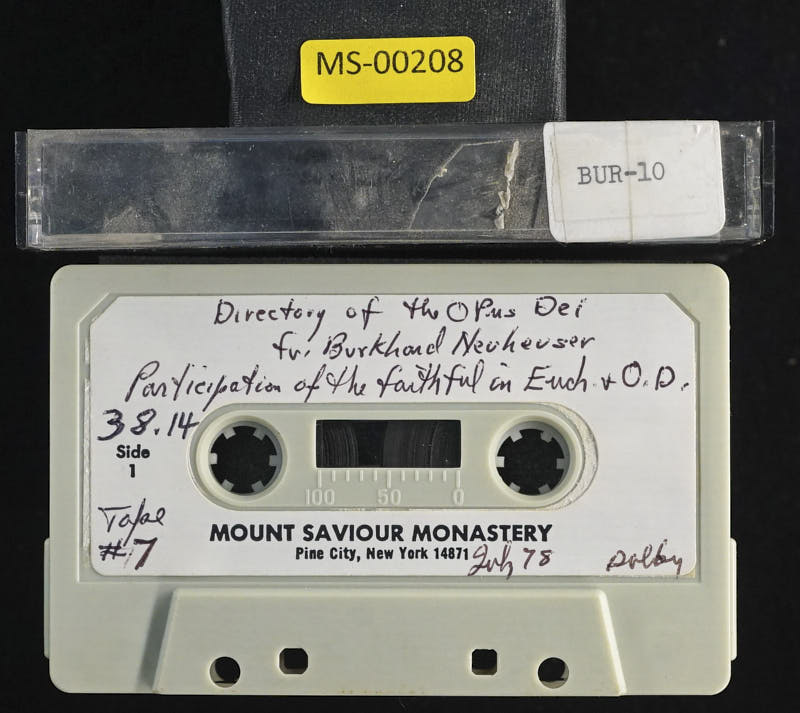
Speaker: Fr. Burkhard Neunheuser
Location: Mount Saviour Monastery
Possible Title: Directory of the Opus Dei - Participation of the faithful in Euch. & O.D.
Additional text: 38.14, Tape #7
@AI-Vision_v002
We can continue in our very simple, common reading of these very simple reflections on the Opus Dei. But simple reflections in practical order, which nevertheless can highlight our situation. And we are reading together 21 in the English text, 22 in Latin. Celebratio omnibus partens. Celebration open for all. And it is not quite evident that the text is speaking so. I remember very well, perhaps in the 50, before the council, in my monastery, Maria Lark, nobody could join to the choir of the monks. Aesthetically, because we did not visit, do not destroy our excellent singing. but not only by practical considerations. Somebody, especially the president, Abbot, president of my congregation, Abbot, very important man, Molitor of Gerlewe, said, our lost divina, our divine office is only for monks.
[01:07]
Nobody else is worthy to share in it. And with time only difficulty, we could move. Not today. officially it must be open to all and we are doing so and you have been the first to do so in the wonderful composition of your chapel the inner circle and the other circle and faithful can very easily participate and I had this morning the feeling when you said it the universal churches here represented and how nice it was that the sisters and all these people immediately was singing together as one church open to this we are not privileged class of men, of Christians. But we are all together brothers and sisters. Therefore, at least in Eucharist, we must be open for everyone. For the worship, for the prayers, for the hours, it's a little bit more difficult. I had yesterday the impression that nobody is singing with you. Perhaps they are invited not to do so. It is a problem, because sometimes they are falsificating, destroying
[02:14]
nevertheless at least it is very important to say and to read and to meditate these words an opening of welcome for others to the heart of the praying community in a line of pastoral adaptation which is fitting for a monastery that wants to be a leaven in its environment you wish to do so, to be so, therefore you must invite them in a certain way, at least spiritually, so far as possible, also practically. But nevertheless, and also that is very important, the text is continuing, this certainly does not mean that the choir taken in the local, special sense must necessarily be open to all, at all times, and without discretion. And you must never lose your identity. You must remain what you are. And if the faithfuls are not able to do that, to conform themselves to you, then it's better that they are remaining in silence.
[03:23]
We must find a good middle way here. And then again, another point, not only inviting the faithfuls to join us in our singing and hearing and answering and celebrating, but also we must remain in every case open to the human situations the present times in our prayers in our thinking to them when we are praying for all the necessities of the church of the world of the day of our neighborhood and so on as you are doing it privately in every psalm in every prayer but also explicitly in the intercessions i think it's quite evident and just In the end of this page 17 will be found the living witness that the prayer coming out of the word of God on the objective norm which we are appropriate subjectively in our hearts is capable of creating profound and vital contact with God because it passes through the eternally new experience of Christ.
[04:33]
This openness. And then we go on to 22. in the English text 22 in Latin the different importance of the different parts of the divine worship principal parts and secondary parts the principal parts which can never be lacking if we wish to remain in the tradition of the church, if we wish to remain the church, the local church, representing the universal church in this place, here and now, today. Principle paths, hymns, psalms, readings, prayer, according to this wonderful text in the letter to the Ephesians, filled with Holy Spirit. Singing in our hearts, in hymnis, psalmis, et cantitis spiritualibus.
[05:40]
Always giving thanks to God the Father in Christ our Lord. Here are the main elements, hymns, canticles, and psalms. And it may be difficult to explain exegetically what was the meaning of these words in the letter of St. Paul. But for us, after the tradition of so thousand years and more, we know hymns, It is possible to sing in a special musical form and psalms, the normal psalms of the Psalterium of David, and canticles which are in a more joyful way praising the Lord. But that is evident. The more important part of this number 22 is the insistence on the secondary part. For example, acclamations, versicles, responses and greetings. They are to highlight the communitarian dimension of our community, allowing to penetrate more profoundly in the meaning of all these things.
[06:47]
And in the first years after the Council, in the first beginning of our liturgical reform, in many monasteries, all these things have been dropped. No antiphones, no versicles. And perhaps also the acclamations, all changing in a very strange way. I know a monastery in the world, a Benedictine monastery, which was beginning, the divine office, with the words of Benedict Camus' domino. It's possible to say so, because an invitation to bless the Lord, to praise the Lord. Nevertheless, it seems to me very strange to do so. therefore the right way to do it and here the last words in this number 22 are important they are only secondary parts it is quite possible to change
[07:56]
to shorten. They are given examples, taken from Saint Benedict himself, who says that the antiphons are omitted when the community is too small, according to the way in which in all times antiphons have been said several times during the Basance. And on account of problems connected with the timetable, when somebody is rising up in the morning too late, we have no time to say the entire visuals. On the other hand, these elements surely contribute greatly toward inserting the whole prayer more directly into the mystery of the liturgical time and hour of celebration. We need therefore to draw attention to the mistaken sense of simplification and of essentialism which dispenses with those elements of the celebration too easily. There is a real risk here of impoverishment. In nearly all our monasteries, also in my monastery, it happens so. We don't have any more in certain hours versicles.
[08:59]
Pity. And especially antiforms. In the Concilium and Exequindum Constitutionum in Norm, we, the Benedictines especially, Don Cardin and many other people, we are fighting defending the antiphones because many people, long people said antiphones have a meaning only in music. They give the tone. It's not true, it's not enough. As is well said here, these elements help to insert the whole prayer more directly into the mystery of the liturgical time and hour. It's the same psalm which is said in Christmas, in Epiphany, and in Easton, in Pentecost, and in the Feast of Our Lady, but always in a different way given by the antiphons. It is not only a mean to find the tone, the musical tone, but it's also a mean to see the meaning of these psalms, the way in which it must be read and must be sung on this day.
[10:02]
and to help in this way in the new liturgia horam in the Latin text they have given three elements a title which is explaining the literal sense of the psalms a mystical word which is explaining the mystical meaning in the light of the New Testament and finally the antiphon and all of this helps us to sing to meditate the psalm more concretely to show us this specific aspect of the mystery of Christ celebrated today. The entire mystery of Christ, which is always entirely together, is celebrated under this aspect. The entire mystery of Christ differently celebrated in Christmas, in Epiphany, and Eastern. Therefore, the importance also of the secondary parts. They are not quite necessary. They can be admitted. They can be changed in the right way. But nevertheless, we must see this risk, real risk, of an impact And we can understand the necessity, perhaps, to undergo this risk in the first years, but not with time, where we are accustomed to new forms.
[11:14]
We must go back to these rich variations of the secondary path. It is my opinion. You are free to think what you wish to think because there is a certain liberty. And now we come to a very important number of let me see excuse me 23 in English 24 in Latin the monastic form must be retained without derogating that the Opus Dei is regulated according to content and forms that are objectively determined. Therefore, we are following this objective norm of the infinite mystery of Christ.
[12:15]
Nevertheless, we must recognize that the celebration of the Opus Dei and the assembly itself is enriched and integrated in a manner stable and constant that each community wishes for its liturgy. There is a new point, a certain flexibility, a certain possibility to adapt it to the different situations. And the most excellent expression of this, our will, is this book, the entire thesaurus liturgia horara monastice. The abbots in their congress and the commission and the abbot primate, Rambot Bigland, nobody... wishes to impose uniform liturgy to the entire order. Also, many monasteries are seeking it. But only possibilities. And every monastery must try to adapt its possibilities to the concrete situation in which they are, and the number, and the way in which they are singing, recitating, and so on.
[13:21]
And the election of the readings, and so any more. And here we must therefore retain the general ecclesial situation because we are the church in prayer but in this place as a local church and therefore because we are a local church here in this monastery as a monastic church and that means not a dead uniformity but we are fighting against a merely juridical consideration who have a breviary which must be persolved by everyone. We must seek a true integration of liturgy, of our prayer, and community. And therefore, in the last lines, he said, there is that community, and therefore, there is that opposite. Not in absolute liberty, we must follow some structures.
[14:24]
structures of the church structures also given in these thesaurus certain hours we shall speak about them a certain structure of every hour beginning acclamation God come to haste to help me in Psalms reading prayer or Psalms reading prayer so on there are some possibilities to change but nevertheless a common structure. We could not, as we said already, we could not make a structure only readings, only prayers, without readings. At least that is my opinion. That is the meaning of the Cesaurus, the meaning of the Constitutio Generalis in Liturgia Rhorarum, and the meaning of the Reform, also in Sanct Anselmo, and also elsewhere. Sometimes there are hours without any real reading For example, in the company, we don't have a reading. It is a short word of God, as you have it in the minor hours.
[15:30]
But we must arrange these traditional forms, these forms given by the Church, also according to our monastic tradition. And then finally also to the renewed spirit of the Vatican II. which is corresponding to a pneumatic revitalization of our ecclesial prior life. And as we have said it already, sometimes we can do that more easily because this renovation of the liturgical constitution itself and then the general institution to the liturgical vows is made in great part by monks and both The liturgical constitution and the new liturgia horarum, liturgia of the hours, the last coronation of an apostolic work which has been given especially by the monks, by Benedict monks in France, in Germany, in the United States, and so on.
[16:39]
Therefore, if we are conforming ourselves to the spiritual principles of the Vatican Council and of the reform after the Council, following our own tradition, But you must do it. And now, in English text number 24, 25 in Latin, the number of the hours. And here, evidently, they give the citation of the rule of St. Benedict seven times in the day and once in the night. But then, this old numeration, seven and one, wonderful, mystical, since seven is a sacred number, plus one gives the protection, eight. A wonderful idea. But nevertheless, this old numeration was only one possible way to help the monks to respond to the command of our Lord, the apostles, for tireless, insistent, continuous prayer, to which the monk is called.
[17:49]
do it in seven times and once the night and we can do it also in in in other numbers only if all these possibilities can help us to pray always everything new numeration therefore must guide us to the same end but in consideration of our concrete situation and that we can find also in it a living prayer of even better quality and here is the A reason because we were changing this disposition of Saint Benedict. For our situation of today, in nearly all the monasteries, seven times a day and once a night is too much, we can do it only if many don't come to the hours. For example, in my monastery, we were insisting with Father Raphael very strongly individuals at four o'clock or five o'clock in the morning, with the consequence that at least a third, if not half of the community was not coming. but sleeping. They came only every second day.
[18:57]
Today, we have our visual later, with consequence, that the entire community is there, present. It's better to do so. Therefore, change the disposition of all times to be able to call together the entire community... Here we are insisting in the principle given by the good and holy Abbot Emanuel Heufelder of Nieder-Altreich in Bavaria, minus orator, but mellius orator. It is better to change the old disposition and to be humble in being content with not so great numbers, but to do it better, to do it more slowly, to do it with better quality singing. we said it already, in St. Anselmo for many years, for 50 years and so on, we were praying the entire office, singing nothing. And today we don't say such a large, great office, but we are singing every day, because St.
[19:59]
Anselmo is quite extraordinary new thing, new reality, and so in many monasteries. But all his new... This position is made according to the principles of the Vatican II. There are hore cardinales, very important hours, two lords and vespers. Then still, according to the Vatican II, our visuals, and also to pray better, it was said it is possible to extend the recitation of the entire Psalterium no more, according to the rule and the old monks...
[21:10]
for every week but for a greater time the council did not say for worship time but then in the reform after the council we said four weeks for the secular priests and Bonini and the concilium the congregation then was insisting for monks is too few at least the entire Psalter 150 psalms in two weeks and All this means the sincere will to insert the prayer into the reality of the community's life. To give a strong time to this hour. It can be a strong time. That we are really praying in the different hours. So far as possible, the entire community together, the church in this place. All must be able to be present, more or less. Therefore, sometimes we are not saying some of the hours, for example, only one hour minor, not three, and so on.
[22:18]
But a minor number only to can promote the quality of the remaining hours. As we said in page 21... First, the reduction of the times of the celebration, of the hours, must not end up in a diminution of the time of prayer and much less of its quality. This is what happens when we make every celebration a real strong time of the Opus Dei, even in its form. We listen in the few hours which are remaining more attentively, calmly, relaxedly to the readings. There is silence of the prayer. more prolonged, more interior. There is more, I cannot read it, low way for song, more variety in celebration, et cetera. It is a game. And you are doing so, and most of the monasteries are doing so. It would be terrible for us to diminish the number of the hours to gain time for work.
[23:27]
We are in... diminishing the number of the hours to say the remaining hours more excellently. Having diminished the number of celebrations, it would be natural and laudable to wish to prolong those which remain. But you must never put together two or more hours as it was done also in the beginning. Many monasteries who were not able to say third in the morning, sixth at noon, and noon in the afternoon were Combining the three hours in one hour is terrible, not right. And therefore, not bringing together nine psalms in one aura media. We must make a new disposition of the psalms, therefore. And it would be more terrible to combine all the hours with three things at the same time. It would be, again, a juridical interpretation against the real meaning of the hours, which must be celebrated in their true time.
[24:33]
Okay, that's quite evident. And now we come to 25. The chief hours. Yeah, it's quite evident, according to the council. These chief hours are lords and vespers. In order to underline the chief nature of these two celebrations, We should remind ourselves especially of the fact that they are the memorial of the resurrection, Lord, and of the death of Christ, Vespos, more or less, respectively. As such, they should be considered very close to the memorial of the Eucharist. So we could have a threefold memorial, Eucharistic celebration, where death and resurrection are celebrated together, and in the Lord, more or less, according to St. Cyprian, the resurrection in Vespos, Afternoon, our Lord was dying, but going through the death to a resurrection. I would not like to see in the rest, but only the death of our Lord, the entire Pascal mystery.
[25:38]
But there is another terrible point in this number. Before I come to this terrible point, the text says very well It would be convenient to give some symbolic expression to this celebration. Incense in Vespas, as you are doing it in Sundays, and light in the morning. You can do it. It's possible. Suggestion, but not necessary. But then the text is finishing. And in Latin, it does not finish. Again, a terrible abbreviation. And I don't see the reason, or I see the reason, because the people are against it. the text which was given in Latin. And the Latin text is so. Meanwhile, these two hours are really hore cardinales, important hours, the most important hours.
[26:41]
In the monastic tradition, there is a hore indignissima, most important, the vigils. They did not take this text, inviting the Benedictine monks to to no more insist in the visuals. Incredible. Because of the eschatological meaning, which is specific for the visuals, where we are waiting for the coming of the Lord during night. During night would be at evening, very early in the evening, anticipating, or in the morning. Father Otto Kassel and also Abad Herbergen liked very much to insist in the possibility of celebrating the visions in the evening. Especially Otto Kassel, they have been people, men of night walk. Therefore, in the evening. And Abad Herbergen could come when we, during the war, in consequence of the air war, were anticipating the visions tonight.
[27:49]
He could not come in consequence of his health in the morning. But nevertheless, our community was against it. We wish to have it in the morning. Also for modern people, more expressive. In the morning, when the entire world is in silence, we are praising the Lord and reading His Word and so on. In every way, it is said here, the celebration of the visuals is eminent not only because the external solemnity in certain times given to it in the wonderful invitatorium and so on and the way to sing the readings sometimes or the sounds but more because of its characteristic elements because it is a prayer contemplative peaceful
[28:52]
and prolonged. The entire text is taken away. Contemplativa, pacifically sitting, hearing the word of God, answering to it in silence. Pacifica, there's no disturbation. And we have time. We have time, really, because it's outside of the time of work, in the morning, before we are beginning to work, more or less. Of course, there are the causes, too. Therefore, it is enough to insist in this point. Vigilis. There is also a certain inconsequency in the text of the liturgical constitution. Lue hore cartinalis and ora lectionis. Ora lectionis is very important. For the secular priests, ora lectionis, the name was taken. We could not find a better name to take away any relation to time. You are invited, you are able to say this hour, according to the necessity of a pastor, in the time in which you are free.
[29:58]
You are no more obliged to anticipate at 2 o'clock. You can say it at 11, or at 2, or at 4, when you are free. The other hours are related to time. The whole religion is not. Nevertheless, for us, it must be related to night and not taking another time. So, and then come in Latin, number 27, cantus in celebratione, and the entire number is not given. Again, why? Because it seems monks of today are not obliged to sing anymore in the office. Oh, we are not obliged, yes, but we must be invited. We could not forget it. It's not given. It's terrible. And it's well said, with the help of the modulation of our son, a community, a monastic community, which has a permanent ecclesial communitas, can give greater importance, first, for the degree of celebration of solemnity, of feast, of memoria, of weekdays.
[31:18]
You can change. You must not change always all the things, but you can change the entire office in the solemnity. Some elements in feasts, and at least somewhat also in every day. You are free to do that. You can distinguish by the way to sing or not to sing the different hours of the day. And sometimes in every day, in every hour, give importance to some elements. For example, in my monasteries, we are singing always the first beginning, in Latin still, in every hour. And so on. You are free to do that as you like to do, but it is necessary to see these possibilities. The great, the most important value to sing. And especially the monks, with special preoccupations, dedicate themselves to sing well. because it is the most convenient mean for the expressions of praise, of contemplation, which is in the greatest way specific for monastic celebration.
[32:42]
We, as monks, we are celebrating incantices, singing, praising, and so on. And it is convenient to sing more or to sing in a more solemn way in the Sundays, in the feast days, and also according to the capacity, to the possibilities of every congregation. There is liberty. You are not obliged to do it, but it would be convenient to show at least the ideal. Not for you, you do it, but for the entire Benedictine Confederation. I cannot understand the people who have to meet this terrible arrangement. And so the most important hours, lords and vespers, if they are celebrated in solemn songs, Really, Rerum Veritate can be regarded as the most eminent hours of the day, as we are doing it in Sancto Anselmo, where we have a very simple office, but the entire community of Sancto Anselmo in Rome, every day, notwithstanding all our scientific work, all our occupations, are singing the festivals.
[33:57]
And also in the morning office, where we have linguistic groups, every group the American-English groups and the French group and the Italian group and the Latin group try to sing so far as possible. Also if we in the Latin group are sometimes only four or five old people. I'm not against the modern language but nevertheless not forget also the possibilities of the easy possibilities to sing in Latin because it's very difficult to sing in Italian And also for English melodies in Rome, we are not very, no, the English makes it very well, make it very well. Nevertheless, it is sometimes very difficult to find the convenient melodies in letters that are ready. Echo, so 27. And now we come to 26 in, no, let me see.
[34:59]
Ah, 26 in English, yes, is the last. the performers of the celebration. And here it said all the members of the community are the performers. But there are special performers, deputies, deputies, to be the animators. There is the president, the abbot, and it is well said, the abbot can be the animator for the entire community to begin, to start, to explain by himself or by the Hebdomadarius, which he is doing in his authority. There are the readers, the cantor, the psalmist, and the monitor, in English, the announcers, which is a custom taken from the parochial liturgy, where we had animators, announcers, commentators for many things for the monastic community.
[36:00]
I think it is not necessary, but it is possible. You can do that. Somebody is saying we are now doing so and so and so. Possibilities, yes. There is the scola cantorum, the assembly. And then in the end, they are insisting here, in the end of page 22, it would be necessary that the heroes will be edified if the assigned office is done with humility... gravity and reverence, but also with competence. The principle so common in monasteries, according to which everybody must take his turn at doing a certain job in the community, cannot be applied to the celebration of the Opus Dei if we are trying for, as it should be, an edification for competence. And we had formerly discussed that everyone must do the office of the heptomada, and then the poor man must try to sing, and he could not. It was terrible.
[37:01]
The most excellent example of such an impossible form was the good, pious, and holy Aberprimate Vizidus von Stötzingen. He was incapable to sing one note rightly. And nevertheless, he was singing the great gospel of Christmas night. And he was exercising with humility and with zeal for hours and hours to do it rightly. And so more he exercised, so more it became terrible for us. It's better not to do it. And to invite someone over to do it. And so forth. And also we changed in my monastery. Everyone can be the first president of the celebration except Domala. But then he must not give the intonations. The cantor is doing it. That all is done with competence and therefore for the edification of the community. And then here, the English text is going on giving a good commentary, a good end, which is not found in the Latin text.
[38:10]
That is strange. Finally, Jews who perform special roles in the celebration have set a place. It's very good, very well said. within the assembly that is suitable for their task. That's the canto. You can say it must stay in the center or in the front of us. And also the next number two is not in the Latin text. Through regard to the walls in which the interior dialogue is expressed, they cannot be all recited uniformly, but must correspond in expression to the diverse roles they have in the celebration. Here, perhaps we could be we could have more fantasy to find the possibility convenient to the different forms. Acclamations, proclamations, songs. In fact, each one of these forms is intended to interpret the interior meaning of the formula that is spoken. And it is intended also to create or solicit a corresponding attitude in the participants.
[39:19]
Only thus does the celebration become alive within all tours present and provoke a living and truly responsive dialogue in the heart of the assembly for each of these forms become different moments of celebration to make living our office. Here also, I think, in the first beginning, in the years after the council, we became too simple. And now again we could find variation forms, find new melodies for the acclamations and proclamations as you are doing it for the Amen after the canon in the Mass and the Amen after the Gospel in the Visios and so on. And so far I have finished my humble commentary to this I must say again, wonderful document directory, which is only in the introduction, theological and practical introduction to this thesaurus.
[40:21]
And it would be convenient to study it too with the wonderful, great possibilities where all these elements, all the secondary elements are given in a great abundance little chapters for the different weeks of the entire year for all the festivities and versicles and so on and the possibility to show the different forms of the disposition of the Psalter in the end with the clear intention they are giving only examples you are free to make others It is difficult to find a good disposition. Therefore, in a certain way, for many communities, it would be better to take one of these possibilities, to Hulofs and Benedict, or Christogonus Waddle, or Cheyenne, or Nostker Fuglister, or Emmanuel Heufelder, or, I don't know, your own way, and so on.
[41:24]
You are free. And all that, because we are trying to realize the rules of the constitutional constitution, In the liturgy, especially in the Eucharist, but not only in the Eucharist, the work of salvation is actualized according to these wonderful words of the old secret and the ninth Sunday after Pentecost. All the times where we are celebrating this work of anamnesis The work of salvation is actualized. This is really true, especially for the Eucharist, but it is also true. And the entire Constitution and the documents after the Council and the Pope himself are insisting in this point. All these forms give a real actualization presence of the work of salvation in different form.
[42:28]
And when we speak of the reality of the Eucharistic presence, This does not mean that the other reality would not be there. Only the Eucharist has a more intensive, more substantial presence of work and person and body and blood of our Lord. But this presence is spiritually given, really, also spiritually, in the other hours about which we are speaking here. And in all these hours is true also the wonderful words of number seven of the liturgical constitution. Christ is present to his church in every liturgical action, especially in the Eucharist, but then also in every sacramental celebration, and then more, when the holy scriptures are solemnly read in the assembly, and when a community, two or three and more, are gathering together, then he, the Lord, is present in our midst. see this reality insisting it and therefore celebrate our hours so that the Lord is present in our midst in this wonderful high way in this great form that then after these high points of liturgical hours where the church is really in a strong way together on our entire life could be continued in Christ our Lord the entire not only liturgy liturgy alone
[43:52]
we must say it very strongly, would be that. Liturgy is the highest point to continue in the entire life. Therefore, liturgy does not exhaust the activity of the church. But nevertheless, number 10, it remains Kuhlman advance, the highest summit to which we are always going, and the source from which comes our activity. And I wish you that you could continue in the way in which you are celebrating your liturgy to be in your entire life in Christ Jesus. but we can still discuss, if you like. A community could not have sung responsories or antiphons. What is your opinion if, say, like a reader, read the responsory or read the antiphon before the sung? Or a cantor himself... You are right. You can do so. And so far as I remember, that is the old... custom in the Italian monasteries.
[44:55]
In the Italian monasteries, acolyte was saying the antiphon, not the community. You can do it, yes. And then the antiphon is not a melodical, musical element, but it's only a motif to say the sound. And it's not important, not necessarily that the community is saying it. Nevertheless, as you are doing it in the big... antiphones vespers and gloths you are speaking solemnly together singing solemnly together in a very simple way the antiphones is also very fine but you must not do it every day for every psalm in a certain way it would be nice I am from this opinion more or less it would be nice to have an antiphones for every psalm as is in the new liturgy of the hours of the Romanite Saint Benedict's does not have it so. He has only antiphones for some psalms. And we must confess, he did it not very well.
[45:57]
Because the antiphones don't correspond to the content of the psalms in no way. They are only taken one verse, which is corresponding to the first psalm, to the second or third, he does not correspond. And therefore, in the new liturgy, and we must do more or less the same, we must choose our antiphons so that they are really adapting the psalms in its meaning to the concrete situation of today, as it is made very well in the old liturgy in the great solemnities. And there must be more or less antiphons normally, which are not histories of the saints, as we have it in St. Benedict's feast and so on, but taken from the psalm. There are many possibilities to do it. Here I find it as just the opposite. It ruins the song. It ruins. but you have another way to sing your antiphons you are no more in the old form that the antiphon as it was in the old antiphonarius is really giving one of the eight tones and it was impossible to sing a psalm in another tone in the antiphon you are outside of this form
[47:26]
For you, the antiphon more or less is only a more or less solemn recitation of the antiphon to give a motif. But there is a possibility, yes. I don't understand. You can say the antiphon is in recto tono, yes? And then? No, yes, yes. I said it already sometimes in Italy to some congregations. If you don't have melodies, speak in a certain solemn way the antitone. Not too simply, at least, as you are doing it for vespers and laws. And then freely you continue with your sound tone as you like to do it. There is no real connection between the two. It's more important, yes.
[48:50]
That's why I feel it should be well resided instead of trying to sing a melody and then change melody. Yes, well recited, you are right, well recited, but at least well recited. Otherwise, I have personally the feeling if you are reciting it only and you come with a wonderful thumb tone, there is too big a difference. At least as you are doing it, for my judgment, very well in Loss and Thespos on Sunday, you are reciting in a certain solemnity, reciting it. but with some variations, with a second voice. The antiphon, in turn, very well the Magnificat or Benicris is following. You must not do it every day. Every day it would be possible to give only a recitation of the simple recitation and then follow the psalms, yes. Also here, at least in the beginning, for example, for laws, it would be more easy to take antiphons and speak them.
[49:56]
and then the sun is given in song. But with time, perhaps it would be possible for some experts to find also, with time, to find again melodies that we don't undergo the risk of this impoverishment, which is really the case after the concert. And we must remember the old wonderful melodies have been created during 100, 200, 300 years. And we cannot do the same in 10 years, but at least remain open to the possibility to give some solemnity, a certain solemnity, in certain days, at least, musically, to the antiphones. Perhaps it was a little bit too much. You are right. And nevertheless, Some of these elements would not be bad.
[51:00]
We were instructed as novices, as young monks by Abad Herwegen, the versiculus is a signal. The entire community now is changing from the first nocturne to the readings. You have a signal in the benediction, the blessing. Yeah, you can do it. But nevertheless, especially If you sing the versiculus, for example, with a certain musical intonation. I don't know the versiculus. Very simple, in a normal day, whenever there is a certain signal, in certain festivities of festum.
[52:07]
Attention, please, dynamis, stormen octoos, according to the Greek liturgy. It's possible, not necessary. But here, the directory wishes only to insist we must be prudent not to lose everything of the tradition. In the tendency, a very good tendency, to become more simple. We must find also our way, this way to give the versicle with the melody on the last syllable is perhaps possible in Latin, but not in English, in German. In German, impossible. In English too, I think. Dr. Brooker, would you think one aspect of the relationship between laws and vigils, for example, morning vigils, is that laws is kind of the awakening, greeting of dawn, and it's more celebration, whereas vigils are more peaceful.
[53:19]
Yes, yes, yes, yes. as you are doing it. That does not mean that in visuals could be some solemn elements. For example, the invitatorium, which you are singing it. But it was not right as we did it in Rome and in Maria Laga, in all our monasteries, in the great festivities. We were reciting without any melody, the psalms, and singing in the most solemn way the readings, which are not made to to sing. It was very nice. It was very nice and very difficult, too, for some people. Therefore, today it's better to sing the Psalms in greater solemnities and to read the readings. It's corresponding to the Word of God. It must be read. On the other side, also, it's a very big problem discussed now also in Germany. Gospel. Readings could say be song, or must say be proclaimed.
[54:28]
Especially it's a problem for gospel. It was very nice to sing at once. Could we do the same in English and German? And many are against it. No, we must proclaim it. In that time, Jesus has said to his disciples, in a certain way, he's more expressive. But nevertheless, great German authors is Bach. You remember, you know, the passion of Matthew and of John, of Johann Sebastian Bach. He had a wonderful way to sing the German text. And therefore today we are trying to find new melodies, not so rich as the melodies of Bach, but new melodies which are proclaiming the truth of the gospel also in this melodical way. Therefore that it can go in our hearts more deeper, meaning different.
[55:34]
In a certain way it's better to speak it well than to sing it badly. as it sometimes was said by some priests who were not able to do it. You could take the last sentence in number 22, where it says there is a real risk of impoverishment, meaning not only impoverishment for the people, but it impoverishes the time. Yes, yes, yes. We are losing. The office doesn't signify what time of day and also what time of the year the church is celebrating. And there's a responsibility to have the best sign that you can have. We must think that it is a danger for ourselves. And our offices are really, with these smaller secondary elements, are really good offices. It would seem like if you just had the primary parts only, it would be very hard to tell if the psalms are, you know, you could go to the psalms and you don't know if it's an evening one, if the windows are a morning one, there's no way to tell what time it is when you're celebrating.
[56:50]
Nevertheless, you could say you come to Vespos knowing very well is the evening. Therefore, I am singing the psalm in the context of evening. But it's also convenient to have some... expressions, yes, in the sign, in the antiphon, and so on, in the texts. And therefore sometimes we are choosing also psalms according to the situation of evening in the Vespers. But then we are singing in Vespers not only for evening, but sometimes also in the Thanksgiving for the mystery of the day, in Christmas Day, or in novel solemnity. Singing the psalms to praise God because He has given us his mystery in such a way, Assumption of Our Lady, and so on. When we have a solemnity, we have a motif. And I found that hard in some ways with the introduction. We had an introduction.
[57:51]
Then we had another kind of another introduction with the incense. Nevertheless, we have three psalms, and perhaps, according to the ideal, you would have three antiphons. We are singing this psalm to see the eschatological glory of our Lord. And then we are singing in Christmas, the second psalm, he is great in his mercy. And we are singing the psalm de profundis in Christmas. And if we are taking this antiform, then the entire atmosphere of this psalm is changed.
[58:54]
Some priests said, how could you say the psalm de profundis on Christmas? He is set only for death. It's awful. Because we are singing the psalms not so much with the insistence of the profundis from the deeps I call to you. But we are insisting, it is our point. Lord is great in his mercy. He is redeeming us. He has redeemed us. Therefore, the different antiphones are good introductions after the general introductions that the Lord has to help us in the evening time with the incense, the sacrifice of praise in the evening, and then the antiphones and the plants in their specific meaning for this feast. I would not have any difficulty. And remember, all these are suggestions.
[60:01]
You are free. But nevertheless, let us think about it. If time... We are already... No, we are more than 10 years after the council. A very short time, but nevertheless. Still... And here, there is a book given last year. And I would say, every community, also the communities which are already accustomed to have their own office... many years, as you, are invited to think again about the possibilities given here. For example, this is a wonderful work done especially by a pharaoh, I'm going to find the name of one of these monasteries in Italy, for every reading in the year, a responsorium which is corresponding to the reading itself. A enormous work. Yes. And formally, it was not so.
[61:06]
You remember, we have set the same responsoria for three, four, five weeks with quite different readings, more or less adapted, but never corresponding to the precise text. An enormous wall. Everybody reading with its own responsorium. that there could not be a common reverie, say, for example, I don't care, especially it's interesting, supposing we had one for the confederatio and would the individual monasteries with supplementa or something? You are right. It would have been possible. But it was not possible because, and we were fearing it, the entire confederation, especially some congregations, some others, would have been furious if we would have imposed it.
[62:11]
The Abbot primate, Rembrandt Wigglen, would have been lapidated with stone if he would have made a breviary. We, Henry Ashworth and I, we were hoping we make this work, hoping that with time, by itself, there will come a common... by the perfection by the qualities of this treasure and so is this better there was so much aim desire for spontaneity for liberty for the liturgy of the local church that liturgy for the entire confederation would have been impossible there would have been taken it immediately here in file. And all were feeling that the Abbot primate would impose it, or the congregation, but in Abbot primate and congregation, we were from the same opinion, or a certain liberty, but in, how do you say, inside the framework of these structures.
[63:26]
And therefore, with time, perhaps, and so on, For example, you can arrange your office if you wish, but nevertheless, for a Benedictine monastery, it would be necessary, convenient, that in the visuals of Sunday, the end is the gospel. And it would be also necessary, convenient, that for Benedictine monks, the gospel would be finished by Amen. And to do it, you must find some possibility, because formerly, it was so, we were singing... There was a final conclusion, and all have known. No, we can't say amen. Today is impossible. You are finishing. Nobody knows when is coming the end. And therefore, in my mother's name, we do it so. The abbot says, after the reading, these are wars of life.
[64:27]
Amen. Or in Sundays sometimes, no, in Sundays we say, the Lord is risen. Amen. And then till it gets lost. And I would find it very strange if we would lose completely this acclamation after the Gospels and the visuals. We hope there are possibilities to change. You can change. You are free nevertheless with time. Our intention was, if it is possible, let us retain this. the words, the letter of the rule. If it's possible, if it's not possible, we could change our liberty, as St. Benedict himself has said it. I don't know how you do it. Have you the tradition lost still? Okay, fine. We say this is the gospel of the Lord. Okay, then you can answer. Only you must find a word which is not identical with the words after the Gospel in the Mass.
[65:28]
Because with time, everyone after a certain formula is answering immediately in the form he knows. And therefore it must be a form different from the Mass. in a certain way yes at least officially because there are singing these hours better singing for example I don't know it precisely but so far as I see the situation in monasteries where in consequence of the enormous burden of work they never have sung the office.
[66:30]
No, having only two hours a day, they can sing it in the morning, sing it in the evening with greater perfection. If the prayer life is really has grown, I don't know. But I think the diminution of we made this experience, we have No so many hours anymore. We lost, under Abbot Basil Abel, first, before the council, already the prime. It was allowed to SBF to obtain the permission not to say the prime. Therefore, we had time to pray in the morning. Somebody had time also to sleep, yes, that's true. But you cannot hinder that. At least there was the opportunity to pray. And now, in my monastery, we have the morning office with the combination of visuals and lords, six star, vespers, and compeline, and the mass, for more or less five times with the mass, or six, because the morning office are two hours, practically, together.
[67:51]
and therefore you are free not to work and to pray if you don't do it you must say again in a certain way it's not important to change texts numbers hours but to change the spirit if you don't change the spirit you change everything and it's the same as before There is a great danger, and for many it is so. They change the altar, they change the language, they change the readings, and they are doing the same mechanism as before, without praying entirely. And therefore, always, again, these wonderful words in the instruction of 64, the intention of the reform is not so much to change, but to realize this pastoral action is... that the Pascal mystery could be expressed in the life, in the living celebration of liturgy and in our entire life.
[69:04]
If you don't intend to that, it's nothing. It is difficult to do it during the entire life. I have the impression that in history one of the distortions Solemnity became, you know, for people, solemnity means singing. And for me, singing can be a very, you know, a real distraction if it's done badly. Like, I don't know where he got the principle, but for him, the preface had to be solved. And he was there, you know. He could not, yes, I know, I know. Here, again, the council was insisting, if you cannot sing the Mass, the High Mass, the Pontifical Mass, say it, it's better, yes. And nevertheless, we come up to preach the oral, says St. Augustine, who is singing, is praying twice.
[70:06]
Per se, to sing with the angels, it's better to sing. Excuse me. Here I don't agree with you. It is wonderful that in every Mass and in our Latin Mass in Rome, every day we are doing it, we cannot sing the intro, we cannot sing the offertorium, but we sing in every Mass, every day, preface, Sanctus, and Pater Nostrum. Also with all the other things that are not said, not in song. Song is, I would say, pneumatic, the Holy Spirit. But you are right. Sometimes this is more difficult, this burden is too difficult, and this distraction, and so on. But it's the same. If you say it badly, it's also a distraction. Yeah, this was something that some people talk about singing here, about improving the liturgy, and it's always in terms of singing, and I have difficulty with that, because I think if you can improve the liturgy, if
[71:12]
You introduce a reading or if you introduce something like that. Here I don't agree. Totally. You are right. Introducing readings, we can't promote the liturgy. But at the same time, we must not forget that liturgy is not only an intellectual thing. It is also an expression of the entire man. And the entire man is expressing himself joyfully, praising when he is singing. We cannot praise... in the eminent sense when we don't sing. Or if we wish to praise the Lord, then we must sing. This is one of the elements which we have seen in our times in the youth movement. To stay in the mountain and to see the beautifulness of the world and then to shout out in a hymn, but in singing a hymn. And so this is true. As he said in the Psalms, in Timberley, and if you are doing with the harp and so on, for me it is marvelous.
[72:15]
One thing I found is that we have a hymn, a book of hymns, and we have 220-some hymns and all that. And then after we all know, you sing them a few times, and then, you know, it... Sure, in a certain way it is true. All things become common. But nevertheless, I must say, at least in the old liturgy, everybody hear again the same melodies for Christmas, for Easter, for Assumption of Our Lady, and everybody hear again wonderful. And it never became too much. If we find it, here is our difficulty, if we find it in our modern languages, excellent melodies, they will not become noyous. The difficulty is our melodies today are still very simple, sometimes not well made. And one of the reasons, because our Abad Urban Baum is so against German Gregorian chant, he says, things are not well made.
[73:27]
It's an adaption of German language to Gregorian chant, which does not functionate. You can do it for some days. You are enthusiastic because this is a new thing. After a certain time, you are realizing it is badly made. Then things are lost. But we must try to make it so well that we are convinced by the melody. That is difficult. Therefore, we must make some experience. We must begin to do it. And with time, you find, and I have the impression you have some melodies which are well made. For example, the melody of the incense is From my judgements, well made. And our melodies too. But nevertheless, we did not yet find, not in German, not in English, not in French, not in Italian, melodies which have the same powerful expression as the old Latin Gregorian chant melodies. What can be said in English and German instead of that?
[74:29]
speaking strongly to also to the people who don't understand Latin. Oh, in the old Sunday of Sextagissima, exurge domere. I face it in terra venta nostra. Exurge, exurge nera pedas infinum. You have some application to it in English, but in Latin, yeah, the melody is still there. But in Latin, some melodies are not translated. Perhaps you have all them translated. Okay, fine. They are still there. And I am enjoying it to hear the old melodies. And so on. But the thesaurus, the directorium, again, according to my judgment, excellently has spoken about the country. And your difficulties are expressed here.
[75:36]
They did not bring it. You are right. They are right. There is a difficulty. But nevertheless, we must overcome this difficulty. And therefore, also, it's necessary to be competent to exercise, without the excitation. And also, this insistence of the cantor, and our cantor is insisting very much, indeed, in the last days, you have already, you are for half a tone. This is awful. We must retain in the entire office the same tone, not falling. But how do you say the declining? It's difficult. And we need always again, and Abad Urban, our former cantor, said, it is only an element of attention, sometimes of tiredness.
[76:37]
But especially if you are present with body and spirit, you must not fall down. That is, yeah, yeah. to stay in the presence of God is difficult. It's not easy. We are tired, nevertheless. Therefore, in a certain way, we must become independent from certain... difficulties which are in every community there are days where the entire community is nevertheless because although the most perfect melody cannot realize the greatness of the presence of the mystery of Christ which is greater than every human beautiful melody I thank you for the opportunity you have given to me.
[78:01]
Also for me, I must say, it is after 50 years and after more than 50 years, always the same. According to these words, which has been written here in the cake, so far as I remember, according to the words of the hymn of St. Ambrose of the Old Lord's Fourth Monday, and citated by Romano Guardini in his book of the Spirit of Liturgy, Laeti Bibamus Sobrium Ebrietatem Spiritus. Joyfully, we wish to drink the sober Ebrietas. Drunkenness. Drunkenness of the Holy Spirit. Therefore, we need some... We need movement, overcoming all the difficulties of the years, of the weather, I'm sorry.
[78:53]
@Transcribed_UNK
@Text_v005
@Score_93.73