You are currently logged-out. You can log-in or create an account to save favorites and more. more info
Reimagining Sacrifice in Modern Theology
AI Suggested Keywords:
Given to Benedictine Juniorates
The talk explores the theological understanding of sacrifice, focusing on its modern reinterpretation and integration within sacramental theology, particularly the Eucharist. Key themes include the influence of Edward Kilmartin's critique of contemporary Catholic Eucharistic theology, the intersection of sacrifice and creation, and evolving perspectives on sacrifice in relation to cultural, scientific, and theological developments. The discussion also considers gender implications and critiques from feminist theology, before delving into the New Testament's take on sacrifice. The presentation considers both historical and current theological interpretations, aiming to reconcile traditional views with modern theological and scientific perspectives.
-
"The Unionists in the West" by Edward Kilmartin: This posthumous work critiques modern Catholic theology's approach to Eucharistic sacrifice, emphasizing the need for a more robust integration of Trinitarian theology.
-
"The Power of Sacrifice" by Iain Bradley: Bradley examines the cultural perceptions of sacrifice, how it conflicts with modern values, and explores its enduring significance through various cultural and spiritual lenses.
-
"Creation and Chaos" by Hermann Gunkel: Offers a foundational examination of Genesis, focusing on chaos and order, influencing contemporary theologies around creation and sacrifice.
-
Jean-Luc Marion's Writings: Highlight the concept of God as loving and self-giving, distancing from traditional metaphysical conceptions.
-
Eucharistic Prayer of Adi and Mari: Discusses its recognized legitimacy despite lacking a traditional text of institution, illustrating differing sacrificial understandings between Eastern and Western liturgies.
This comprehensive examination of sacrifice navigates between scriptural interpretations and their implications for contemporary theological discourse, culminating in a call for deeper integration of sacrificial and self-giving principles within both personal spirituality and ecclesiastical practices.
AI Suggested Title: "Reimagining Sacrifice in Modern Theology"

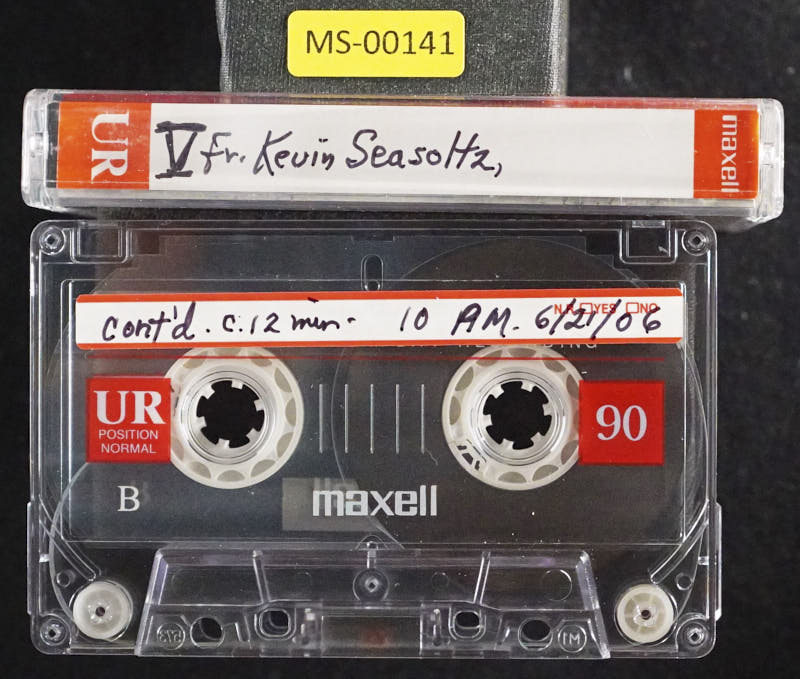

AI Vision - Possible Values from Photos:
Speaker: Fr. Kevin Seasoltz
Possible Title: 10 AM Class
Additional text: IV, original, SAVE
@AI-Vision_v002
and compassionate God, that you teach us the wisdom that is hidden in your gospel, that we might hunger and thirst for polyness, work powerlessly for peace in our lives, and seek for the blessedness which comes to us, and we allow you to integrate in our hearts. take this prayer as always to Christ our Lord and in the power of your Holy Spirit. Amen. Thank you. God alone is the source of all good gifts. That extraordinary generosity is manifested above all in the sacrifice of Jesus, the only Son of God, and in his sacrificial gift, then, of the Eucharist.
[01:12]
Those of these gifts as sacrificial are indeed, I think, a revaluation in light of contemporary theological people. I want to set that for you this morning. In a book that was published posthumously called The Eucharist in the West, Edward Kilmartin, a Jesuit who died of cancer a couple years ago, private Notre Dame and then stepped many years at the Oriental Institute in Rome, spent most of his academic life really exploring sacramental theology and very specifically the Eucharist. He asserts in this book that what can be described as the modern average Catholic theology of Eucharistic sacrifice is, in general, a weak synthesis without a future.
[02:18]
Then he goes on. In the average Catholic synthesis, in a terrible sacrificial act of Christ and that of the Church, tends to be limited to the moment of the consecration of the gift by the church, which is identified with the moment of the recitation of the words of Christ contained in the narrative of institution. Viewing the fact that the members of the assembly are also the acting subjects of the Eucharistic prayer, His average Catholic theology of Eucharistic sacrifice logically implies, then, a defective interpretation of the relationship between the Christian assembly and the presiding minister. You might have noted in the newspaper that in the past year, the Eucharistic prayer of Adi and Mari
[03:25]
was recognized by the doctrinal congregation as legitimately used. In that particular text, there is no, no text of the Institute. The commentators, especially Robert Taft, who talked at the Oriental Institute for many years, claims, the best we can say, it's implicit. in the text itself. There are other Eucharistic prayers we don't use today, which were without, basically, a text of institution. The Eastern Church, by the way, takes a very different approach to all this. It's the whole mass which is the form of the Eucharist, or at least the whole Eucharistic prayer, and not simply the text of institution. In concluding his assessment, Gilmartin notes that the average modern Catholic theology of the Eucharist displays only a weak integration of Trinitarian theology.
[04:35]
In other words, our Eucharistic theology tends to be almost exclusively Christa monis. Most importantly, the theology and the role of the Holy Spirit needs to be thoroughly integrated and the consequences then drama. In fact, he says, it is the lack of a systematic approach to the role of the Holy Spirit that lies at the base of the overall weak Western theology of the Eucharist. Now I would note here that the overall weakness of the theology of Eucharistic sacrifice is not in time to the Catholic West It's characteristic of much of Western Christian theology in general, Protestant as well as Catholic. And one of the major difficulties in developing a statutory understanding of Eucharistic sacrifice today is the simple fact that the basic meaning of the term sacrifice is the subject of both citrus disagreement among scholars.
[05:50]
Not only has the historical division in Western Christianity between Protestants and Catholics been perpetuated by continuing disagreements about the sacrificial nature of the Eucharist, but also systematic theologians and biblical scholars often disagree about the correct interpretation of the nature of the sacrifice of Christ himself and Christ's role in what we call atonement. And furthermore, the very notion of sacrifice is often rejected today in contemporary Western culture. Why? Because it is often looked upon by many people as the antithesis, self-fulfillment, success, and self-actualization. You know, as those of people who are a little older, the virtue of self-sacrifice was once highly esteemed.
[06:57]
As one commentator points out, like good manners and loyalty and team spirit, it seems to belong to the world long, long gone. What I want to do this morning is look at God. as the sacrificing one. As you look at God's sacrifice as a gift. I will, very briefly, highlight some of the skepticism that the term arouses in the contemporary world. I will then explore its place in a theology of creation and the way This whole subject of sacrifice is related to contemporary science. Some theologians feel that because the notion of sacrifice has provided so much dissension and dispute, it ought to be abandoned.
[08:07]
I don't agree with that at all, because I think it is so richly embedded, certainly, in the Bible and in the Christian tradition that we have to grapple with the issues rather than discard the term. All right, a little bit then, first of all, about the term sacrifice in our contemporary culture. In his introduction to a book that I have found very helpful called The Tower of Sacrifice, the Scottish Reformed theologian Ian Bradley, P-R-A-B-L-E-Y, speaks of the riddle of sacrifice. The concept is prominent in the teaching of Jesus and also the way in which his life and death had traditionally been interpreted in the teachings of Jesus and consequently by subsequent theologians.
[09:12]
has however provoked divisions among Christians and is often felt to be repellent from many culturally sensitive men and women. Perhaps it's the emphasis on denial that the term tends to conjure up denial. is looked upon as conflicting, then, with the very positive and life-affirming message of Jesus, that we have come so we might have life and have it to the full. And so, many people, it seems today, who are writing about this issue, have internalized a negative understanding of sacrifice because the word that's traditionally emphasized cost rather than gain, and loss, rather than the enhancement of life.
[10:20]
Furthermore, they tended to associate sacrifice simply with suffering, rather than a positive form of self-giving and a free manifestation of love. What was the result of these complications then? Like death, Sacrifice has become, in certain areas, a taboo subject. Bradley says, it relates uncomfortably to the self-centered, romanticized package of instant sexual gratification and constrictuous consumption, which is presented to us daily as the essence of the good life. in popular magazines, television soap operas, and advertising slogans. He goes on and he says, our economy is ordered on the principle that any kind of sacrifice, say limitation, or surrender, or postponement itself be pleasure, is not just undesirable, but it's wrong.
[11:37]
It's built on credit, on the lip now, and Pay Laker principle exemplifying, he says, by the little plastic flexible friends who take the waiting out of their wanting. It is all to say, this has led them to the emergence of what has been described as the I want and what I want I get generated. In certain areas of psychology also, and in certain aspects of New Age religion, I think you find the same similar approach. The stress in our world is often upon self-fulfillment, self-actualization, self-awareness, and that all seems to be the very opposite of limitation or surrender or denial that are expressed in the term sacrifice. Also, this is important, some feminist theologians in particular are especially hostile toward the notion of sacrifice because they think it has been used to justify suffering, particularly the suffering of women caused by injustice, sexual and physical abuse, and oppression.
[13:09]
And as you know, probably in church history, It is simply true that in Christian tradition, some commentator, newly patristic writer, going down the tongues of kindness, they have afforded women a very negative place, first of all as a cause of evil and suffering, and hence women are set to deserve suffering as a punishment and as a means of expiating. Furthermore, Many people, and especially women, have been taught to suffer as Jesus did. Because they get brought up in a Christian tradition focused almost exclusively on the suffering Jesus. And they founded him then a model for imitation, which has induced them then to endure violence directed against them. You probably know in the past women were often exhorted to sacrifice their children for ministry in the church.
[14:15]
They were told to sacrifice their need to the needs of their husband to children even when these were then invested in violent or abusive war. Complicated background here. We have to look at. So, encouragingly, there are some significant signs that self-sacrifice is still being acknowledged as an ideal. In spite of the contemporary preoccupation with self-fulfillment and self-centeredness, there does seem to be a hunger for signs of a real sacrificial spirit in the midst of our consumerism and our struggle for success. For example, Paul Piedes, an Englishman, says, it is those who have given themselves away in the most benefit manner to stand out in history as the most vital personalities.
[15:28]
Francis of Assisi to Simone Bay and Mother Teresa of Delphata. In the bubble, this is the pattern of the cross and resurrection which then gives us the courage to believe that to give oneself away in forgiveness is to become truly oneself. It's also the interesting phenomenon that Ian Bradley points out, and that's the remarkable success of the musical Les Miserables, which has been witnessed, by the way, by about 50 million people around the world. And if you've seen it, or perhaps you've looked at the VCR here, it's fascinating because everything you're in is devoted to self-giving, not to self-service. So, there's this background there. On a theological level, in the 1940s, it was sounding forky revisionist work on sacrifice of all done by French
[16:39]
capital villages, especially Eugène Lasseur, who booked the Christian sacrifice, linked sacrifice, above all, with order, and adjourned the life of self-sacrifice as the basic characteristic of human beings, made in the image and likeness of God. And then, in the second half of the 20th century, there was an important revival of interest in the theology of sacrifice, especially in Great Britain and in continental Europe. Perhaps this interest, especially in the closing decades of the last century, stray from a reaction against the dominant culture of consumption, materialism, and self-preoccupation. Another interesting point, I think, is the ecological concern as well as the issues of economic and social justice, prompted cultural anthropologists then to promote sacrificial lifestyle, especially among the wealthy people of the world.
[17:53]
And this is where biblical and patristic scholars come in. They have retrieved the importance of self-sacrifice in the New Testament period and also in the early church. Likewise, the ecumenical movement contributed, importantly, to a rehabilitation of the concept of sacrifice by encouraging honest dialogue between Catholics and Protestants in the area specifically of Eucharistic theology. And the centrality, then, of the Eucharist as a sacrificial meal in both the New Testament and the pre-Referlation tradition of the Church. You know, up until the time of the Second Vatican Council, we regularly described the Eucharist simply as a sacrifice. Then there tended to be the tendency after the Second Vatican Council simply to describe the Eucharist as a meal.
[18:59]
So Largen and others emphasized that the Eucharist is, above all, a sacrificial meal. bring the two themes together. As sacrifice is dominant, the sacrifice will manifest itself in the context of a meal. We'll talk about that a little bit later. All right, what I'd love to do now is to move on and talk about sacrifice and creation. Have any questions for a new book? You know, what was Carol Martin's book? What was Carol Martin's book? It's... Egypt, unfortunately, he didn't do anything. Robert Daly was the editor of the thing. And it's public by Nick Press. I must confess, I had this done an hour ago, because what happens in the book, because he didn't have to find it, you lose the forest for the trees. It's so detailed. It's the interest in the Western tradition.
[20:02]
It doesn't pay much attention to the East, but it's mainly the West. I just thought I had a comment, because I remember the Anapra, Addo, and Mari when it came out, and I didn't think of media that said it presented it correct. There's no institution, per se, but I want to point out the words of Concentration are in there, but they're like an American poem. Well, they aren't an American poem. They are interested. Robert Tapp did the basic commentary on the document, and it's presumed that he also wrote the document that went to the congregation. the doctrine of the faith. And then he did an article for me in Worship the Church Pocket. And so he's very clear. It's not explicit in me. There is a historical survey of Jesus' activity, but you do not find an actual text of the institution as we find in all the other euphemistic words that we do. Sorry, not in my form. I mean, I read it myself today. The words are in there.
[21:02]
They don't have an explicit... So then I think there's a contradiction that if they're in there, they should be explicit. Well, I didn't bring the text explicitly. Maybe you'd find more than I would read the text. Anyway. It's caused by the revolution, by the way, especially among other German dicasteries, you know, about the legitimacy of moving in this direction. Because, as I mentioned before, The Texas Institute is so important, you know, for most presiders in the Western tradition. Not so in the East, but the style of celebration tends to be very, very different. And so the assembly is involved in their inaphora throughout the whole text with acclamations built in effectively into the text. All right, let's move on then to sacrifice and creation. Secondly, I think one of the most positive developments straining from a renewed theology of sacrifice has been what I would call the construction of a fresh natural theology based on the power of sacrifice as the engine that drives all life in the universe as well as the principle at work
[22:35]
in the heart of the god. God being, first of all, and most of all, the sacrificing one. Now, you know, Charles Darwin published On the Origin of Species in 1859. And today, the majority of biologists still commend it for its general accuracy, but they have added, as you know, their more recent knowledge of genetics. But most scientists do not doubt that life on this planet has in fact evolved along the lines that Darwin laid out almost a century and a half ago. There is no doubt that an updated evolutionary interpretation of life, of language, of behavior, morality, and even religion, have lately been gaining unprecedented attention by natural scientists, by philosophers, by linguists, by ethicists, by social scientists, and even more recently, by the medical community.
[23:52]
It's true that a theology that's obsessed with the good order and divine design in the universe is really quite ill-prepared to cope with the theory of evolution. And such a theology leads to confront the hard question that John thought in Georgetown and has written extensively about this relationship between sacrifice and happy passionism, a suffering God, and theology generally. has raised a number of hard questions. He says, what if the cosmos is not just and border, but is still unfinished labor of creation? In other words, what he's asking, what if creation is an ongoing experience on the part of God? He goes on, he says, suppose we look very carefully at the undeniable evidence we have today
[25:01]
that the universe is still coming into being. And suppose also that God is less concerned with imposing a plan or design on this process than with providing a vision for the universe that allows it somehow, because of free will, to participate in its own creation. The idea of God, he says, becomes not only compatible with evolution, but it also logically anticipates something like the kind of light world that Darwinian biology sets before us. Well, the traditional view of creation transmitted through Judaism to Christianity is certainly being questioned by various Christian theology, and they are especially influenced by strong contemporary movements such as patricassianism, as God's Supper, and also process theology, and they employ images of God as the crucified one who, as the divine risk taker, in fact, suffers.
[26:29]
along with humanity. They speak in terms of God's own brokenness, God's vulnerability, and they view creation then as a continuous open-ended process involving God exposed to the world rather than as a distant being who created the world once and for all and then left the world to its own resources. Once and for all, Moab came birth to the universe and then said, go on your own. Bradley gets remarked, it is indeed much more possible now for Christians to conceive of creation as a continuous sacrificial path on the part of God, which involves costly love, self-limitation, and surrender.
[27:37]
Along these lines, highly respected biblical theologians make much of the theme of chaos it created. Due above all the pioneering work of Herman Gumpel, who in a very seminal work Creation and Chaos, that was published in 1895, described the opening chapters of Genesis then, above all, in terms of chaos. Traditional Jewish and Christian theologians had described God as creating the world out of nothing. Today, however, many scholars interpret the Genesis accounts as processing whereby order and form are fashioned gradually out of chaos. And it's pointed out that in this then they're in line with Justin the martyr, the Greek apologist, who in the second century maintained that God created all things out of formless matter, out of chaos.
[28:49]
Grandly has pointed out that many scientists have recently become interested in chaology. The study of the apparent random disorder that seems to characterize matter. So physicists, mathematicians, astronomers, stress to them the instability and the unpredictability in the created world. Chaos. they emphasize, appears to be present as the context for order and harmony, just as it's set up in the foundation for creation in the Genesis account. It's also pointed out that the Bible seems to affirm the very close link between creation and redemption, as God's creative activity involves a continuing process
[29:50]
of redemption or salvation from the forces of disorder and chaos in the world. As a matter of fact, the solace in the prophets portray God not as a divine magician creating something out of nothing, but rather as one who is constantly at work in order to sustain order and purpose in the world and to fashion form out of formless. The theologians described, then, God's own activity as one of sacrifice. Understood not at all in terms of the cultic offering of victims, but rather as self-giving and, in a sense, self-limiting. In its linguistic groups, the word sacrifice comes from the two Latin words
[30:53]
Sopra and fachere, meaning to do or to make something holy. And so John Bach suggests along those lines two images which might then give witness to God in an evolutionary context. The first was the starkly bewildering and often suppressed image of God. as humble, self-giving, fully relational, suffering love. The second is the image of God who invites, rather than forces, the world to realize his own possibilities of being. He says this is not the God of frozen design, but one who disturbs the status quo
[31:53]
for the sake of a richer future. This is the image of God as power of the future. It's the God who Rauner in his later writings began to call the absolute future. But Thierry Jardin had in mind that he referred to the universe as resting organically on the future as its sole support. In other words, upon a God who is less alpha, And more, Omega. He says it's the God of Abraham, Moses, and Jesus. It's the Pauline God of the new creation. What he is, you might mention. tries to be an expression to the sacrificial understanding of God in creation this way.
[32:58]
He says creation involves God in pulse. Involves God in pain in the very beginning. God is always sustaining his creation and keeping it from falling into nothing. And in creation, God gives freedom to something over against himself. He limits himself by the freedom of others, his creatures, and becomes, in a sense, he says, vulnerable to their decisions. Now, if we affirm that creation does represent a sacrificial disposition on the part of God, then the biblical theme of the one who brings order out of chaos is a special significance. And certainly, we know nothing valuable, nothing bordered or well-structured is created, in fact, without considerable effort and cost, as I think as every creative artist knows quite well.
[34:11]
So there is a contemporary effort, then, to retrieve a natural theology which makes name for God seen not as a divine watchmaker or a deterministic law enforcer, but as one who works in order to bring order out of chaos, who struggles to bring life out of death. And this theology, natural theology, is strongly supported by an element of key modern capable scientists who are also important theologians. Notable among them would be John Polkenhor, a very distinguished physicist from Oxford, who also then was trained as an Episcopal priest. In this country, Brian Slimming, Paul Dady, Robert Jastrow, Arthur Peacock.
[35:18]
So these folks, Highlight, and by the way, they do not look upon their work as finished products. What I think is so important for us today is to learn to have a few self-doubts. So, as you often remark, every time I come up with an answer, it's simply the occasion for another question. And to go through all this complicated material, you certainly come to the conclusion at the end, I have to learn to live within the beauty. Freud, you know, used to say that the measure of a person's maturity is this or her ability to live within the beauty. This broad area which is being quite responsibly explored, but with unfinished answers. So these physicists astrophysicists and biologists and so forth, they highlight the goal of the centrality of the sacrificial principle and the dependence of life at every level on surrender, self-limitation, and death.
[36:41]
It's a prelude to do life. They point out If this occurs, for example, on the macro scale of evolution, with its dependence and destruction of entire species, and on the micro level of the individual cell, where a determined cycle of death and renewal is absolutely necessary for healthy growth and development. Their basic point is that For every organism that dies, a new one is born. Life, then, on all levels, is really dependent on death. For the component, then, of this realization is the phenomenon known as programmed cell death through which the healthy growth
[37:48]
and development of all living creatures depends on cells constantly dying and then being reborn. Bottom line here is very important I think. Death then is not really the opposite of life. It's always a prelude to new life. Just as death paged away for new life in nature. So also, in Christian theology, death is the port of entry to resurrection. As Bradley has pointed out, this pattern of life coming out of and through death in the physical universe seems to parallel the saving and freeing power of the shedding of blood in the sacrificial rituals of primal religions, and also the mysterious shedding of blood in the death of Jesus Christ upon the cross and his consequent resurrection, as well as the centrality of the pastoral mystery then in the lives of all of us as Christians.
[39:10]
Christian theology, modern physics, chemistry, and biology are not then, in fact, in opposition to one another. Are you getting a feel for it? I know this is complex material. Come on, Peter. Last summer at the Junior Institute at St. John's, we were told to be cautious about process theology. Yes, I would be cautious too. Why? Basically because there is no metaphysics. No metaphysics. And yet, if you read contemporary deconstructionists, for example, like Jean-Luc Marion, he says, what often contemporary metaphysicians have done is basically try to capture God in supreme being. So Jean-Luc Marion, who's probably one of the most significant Roman Catholic theologians operating today, teaching at the University of Chicago one semester, took recourse twice.
[40:12]
He says, all we really know about God is the manifestation of God as a loving one. And that would tie in with what these other people are saying, God as a self-giving one. So, we put aside the idea that creation features us as the love of God. No, no. We would look upon creation as a manifestation of God's love. No, I don't mean to be fair. No, no, no. No, these are quite things like one. No. But see, you look upon creation as God's extension beyond his transcendence. He becomes imminent. And there again, you have the twofold mission of the Word and the Spirit in creation itself, in the humanity of Jesus, in the church, and hopefully in us. So that's the pleasure. The analogy of the dying off of cells is the precursor to midlife.
[41:14]
That is like with death and personal blood. How do you reconcile that with the personal Christian life and death? How do you reconcile it? It seems like an insufficient banality to me. All of these are in the realm of banality. I think what we always learn, every time we talk about God, we are talking analogically. We're always in the realm of metaphor, but we keep exploring metaphors and symbols and rituals to give us at least some insight into God's love for us. And if you see the body's soul not as dichotomous, but as a united whole, and eventually somehow a mysterious combination of the body that's buried. eventually reunited with the soul in terms of resurrection.
[42:16]
It's not resuscitation, though. As Paul points out, resurrection is about all the spiritualization of the body. And whether you want to go so far as to describe that in terms of the transformation of material into energy, I'm not sure I would be willing to go that far. Interesting point that runs everything. I've got a quote by Carl Monaco, the universe, uh, Mr. Russell. All you need to know here, don't get lost in the detail. It was just a really cool way of explaining it. They're, they're, they're, the future. They're, the absolute future. And they're preoccupied. In other words, they're preoccupied with an initiated eschatology. Not fully realized, or not simply in the future. The resurrection, the transformation, the resurrection, in fact, is beginning to happen now.
[43:16]
It's always God's initiative. As I'll see, if you'll see, I am not terribly comfortable with happy passionism, with the suffering God. I'll make for that. I was just thinking that if you start in theologizing the concept that God is the creator of all. And from that, then you say, well, an artist, you know, analogizing again, leaves his print on everything that he creates. And when you start talking about God creating heaven and earth, verse that is like earth and heaven are what leads to the other through a process. And if you think of even the cell matter and everything else, if you see that there is a divine planet marking all of what God has created, which is everything, then you can see and even bring it down to that micro level of biology and see that a dead cell is replaced by a new life and so on.
[44:23]
But if you don't, if you just try to explain it on the level of science, then what, you know, if it seems to be anything to do with God, it begins to be our understanding of trying to grapple with the minutia of part of what God has created. I often say to people, well, how do you square creationism with evolution? And I'll say, well, if you can think about it, tell me something that man has created. Man manipulates what God has created. And that's what we do when trying to understand God. We manipulate all of what is there for us to understand, including our minds, to grapple with. and to try to understand God. And if you have that understanding, then all of the stretches are valuable and not harmful and not heretical unless you state it as absolutes. I suspect the artists would be very nervous about that term, manipulated.
[45:25]
Yeah, well, but they are manipulators. It's like engineers. I talked to engineers, gave them a prayer, and I said, you know, that Here we are today, you know, a group of engineers, you know, hundreds of them in this group. And I said, we imagine ourselves as creating these bridges and these other edifices and these objects. And I'd like to pause for a moment, and we will say a prayer to the creator of the things that we manipulate. I can get the term, though, as negative. I would be like, if I'm a regression group of artists, certainly to use a term like that. What else? The word sacrifice is both a verb and a noun. It appears about 213 times in the Bible.
[46:26]
It's also quite prominent in most Eucharistic liturgy, and it frequently requires in the hymn texts played an important role in our Christian faith formation. The chant is frequently used to refer to the human prayer of praise and thanksgiving that is offered to God. Nevertheless, while this three sacrifices has got a rather uncomfortable place in the Christian tradition, Jesus himself continued the prophetic criticism. cultic sacrifices that were offered in the place of social justice and charity. For example, in Matthew's Gospel, Jesus Christ quotes the prophet Joel, Go, learn what this means. I desire mercy, not sacrifice, says the Lord. Likewise, in Hebrews, it repudiates the meaning of the old covenant that was expressed in terms
[47:34]
of the blood of goats and care. The new covenant rejected animal sacrifices, looking upon all the prescribed Old Testament sacrifices as a shadow of good things yet to part in the book of Christ. A main purpose, though, of the ritual sacrifices was to offer thanks and praise to God, and many of the offerings of the first truths in the Old Testament fell into that category because they were celebrated as a confirmation of God's covenant to the people and God's desire then to share this gift with others. But we know, especially from reading the prophets, that not every kind of sacrifice was pleasing to God.
[48:42]
The emphasis then tended gradually to shift away from the habitual slaughter of animals towards the inner sacrifice of the broken and contrite heart and the moral qualities of obedience, repentance, and self-operative. In the New Testament, then, there is very little about sacrifice in the exclusively cultic sense of the term. Quite probably because the early Christians associated it with both Judaism and paganism. However, there is much sacrificial language derived from the Israelite cult in connection with the light, the passion, and the death of Jesus.
[49:48]
However, much of this language, especially in the Pauline focus, considers sacrifice as a spiritualized event, a Christologized sense comes forth. In other words, the emphasis is on interiority and the spiritualization of sacrifice stretched by the prophets. That is to a large extent confirmed and then continued in the New Testament, especially in Jesus' own teaching. His emphasis certainly was on the cost of discipleship, manifested in a light of selflessness, even self-evalued. There's no doubt, though, that the New Testament writers kicked out the Old Testament ideas about the power of blood sacrifices, and then what do they do?
[50:50]
They apply them to the death of Jesus. For example, Jesus is portrayed as the Passover lamb, virtually slaughtered to a mere catastrophe, and the delivery of Israelite from danger. Likewise, the death of Jesus is interpreted in terms of the ceremonies carried out on the Day of Atonement. The purpose, then, of the various New Testament texts that we have, especially in Paul, seems to be to situate Jesus like death and resurrection. Within the general context, of Jewish worship patterns and to establish clearly the fact that this single self-offering has achieved what thousands of burnt offerings failed to do, and he effectively atoned for the sins of the world, made one unity again.
[51:54]
For Paul's writings, while decorate the theme, which many scholars find also in the Jehoshaphat, provide the most complex, yet I think illuminating treatment of sacrifice in the New Testament, especially in support of God, as a sacrificing God. In his Reflections, for example, on the Last Supper, Paul stresses Jesus' sacrificial action In shedding his blood. And breaking his body. For the disciples. Self-giving. In writing about Jesus. As a sacrifice for sin. However. Paul is very careful. To assert that the initiative. Is with God. And that God. Is the author. Of sacrifice. That is very key. Of the patient. for our discussions of this issue with Protestants.
[53:03]
We are not the ones who offer the perfect sacrifice. It's because Jesus shares his spirit with us that we become one with his one sacrifice. So in the high right days, there is no gift that God or Christ is being sacrificed by humans, so that humans might be restored to life. The emphasis is rather on God's activity, on God's self-giving, God's self-emptying in the sun, who was in the form of God, yet he laid no claim in equality with God, but made himself nothing, assuming the form of a slave, bearing the human likeness, sharing the human lot, he humbled himself and was obedient even to the point of death.
[54:03]
Death on a cross. Now, it's a text of Philippians, by the way, which has really formed the foundation for a chaotic Christology. It sets out the life and death of Jesus as the exemplary cause of atonement in the etymological sense of bringing about unity. As Jesus descended to the bottom of the central scale and into the depths of human suffering, he then obviously stands at the strong challenge to our human aspiration for mobility and success in worldly terms. That's self-giving. characterized the whole life and ministry of Jesus in, it continued. He continues to suffer in us.
[55:05]
The sufferings of Christ abound in us. It's the gift of the Spirit that makes it possible for us in turn then to be self-given, to abandon one's inner life. So the disposition of which prevailed within the lines of the Trinity. Trinitarian life is one of mutual self-giving among the three persons. Trinitarian theologues today do not emphasize so much the unity of God. They are much more interested in the interpersonal relationship of the three persons. To the cross on Calvary then, certainly is supremely important as a manifestation of the sacrificial dispositions which are eternally present in the Godhead. And those dispositions then were perfectly realized in the humanity of Jesus as he revealed that it's the very nature of God to give.
[56:19]
to be a forgiving God. Those dispositions, then, must be realized in the church, which is the body of Christ in our time and our place. So, as the Supreme High Priest, Christ continues to offer himself to the Father in heaven in the same way as the Father offers himself to the Son. But through the power of the Spirit, we disciples of Christ are called then to follow the path of serenity, of self-giving, exemplified by the life, death, and resurrection of Jesus. The fullness of God's revelation has taken place in the humanity of Jesus, but it's still in the process of of being realized in us, in the church.
[57:23]
What I'm saying here is that the way of God is the way of sacrifice. Our way to God and to each other is the way of self-sacrifice. Consequently, salvation comes to us by partaking in the paschal mystery of Jesus Christ, that the power of the Spirit comes to us through the sacrament, through faith, through sacrificial living day in and day out. Now certainly, efforts to explain these complex and sometimes conflicting biblical teachings have, as you know, often left the bitter divisions among Christians, especially concerning the nature of Jesus' self-righteousness. Evangelicals and fundamentalists have often stretched the substitutionary character and the once-for-all efficacy of Jesus' death on the cross, while others see it primarily as exemplary and revelatory of what God is true to God.
[58:43]
Hence, they see God's sacrifice in the world as an ongoing concept. Of course, the major division in Western Christianity was inaugurated by the Reformation and the Protestant understanding especially of the Eucharist as sacrifice. Roman Catholics have traditionally stressed the objective character of Christ's sacrifice in the Eucharist. whereas most Protestants tend to focus on remembering the all-sufficient work of Jesus on the cross. There is, by the way, fortunately, an increasing agreement about the sacrificial nature of the Eucharist among many Roman Catholic and Protestant people. All right, we'll take a break now, and then let's come back. I want to be with the whole question of Patrick Cassidy.
[59:43]
@Transcribed_UNK
@Text_v005
@Score_91.88