You are currently logged-out. You can log-in or create an account to save favorites and more. more info
Reconciliation: Bridging Divine and Human Wholeness
AI Suggested Keywords:
The talk delves into the biblical foundations of forgiveness and reconciliation, emphasizing their significance in bridging human brokenness and divine wholeness, particularly within the context of the New Testament. Drawing primarily from 2 Corinthians, the discussion asserts that reconciliation is central to Christian life and highlights the personal and communal transformation resulting from embracing this divine mission. The dialogue also explores psychological and spiritual dimensions of forgiveness, illustrated through historical and contemporary examples, and compares the nature of Christian freedom with secular interpretations, ultimately emphasizing that true freedom is found in living according to the gospels.
- 2 Corinthians 5:17-21: This passage anchors the discussion on biblical reconciliation, describing the transformative effects of being in Christ and the Christian duty as ambassadors of reconciliation.
- Isaiah 6: Isaiah's vision is used to illustrate the theme of recognizing one's own sinfulness in the encounter with divine holiness and to understand the need for forgiveness.
- Luke 5: The story of Peter's call serves as another scriptural example of the recognition of sinfulness upon encountering Christ, paralleling Isaiah’s experience.
- Psalm 139: Mentioned in a reflection on living in divine presence and the continual human longing for God’s infinite reality amidst a finite existence.
- Hannah Arendt's "The Human Condition": Cited to stress the necessity of forgiveness in liberating human action from past transgressions and enabling a future free from those consequences.
- Ronald Rollheiser's "Against an Infinite Horizon": Referenced to discuss the human longing for more than what life offers and the incompleteness that comes from a finite understanding of existence.
- Karl Rahner: Quoted by Ronald Rollheiser to convey the perpetual sense of insufficiency inherent in human experience, leading to the realization of the infinite within.
These references collectively underscore the theological, spiritual, and practical facets of forgiveness, illustrating the complexity and necessity of internalizing this divine gift in personal and communal life.
AI Suggested Title: Reconciliation: Bridging Divine and Human Wholeness
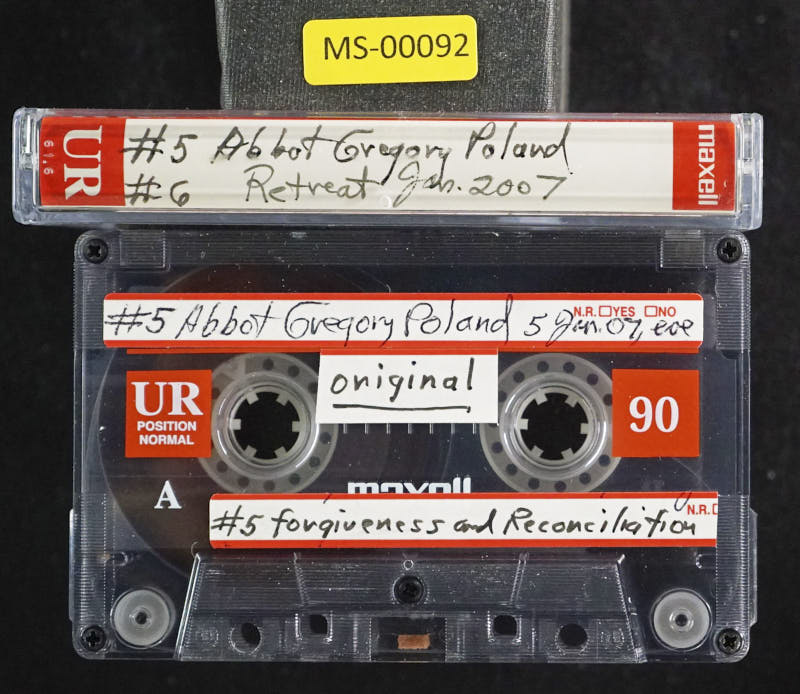
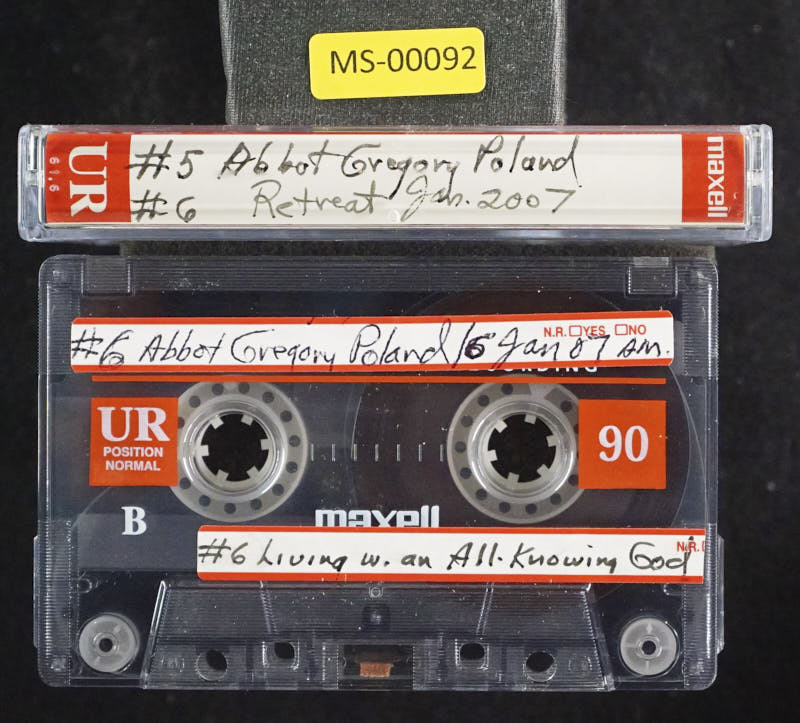
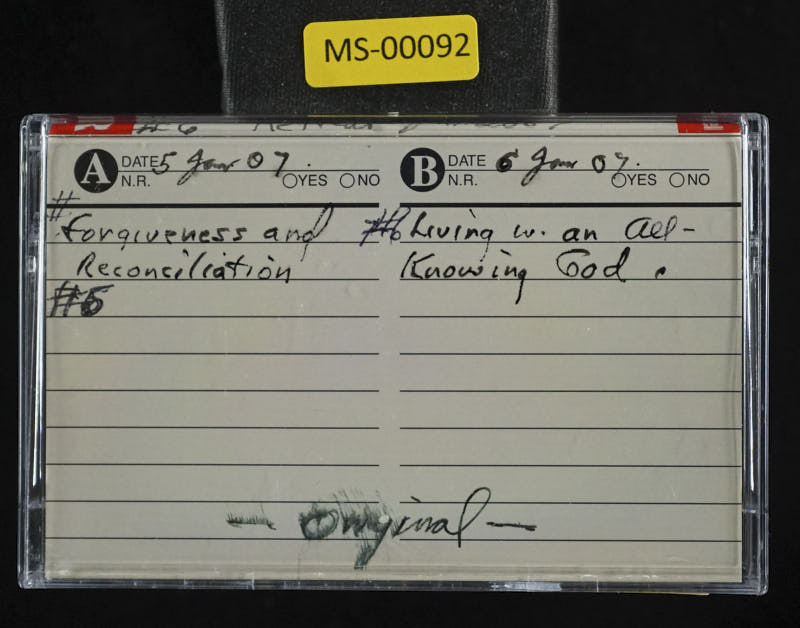
AI Vision - Possible Values from Photos:
Speaker: Abbot Gregory Polan
Possible Title: Forgiveness and Reconciliation
Additional text:
Speaker: Abbot Gregory Polan
Possible Title: Living w. an All-Knowing God
Additional text:
@AI-Vision_v002
Tell me whenever you're ready. Let us pray. Father of compassion, in the fullness of time, you sought to bring the world to reconciliation by the saving death of your son. Help us to know the price of our redemption and to receive it as the free and unmerited gift you offer us. We ask this through the same Christ, our Lord. Because of my years of teaching Scripture, I am not a person who is given to sweeping generalizations, especially when it comes to the text of Scripture. But I have come to discover over the years that there is a foundation which underlies the whole of the New Testament and draws us ever more deeply into the mystery of Christ. It is the meaning of forgiveness and reconciliation.
[01:05]
In passage after passage, the New Testament tells us of God's plan to reconcile the world to himself through Jesus Christ and how then we are to become partners with Christ in reconciling the world to the Father. The message of the gospel is a word of reconciliation offered to us, especially by the living example of Jesus. Every word... Every action of Jesus was focused on bridging that gap between human brokenness and divine wholeness. And it is my firm belief that reconciliation is God's great dream for our world. A place where we find this message in the New Testament capsulized in brief is St. Paul's second letter to the Corinthians, chapters 5 and 6. Listen to this message as St.
[02:06]
Paul brings it all together in a really dynamic fashion. If anyone is in Christ, there is a new creation. Everything old has passed away. Everything has become new. All this is from God who reconciled us to himself through Christ and has given to us the ministry of reconciliation. That is, in Christ, God was reconciling the world to himself, not counting their trespasses against them, and entrusting to us the message of reconciliation. So then, we are ambassadors for Christ, since God is making his appeal through us. We entreat you then on behalf of Christ, be reconciled to God. For our sake he made him to be sin who knew no sin so that in him we might become the very righteousness of God.
[03:17]
These words of St. Paul are addressed to every Christian who has shared in the gift of Christ's redemption. And it is my conviction that in a world so torn apart by violence and war, in Christian churches scandalously divided into denominations at war with one another, in parish communities split into camps of liberal and conservative, all of this calls us all the more forcefully as Christians to be ambassadors, according to Paul's message. And I would say, too, it is one of my deepest hopes as abbot that my community can be a haven of reconciliation and forgiveness, and certainly among the monks themselves, but also among the many guests who come to us from experiences of brokenness and alienation in their lives.
[04:25]
If we Benedictines hold tenaciously to that charism of hospitality, then we must be ambassadors of God's reconciliation. If we understand discipleship as walking in the footsteps of the master, then we accept the call to be agents of divine forgiveness, and that is no small order. The mission is of divine proportions. But what is important is is to realize that God's grace remains the operative vehicle by which we are then fashioned and molded into ambassadors of reconciliation. The work of becoming a reconciler to others does not come of our own doing, but rather it is a journey of the heart. Our desire to live in accord with the gospel of Jesus
[05:27]
becomes then the foundation upon which God alone builds, fashions, and creates us anew. Until I understand with a peaceful heart that my human condition is broken and splintered, I will not be able to direct others to forgiveness and reconciliation. I have to know this. I have to experience this within myself. And here I'm not talking about some kind of unhealthy breast beating which pulls me down and keeps me from realizing my God-given gifts, sinner though I be, but rather in coming to the realization of my own sinfulness, I am overcome with peace and hope at this mercy, this compassion, this unmerited forgiveness that I have been given by God.
[06:28]
And all this needs to flow out of an authentic relationship with God, a relationship which shows me who I am in relationship to God and who God is to me. Now, at first that may sound very singular, very self-centered, but there's a powerful element of truth in this. in this thought. And a place where I found a true sense of this comes in the 4th and 5th century monks of the Egyptian desert. And there is a saying there that may surprise you at first, but I think it has something very important to say to us about this idea of forgiveness and reconciliation. Abba Alonius was known to say, if a person does not say in his heart, in the world there is only God and myself, that person will not gain peace.
[07:36]
I remember reading that and reading that and reading it and thinking how initially self-absorbed that came across. But only with time and reflection did it begin to make more sense to me that if a person does not say in his heart in the world, there is only myself and God, that person will not gain peace. I think what Abba Alonius is talking about here is that our relationship with God is so primary and so fundamental that every other relationship that we have in our life is impacted and affected by that divine human relationship. And if my relationship with God is firmly established and solid, I will then come to know how every other relationship in my life comes to find its rightful place. The peace that comes with claiming our self in God then becomes the foundation of our ability to then carry
[08:48]
God's reconciling love to others and often in the most simple, humble, everyday ways. It is because I know that there is this vast abyss between myself and God that I can be awed at the way that God continues to save me, to reconcile me, to draw me into his love and to bless me abundantly. And in that relationship, then, I come to know the meaning and the heart of forgiveness and reconciliation. Now, I've been using these two words, forgiveness and reconciliation, almost synonymously and certainly rather freely. But there is a difference between the two. And the best way I know how to describe it is this. Forgiveness is a one-way street Reconciliation is a two-way street.
[09:55]
To forgive is to make the conscious choice to release the person who has wounded me from the sentence of my judgment, however justified that judgment may be. It is a choice to leave behind my resentment and desire for retribution, however fair punishment may be. Forgiveness involves excusing a person from the punitive consequences he deserves to suffer for his behavior. The behavior remains condemned, but the offender is released from its effects as far as the forgiver is concerned. For the one who releases, such forgiveness is costly, both emotionally and spiritually. It reflects in a finite way both the manner in which God forgives and the costliness of that infinite gift.
[10:59]
Forgiveness constitutes a decision to call forth and to rebuild that love which is the only authentic ground for any human relationship. And such love forms the sole secure ground of our relationship with God as well. It is only because God continually calls forth and builds this love with us that we in turn then are able to do it with one another. Thus, to forgive is to participate in the mystery of God's love. And maybe that old adage applies here. To err is human, to forgive, divine. In all this, we realize that forgiveness is offered unilaterally and without condition. Forgiveness does more than release me from the corrosive burden of angerness and bitterness.
[12:06]
It also removes hidden or overt effects of resentment in my way of relating to others. But reconciliation is a two-way street. Reconciliation is the promise that lies at the heart of forgiveness. It is the kind of full flowering of the seed of forgiveness even when that seed is hidden from sight. The gift of forgiveness will often feel incomplete if it does not bear fruit in reconciliation. This holds true in God's forgiveness of us as it does also in our forgiveness of one another. Reconciliation means full restoration of a whole relationship, requiring conscious mutuality. No reconciliation can take place unless the offender recognizes the offense, desires to be forgiven, and is willing then to receive forgiveness.
[13:16]
Thus, The role of acknowledgement and confession of wrongdoing belongs to the dynamic of forgiveness in relation to reconciliation, and yet not to forgiveness alone. Each of us must make the move toward reconciliation in our lives when we see it as a necessity, as something important. Authentic reconciliation will come out of a personal relationship with God. It is in this most fundamental relationship with God that we come to know who we are, both as creatures of God and children of God. If we are able to understand how much we are loved by God, that opens ways for us to begin. And I emphasize... to begin comprehending the sinfulness that we bear in our mortal frame.
[14:19]
And yet I believe it must be God himself who reveals to us our sinfulness. When we pray to God that he will reveal to us our sinfulness, we are praying to enter into a mystery. When we stand freely before the goodness of God, our sinfulness is revealed to us as a mystery bigger than ourselves. There are two powerful passages in the scripture which I think give us an illustration of what I'm talking about here. One in the New Testament and one in the Old Testament. And interestingly enough, both of them come within the context of a call to service. In Isaiah chapter 6, where the prophet receives his call. The prophet has an experience of God while he is in the temple. And the text tells us that Isaiah's vision is of the otherness of God.
[15:29]
The text tells us that Isaiah, faced with the presence of God, can only cry out, Woe is me! I am a sinner! I am a man of unclean lips living among a people of unclean lips. How significant it is that the first thing that the prophet does in coming before the holiness of God is to acclaim his sinfulness. Union with God enables people to see themselves in a wholly different perspective. The prophet is dwarfed by the presence of God. But in experiencing that greatness, all he is able to see is his sinfulness. The second passage is found at the beginning of the fifth chapter of St. Luke's Gospel, and it tells the story of Peter's call at the beginning of Jesus' public ministry.
[16:33]
Having sat in the boat and taught the crowd, Jesus then tells Peter to lower his net for a catch after a full day without catching one. Having heard Jesus' word and then seeing and experiencing the great catch of fish, Peter knew that he was in the presence of someone very unlike himself. And so Peter drops to his knees and says, depart from me, I am a sinful man. A remarkable similarity with Isaiah. The realization of God's goodness brings any person to a new awareness of their need for healing, for forgiveness in their lives. And interestingly enough, Peter says to Jesus at first, depart from me.
[17:37]
And at the end of the passage, he leaves everything and follows him. What beautiful irony. We're all familiar with the Greek expression in Mass, Kyrie eleison. And literally the word eleison in Greek means to unbind, to free, to unfetter. And it's opposite. liaison gives us that borrowed French word liaison, which means a close bond or a connection. And so mercy, in its Greek sense, prays that evil bonds and connections will be broken and shattered by God, and that we will, by the Lord, be set free. When we call upon God to have mercy on us, we're asking him to loose the bonds which hold us tight to our sinfulness and to all the consequences of our wrongdoing.
[18:42]
When we see the magnitude of God's gracious response to our desire to be forgiven, should we not do the same to our neighbor, to our family member, to a confrere? In her work entitled The Human Condition, the Jewish philosopher Hannah Arendt writes, Without being forgiven, released from the consequences of what we have done, our capacity to act would, as it were, be confined to that one single deed from which we may never recover. We would remain the victim of its consequences forever, not unlike the sorcerer's apprentice who lacked the magic formula to break the spell. When we discover and even rediscover anew the power of forgiveness in our lives, we hold the potential then of sharing in divine liberation, God's continuing act of freeing his creatures and his children from their own self-created destruction.
[20:00]
Hannah said, what are you to feel like? Let's see. Without being forgiven, released from the consequences of what we have done, our capacity to act would be, as it were, confined to that one single deed from which we could never recover. We would remain the victim of its consequences forever, not unlike the sorcerer's apprentice who lacked the magic formula. to break the spell. There is a mother in a family I know in Ohio who models for me one of the strongest examples I have ever known of someone who has come to understand and to put into practice the gospel teaching of forgiveness and reconciliation. About
[21:07]
Twelve years into their marriage, everything seemed just about as perfect as it could have been for Barbara and Bill. Bill had a good job and was bringing home enough money to allow them to put down a substantial down payment on a new home. They had four healthy children whose positive disposition was obviously the result of a very happy home. One day, Bill never showed up for work, nor came home at day's end. Barbara had been out all day with a number of things to do, and only later that evening did she discover that Bill's dresser drawers were vacant and the clothing was taken from his closet. It was a devastating blow to Barbara. Everything seemed to be going so well. They had everything to live for and to enjoy together.
[22:09]
And not a word seemed to suggest why this had happened or where something had gone wrong. Barbara had to step out into the working world, raise four children, feed and educate them as a single parent, to say nothing of what the abandonment and betrayal by her husband came to mean to her. 27 years later, the doorbell rang, and much to Barbara's surprise, it was Bill. And before Barbara could get out a word or even express her shock, Bill said, I've just returned from seeing three different doctors who have all told me the same thing. You have terminable cancer that has spread to your vital organs, and you have three months to live. I have no money and no savings. and I can only turn and ask you to take me back into your home. Much to the amazement of her friends and the anger of her children, she took Bill into her home, cared for him, and nursed him until he died two months later.
[23:25]
Barbara would tell you that her decision to take Bill back into her home came from the years of seeing How her lack of forgiveness of him had in the end been the most crippling part of his departure. It was worse than all the extra work demanded of her as a single parent. She had been held captive by her anger, resentment, and experience of betrayal. And in struggling with these real emotions, she saw how it was debilitating her both as a person and and as a Christian. In seeing the potential for her destructive behavior within herself, she came to see how any other human being could do something as terrible as Bill had done to her and their children, and as awful as she was doing to herself. When she took him back and gave him a place in her home,
[24:32]
she had not forgotten what he had done to her and their children, but she had forgiven him. She did not accept him back as her husband, but as someone she had once loved and was now in dire need. And she would tell you that in her own mind, she could not have turned Bill away after she had discovered the potential for evil within herself. But in releasing that pent-up anger and giving it no resting place in her life, she was free in a way that she had never been before. But more importantly, Barbara had not only forgiven Bill, but she had become an ambassador of reconciliation. Barbara had not only forgiven Bill, but she stood there on that threshold of reconciliation which was accomplished.
[25:34]
Further, she served as an ambassador of reconciliation in bringing her children to the same threshold which she herself had crossed. When her children could not understand her example and felt compelled to tell her that they thought she was playing the fool, they were forced to then listen to her reply and they came to see what their mother had both suffered and then passed beyond. Barbara had bridged a huge chasm which separated her children not only from their father, but also from God, and possibly from many other people. Their failure to forgive had kept them into entering into one of God's most precious of gifts, forgiveness, and reconciliation. I will conclude as I began from Saint Paul.
[26:40]
If anyone is in Christ, there is a new creation. Everything old has passed away. See, now everything is new. All this is from God. who has reconciled us to himself through Christ and has given us the ministry of reconciliation. That is, in Christ, God was reconciling the world to himself, not counting their trespasses against them and entrusting the message of reconciliation to us. So then, we are ambassadors for Christ. since God is making his appeal through us. We entreat you then on behalf of Christ, be reconciled to God. For our sake, he made him to be sin, who knew no sin, so that in him we might become the very righteousness of God.
[27:48]
2 Corinthians 5. 17 to 21. My sister is kind of a similar thing. Her husband didn't walk off the fever, but he really had a lot of problems with and then finally ended up living with somebody else. Anyway, he started dying of cancer. And I was very proud of my nephews, Ken, my sister, that they went and saw him and helped her.
[28:50]
But she insisted on doing this too, that this woman that he was living with, But I'd correct my sister. Yeah. Yeah, that's a powerful, powerful thing. They did not hate their father. They did every reason. This hadn't come with age, this little stuff. Yes. Because there's many of you, that wasn't very vulnerable. Corrosive anger, huh? And hurt and betrayal. The goal seems impossible, but in this phrasing of it, that's what the goal is.
[30:01]
It is. How would you describe the Christian freedom compared to the freedom of an American? Christian freedom, huh? Well, I would say that it's a freedom to be able to live by our deepest values, And in the midst of that, to know deep peace within ourselves. In one sense, we don't have to, there doesn't have to be some kind of a dichotomy between Christian freedom and our freedom as citizens or the like. But there is that element of
[31:09]
being able to live freely under the will of God as we know it, for ourselves, and to be at peace and to be able to follow that from our deepest convictions and values. Well, freedom from any kind of pressures that would want us to act or to be in a different way. People have freedom, they call freedom to go the easy way. And, well, I always tell the Christian, freedom is not easy, but it's very peaceful.
[32:11]
At the end of the journey or in the journey, in spite of the conflicts and the conflict. And I always felt that American freedom is really, it is not freedom. Because most people, they think that if they can do what they want, when they want, that they're not happy with all that. Yes. And I remember hearing or reading the daughter of Freud. She was in England. And with all these people at this, freedom to do sects, all the sects, and they are free to do what they want and all that. And she went into psychology also herself, and she discovered, she said, they were the slave. So slave, because they were just giving in to the instinct, their animal instinct.
[33:18]
And they were not free at all. They were calling that freedom. woke up. That's the big difference that we talk about. Never enough, he does it. I think this one likes to do it. Earlier you said, you said freedom, forgiveness, forgiving. This cost people emotionally spiritually sure if we see forgiveness as a one-way street and if you and I have a conflict and I choose to forgive you and you don't see any reason for you to have to forgive me emotionally and spiritually that's costly
[34:23]
Because what it means is that I have made the step to release you, but you've not done it with me. That's costly emotionally and spiritually. It would be reconciliation. But there I was speaking about forgiveness. Well, I would say that emotionally, you know, we can feel. We can feel it. Spiritually, I think that we can know that we have made this choice to act like Christ or to do something according to what the scriptures teach us. But it's still tough. Yes. Sure.
[35:27]
If I just have forgiven somebody, but I don't feel any different about the person. I wonder whether I... Yeah. And that's what I was saying. One of the monks asked this morning when we were talking about that very thing. And I think we have to realize that forgiveness is a journey of the heart. And... You may want to be able to forgive someone, but it doesn't just happen with the snap of the fingers. And a lot of times you can say, I've forgiven, I've forgiven, but it hasn't sunk from the head down to the heart, where the release of corrosive reactions are still there. And you can only release yourself to have the feelings, good feelings, if provided you were able to do that.
[37:35]
You just, you go with, well, what I feel good, that's fair to mean that you release yourself. You let go so that God can enter into I was reminded of something that happened. I had to make a decision, but God said, go back. I went back and decided it was a wrong decision. And I felt good about it after I went back. I actually went back and sat there and said, all right, I'll wait for you to tell me. At a certain point, I be just thinking that unless you do that, it can be hit or miss. You know, whether you forgive or whether you, you know, I can forgive you, but I'm always, if I forgive, I will.
[38:45]
Like you said, there are two examples. You know, a person all of a sudden realizes I'm naked, right? I'm sinful. Forgiveness. That seems to me that it's a real forgiveness. I don't want to say forgiveness, but somehow it's something about being naked before God. It's a real release. I don't know what it is. Release. I don't know if you look at what it probably is that between forgiving the person and forgiving the cause. Are you supposed to forgive? Let's say this woman, she's supposed to forgive what this person did, forgiving him, taking him back and all that, but what he did.
[39:46]
Yeah. Is that... no it's not saying because I don't think my sense in knowing this woman I know this woman that was not the sense she had not forgotten what he had done but she had forgiven him what he did she released him from the awful thing that he had done to her and to their children. Exactly. Exactly. Yeah, that's why it's not always a toy street. I mean, these people that forgive murderers of their families. Yes. Sometimes the guy will sit down and pawn them. Yes. But it gives them. So sometimes it is a one-way street just to get rid of the pain you've had.
[40:52]
sometimes leads to a two-way street of reconciliation, which is a win-win. But just to forgive is a win within yourself. Because if not, it's just bent up anger and wasted energy, and it's going to fester and create a bunch of oxygen. Oh, yeah. For example, to forgive would be The evil or the hurt has already finished. It's already done. But let's say if this person continues hurting, how do you do that? Because you would like the hurt not to continue doing something that's very wrong. I think that's very difficult. It is difficult. But I think unless you work toward forgiveness, it's going to continue to eat you up.
[41:59]
But how would I forgive in that case? What do I do? Or how could the forgiveness take in place? Does this person continue to take the criminal? Yes. Yes. Or abuse it, I think. Yes. All that you can really do, you don't have any control of what he does to that person or that person. All you have is control over what he has done to you. And you have your choice as to whether you are going to forgive or not. You can't control that. All you can control is what your choice is about the way you have been treated. that life is more complicated in the sense that these people that are involved outside in the sense that they're not involved with you, I don't know how to put it, you know, he's hurting these other people in the sense that they are, have a duty to save the travesa, to repair the, I don't know.
[43:16]
How do we cope with evil? If this person keeps abusing something that's evil... We're talking about two different things then. Coping with evil is different from forgiving. Those are two different things. How do you know that you have forgiveness? How is it expressed? How is it expressed? This person is hurting me. How do I know that I have forgiven him? I shake his hand or whatever. Or just mentally I say I have forgiven, but still it's very confused with me. Sure, sure. Well, I think it's something that you do with the grace of God. So, for example, if you come before God and say, God, I want to forgive this person for what he has done to me.
[44:22]
And you continue to pray for that grace of forgiveness within yourself. And then you come to know it over time. But it doesn't happen like that. It really doesn't. At least that's my experience. Sometimes it seems too that people aren't aware of it. And part of the courage is to in some way, but doesn't make it worse, but get across to them that what they're doing is harmful and just, or whatever it would be. But to bring it to their attention, may be necessary to realize what they do. And that could be a worse understanding for it. There's a lady who comes here from class almost every day and she can't stand priests because she kind of, she heard that priests abuse children and she's very concerned about the safety of children.
[45:46]
Therefore she tends to label most priests as abuser, and it's impossible to convince her otherwise that she goes after other people so she thinks that they are abuser, a doctor, for instance. And then some people said we should tell her not to come to you anymore because she goes and faces right And you better watch out, because I knew about giving you zip that you can't do it that others like you haven't done. And of course it is. And even one was afraid to come, a priest was afraid to come back, unless we did something with this lady, but we haven't done anything. But she's still around. Is she mentally disturbed?
[46:47]
Yeah. You know, that's a problem. That's a problem that we have. Is she a rather heavyset woman who sits there and never opens her mouth during Mass? I thought there was something wrong. Yeah. She's a nice person. She just needs to stay on medication. I mean, I have schizophrenia, so I can understand. But, I mean, you need to get people's faces threatened. I mean, if she was saying her medication, I think things would be a lot easier for her to treat people around her. Obviously, she's been walking here for many, many, many years, so she wasn't always this wild. We'll pray for her. I have another .
[47:50]
And now the situation, as you know, is coming to a very strange... There are many people who... And of course, the clergy or the bishops in Cuba ask for reconciliation and forgiveness. How can that happen? I really don't know. I mean, what do you do or how is it shown? reconciliation and forgiveness. I've been praying to him and he's getting better. Keep praying. Well, you know what I think is important in a situation like that is
[48:53]
We cannot, say for example, as a church, impose a way of reconciliation. But I think that the leadership, the Catholic leadership, needs to bring people together to say, how do we free ourselves from angerness and bitterness? How do we come to forgiveness? How do we come to forgiveness? But there is a big problem. It's going to be in this problem. That's the problem. I can't believe it. [...] Yes. Do you know anything about the husband's reaction to being forgiven?
[50:02]
Yes. Well, yeah, it was... Yes. Yeah. And as I said, you know, the thing was, too, that she really stood as a bridge to bringing her children to this reconciliation. Obviously when he came to the door, he was asking for forgiveness. And it was achieved. But he didn't even live that long for what you might say the effects of that to really just kind of enjoy it. They told him you have three months to live and he lived just a little under two months. We're not going to have any water chaste into wine, but we might have a cookie or something.
[51:10]
Okay. Good. Thank you very much, by the way. Good. I appreciate it. Let us pray. From Psalm 139. It was you, O God, who formed my inner being, knit me together in my mother's womb. I thank you who wonderfully made me. How wonderful your works which I have known. Almighty and eternal creator, you fashioned and made us. Help us to know and to see your ongoing work of creation in us. Make us supple and ready in your loving hands, eager to follow your holy bidding.
[52:14]
We ask this through Christ our Lord. Amen. Over the years, in my work in our seminary, I have taught a course on the Psalms numerous times. And one of the questions I always ask the seminarians at the beginning and at the end of the semester is, what are your favorite Psalms? So very, very often, either at the beginning or at the end, they comment that Psalm 139 is a favorite of theirs. For them, it contains something important about the living of life within a great mystery. The psalm begins with an address to God, O Lord, you search me and you know me. You know my resting and my rising. You discern my thoughts from afar. You mark when I walk or lie down. You are acquainted with all my ways.
[53:17]
Before ever a word is on my tongue, you know it, O Lord, through and through. As we read through the Psalms, there are examples of where one ardently seeks the divine presence while another tries to flee from the divine presence. Some of the Psalms are starved for a sense of the divine presence, while others are in dread of divine nearness. Some beg of God a respite from the pursuit of them, and yet what is later explained in the same Psalm is the desire for communion with God. Oh, where can I go from your spirit? Where can I flee from your face? O search me, God, and know my heart. O test me and know my thoughts. There lies a tension in these words that echoes the abiding strain in the human heart of praising God for the divine presence which touches our life and at the same time lives in dread of it.
[54:32]
In Hebrew poetry, it's often a worthwhile thing. to read the opening verses of a psalm and then to read the closing verses of the psalm. There's often a real connection that the Hebrew poet brings between the very beginning and the very end. Often a repeated word or sometimes even an opposing thought to show how the psalmist has journeyed through this spiritual experience and where it has brought him. Notice, for example, in this Psalm 139, it begins, O Lord, you search me and you know me. And it concludes with a plea using those same words, O search me, God, and know my heart. Test me and know my thoughts. In those words, there is both a fear of God's love and compassion and the request for more of it. And isn't that reaction?
[55:35]
in our lives so often true. When we ask the question, why is it so, does this psalm open to us the mystery of that divine-human relationship, and if so, how? I would like to think that there is planted in the human heart an almost unconscious knowledge that there is something in each of us that is infinite. And yet at the same time, we live in a finite world, a world that will offer us many wonderful things, but in the end will never truly or fully satisfy us. We long for a sense of satisfaction in our work, in our relationships, in our prayer, in our community life. in our dreams and our hopes, and yet we have to live with the knowledge and the inner sense that no matter how hard we try, it will never fully satisfy us.
[56:44]
Life on earth is destined for something else, and until we come to that experience, we will long for more. In his book, Against an Infinite Horizon, Ronald Rollheiser begins by quoting Karl Rahner with the words akin to what we have just been reflecting on, and Rahner writes, In the torment of the insufficiency of everything that is attainable to us, we come to understand that here, in this life, all symphonies remain unfinished. What I think he is approaching here is that With the infinite that resides within us, life will always fall short of what our heart was created to desire. Our happiest and our healthiest relationships will never fully satisfy us.
[57:47]
Our dreamed-for work will have its boring and tedious times. Our hoped-for sabbatical will end with projects unfinished. Our greatest expectations will never really fully measure up to our hopes. And so through life, we continue to wait for something more, something better, something other than what is presently taking place. Even things of beauty fail to give us the peace and contentment that should stay with us after the experience of them. And somehow we know and believe that God is to be found in the midst of all of this. The psalmist says, oh, where can I go from your spirit? Where can I flee from your face? If I climb the heavens, you are there. If I make a bed in shale, you are there. These are the questions which the psalmist asked.
[58:52]
What are the questions we, in our own day and age, ask of God? of ourselves, of those with whom we share our treasured thoughts. I would like to compare it to a current of electricity that runs through the walls of our monasteries, our workplaces. The current is there, and it fulfills its function, and it's powerful, but only every once in a while does it shock us, often unexpectedly. into realizing that it's there. In the human heart, this current is characterized by an ambiguity, a quietly gnawing uncertainty. It is a doubt, an uncertainty, or an insecurity about all kinds of things in life, who we are, what we should do, where we should be, what people should think of us, what we think of them,
[59:57]
how I should respond to this situation or that situation. But behind all that lies our uncertainty about God. It poses questions like, if God exists, why does he permit evil in our world? Where is divine help when I am down and out and need it most? In short, can I really count on this God who at one and the same time is both the creator of the universe and a father who cares for me more than any human father could. The Church, in her wisdom, incorporated texts like these into the liturgy from the Old Testament, like Psalm 139, to demonstrate for us the meandering current that runs through the human heart as part of the reality of our lived experience.
[61:00]
And though at times this can feel to us like a painful burden to struggle with so many questions, especially in our lives as monks, these very questions become for us the way of encountering God, knowing God, reflecting deeply on the actions of God in our life. How often have we heard in the fathers of the church, what was not assumed by Jesus Christ was not redeemed. Jesus bore our temptations, and we heard it vividly expressed in St. Matthew's account of the Passion, where he cries out from the cross, My God, my God, why have you forsaken me? This is also something to see reflected in the lives of the saints of the church. No matter how high her members have reached, there still remains in some degree or another a current of, what does this all mean?
[62:06]
What is God saying in this? God, are you there? The prophet Jeremiah spoke of this in regard to God when he says to the Lord truly, You are to me like a treacherous brook, like waters that fail. While that may at first sound blasphemous to us, it is a true response of faith in the midst of uncertainty, fear, and doubt. Those who formed the canon of scriptures gave us Jeremiah as a model for us to keep searching and to never lose heart. In verses 13 and 14 of Psalm 139, the text reads, It was you who formed my inner being, knit me together in my mother's womb. I thank you who wonderfully made me. How wonderful your works, which I have known.
[63:08]
What has happened here? The psalmist has passed through the groaning, the sighing that comes in human life, and importantly, he has passed beyond it. And it has led him to a new understanding of what only God can give us. Wisdom. God does not ask us to pretend that problems do not exist. But he asks us two things. First, that we might be willing to trust him in our pilgrimage through life. And second, that we might fix our eyes on the one who has passed through it all. even entering the portals of death and been victorious in it. God asks us to follow the one he sent to lead us through it. We might approach it from another angle and say that Christ comes into our lives and asks each of us this question.
[64:10]
Will you allow my Father to draw you through your maze, your turmoil, which at times... you find to be in your life. Though we hear the words of Jesus in the sixth chapter of John's Gospel as related to the Eucharist, there is another level of hearing which takes on another step deeper into the divine human relationship when Jesus says, it is the spirit that gives life while the flesh is of no avail. The words that I have spoken to you are spirit and life. but there are some of you who do not believe. Jesus was asking his disciples if they accepted him as the spokesman for their lives. And that is a real question for us even today. For us Benedictines, it is the call to listen deeply. And sometimes that will mean waiting and waiting for God's response.
[65:15]
But remember, waiting upon God's voice as difficult and as unsettling as it can be at times, is a sacred place to find ourselves. The psalm closes, O search me God and know my heart, O test me and know my thoughts. Those words are a powerful cry to God in their Hebraic sense. In Hebrew, to know is to experience in our human frame. in our mortal body, our fragile self. And as the psalmist began with the statement, O Lord, you search me and you know me, he now takes those same words to search and to know, and he beseeches God to continue doing in him what will affect the kind of change that will lead into the ways of God, into those pathways where God teaches us.
[66:18]
divine instruction. There's also the image of the heart, which in Hebrew brings together both the mind and the heart, the will, the thought process, and the seat of our emotions and passions. Reflection on this thought leads us to see where this same idea strikes a rich chord in the New Testament. Blessed are the pure of heart, for they shall see God. And isn't that what Psalm 139 seems to lament? A God who remains present but unseen, all-knowing yet mysterious, active in our lives but oh so obscure in the doing. The promise of Jesus in this beatitude almost seems like a response to the prayer of Psalm 139 in that we might see God.
[67:19]
In this beatitude, Jesus suggests that the heart that truly listens shall hear God's voice, not simply in the quiet of reflection, prayer, or worship, but in every hour and in every place of life. But this beatitude that is so deep and so wide is not vague and misty, which our struggles so often resemble. We know that there is a search going on within us, and yet we are not fully certain of its aim or its goal. But this beatitude draws to our lives with a message that we can at least begin to understand. It tells us, first of all, there is a vision of God for us human beings. And what this vision may mean as a promise to be fulfilled hereafter, we do not know for certain.
[68:22]
We can only believe that it concerns a glory that our description can only make indistinctly and a greatness that our imagination in the end will only belittle. It is not ours to say what life will be in God's tomorrow when the soul will no longer be confused and thwarted by our human senses, and when our spiritual eyes shall look upon the unveiled face of truth and love, who is God. And somehow from afar, the psalmist wrote this, knew this when he wrote, lead me in the way of life everlasting. Like the psalmist, we naturally look ahead to the future and we ponder it seriously. Yet when we come upon the words of Jesus in this beatitude with its vision of God, we see that our first concern should be the life that we are living now, at this moment.
[69:27]
We are in the world to see God. This is the final spiritual purpose of life. And all too easily can this aim be forgotten or frustrated. But to search for to find and to see God in this, our world, is life's highest possibility and truest destiny, and it is always with us. It follows the sinner in his wanderings, the fool in her folly, and the strong in their willfulness. It is all-inclusive. It waits for us in the quiet places of thought and in the clamor of the world's Whether one be a monk, a priest, a parent, a housekeeper, or a banker, the vision of God is close at hand, for he has planted in the heart of each of us that desire.
[70:30]
It is before us in the beauty of dawn and in the quiet of evening twilight, in youth and in mature age, in gladness and in grieving. The vision waits there for us to catch a glimpse, to take it in, and then to ponder it deeply, to find God there. The probing question remains, how can we behold this vision? How do we catch a glimpse of it and then keep it alive within ourselves? The psalmist would say that only divine instruction can reveal to us that tremendous mystery. Oh, search me, God, and know my heart. Test me and know my thoughts. See that my path is not wicked and lead me in the way everlasting. God is the one who reveals to us, and so often in the unsuspecting moments, sometimes in the most difficult of situations, where he is to be seen and found in life's journey.
[71:42]
in that sixth beatitude would tell us that the conditions for seeing and finding God are moral imperatives. We must have purity of heart, for it is the heart that truly sees. True vision comes through that place where more than mere thoughts and ideas reign, namely the mind. Rather, true vision is seen when the mind and the heart come together. The elements of light and darkness in life are accounted for by the cleanness or the uncleanness of our heart. Vision is determined by the way character is lived out, made present in our day-to-day run of things. And in this model, wisdom does not begin with intellectual conception. but with moral principles that flow from the Gospels and from the Scriptures.
[72:43]
God is not far from any of us, and it needs but the cleansing of the inward life, the self, from selfishness and a concern for the things of earth. Good though they be, they cannot be our primary concern if we wish to see and to find God. if they take that primary place away from what is divine, we run the risk, we risk the fate of Jacob whose words still speak loudly to us today. God was in this place and I didn't know it. Our great consolation is that we live with something of the infinite in us while still living fully in a finite world. Because of the infinite in us, we feel the ache, we experience the tug, and we remain confounded by the uncertainties of life.
[73:49]
But our belief strengthens us to know beyond a doubt that amid the familiar and repeated tasks, amid all the gazing and the giving, all the doing and the bearing, God is hidden within those things, and it takes only eyes of faith to see the eternal in the finite. And remember, Jesus came among us for that sole purpose of enabling us to see, to discover, to touch, and to hold, even if only briefly here, with that inner vision that keeps us looking and listening for the God who both surrounds us and dwells already within us. Infinite touching finite, finite possessing something of the infinite. It keeps us longing for God in whose image we were first fashioned.
[74:53]
infinite touching finite finite possessing something of the infinite keeps us longing for god it keeps us longing for god in whose image we were first fashioned I would say some of the psalms for some of our brothers, and I was amazed at the vespers.
[76:10]
I mean, the psalms they told me are so confident, and they're so strong and alarming. The Roman offices, what type of, doesn't have that kind of open and . Six minutes. Yeah. But they really are beautiful collections. You mean in the Tessaurus? You mean the Psalms that we have in the Tessaurus? Or in the Roman? Yeah. Well, they are all brief. But they're amazing. Really, I mean, there's a strip that they selected, but I sit lots of investors, but when the book opens now, that's what everybody said. It really is amazing how confident that they are. And you're not kind of wishy, wishful thinking about it, but I read very well.
[77:18]
Oh, confidence in God. I've been asked, this is the importance of recreation somewhere appropriate. Through the fact that I got asked to heal a few of somebody who's going to die, and also a couple of times I've been asked by people, how do you know there's anything on the other side? And he thought to me one day, I said to one person, you know, I wish you were the person who believed me, but anyway, I don't know if the person was out. And that is when you tell a story, tell the story of the person, you can't tell the story. You can only tell a story that says something about the person. And it suggests to me, right there, that there's the infinite in the person. That even the person couldn't tell as long as the story could try. And when you said that, that the infinite is in all of us.
[78:21]
even though we live in this finite world. That's what it comes across to me as. I haven't thought of it like what he said before somebody was. They're saying the Messiah is all of this, you know, can we recognize it? We feel for that. We bring that up.
[78:48]
@Transcribed_UNK
@Text_v005
@Score_88.11