You are currently logged-out. You can log-in or create an account to save favorites and more. more info
Awakening Through Humility and Vigilance
AI Suggested Keywords:
This talk explores themes related to Christian life, vigilance, and the impact of sin, particularly greed and envy, illustrated through anecdotes and parables, including references to works by Dostoevsky. The discussion also touches upon the challenges of communal living, the balance between personal responsibility and obedience in monastic life, and the broader economic implications of community dependency and self-sufficiency.
Referenced Works and Authors:
- "The Brothers Karamazov" by Fyodor Dostoevsky: Referenced for its story of the woman and the onion, which serves as a commentary on greed and the communal impacts of personal sin.
- Saint Benedict's Rule: Discussed regarding its views on possessions, obedience, and humility, highlighting its guidance on community life and personal spirituality within monastic settings.
Concepts and Themes:
- Greed and Envy: Examined as destructive sins affecting both individuals and communities, with real-world implications for monastic and lay life.
- Monastic Life and Economy: The tension between self-sufficiency and dependency on external benefactors is analyzed, particularly in the context of supporting monastic communities.
- Christian Vigilance and Humility: The importance of being spiritually awake and responsive to God’s workings, alongside an emphasis on the virtues of humility and responsibility.
Cultural and Economic Considerations:
- Land Ownership and Resource Management: Alaska's approach to communal resource ownership is discussed as a model of economic sharing and potential societal implications.
AI Suggested Title: Vigilance, Greed, and Communal Grace
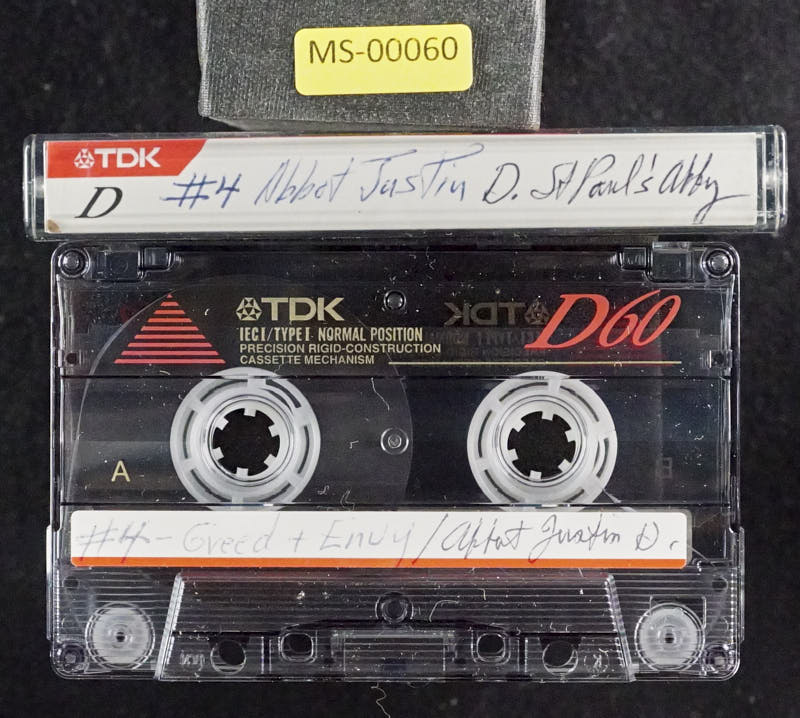
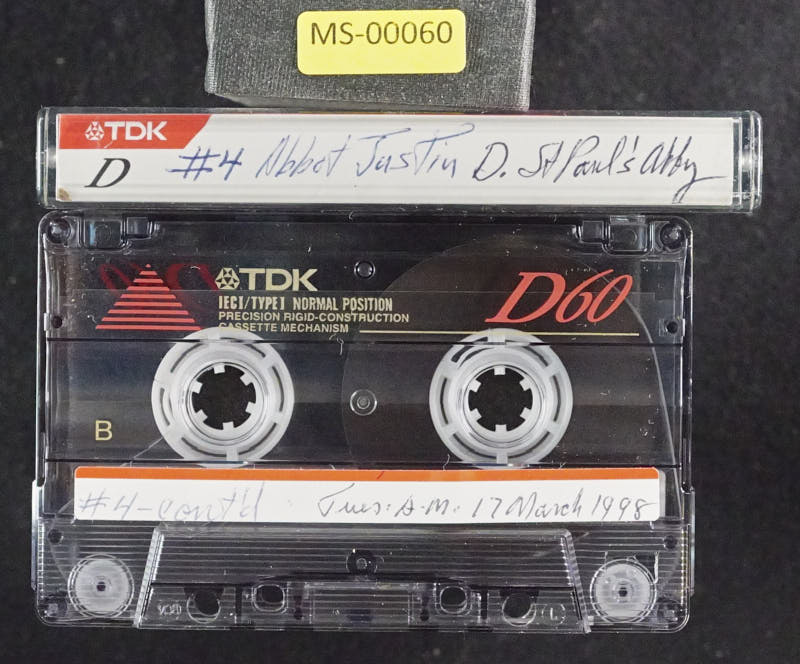

Side: A
Speaker: Abbot Justin Dzikowitz, OSB
Location: St Pauls Atty
Possible Title: Greed & Envy
Additional text: awakening, avarice, mercy, who owns the earth?, envy
Side: B
Speaker: Abbot Justin Dzikowitz, OSB
Location: St Pauls Atty
Possible Title: Control
Additional text: greed, inertia, spontaneity, responsibility, journal
@AI-Vision_v003
And the jade plant, this rubber thing in the library building is spectacular. There's nothing, I've never seen anything like that. The only time I saw one like that was in San Francisco growing in the street, you know, next to someone's house. It's a remarkable, remarkable tree. Just, oh, geez, it's beautiful. Oh, it's spectacular. There's thousands of babies I know sent out around the country. Amazing. Amazing. Beautiful. The ones they had at the show were not anywhere near. How spectacular was that? I enjoyed the word that Horace used in his list of... We heard it last night in the reading in English. inordinate love of wine. Well, in Latin it comes across very, it's delightful, it's called venosus. The names of the sins in Latin and some of the Latin lists are entertaining.
[01:06]
Superbia, luxuria, venosus, delightful. And yet, they have a, they're like a snake, maybe nice to see at a distance. I enjoyed the story this morning of Calvin Coolidge being robbed in the hotel with all the protection of the Secret Service. That tells you a lot about government. An intruder. Two months ago in the rectory of the Dominicans in Anchorage, I woke up at 4.30 in the morning and I heard someone walking around the house. It was on January 25th. A reason I can remember that, it was my birthday. And I said, hmm, someone's walking around upstairs. And I thought it was the pastor who couldn't sleep. He had just come back from a trip to Kenya where he's been invited to work with the Dominicans as they reestablished their presence in East Africa and Kenya and Tanzania. And I said, well, he probably can't sleep.
[02:09]
But then the footsteps persisted, and about 4.30 I got up, and I said, well, I'm going to go see what's going on. And I find a stranger in the house, a young man, about 20 years old, in the room next to me. I live in the lower level, in the basement. And he was in the room next to me, so I said, well, who are you? And he says, well, I'm Rob. Oh, and I said, well, where are you from? He says, well, I'm from here. Okay, I said, maybe we have a guest in the house that nobody told me about. I mean, that can happen in a religious community. So he says, I'm going for coffee. He goes upstairs, and I said, I'm going to check out this room he just came out of and see if he's really staying in there. And so I looked around the room, and it was obvious that it wasn't occupied. The bed was not disturbed. And I had seen him going through the closet in the room. So I looked in there, and nothing was out of place. And I said, well, my goodness, look at that. There's no sense in me waking up the whole house. So I go upstairs.
[03:10]
I said, I'm going to check upstairs. No sign of him. I check all the rooms on the first floor. I check both the entrance and the exit, and they're locked. And I said, well, this guy's probably gone on his way. Well, about 20 minutes later, the pastor has a little dog, a Westie. It's a West Highland Terrier, about 30 pounds. And this dog is going crazy. He's upstairs on the second floor. And he's got this poor guy cornered in a closet. The guy is holding the door. And this little dog about this big is going crazy, barking and yapping and... The next thing I see is the pastor is ushering out this young man out of the rectory. Sad case, but certainly a frightening experience to be awakened at night. It certainly gives meaning to the thief breaking in. And it does. It catches us. An experience like that takes us out of the time that we're in and kind of wakens us to other realities.
[04:19]
It really does. You really come out of your sense of sleep. Our next project was finding out how this guy got in the place. So we were walking around, checking the doors and windows, and one of the people, now everybody was up in the house. We had a visiting Dominican, so there was a whole group of us trying to figure out how did someone get in here. And one of them didn't have shoes on, and he felt the rug was cold and wet because of... of course, the amount of snow we have, you're always bringing snow inside, and by the front door. So he said, well, he came in this door. Now, how did he get in? He had got his hand through the mail slot in the door and was able to turn the doorknob. Now, we all tried it and couldn't do it, but this young man evidently was able to do it. But he was one of the lost people, fortunately, just one of the lost people, not being violent, probably a young drug abuser looking for some kind of way to... Of course, he said he didn't have a home, but he was dressed too well, so we didn't get much of his story, but sent him on his way.
[05:23]
But it does awaken one to a different reality, especially in the middle of the night, because all kinds of things cross one's mind about what's going on. I guess the worst experience I had like that of being wakened to another reality was once visiting the Salesians in Tanzania. I was on my way from Dar es Salaam to Paramio, the big monastery in the Songia area of Tanzania. And we stayed overnight in the Salesian seminary. And... I knew the director there. He was from Newton. He had been part of the Salesian community that was at Newton years ago. So it was very nice to see him. And they had a new minor seminary that was flourishing. And we were able to stay in the guest quarters of this new building. Well, in the middle of the night, I wake up. There's something in the bed. And it's not me. And I said, uh-oh, don't move.
[06:28]
And my first thought was, I've got a snake. And so I reached over and got my little flashlight. Never travel without a little flashlight, because the power goes off. The generator stops about 10 o'clock, and there's no power. So I take the flashlight, and I begin very gently looking. And I see the largest rat I had ever seen in my life. It was about this big, like a cat. And I had felt it. It had run down me. And I said, hmm. And there it was on the floor. I said, oh, this will not do. So I moved and ran into the bathroom and I closed the door. And I said, well, that's fine, but what do I do in the morning now when I get up? So I said, well, I leave the door open and I'm holding the flashlight like this because I know they bolt if they're cornered. And here he is behind the toilet looking at me and he bolts. He flies through the air and reaches the outside door of the room runs around the door and goes underneath and leaves.
[07:31]
And I went, oh, thank God. I barricaded the door, and then I go back to bed, and what do I hear in the ceiling? There must have been hundreds or thousands of them in the ceiling. So I politely lit the candle, as St. Benedict advises us to have a light lit in the room, and went back to sleep, sort of. Next morning I wake up... And I asked, I was with Fr. Damien, we were traveling together, and I asked him, he asked me how I slept. I said, I didn't sleep very well, I had a rat in my bed. He said, well, what did you do with it? I said, I chased it out. He said, fine, chased it down to me. Well, that's certainly an experience of being awakened to a new reality. There's something like that that we are called to in Christian life to be awake, to be alert, to be vigilant. Now this, of course, is a graphic homie example, but on the spiritual level, we are invited to be awake as to what's going on. Now, the slumber or the sluggishness or the fog is sin.
[08:39]
And perhaps it is capital sin that keeps us in the fog. The sources of sin in our life are like the fog that prevents us from being alert, aware, and awake as to what's going on. A couple of other stories. Here's a nice story worth our reflection. Once upon a time, there was a king who ruled a small kingdom. It wasn't great, and it wasn't really known for anything, for any of its resources or its peoples. But the king did have a diamond, a great, perfect diamond that had been in his family for generations. He kept it on display for everybody to see and appreciate. People came from all over the country to admire the diamond and to gaze at it. Soon word of it spread to the neighboring countries and people came to look at it. Soon people felt that the diamond was theirs.
[09:41]
Somehow it gave them a sense of pride and dignity and worth. Then one day a soldier came to the king... with the news that although no one had touched the diamond, for it was guarded night and day, the diamond was cracked. The king ran to see, and sure enough there was a crack right through the middle of the diamond. Immediately he summoned all the jewelers of the land and had them all look at the diamond. One after another they examined the diamond and gave the bad news to the king. The diamond was useless. It was irredeemably flawed. The king was crushed. So were the people. Somehow they felt they had lost everything. Then, out of nowhere, came an old man who claimed to be a jeweler. He asked to see the diamond. After examining it, he looked up and confidently told the king, I can fix it.
[10:50]
I can make it better than it was before. The king was shocked and a bit leery. The old man said, give me the jewel and in a week I'll bring it back fixed. Now the king was not about to leave the stone out of his sight, even if it was ruined. So he gave the old man a room and all the tools and food and drink he needed and he waited. The whole kingdom waited. It was a long week. At the end of the week, the old man appeared with the stone in his hand and gave it to the king. The king couldn't believe his eyes. It was magnificent. The old man had fixed it and had used the crack that ran through the middle of the stone as a stem and carved an intricate, full-blown rose, leaves, and thorns into the diamond. It was exquisite. The king was overjoyed and offered the old man half his kingdom.
[11:54]
He had taken something beautiful and perfect and improved upon it. But the old man refused in front of everyone, saying, I didn't do that at all. What I did was to take something flawed and cracked at its heart and turn it into something beautiful. Well, there's the process of what God can do with us in the face of our sin, our weakness, and our troubles. And I think that little parable is a helpful thing for us to keep in mind, that God is at work, grace is at work in our hearts and in our lives. I'm going to tell this next short story two times, one at the beginning and one at the end. Today we're going to look at greed and envy this morning, and this story perhaps will be helpful for us in understanding how these things work.
[12:59]
It's the story from Dostoevsky, from the brothers Karamazov, the tale of the woman who did nothing good in her entire life, and at the end of it was thrown into the lake of fire to burn for all eternity. her guardian angel pleaded her case before the throne of the Almighty and remembered that once this old woman had given an onion to a beggar. God told the angel, go and get that onion and pull her out of the lake of fire with it. The angel did as directed and the woman was being pulled up by the onion. The other residents of the fiery lake, observing what was happening, grabbed hold of her feet, and soon a string of souls was on the way to salvation.
[14:02]
At that point, the old woman, looking down and seeing what was happening, began to kick and shout. She said, let go, it's my onion. And at that very instant, the onion broke, and she returned to the fire. Well... The next age, play age, children are in the... socializing with other children and it's the time of learning initiative play age and we all have this is perhaps where we have easily memories of of the time in our own development when we are beginning to get along with other people play age and the conflict that happens here is initiative initiative versus guilt
[15:15]
And initiative is the ability to begin to do things on one's own. Initiative. And the failure or the checking of initiative leads to a sense of guilt. Boundaries and limitations become important for the child at this age and development. And the child is told not to cross the street, not to go to some neighborhoods and and to be among their friends. And a thing that often happens and is very easily observable is when they have toys and the child says, give me that, it's mine. And the whole notion of possession begins to happen at this age. And that's a very striking thing, watching young children with their toys, give me that, it's mine. And we see that as a... a real aspect of the dynamics at work at that age of life.
[16:19]
Guilt arises in this. Children are told... Guilt arises in the transgression of limitations, the transgression of boundaries that are established for the child. And it is the beginning of the development of conscience that occurs. And perhaps... genuine morality has its start in the play age. Greed, the sin that we can look at that has perhaps its origin in this dynamic, is the insatiable desire to possess or acquire something in an amount far greater than we need. So greed has perhaps its source in this dynamic of our of our unfolding personalities. Avarice is a form of greed which stresses money or riches or implies miserliness.
[17:22]
Other words for greed are acquisitiveness, an excessive effort in acquiring or accumulating wealth or material possessions, or covetousness which implies greed for something that another rightfully possesses. What makes greed a deadly sin? Well, it distracts us from what is important in life. We read in the epistles that it is the love of money that is the root of all evil. We also read in the gospel the parable of the rich fool storing up in his barns and what good does it do because his soul is required that very night. Looking for the personal disposition that gives rise to greed we can discover a wider, unseemingly unlimited radius of goals. Disregard for rights comes out of greed.
[18:25]
Disregard for the privacy and possession of others are a feature or a dynamic of greed. The seeds of greed are obvious in this play age. And the traditional virtue for wrestling was greed. Let go. It's my onion. The way that we are traditionally encouraged to wrestle with that is through the virtue of mercy. There are questions, though, that are wider than just the personal wrestling with the notion of greed and money. Now, St. Benedict uses very strong language regarding possessions in his rule. He uses the Latin word for private ownership, vizium, which even sounds bad.
[19:30]
Vizium. This is vice. This is like a snake spitting. Vizium. he says, the vice of private ownership. And that's strong language for the holy rule, private ownership, and you calling it vizium. You know, looking at it, aside from the monastic context, private ownership is a right that happens in society. And Benedict is calling it, in the context of monastic life, vizium. So we really need to wrestle with that in our own... our own lives. Sometimes people who belong to monasteries or religious in general become great collectors of shirts, socks, of all kinds of things. It's very easy for us to put all our energy in the collection of things. I went cleaning out my room, discovered I had 25 sweaters, and I said, my God, what am I going to do with 25 sweaters? So I put them right in the mission container that was being sent off
[20:34]
to Africa I said you know and the other thing that happens to us is that people give us things and I think we have to one person told me that the first half of life is the acquisition of things education and goods the second half of life ought to be the disposition of them just getting rid of all these things that we have accumulated that get in the way and it's not so easy And it's not easy for communities to let go sometimes of things that we acquire that are in the way. And there really is a communal dimension of how to cope with possessions and ownership and try to make sense out of that. Also, we have to wrestle with issues of economy as members of monastic communities and how do we support ourselves, what do we do with our goods, and there's a real challenge to us in this. Who owns the earth?
[21:35]
That's the ultimate question. Who owns the earth? And this battle is going on. In Alaska, they've decided that the people own the oil. And so every year, well, this past year, they gave everybody living in Alaska $2,000 in the mail for living there. Of course, that was their part of the oil revenue. They called it the permanent fund. They have billions of dollars stored up in this... in this oil business that the people are to own it. And of course, Alaska just went through this great wrestling over Indian land, indigenous people land, and didn't recognize the indigenous people of having any claim to the land. It was a remarkable case. Of course, it was the shortest brief I think the Supreme Court ever wrote on the topic. They decided that, well, no. They're not going to divide Alaska up into Indian reservations like they would the rest of the country because of a previous law that was done shortly after statehood.
[22:41]
And an interesting but very complicated notion. But the question is, who owns the earth? Who owns the land? Who owns property? Who owns anything? That's something that we need to wrestle with, too, as part of our monastic lives. Greed. Greed has funny expressions in our culture. I was sitting in Austria two years ago working on a project. I was on my way to general chapter, and I took a week. I had to write a number of papers. And so I was sitting... in the Monastery of Ficht in our congregation, which is about 20 minutes from Innsbruck. It's in the Inns Valley. And there in front of me are the Alps. Absolutely beautiful. And snow-covered, even in September, early October.
[23:44]
And I'm riding away and enjoying the view, spending a very quiet time with the monks. There are a handful of monks in the old Abbey of Ficht. maybe a thousand years old, and I look out the window, and there, in the lower right corner, are the golden arches. McDonald's has invaded. And I said, well, this is either gluttony, but it's probably greed. They're everywhere, blighting the view of the Alps, only in the lower right-hand corner. See, it's easy to point our finger at the multinational corporations and say, oh, look at what they're doing, look at how they're exploiting the earth. Well, everybody is involved in this project, and we all have to wrestle with that. We all have to come to some kind of terms. And I think the best way is, first of all, personally, and then in the small community that we live in, the deliberate gospel community, to have some perspective on how we're going to deal with our corporate goods, with our investments, or the way that we are supported.
[24:58]
It is an issue that we need to, I think, wrestle with. And we can't escape this notion that... greed can enter and cloud our journey to God. Envy is more subtle and more dangerous, perhaps on the personal level. The next age is the school age, and Johnny goes off to school and finds out that he can't do the multiplication tables or long division, but that the kid next to him can't. Now this becomes a real interesting dynamic. School age, industry versus inferiority. Being able to do things versus a feeling of inferiority. This gives rise perhaps to the notion of envy. Now Basil the Great thinks that envy is the greatest of the sins.
[26:00]
It's really surprising looking at who picks which one. Basil the Great thought that envy could only be removed by a direct intervention of God. Clearly, God's grace is the only thing that could remove it. Envy is sometimes called the sister of greed. We have commandments of not coveting. Envy is clearly... coming out of the Decalogue. Most of us assume the right of possession today. We take it for granted. Envy is the sin that comes from the conflict or discontent or ill will because of another person's advantages or possessions. Envy is unusual
[27:03]
in one aspect in relation to other sins it is always directed against another person and then it sends us raging back to ourselves that person can play the piano listen to that person play the piano I won't even take lessons I'll never be that good this is how it can wreck havoc in our monastic journey. If we're given an assignment, suppose we're asked to be the choir director or we're asked to have some function in the monastery and we know there's another guy who studied at the Juilliard in the monastery. And so we will half-heartedly go about the task because I'll never be any damn good. That guy went to the Juilliard and he plays the piano and it sings like a bird. This is devastating to any type of communal growth.
[28:08]
I mean, you can take all the lessons in the world, and that other person has a natural gift for doing something. They're going to be the one that can do it. It's not delighting in their gift. It's raging back to ourselves, realizing that I can never, I can never be as good as that person. And it can lead to the inertia of giving up and saying, no way. That's a way that this can creep in into our experience of life and paralyze us. Let me read that story again from the brothers Karamazov and we'll stop there. Dostoevsky tells the tale of a woman who did no good deed in her entire life. She was thrown into the lake of fire to burn for all eternity.
[29:12]
Her guardian angel pleaded her case before the throne of the Almighty and remembered that she gave an onion once to a hungry, starving beggar. God told the angel, go and get that onion. Pull her out of the lake of fire with it. and the angel did as directed, and the woman was being pulled up by the onion, and the other residents of the fiery lake, observing what was happening, grabbed hold of her feet, and a string of souls was on the way to salvation. At that point, the old woman began kicking and shouting, Let go, it's my onion. At this very instant, the onion broke, and she returned to the fire. She had greed. The others had envy. Let's stop there and perhaps have a few minutes of, oh, no, we won't. We're going to go on.
[30:14]
I want to talk about St. Benedict's Rule. I want to talk about the third and fourth degrees of humility. Let's hear what they are and then say a few short words about them. The third degree of humility is that a person, for love of God, submit himself to his superior in all obedience, imitating the Lord, of whom the apostle says he became obedient even unto death. The Philippians hymn. And the fourth degree of humility is that to patience with a silent mind when in disobedience he meets with difficulties and contradictions. Scripture says, he perseveres to the end. He it is who shall be saved. In the third and fourth degrees of humility, two words that perhaps will help us with regard to the third degree, the word spontaneity.
[31:22]
Spontaneity. submitting to superiors in all obedience, giving rise to this modern use of the word spontaneity. Spontaneity demands a giving of self wholly to the task at hand, whether it is a slice of bread or creating a work of art. Each demands are full and wholehearted attention. And for this we need an enthusiasm. Here is a practical application of something to do with living spontaneity, living according to the third degree of humility. Take some time, maybe today, 15 minutes, and review your past life. Recall the accomplishments and failures. Accomplishments, failures. Shattered dreams, lost opportunities.
[32:27]
make them real again by considering the contribution they make to our present reality. Even the worst of them can be seen to have brought us to our present achievement. We can ask ourselves or tell ourselves, I am today the sum total of all my past experiences. The fourth degree of humility maintaining patience in the spite of difficulties, perhaps the word that will be helpful here is responsibility. The opposite of responsibility is reaction, but responsibility, to be able to respond. By responsibility, the monk gains introspection, by which the seeker uncovers the blind spots in his spiritual awareness. To do this, we might need a notebook.
[33:31]
Not for anyone else, but only for ourselves. A notebook that we can destroy. And in that notebook, we might be able to write down the things the blind spots in our spiritual consciousness. Let me stop there and open this up for our discussion. ... [...] And that always bothered me because it's a right in ownership. And then in monastic life, he looks at that. He really looks at that and uses the strongest language against private ownership.
[34:35]
And yet, he really, it becomes a barrier. It really does become a barrier. That's why the monk is supposed to be relatively free, and we are. of those concerns that come with ownership of things. We are meant to be relatively free not to live a privileged existence, but in order to not have the barrier of worry and concern and the opening to all of this anxiety. Even in the desert, we'll see that with Avigrius talks about the temptation is that The monk living on his own, oh, what if I live an old life and live to be an old man with no one to care for me, so I better start storing up things for my old age. The community life is supposed to free one from that kind of worry. and yet we have a responsibility.
[35:39]
It's not always easy to... It usually falls on the shoulders of the superior or the person who was working in the office, the seller, but it needs to be a responsibility of the whole community somehow, of approaching the goods of the monastery and the ownership, and yet to be free, not to be burdened with that. It becomes a problem in communities that are not self-supporting. Our communities in this country have a responsibility to be self-supporting. There are communities in other parts of the world which are burdened heavily with not being able to support themselves. And that creates tremendous problems also of being... having to depend... on foreign benefactors to keep your organization going.
[36:42]
I think we have a right as members of the church for our monasteries to depend upon the faithful in our country for our support. At home we often have this notion that we should be living without appealing to our benefactors. I think that there is an old tradition that the faithful support monastic life. They're not able to perhaps live it, but they share in a real way our monastic life by their contribution to it. And that's nice. But something in us, in our monastic conscience, wants to tell us that we ought to be making enough fruitcakes or sell enough Christmas trees or make enough cheeses that we don't have to worry about some of our poverty. And some of our real struggle is allowing ourselves to be somewhat dependent upon benefactors for our monastic life. But if the whole organization is completely dependent upon benefactors, then there comes the undue anxiety.
[37:47]
What happens if the well runs dry? That's a real love. But I imagine people might have some reflections on that. I'm very interested in that because our communities in Africa struggle with this. And I would love to find a formula, but the whole economy over there struggles with that. Most of the roads in some of the countries that don't have the blessings of oil are some of the countries have to rely upon European powers to come in and put their road work in. And they feel terribly dependent. I was at a fundraising meeting for Father Damien's school in Dar es Salaam, which was the first time they had ever tried this. They were going to try to raise funds among the African community for the school. The Prime Minister of the country came to this
[38:48]
fundraising thing. And they were very successful. They raised the equivalent, or they raised $10,000, which is the equivalent of about $100,000 in our translation of funds. And it was a remarkable experience. And the prime minister was berating them. He says, look, everything comes from outside. We have got to assume the responsibility for our own schools and for our own... And I thought that was pretty healthy. I thought that was a good sign. And of course the concern is how to keep institutions and organizations going. Ourselves too. How do we do that? I think the first step would be the healing of that dependency attitude among religious people. Number two, there are certain dioceses let's say, in Nigeria, that are self-sufficient.
[39:50]
And there is no attempt on the part of the bishops to get the self-sufficient dioceses within the same ecclesiastical province to support those others that are more or less not as... When that is healed, Because I don't think there is much need for them to come out to this site, ask for. Rather, they should struggle there because even the individual families struggle to maintain independence within the structure. Similarly, I think the church, the parish, the diocese should be able to pass. Now, a typical seminarian, that That seed is sown in his mind. As a seminarian, he has to look out for gifts from outside.
[40:54]
As a priest, he has to look up to other people. He gets the foreign spirit. I think it's so deep in the upbringing. Some people will be ashamed to go back. Many people, you've got a shame if you want to beg. That is there, and it's so into the second place. As soon as you have a place, you have to be expecting from other people. It's wrong. And yet, you see, in monastic life, we are invited to be free from having to beg for our existence in order that we might praise God by our life without that kind of worry. And yet we have a responsibility to be sensitive to our corporate economy.
[42:00]
When you talked about envy and the idea that envy destroys us, you know, if we bring back that advantage within us, what about Also, the other side of that point where envy is destructive to others, not only to ourselves, we ultimately hurt ourselves, but in the process of hurting ourselves, we also destroy others. In an example, you have someone that went to Juilliard, graduated music. The person in the monastery is obviously talented, can lead, the choir and said, I'm just speaking loud not to emphasize of the brother, but okay, but it is also part of our monastic, not tradition, but it doesn't happen, that precisely because of that, that person is put down. The talents are not recognized. You know, it's almost like in some societies, like in Japan, if you stand out,
[43:10]
they'll make sure that you're cut down again. When you're on top, you get shot at. And that's something that's also very real in community. And even the person is afraid to manifest a talent. You're, oh my God, you know, if I say anything, then I'm being proud of being this. And then other people are going to go after me. There's nothing like being at home in one's own community. You know... There's no way of getting above the others. We've proven, monastic life has proven again and again that communism doesn't work. I don't know why they tried that experiment in Russia for all those years. I've said this to my community any number of times. I said, look at our cars. We've proven that group ownership doesn't work. Nobody takes care of them. But more so with this. Now, I've seen this happen in East Africa. person in town decides that he's going to become an automobile mechanic.
[44:13]
Now, this can happen in a community, too, but it happens in society in East Africa. Someone decides, oh, I'm going to be the automobile mechanic. So he starts his shop, he gets all his tools, and he's making a great business. Fantastic. Well, everybody else is looking around and saying, hmm, how come he's got more than I have, and at night they'll come and burn down the business. Now everybody's equal, which is an awful denial of God-given talents. Now, the same thing can happen, I believe, in monastic life. Someone can have a real talent for something and the community will not allow that person to manifest that talent. In the past, some of this was fostered. I know the case of an artist in the community in the Midwest who studied at the Chicago Art Institute. I mean, this guy really had his, he had his MFA from the finest institution. And the abbot sent him to teach kindergarten after he came home with his MFA so he wouldn't get a swollen head.
[45:13]
And that's a sad experience of, I mean, and it broke the man, broke him, which is a shame, which is really wrong. I mean, his whole life was affected by that. But it can subtly arise in a community not allowing someone to get ahead. Envy is at the heart of it. Right. Envy is at the... It can be very destructive. Basil thought that this was the greatest of the sins. I'm sorry to be talking so much. I happen to have been in civil service. People that are allowed to gain on are those who do not manifest. any dialect at all. Just pass off. Whether in Britain or in Nigeria. I think the same thing would happen in a community like this. That's what I was trying to say. The same thing would happen in the diocese. In the meeting of priests. Presbyterian.
[46:15]
You have to talk out. You speak out what you really believe. You never get up. Well, that might be Harry Truman has said, and which I'm in agreement with, his most difficult job as president was to get people who could do a job to take it. They refused to take it. And it probably is these fears of being excluded or all these other things, of failure, of course, is there, but also of being made a pariah or sniped at or whatever. But... But I find it's true. People who have the ability to do things don't want to do it. Now, there's a whole list of reasons why we don't. But I think we also have to see that... And also, somebody rightly using these talents is true. I finally come to the conclusion that human, say, problems are very, very difficult.
[47:17]
But what makes them impossible is sin on the part of either the person himself or other people's. make what is difficult into a sin. And so there can be sin on both sides of all of these things. But I know it's also very difficult to get people to take, you know, to take a job that they could do for whatever, and each one of us have a different reason why we didn't take it, but that also works out. And it can be afraid of the envy or the sin, you know. And I think there's something that Benedict says in the third and fourth degrees of humility, the obedience and the persistence, even if it becomes difficult, in using two words that he doesn't use, two modern words, spontaneity happens as a result of obedience and responsibility can occur by persisting at the task. That this is really the way of humility, of...
[48:20]
sort of hearing the superior give the assignment and then taking on that job spontaneously and then it can lead to a responsibility. There's something in the third and fourth degree of humility there for our reflection. You know, I was thinking of the use of responsibility and spontaneity. It's like it's the opposite of think of as security. As I was listening, I had my hands folded like this, and I couldn't help me think, there's the reason why I had my hands folded like this, the same reason why I go to sleep in the fetal position. It's kind of like security. The gluttony seems to me it's hoarding, because that's a
[49:21]
I don't know the way of being secure, or I want to go to the extreme of being like God, for God, you know, like having me wanted to be. They couldn't, they didn't want to be dependent. It seems to me when you're responsible to obedience, or to another, and you're spontaneous in your responsibilities. It's going out of yourself. Right, it's an opening. You're taking your gift and you're doing what God wants us as opposed to something like this. And it was just sort of, why am I sitting on that? I always think that sometimes it's true it's fear of criticism. Right. But I think a lot of times it's fear of conflict and unwanted attention in the presence of conflict.
[50:27]
I have an experience of a very large community in the Midwest, Benedictine community, which was very badly divided. So those who were in formation, especially the prodders, not so much the brothers, but the prodders, had to be very careful. how much they talked to individual fathers they talked to because the conflict was so strong in the community. In other words, you were seen to be taking sides. You were bringing attention to yourself. So people didn't volunteer for anything. People shied away from all that kind of spotlight because they were afraid. Or they didn't want to be involved in the conflict. They didn't think it was worth it. And let's face it, in every community there are conflicts and even sort of personal conflicts and personal relations. It's awfully hard to avoid, even in the best way. Sure. I think we were dealing here with the idea of the possession, you know, in some ways the, you know, the thing, you know, the rights of the possessing.
[51:35]
But when there's the element of detachment there, And even a talent, you know, if I was a musician from Juilliard or something, then it's a possession, really. But then the idea of detachment, I think it's very important. The danger, I see, if there's no detachment, then the possession, or it becomes idol. And you worship your idols, you worship your God, and you don't want anybody to scratch it. Then the attention is no longer on God. Who's going to scratch my car? Who's going to criticize my performance if I play something? Some people will say, well, To avoid that, I won't play at all. If you don't do anything, you don't get it.
[52:39]
But at the same time, it's a cop-out. It's not life. Right. The real challenge is to see the talent or the gift and to be free and give it back to God. But easy to say. Not easy to do. It's very difficult. I found it in God. being involved in formation, you know, when the novices would ask me, we were talking about obedience. What if the superior is wrong? And you know the superior is wrong. But we still are called to obedience, depending on the seriousness, of course. But that's a very difficult thing to apply that patience that St. Benedict talks about, because, and you can't deny it, you talk to the novice. I couldn't tell him. Well, the security is always going to be right. No, there are times when you are right and he is wrong and you know it. Even if he doesn't, you do.
[53:40]
But what do you do in situations? But that's where there's surrender. You have to trust in somebody greater, which is God. Almost impossible, I would think, for a novice. It's very difficult for us as we go along. our journey, but certainly for a novice, my goodness. And I can see the struggle they would have with that. Especially in our society, in modern times, where in this society that is not accepted at all. You know, if you're right, you're right, and you have to stand up. And yet the importance of obedience to open one up Now, only by the example of the elders, I think, the novice really can be taught how to do that. That's the real freedom. It's very painful. It's the death. But that's when you live it.
[54:44]
You surrender that. But at the same time, there's a vision. There's a spontaneity that follows. You know, the surprises. Because, you know, I... I have a degree in literature, and I learned something about radar before coming here. But I didn't know that I would end up in charge of two hundred sheep, and we had cows, or in charge of the cows, or writing with pages on the computer. But because I put into a certain situation that led to that... It unfolds somehow. Well, Benedict has an antidote, but he also says, which is true, we're going to suffer injustice in any group, and that's not malicious, we just simply aren't able to be totally just.
[55:45]
But he says, again, the opportune time and so forth, that a person comes and says, this is beyond my strength for the, you know, I can't do this or whatever for whatever reason. And because that helps the superior, anybody else needs that help of the feedback, you know, from somebody, but they also need it in a way that doesn't set up a defensive, you know, thing going like that to somebody. And it is very, yeah. So anyway, it's difficult on both sides, but again, it's a trust. Our trust really is in God that somehow the God is going to help it. But you can't totally trust in God. I mean, I have to take my responsibility for my refusal to listen or my, you know, the biases that this may bring out in me or prejudice and everything else. And then see that as a blessing. If somebody says, you know, this is wrong, that I can accept it. And to a degree, I think anything that we do, if we look at it, it could have been done certainly differently.
[56:50]
but it could have been done better, or, you know, certain aspects of it could have been done better. We have to be careful we don't, you know. But anyway, it's true, and we learn by going along, we're making mistakes or weren't careful enough, or too careful, you know, both sides of it, you know. So it's helpful if that kind of a thing can go on, and somebody not insisting on their own way of, you know, I just read that Ignatius is a Jesuit, and all this thing about obedience for them, but if he really saw someone who was detached, he almost always agreed to what they wanted to do, because he realized they were trying to do well, and they probably knew the situation and some given thing better than he did. Again, if he found that they were detached and could take it or leave it in a certain sense. But that's a responsibility we all have, to be able to use it in a... to use our talents and our gifts, but also that they may not be appreciated, or they may not be chitten, something like that.
[57:58]
So it's a difficulty, but it's a difficulty that we struggle with, again, because God is bringing something out of all that, again, as I was saying, that neither of us know, actually, at the moment. So the things that a superior can call someone on that really is obedience to our vow is almost non-existent. So it really is a voluntary, as Mendick says, the blessing of obedience really means listening and responding to one another. And once we get a certain self-possession, which we have to have first, otherwise we're just making a door out of ourselves, a certain self-possession, then there is this gift of oneself, which really is a strong, bright weapon against the devil. We're allowing God to be present. Without that faith, I don't think we couldn't be obedient. Right. And codified into canon law, it becomes death. It becomes pure legalism.
[58:59]
I mean, it really stifles. There's absolutely no spiritual breath. It's just nothing. So I think that's a good thing about living life. The person is supposed to say at a certain point, you know, you're supposed to try to do it, but I just can't act. I can't act, you know. and not be blaming somebody or anything, but just too much. And anyway, the whole thing, it's just a real struggle of growth to see why I can't do it or what's going on and all these other sort of things. It's really entering into a real dynamic that makes something quite beautiful once it gets, in practice it's very messy, but in the long run it's something which really is, again, manifest God's goodness and love and promise. listening to a tape by this Donna Markham she's a Dominican sister and she's now the CEO at South Donna psychological place in Toronto and she was saying that you know we've gotten to the extent where where we we don't call on anybody to do anything it's all volunteers you know ask who would like to do you know whoever wants to repaint the car or who wants to you know change the light to who wants to take this and
[60:20]
But we don't call each other out now. But again, that requires some discernment on the part of the various community, too, of what gifts someone has and so forth. But we've gotten so to the volunteers and we're afraid to ask anybody to do anything. And that it's, in our culture, we're the opposite extreme instead of don't do this or do that. We just wait till somebody volunteers or don't get done. And she didn't know us, so she got the group here. So there's a tendency in the earlier days in Manastic Life, once a candidate would receive the community, the idea is to sort of break his spirit. They need to become more valuable. I think we're fortunately departed from that. Breaking a horse, yeah.
[61:22]
I've heard people talk about that in the monastery too, that, oh, we'll break him. And good grief, they broke him. Yeah, yeah. Yeah. Yeah. Yeah. One of the things about our community is we don't all come from the same, this particular community, we don't all come from the same geography. We come from a variety of backgrounds, and it makes a very rich culture.
[62:05]
@Transcribed_UNK
@Text_v005
@Score_89.56