You are currently logged-out. You can log-in or create an account to save favorites and more. more info
Dynamic Rhythms of Spiritual Life
The talk discusses the dynamic and rhythmic nature of spiritual life, contrasting with more static models of spiritual progression, and emphasizing ongoing struggle and reliance on divine assistance, as highlighted by the Desert Fathers like Evagrius. It underscores the significance of psalmody in monastic practice, its historical transformation, and how it nurtures a deeper connection with God. The speaker also explores the transformative and reflective role of the Psalms in personal spiritual development, supported by historical practices and theological insights from Athanasius and John Cassian.
- Evagrius of Pontus: Discussed for his teachings on temptation and spiritual struggle, particularly his assertion that anger remains a persistent struggle until death.
- Desert Fathers: Their insights are used to illustrate the continuous nature of spiritual struggle.
- John of the Cross and Teresa of Avila: Referenced to critique the misinterpretation of spiritual progression as linear stages leading to mystical union.
- St. Benedict's Rule: Highlighted for its emphasis on communal prayer (psalmody) as central to monastic life.
- Athanasius' Letter on the Psalms: Cited for insights on how the Psalms encompass the emotions and movements of the soul, acting as a reflective and therapeutic tool.
- John Cassian's Institutes: Mentioned for his description of early monastic psalmody and prayer practices.
- Second Vatican Council: Referenced in the context of the common priesthood and its expression through prayer and psalmody.
AI Suggested Title: Dynamic Rhythms of Spiritual Life
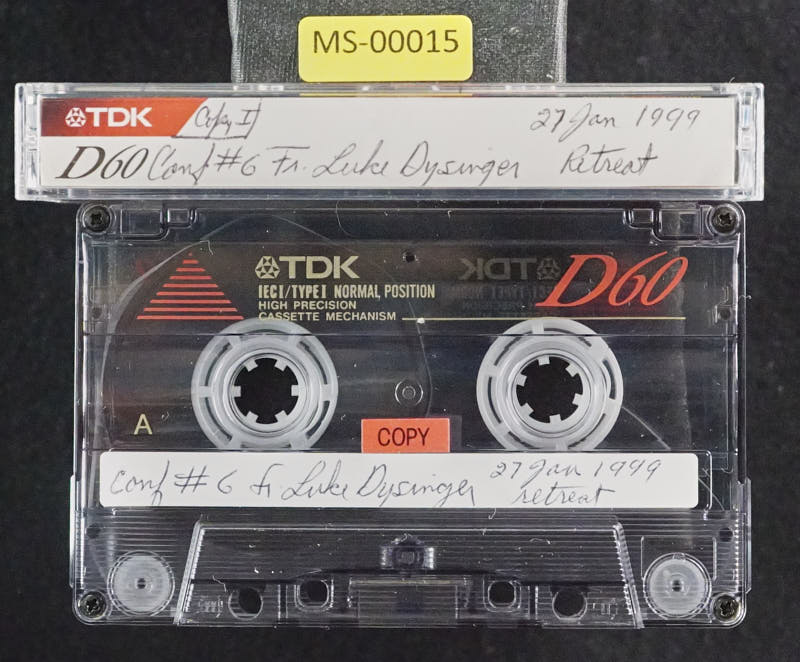
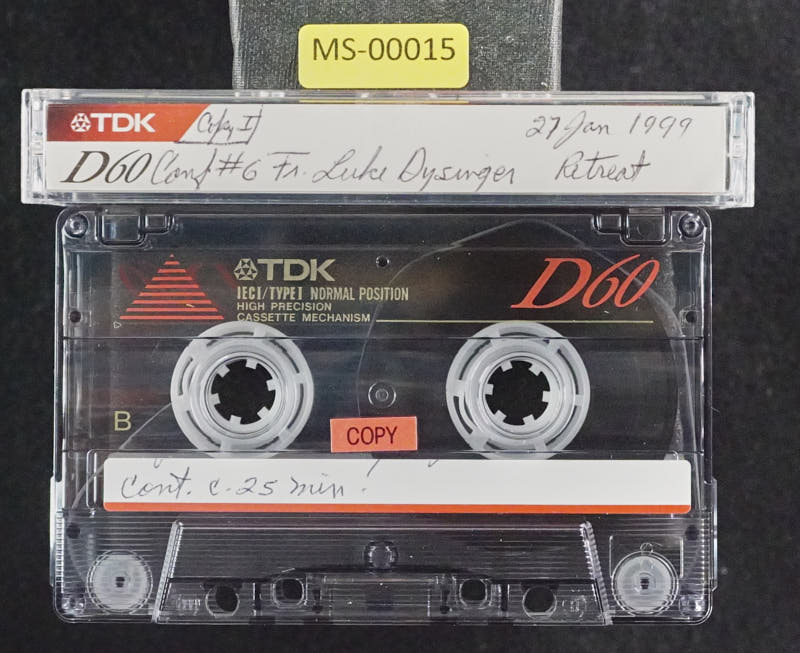
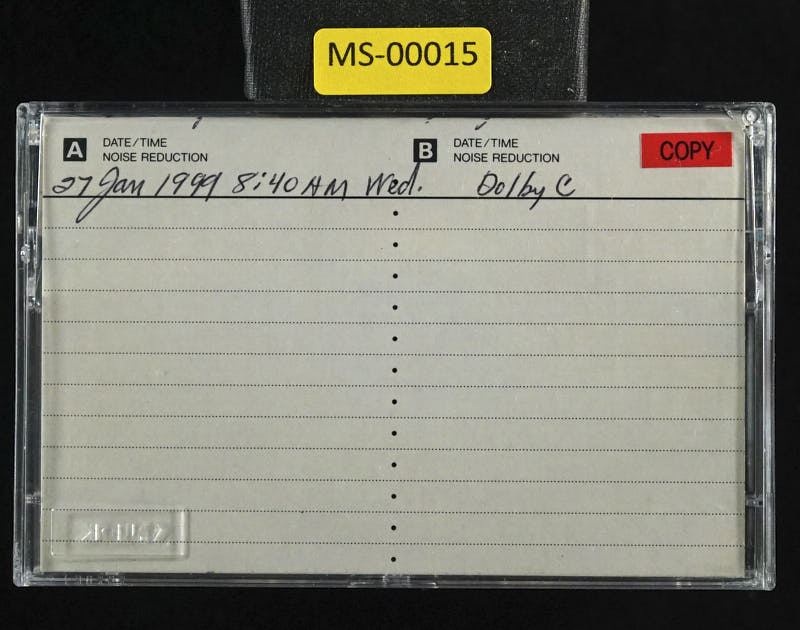
AI Vision - Possible Values from Photos:
Speaker: Fr. Luke Dysinger
Possible Title: Cont.#6
Additional text: Retreat, Dolby C
@AI-Vision_v002
We have been looking really at two kinds of dynamics over the last several days together. On the one hand, a sense of a dynamic spiritual rhythm that exists in what you might call the human heart or the depths of the soul. And I think it's helpful for us to look at it and to think of it as a rhythm, as a movement, because unfortunately, some of the models that have tended to come from the tradition of the last three or four hundred years have tended to be a bit static. The spiritual life has tended to be looked at in terms of levels or stages, a question of attaining one spiritual plateau after another. And unfortunately, the difficulty with that image... truthful though it may be in some ways, is that it sort of implies that you leave the previous plateau behind, that once you've got up to one level, well, you're there and you don't need to be somewhere else. Whereas the monastic insight has always been that all the dynamics are always present to some extent.
[01:08]
That is to say, there is no form of perfection known to human beings in which temptation is absent. And therefore, there is no stage or phase of our spiritual life where the struggle against temptation will be absent, or the need for constantly calling on the Lord, or using the weapons and skills and craft and all the things that we've learned from God and from one another about how to say no to temptation and say yes to God, those things remain until the very end. And there's some wonderful Desert Father Apothegma about that. Evagrius often says that particularly the temptation to anger persists until the moment of death. That whereas, he says, the young tend to struggle more with temptations concerning what we yesterday called epithumia, desire or longing, either questions of sexuality or acquisitiveness, possessions and things like that. Those who have been in the spiritual life for a long time or for the whole of their lives and who are approaching heaven are still struggling with anger.
[02:16]
Will, until the day they die, find themselves in constant need of depending on the Lord to help them avoid displacing that tendency to use one's spiritual weapons in the wrong way and against the wrong people. So we have to be both grateful to the tradition for reminding of this and a little cautious of the sort of language or the kinds of models that imply that somehow you get it all together as a... as sort of an ascetic, and then you graduate up to one kind of contemplation, which then fills your life for a variable number of decades, and then finally you're absorbed into a kind of a mystical union with the Lord that goes on forever. That's a kind of a parody of something that John of the Cross and Teresa of Avila never actually said. And that particular parody is very common in some of the manuals that date particularly from the 17th through the 19th century.
[03:18]
But the kind of language persists, unfortunately. And I think we have to be aware of the fact that our monastic tradition offers an alternative to that. An awareness of the fact that the human heart, the depths of our soul, are constantly in a rhythm of presence to the Lord through doing. presence to the Lord through engaging in things, presence to the Lord through being aware of both inner struggle and striving and changing, and also the experience of stepping back, quietly listening, allowing the Lord to speak to us in quiet and in Sabbath. And the whole of our lives, and indeed the structure of our liturgy, and if we choose to apply it there, the nature of our relationships with each other will remind us of this. And indeed, even in the most ordinary aspects of life, for example, at the workplace, this is the natural rhythm of our human experience. We're striving, struggling, trying to find the answer to a question, and then we stop and sit back and maybe attend to something else or have a cup of tea or something and then suddenly discover that we've got the solution that wouldn't come during that period of struggling and striving and seeking to answer it because we have to have both, the intense focus
[04:36]
and the quiet, more receptive willingness to allow things to be put together for us at levels other than our own conscious awareness. So even in daily activity, even in our work life, there is this underlying rhythm of activity and receptivity. And I think it's useful for us to highlight and to look at a couple of points in our lives where this is most clear. where we make very specific decisions as communities about highlighting this rhythm and about looking at these different poles as places in which we need to learn, as movements within our own heart with which we need to be comfortable. And one of the primary ones is the practice of psalmody, that which is at the very heart, the very core of our life as Benedictines. And although it's been very common to say that there is more to monastic life, there's more to Benedictine life than the Opus Dei, nevertheless, St.
[05:37]
Benedict says that nothing is to be preferred to it. And there is for us as Benedictines, as monks committed to the rule of Benedict as our way, a sense that there is something about common prayer, about... praying the office together that is very much the center and the core of our lives. Much may change. The people in our lives will certainly change. The faces in community obviously will change. The structure of buildings in some unusual circumstances even, and this causes a shudder to go collectively through Benedictine hearts, even maybe even the land in which we live. My own community was exiled and expelled from its original foundation and our foundation in California has been a new home a continuation of the same community, but a discovery of the fact that stability, as John Leclerc used to say, does not always mean immobility, although I think he used that to mean other things, perhaps an explanation of why he was often on the go. It may even happen collectively to communities.
[06:39]
But at the core of our lives, at the center of our self-identification, will be a sense that it is not sufficient for us to pray by ourselves, at least not as Cenobites, setting aside for the moment the question of the vocation to the anchoritic life, the question of the hermit life. Although even there, the Benedictine hermit exists in a dynamic relationship with the Cenobium, whether in the Kamal de Lis model or in the model of the places which have people living in specifically defined hermitages. But putting that in brackets for the moment, a fundamental part of our charism is that we do pray the office together. And we're not the only ones who do, of course, but for us it's much more central than it would be for other equally valid and important traditions within the church. For example, for a Jesuit to need to pray with his brothers would be a weakness, not a strain. because there is in the model of St.
[07:40]
Ignatius nightly questing, being able to penetrate the recesses and the borders of where the gospel hasn't been preached, a sense that you have to be able to do it on your own with minimal help. You have to be able to spiritually survive on private recitation of the office. And it's good when you have community, but it's not an absolute prerequisite. It's not something you would absolutely try to create as the first thing you did once you arrived in which we would tend to do. And I think that's useful to be aware of. This is part of what God calls us to be, part of how we understand ourselves and therefore part of our gift to the church. So it's good for us to be aware of how we continue to live out in this age a very ancient tradition, a very ancient way of praying that comes to us from the earliest centuries of Christianity. We mentioned, I think, day before yesterday, that psalmody, the praying of the psalms primarily, acquired a particular prominence during the 300s.
[08:43]
And all the reasons for this haven't been sorted out. I don't know whether they really can be, but some of it undoubtedly had to do with the use by the Arians of catchy little songs and jingles that express their particular theological viewpoint, and the need for the Orthodox to have alternate songs to sing. And the conclusion after all of this, if you will, theological warfare on vital subjects, vital questions, by use of song, a kind of a collective sense of, well, let's sing what we can trust. Let's spend our time praying what we know will be nourishing to the heart and won't lead us off into error. And that's the ancient song of the church and, finally, of the people of Israel. Because in choosing the Psalms and in making the Psalter the center of our lives, indeed choosing to pray the Psalter regularly, whether in a weekly cycle or more frequently or slightly less frequently, but choosing to pray the whole of the Psalter as a part of one's spiritual discipline meant that Christians were using the Psalter even more than their Jewish brothers and sisters.
[09:55]
We inherit the Psalter. We inherit the Psalms from the chanted tradition of the temple in Jerusalem. The Psalter is a hymnal. It's not a book of poetry in the strict sense of the word. It's poetry, all right, but it's poetry set to music. It is a hymnal for which we've lost the music. The music actually exists in old manuscripts. One can reconstruct the... and dash notation that exists in some older texts of the... of both the Torah and of the wisdom writings, which were intended to be chanted, but it's highly debated how they should be interpreted, and no one knows for sure what they sounded like. Certainly nobody has reconstructed the tonal systems of those days, whatever anyone may say about thinking they've got it. We don't know what the songs and the chants of the temple were, but undoubtedly Christians inherited some of them. It's been suggested that some of the most ancient music in our repertoire includes things like the exalted, a very ancient hymn and probably a very ancient melody as well, although obviously it's been modified over the centuries.
[11:08]
But we inherited a tradition which we then took so seriously that Christians were doing more with the Psalter than their confers in the traditions of the people of Israel. The psalmody became very much the center of Christian life. And I think it's well for us to reflect on the fact that that persisted until very recent times. You on this coast probably know far better than a lot of people on the West that the word that was used to describe the books by which children were taught to read in this country in the 15th through the 17th century was the word primer. And that word comes from the office of prime. A primer was a condensed form of the Book of Hours, which was a form of the Office of the Blessed Virgin, which had been the most widespread book in the history of Christianity from about the 12th to the 16th century. You taught children to read by using the Psalms, and you began with the office of prime, with the Psalms that were proper to the little office of the Blessed Virgin for the time of prime.
[12:15]
So, they were still called primers when the Puritans brought them over, and they still included the Psalter. when our Protestant brothers and sisters attempted to adapt that tradition. So, there is even in our own language a reminder of the fact that the Psalter was a very basic way of learning language skills, learning to at least read, if not to write. And I think it's important for us to be aware of the fact that we define literacy very different from the way people did in the ancient world. It's probably very true that many ordinary Christians, the majority of ordinary Christians could not write in the ancient world. But probably a very large number of them had some ability to read. How much is not certain. But the ability to read simple texts and especially to be able to cope with texts that were used in the liturgy, and that would have above all else included the Psalms. Remember that Benedict and the Master just expect everybody who comes to the monastery to memorize this altar.
[13:18]
This is not regarded as a big chore. It's the sort of thing you do when you join the monastery. And since you're praying the Psalms every week in cycle, you absorb it to some extent and then you consciously choose through this reciting to yourself, this repeating of the text to yourself called meditatio, you consciously choose to memorize and make those texts a part of your own. And that's true whether you're able to read and write or not. That's just the kind of thing that everybody did. And indeed, memorizing large blocks of text in the ancient world was extremely common. But the form in which the Psalms were primarily sung in the early Christian community has become clearer recently. We as monks often love and prefer the antiphonal style of having one choir answer the other, which is a very beautiful way of doing psalmody and very proper to monasticism. But the more ancient form of psalmody is the one we hear every day at Mass.
[14:20]
during the responsorial psalm, and often during the communion hymn, in which an antiphon is sung out, and the people use that as a refrain, as a refrain between verses of the psalms, which the cantor primarily sings. That was the most... basic and ancient way of praying the Psalter, which would have been common to everyone and which probably was the way in which the earliest monastic communities did the majority of psalmody, especially at the vigil office, especially at the office where there were lots of psalms to get through in the very early morning hours. The cantor would have sung most of the verses, the community would have sung a refrain, or possibly used one of the shorter psalms as a refrain. And as a consequence, a large part of the psalmody was in fact, as Father DeVogui has reminded us, listening. Not actually saying it yourself, but listening to the text being sung out. So, when, as Father Pryor reminded us several days ago,
[15:24]
when we were reminded collectively as a monastic world that the Psalms are not necessarily our prayer in the sense that we are required to say every Psalm believing the sentiments of the Psalm, although sometimes we can do that. he was absolutely right in recovering the more ancient sense of the Psalter, which also corresponds to the actual practice in the early monastic communities, where a large part of the Psalter would have been listened to, taken in by those who were praying it. And praying it in the sense of allowing it to touch the heart and then yield a kind of a response which became prayer. That response is very specifically described in John Cashin's Institutes in several places. And in them, he describes particularly the vigil office in the Egyptian monasteries he visited, presumably at Skeet and at Nitria, and in other places as well.
[16:24]
At the end of the psalm, the community would stand with arms outstretched for a moment, and they would throw themselves down on the ground in a kind of a full prostration, which we still see, of course, in the Orthodox tradition. The metanis and the casting of the self down onto the ground in a kind of a liturgical push-up, which lasts for a brief time, and then the person springs back up again. is a reminder of, and is probably very liturgically connected, to the ancient prostration which was done during psalmody, either at the end of the psalm or in the middle of the longer psalms during a break. However, Cashin makes it clear that this period of prostration, this period of private self-offering, because, of course, that's what prostration is, when it's done at profession and at ordination and at other great ceremonies, Prostration is a way of saying with our bodies what we're doing with our hearts. It's a way of offering ourselves to God. The only thing I have to give you, God, is myself.
[17:24]
And I give to God the response of my heart, which has been awakened by hearing these words, by experiencing the text of this psalm. So the casting down on the ground that would have taken place was at the same time an offering to God of whatever it is that would have happened in the heart. And then after a time, and it was indicated by the superior or by the cantor, the community would stand up, And with hands outstretched, stand for a moment, and the silent interval would be concluded with a psalm prayer, which the church, which our Holy Mother of the Church and her wisdom has elected to reintroduce into the Liturgy of the Hours. And so there are psalm prayers after each of the psalms, but I have yet to meet anyone out there who actually knows what to do with them. I mean, what is supposed to be done with a psalm prayer during the collective recitation of the divine office? People do not cast themselves down in prostrations anymore. Very rarely is there a period of silence after each psalm, which the psalm prayer then concludes.
[18:26]
It's a very wonderful thing to have reintroduced, but there's a lot of catechizing and a lot, I would say, of experimenting yet to be done to determine how that which was put back into our celebration in theory in the 60s is now actually to be lived out in the post-90s. We know from the tradition what that was. It was a way of offering together in a collect, a decollect prayer, the prayer of the community that had been offered during the silent interval afterwards. But how that's to be lived out today is part of the unexplored frontier of psalmatic liturgy in our own day. And perhaps you will contribute significantly to this, both in your own community and in the work you do with other people. But what we see or what we are reminded of in all of that is that at the heart of the celebration— of the Liturgy of the Hours, every time we do it, whenever we do it in a way that does allow intervals of silence to be interspersed with our experience of singing the psalms ourselves or hearing the psalm chanted by the cantor, is a rediscovery of the inner rhythm of our own heart, listening to the Word and in silence offering back the self, allowing the text to touch us
[19:43]
and then allowing ourselves to be part of what we give back to God. There is a wonderfully, if you will, Eucharistic aspect to this understanding or this experience of hearing, receiving, and then self-offering. The language of the Second Vatican Council about the common priesthood of the faithful is often used but I think only rarely appropriated at its deepest level. And it may well be that stepping away to a certain extent from the Eucharistic celebration itself is a good way of trying to recover what that language is about. We are all, in virtue of our baptism, constantly re-offering to God ourselves and others and our lives. And when we express that liturgically, by intervals of silence, which are intended for that act of offering, or by the more ancient physical representation of that, a full prostration during the intervals of silence, we are literally acting as priests, not just metaphorically, not just in a kind of a sort of a euphemistic way, oh yes, well, we have to use that language so that people don't feel bad about not being ordained.
[21:02]
Not at all. This is the fundamental form of priesthood. Christ is the only priest. There's only one priesthood, and that's Christ's priesthood. It refracts out in a whole variety of colors, and those colors or orders are expressed and experienced in the church in different ways by the episcopacy, by the presbyterate, by the diaconate, and by the laity. But the fundamental priesthood is Christ's priesthood into which we are all... baptized. And we exercise that priesthood most primarily in prayer, in our act of self-offering, in our offering of one another. And so it may well be that as we find increasing language and ways of helping people understand the ritual gestures that are part of our life that will also be enabling people to understand more fully and truly what priesthood is all about, not just at the Eucharistic celebration, but in the Eucharistic thanksgiving offering, which is the giving of ourselves to God every time we pray, whether privately or publicly, but especially when we pray together in a way that highlights this inner dynamic
[22:16]
of listening or hearing, and then offering back to God. That is a fundamental expression of the most basic form of priesthood which we all share in virtue of our baptism into Christ. So, there is, in what we do in the Liturgy of the Hours, you know, kind of a powerful dynamic, kind of an exciting spiritual dynamite waiting to be unpacked, waiting to be shared with people, and I think we're only just beginning to discover it, to be able to highlight the places in our liturgy where it still remains. The bowing at the Gloria Patri at the end of each psalm is the continuation in the Western liturgy of that ancient form of prostration. It's an exercise with the body which reminds us of the fact that we are placing ourselves in the presence of the one before whom we bow or prostrate and offering him the only thing we have, which is to say ourselves. So that's part of the rhythm of offering of psalmody.
[23:20]
But the rhythm of listening, the rhythm of hearing, the rhythm of allowing the words of the Psalter to be just lots of things for us, I think is also not so much unexplored territory as territory which people very much want to venture into but often aren't sure where to look. Well, One of the sources that I think can be helpful, perhaps in small doses, is a wonderful letter by the author of The Life of Antony. The author of St. Athanasius the Great wrote a letter. There's just one. You can take one and pass them along. On the subject of how the book of Psalms ought to be prayed. And this book, obviously, became something of a bestseller. It was very widely known. It was... Some of the insights that it contains were made available to the West because some of its more catchy phrases found their way into the writings of people like Cashin, who then became the bedrock of the Western spiritual tradition and informed the way everybody thought and reflected on the Psalms.
[24:29]
And we're not going to look at this text in detail. If you'd like to look at it yourself and reflect on it, please do so. The only reason to give the Greek is because the translation isn't perfectly adequate in places I've modified it in some spots, but left it in others. I've tried to leave it as best I can pretty much close to Greg's translation in the volume on Athanasius in the Classics of Western Spirituality series, which you have here and which is very widely available. Most people look at that volume as containing the life of Antony. That's what they think it is there. That's quite true. It does contain that, but it also contains this letter. And this letter has some wonderful insights on what psalmody can be. Because I think part of the trap we fall into or allow ourselves to fall into is thinking that we have to become the psalmist. We have to... take on the mindset and the experience of the psalmist in order to be praying it properly, as if the psalmody is something like a movie and we're supposed to really get into it and experience the same sentiments.
[25:38]
To some extent, Athanasius tries to use the language of the sentiments and the language of the Psalter, but for him the key is not so much trying to go back in time to the experience of the people of Israel, and it's especially difficult to do that with a psalter, because in many cases we have absolutely no idea when the darn thing was written. The psalms above all else of every book in the Bible, in many cases, are the most difficult to date. They often refer to events that took place centuries before the psalm itself was written. In some cases, they've been substantially redacted, modified. In some cases, they were originally hymns from other religious traditions. Psalm 103, 104 is probably Akhenaten's hymn to the sun god Aten, which has been substantially modified so that references to the Nile can now be understood as applying to either the River Jordan or to the Mediterranean. And in the same way, it's thought that several of the
[26:39]
of the God present in the crashing wind hymns are probably Canaanite hymns to the God Baal, which have been modified in such a way as to allow them to properly pray to Yahweh. And that's a wonderful thing. I mean, people shouldn't shudder in horror that we've taken on these things because, after all, what's the Christmas tree? You know, what's the Easter Vigil candle, if not the modification of existing traditions that existed in Northern Europe and their adaptation by Christianity? It's a wonderful thing to see that God, the Holy Spirit, has continued to do that throughout history, that the Psalms themselves are the adaptation of what was good and holy in other traditions and bring that into the life of the people of Israel, but makes it very difficult to do a modern exegetical, now we must understand exactly when this psalm was written and who it was written for and what it's about, because sometimes you can't do that. We just can't know. Hymns above all else seek to be timeless. They seek to be poetic expressions that help you understand the meaning of an event, but as to when the thing was composed, well.
[27:45]
So, we have to have a rather different approach to the praying of or to the listening to in the sense of the text of the Psalms than a modern exegete might tell us we're supposed to have. And I think Athanasius does a good job of pointing out what this approach might be. He says, the Psalms, the book of Psalms has a grace of its own, a very distinctive exactitude of expression, because in addition to other things with which it possesses an affinity, and it's like the other biblical books, The Psalms possess beyond that this marvel, namely, that the book of Psalms contains even the emotions of each soul. And he uses the word kenemata, the word movements. The Psalter contains within it every kind of inner movement of which our heart is capable of. Now, think about that for a moment.
[28:46]
Isn't it true? I mean, one of the scandals of the book of Psalms and one of the great perplexities, I think, in the church is that, you know, people's need to constantly be editing them out. Ooh, that's much too harsh. Oh, vile language. We can't appreciate that sentiment. So, we extirpate, we throw out that psalm. And so, you end up with either a kind of a neutered psalter or a psalter from which the most apparently violent texts have been removed. I haven't... so completely recover from jet lag is to be able to enjoy the beauty of your vigil liturgy yet, but I still have hopes that I may be able to do that and discover whether your solution to the problem is the same as ours, namely that you take the most difficult psalms and put them at the vigil office when consciousness is not as much of a problem as it is at other times of the day. But that's not absolutely true, of course. I mean, one seeks to find a way of appreciating even those movements of the human heart. Some of the more cynical monastic, or I should say skeptical monastic authors, in this case one of the musicians at Appleforth Abbey loved to refer to the Psalter as, ah yes, eloquent and intriguing testimony to the spirituality of the late Bronze Age.
[30:00]
which is another way of saying this is a reflection of primitive people, you know, of the way probably a hundred gatherers were thinking about the universe. And that's not absolutely true. But what is true and what Athanasius absolutely admits is that in the Psalter is every movement of the heart. Everything from the most exalted praise of God to the most anger-frustrated, table-banging fury at enemies. You know, I saw you kill my children. I want God to kill yours. In the same way, the kind of angry, frustrated, casting out of fury at another person. And the trouble is, if we accept the modern, dangerous enlightenment myth, that if we pretend these things don't exist, they'll go away, that just means that the next time they jump up, we'll refuse to believe it until it's too late. We won't actually get involved in doing something about what's happening in Germany when the next genocide happens until it's already begun to happen.
[31:07]
We won't actually get involved in anything connected with African nations where one race is being destroyed by another until after it's happened because people aren't like that anymore. Human beings don't do that stuff, do they? The reality is everything in the psalmist is still present in human society and not just in Africa, Germany. Look within your own heart. Isn't the psalmist being honest about what we actually feel? Isn't the psalmist articulating our real response, the real movement of the heart? It isn't to say that we have to act on that or should act on it or even should believe that it's good, but to recognize that that is part of our real response and the act of bringing that into the presence of God, which its presence in the psalm entails, means that we believe that even those dark and destructive And even anti-light parts of ourselves can, in fact, be dealt with by God.
[32:14]
The worst of the Psalter is a reflection of what may be real for us. And if we ignore it, that just means we're not likely to recognize it when it happens. Again, maybe not even out in other countries, maybe even on our own. maybe not out in other lives, maybe even in our own hearts. The Psalter is a reminder of what is possible for human beings and a constant encouragement to bring all of that into the presence of God. There have been a variety of ways of expressing this. We once had a retreat master who told us, and I will... will put a veil over the community from which he comes, perhaps for the sake of anonymity. But he said that during his novitiate, he was encouraged, or it was recommended him by his novice master, that in order to deal with the cursing psalms, they were permitted to direct in their hearts the cursing psalms against a particular member of the community. But... only for as long as the psalm lasted.
[33:17]
And then, of course, they were to bow at the Gloria Patri and give it all to God. An acknowledgment of what they felt in their hearts, a recognition of the fact that maybe this person deserves something like that, or at least that's the way I feel at this moment. and then the giving of that all to God. Well, I discovered eight or nine years later from that same retreat master when he came back for another visit, and I mentioned how useful I'd found that statement of his. He said, well, what I never got around to telling you was that that novice master was the most unusual person. We discovered years later that he used to go into the woods and scream and scream and scream, and nobody knew that until later. Well, it probably explains a lot. So I would suggest that one take that recommendation with a grain of salt But look at it as someone's attempt to grapple with the violence and the pain and the frustration that one experiences both in the text and in the self, and a sense that the two have to come together in an act of self-offering in which I'm genuinely giving to God, the person that I am, seeking to change, seeking to change, seeking to become another kind of person.
[34:31]
towards the bottom of the same line, there's this famous phrase from this text that John Cashin picks up. It seems to me that to the person singing them, and he doesn't just mean the cantor, he also means the person listening to the text. He explains that in the next paragraph. These words become like a mirror. They become like a mirror. They are a place in which we see reflected the self. The person sees, perceives, understands himself, and again, the movements, the kenemata of the own soul. And thus affected, touched, sensibly touched by these things, the words might be recited. In other words, Athanasius is saying we don't sterilize or sugarcoat or or pretend that the words of the psalm are something other than what they are. We do go beyond them.
[35:33]
We do definitely seek to find Christ lying at the heart of the frustration and the perplexity that they maybe evoke within us or seem to be reflecting in the life of the psalmist. We definitely do seek to see them in light of a world touched by the healing and redeeming power of Christ and being drawn back into union with the Lord. but they are a mirror, and we have to accept them as a mirror so we can begin to see ourselves. And on the other side of that same page, the same kinds of phrases are used, but with another very significant insight. It was for this reason, in the second paragraph he says, that the Lord made himself resound in the Psalms before his sojourn in our midst. The Psalter anticipates Christ, both in a kind of a prophetic way, but also because it expresses the yearning of the human heart, the need of the human heart for everything that Christ is. Christ somehow resounds in the Psalms.
[36:36]
And this is our conviction. It's why we pray the Gloria Patria is the proper conclusion to the Psalms. Because the Trinity is expressed in these texts, even though they are the book of the people who knew only the Father, who knew the Son and the Spirit through their actions rather than through their names. And in that way, he provided a model. kind of imprint, a type. The image is kind of like a seal being put down in wax. The Psalter bears the imprint of Christ, and so our own souls will bear the imprint of Christ if we allow the texts to touch us, because he goes on to say, from the Psalms, the one who wants to do so can learn the emotions, again, these movements and dispositions of the soul, finding in them, meaning the psalms, also the therapy and correction suited for each emotion.
[37:38]
The Psalter is not only a mirror, it is also a workbook and finally a remedy. And this has been expressed in a whole variety of ways, that psalmody and the music of the psalms has a soothing effect. And we know that. The singing of a text will naturally tend to make the heart quiet, will tend to, in the words of the ancients, calm the fury of thumos, this energy that is sometimes misused as anger or rage directed against a brother, sometimes the simple chanting of the text will calm the heart. The great biblical image of this is David playing the harp and chanting the songs or the psalms in order to calm the frenzy of King Saul. It didn't always work, obviously, but it did for a while. And that is part of what psalmody does. At its most basic, if you will, physiological level, it touches us and quiets or calms that particular kind of our imbalance. But for those of us who wish to allow it to be so, the Psalms can also be a mirror, a window into something more, into the very presence of God, into the perception of who God has made us, of who God enables us to become.
[38:58]
One of the most beautiful images, I think, of this, deeper sense of psalmody, the, if you will, allegorical or mystical experience of the text, where we move beyond just the physiological level of the music touching the heart or the surface question of what event in the life of Israel is this from to the more important question of how is Christ mysteriously present in these words and images? What is this saying to me about my own being drawn into union with God? One of the most beautiful descriptions of how that happens in the human heart is, and I'm sorry, it's on one of your previous handouts, so if you want to refer back to it, feel free, but I'll just read out from it here. It's on the back of your Pelagia the harlot handout, on the page marked Beholding the Glory of God in Creation. There's a very beautiful essay. that one of the Desert Fathers of Agrius wrote called On Various Tempting Thoughts, De Malignis Cogitationibus.
[40:00]
It's just been re-edited. It's been edited in a critical edition, so hopefully this means that there will be a good translation of the whole text, which has never been available in English before at some point in the near future. But one of the really beautiful sections from it, and I should also mention that even though Avegarius was condemned, this text continued to be read and meditated upon in the Eastern tradition despite that fact because it was attributed to another author. It was attributed to St. Nihilus. And at the core of his discussion of how we deal with various kinds of temptation is a beautiful image of the praying of the Psalter. He says, if we are weary from our toil and a certain achidia or listlessness, a certain inattentiveness or even lack of interest in or perhaps expressed more strongly a dislike for our holy duties has afflicted us, we should climb a little onto the rock of knowledge.
[41:00]
That's a key word for him, onto the place of contemplation, onto the rock where we're allowing ourselves to inwardly see and and have a conversation with the Psalter. Let us engage in conversation with the Psalms. That's a word for conversation, but it's also the word that he uses in his treatise on prayer to describe our conversation with God. have a little talk with the Book of Psalms, with the Psalter. And the way we do that is, and it's wonderful that you have the harp being played in this community for the accompaniment of the Psalms of Compline because he uses the image of the harp or the guitar. It would work either way. We pluck the strings of the Psalter because this is a word play. The word Psalter or Psalterion can mean either the Book of Psalms or the instrument that you use to accompany it. It can refer either to the harp or the lyre or to the book of Psalms. It can mean either thing, and so he's kind of doing a little word play.
[42:01]
We have a conversation with the Psalter, and we do that by plucking the strings of the psaltery with our virtues. We are able to understand the deeper meaning of the Psalms if we're struggling in our own hearts with the acquiring of the virtues and the expelling of vices, being aware of how we fail and how the Lord enables us to stand up again, engaging in this work of inner struggle, if we are, as the Desert Father said, falling down and getting up and falling down and getting up and learning what that means and finding ways of perhaps not falling so quickly or getting up more readily, that's part of the stroke, that's part of the pluck that we bring to the words of the Psalms. Then he uses another image for it, let's tend our sheep pasturing below Mount Sinai. This is an image he's invoked in previous paragraphs, so that the God of our fathers may call to us out of the bush and grant us the inner meanings of the signs and wonders.
[43:05]
This is a kind of a, almost a code language by which he says, if we bring to our conversation with the Psalms our own experience of struggle and with our own sin and desire to live in the light of God, and also our experience of God, when we do perceive the Lord present in things, when we see Him in the created order, when we're allowed to simply quietly be in the presence of God, then we are going to perceive as well God's purpose, God's deeper meanings, God's logoi in these things. And he says, then our reasoning nature, It's having been put to death by vices, raised up by Christ through the contemplation of all the ages. For Avagrius, for the Desert Fathers, the source of contemplation really is the Psalter. That's where we learn about experience of God.
[44:06]
It's where we learn about ourselves. It's the mirror in which we see our own struggle reflected. It's the place where we're drawn into a more radical honesty about who we are. And it's also a kind of a place in which we begin to see reflected what God really is making us into. to use his own language, and it comes out in the last paragraph there, then at the time of prayer, and by that he means the time of repose, of beginning to see God, we may actually catch a glimpse of what God is making us into. We are like the sapphire. We are like the color of heaven, which Scripture calls the place of God, seen by the elders under Mount Sinai. And I've given you up above the reference in the version of the Bible that the Desert Fathers would have been using, namely the Septuagint. The place of God on which God stands, this glowing blue sapphire sea, is the heart, is the depths of ourself.
[45:08]
The Psalter reflects us both in our weakness and in our struggle, and it also allows us to see something of what God is doing within us. In moments of repose, in the joyful vision God sometimes grants to us, we also perceive that we are being made more like Him, that he stands, dwells, is present within us, and this we see as something like the light of Mount Sinai. So, I think there's a lot for all of us to do in learning to help this very beautiful and contemplative understanding of what it is that happens during the Liturgy of the Hours, both both truly deepen in our own lives and be something that we can learn to share with others. Just kind of a closing thought, we live in an era which is now several decades out from the idea that the Liturgy of the Hours ought to be part of the whole people of God's stuff.
[46:14]
They ought to all be able to have this as a part of their own experience of offering of self and sanctification. And instead of a kind of a growing enthusiasm for and delight in the divine office, what one finds instead is just as much of an interest in flying off into this form of spirituality and that form of spirituality and going off on this pilgrimage and, you know, having this experience of an apparition somewhere as ever was the case before. The original project of helping this very beautiful core of discovery of what God's doing in our hearts and in our communities, place wherein we see ourselves and are drawn ever closer to the Lord is as much a potential as it ever was. And for those of us for whom it's at the center of our lives, I think we're not only invited but maybe even commanded by the Lord to find new and ever more resourceful ways of putting this at the disposal of the people of God whose proper province it is supposed to be and has declared to be now for quite a long time.
[47:20]
What we'll do this afternoon is continue looking at this rhythm of consecration and sanctification in light of the practice of Lectio Divina. And perhaps then tomorrow we can have an opportunity to catch a little flavor of or a little hint of a kind of an exercise which, again, may not... be necessary at all for those of us who, for all of you who practice Lectio on a regular basis, but can be a very useful way of teaching other people about the practice. Questions and thoughts? In the intimate spirit of works, in the Latin, it is all frequently to pray. Yes, that is, isn't it? That's right, absolutely true, to prostrate frequently to pray. which I guess I'm indeed privately. That's right. And of course, to this day, I'm told, I've not been on Athos myself, but one of our community who has says that one of the very first questions you're asked, even before you're asked when you celebrate Easter, which of course determines whether there's any possibility of being in communion with you, which of course there won't because we're Westerners, but before one knows that, the very first question you're asked is how many prostrations do you do?
[48:39]
That's a kind of a definition of whether you're a monk, whether you're casting yourself down to the ground literally hundreds of times per day, and sometimes more than that. That's a kind of a self-definition and a monastic practice. It's a sine qua non of being a monk in the Eastern Church. And then, of course, when do you celebrate Easter? That determines whether you're excommunicated among other houses on the Holy Island. I mean, there are monasteries on the Holy Mountain that are not in communion with each other as well, so we needn't feel perhaps quite all that bad about it. But, yeah, it remains a common practice. And, you know, how one can recover that in our own day is a very good question. Maybe just by doing it. Yes. Yes, I think that's absolutely right.
[49:43]
Oh, yes. Yes. Absolutely. Well, and the thing of it is, of course, many of these, several of these denominations, even the Presbyterians, now have forms of celebration of the divine office in their hymnals. In the Lutheran tradition, prior to the 1960s, what we would call... lauds, a sort of a version of matins and lauds, was an alternate service that could be used on Sundays instead of the celebration of the Eucharist. And it was one of the versions of the service, which many of them knew, and which now is very, very uncommonly celebrated in their tradition. But they also had a form of vespers, which could occasionally be used as an evening service. So they always had those possibilities, but now in their tradition, the Sunday celebration of the Eucharist is being highlighted as something that ought to happen. And so they asked the question, well, what are these for? If they're not, will we do
[50:44]
on Sunday, well, maybe they could be what we do each day, and there is a recovery, a rediscovery of it, and a real great enthusiasm for exactly that. I think part of the key of it is, you know, we sometimes forget as monastics, part of what makes it easy for us as Benedictines, or easier than it might be elsewhere, is that we do have a love of music. We do have a chanted tradition. Boy, all you have to do is visit communities where it's just a droning recitation of one sort or another, or just recto tono, or, you know, sort of badly recited, and you realize how, for them, many times the office can be an awful penance, a thing endured, rather than an opportunity to deepen in one's spiritual life. So, for Lutherans, and even, I think, more so for Anglicans, who have a tradition of sung chant, a very rich tradition, they can bypass that problem, because it almost wouldn't occur to them to recite the office and make use of their own musical resources. Part of what we, I think, as Roman Catholics have to do is continue to develop those resources and find very straightforward ways of allowing people to realize that it isn't all that difficult to chant the office.
[51:50]
And I mean, you're to be commended here because a lot of the psalm tones you use are wonderfully straightforward and very easily applicable. You know, parenthetically, of course, the big problem is the copyright on the Grail Psalter. I mean, if you want to publish anything or put anything in a form that's available to other people and you want to charge for it, you're going to have to pay big time to the ones who, I think it's GIA that controls the copyright on the Grail right now. So there's a legal problem involved in that. But that aside, you know, to begin to use the resources God's given our communities, I think will be a wonderful thing for our people. And in a number of years we had a clergy group that was Protestant and Catholic. And then recently we had a group which is also some clergy. And on two different occasions, because we're reading scripture, we thought it would be good to take the Psalms. And it'd be ideal to get one of the rabbis in town.
[52:51]
So physically that's one of the men. And he said, well, as a matter of fact, that was a part of their seminary train that was the least. It was the least, yes. Recently, there was a baby rabbi and we asked her if she could join us. And she said, well, as a matter of fact, that was my least. The least thing that we studied in the seminary. I thought she went off with a feminist. Oh, well. The cursing psalms, the male psalms, more like stuff. But anyway, the thing that was striking was, of all things, in Jewish rabbinic The Psalter is the weakest. It's amazing, and that's undoubtedly not the way it was in first century Palestine. Obviously, the fact that the Psalter is so frequently on the lips of our Lord is not just God's love of the Psalter, it's undoubtedly that, but also the fact that this was the language that was being used by the people of Jesus' day.
[53:54]
The Psalter probably had a more widespread providence in those days. Certainly, the Hallel psalms were sung at the Passover. And the gradual psalms were probably still used in temple celebration as what approached the temple. the Psalms were undoubtedly a part of ordinary, if you will, Jewish catechesis. Now, the fall of the temple and the kind of triumph of Pharisaic Judaism, which of course is the form of Judaism that exists right now, meant a whole variety of reconstructions and changes. And, you know, the trouble is, you know, anti-Semitism is real. There's no question about it. But at the same time, some very fine Jewish scholars, Geza Vermesh among them, have pointed out that a desire not not to be characterized as Christians, and not to do what Christians do, has often characterized different aspects of Jewish practice as well. And it may be that overwhelming Christian enthusiasm for the Psalter in the fourth century caused a certain reserve in regard to it. That's what I thought.
[54:55]
You know, in some way, we use them so much that they kind of back to end, because that was it. Christology interrupted. Yes. Yes, that's right. That's right. Yeah, yeah. Well, absolutely. You know, we like to think of ourselves as moving in a single direction, but it's like being on two feet. You know, you go to one side, then you go to the other side, then you go to the other side. You're moving in a direction, but there's a lot of shift. It seems that one aspect that we, for us, we kind of, in different in some ways, while the sensitivity of the psalmist. I feel that if you love somebody, you don't want him to be hurt, and therefore anybody who opposes God should be out of sight. And with our objectivity, we say, oh, this is exaggeration.
[56:01]
But when you're really in love, you know... I think you're absolutely right. There is a quality of passionate love to the Psalter that's really at the core of it, and it's not the sort of thing you can get objective about. There again, we get angry, we get perplexed at the apparent expressions of the anger of God, and yet, if you look at all the other Near Eastern deities, Yahweh's the only one who cares. The anger is the expression of his caring, his compassion, his frustration with these people. Most deities in most pantheons couldn't care less about human beings. Human beings are something to be toyed with, something to be played with, something that might amuse you or certainly things that you can destroy at will. Yahweh is the only one who cares so passionately about what he's made that he gets angry, that he cares enough to get angry. Only parents who love have the capacity to really be angry because it reflects a relationship, a committed relationship.
[57:04]
Now, obviously that can be misused and twisted, but I think you're absolutely right. It's only from that perspective that one can understand it. And the poetry of the Psalter is so different from poetry that we would enjoy. I mean, we expect words to rhyme if it's a poem, but the poetry of the Psalter is in terms of meaning. It's a delight in using the same word in four different ways. We're using... four different words to get at deeper levels of meaning of one thing. And what that means is there's always going to be something new that we can find in the Psalms if we allow ourselves to. We may know the text, we may know the chants, we may be, in a sense, on one superficial level bored out of our minds, but on another level, there are depths always to be discovered, and certainly insofar as we allow… the deeper meaning of the passion that they express, that the presence of the Christ who stands behind them to be there will never exhaust them. Good. And a short conference this evening so we can celebrate a feast day.
[58:06]
@Transcribed_UNK
@Text_v005
@Score_95.7