You are currently logged-out. You can log-in or create an account to save favorites and more. more info
Some Remarks on Expectations
AI Suggested Keywords:
The talk explores the complex role of expectations in human experience, particularly during the holiday season, as a source of suffering driven by both personal and societal pressures. Drawing on themes from Buddhist teachings, the discussion emphasizes the importance of being aware of and critically examining personal expectations to reduce their potentially negative impacts, fostering a clearer perception of reality and nurturing relationships free of preconceived judgments.
-
Lama Govinda's Teachings: References to the potential for transforming Western holiday traditions into Buddhist celebrations, underscoring the thematic connection of light overcoming darkness.
-
Charles Dickens' Quote on Weather: Used to illustrate the perspective of embracing different conditions, symbolic of accepting varied life circumstances without bias.
-
Rilke's Exploration of Love: Invoked to contrast expectation-free love against love bound by reciprocal expectations, emphasizing selfless behavior.
-
Suzuki Roshi's Meditation Guidance: Cited in regard to the pitfalls of engaging in meditation with a 'gaining' mindset, advocating for openness without fixed expectations.
-
Dalai Lama's Lecture on Hopelessness: Discussed in terms of distinguishing between realistic hope and blind optimism, emphasizing clarity in understanding potential outcomes without attachment.
-
Interdependence and Buddhist Perspective on Causation: Discusses how recognizing interconnected causes and conditions leads to a deeper comprehension of reality, challenging Western views on fault and blame.
AI Suggested Title: Beyond Expectations: Embracing Present Realities
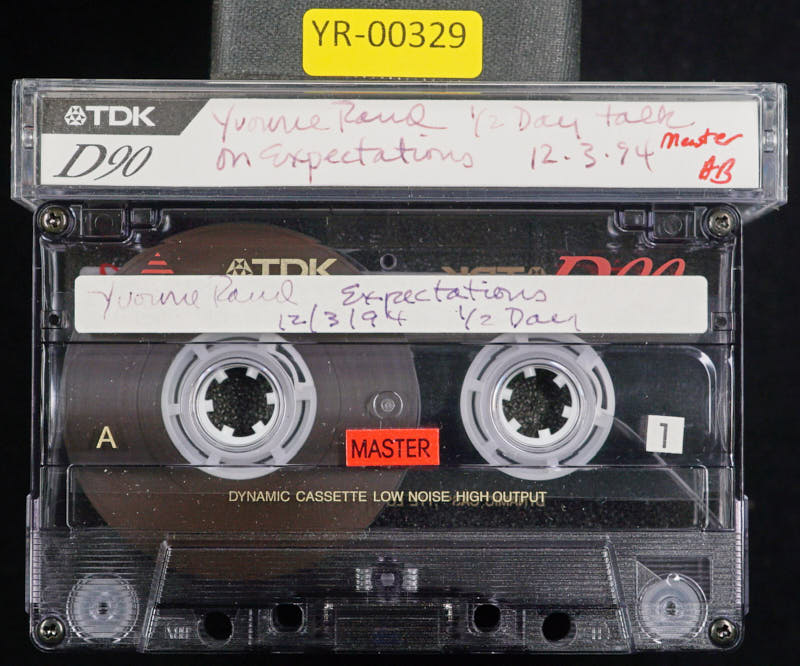
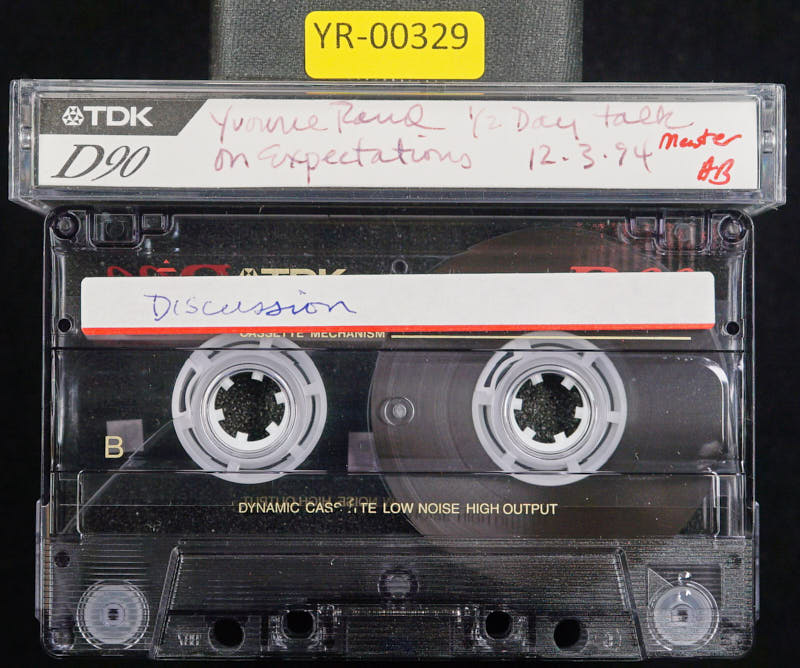

Speaker: Yvonne Rand
Possible Title: On Expectations
Additional Text: 1/2 Day Master
Speaker: Yvonne Rand
Possible Title: Discussion
Additional Text: 1/2 Day Master
@AI-Vision_v003
I would like to propose that my talk this morning might be called Some Remarks on Expectations. A friend of mine and of Bill's, a quite wonderful gardener, told us one time some while ago about a talk she gave titled Some Remarks. Both Bill and I were quite enchanted with the some part. Because, of course, we can't ever say everything there is to say about anything. I want to talk about expectations this morning because I think that from my own experience and also from observing the different facets and faces of suffering in our human lives,
[01:26]
that for many, many people, this time of year is a very difficult time for a variety of reasons. But one of the big reasons, one of the big baskets, if you will, of causes and conditions has to do with expectations that we have, particularly around what we call the holiday season. And of course the particularity of those expectations will be different from one person to another and from one family or group of friends to another. But we also have a kind of collective, social set of expectations that we are continuously bombarded by, now even before Thanksgiving. I saw my first Christmas tree this year a week or so before Thanksgiving.
[02:30]
The creeping, oozing aspect of the Christmas season. I've watched my children, particularly my son, suffer with Christmas very much having to do with expectations. And I've lobbied for some while that we just drop out of it all. And finally, we all have, individually and collectively, dropped out. And the dropping out becomes quite strenuously visible the day after Thanksgiving. It's such a relief. Because what I notice is that it's then possible for me and the ones that I hold dear in my heart to begin to pay attention to what's actually happening to us today as winter is
[03:42]
upon us, as the days are shorter and the nights are longer. We can take, at least have the possibility of taking good care of ourselves. And we have the opportunity to taste some wonderful surprises if we don't let ourselves get too caught up by the collective societal expectations, the commercial expectations, but not just the commercial ones. The ones that we have about what we should be doing with respect to the people we genuinely care about and are connected to. Nine years ago, I spent the winter solstice and Christmas and New Year's in northern India.
[04:43]
The solstice and Christmas in Bodhgaya, which is the small village in northern India where the Buddha sat under the Bodhi tree until he was fully awakened, seemed so right in the midst of the shortest day and longest night of the year to have the great stupa that has been built at the site of the Buddha's enlightenment to be covered by thousands of tiny lights of the sort that most of us use to put on Christmas trees. And to have the garden that is around the stupa filled, literally filled with thousands of butter lamps. And to have the whole area a kind of monomaniacal practice festival.
[05:53]
People spent the day and the night doing prostrations, sitting in meditation, reciting texts, circumambulating the stupa. It was kind of hysterical in a certain way, but so different from the hysteria that I'm used to here at home. Lama Govinda used to say that the holiday season here in the West can be very easily transformed into the occasion of Buddhist celebration. Because of course, what does the Lord Buddha himself represent more than light in the midst of darkness, through his teaching, through his example of realization? In this season, which is so much about acts of generosity, what are some things that each of us can do that are genuine acts of generosity, that include taking care of ourselves, not
[07:02]
instead of taking care of ourselves? How often do we suffer at this time of year because we have expectations we're not even fully conscious we have? And so we don't have the opportunity, we don't let ourselves have the opportunity to say, is this expectation realistic? Or is this a kind of fantasy? Are there some things that I might do to make my expectation more likely to come about? Like telling somebody what I have some dream about having happen. If I want Bill to ask me to go to the movies, it's much more likely to happen if I tell him how much I'd like to go to the movies, and I'd like to go to the movies with him. It might happen.
[08:02]
Then again, it might not. But there's some greater likelihood that that activity called going to the movies might happen, if I'm aware that I have that longing for a movie, and actually say something about it. I think for so many of us, the expectations that we have at this time of year come from when we were very young. They often are expectations that we have a kind of dedication to not bringing into consciousness. And certainly, the expectations include some notion that if I ask for what I want or what I would enjoy or would like or feel I need, somehow, if I get it, it won't be quite as
[09:03]
good as if those around me read my mind. I don't know about any of you, but I grew up in a family where that was one of the things I learned. To ask for love or attention or companionship or to ask for anything meant that what I received then was somehow second best. It would be much better if someone was a mind reader and figured out what it was I wanted and surprised me on Christmas morning and said it was from Santa Claus. Santa Claus is entirely about mind reading. And of course, the most effective Santa Clauses are the ones who say, send me a list. I'm not a mind reader. It's a very healthy kind of Santa Claus. But so many of our Santa Clauses are the ones who are supposed to be like the Buddha, all-knowing.
[10:04]
My own inquiry into this territory of expectation has led me to conclude that the conditioning that I grew up with about don't ask for it because that will somehow sully whatever will come to you was just very poor and inaccurate advice. Some while ago, Bill and I said, wouldn't it be nice to have a bird walk, a winter bird walk, because the birds that winter here are so beautiful, so wonderful to look at. So we kind of went like this and we picked a date, December 4th. How many of us have some expectation about, oh, wouldn't it be nice to go on the bird walk, and won't it be wonderful if we have a nice clear day?
[11:14]
Certainly no rain. We won't have rain. We hardly have any rain before the turn of the year. Oops. Right here we've had close to 14 inches of rain. So much for that expectation. My dear old friend and teacher, Harry Roberts, took a group of us camping once a month for several years, and we crisscrossed the coast range from San Francisco up to the California-Oregon border. And we had a regular schedule, and we went camping no matter what. And, of course, what I learned was that I don't melt when it rains. I learned something about how to make a campsite, how to make a kind of tent in the rain, in
[12:22]
a situation where we actually could build a fire and cook our food. The delight of sitting under a big, clear plastic tent with the big droplets of rain sliding off the plastic over our heads. We learned how to dress and how to equip ourselves so that we could camp out in the rain as happily, in some cases, more happily than during the summer. I wonder what happened to those people who said, oh yes, I want to come for the half-day sitting on Saturday morning, and then they got rained out. I can't go out in weather like this. I might melt. Expectations lead to enormous amounts of suffering in our lives.
[13:34]
We have some expectation of how something will be, or what will happen, or what someone will or won't say to us. And then whatever happens, we think, oh, how did that happen? There are some things that happen that we can't possibly know about ahead of time. But there's a whole range of our human experience that is affected by the expectations that we have, particularly when we're not aware of what they are. Those are the expectations that lead us to suffering. I don't mean in any way to suggest that we shouldn't have expectations. I think we do. I think that's how it is. And I'm not even sure that's a bad thing. I could even argue that the practice of clear intention is setting myself up for having
[14:43]
a kind of expectation, an expectation about how I might be, how my mind stream might be if I do this or that. I think having expectations can, in some situations, be quite wholesome. So maybe it's more accurate for me to propose that what I really want us to pay attention to is being more aware of the expectations that we have, cultivating mindful awareness of the landscape called an expectation. Because of course, the minute I have an expectation and I'm aware of it, I can then without any effort, the question arises, is this a realistic expectation for me to have in this situation? If I'm going to spend time with a friend who has a hard time telling me the truth about
[15:46]
certain kinds of things, and I go to spend time with that friend with some expectation that he will tell me the truth, that expectation flies in the face of everything I know about my friend and the ways in which he or she takes care of themselves under certain circumstances. Yesterday, I met with someone who was talking to me about some recent experiences she's had with her family. Experiences in which she has felt disregarded or not seen, somehow she doesn't count in her family system. And she then started talking about her own sense of her capacity for kindliness or consideration
[16:47]
or generosity. And I think her description of herself is actually quite accurate, that she's a quite considerate and generous person. The suffering arises with her expectation that other members of her family will treat her in the ways that she wants to treat them. And that, at least historically, up until now, is not what has been so. What has been so is that she seems to slip off the map for her mother or her father or her brother or whoever. In recognizing, oh, there's a certain way I want to be, and that may or may not be the way someone else wants to be, I can then be in the way that I want to be, that I aim towards,
[17:54]
that I cultivate, willing to have what someone else does be different. It comes up around this category of what is or isn't fair. I would argue there is no such thing as fair. And our expectation that there is leads us to incredible suffering. There is this kind of paradox, if I am willing to do the best that I can, day by day, to live in such a way that takes into account the effect of my actions on others, in a way that includes understanding that not all beings in the world will live in such a way. The paradox is that there may be a little more of that quality in the world than if
[19:00]
I say to myself, well, I will only be kindly to others if they will be kindly to me. Rilke's wonderful exploration about what is that love which expects nothing in return. Very different from that loving where I have some expectations about, if I love you, then you have to love me back. If I give you a present at Christmas, you have to give me a present, and not only a present, but one very much like the one I give you in value and all this stuff. I remember one time when I was actually rather young. For some reason, I remember the morning, standing in a field.
[20:01]
I lived on a kind of ranchette, and we had several acres and a lot of animals. And one of the pastures where two of the horses lived, I would often go and stand in. It was a kind of slope, and I could look across the valley to a quite beautiful barn across the way from where our house was. I remember this particular morning when I was about 13, having this very clear sense that one of my choices was to be willing to be taken advantage of. That that was something I probably couldn't control to the degree that I had up until then thought I could control it. And I remember a kind of relief. I do not want to take advantage of others, and if in some circumstances that's what
[21:08]
happens from someone else towards me, I accept that that may be so. It had to do with this notion of fear. Now, of course, the trouble with such a notion is that we can foolishly go into a situation where it's a kind of setup, where we don't contribute to the well-being of the world by letting someone treat us badly. But if in my relationships with myself and with others, what I'm going for is this realm in which I see that each of us is doing the best that we are able to do, then a certain kind of fallout in our human interactions doesn't strike me quite the same way as it might. My expectations may actually begin to be more realistic.
[22:14]
I may have a sense about what is likely to happen in an interaction with another person if I don't expect them to be anyone other than who they are, and am willing to be open-hearted with who that person is and how they are. The challenge is, of course, to bring ourselves to a situation where we are engaging with someone whose behavior may be troublesome, the neighborhood bully or tyrant, for example. If I have some understanding that this person has certain tendencies, then I'm not going to expect them to treat me nicely. That may not be in that person's repertoire this week. But I also, if I don't expect them to be different than they are, can begin then to move into
[23:20]
that state of mind where I don't take what they say or do as a statement about me. I don't take it all quite so personally. And I may, in that enlarged state of mind, be much more skillful and imaginative and certainly have my sense of humor, much more likely than if I'm engaged in battle. So I think paying attention to this patterning in the mind stream that has to do with expectations can be very rich and very interesting and can be a very beneficial area of noticing. And of course, as seems to be true with this whole vast path called the cultivation of
[24:23]
awareness, the more specific and particular I can be, the better. The more my noticing of expectation can be noticing of a particular expectation in a particular situation, the more I'm likely to tease up into consciousness the detail of the situation in my mind. I think that this kind of work with the habit of expectation has everything to do with the potential for the cultivation of equanimity.
[25:24]
And I certainly don't mean to suggest that the alternative is to have no expectations, to have a kind of low-level view about what may or may not be so. What I'm really talking about is the cultivation of our capacity to see things clearly, to see what is so with clarity. For some of us, we have a kind of habit of looking at what could be. We fall in love with somebody because of their potential. And then we spend our lives grousing about the fact that they're the way they are, not the way they could be. Forgetting, of course, that that's none of our business.
[26:33]
That's their business. I've had a kind of test in this area recently because, as I think some of you know, we're beginning to have a little flurry of lawsuits against spiritual teachers for sexual misconduct in their relationships with students. I feel like I'm up to my eyes with listening to people talk to me about their experiences in these situations. The stories are now coming from circumstances that are not limited to the community of Buddhist practitioners. And this whole question of expectation has been a very problematic one for me because
[27:37]
I have clearly some expectations about how a teacher should conduct himself or herself in relationship to a student. But it really is irrelevant what my expectations are for anybody but myself. And in fact, the more fuss and carrying on and jumping up and down that I do with other teachers, if that other person is not of some like-mindedness, we can't even have a conversation together about what is so. Over and over again, as I've been listening to people, what I've been hearing are stories about individual practitioners' expectations about, oh, if so-and-so is a teacher, a spiritual teacher, they surely must be trustworthy, they must be safe, they must know what they're
[28:39]
talking about, etc., etc. And, of course, sometimes what we expect of someone is in fact what is so, and sometimes it isn't. And it behooves us to keep our eyes open and pay attention long enough to discover where we are, not where we wish we were. One of the causes and conditions that lead to the suffering for so many people at this time of year has to do with light and darkness, has to do with, literally, with the shortening of the days and the lengthening of the nights. If I don't have some idea about how it should be, daylight for 16 or 18 hours a day, if
[29:59]
I can wake up to the day as it is, I have a greater possibility of being surprised and delighted by the day as it is and by the night as it is. There are vast treasures in the winter night sky, great beauty at this time of year. If I'm not continually yearning for summer and winter, I can begin to enjoy, I can begin to actually see and experience winter. I suppose part of my shift in my sense about rain has been influenced by hanging out with
[31:07]
the Tibetans, who always view the rain as most auspicious. Makes sense, doesn't it, if we think about the kind of environment that the Tibetans have lived in for so many centuries. Not much water. If I don't let the TV picture of what a family looks like at Christmas time, what has come to be described as the Ozzie and Harriet picture, that kind of fantasy expectation, it's a kind of fantasy, I can be present at this time of year with some openness to the situation as
[32:09]
it is. And there is so much about this time of year and the holiday season that is wholesome and makes a great deal of sense. A time when we want to cultivate generosity, a time of thanksgiving, a time when we actually pay attention to light and dark. I have a friend who's visiting, she's been here for a few weeks, she's been doing a practice period at Green Gulch, and she's planning to come and visit us tomorrow.
[33:15]
And she said with some hesitancy and a little, I don't know, almost fear, she wanted to know what time we would eat dinner, and admitted reluctantly that she didn't think she could stay up very late, because of course she's been going to bed pretty early, because she's been getting up very early every morning. And when I told her that she was coming to visit a house full of chickens, that we like the chickens seem to go to bed shortly after the sun sets, she was so delighted. She didn't need to apologize for being someone who likes to go to bed early, because of course she discovered she was coming to visit a household of people who like to go to bed early. A household in which Bill has been known to get up from the dinner table and disappear
[34:19]
and show up shortly in his bathrobe with his night reading under his arm and say, good evening, when you leave, please turn off the lights. She had some expectation about what it means for her to be a guest at someone's house for dinner. Be scintillating until 10:30. Such a gift that both of us could say, forget it after 7.30 or 8. And you know what I've discovered in admitting that I've become part of this chicken club is that there are a lot of other chickens. It's really wonderful. We're not, of course, living in the fast lane, but that also is okay. It's quite nice.
[35:23]
Getting together over lunch begins to look better and better. Especially if you include having a nap. So I'm fooling around, but I really am quite keen on inviting all of us to pay attention to expectations. The smaller, the better. Very fruitful inquiry. So on the theme of expectations with respect to weather, I asked Bill if he might recite the Dickens poem about weather.
[36:27]
Some of you have heard this. Sunshine is delicious. Rain is refreshing. Snow is exhilarating. Wind races up. There is no such thing as bad weather. Only different kinds of good weather. Tame birds sing of freedom. The wild ones fly. Nature gives to every time and season some beauties of its own. And from morning till night, as from the cradle to the grave, is but a succession of changes so gentle and easy we can scarcely mark their passing. I'm very fond of that poem.
[37:42]
Among other things because it's not what I expect from Dickens. Is it from one of his works? It's from a calendar. A quote on a calendar. And beyond that I have no idea where it's from. Do you know, Patty? I think it was on a calendar of yours. No? It was Lori Fry. It's her fault. Okay, well, there is some hot water and some tea and some cups and some honey in the kitchen. So if some of you would like to go and have some tea, we can reconvene in ten minutes or so and talk about whatever is on your minds or not, as the case may be.
[38:47]
So let's take a little break and get some tea. Okay. Speaking of expectations, I wanted to ask your support with respect to an expectation. I think some of us talked about this the last time we were together. There's a four-photo picture of this frog with expectations. And so much of the beginnings of a long-term relationship is figuring out how much have I lobbed over onto the other person around expectations, such that I don't have much of a sense actually of who's standing there and vice versa. There's a lot of bad expectations. Yes? I'm very intrigued by your commenting about you can only expect for yourself certain standards and not for other people's futures.
[39:56]
And yet, there is kind of a built-in expectation that exists with some people. And I think what I'm learning, because it's really true for me, I work with young people, and their sense of commitment and accountability and responsibility is very different than my own. So I get caught in ambushes all the time. And we always talk about setting clear expectations so that people know where to get to. It can become a trap. What we're trying to do is to build a sense of what do we all agree on that people can agree to in that kind of context. But it's still difficult because people have very different ideas about commitment and responsibility. See, I don't think the problem is when we have differences with expectations. I think the difficulties arise when we can't name what the expectations are. When we're operating from an expectation that we haven't flagged, described, articulated, we get into a different kind of difficulty.
[41:03]
When we have differences, we can talk about those if we can name them. If we have some voice with which to talk about the territory. One of the questions that comes up for me around this question of the expectations I have for myself with respect to being a teacher, and some expectations I have about what are the elements that contribute to a wholesome relationship between a teacher and a student, is how to stay with what I actually can do something about in such a way that will allow a dialogue with people who are operating from a different set of expectations.
[42:04]
Because, of course, part of what is happening is some breakdown in dialogue. Recently, Bill and I had a friend visit us, and he's doing work in other countries, other cultures, and we were talking about how in this country we rely on the law to articulate some of this landscape. So, there's this set of laws that describe how things should or shouldn't be, and what will happen when certain expectations aren't met. It's very rich and complicated territory, I think. Anyway, what I want to encourage for all of us is to look in particular at the pattern of having expectations for each of us individually in our own lives,
[43:22]
and just get to know what is the pattern for each of us in particular. To start with, well, to what degree am I someone who operates from having a lot of expectations, or not? Just to answer that question for starters. I can't help that I'm into gratefulness, okay? But I can't help but notice, as I'm into this, and looking back over the years when I've been sitting with you, is how sitting, when you sit down, of all the things I can think of, sitting is the one where you can have least expectations, and where your expectations are least accurate. As you sit down, you go, you know, the good sitting, the bad sitting, the, well, will this go away?
[44:25]
The complete lack of control for so long, in a way, when you learn to sit of expectations and the slowness with which that all takes place. As I think about it, particularly as it turned up when I went back this summer, I think the sitting itself gave me so many experiences that, when I experienced them in the outer world, expectation is certainly one of them. You know, you sit down and you think, oh, I'm all rested, whatever, this is going to be a good sitting, or this is going to be a good session. And after you've been doing this a while, it's quite difficult to expect what's going to happen when you sit down. And it becomes a delight rather than a problem. Well, you know, it's interesting to me what you're saying, because Suzuki Roshi used to talk a lot about not sitting with any gaining idea.
[45:27]
Well, you teach that. And he was really adamant about the problems that you get into when you do sitting meditation practice, particularly with some idea of getting somewhere, particularly getting enlightened. Because, of course, the very landscape of realization disappears the more grasping there is. So I do think that we can load a lot of expectation on our sitting meditation if we're inclined in that direction. I mean, I've seen a lot of people do it. But just in very simple ways, never mind enlightenment, just sitting down and expecting to make you feel good, do better, whatever. It seems to me I've always said I'm shattered in a very positive way.
[46:31]
Oh, I had this wonderful meditation when I go home and I'm probably going to be saint-like. And the next thing you know, you're yelling at someone because I have more energy. The negative thing comes out more negative and more destructive than it would have if I hadn't been sitting like, whoa. Yes, yes, yes. Irritated. Within 24 hours. It's a surprise to people at the end of a long retreat to go home and realize what a grump one may be the first few days because the world is not the way it's supposed to be. It brings that extra energy into some small negativity. It's more negative than it used to be. Can you just talk about knowing that we have no control over the outcome of expectations? How we can keep ourselves from being pessimistic?
[47:34]
Yeah, I think that's a good question. Could you repeat the question? Kathy's bringing up the question about if I understand that I have no control over the outcome in some situation where I have an expectation, how do I then keep myself from becoming pessimistic? But I think that you're really talking about the flip side of the same thing. If I have no control over how it's going to come out, then I have the expectation that it will come out badly. That's another expectation. And that's a very different state of mind than really understanding that because it's also so that the law of causation is operating. It's not that things just happen randomly. I think that's very important to keep in mind. I may not be able to control the outcome here.
[48:39]
Because there are so many multiple causes and conditions operating here, I'm not a solo agent. The more I understand how much I'm part of this web of interdependence, the more it's just a fact that no one person is going to be in charge of some series of events. There are so many factors in most situations. And in fact, if I can stay open-hearted, if what I keep cultivating and developing a capacity for is these various qualities of mind that the Buddhist path is about, of clear seeing, of open-heartedness, of calmness and equanimity,
[49:42]
of generosity of spirit and mind, the presence of those qualities in a situation have certain consequences. So it's not that if I can't control the outcome, I don't have some influence here. We're not saying that. We're just saying it isn't going to turn out the way I dream that it will necessarily. Well, some years ago I heard a lecture by His Holiness the Dalai Lama talking about hopelessness. And he was talking about what a troublesome and difficult state of mind hopelessness is. Again, I find myself wondering how much of our difficulty with this word and what it represents
[50:55]
has to do with our language. Because there is that hope that is based on a realistic appraisal about what possibilities there are. Being able to see, oh, with these various elements, there is some possibility in the way they may come together, for good or for ill. So there is hope in that sense of being able to see. If there are certain elements present right now, there is at least a potential direction, I can imagine. But then where do we get into trouble? Where hope has a quality of blindness. Where hope has to do with always going for the potential in the situation,
[51:55]
or the potential in the other person, without enough balancing about what is so. I think there is a very important and subtle line there. I know for someone like myself, having grown up in an alcoholic family, one of the ways I survived in the family that I grew up in, was being able to skew for what was possible, because what was so, was so dismal. Regularly, I was disappointed by the facts. So I am out of balance. And I can hang in, in a situation, keeping focused on the potential and not take into account enough, in the balanced sense, with things as they are. Is it likely that this potential will be cultivated in this situation? And where is that place for surprise, for being surprised?
[53:05]
Surprise being willing to be surprised by someone doing something that they've never done before in their lives. I was convinced that my mother would die not feeling loved. That she would not ever, in this lifetime, have the experience of feeling loved by another person. I didn't take into account the absolute, unrelenting doggedness of my children, particularly my daughter, who was not going to let her die without experiencing a certain kind of love and affection and tenderness. And she just took it on, and just badgered my mother for a year and a half, got in her face, heckled her, teased her, just wouldn't let her off the hook. And much to my amazement, my mother got it. She forgets it regularly, but she's had that taste, which I was sure she would never experience in her lifetime.
[54:14]
Am I willing to be surprised? Am I willing to surprise myself with my own possibilities? And am I able, am I willing to be surprised by another person? But again, it seems to me that we want some balance. If we're always looking for the person being, you know, perfect. There's a kind of blindness and a sort of negative self-fulfilling prophecy, because it's based on not being clear in our ability to see. That's why, you know, the first of the Eightfold Path is Right View. Being able to see clearly, being able to see right in the sense of correct, what works.
[55:17]
Being able to see clearly is very, very important. You know, this is why the practice of saying, my archenemy also wants to be happy. I'm much more likely to see that little shred of that person also wanting to be happy in the way I want to be happy. I'm more likely to see that if I can remind myself that there isn't anybody who consciously wants to just go and suffer. Man, it comes up, you know, the stuff I've been reading recently and listening to interviews and all about the whole punk scene. And a kind of fatalism and despair that the whole punk culture seems to be expressing. But, you know, the more I listen to some of these kids and listen to what they're saying and the songs that they're writing and that they're listening to,
[56:29]
I can hear, you know, they're still not an exception to this notion that we all want to be happy. They may feel despairing about that as a possibility. That doesn't mean that each of them doesn't want to be happy. It's very hard to see that in some people because of the way they behave or the way they speak or dress. Somebody walks around with a safety pin through a nipple or a nose or whatever. It's sort of hard for me to think, this person really isn't consciously going for suffering. I'm not sure about it. We were in New York. I saw piercing through parts of the body. I mean, I was just stunned. Anyway, I think the whole notion of hope is tricky, dangerous.
[57:36]
It's very dangerous. Can you cast any light etymologically on the word hope? No. Some other time, perhaps. Yes. Yes. Right. Yes. Yes. Well, this is why some of us have started talking funny.
[58:44]
How is it you proposed introducing yourself a couple of weeks ago? John? I just had a thought about expectations, the way it's kind of showed up for me recently, has been the stories that I tell myself about how things are and how people are. In particular, how one or two people I know are there, whatever. And it's a story, and I have data, so to speak, to back it up. And as long as I hang on to it, it creates suffering in my life. And when I can see that it is a story, and just a story, but has no basis in reality usually,
[59:52]
then I get to see who this person is again. Or it may be that the story is based on experience historically, but what happens when I say, so-and-so seems to lie to me about such-and-such so far, up until now. It's that mind where we hold the possibility of being surprised. We hold the possibility of change, of something unexpected. That if it is true that everything changes, even the person we've known for many years, who has up until now behaved in certain ways under certain circumstances, may this next time we are both in these circumstances, this person may or may not act the same way. That mind state of holding with some tentativeness.
[60:55]
Even what seems to be so. Even what in our experience is reliably what's going on. Always to hold whatever with that kind of tentativeness allows us to stay present. And it's those stories which are usually a generalization. This person always does blah, blah, blah. Or I always do blah, blah, blah. It's a kind of concretized thing. Say it happens that that person has done blah, blah, blah to you over the years. Pretend it's a snake who's venomous and bites you. I mean, it's sort of not a sensible thing to do to hope that the snake's going to change. Yeah. Or to go pick it up. Or to go pick it up. That really wasn't a part of what I said.
[61:57]
No, no, no. It's about my own thing, I'm thinking. I'm dealing with something of my own here. Because we talk about forgiveness. We talk about holding the possibility of change. We talk about all those kinds of things. And it may be true about being burnt. It's sort of like protecting yourself in some way. Not to put yourself out there again. Although it may hurt a circumstance a little bit. I mean, this is something I'm dealing with, so if it's off the mark. No, no, no. It's not off the mark at all. I think that it is possible. Well, the situation that comes up for me with this question is the situation that I have and probably will be holding until I take my final exhalation. The experiences that I had over a certain number of years
[62:58]
with my ordination teacher leave me with the notion that this is someone that I don't trust very much. This is a person that I have some sense of understanding about. Compassion for. And that I wouldn't dream of not being careful around. And that I would be thrilled to be surprised by some change in his behavior. But I'm still going to be cautious and attentive to how I bring myself to a meeting with him. So it's not, I don't think it's either or. This goes back to Bill's issue around the very language we use. That I can be with a snake that is a poisonous snake.
[64:03]
And I can include the possibility that the snake may not bite me. But I can also include the possibility that the snake may. Would you avoid just being in the presence of the snake? In some situations, yeah. Particularly if my own response to the person or the particular situation is such that I'm not developed enough to be able to stand without mostly fear or some negative state of mind. Yeah, absolutely. I mean that's where the advice in the tradition about how to work with anger includes not spending a lot of time with people who are angry a lot. Because we just get more familiar with anger.
[65:06]
This is also where making a distinction between the person and the person's behavior can be very, very useful. I can actually sustain and develop, cultivate real open-heartedness with someone and be very clear about my boundaries and limits with respect to certain behavior. If you behave in these ways, I will leave the room. And I don't have to do it by making that person a terrible person. I can just say, this is behavior I'm not willing to stay in the presence of. And the whole tone with which I do that is different depending on whether I see that there is this person who indeed wants to be happy just as I do. And this person is behaving in a way that I do not want to stay in the presence of. It also means I have to be realistic about what I'm able to do today.
[66:12]
I may be able to do something different next week, but today this is what is possible for me. And I think one of the things that happens in the Buddhist tradition is that there's this idea that maybe we should just be like doormats. We should just let people do whatever they want to do and be this completely open-hearted, forgiving, loving person. I don't really think that's what the Buddhist teaching is suggesting at all. It's not about no boundaries and no limits. Because among other things, if I participate with someone in a way that supports them to be a tyrant, that's not wholesome for me or for that person. When I contribute to someone acting badly in some way or support that, that's not a kindness to that person at all. Any?
[67:18]
You might really round my cage with this notion that there is no such thing as fairness. I've always tried to tell myself that low expectations will spare me a lot of disappointment. So I've been conscious of expectations and the role they play for me for a while. But you made me realize just now that I have a very high expectation that fairness should prevail. I don't think I did. I didn't make you. I said something and you had a response. Okay. All right. Well, I think that for many of us in this society, we have unexamined ideas about there are things that are fair and there are things that are not fair. And that notion of fair can distract us away from looking at what is so.
[68:22]
And if I look at what is so and I begin to develop my ability to describe, observe and describe causes and conditions, I begin to see things in a much more complex but accurate way. And fair slips off the map. I understand that. But it seems to me also that you talk about holding a thought for change or holding a hope for change. Don't you also think you need to hold a hope for fairness? Because if you completely let it go, maybe then you do fairness a disservice. What do you mean by fair? I don't know. That's my point. I think for most of us, if we were going to be very precise about what we mean, we don't really know. I think there are other qualities. Justice? I don't relate to fairness.
[69:24]
Yeah, I think they're related. Ask any eight-year-old, he'll tell you what's fair and not fair. Children at a certain age know exactly. Compassionately. It's a stage of thought. It's a level of thinking. Well, it has to do with a group of children get very excited. Members of the group of children will get very excited when under what look like the same circumstances, one child gets a candy bar and no one else does. Deserve is in there. Fairness. Well, I think it's related. Our ideas about equality are related to our notions about fair. I've worked really hard, I've been really nice to this person and he still doesn't love me.
[70:30]
It isn't fair. There's just a whole lot of other causes and conditions that are leading to the situation being what it is. And this notion of fair keeps me from looking. I'm just not looking at what's going on. And I think fair has a lot to do with expectations. If I work hard, when I get to be 30, I ought to be able to buy a house. Well, that's not what's happening anymore. What it also does, which is really dangerous for me, I know, most likely for most people, is that when the concept of fair is violated somehow, it produces an outraged sense of justice, which is anger in a different context. And it's really quite vicious. I think rules and expectations and fairness are tied up in a way.
[71:31]
Because if you're going to play a game with someone, like hearts or monopoly or chess or whatever, the two of you or group of you have to agree on what the rules are. Because if you don't, then there isn't any game. There can't be a game. That's correct. But to say that is more specific and focused than to say, you can't play because you don't play fair. What we're really saying is, you can't play in this game unless you're willing to abide by the rules that we've all agreed is establishing the ground called the game. So we designate something or someone as being unfair when they win a game of cards by cheating. We say, oh, that's not fair. What we're really talking about is, this person is not willing to play this game abiding by the rules that describe the game.
[72:33]
So I think part of my difficulty with fair is it's a general issue. It's a generalization. There's a vagueness to this category called what is fair. What do we mean when we say someone is fair-minded? I think usually what we're really talking about is someone is not doing habitual judging, judging and blaming. They are willing to listen to or look at as much information about the situation as they have access to to come to some conclusion. They haven't judged it prior to having the evidence presented. Well, that begins to be a refinement that begins to make more sense to me. What happens when you don't have habitual, that is, unconscious judging and blaming in any given situation? The experience of being in such a situation is quite different from being in a situation
[73:37]
where there's a lot of prior categorizing about what is so and what is not so. So for somebody to judge me before they get to know me, my response is it isn't fair for them to do that. Well, maybe that's another way of saying there's something here that isn't working, much the way you can't have a game unless the people playing the game agree on a set of rules that describes or defines the game. Richard? By unfair we mean someone who is undermining what we thought was a useful game. I mean, maybe it's not useful anymore, but it looked useful for a while. Now they're pulling the rug out from underneath it. We can say this is unfair, and we can say we still need this game. It's serving us. But maybe it's not. But I just think we come up with a different description that can be more particular
[74:40]
and I would argue may be more useful when we're using different kinds of language to describe those differences. For example, what happens when people are playing by different rules? You know, there are, if you look at the history of war, the rules for how to fight a war have changed dramatically to the point where we can't afford that particular game anymore because the rules have changed to the degree that we are able to annihilate each other and ourselves. Pretty interesting. I think one of the reasons I'm intentionally something of a provocateur about fair is because my experience is that often when someone says it isn't fair,
[75:45]
they're responding in a way that comes out of a lot of unexamined assumptions and expectations. So that's a very big piece of what leads me to this conclusion that at some level there is no such thing as fair. Because it's just not a precise enough term in ordinary parlance. Bill? I really think this is just a rich smorgasbord here. What you say is it's not fair. Yes, we have the great it and there is no such thing as fair. I'm unhappy. I can't say that because I don't look good. I'm unhappy and I'm not supposed to be unhappy. I deserve to be happy. It is in the declaration of independence of my constitutional right to be happy.
[76:48]
And someone should make me happy. And I'm frustrated because I didn't get what I wanted and had every expectation that I'd be able to get it. It's my constitutional right and somebody out there is responsible for making me unhappy. And I should be able to sue. And it's a cruddy situation. I'm unfairly treated. All right, let me propose a different... Passive voice language. Let me propose another situation. I have been told that in Japan, when there is a car accident, there is no designation of a person who was at fault and the victim. Everyone involved in a car accident is considered to have some participation in the accident happening. That is a very different view. So, you know, here, if somebody rear-ends you, the person from behind is at fault.
[77:55]
The fact that you were sort of just daydreaming and just suddenly stopped in the middle of the road and the person just plowed into you isn't taken into account. But the same accident happening in Japan, there is this notion that if two cars collide, there is a way in which both drivers had some responsibility leading to something called a car crash. Well, still... Yes, that's correct. That's correct. It is putting the emphasis on the and. And that shift is, I think, really crucial if what we're going for is being able to see things clearly as they are.
[79:03]
This gets us back to seeing the multiplicity of causes and conditions. I don't understand that. Well, nothing is as simple as it appears. If you just take these eyeglasses and we go back far enough to all of the causes and conditions that led to these eyeglasses being in my hands, if we go back far enough, we have the entire world. If you unpack the fact of interdependence, you know, there is the person that runs the store in New York where I bought the glasses. There are the people that he gets the frames from, who made the frames. And then there is somebody else involved in making the plastic that's used to make the frames. And then where did all those things come from and who was involved in having them be put together?
[80:09]
Same thing with the glass itself. There is also the eye doctor who did the examination of the eyes that led him to then make the prescription. But there's also, you know, where did my eyes come from? That's part of, you know, my mother and father. And then their parents. And then their parents. Okay, but on the example of the car accident, you're not saying that each one is not a blame person. That's correct. They're both involved because they're both involved. That's correct. Regardless of whose fault it was. There is not this idea that it's somebody's fault. There is a recognition that there is this coming together of causes and conditions that led these two people to be driving in such a way that these two cars smashed into each other. So what we all hold in our minds as you say this, is this sweet nuclear family going down the road and this drunk driver coming in,
[81:13]
totaling the car, this is his third conviction, and that family's dead. And that's what we're all holding. And if that is unfair, we all hold. As we have this discussion. So I tried unpacking that. That was interesting. Well, and when you unpack it, it gets very complicated. Very complicated. Drinking. The liquor industry. And then the third article that nobody reads. And then just for fun I played with it. Turns out that the driver of the car owned the liquor store. No. It's fooling around. But that's kind of unpacking. Carol, what you're fooling around is much more in the direction of an Asian interpretation. Oh, I know that. I know that. The old Dr. Spiegelberg at Stanford used to say, suppose you're walking across the Stanford Quad. A tile slips off the roof and hits you on the head. The Westerner is going to scream. He's going to sue the university. He's going to make a great ruckus. He's going to call witnesses to see what happened.
[82:16]
The Easterner is going to look around quickly to see if anybody's seen a duck into the trees. And figure out, what have I done? Such that this should happen to me. A dinosaur of fire life. There's no insurance industry in Asia. Perception of causality. So just say that again. There's no insurance industry. No. If accidents happen, it's karma. None of this says that the drunk driver shouldn't be locked up. No, no, no. Not at all. Not at all. But there is some recognition of a very complex... The degree of complexity is recognized with respect to the very deep understanding of the law of causation operating constantly. It's a very different view than one in which something just spontaneously happens
[83:17]
without any causes or conditions. We're getting the worst of both worlds in the West. Because now we're beginning to uncatch this and go back and back and back and suing not only the driver, but the... Oh, right. Ted Koppel did this just last night. You can go back, you sue the barman, who let this guy go and drive. They're suing a mother now who let her children go in a car with her ex-husband. But what I'm talking about... But they're not suing the judge. But what I'm talking about brings into question the idea of suing someone. Yeah. It brings into play the idea of blame. That's correct. Pretty well. Well, if you look at the place of blame in Buddhist psychology, it's recognized as unwholesome. The capacity for blame
[84:17]
is seen as a very unwholesome state. And in fact, what we would call a sociopath in Western psychological terms would in Western psychological terms be described as someone who has little or no capacity for shame and an overdeveloped capacity for blame. That's a very, very interesting combination. On this cheery note, I would like to wish you all happy holidays and watch your expectations.
[84:58]
@Text_v004
@Score_JJ