You are currently logged-out. You can log-in or create an account to save favorites and more. more info
Vajrayogini Retreat: Pathway to Divine Union
The talk primarily discusses the methodology and structure of traditional Tibetan retreat practices, particularly the Vajrayogini retreat within the Sakya tradition. It details the preparation, execution, and visualization techniques essential for conducting such retreats, emphasizing the significance of mantra recitation, deity visualization, and the setting of limitations. The session also covers the importance of creating an appropriate environment, setting up altars, and making offerings, as well as the nuanced practices within the retreat to achieve spiritual closeness with the deity.
Referenced Texts and Concepts:
-
Vajrayogini Retreat: Discussed as the primary focus of the talk, detailing the traditional methods of conducting a retreat, including the mantra recitation (400,000 times as per the degenerate age adjustments) and visualization processes.
-
Sadhana Practice: Explained as a vital component of the retreat, where the sadhana is recited multiple times per day with special emphasis on visualization and mantra recitation.
-
Vajra Tantra: This source is mentioned in relation to the mantra recitation specifics, highlighting the adjustments required for achieving realizations in the current age.
-
Sakya Tradition: Referenced as the tradition underpinning the specific retreat methods covered, especially concerning mantra count adjustments and the forms of visualization and offerings.
-
Chakrasamvara Tantra: Mentioned as the origin of certain practices within the Vajrayogini retreat, linking the retreat’s methodology to its broader tantric context.
-
Guru Yoga and Mandala Offerings: These foundational practices are included within the retreat structure, each performed with specific numerical diligence (100,000 times each) to solidify spiritual discipline.
These elements integrate to form a comprehensive guide to a traditional Tibetan retreat, focusing on attaining spiritual closeness and understanding through structured ritual practice and mantra concentration.
AI Suggested Title: Vajrayogini Retreat: Pathway to Divine Union
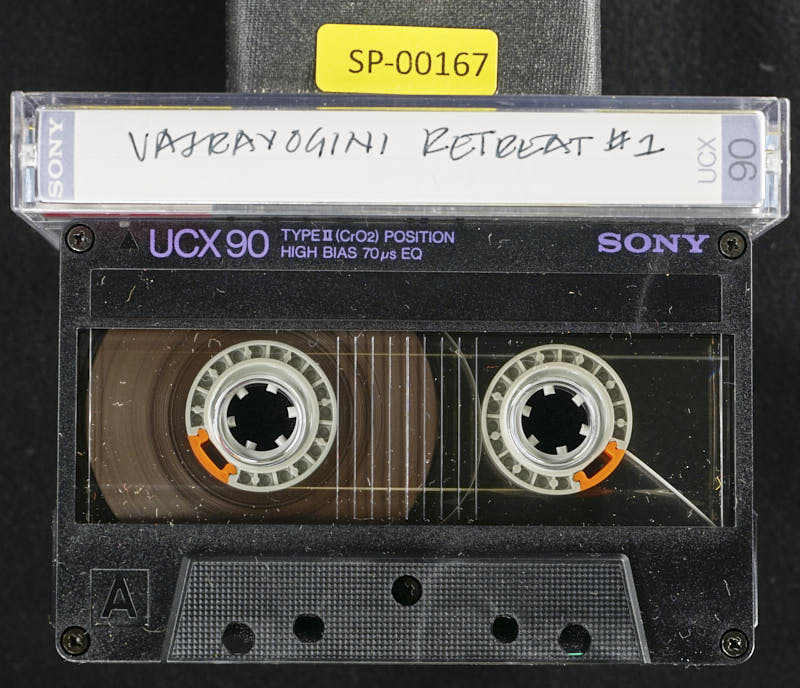
Same series as 00174
It's from the bottom top, because he'd not lose more than you. Okay, this one will lose that. Three faces. Yeah, so it's just the same thing. So we should start?
[01:13]
All right, actually, maybe I'll just explain some things. that retreat first and then before we actually started to give some ideas about a very traditional basic Tibetan retreat and how you would really do it if you were doing a retreat according to the forward or traditional methods, proper methods. So for doing that actually there's a lot of preparations you need and lots of things you need. Of course you need initiation, you need the blessing, teaching on how to do the retreat or on how to do the satan itself. And then when you want to do the actual retreat, it says that there's different ways to do a retreat, either according to realization, according to time, or according to mantra. So, for example, according to realization means that you start a retreat until you actually see the deity face to face or you have some very clear sign that you do not stop the retreat. That's sort of what is known as a retreat of experience.
[02:16]
The retreat of time is certain retreats that you do for a certain time, like seven years, or three years, or one year, or six months, or one week for certain retreats, depending on your deity. There's different traditions that do for certain deities a certain amount of time that you do retreat. And then the most common method for doing retreat these days is actually by the number of mantras that you do. So according to Saky tradition, the basic idea is that if a mantra is less than 16 syllables, that you do 100,000 times each syllable, So, for example, if you do a moniker in your home, for example, a retreat of operative fesha, since it has six syllables, you would do it 600,000 times as a basic retreat. Any deity that has a mantra more than 16 syllables, in the sacriotic school, say that you recite the mantra 400,000 times. So, the Lajugini retreat, from the purpose of recitation, you would do it 400,000 times. So, whatever it takes you to recite that, you do that. reciting this mantra 400,000 times.
[03:18]
Actually, according to the Vajra Tantra, it says that you recite the mantra 100,000 times, but it also says that because we're in a degenerate age, when we can't get realization to 100,000, it's better to recite 400,000 these days. And so what is known as a basic retreat of just, in a sense actually, In Tibetan, the word for recitation like this is , which means to approach. So it means you approach the deity, you come near to the deity. So by reciting a mantra, you come near to the deity, and that you need a certain number of mantras according to sort of general experience of other practitioners in order to really approach the deity and come close. So that's why they say, for example, . Many people actually have to do a Vajugini retreat. It basically takes about two months to recite, a month and a half, two months to recite a month to 400,000 times.
[04:23]
When you're actually doing a retreat, the method of doing a retreat, there's a couple of different traditions. Some say actually that you would do the Satana three times a day, some say four times a day. According to this specific form of Vajugini, which comes from the Saka tradition, the self-secret Sakya, they're very strict now, so you should do four sessions a day, and that are three. So what happens during your four sessions is that you recite the entire sadhana four times. And if you're concentrating on the mantra, then what you do is you just go right basically very quickly through the sadhana. And then when you get to the mantra, then you just stop. And then for the majority of the session, then you're just doing mantra recitation with the correct visualizations. And that's what you're concentrating on. What we're going to do today, or what we're going to do during this retreat, actually is slightly different because, for one thing, we don't have the time to do 400,000 recitations. And also just to give an idea of what the entire teaching is like. And some people actually do a retreat also of the entire teaching of what was given with the community gave earlier.
[05:27]
So the best method for doing that, actually, because it's very traditional, is that you're going to do a very long retreat in which you do the foundation practices in conjunction with the sadhana or in conjunction with the deity. So for example, you would do 100,000 idol prostrations or refuge prayers, which I would like to do, within the sadhana of Adyargini. So to do the retreat of that, for example, and that's what we're going to do in the first session today, is that you start the sadhana, and when you get to the first part, where it is actually the recitation of the refuge prayer, the refuge visualization, you stop there, and you count 100,000 times of that, and that takes actually a month or so in a very strict retreat. Then when you finish that, then you go to Vajrasattva, and Vajrasattva also is within the sadhana. Then you go to Vajrasattva, and then you stop there, and then you go 100,000 ways. You do the sadhana up to that point each day four times. No, you do that, and then when you finish that, then you go on with the sadhana, but very quickly. You must finish the sadhana each time, but your emphasis within that practice is on that one specific aspect.
[06:33]
So first of refuge, and then Vajrasattva. But every sadhana, or every session, you must finish the entire session, the entire sadhana. And then after that, 100,000 of that, then you do guru yoga and then also mandala offerings, each one 100,000. And then when you finish that, then you go on to different aspects. If you want to do the entire teaching, then, for example, the next part really is to concentrate, do concentration meditation with the deity, so that there's a place inside where you stop, and then you start concentrating on that. And we're going to do actually one of these sessions every day like this. We'll change around. When you finish that, for example, I myself did one retreat of Vajra Gini. Actually, I did two retreats of Vajra Gini. One where I just did 100,000 recitations, or 400,000 recitations a month. And actually, I had done the foundations earlier of Vajra Gini, but separately. Like I did one month, and then after some months, I did like a one-month retreat, then stopped for a while, did some other things, then I came back and did another month of Vajra Satchim, and I've got instead of just one solid retreat.
[07:38]
And then when I had the chance, then I stopped and I did the entire Vajra Guinea retreat of 400,000 recitations. And then after that, again, I did another retreat. And during the second retreat of Vajra Guinea, what I did was to go through each section of this. Instead of doing the 100,000 of each preliminary, one way that they do in Saki also is to do three days of each. So three days of refuge prayer, three days of Vajra Sattva, three days of Guru Yoga, three days of Mandala offering. When I finished that, then I did one week of concentration meditation, starting with the central eye, and then just concentrating on that for one session or two sessions, and then going to different parts of the body, and then like spending a few days to a week just doing that on concentration meditation. But again, doing four sessions a day. Then after that, I went to the mantra recitation, then recited 400,000 times the mantra, which took about a month and a half. So, I mean, in that part, the entire retreat took about three months. Then after that, there's the meditation day on thought. Then we start for about one week and do a strict retreat, just on that. Within the side, we're concentrating on meditation and that's all.
[08:41]
Then there's a power practice. Then we start the 10 days of power practice alone, just doing that, concentrating on that. But again, within the entire system. Then finish that, then start on inner heat practice. And then there's some other practices again. So you can go through an entire teaching like that. It's best, I think, actually, to, if you have the time, to do the entire foundation separately, 100,000 each, and then do the basic retreat of reciting the mantra 400,000 times in a strict retreat, if you can, in America. And then after that, to come back and then start really working on each section again, so that you're really, really in tune with the practice. And then you can go back and work on the entire teachings that I call meditation. But again, what we're going to be doing this retreat is to do each section so you just know what it really feels like to go through the entire teaching, and we'll do one session. Each session we do, we'll concentrate on one different thing.
[09:42]
Like today, we'll concentrate on Refuge, but then we'll do the entire thing. So, and that's basically the idea. Now, when we do a basic retreat, the thing is first that you should be in a very quiet place if possible, a place where you can be undistracted, also where you have proper food, proper necessities, and a few kind of help over-happiness. And then the idea actually in Tibetan, the word for your treatment is Sam. Sam actually just means limitations. You limit yourself. You limit what you do. You limit your activities. You limit the place you go. You limit the people you talk to. You limit your time, what you're doing. For example, you're doing four sessions a day. Then you're making limitations on your time. You're sitting two hours, three hours, four hours a session, whatever you want to do. in these sessions, limiting the time that you're doing with yourself. And especially the place that you limit where you're going. In a very traditional retreat, actually, there's a certain ritual that you do before, and you put markers outside. And wherever you put, usually the markers, like a white stone.
[10:44]
And wherever you put that white stone, you can't go further than that. And then you put a second white stone inside, and that inner stone means no one from outside can come further in the neck. So there's sort of two stones. One you can't go further out, and other others cannot come further in there. However, what you usually do is you set up a list of names of people you will meet during your retreat, so that you know exactly who you'll meet before, and those people are allowed in the room. Even those, actually, usually we don't allow in our own meditation cell, usually we'll have a second room or something where we'll meet people, unless you have a special, your own teacher who comes to help you with things like this, or people who assist you for bringing food or something like that. Also, when we set up the meditation room, First of all, it should be clean. Then we have to set up a shrine, which we've done here. So for the shrine, actually, it's good to have an image or a tanka or a painting of the deity. If we have here, we have a couple of images. In front of that, on a higher level, we put the Torma offering. So here we didn't make Torma offerings, we just put out food.
[11:46]
And actually, Torma is just a food offering. And to that, it became very complicated, but everyone wanted to make it very special and very fancy, different types of Tormas with different deities. According to the guy who was the last of the Indian gurus who brought the Landre teaching of Satya into Tibet, and his own disciple, who was the translator of Goma Lakshawa, in their teachings they said actually, Tama offerings is a heap of food, they never made any special designs, but in later times actually became very special. So actually it's just, it's representing food. So basically what we've done there is just put up some food offerings. Also an offering of tea, because during the retreat we had to make Tama offerings out in session. And then in front of those, we put offerings. So there's just the ordinary offerings here, two water offerings, and flower, intense, lamb, scented, water, and then a general food offering. So this is the basic shrine that we're setting up. Sound. Actually, in sake, for an offering, outside you don't put sound offering.
[12:49]
Actually, you just have to put stuff with yourself. There's no special place for sound. Some traditions such as Targiva Vale put a separate offering up there as an eighth one for sound or music. Then when you set up the shrine, on the first day actually, there was a special kind of tree resin which I was burning. It's good to purify the shrine with this tree resin, actually with the smoke of the tree resin. I forget, I think it was called benzene or something like that. It was a couple different times. There are a couple different types, actually. I mean, this one comes from India. And then, in any case, every session also, what you have to do is to bless the shrine by, from the shrine, or on your own table, you have some nectar pills, which I gave some away, which you have. And actually with this, you should sprinkle the water from your left to your right, actually the nectar itself. And then from right to left, you sprinkle water. And this is actually to purify the shrine and just to bless the offerings that you make.
[13:52]
And then every time you make a Torma offering, so every session that you make a Torma offering, you have to put new offerings up. So what we have there, actually, is we have three Tormas, or three tins of food, and I put little cups next to it. So then those little cups will add these little biscuits as a supplement to the Torma offering. You don't have to put new Tormas every day, we just put supplements. So that's what we have up there. And then also for your ordinary offerings, you add a little bit to each one, like the first two awards, you add a little water to each. And then flowers and incense, actually, We just have rice inside, so you can add a couple grains of rice to it. And then burn another lamp, add another little food offering like that. So the only time actually you need offerings is when you're making thermal offerings. For your general day, it's good to have offerings, but during the retreat, it's because you're making a thermal offering during that session that you must have other offerings also. Because actually, what that is, it's called an outer creation. You're invoking the deity outside, in front of you, and you're making offerings to the deities. So for that, actually, we also want to have an offering as an appropriate offering for them.
[14:58]
So that's the purpose of that. And then in front of you, what you should have, actually, you have a small table, and then you should have a spell cup. Now in India, they make very nice little metal ones. And inside, or just an ordinary cup, inside you have some nectar pills, or if not, some beer. This is actually for what's called the inner offering, offering five vectors, five meats. And then a bhaja and bell. For certain retreats, you need a jump. Actually, this is a Vajrayogini retreat, and for Vajrayogini, it's a mother-line tantra. So for mother-line tantras, usually we use a jump. These days in the Vedic, everyone uses a jump for everything, but by tradition, for father-line tantra and also in Mandu-line tantra, we don't need the jump. It's actually for mother-line tantras. And then also summarize for blessing the shrine at the end of the sessions. So these are sort of like the outer things that you need. Then also, for retreat, basically what happens in a very strict retreat is the place you sit for your session and the place you sleep is the same place.
[16:06]
You don't move anywhere. You can lie down. According to certain traditions, people say you don't lie down. What we usually practice is that you can lie down, but the place where you lie down is the same place where you're doing your session. Actually, in scripture it says that the place where you're sitting during retreat should never become cold. So it means you're not wandering off somewhere long enough that your seat becomes cold. And today it's a very cold place. I think it became cold very cold. Here, actually. But that's the idea. Like you could just sit and do your session and not just lie down. So you have to sort of bed in a place, everything at the same. And then underneath of you, to make it firm and also a symbol that you're within what is known as the protection of chakra, that you put a double vaginal, and that's why we made these joints. So what you can do is you put it under you, under your seat, and that's the place where you're sitting around. Under the cushion? Under the cushion. Because actually you shouldn't move. It should be there all the time. So basically in the retreat, really, what happens is because you're using the same seat, that you're never moving anything. Well, it's ever comfortable for you.
[17:09]
There's pillows here. There's lots of them. So what happens then, actually, is that the place that you set up to be your seat, you have this double bodger there and it doesn't move. And also, actually, they would put some cushion grass down as a sign, actually, just like the Buddha Shaky Muni set on cushion grass when you get enlightenment. So as an auspicious sign, this would be the place of your enlightenment. And also sometimes they put rice down. Actually, to do that, you shouldn't be on the floor. You should be on a little raised platform, because if you're on the floor all the time, it actually gets very moist in the same place you're sitting. So in the scripture it says that the place you're sitting there should be some kind of air ventilation underneath of it in order to, just for the purpose actually that things don't become moldy and wet.
[18:15]
That's very comfortable. So that's actually the place where you're sitting. Any questions up at this point? There are two shraves. us to the deity and this is to the... Well, this is just their house shrine, all these people, you know. So basically what we want is just one shrine for the hall, for your room, your place. So you're set in that way. And on the first day, we're doing a retreat in a traditional way. What we have to do is, according to ideal, old ideas, In the area where you're going to retreat, there are certain spirits that live there. And there's different types of spirits that live in a place, like the land itself, like the earth spirit, or different local spirits, sort of place spirits that live in an area.
[19:22]
And some have the power, due to their karma, and also if they happen to have blessings before, to stay here. And some don't have the power to stay here. They're not authorized, in a sense. So the first day of doing a retreat, actually, what we do is the first thing to start the retreat with it is to do a Thurma offering, which is known as the preparatory Thurma offering. And the preparatory Thurma offering is in order to clear the place of any obstacles, any spirits or negative forces which are going to cause hindrances or obstacles to the retreat. So for that, actually, we make the Thurma. Here, actually, we just have some blood on top there. And the idea here, actually, is that those that are allowed to stay here, they'll be invited to stay, and those who are not allowed to stay, they'll be chased out. And when they're chased out, we don't just throw them out very nicely, we actually give them some food, and we also ask them to go in a very firm voice, but also that we do it nicely, that we give them some food. So what we're going to do now, and actually this is here, the first thing is to do this preparatory tourma offering of clearing the area where you're going to do the retreat, asking for the blessings of the deities,
[20:29]
asking for the lessons of the Triple Gem, and then also to pray the area of any obstacles. So to do this, it's actually a ritual itself, which we're going to do on these papers. I have a few other questions. Is there any way to do a retreat at work? In other words, like if you could get up at 3 in the morning and do one or two sessions, or work and come home, or any of those traditions. Actually, it's best to really just put time aside completely because, I mean, there's great benefit in doing like that, but at the same time, it's not a real retreat because you're going to be distracted. And the idea actually, also this idea of limitations means limiting your thoughts, limiting your spirit of experience during that day. So it creates, and it creates distractions for you in trying to do it that way. If you really can't in the beginning, I mean, especially people working, I think it's good to try to get a weekend like this and just do a weekend of retreat in the beginning.
[21:35]
And then eventually you get one week or two weeks or a month, then try to do an experiment in that way. And that's good. Like, you know, for a few, like preliminary practices, you know, like refuge or frustration and larger stuff, I think it's okay to do it in separate sessions like that during periods. But again, actually, there's greater result of it, greater efficacy in doing the practice when you're really concentrated in one time. But it's kind of the conditions we don't want to do. What will all the limitations be? Should we decide in ourselves in the morning? I think so. According to what we can do. I haven't quite been standing up. It means actually during this period now, if you want to stay here, for example, then you should think that, let's say you take the front gate. OK, so that's my limitation. I'm not going to go out the front gate. I go outside. You can make your own, you can say this door is your limitation. You won't go past that door this weekend. Or you say the front gate.
[22:36]
If you want to be really loose, then you say the beach, or you say somewhere else. But generally it means really you narrow yourself. And also the amount of people you want to see, the things you want to do. So, for example, like a weekend retreat, maybe you could just do like Vajjigini or something like this, and then just really concentrate on the mantra, you know, recite the mantra at nighttime if you can, doing four sessions a day for one weekend. And you'll see, actually, great. You know, it's a good experience, something that will happen. And actually, in the beginning, it's hard to do long retreats. The first retreat I'd ever done, actually, I did for about one week. And I was, I mean, I thought it was a very difficult experience, really tired, and, you know, we'd go through one, two-hour session, barely being able to sit there for two hours, jump up and run right into the kitchen the first thing, eat as much as I could, and go to sleep, you know, for the next part, and then wake up and start another session.
[23:46]
And this was in India, where it's really hard to, I mean, you have a little casting story, you know, and trying to put something on there, and there's nothing wrong. So that's quite, you experience a lot of different things. So basically that's what we're going to do. I mean, as we go along, we'll get a feel of how to do things. So first actually what we're going to do now is this preparatory trauma often. Also, if you have Vajram Bell, you can bring one next time. It doesn't matter. What we're going to do now is to make the offering of this trauma to the babies. And then also, at one point, we have to take it outside. So someone's going to have to get up and have shoes on and take it out through like a far corner in the yard and just put it down. And just take the bread up and put it down and bring the plate back. And just leave it there and start like an offering for outside spirits.
[24:50]
So here it says then, it says, prepare for the tomah offering. These are some mustard seeds. When we take the tomah out, actually, we also throw these. And this also is just sort of to plant. Mustard seed actually is supposed to die back even. That's the idea of it. So we use it also. You'll just know how to do it. So on the text, actually, it says, Preliminary Turma Offering for Rajagini. This is about three pages. It says, first, purify the turma by sprinkling it with water and beer. So that I've done, actually. In the nectar pills, actually, there's a little beer inside also. So it includes the beer. We're just sprinkling with wood and sprinkling with the beer. And then to begin the recitation, so we're going to start with this section.
[25:58]
We'll just go right through it. If you have a vajra, actually, when you recite this mantra, then actually you rotate the vajra in front of you in a clockwise direction. And if you don't have a vajra, what you can do is put your hands in the vajra, like in the form of a vajra. We put the middle fingers together, and then Then the index can burst behind it. The thumb is up. So it's in the shape of the top of the boardroom. And then you sort of rotate this as you do it. Then it was like, Om Sumbami, Sumbha, Om Om Te, Om Om Vena, Vena, Om Om Te, Om Vena, [...] And then, then the next mantra will be three times.
[27:06]
We can, we'll show it later. Om āhūm. Om āhūm. Om āhūm. Om āhūm [...] ā visualize that light raises you out from the heart. You think actually you're in the form of Vajrayogini mode. The letter Bum in your heart light raises you out to invoke in the sky in front of you the eight cemeteries, which means like all the raftery places and eight cemeteries where dakinis and dhakas and viras and yoginis actually live and they reside there.
[28:13]
And then we'll make a trauma offering to them, this long one, and during that time we'll rotate our hands a little bit and then put them together in the food offering at the end of the So we start, kitesh kham unjata jivyata kipata mati kramatta nama sarva karma satsu kham vishvita ye sahayika bhavantur hum hum teke soha hum kakai kahi kahi sarva yaksha rakshha bhuta kaita kishashi hum hum
[29:23]
Ava Smara Bhaka Bhakiniya Daya Nima Bhana Yanantu Samaraya Rakshansu Mama Sava Siddhulmeri Traya Chansu Yatevam Yiteshtam Unjasta Jigata Tithapata Mathi Pramata Mama Sava Kara Satsukam Vishwaya Slayitam Avantu om om fete suraha om katha hayi fahid srabai yaksha rakshya urtah preytah pisharchi umabhata akasmara dhatha takinya laya imam vanila gunandhu sumahya rakshantu nama sarvasipaline yamchantu yateivam yiteshtam purgida And we make the ad all things.
[30:32]
Om Vajra Tushke Aum. Om Vajra Dute Aum. Om Vajra Loge Aum. Om Vajraya Vyande Ahum, Om Vajraya Navidya Ahum, Om Vajraya Svartya Ahum. We have the inner offering. Om, Om, Om. I offer this holy offering to the mouths of the Dakini's and spirits of the three places such as Buddha Dakini, Vajraya Dakini, Ravana Dakini, Padma Dakini, Then we'll just start reciting the next part. ... [...]
[31:50]
and the entire collection of that key, and all my life and witchers, your father, and his [...] father, the police of the new people destroyed. We will bestow the groups of various activities to meditators and the power of these lessons. We in class, in the [...] class. Thank you.
[32:56]
Thank you. ... [...] For the sake of all sentient beings who are equal with space, and for them who will be free to cry to you be.
[34:00]
May the special pleasing protectors who are on the side of work be, and make the support of the company, and for them, and for them, [...] for them. Whoever is on the side of darkness, whoever is on the side of darkness, those who are not empowered, and those spirits We'll be right back.
[35:11]
that time you're sort of in an angry mood because you're really chasing someone out this time then next also when you're doing a session Every session always must start with a prayer to the Gurus, because you seek their blessings through the Gurus actually that you'll be able to receive the actual blessings. So in this book here, there is a mini prayer, a very short one, on page 50. I pray to the great Vajjadawam, Vajjadawam, Maha Siddharna, Vajjadawam, the cantine brothers.
[36:59]
So let's sing. May I look to our Sakyataka, Sachin Sainte-Sainte-Ninho, and to the Lord, the Lord, the Lord, the Father, the Son, [...] I pray to [...] We actually all the conquerors, Chincha-ni-ko, Ka-da-nda-gwa,
[38:17]
Then, whenever you want to make a Tumma offering for a session, you must do what is known as the womb blessing and then also the blessing of the shrine. The first thing that we just did before actually is just for the first day of the retreat. You never do that again. It's just to cleanse the place for doing the actual retreat. But for every session that you do, whenever you make a Tomah offering, then you must do what is known as the womb blessing and also to bless the shrine because you want to make those offerings. So again, this is on these sheets that we gave out. The first one where it says to bless the womb and the objects of offering. So since this session we're going to do a Torah offering also, then we'll do this.
[39:33]
First we start. Out of the state of emptiness, one's room of fears has never to run and from this arises a celestial mansion made from various jewels. It is a corner shape, with four doors, which are two divide, of four pertinents, and decorated with all the adornments. Thus it is in complete the law of the signs of a celestial mansion. Within this, from many letters of, arise all the books of transcendental wisdom, which are vast and extensive. Within these, from the exilations of the letters of whom, of purely barest objects of offering which are made from divine substances.
[40:56]
Drinking water, washing water, flowers, incense, lamps, perfume, music, music. All of these are filled with vast, pure, endless, and filled the entire earth, sky, and space in between these two. They are inconceivable by the power of offerings described in the story of Arya Samantabhava. and they expand and preach to include all the offerings of the nations, the gurus, and the questions of the eighties, the buddhids, and the disciples of our children this morning. Om Vajjaharmihahum Om Vajjaharmihahum Om Vajjaharmihahum Om Vajjahphushpehahum Om Vajjaharduhpehahum Om Vajjahalokehahum Om Vajjahkandehahum Om Vajjaharmihahum Om Vajra Shabdha Ahum. With this mudra, here actually it's called Treasury Iskari mudra. You put it to your forehead and then you say Om Vajra Spada Matam.
[42:01]
And then if you have the Vajran bell, you ring it. And then you recite the slum matcha three times in order to increase the afternoon. Om Vajra Shabdha Thank you. So that's in order to bless the room and actually let you do it at the beginning of these sessions. So then we're ready to actually start the sound room. So it's a little longer today because we have to do this initial cleansing.
[43:05]
So what we're going to do is to first session we're going to concentrate on the refuge. So what we're going to do is do the long sabna project which starts on page 51 and we're going to do the entire sabna up to 63. So what we're going to do then is concentrate just first now on just doing the refuge. And actually we didn't have a lot of time so we'll recite the refuge for about a half an hour. I think actually we can just do it silent. We'll start and begin together. And then the part you repeat actually where it says, holding steadfast from this time until the essence of enlightenment is reached, I and all living beings who are equal to space, take refuge in the most holy and vulnerable preceptors, we take refuge in the perfectly enlightened ones, take refuge, the blessed ones, take refuge in the holy teachings, we take refuge in the local assemblies. So the part where he reads, we take refuge in the most holy and vulnerable preceptors, from there I read the word we, and that you just keep repeating again and again.
[44:12]
What we're going to do here then is to visualize and think that the place we're in is really pure realm. It's actually the pure realm of vajra genu, the pure flora realm. That within us, under us is the vajra flora, that we're sitting on this double vajra. But actually what this means is the entire flora under us is made out of vajras. There's two huge double vajras, and people will be filled with vajras as a form of perfection. And then around us also is a huge vajra fence of upright vajras, and then we'll talk about them with vajras. that we're within this very vast and solid form of protection. Then within this actually is the bitter realm of Dr. Gini, which is very pure, very pleasing, very nice. The odors have a very nice sense of all the sounds that we hear, the sounds of Dharma, the sounds of the mantra of Dr. Gini. The floor is made out of sapphire gems with drawings of gold on them. and there was no sapphire, it was very soft, so that if we push down on it, it goes down, if we pull it up, it comes up, it's just company, just the way it is.
[45:18]
And within this realm, actually, everything is just pleasing to the mind, everything is really just as we wish, as we would ever wish it to be. Then within this realm, in front of us, we should visualize a huge tree, a wish-for-filling tree, meaning actually that anything that we would wish of this tree, think of it, it would give us, it would bestow our wishes. And on top of this tree, There's a lotus, on top of this lotus, there's a lion-supported throne, a jeweled king, made out of gold and different jewels, permanents. On top of this, again, is a lotus. On top of lotus is a black moon disc. And seated on top of the moon disc is our own guru, the guru who gave us his teaching about Jungini, in the form of Gero Bhaktadharma, his body is rubbing cover one face in two hands. His right hand is beating a dunk, a small bundle of dunk. His left hand holds a skull cup filled with nectar at his heart. On his left shoulder, he has a katanga staff, and he's seated at his feet across in the Bible position. And in this way, actually, he's a complete combination, a complete shrine, that his mind represents the Buddha, and also the Buddhist, that his voice represents the Dharma, the teaching of the Buddhist, and that his body represents the Sangha, the powers of the Buddha.
[46:34]
So that in one form, in one single shape, that he's the entire refuge, entire shrine, to whom we're going to take refuge. from depths of our heart and look upon as our soul, savior and refuge to whom we seek shelter. And in front of this is ourself, we're seated there, seated on the ground. And our right is our father and left, our mother. In front of us, all the enemies, the spirits, and the hindrance, the obstacles, and the creative harm. And then also beside us, and then behind us, you know, protecting it with your body. You can visualize yourself prostrating when prostration is actually from your body. Millions of emanations come out of your own body and they're all making prostrations to the triple gen. That with your voice, that you're resounding the refuge in your mind, that you're concentrating completely on the refuge heart and that you're creating very deep faith in great devotion from the very depths of your heart to the triple gen.
[47:37]
And then maintaining this visualization and really concentrating armed with you in front of you, where there's a complete shrine, then we'll recite the refuge as many times as we can. So, I think what we'll do is recite it all together once and then after is to do it individually. Holding steadfast from this time until the essence of enlightenment is reached, I am a loving being, super equal to space, We take refuge in the most holy and venerable preceptors. We take refuge in the perfectly enlightened ones, the blessed ones. We take refuge in the holy teachings. We take refuge in the noble assemblies. We take refuge in the most holy and venerable preceptors. We take refuge in the perfectly enlightened ones, the blessed ones. We take refuge in the holy teachings. We take refuge in the noble assemblies. And then, just like a flap of hers, they all go off to own individual better realms.
[49:00]
Then the rudder, tripling in the south, from the top of his head down, and also from the front of the curtain, upwards, dissolves into a red light through a small little ball of red light remaining. And this comes down through the sky, from the sky, and enters into the top of your head. He sends through your body and emerges through your heart. So in this way, in your own mind, the tripling gem, Buddha, Dharma, Sangha, and Buddha completely merge together. When understanding that your own mind is the real triple gen, the priority of mind, the priority aspect of mind is the Sangha, that the empty nature of mind is the Dharma, that the combination of these two together, the priority and emptiness, which your mind totally merge together, is the Buddha. And with the essence of these three, the priority and emptiness in the combination. Also, these two are non-bicker on each other together. essence, that your own mind actually is the real, ultimate trick-or-gen, and it's just your mind and mistake.
[50:02]
On attaining the stage of the perfectly enlightened ones, I must rescue all the human beings from the creation of Messiah. For that purpose, I am practicing the profound methods of Archie Eugenie's path. On attaining the stage of the perfectly enlightened ones, I must rescue all the human beings from the creation of Messiah. For that purpose, I am practicing the profound methods of Archie Eugenie's path. I'm attaining to the stage of the perfectly enlightened ones. I must rescue all our living beings from the way I receive samsara. For the high purpose I invite to see profound methods of biology be in his path. So now we're just going to go right through the sideboard. The next part is about the sideboard. So this will be the medication and the restation month for 21 times. So the rest I'm not going to explain. And then as we go along through the sideboard, through the days, In each part will be explained. Okay?
[52:28]
In an instant, upon the crown of one's head appears the blessed one by yourself, or if you do a long-term offering. In the morning, if you're doing four sessions a day, you do one in the morning, and so on, you do per-lopping about your evening, from the very cemetery in the Gakini. If you do a long-afternoon-term offering, then you do other yidams also, if you do a, like the to the Vajra and then others, and then Vajra Yudhini, and then to all the protectors like Mahakala and, you know, there's other special protectors of Sakya, and then especially for this, again, for the cemetery. And then after that, we're going to do the rakins. So we're just going to do the short one. And then I have a short tonal offering for Mahakala. So at this point, then, we're all going to page 90 and the tonal offering. Page 90. So the first time I came, I'll just do Bhajjim.
[53:31]
So if you have a Bhajjim, take it now. Om Sumbani, Sumbha from home, te. Om Guna, [...] G Out of the state of emptiness, from A arises a star, which is high and vast. Inside of this, from the dissolution of the five meats, five macros, and the five transcendental analogies, arise a great ocean of transcendental knowledge master. These needs... I don't think we have to, actually just that we think the nectar, the torment really is possessed of the five needs, five nectars and five kinds of technologies. And at the bottom it says, This is actually, of course, just a blessed view of the farmer.
[54:45]
Next to invoke that you need to become, author of this thing. Lightways issued from one's heart, to invoke from the Akanishita realm, a well-being Vajramudinye, surrounded by the Buddhists of Samaritans, Buddhas, Thibides, Vahna Palas, the World of Guardians, these appear in the sky in front of us. Om Vajra Samaraja. Om Om Om Sava Vodha Dakinye Vajra Vajramudinye Vajra Vajramudinye Om Om Om . [...]
[55:50]
OM OM OM SRAVA BLURA LATMIYE VAJU ADVARNAMYE VAJU AVARCHAMYE OM [...] I offer this holy offering to the Mahārādhu. I offer this holy offering to the Mahārādhu. I offer this holy offering to the Mahārādhu. Thank you.
[56:52]
cemeteries. So, we can only just read it. So, yeah. First, we start, actually, again, to bless the tournament for them. Om, ha, om, ha, ho, shri. [...] In the stride forward, here is the letter, from there is the letter, a separation of forms in the sky, a wing down the line. From Ra, from the ocean of blood. From Sum, a vast brown circus. From Kem, a mountain narrow of skeletons. From Ram, a sun mandala. From Sum, a celestial mansion, which is a palace of skulls, four-sided and made from dried human hands. The roof above is constructed of human legs and various ribs and bones. It is adorned with parapets and railings of dried skulls, from which hang garlands and half-garlands of fresh intestines, Beneath are arranged various bones, fresh and blood.
[58:39]
Upon that, from the syllable palm, appear two lotus mandalas, with the sound of whom come lotus seats. From ma appear sun mandalas, with whom come solar seats. From a appear moon mandalas, with whom come lunar seats. Above the seats, from the seed syllables whom and am, appear a conch shell and a cowi shell, marked with whom and am. From these arise the lords of the cemetery, father and mother, both possessing the form of fearful skeletons, white and radiating light. They each have one face, two arms, and wide staring eyes. Their tongues are curled back and their fanged teeth are showing. In their right hands they hold aloft in the air a dried skull cup, and with their left hands they hold at their hearts a skull filled with blood from which they are drinking. They stand in the half-barger position with their right legs bent and resting on the left thigh in the manner of dancing. They are attired with a lower garment of very colored silks and are adorned with jeweled crowns and earrings.
[59:43]
They abide in the midst of blazing flames of wisdom surrounded by an infinite retinue of worldly and super mundane dakinis. At the forehead of each his own, at the throat ah, at the heart boom. From the who with their hearts light Rays of light emanate and invite from their natural abodes and from the Dakini land of Urigan the glorious lords of the cemetery, father and mother, surrounded by an infinite retinue of orally and supermundane Dakinis. Om Bajra Samayi. Om, glorious and powerful great mighty ones who perform the aim of the four kinds of acts, Pray now approach to this very place of one who has faith and great tantric vows. Shri Shumashana Adi Patye Ayehe Dhal Jahung Pham Ho Padma Kamalaya Yatspam Om Bajra
[60:57]
The Samaya and wisdom beings are rendered non-duly. The hosts of deities of the Bhagavan Chakrasambhara mandala bestow consecration. The nectar fills their bodies, all impurities are cleansed, and the remainder of the nectar overflows and becomes the two-armed Chakrasambhara adorning their heads. I praise the words of the cemetery bells, you who show a fearful form, for the stake of controlling all evil ones, who perform the actions of the conqueror's thought, and bestow the objects of our desire.
[62:08]
Om Vajra Samaya Spram Samaya Kodam The glorious lords of the cemetery, together with their retinues, having accepted this prophet, Tormel, please perform the activities of increasing our long life health and enjoyments, and inhibiting all thieves and robbers, and pray annihilate all mischievous blights, demons, and evil spirits who would harm and injure, in general, all sentient beings, and in particular, we yogans and our dependents, who do not transvest the pledges and commands of the holy gurus and the deities of the Sri Chakrasambhala.
[63:18]
Thus assign their duties. Imagine that they partake of the tunnel through Vajra tongues, which are like hollow beams of light. Om Vri Raja Vri Raja Kuma Kuma Kuna Sri Svaha Sri Samshana Shmasai Adipati Mahapisachi Valimta Ka Ka Kai Kai Om Puri Raja Priraja Kuma [...]
[64:25]
Imagine they partake and are pleased. Om Vajraya Vajraya Kuma Vajraya The glorious lords of the cemetery, together with their retinues, having accepted this prophet Torma, please perform the activities of increasing our long life, health, and enjoyments, and inhibiting all mischievous sprites, demons, and evil spirits, who would harm and injure, in general, all sentient beings, and in particular, we yogans and our dependents, who do not transgress the pledges and commands of the holy gurus, and the deities of the Sri Chakrasambhala Manda.
[65:26]
I praise the loads of the cemetery grounds, you who show a fearful form for the sake of controlling all evil ones, who perform the actions of the conqueror's thought and bestow the objects of our desire. I praise you who establish in happiness beings who dwell on the path which is right, rescuing us from the bonds of existence and granting us aid in all happiness. Having considered your promise towards all those who make offerings and propitiate you, please bestow every one of the cities upon me. Thus grant my request, just as I have prayed. To the glorious ones who are guards of the doctrine, together with all of their retinues, I offer an ocean of trauma oblation, and also those tantric substances which are a source of all the accomplishments. Perform those deeds and assigned now to you. ... [...]
[66:52]
Thank you. [...]
[68:22]
Sarmaya Hichanthu Mamaswaya Siddhulimaya Prayacanthu Yatiram Iteshitam Hunjata Jibheda Hupata Mati Kramata Mamaswabha Kharaya Setsu Kampushulaya Saharika Pervantui Om Om Om Om Om Om Om Om [...] alo de ahom, om bien de ahom, om noe de ahom, om shayda ahom, om ahom. Buradakini, vajudakini, lavaradakini, [...] I have made myself also such a change to the purity of our own child, and with the style of our own church, and with the style of our own church, and our own church, please.
[71:25]
Om Shri Bhajana Hedukha Samadha Manakalaya Hedukha Tanaka Christophe Ramakalas. was incomplete and spoiled, and whatever my ignorant mind was asked, I was able to do what did it myself. May the Master forgive all such.
[72:27]
I want the Buddhists and the Buddhists and the Buddhists, reciting in the deep direction, please pay heed to me, as long as the ancient beings who are equal to the limits of space are not placed in the non-abiding nirvana, until then may the conquerors not pass unto the nirvana, but continue to remain. especially in the deities which are made from God, so as to enter into these images, continue to remain, so long as they are not destroyed by the four of us. Have I continued to remain? May we currently protect God, and place myself, and all sentient beings. Oh, the Super-Vishtha of Drona Yiswah. But this time you have rights, actually. You throw the rights onto the image. Actually, the Vajjigini of the other deities you invoked to offer tomas, now you ask them to enter into the image you have there, each one respectively, so that they remain with you.
[73:27]
And then for those deities that you don't have a picture or image, then it says, to the transcendental aspect of the tomas guests who are without an image, May you bestow all benefits upon sentient beings, and grant all over cities of desire. Now please go to the door of the world, from which you came, and to return here again, and when requested, God tried to rule. Turn it out, please. Turn your hands out. That's it. So this is to stand up now. So that sounds the church and mental knowledge aspect. All right. And then it says, the transcendental knowledge, the transcendental aspect returns to the natural goals, and the pledge aspect, the physical form which we invoked, are now fully absorbed into oneself. Now we go back to the side note again, on page 62.
[74:31]
It says, once again, bind on the armor. Red Ong Bum at the navel is the essence of Vajra Varevi. Lohan Yong at the heart is the essence of Yama. White Kami Yong at the mouth is the essence of Mohami. Yellow Kami Pim at the forehead is the essence of Chirvami. Green Kami Hong at the crown is the essence of Vajravi. Smoke Kami Hong at the head of a lemon is the essence of Vajravi. Amen. Home on page 63. Om Sumbani Sumbha Ho [...]
[75:44]
Through this mode, then, may I have an attainment that only the child could be placed upon a stage of being without exception. That's one session. Actually, if you wish, there's some prayers to Madriguini to recite at this time. So that's one session. I mean, we just went through it. I mean, it'll pick up as we go along. What we'll do next session, though, is instead of reciting Refuge for a long time, we'll recite Vajrasatma, and then get that into it. And then third session, we'll do the Guru Yoga. Now, is it a parody that one does the Madriguasatma as in the Sadi now? There are other Vajrasattvas.
[76:49]
It's good to keep it within this, because this particular form of Vajrasattva comes from the Chakras and Vata Tantra. So because Vajra Yudhin is of the Chakras and Vata Tantra also, it's within the same system, so it's better to keep that system. There's a shorter lower cemeteries tunnel operation. There's two given out. Yeah, that's the long one. But this is really the idea. So what we'll do now is, I mean, we're going to keep doing the sadhana again and again every session, and then we're going to concentrate on different parts, so that you really just have an idea of what it's really like, what the sadhana is like, what the different parts are, and then also what it is to do retreat and complete. Actually, like to do the formal offerings and everything is a bit complicated, but really it's a part of the yoga. So also as part of the retreat idea is that when, now actually you should think that you're in the form of Bajra Ghini.
[77:54]
And it's very important during the half time, especially when you're in the retreat, to keep this idea that I'm Bajra Ghini. And then when we eat actually, at the time of doing eating, we're going to do eating yoga, which actually is in this book somewhere. When you do the food offering, that's on page 6 at the bottom. You do that. Also, this mudra is like this. First, for any food offering, first you put your right hand at your heart. I'm not going to come down and say, and then you change them together and so this is actually just showing emptiness showing the horizon of purity and then the common foundation together and then the last part is the Vuru Muja which is like this you take the middle fingers and touch the thumbs together middle fingers and thumbs and then you bring them together touch them together so put the sides, the heels of your hands together
[79:25]
and then bring it to a view. And then hook the ring fingers with the index fingers. Yeah, okay, you got the first part. Now, yeah, come up close. Push them together. Yeah, okay, get that. Put these together. Don't touch these.
[80:28]
And then, um... Yeah. Uh-huh. Thank you. So that's, that's really good. So he's gonna, he's gonna get it, he's gonna get it. And he's gonna cross him, cross him, cross him. Well, can't let go. That's all we do just before we eat? Actually, if you want to do it on page six, there's a bottom part. There's a placement on page six. You recite that mantra, then you recite the emptiness mantra, and then out of the state of emptiness. food in the pure light. And at the end of that, you're going to get the oh not one power straight.
[81:34]
I mean, there's one paragraph which ends with oh not one power straight. Yeah, I see it. And then at that point, you just think that you're in form of Raja, you have a right of bond in your heart, and you're offering this pure fruit to the bond in your heart. Thank you. Is the mood not necessarily whether I eat everything that I eat, my roommate, she would feel like maybe... No, I mean, you don't do it. Actually, just you think to yourself. If you want to do it in a very short way, you start, just do yourself and say, oh my, [...] oh my. And then you offer it to yourself as a daily, like one million times. Exactly. You're going to just think it, just don't. Yeah. It's not for daily practice, for retreats. I guess about 2 or 2.30.
[83:10]
So we'll start the second session now. In order to do this again, since we make the torma offering, and the first thing is we have to add additions to all the offerings. So we've done that. So the three tormas we put, actually just use like little biscuits to add as supplements to it. And then for all the offerings, like the water and the others, we don't empty it out. We just add a little bit more to each one. Add a little water to the first two. And then instead of flowers and incense, what we do is just put a few grains of rice in there to add to it. Put a new candle inside. using oil just add a little oil and then more water and then another piece of biscuit for the food offering and then taking the nectar you you sprinkle the offerings from left to right now with some water you sprinkle from right to left and then that'll blesses and purifies it so So again, when we start the session, what we'll do first of all, then, is first recite the prayer to the lineage.
[84:18]
Every session we recite that, seeking their blessings. And after that, then we'll recite the womb blessing again, the womb blessing in order to bless the offerings, because we're going to make a common offering also, so that has to be known. So first on page 50, we'll recite the prayer to the gurus, connect to that on the separate sheet, where it says to bless the womb and the objects of the offering. Actually, it's said in the scriptures that you're supposed to bless the offerings you put up there because otherwise, according to scripture, it says certain types of spirits will come and take the offerings. So they're not actually entitled to these offerings. So by blessing it, it purifies it and also purifies those who are not allowed entitled to have the offering to keep them away. And then it'll be used for the proper purpose. So that's the reason it's given. So then we'll start on page 50, first of the prayer. I pray to the great Bhajodana, Bhajodhini, Mahasiddha Naritaka, the firm King of Waters, Chelet Tse, Maldotsawa, Sakyata, Sachinpunga-Nyubo, and to the Revening Waters, Sonam Seymour, and Daphagatsa.
[85:33]
I pray to Sakyat Kanchin, Pabra Namoche, Funcha Mata, Chojanezra Bhubha, Sonam Niyakse, Vyamsa Nakenya, Hirayalum, Thank you. [...] The Master of Our Races, the [...] Master of Our Races,
[86:42]
Now the Moon Blessings. Thomas, bless the room and the objects of Atman. Om Sumbhani Sumbha Pum Bho Te Om Gyanar Gyanar Pum Bho Te Om Gyanapaya Gyanapaya Pum Bho Te Om Anaya Ho Bhagavan Vidiraja Pum Bho Te Om Swabhava Siddha Saravdhamma Swabhava Siddha Om Out of the state of stimulus,
[87:48]
on the room of a field of the living room, and from this arises a celestial mansion made from various jewels, with its twin relationships, with four doors, which are deepened by four credence, and they are created with all the adornments, whilst it is complete with all the silence of the celestial mansion. Within this, many of everyone's eyes, both of transcendental wisdom, which are direct and extensive, Within these, from the distillation of the middle of the earth, a pure of the world that uses the offering, which are made from divine substances, drinking wine, flowers, incense, lamps, procuring pure to the new music. All of these were the vast, pure, endless, filled with the fire of earth, described as the base in between these two. The young conceivable, like the flowered offerings, described in the story of of your friends from Buddha. And we expand and increase to include all of our friends, the visions of the gurus, and the question of deities, buddhas, and bodhisattvas of our duty in this assembly.
[88:58]
Om Vajra Paragya Mahu Om Vajra Paragya Mahu Om Vajra Bhushgaya [...] Mahu Om Vajraya, Om Vajraya, Om Vajraya, Om [...] Vajraya. sudden on page 51.
[90:20]
And here actually what we'll do is we recite the refuge for 21 times only. And then we'll go into, we'll do the Vajrasapha meditation as the main one. So for the Vajrasapha meditation, just remember that the Vajrasapha comes with on top of your head about six inches high, resting on a lotus and moonless. And as you're reciting the mantra, we'll recite it for whatever time. an hour, so we'll see how long. And during that time, you should be dividing your visualization into seven parts. The first three are known as the three common visualizations, and the next four are the four uncommon ones. So the first lecture is that the nectar is coming down in the form of different kind of nectar, like milk and substance. And this comes down in order to purify you of any sickness or illnesses that you have. And the purification actually, really, if you have what is known as a cold disease, then you should think the nectar is red and very hot, like the sun. If you have a hot disease, what is known as a hot disease, then the nectar should be very cool, like a moon crystal, a white vision color.
[91:30]
And then if you have any kind of air diseases, lung disease like this, then the nectar will come down, so like it's not butter. So as the nectar comes down and fills your body, it drives out all the illness, and then through the two lower passages and also through the soles of the feet and the um the toes of the feet uh all this black liquid is coming out and this black liquid actually is all your diseases and illnesses and you think it comes out and then just disappears into emptiness so that's the first visualization second one is to visualize the uh driving out of uh negative forces and evil spirits like this so this time the nectar comes down starting from the home and the heart of the roger cephala passing from his body into the mother's and then down from both their bodies. It comes in through the top of your head. And here it's like a copper-colored type of liquid, like melted copper. And inside of this, there's many little wrathful deities, like little Vajrapani's or little Haya Grievous, all different little deities inside, actually very small, like grains of rice that big.
[92:36]
And they come down through your body. And then it drives out all these evil spirits and negative forces. And all this comes out through the lower parts of your body. But here they come out in the forms of like little creatures, like snakes, frogs, spiders, ants, flies, all kinds of creatures that are unpleasant. And then again it disappears after it exits from the body. And the third time the nectar comes down right in color, and here actually is to purify all your negative karma and rustes that you've accumulated since the beginning of this time. And these actually issue out from your body in the form of a very thick black tar, a tar you put on the street, a kind of tar, a thick liquid, driving out all these negative comments that you've accumulated. And the fourth visualization, so the first of the four uncommon ones, is just the nectar comes down and just comes down and just fills up down to the level of your eyebrows. Just like from the top of the head, it fills up just to here. And as it arrives at the forehead or at the eyebrows, then this means you receive vows consecration, reverse consecration, purifying all bodily defilements and impurities.
[93:44]
and also receiving the body blessings of the Buddhists and the night and beings. Then it comes down, fills down to the level of the throat. In this way you receive the secret consecration, all impurities and observations of the Buddhists are purified, and you receive the voice blessings of all the night and beings. Then it comes down to the level of your heart, and by this you receive the third consecration, the wisdom, transcendental knowledge, all mental impurities and observations are purified, and you receive the night and blessings of all the Buddhists and the Buddhists. And finally it fills from the top of your head all the way down to the the tips of your feet. And in this way you receive the fourth consecration, purifying body, voice, and mind requirements as well as any residue or any type of residues which would remain behind. And you receive the body, voice, and mind blessings of all the night and boons. So maybe what you can do, if you're doing it in a very long session, let's say if you do 700 recitations, then you could divide it, 100 each. Or you could just do like seven of each.
[94:44]
or 21 of each.
[94:46]
@Transcribed_UNK
@Text_v005
@Score_38.38