You are currently logged-out. You can log-in or create an account to save favorites and more. more info
Vajrayana Visions: Path to Purity
The talk explores the use of Vajrayana visualization practices for purification and enlightenment, specifically through the Vajrasattva meditation and visualization techniques. The discourse emphasizes the use of nectar streams for purifying illness, spirits, and karma, along with detailed instructions for deity yoga practice, particularly centered on Vajrayogini and the practice of offerings. Specific ritual steps, the symbolism of mantras, and the process of self-visualization are detailed, highlighting the integration of visualization techniques for realizing the mind's pure nature and connecting with the ultimate state of enlightenment.
Referenced Works and Key Teachings:
- Chakrasambara Tantra: Discussed for its visualization practices where letters embody deity forms, differentiating its system from typical body mandala visualizations.
- Vajrayogini Practices: Described in detail, illustrating the progression from visualization through to enlightenment, emphasizing the transformation of body and mind.
- Buddha Yoga Practice: Emphasized for enhancing faith in the Buddha, allowing practitioners to tap into the non-conceptual nature of mind.
- Marpa and Naropa Interaction: Cited as an example of the importance of guru devotion over direct deity experiences, illustrating the principle that the guru's blessings lead to all spiritual realizations.
These references are critical for understanding the specifics of Vajrayana visualization practices within the talk.
AI Suggested Title: Vajrayana Visions: Path to Purity
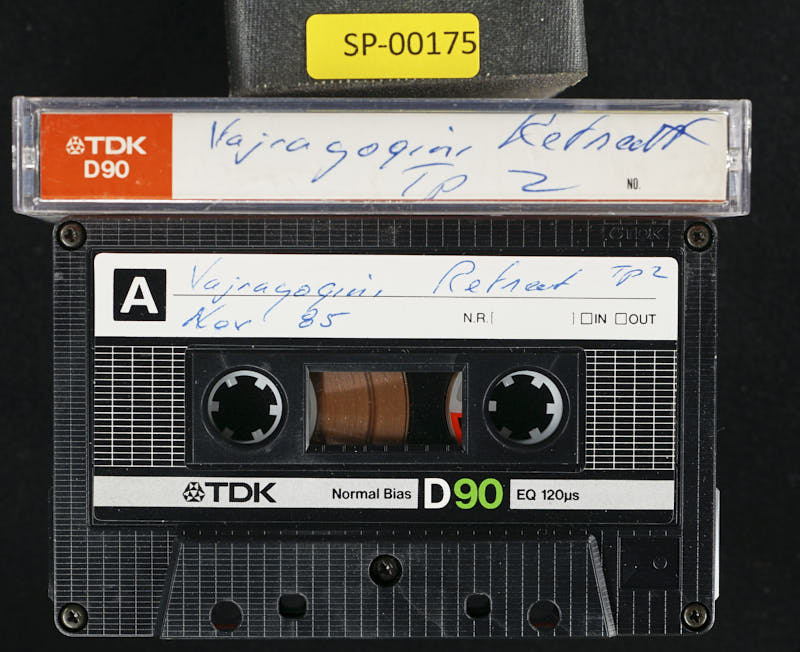
So basically, we're going to concentrate on that part during this session. So when we will restart the SADMA, I won't go through long visualization process, but Repuge will work through that, recite that 21 times, and then quickly move on to the SADMA, and then really concentrate on that. And then towards the end, then we'll go through the SADMA again very quickly, like we did this morning, and then determine offerings in the end of the session. So this is actually just to get it working with how the SADMA really works, like this. On a painting to the stage of a perfectly enlightening one, I must rescue all living beings from the great creation of Sonsara. Without purpose, I am practicing the profound methods of IJD's path.
[01:03]
On a painting to the stage of a perfectly enlightening one, I must rescue all living beings from the great creation of Sonsara. Without purpose, I am practicing the profound methods of IJD's path. On a painting to the stage of a perfectly enlightening one, I must rescue all living beings from the great creation of Sonsara. Without purpose, I am practicing the profound methods of IJD's path. On a painting to the stage of a perfectly enlightening one, I must rescue all living beings from the great creation of Sonsara. For that purpose, I am practicing the profound methods of IJD's path. On a painting to the stage of a perfectly enlightening one, I must rescue all living beings from the great creation of Sonsara. For that purpose, I am practicing the profound methods of IJD's path. On a I must rest you to other beings with grace rich supply. With an effortless land, [...] I must rest you to other beings with grace rich supply. He did it with his feet right in the vagina. And where is the crown aspect of his race, says I both himself. Seated on to the backs of mother heart, it's you barely. Whose body is white on the heart.
[02:05]
Only her life is found out. He's to go out with a hybrid. And this is in union with the God. Rest in my own ways, with the little body of heart. If it's a way, it's a little home. My eyes are like straight forward to it. So I want to try to let on all it. Would you take care of the power of the power of the darkness? Would you take care [...] of the darkness? Would you take care of the darkness? Would you take care of the darkness? Would you take care of the darkness? Would you take care of the darkness? So one, don't put it.
[03:18]
Different types of visualizations, first to purify illness, the nectar is either white, red, or yellow, driving out illness between the form of black lipid or also its blood and pus. Then, drive out either spirits, the nectar is copper-colored, velvet, raffledetes, driving out either spirits, nephons, if small insects or snake spiders are good. And third, to purify karma, the nectar is white and coloring, driving out. black tar, black tar, black smoke, and then escaping the poor consecration. So, maintain the visualization, it's like a macho. studying the next verse with the core powers, which mean, first of all, they're clearly visualizing my disciple with the concert on Dr. Ned, just trying when you're making your confession.
[04:56]
While the misdeeds have been gone previously, you really regret extremely what you've done to get the power you regret. And then also thinking that you will never do such misdeeds that unhold your actions again in the future, give the power promised me, but also a true relying upon the Shrine through the power of the Ragnarok to come from another to do such a thing again in the future that this rejuvenated, remused all your vows and pledges, and also purified you, so those who felt in my name, felt the prayer. I, the Luton, [...] The eyes of the dark possessed the object of breaking the ashes, the geese-cheeps, and the wind growing. I can make one package for every one of the eyes of the root of the ashes of life in each of mine.
[05:59]
And if you're aware of the grain, all the ingredients of the things fall out for saving the bones. Having put this budget of the night and all this knowledge of life, in order to the top of one's end. So in this way, relatively speaking, we have done these misfortunes which caused us to have sickness and evil spirits to have us, you know, bad karma to have been at this time. But actually, then ultimately, there is no bad deed that has been done. There's no one who's done this deed, and there's no result of the deed. There's no action in the deed itself. So actually, the mind itself is temporarily covered over with these doubts and requirements of having done these deeds, and also temporarily covered over with the idea that we need to necessarily confess these deeds. But this is actually the covenant of the mind that actually, in reality, the mind which produces these thoughts is cured by its own nature, and its purity is empty of any truth, any conceptualization whatsoever.
[07:12]
Ultimately speaking, the ultimate confession, the ultimate Vajrasattva, means you're actually the pure Vajrasattva body, voice of mind, by then absorbing into your body, non-dovely merges with your own body, voice of mind. In this way, from the ultimate point of view, from the ultimate confession, there is no one who's committed a bad deed. There is no one who needs to be purified. There's no action of purification. You're just concentrating or resting your mind in a state of purity. For what it's said, actually, one's body becomes pure, like a crystal egg. It just means, actually, that your mind from the very beginning is cure, and this purity of mind is empty, and this empty and cure, mind and I will be much together. So this is the ultimate Vajrasattva. Here, actually, we'll let you put it a little while on this note. In the sky, it will punish one. Cures, as the last day mentioned, but none will be cured and clear. Shouts and let the novel. Well, you do four doors.
[08:26]
If you do four sessions, then there's two morning sessions. You do the three form offerings. In the afternoon session, you do four. You do maha kala. Actually, usually it's about evening time when the sun's going down. So at that time, actually more, if you do more, I just didn't do it at that time. In the evening, again, couldn't do that. So here, actually, generally, my car actually has a very, very long phone offering, about 10 pages long, but here's one character at the next, very simple, easy. So we did it again, again, by all car, blessing the tournament. So... from the palace of the pure Now, the short one of, uh,
[09:39]
the lotus cemeteries we have together now. So, actually, it doesn't say there, but first you start. You can write it in, so it's all moth and have a little bit to say that. So, from one's heart, the light bulb is emanated. and in the sky before one appears a wood mandala, and oceans of flood, above which is a vast surface frown. Our days rest an out-nutter, a sentence, on top of which is a four-sided pallet of scouts. Inside is a common city of the winter's sight, and the greatest lords of the cemetery, Father of the Lord, surrounded by the indiretable, or void witness with the land of the King. And it says, to establish them in their pledge, do the Pai Tan Moodra.
[10:44]
And then taking that, you're placing them in their vip, then you say, Vajra Samaya Stone. Vajra Samaya Stone. Something to establish them in the Q-Tip Pledges. And then, again, with the Pai Tan Moodra, then the next launch was the launch of offering the tunnel. Om Girajah Girajah Kuna Kumthits Mahapisharachit Sa Parivara Gidang Balik Bunjah Khakha Khadil Khayhi Sarva Siddhangi Nay Tawaya Chantkyo Swana Om Girajah Girajah Kuma Kumthit Mahapisharachit Sa Parivara Gidang Balik BUNJA KAKHA KAHRI KAHRI SARU SEGUN NE KRAYA CHANTU SOHRA OM GERRAJA GERRAJA KUMA KUN KUMPTI MAHA TESHA CHI SARU PARI WARA IDAM LINGTA BUNJA KAKHA KAHRI TAIRI SARU SEGUN NE KRAYA CHANTU SOHRA OM SHMASAMA PATHI
[12:07]
I offered this foliation to the mountain of the road for us. Thank you. [...] It's a party. Usually in a Tormach offering, the mantra offering, the first tap you do in a lotus round mudra and then back the middle of it and you stop and put it into what is known into it.
[13:29]
Actually, bhajra hands are like this. So half open bhajra hands are turned down. So the lotus round mudra is just moving the hand this many. It's about halfway through. Just take about halfway through. Then put it in the bhajra, hold it hands, and then open it up. Wait, let's go to the camera. Okay. Next is the camera frame of the cartoons. It's on page 902. Oh. [...] . [...]
[14:51]
Thank you. Om Kha Kha Kavi Kari Sarva Yaksha Rakshasa Uta Pratya Tisharajee Omadar Apasamara Raka Patriyandarya Ilong Olayu Duranthu Samaya Rakshatthu Marnath Swapasidvanne Twai Tansthu Yate Vam Teshtam Hunjata Jigitha Tipata Matri Kranaka Marnath Sarva
[15:52]
. [...] Thank you. . . .
[16:52]
. . with places to approach the land, to help the cyber, allow the battle of political groups to grow. But they need no direction, and a political source of expenses are to go at the bottom of the district, but by the state of us, are to support our sponsors, and then our hearts and actions should report the Obama, may be the end of the virus, and on so on, like when it's insane, where our protect and greatly assist us, is the effective use. Oh.
[17:53]
Oh. Thank you. ... [...]
[19:38]
Whatever was incomplete and spoiled, and whatever my ignorant mind had had to do with my fellow, made a matter of evil. All the people that would have thought was, is that I could have been a reaction that is a very easy to see, and that wild and all precious things to our equal and great perspectives. I'm not, I'm not. [...] but to have you in the universe that you should be able, so as to enter into these communities, continuing to regain the love on this day, which is on this project, to damage fact for violence, and then in continuing the aim, in terms of the project, the art of the system, and all of the communities, and to protect the capital of the world. to the transcendental aspect of the . [...]
[20:58]
. [...] The transcendental knowledge, the transcendental Aztecs return to their natural abode, and the French Aztec, an idolatry to oneself. Ja. [...] Turn it up.
[22:27]
the armor of being defeated on page 62. So what homebound have been made over the essence of Dr. Baraday, you look for the young at the heart of the essence of the armor, where I train along at the house of the armor, you look for the same thing that the poor is the essence of Shodani, when we in the world At the crown, it's a gas and fire. Smoke, car, a-k-a-k-a-k-a-k-a-k-a-k-a-k-a-k-a-k-a-k-a-k-a-k-a-k-a-k-a-k-a-k-a-k-a-k-a-k-a-k-a-k-a-k-a-k-a-k-a-k-a-k-a-k-a-k-a-k-a-k-a-k-a-k-a-k-a-k-a-k-a-k-a-k-a-k-a-k-a-k-a-k-a-k-a-k-a-k-a-k-a-k-a-k-a-k-a-k-a-k-a-k-a-k-a . . .
[23:55]
The last part actually is to... But actually, let's create different female protectors around you. So during your off time, whenever you're going anywhere, that you'll protect it. And actually, by doing it front, in the east and above, and we're snapping out through the left hand. Usually, they snap with your little finger, but with this, I don't know, like it's like you snap your first finger. And it generates with the middle one, but for this, it's the first. Yeah, it's hard to make it down, but first and front, and then up. And then... Here it says, actually, to the north. So the north is on your left here. And then behind and down, which means the west and below.
[24:59]
And then to the south, which is your right. And then here, the east and south, so the south east. And the north east. And actually, it doesn't say to do it a third time, according to one of the previous lamas we've done with the threatening gesture, kind of, in China, third time, sort of like oral tradition. So threatening gesture is sort of like a dumb inside. of course, just over and then extend the first and very little like this. Well, we did it once like this, and once like the reverse, and the third time we did the adjustment. So in the. This is in the Buddha Yoga practice. The main Buddha, the Buddha, is in the form of Buddha Bajra Dharma. His body is red and colored, one face, two handholds, and a vajra and bow, close to the heart, breathe in a vajra position, with nothing on his shoulder, no.
[26:03]
The other, the Buddha, the lineage movements are all in the form of Vira Bajra Dharma. They're in a circle surrounding him, all looking in towards him. And they're in the form of Vira Bajra Dharma, and the body is red and colored. The right hand holds the Dharma roof, the left hand holds the skull cut to the heart, and then the Katanga step on the left shoulder. in our own form of . So at one point, to all of them, then actually there's other offerings which are made, which means, like, first of all, offering all of our relatives and our pandemics and people who are indifferent to them. And this is actually to overcome our desired hindrance. So sort of actually offering our own desired hindrance to the form of . Then we make other offerings, like drawers and incense. and then different types. They look like an inner offering, which is their own offerment, which is actually here, just all the naturally residing or naturally existing nectar in the world is offered to them. It's called inner offering. Then here, the secret offering is that from our heart, many goddesses issue out.
[27:05]
It says of Padma Bhakti in other classes. Actually, according to ancient Tantra in India, all women in the world, I think, were the three classes. One was called Padma Bhakti. She probably just named Lotus and Bhakti was very And actually, it's by the shape of body and signs of what class of a person they want. So they would start dancing. And then all of them, actually countless, they start to absorb into each other until finally, like as many gurus as there are, that many Vajraginis remain. They all turn into the Vajraginis, the same number as gurus as there are. And then each one of them, whether they sit in the lap, whether they were to embrace him, this actually offering the bliss of samadhi, the bliss of meditative trance. in this actual film. And the fourth operant is the operant of reality, which means actually that there is no one who's operant, there's no one who receives the operant of the operant itself. So these are the four types of operant, yeah. Literally, we should see ourselves, or then, what does it say?
[28:06]
At the end of the vibe, you say so. Crystalline. Crystalline. Actually, it just means that your body, basically it means to become very pure. It means actually the nature of light. And if a person's really purified, and in fact, they say the person makes a rainbow fire, that's the truth, then you could really hold your hand up until, like, you know, like what we call that flashlight when you find it sort of becomes red. It's like that, but really clear that it's still red, sure. That's not true. See? What's that? And that's where I can see this in here. I was trying to go through the steps of the office of day to get the four consecrations. Mm-hmm. Then he comes there as a... ...oric delight.
[29:11]
Right. Purges with the bomb in our heart. Then when they come back, they do it. Okay, first, at that point, the letter bump. At that point, you're in Bajra Guini, but very, very small. If you remember, what happened actually is that the Bajra Guini came out from the essence of your mind and the form of Bajra Guini, not the size of your thumb. This comes out from the central vein, rises out through the top of your head, and she comes and starts cutting up your body. So your body disappears, but that little Bajra Guini is your mind. That one remains. So you're still there in the form of Bajra Guini, but that very small little Bajra Guini. That's all that's there now for you. Okay? And your body's been cut up and then purified and offered to all the goods and natural health. Then, at the end, the Buddha dissolves. So then the four consecrations come to you in that small point of Vajjurgini. That little Vajjurgini. Your consecrations are coming to you there as that form. Then the Buddha dissolves into that little blob of light. That enters into you as Vajjurgini right there. And then that little bum in your heart emerges with that. And that little bum just starts getting bigger and bigger.
[30:13]
You just take a filthy room. and your body just becomes like a rainbow, and the letter palm becomes a rainbow. And then just like you see a rainbow in the sky, then all of a sudden it just disappears. Then you remain in that state of emptiness for a while. And then arising out of that, now you're going to do the self-creation of yourself in your form of deity. So out of that you appear as what you're meaning of. Can you see that back down? But here actually, this time, you just say, make attention to become a deity. And then in your heart, it's letters AA. And then that's going to dissolve again. If it's like instantaneously, you become Vajraveni. Then it has the things that enable the hearts of two letters A-A appear, and then the Dhammakata. Okay, and then inside that is the Moondisk, and then the Machuodri, a matter of bone. And from that light raises you out, and then this body that we just became Vajraveni. Now again, that is often called Vajraveni. And then from that, you appear as Vajraveni. Okay, wait, wait, wait. Yeah, I know that's all in there, but it's here.
[31:14]
It's here, but I understand what A within the heart appears, a Dharmakara, red double triangles. On it, press them like this. Right. Which is not inside the Ketonga. Dharmakara. It's actually, Dharmakara is these inverted triangles, inverted pyramids. That's, it says from two letters A, A-A, appears two inverted pyramids, okay? Yeah. Actually using the same word. First it says Dhammakara and then it says two triangles. It's the same. Dhammakara has just essentially worked for that. So what happens is you do a six-pointed star. But it comes down to a single point. It's like a three-dimensional thing. Like an inverted pyramid with three sides. It comes down to a point. Then right on top of that, which is in your heart, you just became Vajugini. Now let's say that you became Vajugini. Then in your heart, the letter is A. They became the two triangles. Then the letter Aki, that became a Moondis. On top of that, appears the letter Bum. Then from that light raises you out. Fill your entire body. It purifies you. And then this body now becomes like a ball of light.
[32:14]
A huge ball of light. And then out of that you will get a purification. Okay? I can look confused. The double triangle is flat. Or it stands like this. Inside which is the little bump. Or it should be, you know, light, flat. You know, like this. If you look at the top, if this was the triangle, this would be the double triangle here, when you look like that. But then it comes down like this underneath of it. So it's like this inside. Right inside your heart. So it looks like that. If you're looking down, you see two triangles. But if you look on the side, it's actually coming to a point. And then on top of that is, you know this. Yeah, full. But it's like this. There's 32 syllables.
[33:26]
Now, each one of them, there's 32 syllables. Each one of them become one Bajirgini. Actually, what happens is the letter bum in the center, it splits up, and that becomes five. That's why all of a sudden, actually, it's a very complicated system. I also don't follow it so well, but usually this is actually a vein in the body, and the letter bum, if you look at it one way, it just looks like a little stroke. That's all it is, a little stroke. You look at it from another way, it's like a letter bum. Very hard to see. Then if you split this apart, it becomes these four letters. So from that one essence comes these five. Four letters? Five? Well, bum in the center, and then la-la-la-la, so then five. So that then needs to become the five Bajouginis in the center. Red, Bajouginis in the center, right? Red. Yellow. And then around each of those 32 syllables now takes the form of Bajougini. Then, later you take all these syllables. Syllables.
[34:29]
the rest, the remainder of the body of the child. Actually, here they're not really the body nonetheless. We wouldn't call them that. We would just say that they are letters, because they're not deities. They're the essence of these deities, but they only take the form of letters. Whereas those, what on bum at the navel is the essence of the body of that idea. They never take the form of a deity. They're the essence of those deities, because they're the forms of letters. And here, you should visualize the moon disk by standing upright, and on there are written the letters. And that's what they are. So they're really, in this case, not really part of the body mind. We do these... Sure. Even at the end, after we do that, you never see them as deities. No. Even at the end. Yeah, always they're not. This is actually part of the Chakrasambhar teaching, they use letters always, all the time. I saw one Chakrasambhar, Long Sadhana, they must have about 120 letters all over the body. I don't know how you can visualize it. But this is a system of Chakras and Vata country. There are letters more than babies.
[35:31]
Kachur, is that the same as the... Kachur, Kachali. Yeah, Kachur I think is Tibetan and Kachara is Sanskrit. And Kachari means about you being. Kachaja is your voter round. Actually, there comes one of the mandalas of Chakra Sambhara, which represents actually different, almost in a way you could say it's like a body mandala. I mean, it's just transforming parts of the body into, or seeing them in their divine form. Oh, Ravi. No. Actually, Bhairava... There, actually, is one of the worldly Hindu deities.
[36:31]
It's referring to one of these, one of the world. Bhairavi, the eye ending like that shows it's female. And actually, again, it's just one of the goddesses of one of the trekkers in Balamanta, where these goddesses were sort of like, sort of worldly goddesses, but then brought within the mandala to be transformed into the blind being. Again, here, actually, it should be a long eye of the second, so it's a female. These are all females here. So it actually could have been his concert or something like that. And again, she was brought within my law. Usually they'll have stories of how they were brought within it, subdued and assessed by one of the deities that got into the monopola and then put on the path of lightening through that and left it. So generally speaking, they're sort of worldly deities which are transformed. And a lot of deities have the same name. You can't always say it's the same one. There's a lot of different yama with a lot of dramas even here. But it's not always true. Actually, first, the Vajra Guini comes out, and then she looks down at you.
[37:44]
The Vajra Guini is the essence of your mind in the form of a small thumb-sized Vajra Guini, which is your mind. This comes out, and then cuts you out. So at the end, what's left is that, and that's your mind. So this body is not finished, but that mind, that Vajragui, the view and the form of Vajragui, your mind, that's what takes the initiation, the consecration. That's what's not until you dissolve into evidence. Well, I'm still a little confusing of the process. The process, she comes out. She goes upward, you know. She sets the navel, and she comes up to the central vein, to the top of the head, and then she comes and looks at you, and in the right hand she has a curved mic. And then with that curl knife, she touches you here. In the small letter, you touch the... Well, she just touches you. With that knife, you know, and by just touching it, all of a sudden, this comes off. Careful, the head comes off. Then in front of you, there's three skulls, like a dry skull, you know, in the form of a tripod. And then this one comes down and is placed up on that. And all of a sudden, it just becomes big. Actually, you should think this whole entire world. It becomes larger and larger.
[38:45]
And then she comes in with that knife. First, she touches your ankle, your knee, and your thigh. And just by touching it, each piece falls off. And you think that she shows it right into the skull. And then she does the right leg like that on the knees. And then, you know, just pulls it in. And then she cuts it around the way. So the middle part of it again pulls it in. And then cuts this midsection, and the upper section. And then she cuts the arms in three places. And then the neck. And then this part, which is left now. And also that goes in. And then you start, and by doing that, you think that Underneath the sky cloud, there's a fire, and the fire blazes up very great. It starts to boil. So all of your body inside that starts to heat up. And all the impurities which you have, all the impure substances that burn off. Just like if you heat butter, all the impure substances that burn off, and the really clear, pure butter remains. So all this stuff burns off. And what remains there is this very pure nectar. You think actually it's very cool to the touch, white in color. It has this very nice taste, sweet, very pleasant.
[39:46]
And then... What's left now is your mind in that little Vajrugin. She stays. She stays where? I'm sorry. She comes and sits where you're sitting. Stay here. Even though God did not die. That's your mind. Okay. And then from your mind as Vajrugin, that little one, many, many goddesses come out and they take a mentoring offer to the Guru. What do they call that? Well, there's a system which is called Chuk. This is not a pure chope practice. It's sort of like chope. A real chope practice deals a bit more with ritual and also a lot of tune in music. And generally that's done, it's a bit of a more violent practice because one thing is to be out in a cemetery somewhere, it might. And also who you're offering to, you want to invoke very violent spirits and ghosts. And really that, in this case, we're not really doing that. It's more to the guru and to peaceful deities. And they're actually what we want to do. to really try to invoke and bring, in a very terrible place like a cemetery, some really violent spirit and give them our body.
[40:50]
So, basically, it's slightly different. What does it mean? You get rid of your clinging to evil. What's all the evil in you? Well, every evil you've seen as well is actually not at the station of your mind. So, you're cutting up your body, you're giving yourself away to your own hatred. And by doing that, you're getting rid of your hatred. Especially this cutting practice is supposed to be really equal. It's a very violent practice. It's a bit violent. But in the church practice, when they're merely inviting leads, is that to tame leads to other spirits? No, to tame yourself. Because actually it says very clearly in the scripture, if you tame your own mind, you tame every other spirit. It's a reverse process. But also, if you can make offerings to them and do it in a proper way, essentially you can, because they can't hurt you anymore. So this is sort of a peaceful type of tune.
[42:00]
But also, usually in tune, what happens is they have these very big drums, and there's a very beautiful chant to it. But they like to chant, because that type of chanting is supposed to... It's a method, actually, to invoking different types of spirits. I mean, certain types of people or spirits in this world who are attracted by a certain sound. In fact, I mean, we have certain types of music. Everyone likes to draw shit together. So that's a good joke. There's a certain type of tune, which is very nice to draw different types of spirits. Well, that's probably a little more complicated. And there's also some types of different aspects of the church. The way I pronounce it, though, is slightly different.
[43:03]
I mean, I read it more in Sanskrit form. Actually, the first part where it says, That's all actually invoking, just to invoke all the Thakini's, which requires actually. John has given us five passages of Thakini, so this is referring to invoking them. When they're talking to me often, it's on, kakka, kahi, kahi, sarva, yaksha, rakshasa, bhuta, kreta, tishachi, unada, apasnada, baka, thakiniyadaya, inam, valin, ranatu, Actually, the first half of... The thing we gave out this morning of...
[44:14]
What's the linear tunnel offering? What, the eight characters offering objects? Uh, not necessarily to that. Yeah. Yeah, I mean, here actually, uh, it's just eight different types of, these are more earthly types of spirits. like the magnet or a motor spirit, tree spirit, spirit. They have all kinds of spirit that cause madness or cause you to lose your way or to make you lose your memory. So there's, so actually in some scriptures it said there's 84,000 races with this. And here actually there's a very simple way they classify eight forms. And these eight are actually been secluded by the Dakinis in order to help people practice, practitioners. But here that's why you say actually I offer these things and I even frustrate you because they're not ordinarily significant. So anyway, that of the first tech is just saying, saying, now you're under these judges, and having the nine judges will remain there, and then I'll give you this kind of .
[45:36]
And now take that, and then do your job to protect me. And after that's a border-darkinian, larger-darkinian-darkinian. These are actually the five classes of borders, the five transcendental or five border ratios. So each rate has its own darkinian communication. So I'll read that soon. Three, nothing to do. The end of the search and the end of the migration. Yeah, three messengers, generally it means the Vajragini. Three kinds of Vajragini? Yeah, that's right. There's Samboku Kaya Vajragini, Mamanu Kaya Vajragini, and the mantra of Vajragini. So, Samboku Kaya Vajragini means the one who lives in Atomish, the one who lives there, who lives there. And the Mamanu Kaya Vajragini means like all the Vajraginites and witches who live in the 24 holy shrines or the 8th Santa Paragraph programish places.
[46:43]
I have another question to you. Well, we're doing a lot of science. We did it. And there were different visualizations. And the first one was the different disease, the cold, the hot air. What comes out of it? This is actually a tobacco classification. In a very general way, any kind of disease which arises from about the waist up is called a hot disease. So I think even colds, lung disease, these are actually hot disease, as far as I know, because actually it arises too much sleep within the body, like kind of the inner heat, so the body that will balance because of excessive heat.
[47:58]
For example, like if you have tonsillitis, or there's tight control or something, good to actually heat, cause that heat, too much inner heat. Cold disease is generally the part of things below the waist, but also it's including kidneys, so any kind of urinal infections, or even swathing up the lights or things like this. Things are actually cold. These are actually cold. Earth's body becomes easily cold. So there's some... Well, there's not enough heat in the body. There's a lack of heat and excessive cold. And air diseases generally are like dizziness, madness, unbalanced. These are some examples. I don't know. So that... There's also a classification. Probably there you just add it together with the air disease. Are there breathing exercises with air disease? I don't know. Usually for breathing, not. I mean, not for air disease. A way to help air disease means the body's not heavy enough.
[49:00]
So there's lightness in the body. So the good thing, one reason it really causes is because of diet. So it's good to take meat if you have air disease to make the body heavy. You eat potatoes, or even fat, meat fat, and then make a soup out of it, and bring the body down. And I've seen people actually have done that. It's just, you know, they're too lightheaded. So it can be caused from different things, but it also causes that. So actually, when you lose too much blood, actually air is rising in the body, so it's coming up and actually causes lightheadedness. So to replenish the blood or make your body, actually ultimately it's going to be heavier to bring it down. It just brings the air in the body also down, inner air. and different types of diet, I should have to say. Well, that's only one. So usually air types of practice form, because your air is already out of balance, it'll take it in the worst way. What's the fasting air form? Leafy airs?
[50:02]
Like the body, right? No, because actually, when the air is out of balance, I've seen people try to fast when they have air disease. All of a sudden their ears start ringing. That's also air disease. It means there's too much air in the head or too much air rising to the body. And that's caused actually by not enough food. On some occasion, usually someone with an air disease shouldn't fast. I've noticed one woman actually, she was saying also, she always had like when she did medication intensive, Or even she was translating elsewhere in New York. She was translating from English and German. And just due to concentration, she would get a lot of headaches and airiness, you know. And she tried many things to cure it. So what I told her one time was to do Vajrasana meditation. And when she'd do it, she would concentrate on hearing and get worse, you know. So I told her to bring the air down to her stomach. And then concentrate, instead of concentrating on the neck or coming into the top of the head, bring it all down. Bring her visualization right down to the enable.
[51:04]
And then bring it down and everything's pushing out and pushing down. And that helps to do it. And then it brought the air down and it got it. And when you're concentrating a lot, actually you're doing right at it again, so the air is going too high. Sometimes that also happens if you do too much sun and too much mantra recitation. I like that. And also for certain people, different times of day will affect it. I find it, especially like at sunset, it's easier to become a little more airy. you know, just to move into the world, or move into the ship in the day. I think actually, like, you have to experiment yourself, because everyone's thought is different, so how different leads will affect your life in the same way to help yourself. What is your specific problem? No. Yeah. It's Chinese medicine, I'm sure I come from it.
[52:09]
Yeah, but the principles are the same. In addition to the diseases and the way it affects the bodies, it's actually Chinese. It seems that at the end of this, we have visualized the bhajai, bhajai, you need a small one from the navel, and ascends along the... the central vein, and then the ball of light absorbed, and the three, you know, the central vein, and the russama, and the russama, you know, absorbed into the water, you know, the same, you know, brain. If you reach the top of the head, and then, you know, it goes to the kachana, and kind of the You know, I could get too concentrated on the chair than the headache. Well, that time, actually, at that point, you should think, actually, you don't have the body then.
[53:12]
But how? Make your head a little lighter. You know, I mean, don't concentrate it as a physical form right there. Just keep your body, make yourself more airy at that time. You know, less... No, it's all right. I mean, what you're doing is right. I mean, it's not wrong. It's almost like, what do they call those lights, you know, when they flash in the sky? Like, right at the end of it. Yeah, searchlight. You know, at the end, it sort of looks like a little ball at the end. That's it. That's what you were at that time. Oh, with two veins in the center there. The three veins, when they come up, do they go up like this or down?
[54:13]
The central vein goes right up to the top. Right. And the two on the side, they come up to the top and they curve down. They come down right within the skull. And then they come down right to the top of the nostril. So will they ensure the... into the... You know, it's like a spider. You know when a spider drops her, when a spider is in a web and she drops down, and then there's like a trot of the web comes down. When she comes up, she brings that robe into her. It's like that. The spider goes up. The vaguidoo goes up, the web, the veins are going into her. So the spider, when she gets to the top, that robe's not there, or that trot's not there anymore. And it gets to the body, right? That robe's going in. Well, at that point, you're not body enough. It's just a web of light. So actually what happens is the legs and the arms absorb into the body, and then the body becomes like a ball of light. And in the center of this ball of light is three veins, with the center one. And as she goes up, the lower light comes under her, and also the veins underneath of her also come up into her.
[55:15]
And as she comes up, the veins become shorter and shorter, and the light also is like that. And finally, she's right at the top of the head. It's just her, and then she goes up. I think it's in some of the tantrums, you know, I can check that some of the tantrums. Because in Vajrayogini Bodharam, it's not like Amitabha's Bodharam. It's very different. This is more of a... It's more of a mental state than a physical Bodharam. There's a certain bit of that quality. Although there's still, actually.
[56:17]
Sarchan Sopgyatso, he was actually very famous for Vajrayogini teaching. He's the one who started sort of a self-saccia. So Vajrayogini liked him very much. She would come down to visit him. Then one time there was a story where, from Kachata realm, This one staircase came, a spiral staircase came down. It was made up Quora, Red Quora. It came down, and she walked down there. And she asked the sergeant to come back with her. He said, no, I can't go yet. He said, actually, he wanted to write some more commentaries about Bumbridge teaching me. He said, still, my mother's alive. I've got to wait. I said, I'm not coming now. Well, no, but you're getting very disappointed. She walked back up the stairs looking at him. And then what happened? But I think it's very clear, and he'd have no trouble getting there later. Yeah. Thank you.
[57:18]
Thank you. So we're going to do the last session tonight, so we're not going to do thermal offerings with this. Since we don't do Torma offering, we don't do the Moon Blessing to start with. There's no need for it. The Moon Blessing and the Blessing of the Shrine is only when we're going to use it. So actually, already, we've taken the water off the Shrine and taken it outside and thrown it out in a clean place. So we don't even need the Shrine for this session. If you want the Barnabas, it's fine, but actually there's no need, because there's no actual offering of any outer offering going on. There's an amazing assignment, but not invoking the deity outside and making offerings. So what we're going to do this session, still in any session, of course, you have to start with prayers in Hulu. And then what we're going to do is to do this, and then we'll do 21 recitations at the refuge, and 29 recitations at the Vajrasattva. And what we'll concentrate on this evening is the Buddha Yoga.
[58:19]
And actually, this Buddha Yoga has a few special things in it. So, well, this is not only the way it's done. We're going to repeat a few things inside of it, just so you really get familiar with what's right. So we'll start the, as it is, on page 52. And the first part, just to create the shrine in front of it, and do that to the normal. Actually, the triarchal recitation for counting, like 100 counting, is the prayer plan on page 54, where it says, That actually, that stage, we're going to stop, and we're going to chant that for about an hour, just that prayer. to really circumvent the death and the blood. And this is actually the prayer that we use for trumping, for accumulating the numbers. Then after that, we'll go on with the sadhana to make the outer, inner, and secret offerings, and real offerings. Then this offering, Kusali, we're going to do it a few times, if it's actually the very important practice. So what we'll do is actually we'll do a Kusali offering.
[59:22]
This is the one of cutting your body. That will do that whole visualization up to the point of it. Actually, we'll just do it once together, you know, by reading it out loud together, up to the point where you make all the offense to the Voodoo. And then we're going to go back and everyone just do it themselves about two more times, just to get a few other visualizations that we really like, because actually in fact, it says special method for accumulating nerve and also transcendental wisdom by understanding its practice. So we'll do that a few times. And then we'll go on with the Sajna after that. to receive the full concentration. And then at the end of that, on page 58, where the body is absorbed into your body and the leather bum expands. But one paragraph, again, we're going to concentrate on for a few times to get this realization. And then we're going to stop there for a while and do that meditation, I think, at that point. Because it says in the scriptures that the only way that you can understand or gain the realization of transcendental knowledge, that the true nature of the mind, is that there's no other way to do that.
[60:26]
I mean, we need proper qualities, conditions, but it's true that I think this really arrives, and it says actually that it's an instantaneous arising, and when we have a real connection with the Buddha, when our own mind is ripened, when our climate is ripened, and we have all the qualities and conditions, which means like accumulation of merit and accumulation of wisdom, true, and then such a practice as this, then actually we can tune our mind with the Buddha's mind and then the real transmission of that point. And this is actually expressed in the subject here, actually, by the Buddha exhorting into your body and then another bump, not expanding and dissolving. But this really is basically what it is, is nature, or the nature of the mind itself. And the mind itself is actually the Buddha from the ultimate man of the earth. So we need the average reader to give us that blessing to make that connection. And then we should be inner Buddha, which is actually the nature of our own mind. So this whole Buddha-realable practice is just for the purpose of that, to gain that realization, or work it. of giving all these different types of offerings, especially, probably often, is just to ripen our mind, to gain from our, to prove the proper conditions, by which then we can really meet with the truth, the truth, for our own mind.
[61:41]
And if there's in many scriptures, such as, like, if I can talk to another, that it's only by the blessing to the good of himself, you know, that this will rise. So that's why we're concentrating on this practice tonight, where we could. And then after that, we'll be... I'd like to decide to get more equipped with practice. We've been doing a lot in session today. So, is there any questions on that? Actually, for that also, maybe, you know, many people just practice video that they practice, maybe, or anything else. So, here, actually, in talking about such a group that they do emphasize video, that's why they told Islam, suddenly, Islam is Basically, I think it's really a practice that you've killed it in order to gain existence. And it's through this practice, actually, that many people in India and for that have actually gained realization. It's a very special and holy practice. One of the Asian organizations who also made the Asian project, his main practice, actually, which is really, you know, taking a prior step to that one, we're going to do three sites a thousand times a day.
[62:53]
And everywhere he went, anything he did, he just told everything was a Buddha. Yeah, but that thing happened to him. It was like the captain of his Buddha. There was a girl carrying him in a violent form. But something would happen to him, there was a blessing to the Buddha, or it was a pretty game of much life. But everything he did, he just died in Buddha. And actually, through that thing, he died in the image. So, nope, I'm going to be working with you. So that's why, actually, in this practice, it's actually a Buddha. It was emphasized in a very big way. And this actually was written, it's actually written by, it originated by, More of that, who had the same, who came from BBC, but one session left, and with the English Revision. So, the real that's all, they're very important. And actually, some of it is the essence of the entire Vatiana path, because it's true that we enter into the path, and then else it's true that we're able to really do a lesson. Community to the story, one time, More of that, it made the cycle. One of them was Marpa, the founders of Karbusek. And Marpa one time was in India with Naropa.
[63:57]
And Naropa decided to test him in the yoga practice. So she manifested Kavadra, the entire Kavadra mandala in the sky, and Maropa was sleeping. I mean, Marpa was sleeping instead in the house. So Naropa called and said, Marpa, he said, wake up very quickly, because your Yidam is in the sky. You better come out and see him, so you never see the deity. So Marfa, if I start wrong, he woke up and he ran outside and saw Devaka in the sky there. So Naropa said, who do you prostrate to first? Do you prostrate to the Guru? Do you prostrate to the Yidam daily? So Marfa thought, you know, every day I can see the Guru. It's not every day that I can see the Yidam. I thought maybe I'd better prostrate to the Yidam first, but then he prostrate to the Yidam, and then he prostrate to his Guru, Naropa. And Naropa said, actually, it's only because of the blessing of the Guru. that anything arises. And actually, even the manifestation of the Yidim was only the Buddha's blood. And then at that point, the Yidim, the Hivaja, dissolved into light and absorbed into the Buddha himself. He said, actually, the Yidim is helping the Buddha himself.
[64:59]
He said, you've made a mistake. You're wrong. So actually, at that point, he gave a verse. He said, without the Buddha, actually, even the word Buddha cannot be heard. So actually, the Buddha is the real source of the entire tutu, and the real source of the entire, especially the Vajlamic tribe. So it truly does not believe anything kind of wrongs for you. So if you think for that reason, you have to look right on that. So that's why I see also here, there's a part in this practice of God's beginning. So we'll concentrate on that now. So of course, we recite the lineage prayer. They start the same. That's it. No, I had a tip. You take some good night. The last, the last second, that we've been dancing.
[66:03]
That just means a city for women. Okay. [...] Actually, also in that prayer, there's stories about how Vajrayogini saved or helped other people. Each one, I say, has a very long story. It says that she and Grace Dantaka actually was a great Indian with her. And he, I don't remember the story very well, but he was going to be killed at that point by something in the form of Chakrasambara with Vajrayogini's absurd and showed actually miraculous power. It showed actually a true Vajrayogini teaching, or Chakrasambara teaching with people. And the one of Kusale actually, it says actually Kusale is the one there who was, we do the practice of Kusale. Would you like, it's an interesting story, but it said actually one time there was one great Indian guru by the name of Krishnapa, or Krishnakaran, who actually also has a lineage of Chakrasambara teaching. And one time he was traveling in India, and he came up to the Ganges River, so here it says actually in the prayer, it says, Reverend Kusale on the banks of the Ganga.
[67:12]
So actually he was traveling alone with this Buddha with some of his disciples. When they got to the bank, there was this one old woman there who was really ugly and sort of had many sores and dicks on her body. She was not very diseased. So she came up to the Buddha and said, please, you and your disciples are going to cross the river now, so please put me on your back and carry me across because I can't walk across this Buddha. The Buddha taught to himself, actually I'm a very great being and I have to help many sentient beings. So if I carry this woman and I get this disease, Then it won't be a benefit to others. So he thought, maybe I shouldn't carry that. She thought, it's a less benefit. So he said, no. And then one of the disciples was named Kusale, a beggar or poor. The disciple was little. And she asked him, he said, will you please carry me across the river? So he said, fine, hop on my back. So he started going across, and when he thought, halfway across, she transformed me to Bajugimi, looking by the arm and took him away. See? So we will actually pay out in that case.
[68:15]
Oh, Kusali is a beggar. Kusali actually is a Sanskrit word that means beggar, but actually also is the name of this one person who was named in relation to his compassion, but a lot of this woman actually was kind of that fit. That's why I sometimes also encourage that sometimes in the world of illusion, which means the world of society appears, There's a demon in it, or sometimes there's an ugly one. I find it beautiful. It's about you, we think, the wrong. Yeah. I'm just speaking to you. You know, would you just be sure to do this after that great time? Yes, perfect, and holy life. We just have to pray with you all the blessings I need you up close to your life now. I wanted to get clearly again what that visualization was of the perceptuals here, these four. Yeah, say about... Say about, to give a general this right, from the place between your eyebrows, about three feet in front and three feet up, about there that you want to set in your mind to direct your mind.
[69:29]
And the visualization, you can make it very big or very small, whatever's comfortable for you, but sort of in that direction, so in the space of time view. And right in the center there, There's a line supported Jodron. There's a lotus, karm, and moon that's getting on top of that. In the center, there's the Guru. The one from whom you received the initiation and the teaching. Any teaching that you practice, the Lama who gave you that sort of teaching, for that teaching, is your root guru. So that's why also when we make offerings, it says also at one point, to the root guru, we make the offering. To the lineage guru, the line divism of the offering. And then it says also to other gurus, on the third language. Well, language means, well, from Bhajit Dara to Bhajit Dini, to all these ones that came up to the present and were built with language. So then you had to be tried. So also later it said to the other Hindus, so if there's actually any other teaching that you've received, you also have other rukh gurus. So also you make offerings to them. So then, in the center, it's the rukh gurus, the one that Bhajit Dara, or Bhajit Dharma.
[70:33]
So a piece like this, He has the hands crossed over his heart, holding a Vajrayan bell. He's red in color. And then surrounding him, so starting in front of him, back to you, is Vajradara, and then Vajrayogini, and then Naropa, and then the Pantene brothers. Each one, one after another, just in a circle, all looking in towards him. But all of them appear in the form of Vajradrama, which means their body is red and colored, but the right hand holds the domino, the left hand holds the skull completely apart, and then the katana staff on the left shoulder. And there, it's funny, and there are a knife-pump, the booty surround, and he is looking for one. Is it through with the consul? Actually, no, because here, well, you could, but here, actually, holding the Vajra and the cross represents the immunization of the consul. The other one, the other one, the better Vajra data, the normal hat with katana, that work is just that katana staff represents the consul. So, by symbol, they all have, but without, sort of, they're not at best symbol, you know, what you mean.
[72:00]
That's right. and it comes out to our head and then the phone, the phone, the phone becomes large. Does it like sort of go through it and go out of it or will become large too? Well, actually, you can go either way. You can just think you ought to become large. So it's sort of like then actually what equals you just can be in the digitization of yourself, of our community. That sort of just disappears. And then you just really concentrate on that phone. And then the bomb, you know, it's sort of like a square shape that a bomb in Tibetan. I hope you do it in English, it's okay. Right, but then it becomes booger. You know, and you see it becoming big. So you really concentrate on that letter, which is your mind blur. Because also the formal body you can use your mind. It's a mind one, especially here, because it's the one that came out, the other one that's in your mind. So you can see your mind in the formal body you can see your mind in the formal letter BUM. Either one is valid here. So here actually what we do is just take our mind off of the formal body you need it and just concentrate all of the letter BUM. So just let the personal share dissolve and then just keep your mind connected to that BUM.
[73:02]
When the seat is not really important, the seat just gets a little bigger, a little bigger, and then really expands. You can just see a huge letter bump going in this room. And then go down, find the room, and just go figure out a little bit. And then finally, get it resolved. When it resolved, you do a good estimation of how I hope that you want to get. Yeah, here actually, the perfect, all of these practices throughout the whole teaching, even with Refuge, Vajrasapha, Buddha, Yoga, or meditation on top, All of them are for the same purpose of getting to the nature of mind, the true nature of mind. But here what we can do is sort of emphasize the true nature of mind from a certain aspect. For example, at the time of refuge, we can concentrate on the nature of mind, which is always the same case of being clarity, happiness, and the combination of two. So there we can categorize it like the clarity is Sangha, happiness is the Dharma, the combination is the Buddha. So here for buddharyoga practice, and especially because it's true that buddharyoga we really can very quickly the understanding of the nature of mind, but the clarity of mind here we can see, place it as faith in the movement.
[74:09]
Because the functioning of mind is the clarity of mind. What clarity of mind means actually is, the characteristic of the mind is its clarity. And this clarity of mind is non-ceasing, it can never cease. The clarity of mind we have now, which functions and sees this world, this is an impure aspect of parity of mind, but it's that same parity of mind, it's that same continuity of mind which gains enlightenment. It's only one continuity, one link, one lineage of mind. So that's the parity of mind. It never sees it. Now it's impure because it's covered over by defilements and we see things impure. When we gain Buddhahood, it's the same parity of mind, but it's been uncovered, or it's all the impurities have been uncovered. So here, actually, what we want to do at the time of Buddhahood Yoga is to use the parity of mind, but here to nanathelsa in the time of faith. so that actually we can make that link, a very strong link with the huddle. So it's best for actually just to leave the mind in a clear state without any thought. It's just like actually if you have a pool of water, and when you agitate, there's a lot of dust, and if you let it settle, it goes down, there's still a pool of water.
[75:14]
That's the clarity of mind. And then when it's agitated in this time, when we're sitting there trying to rest our mind in this clarity, if it's agitated, then make that agitation in the face, in the huddle. Then immediately take your mind away from whatever you thought of. Maybe think about your house or something. Then say, this is faith in the Buddha. Change that thought into faith in the Buddha. Subtle the mind in that faith. Devotion in the Buddha. Keep it until it becomes like a pure Buddha. And then we check the nature of that mind. Like when we check the nature of the Buddha, we check the nature of the mind and then settle the faith. Then actually we can't find it. It doesn't have a kind, it doesn't have a shape, it doesn't have a place. It's not formed, it doesn't cease. We can't do anything with it. We can't find it in any way. So it's completely empty of any... existence of its own. And also its antagonism, which is not real. We can hold on to it. So that emptiness, actually, we're looking for that emptiness. We found that emptiness. So who's looking? That's the clarity of mind. So that one of them looking here, he found it.
[76:16]
And then he came here. Well, the clarity of mind is the looker, and it can't find itself. So when that thing can't find itself, but it's still looking, that's when they merge together. And that's called the combination of clarity and lending. So here was the emergent faith and lifting, clarity and emphasis. And then actually when we can get that, we let the mind rest in that state. Because if we get that in hope, that's fraction. And that doesn't work on it. That's also mature conceptualization. So when we can see, when we can get the mind to west of clarity, then search for what that clarity is. And we can't find it. But when we get that point, then we just let the mind go. Sit there. No breathing. No one who's meditating. No one who's sleeping. No one who's found. Nothing is done. And if we disturb that, get faith in the book. If you need to, take a woman in the sky again. She becomes a ball of life, enters into your head, merges into a lot of plumbing, becomes big, rested again. If you need a good relationship, keep him coming to you again and again, so you make the life.
[77:25]
That's right. Actually, what you can do is think the entire universe is about celestial imagination. Right. I mean, you cannot, though. The idea actually is really that, I mean, you're within this entire, because this celestial imagination is created from your own vision. I'm in the vision of your own, of ultimate reality. So actually you'll not exclude it from that reality. You're still within. So then in that case, it's a good place to talk with it. I mean, they're actually saying it's in front of you so you can really see its shape. I mean, you have to feel what it is, and it's like the square, the square load in it. Actually it's square and it has two stories on it. The ground floor is square and that kind of shit. Our spirit will go, and then on top of that it's square again. They didn't have that .
[78:27]
So, in fact, all the Buddha's are saying, So, actually, you were also in front of me, you were tired of that, that you were thinking about. Actually, the ones above, they don't have floor. See, actually, what happens when they just imagine that, is that on the ground floor, there's a square outside, and each side has one door on each side of each. And on the sides of each door, there's two pillars that come up. There's four pillars. They come up on the side, and then it comes back. And then there's four cut in it. Four cut in it. Four cut in the section, in fact, there's four steps. It enlarges on top of the doors. And on top of that, there's a lot of this, and then the rhino wheel, or two gears, and the umbrella. So each door is like that. So this is square on the bottom. And in the center of that was like, well, eight pillars. in the main direction. And then on top of that, there's like a curved beam that goes around from there. And from that curved beam, so the center part's empty.
[79:28]
From that curved beam, a ceiling comes up. So actually, what happens is, this is the floor down here. In the center, it's empty. And then this flat thing goes up to get to the edges of the wall. So if we look up here, there would be a circle in the middle of the building there, which would be open. And then, inside of that circular part, there's two bodgers. One bodger goes this way, the second bodger goes this way, and then two come up this way. And on the front of that, there's a square then, where these two meet, where the cold bodgers meet, this or like that then. And where they meet, another world comes up. A level, that's right. So that's square then. So actually, if you're right in the middle below, and you look up, you can see straight up to the top, So then let me get all empty. But the violin had the square, and that one was ran because of the beams flowing around. On top of that, it becomes square again. So the third floor... Does each wall have five different forms going out?
[80:35]
It can be done a very long way, like a coordinated object on the third platform. Does that mean that each direction is out of the way that's following the building? No. All of them run one in each direction, outside the wall. Inside up the wrong color. The plural will change color. The plural actually in the east, it'll be back here. It starts in the center, east it's white, south is yellow. Right. West is red, and then the north is green. That's right. For those colors, those colors, for most of the time, I think in the color of chakra it's slightly different, but generally most of the time you take the same. Um, they had to actually, actually, they represent elements of what they were doing. When we do the distribution of, uh, taking the beach, you know, how do we, uh, how do we visualize, you know, the world, [...] the world.
[81:46]
At the end, actually, first, light goes from his heart as you out and touch all the sentient beings around you, before tying them to the day of what you're doing, and then disappear, and go, and go their way. Don't he himself, it's almost like what we were going, from the throne upwards, he starts to absorb the light from the top of his downwards, also becomes light, and then he becomes like little balls of orange light, or red, and that little ball of red light now comes down, and moves into the top of your head, and moves into the heart. And at that time, your own mind ends up on the triple gen approach again. Well, that was the creation of life and thought. First, you only did this practice for the sake of attention, and then by the fact. So, tonight then, what you should do, remember, in this practice, actually, you're sleeping in your way, but naturally you're sleeping in your way.
[82:47]
When you go to sleep, there's two ways to do it. If you want to feel in a state of happiness, just lie down. And then this softball suit just diminishes, it becomes very small and diminishes like a rainbow. And if you want to do it in a different way, then you can think actually that where you're sleeping on the core actually is a big level triangle, which actually represents the celestial dimension of our unit. In the center of that bed that you're sleeping on is the dual turn. On top of that dual turn, you just stop in the form of our unit lying on your side. And then just above you, so if you're lying this way, just above you, a little bit up, is the Buddha himself, you know, in the form of God of Vajra Dhamma, or God of Vajra Dhamma, he's sitting on a throne, and you know, he's sitting there, you want to do it, and thinking that you're talking about what you're doing, and thinking that you have great devotion to the Buddha, that he's there, protecting you, and watching over you, and it is cool.
[84:08]
And then, if you're doing this form, if you wake up in the middle of the night, the first thing you should think is the Buddha's idea. And if you sleep in the emptiness, you can't get up. Is that true? And then when you get up in the morning, if you're sleeping in this emptiness state, then as soon as you wake up, immediately think, I'm about to get up. Very quickly, just like that. just to reappear in what you're doing. If you see anyone around you, I think that's what you're doing. And then also, if you're doing it in the other form, when you wake up, think, actually, what you're doing is what you're doing, [...] is what you're doing.
[85:13]
Well, actually, the essence of all babies are the same. I mean, because they're only one essence, they can take different forms. So, for the purpose of keeping your commitments, you know, to do other five moves, And during that period, you just, you know, you stop for a moment, do the other cognitive, and then as soon as you finish yourself, and then again, you think I'm Vagiavini, and then keep that thought in mind. You know, please, if you really do wake up in a normal night, and you get a very pointless point, would you, would you consider that you woke up as Vagiavini? Yeah. And then do it again as you went back to sleep? The fact that what you could just do is just think, actually, the nature of all parents, which is really unpleasant as well. And then just try to... And if you want to do the whole thing again, you can.
[86:15]
But actually, if you want, it's a very simple one. You just think, actually, well, I invite you to do it. And then, actually, in the morning, you're going to do an extra tasting. On top of the mantel, there's a piece of paper with an electric cloak in time. So I will take one. And I can put an extra tasting. Thank you. Thank you. What time is it set? It's actually 6 to 8 and then what? 9 to 11.
[87:01]
@Transcribed_UNK
@Text_v005
@Score_54.9