You are currently logged-out. You can log-in or create an account to save favorites and more. more info
Transcending Thought Through Inner Vision
AI Suggested Keywords:
The talk delves into meditation beyond thought, focusing on the process of non-duality and the mind’s true nature through symbolic and practical meditation methods, including sadhana practice, breathwork, mantra recitations, and visualization techniques. It emphasizes the use of visualization and meditative practices to understand the nature of mind and emptiness, illustrating the process of non-duality and transcendence of conceptualization.
- The Diamond Scripture
-
Reference to the Buddha’s attributes as described in this text, including the “five eyes,” symbolizing different aspects of wisdom and perception.
-
Adhya Samantabhadra
-
Mentioned in the context of offering practices. Represents the expansive and inconceivable nature of offerings as symbols of the practitioner’s mind.
-
Vajrayogini
- Central to the meditative practice discussed, representing the nature of the mind itself, and used in visualization practices to demonstrate the non-duality between self and environment.
This concise summary highlights the dual practice of meditative exercises and visualization to explore concepts of mind and non-duality, essential for deepening understanding in Zen and Vajrayana studies.
AI Suggested Title: Transcending Thought Through Inner Vision
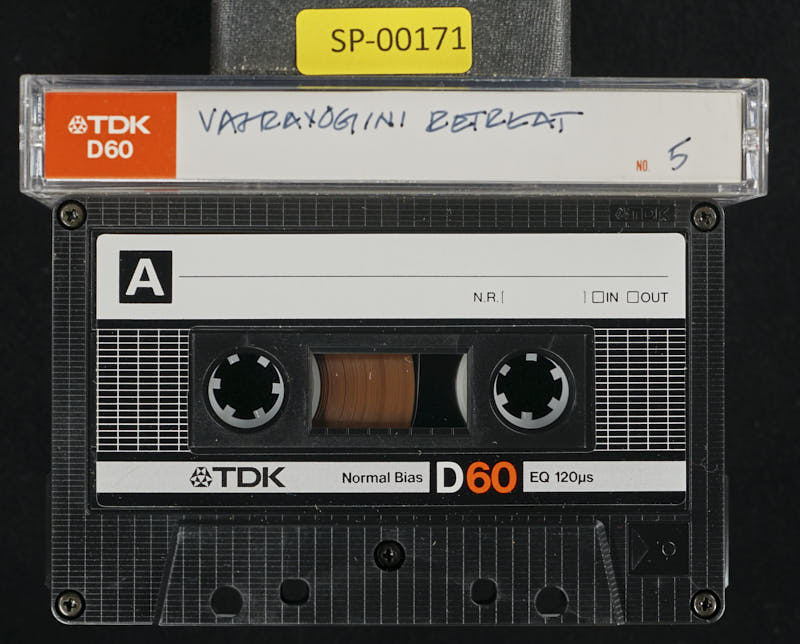
Same series as 00174
The emphasis on this session will be on the meditation beyond thought. So what we'll do is go right through the entire sadhana fairly quickly. And then we'll also do the vocal and the mental recitations of mantra like we did last night, but just in a very brief form. And then also the supplementary meditation, process completion meditations. And then we'll go right into the meditation. Meditation Beyond Thought. Usually when you do the sadhana as a complete form, more or less it'll be what we're going to do today. That's pretty much how it is. Actually starting from the beginning and going through the vocal mental recitations and then also these short process completion practices and then the meditation beyond thought is pretty much as the sadhana is for a daily type of practice. And then later today we'll do a little bit of the process of completion teachings like the inner heat and other things. which are actually supplementary, they're not really part of it, they're sadhana practice.
[01:02]
So, we'll start off the first one then. First with reciting the prayer to the gurus and then the rune blessing because we'll do a turma offering. So starting on page 50. I pray to the great Bajrata, Bajrugini, Maha Siddha Narodapa, the Pan King brothers, Sherebse, Maunga Tsa, Satyapa Sachinunga Nipo, and to the European brothers, Sonam Seymour and Dapha Gyatsun. I pray to Satyapanchin, Papua Rinpoche, Koncho Pa, Hyoje Rappu Pa, Sonam Gyatsun, the excellent attainment of Yolong, Sengi Gyaltsin, and the Sonan Gyalchok. I pray to Janyang, Chempo, Longgat Gyaltsin, and Dachin, Choje, Lodo Gyaltsin, who will link with you with all the Rinpa, Master Gyaltsin, Monyang, Kinze, Wong, and the Lifeswing Gyaltsin.
[02:23]
I pray to Wanchu, Ratan, Sonan Chokton, Sonan Chokru, the ambitious Kenwar, I pray to the master of all races, I pray to the lord of secrecy, the spiritual ancestor, The actuality of all the conquerors, Shepennyinpo, can have drawn Navankonga into the rude preceptors. By the power of meditating upon the yoga around Kachadi process of creation and the yoga of the central vein process of completion, bless me that there arises in me the great bliss of the simultaneously arisen transcendental knowledge and to obtain the stages of Kachana.
[03:31]
Next is the room dressing. Om Sumbani Sumba Om Om Pet Om Gena Gena Om Pet Om Genapaya Genapaya Om Om Pet Om Anaya Ho Bhagavan Out of the state of emptiness, one's room appears as a letter of room, and upon this arises a celestial mansion made from various jewels. It is square and shaped with four doors, which are beautified by four pediments, and decorated with all the adornments. Thus is complete with all the signs of a celestial mansion. Within this from many letters are arise skull cups of transcendental wisdom which are vast and extensive.
[04:42]
In these from the dissolution of the letters whom appear the various objects of offering which are made from divine substances. Drinking water, washing water, flowers, incense, lamps, perfume, food, and music. All of these are good, vast, pure, endless, and fill the entire earth, sky, and the space in between these two. They are inconceivable like the crowd of offerings described in the story of Adhya Samantabhadra, and they expand and increase to include all the movements and vision of the collection of deities, buddhas, bodhisattvas, or vajra-gini's assembly. Om Vajra. Om Bhaja Sparana Kham.
[05:54]
On va ja bien de rameta, rameta, rameta, saba, rameta. Visualize the place that you're in is the pure realm, pure Buddha realm, open realm, very pleasing to the mind, very conducive for practice. And in the center of this realm is a huge wish for a playing tree, on top of which is the lotus, a jewel of Theram, another lotus, a moon disk, runs one guru in the form of Virabha Dhamma.
[07:05]
His body is red in color, at one face with two hands, the right hand holds the Dhammaru, the left hand holds the skull cut to his heart, a tilt with nectar. On his left shoulder is the tongue of the staff, He sits with his feet crossed in a larger position. Then in front of this, on the ground, seated yourself, on the right, your father, and left, your mother, in front, all enemies, people, spirits, and behind, all ascensioned beings of the six realms of existence, all in the form of human beings. And then with one thought, on ascension, with very great faith, that one takes refuge in this combined shrine, which is in the form of the Guru, which represents the Guru, Buddha, Dhamma, and Sangha completely together. Then with that visualization, we recite the Refuge 21 Times. Holding steadfast from this time until the essence of enlightenment is reached, I and all living beings who are equal to space take refuge in the most holy and venerable three separate. We take refuge in the perfectly enlightened ones, the blessed ones.
[08:08]
We take refuge in the holy teachings. We take refuge in the noble assemblies. as we did last night. First, to clean the residual airs, let you block the right nostril. First, pull in through the left nostril, inhale, bear a deep breath, and then block the left nostril, and exhale through the right.
[09:17]
Then inhale through the right, exhale through the left, then through both. So we'll do this three times, the whole set three times. to the right, soft, hard, soft. And then back to the right. do it, right?
[11:28]
Take in a little lower air, and then scoop in the upper air. And as you bring the air down with a little spittle, think the leaders in the heart will become the letters, the Montrose letter bomb, and they go straight down to level the navel. And then if you wish, take in some lower air again, cover the vase, and then meditate. Read the letters of the mantra. across this a few times.
[13:01]
In my same place, but direct them to the four winds of the Dharmakata, where you focus on the four red glyphos spinning around very quickly. take in the air the same way to devise your tension, or just take in the upper air, hold it, and then just focus on his foot visceral, it's turning at the level of movement. at the navel with the letters, everything's dissolving into emptiness. And then, you yourself, in the form of Ajardini, from the secret organ to the top of the head, and then turning down to the place between the eyebrows is the abuduti vein, which is about the side, the middle finger width.
[14:23]
Outside is white, inside is red. The lower end of this, there's a red blissful spinning very quickly and left, anti-clockwise. And at the top, also, there's a white blissful spinning very quickly and anti-clockwise. By directing your mind to the blissful at the base of the Abhagduti vein, watch this red blissful start to ascend through this Abhagduti vein, very slowly, very leisurely, coming up. And as it comes up, rises up through the Abhagduti vein of your heart, all visions, all appearances, all the thoughts, minds related by bliss. Then direct your mind to the white bliss world placed between your eyebrows. See it's spinning very quickly in an anti-clockwise direction.
[15:26]
Then it starts to slowly rise up through the alpha loop again, through the top of the head, and then descend through the alpha loop, spinning very quickly in an anti-clockwise direction, and descends through the alpha loop until it arrives at the level of the heart. During this time you think that all appearances there is white and also the nature of emptiness. direct your mind to those two bliss worlds at the level of the heart, the white one on top of the red, and they start to spin very, very fast in an anti-clockwise direction until they join together into a pink-colored bliss world. They spin quicker and quicker, more violently, until finally they dissolve into the state of emptiness, and rest your mind in the non-duality of bliss and emptiness itself.
[16:27]
If you wish, it was time to also take the power's retention of breath. which is on page 77. So this is also a very special method of meditation. We use at the end of the sadhana, there's a common meditation without thought, the uncommon one. Once you've received the teaching of the Uncommon Meditation, I thought you'd just use that one as your daily meditation. And this is a very special method, actually, of realizing the nature of mind. Actually, what happens is during the first part of this meditation, we visualize the Vajugini at our navel, which is the nature of our own mind, in the form of Vajugini. And then she rises out through your body, through the left vein, or through the right vein, rises up through the right vein.
[17:28]
She's out and remains outside your nostril. Actually, the two veins on either side of the central vein, they sort of represent subject and object, subjective mind, objective mind. And when Vajrayogini issues through the right vein and issues out and pervades the universe, it's like your objective thinking or your mind creates this world. So the Vajrayogini there actually is a symbol at this point just of the objective world itself. And then she makes offerings to all the Buddhas and Bodhisattvas and also transforms all the sentient beings and animate in also inanimate things of this world, which show actually that everything is just the nature of your mind. It's actually a symbol. All appearances of this world are of mind itself. And then this mind returns, actually you're inverting the mind into yourself, so then all the Vajra-ginis come back, absorb into the Vajra-gini at the outside your nostril, and she enters into the left nostril in the sense to the Lama-naven, and merges back with the Vajra-gini at the navel.
[18:29]
So this is showing actually your subjective self, the subjective mind, So that here, what happens is that you see that the mind itself, the all-appearance of this rod are just mind. And that mind itself here just takes to form a shape of Vajrayogini, or the shape of a deity. And that that deity which you see is really of the appearance, it appears, but it's of the nature of emptiness itself. And to show actually that this mind only appears because of causes and conditions, that it has no true nature of its own, it also issues out lights to dissolve the body. And when the body dissolves into it and then she disappears, she goes off to the Buddha realm. This shows actually that this mind itself really also is not of any true nature of its own. So this is actually a very profound method of understanding. Actually there's a long meditation of first seeing that all the things of this world are just of nature of mind. And also that this mind itself is just an illusion. And that illusion also is without any real true nature of its own.
[19:29]
So actually this whole process of doing this meditation is just to understand that nature of mind through a symbolic method of having what you need to issue out, showing objectivity, returning to showing subjectivity, then showing objectivity and subjectivity, merging into non-duality in one form, and then also seeing that that non-duality doesn't exist also, that it's just the appearance of clarity of mind and emptiness of mind, which itself cannot be grasped in the ultimate stage or in the ultimate reality. So that's actually what we're doing. And this becomes a very profound method because also along with that it's attached to the more subtle body, which means actually the three veins of the body, which is the most subtle elements of the body, meaning the central vein, the right and left veins. So actually the right vein and left vein showing objectivity and then subjectivity. And then when she enters into the central vein in the middle, this is showing the merging of subject and object together into one. And then also showing that this is a non-dual state,
[20:32]
and also a state which transcends even the idea of non-duality. This also disappears in the state of emptiness, or rises up and disappears at that time. So it's a very profound method actually for coming to understand this nature of mind. So then what we'll do then is just practice it a few times. We'll do the first part a few times to get this idea of her coming out, issuing out the whole world, transforming into Rajagini, coming back and merging with it. Vajrugini's navel. Then we'll do this a few times. And then after that, then we'll go into the second part of the meditation. So, you should visualize very clearly yourself in the form of Vajrugini and all the ornaments and objects that her might be skulked out and different objects and ornaments that she wears, just as you are in the sadhana. Then you should visualize very clearly that from the navel running straight up to the top of the head are the three veins. In the center is the avaduti vein, on the right side the rasana vein, on the left side the larana vein.
[21:36]
And these veins actually, they're separate, but they run along with each other. They're not attached to each other, they're not connected, but they're just placed next to each other. They run straight up through the body. And the avaduti vein is slightly bigger or slightly wider than the other two. Then you think actually that the avaduti starts from the navel, goes straight up to the top of the head and just stops there at the brahmaranda opening at the top of the head. And generally we say the brahmaranda opening for any one person is about 12 finger widths back of your own fingers from your eyebrow level. So you sort of get an idea where it is right at the top of the head there. So that's about, I mean it's not exact, but that's about where the brahmaranda opening is on a person. And then you should see that the other two veins, the rasana and lalana, also run up along with the central vein, right up to the top of the head, and then when they hit the top of the head, they curve down along with the skull, and they curve down into the apertures of the avaida nostril.
[22:40]
So they run all the way up together, up to the top of the head, and then the two spread off, the right and left vein spread off and come down. And then at the base, where these three veins come together, the Bhajiwajuni is standing there. So basically, she's sort of in the middle, of the avoduti vein, and then the rasna and nalama veins on either side, they come down and then curve up and go into the avoduti vein. So her two feet are on the ends of those two veins. So they come down and then curve up into the central vein, and she's standing there with her two feet on both of those, so more or less inside the central vein, but also connected with the other two. So visualize that very clearly first. Visualize the three veins and then bhajurgini with the navel, completely adorned with all the ornaments and objects, just the same as yourself. And that bhajurgini outside your nose, that many emanations issue out, just countless thousands and millions of emanations just keep issuing out.
[23:52]
And all these little bhajurginis go off to every Buddha realm. in all the ten directions, makes offerings to all the Buddhists and Bodhisattvas, various different types of offerings. And also all these emanations go off through every world of existence, every universe, and there, by their touch, by their presence, all things, all the animate living beings of all these different worlds, as well as all the inanimate objects, such as trees and grass, houses, everything, all objects, everything transforms into forms of Vajrayvini. Now all these countless vajraginis return and they all absorb into the vajragini outside your nose. Then as you take an inhalation, just normal breathing but just inhalation, you think that vajragini outside your nose enters into the left nostril, rises up through the left nostril and then goes down through the lalana vein on the left side of the body and then merges together again with that vajragini at the navel.
[24:57]
And at this point, you can do the vise retention of breath at the navel and then keep the vitruvini there. So what you can do is when you inhale and the Vajrayogini comes down from the navel, it merges with the one of the navel, the one outside the nose comes in. With that inhalation, you do that all together with it. It provides retention of breath. It all emerges together. So try and do this a few times now. Just visualizing yourself. See that Vajrayogini at the navel. Another one issues out, rises up through the right rasana vein, comes out through the right nostril. And from that one, many emanations go off.
[26:04]
make offerings to the bodhisattvas, go up to all the realms of resistance, transforming them into the Vajrayabhinis. All these return, enter into the left nostril, descend through the left nostril, and merge with the Vajrayabhinis. And if you can, actually, with one exhalation, you think that the Vajrayabhinis comes out, makes all the emanations, transforms everything, and then as you inhale, if they come back, and then enter into the left nostril, and then merge with this. But in the beginning, it's hard to get the breath and the the visualization together. So, if you came out, just do ordinary breathing without any special. And then just see the Vajrugini coming out, emanating, transforming the world, reabsorbing for the one outside the nose, and then merging with the one of the navel. You just do that visualization sometimes. Vajrugini in the navel. And visualize it from her many light rays that she has to fill your entire body. When the body is filled like this, then all the limbs of your body, your arms and legs dissolve into light and absorb into the trunk of the body.
[27:10]
And the trunk of the body itself also becomes just like a huge egg shape of light, a globe of light, reddish color. Within this globe of light, you have the three veins running up from the base of it, right to the top, and Vajraguini standing at the base of these veins, basically a globe of light. And finally, when she gets right at the very top, which is actually the spot of the Dramadanda, the top of the head opening, then everything just absorbs into her, and just her by herself now, which is really your own mind, but in the form of merging of subject and object, or the state of non-duality, which is actually non-duality, clarity and emptiness of mind. And then very quickly, she just goes straight off right through the sky, and just follow her straight up, very far, far, far, until she arrives at the pure realm of Kachana, which is like a beautiful, with a huge bunch of tents, or tents made out of rainbows, and many rainbows, and showers of flowers in the sky, and very sweet sounds of music, different types of musical instruments being played, very beautiful, different types of scents.
[28:25]
Then as she arrives there into this very beautiful realm, then all of a sudden it and she, everything just disappears, it dissolves into the state of emptiness. But here, actually, it's the complete natural state of mind itself which is the combination of clarity or bliss and emptiness itself and the state of clarity and emptiness is a state which is not grasped at this point actually you have no thought of someone who's meditating someone who's something which has been meditated upon the mind just transcends any conceptualization whatsoever and just rests in its own natural state so then meditate like this for a while, and then after a while, let her reappear, come down, and arrive at the brahmananda, opening the top of your head, and then your body reappears once again, and then start the visualization again with her at the navel, light rays that you are now, dissolving your limbs into the trunk of the body, the trunk into the well of light with the veins, and her rising up through that, and going shut up through the top of the head, and then arriving at the kachadaram, and dissolving the state of emptiness of brahmanata, and then do that visualization a few times,
[29:37]
Then finally, just try to keep the mind for some time in the state of mindfulness itself, or in the state of non-gul, prior to mindfulness, and let it rest there for about ten minutes. Once again, reappears in the sky, ascends through the sky, and then as you rise at the top of your head, you again appear in front of Rajagini, but here known as off-time Rajagini, or obsession, which is Rajagini without hand objects and also without ornaments. which is actually on page 62. So then at that point, actually, when you re-appear that, then we'll do the term offering at this time. So we'll do the Ratchagin term offering first, and then go to the cemeteries and the Dakinis. So this is on page 90 first. That's it, that's [...] it.
[31:09]
Out of the state of emptiness from A arises a skull cut which is wide and vast. Inside of this, from the dissolution of the five meats, the five nectars, the five transcendental knowledges, arises a great ocean of transcendental knowledge nectar. Aum. [...] A light rays issue from one's heart, one book, from the Akaniṣṭha realm, the Reverend Vajrayogini, surrounded by Buddhas, Vedas, Gini's... You know, the sheets that were given in the beginning for the preliminary kama offering.
[32:12]
You know, it says actually, actually it's also on page 93, but there it uses Sanskrit words. It says, to the entire collection of gods, the entire collection of nagas, the entire collection of yakshas. Actually, the first part's that, it's just naming who you're making the offering to. So it says, kakakai kahi, basically it's just an offering word for giving food. And then sara means all. Then yakshas, these are different types of spirits. Yakshas is a... In here it's called a harm giver, if someone just gets harmed. Raksha is like a meat-eating demon. Bhutta is like a ghost. Pratha is a hungry ghost. Kishashi is a flesh-eater, someone eats meat, human meat, actually. Umada, I think it's one who causes madness. Alpha Smada is one that causes memory loss, some kind of spirit. And Dakkas and Dakinis are male and female. Here it's actually worldly sort of... It's supposed to be like the sort of type of spirits that can fly in the sky, but here they cause harm, basically. But all these, in this case, they're naming all these classes, basically there's eight classes of spirits here, but here they're placed under control.
[33:21]
They're placed under control by some great, like the Buddha, some great saint. So it says, now you've been, you've promised to help us. That's why actually it says, means you've been placed under your pledge. You know, you've made a pledge, you've been placed under that pledge. Now, because of that, you must give us all the attainments. And also, you must protect us and then give us many things. And along with that, I'm going to give you this and this and this. And the other part, I think, below is different types of things you're giving. I'm giving you meat. I'm giving you food. I'm giving you different types of articles. So, do your job now. When you're done. When you return the options, you have to give you two. That's what you do that. Yeah. Of the first part of that, yeah. The next part of that is something different. Yeah, basically it's the same.
[34:25]
It's slightly different, but basically the same. But the names of all these things are actually translated on the term offerings, preliminary term offerings, bottom of the first page and top of the second page. I think actually it's in order to gain certain types of attainments, to please the deity, to please the elements of the world, or just the nature of the world as it is. Since we don't have control through our own meditation, that this is another method of bringing things under our control. And through making alpha and skidding things, that we were able to bring a lot of things under our control. So especially when we're in retreat, when we want to make things as easy as possible in ourselves, to have less obstacles,
[35:27]
not to be sick, then it's good to make a lot of perma-offerings. Everything's just going to be really smooth for many different points of view. For someone who just tries to meditate and do nothing else, there's a lot of obstacles that can come to arise. I mean, you'll get sick, or something that things won't work right, or things just, there's too many entities arising. So, perma-offerings is one method of just calming the forces of this world so that you'll have more ease in what you're doing. The second point also is to bring different forces under your control through making upwards so that you can gain required necessities of what you need. I think it was an old method actually of, you know, maybe in a sense it was a shamanistic method of bringing things under control. Because even in Tibet it was said actually that when a certain person would die and had great power, when they died and they were very evil with their crime, they would become like a ghost. were a really vicious spirit.
[36:28]
And what would happen, actually, is some rama who had great meditation abilities would bring them under control, but basically by making an offering there. And once they accepted an offering, they were under the rama's control and they had to do what he said. And a lot of the protectors that fed were made protectors by that method alone, just by being forced to pledge themselves to work for dharma. And the basic method of trapping them, in a sense, in the beginning was giving a Buddha. Well, actually in that way, what happens is they just stay like that. Their path to enlightenment is that. They gain enlightenment through that path itself. So it's sort of like a new path opens for them and that they are practicing Dharma through being the protector from the time of being some kind of demon into gaining an enlightened state.
[37:29]
So they can just stay within that form and practice Dharma. And then also, as a parent, we were wondering if Is that us, Dr. Rajivin, you said it's the essence of our mind. Should we be visualizing it through there when we're looking up on our bodies and going up to your veins? No. Do you mean when your body dissolves at the end? No. I was talking about when the Dr. Rajivin comes out and goes back through the mass joy and goes back on the imagination and then the emotions come back on.
[38:35]
I think you're visualizing both at that time because there you're still seeing the world in a dual way, a dualistic way of subject and object. So sort of what you're doing is really dividing yourself and seeing very clearly the subject and object duality. One is your mind, one is your body as a subject and object. And then you want to merge those together and then decide that merge your muscle. So at that point it would be good also just to see both, you know, to get a feel really how you're dividing this world. Our body, ourselves, are living over the world. Right. As a subject and not being. And have that in the other instance where we're cutting ourselves up. Mm-hmm. We're that little Vajjigini. Yeah, you're that Vajjigini out there now. And you just see your own body as an objective entity. And we're cutting it up and drawing it in. That's right. That's okay.
[39:48]
I mean, wherever you feel comfortable in your meditation. I mean, when one does a really good practice of creation, when you really meditate on the central eye and that one, it becomes very... when your practice becomes... when it takes effect, when you really become good at the process of creation where you can visualize yourself properly, a method for doing that actually is to visualize yourself to be very big. And once you can get a clear visualization of yourself as a deity, then to change that around, like to see yourself as very big, and then sometimes see yourself as small as a grain, and then sometimes like see that you're standing inside a celestial mansion, and the celestial mansion becomes very big and you become very small, and sometimes you make it that the celestial mansion becomes very small and you become as big as the sky, so that you can just have complete control over your visualization process.
[41:03]
I mean, actually, we don't really call this a third eye. You know, that concept, this is just a central eye. There's three eyes, but not a third eye like an eye of wisdom. Actually, that concept really is not there in that sense. I mean, some people use it like that, but it doesn't really have that meaning. It just means Basically, it's just an ending for that vein, like the central vein. And symbolically, in deities, it has a meaning like just that the Buddha's possessing the wisdom of seeing the three times of past, present, future. It has a symbolic meaning. I mean, it's focusing on your inner body. So it's not the higher realm. I mean, I've seen some books, earlier books about Deveta used to talk about a third eye and then you would get all kinds of wisdom.
[42:17]
I think that's a slight misconception of what the central eye is. What he's referring to is the mind of emptiness. That's the wisdom of the mind. Actually, in scripture it says that the Buddha has five eyes. I don't remember all five, but one is the wisdom eye, one is the eye of emptiness, one is the eye of clairvoyance. see very far. The one is the freshly eye, which means the human eye, but the conceived eye is about a hundred miles or something. And there's the fifth one, but I can't remember. It actually talks about it in the Diamond Scripture, where it says that when his wisdom is complete, he has all these five eyes. So there's no real sense that there's a third eye, a special one, actually. I mean, eye here just means something by which you see. It's a symbolic term of wisdom itself. Fairly soon, eh?
[43:19]
Say about, well, I'll give a half an hour break. Yeah, good night. Is anyone trying to get information? I think that's why I'm not going to do that.
[46:09]
I'm not going to do that. Thank you. Thank you. Thank you.
[47:20]
Thank you. Thank you. Thank you very much.
[49:06]
Thank you. I'm going to go back and forth.
[50:16]
I'm going to go back and forth. I'm going back and forth. Thank you. I think I've been able to do that.
[52:24]
Oh, that's okay. Don't worry. Don't worry. It says, I have a final pencil. Don't worry. Don't worry. What's the matter? Well, you have the tail. You know that. It's a long time.
[54:49]
I think Krishna didn't bring him there. Yeah, I remember. Yeah. Yeah. I know it, but you put it in the air. No, no, no.
[55:49]
I want someone to tell you. And I said, George, I wish to come, just step on it, step on it, step on it. You know, always care to come and step here. Just step on it. She'll write, she'll [...] write, Oh, that's what I do with you.
[56:53]
Oh, that's what I do with you. That's what I do with you. Oh, that's what I do with you. I do with you. I do with you. Oh, that's what I do with you. [...] She will be doing it. She will be doing it. You don't wear it. You sit on it, you don't have to do it. Do you have to do it? Yeah, right here. Here. No, I just want someone to sit on it. Sit on my back. That's me pretty good. [...] No, don't cry my wrong hair. She won't cry.
[57:54]
She did a one-way. [...] Thank you. Thank you. Thank you. No, no, I'm not worried about this house.
[59:21]
When I used to ask her brother to spend her up, she said, she didn't even know. My own mother is proud of you. You're so beautiful. . . . And then, you have to do what you want.
[60:37]
You have to do what you want. [...] Shri Mataji? Would you say, I'm going to give you three, two, three, one, last one. Huh? Yeah. Ah! [...]
[61:38]
Ah! Ah! Thank you. Thank you. We really I go and go and go.
[62:45]
Thank you. Why not? Because you don't want to.
[63:33]
@Transcribed_UNK
@Text_v005
@Score_57.95