You are currently logged-out. You can log-in or create an account to save favorites and more. more info
Timeless Stillness: Unity in Spirit
This talk emphasizes the concept of "timeless stillness" in spiritual practice, exploring the intersection of busy and quiet aspects of existence, symbolized by the "two moons," and its implications for understanding life and death. The discussion centers on how teachings are transmitted, focusing on Dōgen's work regarding the necessity of an awakened being to transmit enlightenment, alongside reflections on the nature of time and space, suggesting that true presence transcends conventional time. The talk integrates references to other spiritual traditions to underline the unity of human experience through shared concepts of life, death, and enlightenment.
Referenced Works:
-
Dōgen's Teachings on Transmission: Explores the idea that only awakened individuals can effectively transmit enlightenment, highlighting the exclusive interaction between awakened beings as per Dōgen's teachings.
-
Rainer Maria Rilke's "Book of Hours": Mentioned in reference to the cyclical nature of life and spiritual practice, emphasizing the interaction between life and death and the maturation of one's existence.
-
Eliot’s writing on the "still point": Used to illustrate the concept of "true calm, true stillness" in spiritual practice, likening it to the idea of dynamic equilibrium in Zen philosophy.
-
Buddha's Silent Sermon: A koan about the Buddha silently sitting to exemplify teaching beyond words or traditional pedagogy, pointing to the importance of presence and understanding in practice.
Relevant Themes:
-
Unity of Spiritual Traditions: The talk discusses how various religious and spiritual contexts can convey similar foundational truths about existence and enlightenment, encouraging a synthesis of different practices and philosophies.
-
Concept of "Angels of Emptiness": An analogy for how all phenomena serve as messengers of emptiness, connecting to teachings on the nature of reality as inherently void of intrinsic existence, resonating with Buddhist thought.
AI Suggested Title: Timeless Stillness: Unity in Spirit
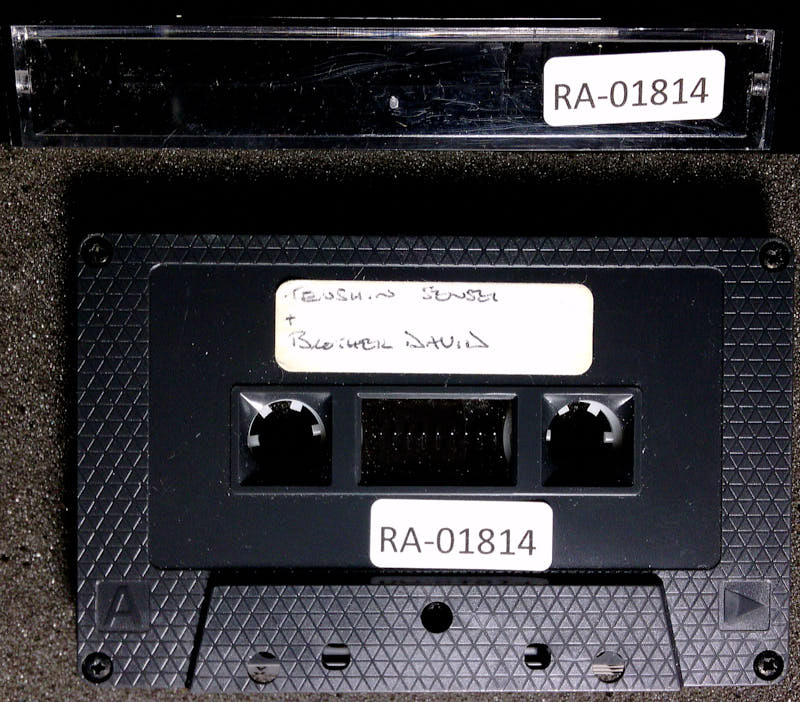
Side: A
Speaker: Tenshin Sensei and Brother David
Additional text:
@AI-Vision_v003
This talk was recorded VERY far from the microphone. Noise-reduction struggles to make out the voices and enhance them. This could be improved with manual remastering.
Tonight, it is a family of our future. It's a little more fun. It's a team for the anatomical. We've been invited to have it, and you're going to know us. I should be an extracurricular of the anatomical. We can invite Eric, the appropriate range. I understand. I get it. This is the power I thought it would be great to invite them, too, before it gets away. No, no, no. Well, I want you to talk about a practice that we can do, not that we can do it, but a practice that maybe has done it.
[01:20]
A practice that's practiced. Not by me, not by you. Not a practice that's exactly what we personally would. But anyway, a practice that rides through birth and death. But practice it doesn't. And nothing disturbs. They have fun of ours, but they let myself die. She's my wife. We need to get home. We need to get back on it. Often times people, I hear people talk about their practice and sometimes they say, oh my practice is this, oh my practice is that.
[02:29]
I can leave it for a little while but then I can lose it. It's unstable. When they're sitting in meditation or living in that way, they find a night full of lots of busyness. When I hear about this, I often think of the story, which I've told so many times. I thought that the union was sweeping the ground.
[03:41]
And the union came up to me. He came up again and said, I'll get very busy. In the end, he said, you should know, brother, that there's somebody who's not present. And the dog always said, oh, and there's two women, sister. And in the end, raised his broom and said, Which moon is this? So, the moon is sweeping the ground.
[04:52]
The moon comes up and says, you're really busy, aren't you? And he said, we should know, brother, that somebody who is not fitting. And Paolo says, there's two moons, visible and not visible. And then he raises his number and said, Which move is this? Is this raising the broom? Is that the physical or the not physical? So in our physical life, in our colluded body, sitting in the ground,
[05:59]
picking up garbage or throwing garbage on the ground. Anyway, someone may say, we're busy. But something's not moving. Something's not busy. Some may say, oh, there's two worlds, a busy world and a not busy world. Well, I raise my hand in my throat. Which world is that? I say these words to you. Which world is that? Is that the busy or the un-busy? If you say it's the busy, well, that's just busy saying busy. If you say it's the un-busy, that's just busy saying it's un-busy. If you don't say anything, then what? Are these worlds of busyness and unbusiness two different types out of two moons?
[07:02]
If so, which moon is this? Which moon is this? You can answer that question or not. Either way, I still have a question, which need is this? Is this the un-busy one? Or is this the busy one? Is this the one that gets knocked out of shape when I am born and when I die? Is this the one that comes and goes? Or is this the one that never moves? Again, you can answer that question, but I still ask it.
[08:11]
Nobody knows the answer. I think it's a good question. And I think it's good to remember that no matter how busy we get, that somebody is not busy at all. And if you see the unbusy one, that's not the unbusy one. But also, is the unbusy one something different than that? Not with it. You can't point at it, but you can't get it with it. It's self-free, you can catch it. We have a study class, and we're studying some text by Dogate about the transmission of the teaching.
[09:32]
In one of these texts it says, only an awakened one can transmit the teaching to an awakened one. Never is the teaching transmitted except by an awakened one to an awakened one. Why doesn't it say that teaching is only transmitted from a living being to a living being? That's because you've never transmitted acceptance of the big people to the big people. Why does it say . Why does it say . Why? Because . First of all, let me thank you for the honor of being here.
[11:34]
I didn't realize who that was it for. I thought this was not a study task. And then I turned over to . When you were talking about these two moons, immediately. Would you speak louder? Yes. When you were talking about the two moons, immediately a parallel came to my mind from our everyday experience. And it's our use of the word now. We said, is this one rule? Is this one rule right now? Right now? When we say now, we mean the present moment.
[12:38]
And it seems so simple. Well, now, that's now. It's a stretch of time. But then we look at the time. And the typical image we have of time is a progression from past to the future, a line that leads from past into the future. And somewhere there's this little stretch of that line, which is the present, between the past and the future. The future is not because it's not yet. The past is not because it's no more. So is and now must be on this little stretch between. But nothing prevents us from cutting this little stretch in half, and half of it is not because it's no more, and half of it is not because it is not yet.
[13:45]
So where is now? And well, everybody knows their mouths. This is just . Yes, but as long as it's a pair, you can spread it. And we find that now is not the time. So we know something that we experience now very clearly. And it is not really in time, because time is that process in which The past is continuously evened up the future with no realm. The is can only be now. Not past, and it was, and not future very early. And is can only be now, and that now is really not in time. We experience it because somehow we sleep out of time. We are in and out of time. And those two, the now that we know, and the time that they know, are quite different.
[14:55]
And yet there are not two moons, and there are not two, because we find the now only in time. But that has been when the historian pointed out there, because that is precisely that day when our time is up. It makes no sense to say after death. Because death is by definition, death. After the rich, there is nothing. For me, any one of us, our death is that moment when time is up. And when time is up, all that remains is now. Because now never was a time. I like the expression of the real
[16:13]
The real here and now is where there's no possibility of any prudent. There's no movement. There's no movement. There's no movement. But there's no fixity either. There's no movement. We have an expression, true calm, true stillness moves.
[17:15]
It's like the moment of the hummingbird, and it seems to stand perfect, and still, because you make it move so fast, but it was getting the hummingbird, the nectar out of the blossom. Yeah, or like a steady top, where it's not wobbling at all. It's steady very fast, but you can't see it move. But if you touch it, it flies off. It's more like, if you take water, a cup of water, and you have some fairly strong sound waves, and get yellow or something, except some strong mechanical waves of water, and the sip of some cup of general will start making waves. And if you set up in another direction, some other waves, You can actually make the surface of the water stationary.
[18:24]
But that stationary water, that smooth water, is composed of the balance of these forces. And if you touch the water with tin, the water will splash, more flat than air. And it will be different no matter. And where you take the tin and the splash will be different. But it seems to be not moving, and yet it has tremendous So it's still, but if you touch it, it responds very dynamically. And he has this passage that . about the still point. Without the point, the still point, there would be no dance, and there's only the dance.
[19:45]
Sometimes they say that they're not moving. does all work for our practice. Not moving. It's really working. And we do many things in our practice. But really, it's doing all the work for us. It's the not moving. And the not moving that we're talking about is not a moving that I can do as you can do. It's the not moving that you already have. You know that one? That's the one that's... That's the only dizzy one. It's all that's right there in this in your present life. Blood circulating. You're breathing. You're thinking. All things are going on. But there's a not moving one there. It's really getting all the work here for you.
[20:45]
And that makes it possible to dance. Thank you. I would rather propose to you that we can't dance if we don't believe, if we don't trust the not moving one. And then we don't feel like it's a dance. It's kind of drudgery. Kind of like, again, can you imagine the water with the sound words of an idiot? It's kind of hard to work, you know? The sound words are working hard, and like those sound waves, those sluts that wave in the surface. But water's still. It's just very easy to treat this explosion of water . Stillness makes movement very easy.
[21:54]
We have a whole set of these prayers. We started out with the busy one with the one that's not busy. Now at time. we're still going to be bad, we're not a person, but blurb and silence. We tend to think of them as opposites or as in a duality, in a dualistic sense. But then we come to realize that if it is really to be a word, not just chatter or twittering or chit-chat, It is simply the silence that comes to the word, whatever we say, opposite to the word. If it isn't silence that has become word, it isn't really word.
[23:07]
If it's word, it's hard to tell. That's a word that doesn't break the silence. expresses the silence. We know very well the difference between breaking the silence and letting something come to the language, or the difference between an exchange of words in the dialogue to different things. Well, it's more than an exchange of roots, it's really basically an exchange of silence. Better not set two moves to join. But another two moves is... is that...
[24:18]
You could save me. You could save me with my legs crossing. You could say, you're all tied up. And I could say, you should know there's someone that's completely free. But I couldn't really be free if I wasn't tied up. We can't be free. There's no freedom aside from bondage in that at all. That we need it. No one says a bird's free of the chains of the sky. Who said that? The bird is white. Our bird's free of the chains of the sky. My birds breathe in heartache.
[25:28]
My birds breathe in a chain to the sky. I don't accept the birds. I don't look at the sky. But also the woman says, it birds leave the air that God wants. So birds fly very nicely, but they're stuck in the air. That free flight was due to their bonding to the air. . [...] How many English you can read in general, okay?
[26:31]
Is it the one which can read in general? Yeah, you can read in general. I can. I live my life in grumbling rings, which pull themselves over things. The last, perhaps I ought to believe, that I will be attending. I'm circling around God, around the ancient tower. And I circle for thousands and thousands of years. And I don't know yet, am I a falcon, a storm, or a great song? I live my life in growing ratings, which hold itself over to things.
[27:39]
At last, perhaps, I won't complete, but I will be attempting. I'm circling around God, around the ancient power, and I circle for thousands of years. And I don't know. Am I popping, a storm, or a wrecked song? Do you know what's going on, Jameson? But it's very beautiful in German. So even for those of you who don't know it in German, it's from Witte's Book of Hours. And let it sound nice enough to work. I say that. I live in my life in wachsenden Ringen, die sich um über die Dinge ziehen.
[28:42]
Die werden wir letzten vielleicht nicht vollbringen, aber versuchen wir es um. Ich kreise um Gott und um den Uraltaturen, und ich kreise jahrtausende lang. Und ich weiß noch nicht, . And in that ,, which unfortunately has really never been, I think it has once been translated, but normally in the ,, only parts of it. And in the last time, he has some . about that our whole life is only the husk and the leaf around this sea that fit them .
[29:52]
Everything depends on living our life in such a way that we mature our death. You could say that we mature the now in the course of time. And then he speaks about the disappointment that so often we are not mature and we are not mature even. And she speaks of angel, flocks of angels, like migrating birds, the same kind of migrating birds through the orchards, and we find all the good reading. Therefore, storm has come to shake them off.
[30:59]
But the task is to mature that death with us. The task is to live a life that really reinforces its death as a fruit, not just as something that happens to us. At every moment, there is this death present. Very much like the other moon. And to face that, this is what makes us remember that. This puts us together in that dismembered state. in which we often find ourselves, to face that now, that death in every moment.
[32:00]
And it gives that seriousness and that weight to our life. Not to be blind to it. Thinking about that in that sense, there is always morbid or life-denying, but on the contrary, is exactly what makes it completely alive. That is something that ties any of the spiritual traditions together. It's something that potentially uniting all humans, because if there's one thing that we all share, maybe they're having to die.
[33:02]
I recently had, I guess maybe we know this, but I don't know. The word angel means, doesn't it? Doesn't it mean that messenger? And the word angel means good news. And English is what it says. Good news. English way of saying that is gospel. To make it an English word, a gossip. And I was, I myself, you know, I had some tendency, you know, as I studied Buddhism, to avoid words like God, and angel, and things like that, because it seems kind of confusing. Recently, I thought maybe it's OK to say that everything is an angel of emptiness.
[34:52]
You know, all things are messengers of emptiness. All phenomena are videos of emptiness. You could even say all things are evangelists of emptiness. Everything that happens is bringing a good new that everything lacks a very existence. And as a matter of fact, the only things, it's only about things that that message has brought to us. So all things are proven, all things are evangelists. Or all things are gospels. But again, in the past, I've hesitated to bring these kind of hands up because Buddhists might be upset to use words like gospel and evangelism. But anyways, maybe it's like that story of Tom Virgil last night, you know.
[36:02]
You go to the story, your wife's into the story, she said, get half a pound of flour and half a pound of salt. So you put your plate out there for the salt. And you say not to use the flour, but you don't want to mix the salt with flour. So you put the plate over. You need the flour. You don't want to mix the salt with flour. But if you try to separate them, you wind up with meat. So maybe if we try to separate Buddhism and Christianity from Judaism and Christianity and Buddhism, then it will wind up with dumping. Of course, we don't mind dumping some of them. We don't mind dumping everything, as we're so afraid, contamination and confusion. We don't want any confusion.
[37:02]
But the problem is, if we avoid confusion, we die once. That's where we swim. That's where our freedom . Anyway, that's what the ancestors said. There's a very Buddhist statement in Latin trance about this. I don't think I heard this, actually. But I think I heard it from Saturday. I don't think I heard it from Saturday.
[38:09]
Suji Roshi, at one time, somebody was saying something disparaging or about Christy. And I don't know of all the same comments, but he said, well, before he knew me, a good person must be a good person. That's an actor that made him do. So either he said it or he said it. You're talking to me. Again, I think for us to try to avoid the fact that we have Judeo-Christian background, it's just like the saying to try to deny our roots. And even though now, even though some of us are not Christians, whereas this Christmas, there was a race of Jews still.
[39:11]
The Jews and Christians are very close to the day that . Very close to the day. Maybe there's some Jews that don't have much to do with Christians, but there's no Christian to the other, so there are Jews. So we try to avoid that. It's really necessary for a time in a person's life to separate oneself very clearly from certain forms or studies. One can't study everything at the same time. So study one thing. That's quite helpful. But then experience simply proves that when you go deeply enough into one tradition, whichever one it is, you come to the point where all the traditions seem together.
[40:23]
And then you are somewhat free to use isoterminology and imagery from another tradition and see You see only from the other side how they are closely connected. And for instance, when you say that everything is an angel of nothing, that might startle or upset some Christians very much, or at least don't know what to do with it. But rightly understood, it's a beautiful expression also something that all Christians should believe because God is in something. God is not this thing or that thing or anything. God is no thing. And so if angels are messengers of God, then they are messengers of no thing. And that no thing is in everything.
[41:25]
And so it all works perfectly well. But they can't screen it on people. That's quite upsetting. I'm sorry. That's why it means good news. You should think that something that's so good would by now no longer be news. Because even though we say it and a moment later the actions that we had completely forgotten. The publish is not back, and it's new again. It has to be really escalated. very much.
[42:34]
I just want to apologize for my not to dress for the occasion. I shouldn't put on the city robes. I have had occasions like that before. One time in Hawaii, one of the least dressed I was invited to talk to some of the scholars there. And it was on the weekend that we were out on the beach. And then everybody was going into the water. And I didn't know what the state was. I come out in my . And they say, as long as you can't for your talk. And I just heard a few of the overawing names that people who have always seen book patterns and book covers.
[43:45]
I was standing there with no props, nothing in the mirror. Nothing. bathing trunks and under a palm. There's nothing to say. Well, I'm really sorry to you. What's your issue? Very good. You can get my horse out. Someday I want, you know, we have this, on the first call, one of our major call-on elections, the first case is, the Buddha comes into the , he gets up on his seat, and . He says, clearly observe the teaching of the Buddha is
[44:52]
I always wanted to get that luxury. I also always wanted to get luxury while I'd come in naked. It's still coming. Now I'm losing weight. Thank you.
[45:34]
@Transcribed_UNK
@Text_v005
@Score_77.69