You are currently logged-out. You can log-in or create an account to save favorites and more. more info
Sesshin Day 1 Dharma Talk
Keywords:
AI Suggested Keywords:
The talk examines the teachings of Vasubandhu, particularly focusing on the concepts presented in the "Thirty Verses," emphasizing the dependent nature of the self and the transformative essence of thought as concept. It highlights the practice of Zazen as a method to engage with the present moment, free from concepts of substance, thus underpinning the attainment of non-discriminating wisdom. This practice of mindfulness allows for acceptance of emotional states and conditions as they arise, fostering an integration of the teachings of suchness into everyday consciousness.
Referenced Works:
- Thirty Verses by Vasubandhu: Examined within the talk are Verses 17 and 22, which discuss the dependent self nature as a concept arising from conditions and the transformation of thoughts, underscoring the philosophical basis for understanding the self in Vijnanavada.
- The idea of "suchness" communicated by the Buddhist ancestors serves as a foundation for the discussion on living in alignment with the teachings and maintaining continuity through mindful presence.
AI Suggested Title: Mindful Presence through Vasubandhu's Lens

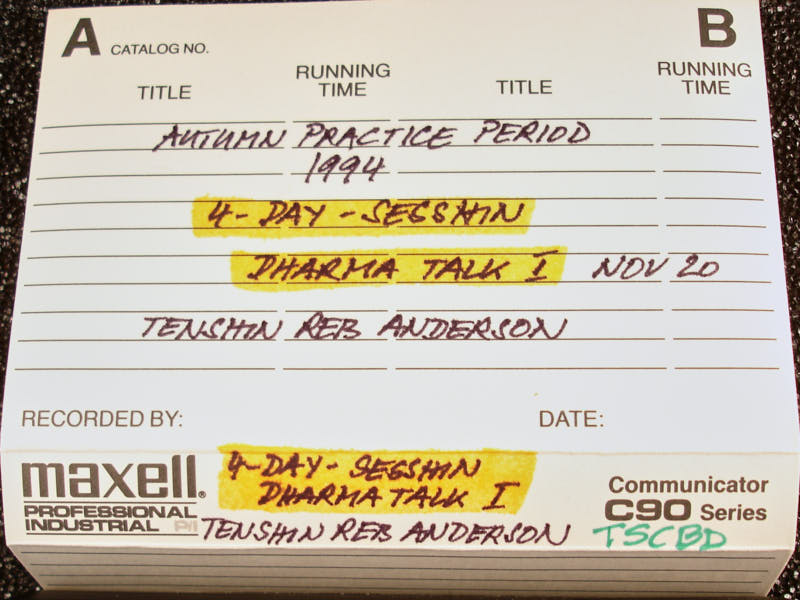
Side: A
Speaker: Tenshin Reb Anderson
Possible Title: 4-Day Sesshin / Dharma Talk I
Additional text: Autumn Practice Period
@AI-Vision_v003
Quietly explore the nearest and farthest implications of these causes and conditions. In the twenty-second verse of the thirty verses by Vasubandhu, he says, it says that a dependent self nature
[01:02]
is a thought that has arisen depending on conditions. And in the verse before that, verse seventeen, Vasubandhu said that because thought involves transformations, thought is really just concept. So, a dependent self nature is a concept that has arisen depending on conditions. When a
[02:32]
of ideas of self, freed of attribution of substance, it is the accomplished, it is non-discriminating wisdom. Actually, what's appearing before us, moment by moment, our birth, our sixth sickness, our pain, our growing older, as it actually appears, as it actually comes to be before us, or as our life, it actually is free of all of our concepts of substance.
[03:45]
So, in some sense, our Zazen practice is just simply, unhesitatingly, without any resistance, just being what is coming, just letting it be, moment by moment. All we need is to be completely absorbed in what happens moment by moment.
[09:13]
Sometimes calm and relaxed. Sometimes seething with emotions, complications, trouble and anxiety. When those things appear, that's all you need. They arise by causes and conditions. And if you can let that be, then these things are happening.
[10:52]
Free of all your erroneous imaginations. All right. Thank you.
[11:52]
Thank you. Thank you. is seething. There is great pain. Somehow, it has turned cold. The blue mountains grow more vast and more blue. The autumn waterfalls are louder.
[13:15]
I take my cane and go out the gate for a walk. I can hear the last crickets singing in the chilly evening. I am happy. The rays of the setting sun shine through the evening smoke that hovers over our village. I throw back my head, drunk with beauty, and sing the willow song at the top of my lungs. By the kindness of the Buddhist ancestors, the teaching of suchness has been intimately
[14:31]
communicated. Now you have it. Please take care of it. If you can take care of it, moment by moment, and achieve some continuity. This is called the teacher within the teacher. This is called the teacher within the teacher.
[15:57]
@Text_v004
@Score_JJ