You are currently logged-out. You can log-in or create an account to save favorites and more. more info
Relational Self: Beyond the Illusion
AI Suggested Keywords:
This talk addresses the concept of self-clinging in Buddhist philosophy, focusing on how habitual self-referencing blinds individuals to the relational nature of reality. It explores the misconception that Buddhism advocates for the complete eradication of the self, arguing instead for recognizing the self as a non-permanent, relational construct. The discussion also examines the importance of cultivating appropriate boundaries to develop a healthy, interdependent sense of self and emphasizes how these practices can shift one’s relationship with suffering, enhancing understanding of relationality.
- Heart Sutra: Central to the discussion on emptiness, emphasizing emptiness of inherent self-existence rather than the absence of self.
- Chandrakirti's Sevenfold Reasoning: Used to illustrate the idea of self as a collection of parts or conditions, significant in understanding Buddhist teachings on interdependence.
- Heraclitus: Mentioned in relation to the exploration of philosophical insights that align with Buddhist principles, specifically interdependence.
- Bette Midler Joke: Utilized humorously to illustrate self-centeredness and the habitual focus on the self.
AI Suggested Title: Relational Self: Beyond the Illusion
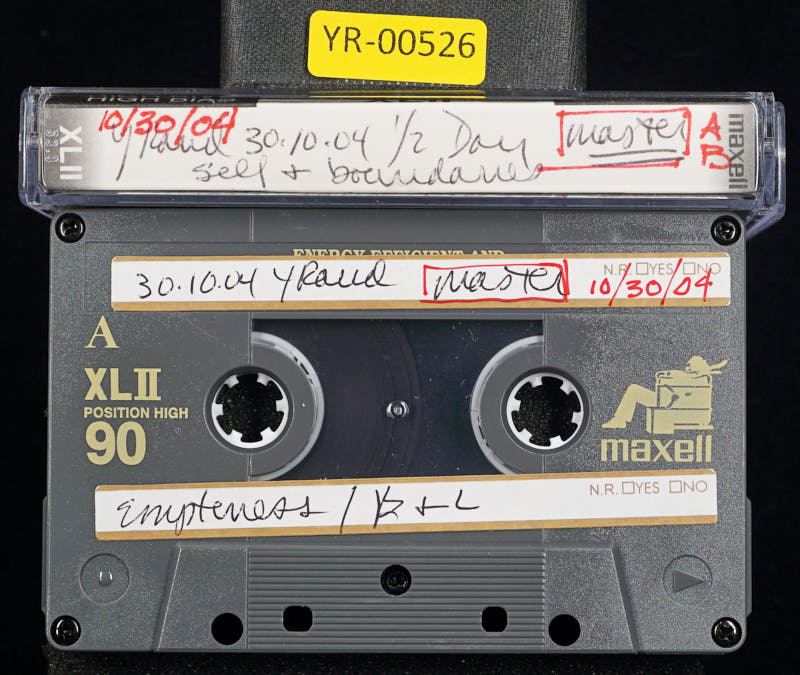
Side: A
Possible Title: Emptyness
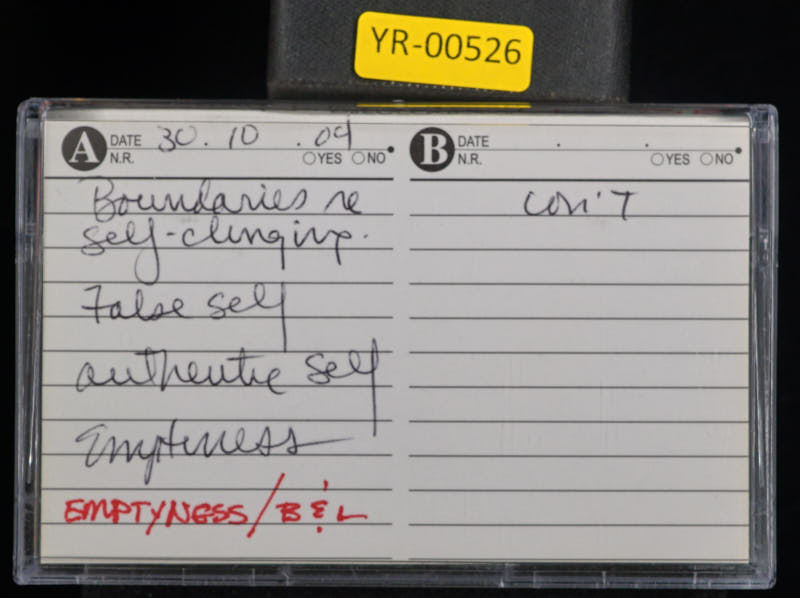
Additional text: 30.10.04 Yraud Master; Boundaries re self-clinging; False self; Authentic self
Side: B
Possible Title: Emptyness
Additional text: cont
@AI-Vision_v003
Good morning. Good morning. I'm happy to see you all. Last weekend, some of us spent the weekend working with jealousy and envy. And I was very energized and encouraged by the retreat for a variety of reasons, including that, with no exceptions, everybody in the retreat was really working the material, if you will. And what arose
[01:02]
out of working with the meditation practice that we were doing was some, and I think all cases for those of us in the retreat, a quite vivid experience of self-clinging. That is, self-referencing in a habitual way, whether it's positive or negative. And one person in the retreat really summed it up wonderfully, well, what about me? So, what I'd like to talk about this morning really comes out of the experience of the retreat. Specifically, a kind of misunderstanding that I think many of us have about the teachings in the Buddhist meditation path about the self.
[02:11]
You know, the self is bad news, if you will, or let's get rid of the self. The wisdom teachings, which are really unique to Buddhism, emptiness. as though emptiness were, you know, a condition in and of itself. And emptiness is the code word, the encapsulation of emptiness of inherent self-existence. Emptiness, that is, there's no solid, fixed, permanent self. That is not the same as saying there is no self. It's the insight of the Buddha that there is no self with these characteristics of permanent, solid, ongoing, separate, independent.
[03:22]
So another way of talking about this teaching is not in terms of what is not, but in terms of what is. What is what the nature of reality can be described in terms of interdependence. Nothing exists except relationally. And I think that's easier for us to get, given our Western conditioning. We have a lot embedded in our conditioning, culturally and historically, as Westerners. is, I think, encapsulated in the great statement, I think, therefore I am. I'd say, I think, therefore doubt the thinking, because sometimes it's valid and sometimes it isn't. And the I am part is the solidifying. I am angry, for example.
[04:28]
It's a statement in which I'm identifying with and solidifying and defining myself as angry. Rather than, oh, anger rises, disappears. That everything rises and disappears. And that, of course, terrifies some people. But you get over it. Well, I know that from personal experience. You know, you think you're on top of the great koan. You think you're on the top of a 100-foot flagpole. and what you're being asked to do is to step off, and then you discover that you're really only on top of a three inch high flagpole, or not. So, what I want to talk about this morning has to do with healthy, appropriate boundaries and limits with regard to the self.
[05:33]
When we begin to see the pattern, the habit of self-referencing, self-clinging, negatively or positively, it's easy to jump to the conclusion that, oh, I should get rid of. The getting rid of or the dismantling, the gradual dismantling of self-referencing does not mean that I'm supposed to be getting rid of self. Even the language of getting rid of, I think, is problematic. Allowing the slow, steady, dismantling, dissolving of that kind of self-referencing that keeps us in the middle of our view about what's so, in a way that blinds us
[06:37]
to the what-so-ness, if you will, of relationality, which has the effect of opening the heart, in my experience. So, what came up in the retreat for some people, and has come up in some meetings I've had with a few of you subsequently, is some confusion about the function of appropriate, flexible boundaries in service of taking care of myself appropriately, cultivating my capacity to be in my own shoes, not in a self-clinging way, but in a way that generates a healthy sense
[07:39]
of authentic power and authority. And of course, for many people who have trouble with the boundary and limit called no, what we're running into is our habit of projecting my sense of well-being out there on the rest of the world to tell me I'm okay or not. And of course, for so many of us, we've grown up in a dysfunctional family system of one kind or another, where our conditioning has been the training ground for that whole process of habitual judging, rescuing, fixing. You know, it's a very interesting list. Some of us have been working for a while now on the cultivation of equanimity, and I've been emphasizing, pay attention to your prejudices.
[08:52]
Because it is our prejudices, our view about how things are before the direct experience, that is the disconnect or the hindrance to the cultivation of equanimity. The quality of ease with what's so. Absent, like, dislike. Want, don't want. Attraction, aversion. And initially, I think, in our meditation practice, where what we start to bump into are the patterns that are the specific landscape of our conditioning. It's another way of talking about this, realizing you're all in something of a board, and I would enjoy seeing you, which means putting on the right glasses.
[09:58]
Where was I? Landscape of our conditioning. Ah, thank you. What is described in the Buddhist meditation path as conditioning is all the patterning that is the consequence of what we learned, consciously and unconsciously, as children in our families of origin. The experiences that we've had in our lifetime, which tend to reaffirm and regenerate those early patterns and the patterns that we come to have as our familiar landscape that are cultural. So beginning to spot, beginning to cultivate the capacity in the mind to observe and describe
[11:07]
pattern, wholesome patterns and particularly useful unwholesome patterns, patterns that lead to the experience of suffering. Because once I can begin to see pattern rather than content, I have a more chance of noticing the pattern without sinking into it. It's that sinking into and recreating over and over and over again what's familiar. So, if I'm interested in the experience of things as they are, not as I want them to be, not as I think they should be, not as I expect them to be, but things as they are, moment by moment.
[12:11]
To do that, I have to, in my experience, and certainly this is a central theme in the Buddhist meditation tradition, is I have to begin to be willing to notice self-clinging, but to understand both intellectually and experientially, that it's not that there isn't a self, but am I defining self inaccurately? And my experience personally and in working with practitioners over a number of years is that learning how to develop appropriate, flexible boundaries and limits actually lays a kind of ground, if you will, not solid, but available, where my sense of self is not the primary referencing, but my experience of the relational webbing
[13:34]
that I'm part of. Now, of course, what I find so interesting is that for those of us who grew up not having appropriate, flexible boundaries and limits modeled for us on the part of our parents, the whole topic is mystery material. It's like, huh, what do you mean? So, along with the experience of self-clinging, what can begin to open up is some willingness to experience self, not separated from other, but relationally, interdependently.
[14:40]
and to begin to experience the ways in which such and such doesn't work for me today, for example. It's not one or the other, it's both and. That is, the sense of self interdependently is actually, I'm proposing, begins to be more accessible developmentally when I begin to learn how to stand in my own shoes and have a sense about what fits for me this morning or this afternoon or in such and such a conversation or meeting. Boundaries and limits. The danger, the hazard is if we begin to get some glimmer of the predominance of self-clinging arising, then we want to just pitch the sense of self out the window.
[15:56]
The appropriate sense, the sense of self that's accurate, the sense of self that is not. And so what happens for practitioners, and I think it's particularly a hazard in residential practice situations, is everybody gets good at pleasing, rescuing, fixing, just all the distractions that keep us from attending to what's actually arising in this mindstream. I know this only rather vividly, having been in a community, a practice community for, I can't believe it, 28 years, in which my willingness to drive my ambulance, as I sometimes put it, rescuing, fixing, saving, taking care of, got celebrated
[17:08]
as, oh, you're such a bodhisattva, always thinking of others. Even if that meant falling on my face from exhaustion. So, of course, I picked what was familiar. I picked a community in which the patterns were stunningly close array the patterns that I grew up with. And it wasn't until I could see those patterns arising that I could begin to notice, oh, I'm doing all these things to avoid being present with my own suffering, to avoid being present with studying and training this mind, failing to understand I'm the only one who can do that, no one else can, much as I might want them to. That if there is going to be change, first of all I have to study the characteristics of my own mind stream and then begin to discover what are the dominant reactive patterns and do I have any sense of how to change my relationship to those patterns
[18:32]
So I'm not continuing to regenerate what amounts to suffering. Familiar, deeply ineffective, or maybe deeply effective in keeping me distracted from studying and training my own mind stream. Now all that sounds to us, especially if we've grown up in a family where we had a lot of finger wagging about, now don't be selfish. it seems like a lot of energy and attention on me. And this is where the long-term view that I have to do this work with this mind stream as a way of uncovering my capacity for being present moment by moment in an unconditioned way, free of conditioning,
[19:33]
which is necessary for me to cultivate my relational capacities with oneself and with all beings. That's the point at which my relationship to suffering begins to change. I think right now with the growing franticness about the upcoming election and the fear that many people bring. The election and what might happen on Tuesday and afterwards is kind of looming. It's very easy under these circumstances to step back and have a wider view.
[20:39]
Step back and experience the world as it is. myriad moments of connection, of kindness, of actions that arise out of a sense of the inseparability of our suffering. And I think it's very easy as practitioners to get so focused on our own mind stream that we can turn away from the world. And I do think that it is important to do that, to turn away from the world as we ordinarily experience it periodically. One way of understanding what we're doing together, practicing together this morning, what we do when we meditate,
[21:57]
hopefully every day, what we do when we go into the seclusion and protectiveness of our retreat, which allows a sense of containment and simplification such that we can actually do a different, focused, more intensely focused time of studying and training the mind. But in the end, what really makes the difference is whatever arises in our meditation practice as it shows up in our daily lives. That's in the end what counts. if there isn't some maybe slow but steady shift in the way I relate to others.
[23:07]
And I don't mean just other human beings, although for some of us other human beings are the major what we think of anyways. I had an experience recently of feeling a significant degree of aggravation with my experience in being with somebody in a working context where I felt a lot of negative stuff coming my way. And the relief that I experienced when I got, oh, I wasn't listening from the perspective of the 98% rule. That whatever this person was saying, whatever barb I felt coming my way was a snapshot, 98% of what this person was saying was a snapshot
[24:25]
of that person's mind stream. And of course, at that moment, later, the noticing that arises later, is the moment where, oh, what's wrong with you that you didn't remember that in the moment? Habitual judging. And as I've said to a number of you before, If I can respect and honor my insights whenever they arise and not get on my case about there being late, the gap between seeing and the moment will begin to shorten. May take a while, but it will shorten. So what I'm, just to reiterate, what I'm trying to bring up for our consideration together this morning has to do with the kind of misunderstandings that can arise in the face of some quite authentic insights about self-clinging.
[25:58]
the danger or the hazard of saying, oh, well, then I throw any attention to the self out the window. I think that's a misunderstanding of the implications around this, well, what about me? You know, the wonderful Bette Midler joke that you've heard me say before. Enough about you. No, enough about me. Let's talk about you. What do you think about me? That appropriate, flexible boundaries and limits are worth training for. My argument is that the more cultivated my appropriate boundaries and limits are, the more there is a kind of decline of that hanging on to the sense of self that's separate and lonely, and an increased capacity for a sense of interdependence.
[27:23]
I know when I first began to experience the degree to which self-clinging was really at the root of so much of my reactive patterns, I was appalled. Didn't feel like good news at all, which is why I recommend noticing self-clinging very briefly, as briefly as possible. and then come back to the reliable, accurately registering and telling, if you will, of body sensation and breath. So I wonder, in case I have caused or been contributed to confusion arising, if there are any things you want unpacked a little bit more.
[28:39]
Betty? I want to make sure that I understood clearly something that you said, and then if I did, I'd like you to unpack it. All right. Did I understand you to say that our relationship with our own suffering shifts when we come to a deeper understanding of relationality? Yes. Could you unpack a little more how is it that our understanding of relationality is the consequence for shifting that experience of our own suffering? I think it's more that the experience of my own suffering which opens up for me my growing capacity for the willingness to experience the suffering of the world, is an instance of interdependence.
[29:48]
It's a manifestation of the description that nothing exists except relationally. And that our sense of our own suffering as isolated and particular, worse than anybody else's, is really the face, if you will, of self-claim. So, embedded here, and I think it's really embedded in the cultivation of the willingness to change, the cultivation of the willingness to turn toward reactive patterns as they arise rather than turning away from them with distraction or, you know, whatever. What's in your kit bag may not be the same as what's in my kit bag reactively.
[30:49]
That capacity of turning toward what is arising in the language I'm using of reactivity, reactive mental patterns, and emotional patterns, the more I develop my willingness to turn towards those patterns, the more I'm willing to turn towards the specific awareness, inattention, if you will, of the arising of a particular pattern and not linger, I'm actually training for the capacity to experience that reaction. That is, as I have more and more capacity to come back into attention with energy and stability as the characteristics of the attention, I can actually be present in the moment of a reaction arising.
[31:50]
That's another way of talking about I'm training for being able to actually experience this particular arising of suffering. But, you know, I'm really using the traditional language coming from the Buddha's first teaching in Deer Park about suffering. I'm proposing that one way of defining suffering is in terms of our reactivity. That's the arising in the mind that we experience as suffering. And when my reactive patterns, especially the dominant ones, begin to subside out of my willingness to experience my own suffering, my capacity then to bear the experience of the suffering of the world has begun to culminate.
[32:55]
And of course, what I'm opening myself to is the experience that your suffering is my suffering. So I'm opening myself to a kind of relational field, if you will. We had a Kellefeplon Society board meeting yesterday, and one of the board members stayed and had dinner with us, We started talking about her brother takes care of her dog when she's traveling. And she said, the dog starts to bark when he's parking his car around the block or two blocks away. And she said, I don't know what the dog's barking about. And then all of a sudden, my brother's at the door. But she said, it happens so consistently. And, you know, there have been studies about this territory.
[34:02]
And a dog will start waiting for its owner to come home at the point at which the owner had the thought, oh, it's time to go home. And of course, you know, a lot of our conditioning is not including that anything is real other than what we can touch and see. So that this relational feel, the implications are quite significant. So are you saying then that our capacity to turn toward our own suffering in a sense broadens our focus? No, I'm saying that the result of doing that is an increased capacity to be with suffering. With any suffering. Right. And that the distinction between, well, your suffering and my suffering begins to break up.
[35:10]
It's to the degree that it's either or. Mine. Mine. Yeah, there you go again. Mine. This is my spoon. Any of you see Spider Rabbit, Michael McClure's play? The main actor was this, I don't know, 6'6", black guy, really skinny, dressed up in a suit that was a combination of a rabbit and a spider. And his name was Spider Rabbit. In the middle of the stage was a table. In the middle of the table was a human skull. And he takes the top of the skull off. having dinner. It's a very dark anti-war play. But he's got a spoon, and he's got the skull, and he's got a hand grenade.
[36:11]
This is my spoon. This is my hand grenade. It's an alarming and remarkable play. And self-clinging is very much in the center of it. mine. Okay, does that open it up a bit? For those of you who aren't used to my way of speaking, this notion of unpacking. Bill and a number of you actually have helped me develop and I continue to want your help when I speak in a way that's so you know, what I think of as the bouillon cube. Let's put the bouillon cube in the water and let it dissolve and describe it a little bit more detail. That's what unpacking is about. I have this suitcase and I can name the suitcase in terms of category, but sometimes it helps to open the suitcase and take everything out.
[37:22]
So please don't hesitate to bring up something that I might elaborate on a little more fully. Becky? The self has the mark of impermanence. I believe you were pointing to it at one point, and that actually I like. Well, you may like it, and then there may be a moment when you don't like it. This is where the liking and the not liking is itself a problem. I didn't experience it as bad news. But the question I wanted to ask relates to the self as being experienced in terms of relationality. Because my experience is that I, if I focus on relationality, I quickly lose myself. I become too focused over there. So what I'm asking is how do I keep that
[38:26]
Well, first of all, if I have that tendency to be what I would describe as other-oriented, that's a reactive pattern. So that tendency, if I can keep whenever that other-oriented pattern arises, note, observe, identify, describe, name, and immediately come back into alignment of head, heart center, para, gravity, breath. In time, the more capacity I develop to dismantle that other, that pattern of other oriented, What comes, what begins to be more accessible experientially is the mind of both and.
[39:31]
And this is where boundaries and limits actually can be quite helpful because if I'm really present with what's appropriate for me in this moment with respect to boundaries and limits. I'm going to have less arising of the need to either be taking care of you or taking care of me, but not both. So the more I'm training for noticing either or thinking and reframing it to both and, the both and, the mind of both and is the mind that begins to experience that you and I are not separate. So I'm uncovering the fact, experientially, of relationality. I'm not creating it, I'm uncovering.
[40:37]
That's the nature of things. So, I think that to understand that our reactive patterns become like a kind of carapace or a kind of crust overlaying things as they are. So that disintegration, that gradual fading away of all that cement coat, if you will, allows me to drop into the experience of things as they are. So it's not that I'm losing something. What I'm losing, what I'm going for, and the more I can experience that that's what's happening, the kind of relief that comes with the gradual fading of the reaction of judgment, for example.
[41:41]
Which has to start with my noticing Judgment. [...] And, you know, for those of us working with equanimity, judgment that's in that category we call prejudice, pre-judging. Which, you know, when you begin to notice prejudice, you begin to stumble into awareness of how separating all my ideas about somebody I don't know that I just see walking down the street as different from me. So I'm also hinting at, if you will, How can I say this? This is where poets have a better time of it, descriptively.
[42:49]
This realm of experience that is available to us is also a realm of experience, if you will. The problem with realm is it sounds like it's some place. of a capacity for kind of resonating. And picking and choosing, having preferences, keeps me, keeps covered over that capacity for relational quivering, if you will. That's the field again. Yeah. A few weeks ago Bill and I had a visit with a friend of mine from the AWAKE meetings where for a few years a group of us were looking at the relationship between the Buddhist meditation tradition and contemporary art.
[44:01]
And this man is an architect and his partner is a designer. and we invited them up to the place we recently bought up in the Anderson Valley. And as I walked around with Michael and April looking at the property and just trying to hold our respective experiences of this place and what we might do there, Michael and I had in this shirt pocket and old panties, making old jottings as we're walking around. And he, of course, cited the house we'd like to build exactly where Bill and I thought to put it. There's a building that is right in the middle of a quite beautiful south view. And another architect we worked with
[45:07]
Bill said, let's tear that thing down. It's not only ugly, but it's like this big obstacle. Michael said, I think that should go. It's ugly. And look at that beautiful vista. Anyway, it was my experience just walking slowly, walking around the property with Michael was the experience of this resonating. Anyway, that evening after dinner, he told me something about his experience with making mistakes and doing drawings as an architect, for example. And he said, what I began to discover or uncover was that there was a lot of energy in mistake I've made in a drawing, and that if I moved into the mistake, so-called, I would begin to uncover possibilities that I hadn't experienced were there.
[46:31]
So he said, I no longer have any erasers. Isn't that interesting? Bill? Two things. One, you pointed to poetry as expressing resonance. What looped into my mind was the haiku, I picked up the moon in my water pail and spilled it across the grass. Yeah. On self, I understand, certainly intellectually and time to time experientially, the conditional, transient nature of the mental concept. We refer to when we say self. And I'm struck by it in terms of the experience
[47:34]
Certainly to a sense of self. Only the profile. You don't need much evidence. The forward protuberance will provide it. But the rubber band snaps back to a sense of self that includes deft hand-eye coordination and a snappy, reliable short-term memory. In the terms of what you're talking today, the challenge that I face is loosening that rubber band grip to allow a more current sense of what's actually so, to inform this mental concept I have of who I am. Well, you know, I know somebody who has had some diagnosis that
[49:04]
that she will in time, sooner than later, lose her eyesight. And of course, what immediately arises is clinging. And it's one of the reasons that aging and dying are so challenging. But for some of us, we're on that edge of some cusp, we don't want to notice, in the declining disintegration side of existence. And as I think many of you know, this is a central focus in Buddhism. just any one thing that has the mark of change, it's everything. And the bottom line in this tradition is that when you get right down to it, all there is, is experience coming and going, coming and going, coming and going.
[50:22]
The ground we need to traverse to come to that understanding and experience with a calm and happy mind is very well mapped out, but nobody said it was easy. It's not. And it's particularly not easy in a culture that emphasizes having. that emphasizes being somebody. I ran into an old friend recently who lives in someone's barn. He said, I can earn enough money to meet all of my current needs occasionally working at the coffee shop. He said, I need about $500 a month I have absolutely nothing except the mat I sleep on and some blankets and a pillow and a few changes of clothes.
[51:40]
He has a few things, but not much. And what I experienced in being with this person, but also he described in his experience a kind of lightness and playfulness in his life that he's always exhibited, but it seemed forced before. And it, at least the other evening, didn't feel forced. A kind of freedom. He also helped that he nearly died a couple years ago. That's a very big help. Yes? I'd like you to unpack a little bit one of the first things you said in your talk, which was about a misunderstanding about no self or nothing being no self, rather than this.
[52:54]
Well, the code word in the Buddhist tradition is emptiness. And in our sutra book, when we recite the Heart Sutra, which is the sutra that carries the description of the nature of reality from the perspective of what's called the absolute. And the language over and over again is emptiness. And what I have perceived in my own experience, but in practicing, especially in the Zen tradition, where the Heart Sutra is really the central sutra, many people, miss what's emptiness of what.
[54:02]
I remember in 1986, when the late Tarantulku was doing some teachings at Green Gulch, I had kind of stumbled onto this teacher and just thought, wow. and invited him to come and teach. And I think it was on that first visit in 86, he spent quite a bit of time talking to different people who'd been practicing for a long time. And I remember one day he said, you know, it's just not good enough to chant the Heart Sutra beautifully. You have to understand it. It's a teaching text. It was kind of a blow, I think, because, you know, we were really good at chanting the Heart Sutra quite beautifully. And I do think that chanting it for 20 or 30 or 40 years, something begins to drop in, but maybe or maybe not.
[55:11]
So, in the form, the version of the Sutra that we use, we have in parentheses, emptiness, parents, of inherent self-existence. That is, the conditioned, often unreflected on description of the self as by its nature solid, permanent, separate. So the self is, the accurate description of self is empty of those characteristics of permanent, solid, separate. But it doesn't say no self. It says emptiness of inherent, solid, permanent, separate self.
[56:14]
So there is this sense of self that's inaccurate and a sense of self or description of self that is accurate, as interdependent. I remember a number of years ago, somebody, you may remember who it was, I now can't remember, did a description of his own arising, existence in relationship to something like a camellia bush, which he had planted outside where he lived. Because this camellia bush, or whatever the bush was, was in the setting in Australia where his mother and father met each other playing tennis. and admired this bush.
[57:18]
But then there are causes and conditions for the bush. And for his mother and father, they each had parents. They each had parents and all the surrounding circumstances that brought them together. So he kept going back and back and back and inciting all of the causes and conditions that led to his being born. And it wasn't just his ancestors, but it was bushes and tennis courts and rackets and boats getting them to wherever they were playing tennis, et cetera. It was a wonderful kind of exposition of what gets referred to in Buddhism as interdependence, that nothing exists separately, independently, solidly. And I think that that understanding of the nature of things is especially challenging for us as Westerners.
[58:28]
It's especially challenging for us speaking English. People from other cultures and language groups where there is no word for I have an advantage. So that's the kind of thing that I'm referring to when I talk about not only our family of origin conditioning, but our cultural conditioning. What's really interesting to me is to look at the historical teachings that resonate more fully with the insights of the Buddha. Bill and I have been talking for some years about doing something on the koans of Heraclitus.
[59:35]
Which I actually think not only would be fun, but actually important. Chandrakirti's sevenfold reasoning where he likens the self to a chariot and says, touch it anywhere. And are you touching the chariot? No, you're touching the axle, the hitching pole, the wheel, some part of it. And so it goes. Where's the charity? For myself, the remarkableness that I'm coming to experientially recently is that I've spent a lot of time deconstructing with the hidden agenda of getting to nothingness.
[60:46]
There's no nothingness to touch either. There's only axle and wheel. And that's... But then axle can be unpacked. Wheel can be unpacked. And this... Well, anyway, I think this territory can be conducive to a certain kind of nervousness of, I'm not sure what, the mind, I suppose. Yes, Bill. I was just going to add, I think there's a tendency to take emptiness, which grammatically is a noun. Yes. And understand it as, therefore, pointing, referring to some thing. Yes. And in Longfell, it's much to understand it as an adjective. Yes, I completely agree with that.
[61:49]
I mean, one of the great teachings for me arises in the garden. And I love this time of year because it is a time of disappearing. And everything that will manifest in the spring is already arising, potentially getting ready now. I commend to each of you the magnolia seed pod that I put on the altar. It's from the magnolia tree on the property next door to the property that we just recently became stewards of up in the Anderson Valley. And I've never seen a seed pot like this.
[62:54]
And every day I just keep looking and at some point the seeds began to show up. And, you know, from a certain standpoint it just looks like a dead branch with this funny raspberry colored stuff on it. We'll see. Okay, I wonder, yes, Cliff, please. Yes.
[63:56]
It was really fascinating. Totally fascinating, yes. And one thing that jumped out at me was the reference to the amount of our ordinary life that is run on an unconscious program. A huge amount. I can't remember the percentage they gave. Do I not love myself? I noticed that I missed her.
[65:30]
Well, I'm not a person who misses people. I don't need to have... Oh, there's a definition. Yeah, yeah. Well, that's the whole thing. It's like a coat that's two sizes too small. Yeah. I had such a profound experience of that when my mom died. I want to reflect back to you what I heard you say at the beginning of what you were saying.
[67:04]
You said, reading the article made you something or other. Something made me... You want to clean up my language a little bit? No, no, no. I just want to make a proposition. that I read an article, my friend goes away, you know, shit happens, as they say, and I have a reaction. And when I stop assigning this made this, I actually have a chance to do the very thing you're talking about moving toward, which is the possibility that I may experience certain circumstances on another day, and what will arise in the mind may or may not be like it was yesterday.
[68:15]
And that habit that I think is very easy to fall into for many of us that the version of it that I think is the most troublesome is, you made me angry. So I get locked in, in just the way you're referencing, I get locked into a kind of position about who I am. And when I begin to make that distinction that you do what you do, and I actually have some say about the reaction or response I have some choice. It's what motivates training, I think. And it's the difference between what you're bringing up as a kind of, the causes and conditions for being locked in to a sense of self that may be very old, may be outdated, but whatever, from a certain perspective, experiences is limiting, which is what I'm hearing you bring up.
[69:24]
and how much we limit ourselves over and over and over again. So are you saying that the coming together of me and the magazine article and everything else that was happening on that day and the entire world was a particular event that... I mean, is that the... Particular... You read this article. And there were certain insights and reactions, perhaps, that arose in your mindstream. The article didn't make those reactions arise. The article may have been a factor in causes and conditions. But I think that language of such and such made me, fill in the blank, is the way we limit ourselves to what we have known in the past rather than being present, which is the condition for experiencing what we've actually never experienced before.
[70:50]
you know, this notion that we live in a non-repeatable universe. Bill, you have in the past introduced yourself in a particular way that I think is relevant to this conversation. I wonder if you might render it, because I'm not sure I can do your self-introduction. conventionally attributed to this collection of aggregates is Bill. It's either a starter or a stopper. It depends on who you're hanging out with, right? But I like the conventionally. I want to tell you, just in closing, a little brief story about our neighbor up in the Anderson Valley who's a potter who made the vase that the magnolia bud is in.
[72:07]
When he was in high school, he's dyslexic. He is dyslexic. There you have it, the problem. And he was about to flunk out of school. And the principal came to him and said, if you don't stop cutting your crafts class, you'll be out. So he went back to the crafts class, and there in the corner was a kick wheel that nobody had ever used. And he went over and was curious about the quick kick wheel, got some clay, learned from the clay and the wheel, how to center and throw pots. And he said, I knew, this is in response to your quoting Suzuki Roshi about what is your heart's inmost request. For Doug, it was this is what I want to go for.
[73:13]
Turns out that a friend of his, was it his friend's mother? Friend's mother was quite an experienced potter, and she befriended him and kind of took him on as a mentor. And he's been throwing pots ever since, and I think he's quite talented. He just is finishing a kiln that he has been building for four years. that is itself a work of art. And he said, you know, he throws pots every day, he's incredibly prolific. He said, you know, in the evening I watch the news, I watch something on television, but before I go to bed I go out to the studio just to look at the pots. And he said sometimes he spends an hour or more out there just looking at the pots. And whenever I go down to his studio, you know, he's got a day's work and he's got, I can't believe the number of pots he's thrown every day.
[74:24]
But for him, it's the manifestation of his experience of what I'm calling the relational field. And so here's something, he accidented into, stumbled into, when he was young, that has been his thread of honoring his heart's inmost request. And what I find remarkable is that the one's answer to what is your heart's inmost request, it doesn't matter what someone's response is, at least so far it hasn't mattered to me.
[75:32]
I feel moved to tears every time someone shows that because The answers come from a place of authenticity within us, not solidity, but those moments when we uncover and discover our ability to just be lined up and present. What was the quote from the article that you made, Cliff, some huge percentage of our lives. on Tuesday, but I don't really know what's informing it.
[77:00]
And that was the quote about the percentage of it that's kind of driven by this vast unknowingness. And then there's our friend's dog who starts to bark. when our friend's brother has parked his car around the corner out of sight. Is he happy or sad? Oh, thrilled, thrilled. The brother and the dog adore each other. Absolutely adore each other. You know, you all know about the hundredth monkey? A monkey will discover that he can take something he wants to eat down to the river and wash it and be able to enjoy whatever the food is.
[78:15]
I don't remember now. And then, you know, someplace thousands of miles away, another monkey We'll be doing the same thing. So it's nice to be webbing together. Nice to see you all. I hope you all got to see the lunar eclipse the other night. Torn between red socks and blue. Both in their own unique ways, quite wonderful. So take good care of yourselves and I hope to see you again soon. Take care.
[79:01]
@Text_v004
@Score_JJ