You are currently logged-out. You can log-in or create an account to save favorites and more. more info
Monasticism: Universal Pathways to Divinity
Conferences in Vina
The talk explores the historical and theological dimensions of monasticism, drawing parallels between Christian and non-Christian monastic practices and highlighting monasticism as an archetypal structure of human life. It also discusses the complex relationship between historical influences and the inherent human tendency towards monastic life, suggesting monasticism as a manifestation of the divine image within humanity. Theological interpretations of salvation and religious understanding in non-Christian contexts are also addressed.
- "Waterproof Paleo-theology": Mentioned as a contemporary theological book, highlighting a diverse approach to spiritual interpretations.
- Alexander's Influence: Historical context of Greek soldiers, specifically Alexander, spreading cultural influences across different regions which affect the development of monasticism.
- Anonymous Christian Theory: Referenced in discussing salvation across different religions, implying that those without explicit knowledge of Christianity might still be saved.
- Council of Trent and Vatican Councils: Cited regarding the church's position on religious life and adaptation of religious teachings to various cultures.
- "Jesus as a Paradigm for Personal Life": An article noted for its view on using Jesus as a model for monastic life, touching on the imaginative versus historical portrayals of Jesus.
- Guy Stonestep's Work on Religious Life: Discusses the diversification of religious life forms, layered with historical narratives and modern interpretations.
- Recent Article in the New Antiquarian and Religious Articles: A source gathering patristic and medieval literature interpretations of monasticism.
- International Religious Conference in Venice: Event highlighting discussions on monastic life and its relevance to contemporary religious practice.
AI Suggested Title: Monasticism: Universal Pathways to Divinity
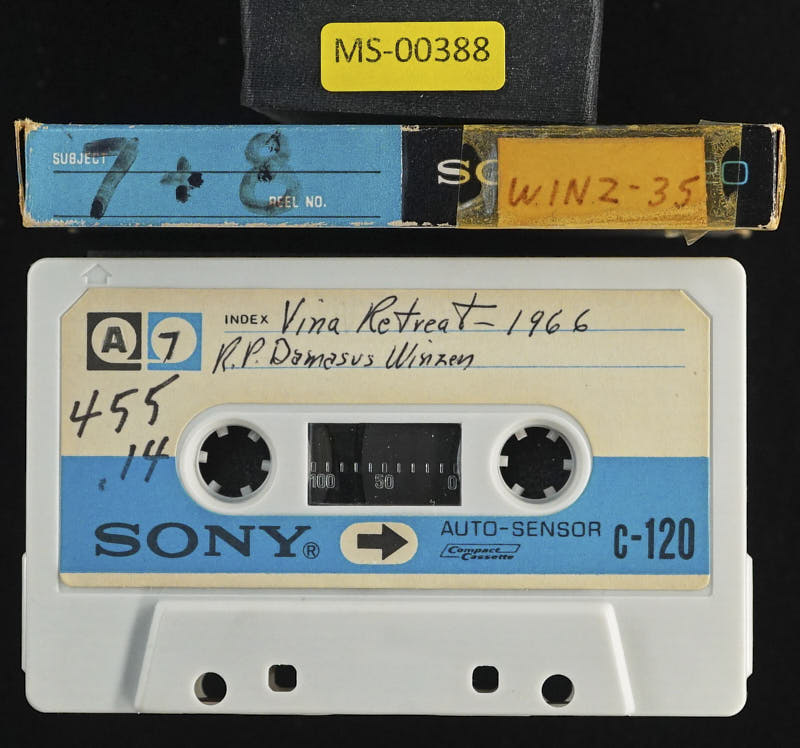

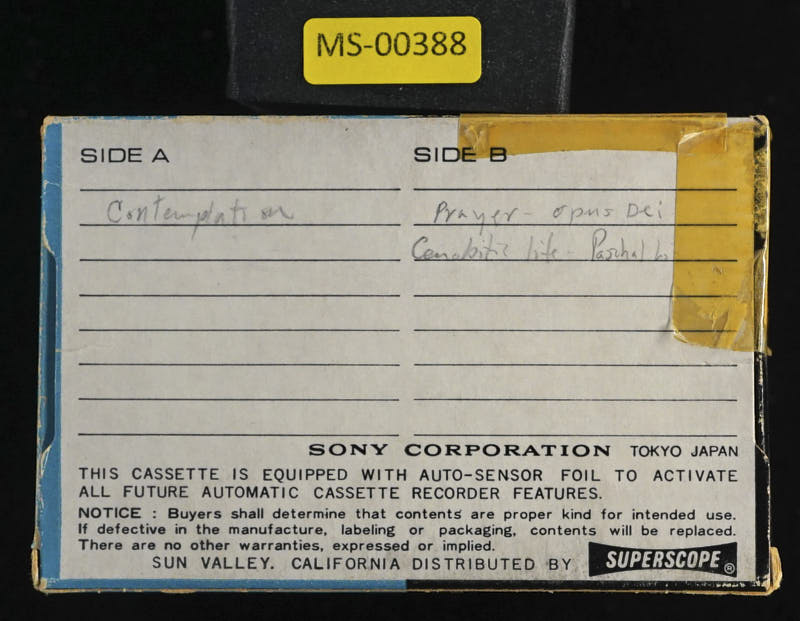
AI Vision - Possible Values from Photos:
Side: A
Speaker: Dom Damasus Winzen
Location: Vina, California
Possible Title: 455
Additional text: Index Vina Retreat - 1966
Side: B
Speaker: Dom Damasus Winzen
Location: Vina, California
Possible Title: 129510
Additional text: Index Vina Retreat - 1966
Side: A
Additional text: Contemplation
Side B: Prayer opus dei, Cambitic life parish
@AI-Vision_v002
And the other lady, I mean, I know it's my time. But that's the weird stuff, and the other footwork still, you know? That is what play has around the mountain, you know? It's a body, you know? It's a hidden life. That, that, [...] that. So, what do you think of the interpretation of this fact? I think it's very much on the right of masculinity. I think considering all non-hood and non-hood. We want to show that there are many similarities in parallel between history and non-fiction mode. So, in a human, we are phenomenal. But there is a specific way of learning a culture, because of the personal relationship to children.
[01:08]
And, uh, learning. Historically speaking, and so, monasticism occurred in a very mixed society, you know, where learning current from all sorts of, all sorts of civil relations were present. God made me to deal with peace at work. Jewish, that is not Jewish, community, that is not Jewish, [...] that is Jewish, that is Jewish, that is [...] Jewish, that There were everything in here, cities, you know, cities were sort of poverty, and then at the time of this kind of appearance and the propaganda inside it was recently in various countries, there was a reaction towards simplicity towards poverty, and the new cities were that.
[02:20]
And so, there was probably Buddhist element, or so, in the dimension of the English, but The end, you remember arriving one day in Chicago, and I met Dr. Mercier-Liard, who you know. And it was a day of the text. So we had a bounty of the university, and then we went to Chinese restaurants. We ended up in a Chinese pagoda. I don't know. And he told me, just today, I came across a new destroyer guy, the wheel of blood. And so he caught me by open, I read, it took people and nothing to put. but I've been totally doing it, and it makes a very difficult book, published in London last year by Japanese theology, with the, uh, uh, the title is, uh, the title is Water-Boot-Boot-Theology, right? That would be a piece of thing that contained, you know? And he has put a little chapter from James and Tyler, you know, of, and all these things, you know, to feed their mentality.
[03:25]
So, There was some, perhaps not many clear ideas that some slogans, also from Indians from everywhere, right? That was the dark, or the dark home, right? Coming from the century, right? And they took here and stopped in Central Asia, and St. Basil, probably stopped. in the documentary on the creation of this day, and they put fed on the lives of typically Occhio... [...] they get fed. But they are good, but the end is gone, and what means that the physicians use them to relieve the impact, but that means they abuse. So you see, to remind me, in the year, eight years ago, you would have asked me, uh, Catholics, or Americans, a couple of people, What the best place is, you know, Neo-Friday, Neo-Maxis, Neo-Machos, teaching for many of them, many of them.
[04:30]
It's a little bit. But they were influenced by current ideas. So that was the real milieu in which the first government actually appeared. And out of which God left picture for that. With the help of the great leader tomorrow. And the help of the bishop. and the rest little. And now we have to try, finally, to understand, to interpret to the very fact. And there are values, levels of possible interpretation. We're just starting to try to interpret that. And it's first a level of history, namely historical activity. What we're doing is doing between Christian monarch and non-Christian current. We need to build and put these in the latest growth of ancient Egypt, every corruption, including Manichaeism, Judaism, and then it was Christian and Judaic Jewish monasticists from Islam to communicate, to make more support.
[05:51]
So that's quite a while. I don't know why the kids don't serve. I tell them what they might kill them. They were saying to the wife, asking what she's doing. They used to be asking to speak. They're saying to the wife, that's what I'm going to do. And, you know, we have to spend all the ideas. We're telling all the world to invite you to people, the song team. You know, the big story of Alexander went to India. That's what I had to, and he's, you know, Burkheim, uh, talked with, uh, saying why the future of India was, uh, not that, uh, he knew that the best of, uh, uh, Socrates, uh, like the temple of India, although, you know, we invented it. I think that all came from Egypt first, by various currents, to various peoples, for years in Merchant.
[06:54]
Yesterday, in the army, we were all concerned, and we were living together in the military and the people. The Jews were wonderful, as we were. The kids, very old, very old. People, Gipsy, Ritano, and things like movies, the Gipsy, probably the king of England, to Central Asia, India, came back to the world, where they are now, then they, to, uh, Central Europe, and so, I thought, oh, there is, government, the [...] government, Then there is a, another, because in spite of the, from evidence of the influences you can see and notice when one has seen on and over, on and over, they don't explain, they are not sufficient to explain, the correct, civilized, and tolerance which they see.
[08:14]
So, there will be something deeper, that is a very historical difference, as it shall say. And there's some things deeper, key, that... Monarchies, Monarchies is what, uh, what do I call it? They would call an archetypal structure of land. That means archetypal, you know, it is, it is all everywhere. If you have land, you might stop them, you have the 70s, 90s, and... To be lost, it's about to realize that the literature that mentioned yesterday's reparations were not allowed to, if you'll say to people activity is in the best of your affective and all of the community and everything, all that people don't stand as many suspicions on. But this human, a society structure of human life, a colony of no standard civil, does meant to be bad.
[09:15]
Not just when it is Monash, but can it too? It's so funny that, uh, the language of the university is sending through this form of Monash. Sometimes, without knowing that was a student, you know, to influence it, sometimes we choose to play. That's deep, I don't know exactly. Although, that's a theological and biologically. But, as well as people like to play on it, on the theology subject, theological approach in these United States. And they are there in some value of hope. The lesson exists by the time it is to kill man in the theology of the image of God. If we realize how the image of God, God has made us look at the first in all of it. And he makes us succeed, you know. And, uh, It's because that it's the same image of saying God is so lame that those of them who are not going to keep living friends of God, see God.
[10:22]
In your head, John, the Jesus, in your head, [...] the Jesus, The idea of the image of God, you know, God's letter, [...] Thank you. Thank you.
[11:27]
Thank you. I consider waiting on the Father, after we went, that he had a tour, so, you know, until then, after he would, he had a return, the nation. When I took the image of God, and I said, you know, each of you is the image of God. I'm nominated. You know, surprised me. Whatever we have done before, whatever we may be, we'll demand the image of God. And so, God is open and recognized. He's given it to us. You know, I knew it. So be confident in yourself, God, for being accountable. I went on to my thread, and I don't remember what I said. But I remember that at the end of the day, some people were begging for me, and those don't, and that's exactly what I needed to hear today.
[12:36]
So, you know, I feel rather depressed. So much, uh, lack of comfort. I think it would be all comfortable. So you see, it's good for us to remember answers But I think phenomenon is one of the manifestations of it. President of the 20 men, oh God, you know, I didn't remember, I was in the Bank of Contra. We were over the next morning, I went again with police monitoring, and it was me, a friend that was an Egyptian. It's kind of hard-minded.
[13:38]
And it was, uh, Western London, and we went to the Amateur, and we went to the senior cell, each one of the other's cells, and, uh, we answered the word. It was, like, 18. So, uh, he put, uh, he knocked his mind to pre-entered, and he could think he was in silence in the first place. So we just kept in silence that way, and we had to sort of see that something was happening, you know? We were in big community, you know? without expressing it, you know, knowing, you know, having the same name for Tao or for God or for... But something, you know, we were, you know, the last kick of night. They know that the level, you know, of the evil of God. I don't have a problem, correct? Yes. There is non-Christian violence. It's the problem of the... Sanitistic family.
[14:39]
...of their religion. There's no Christian religion. The majority of people in the world have never heard about Jib Tzu. There are millions of people here, there are millions of people existing, you know, very storytime, although before the year I stand, nobody heard about it. It was very pure. The project of the Lord Jesus Christ. And today, we are a minority. And increasingly, so, the number of humanity grows up, but the number of humanity we meet in comparison to the population. Anyway, we are the minority. So, the majority of people don't know, and they are not responsible for not knowing about it. So the problem is, are they just done because they never had the opportunity that we had? people look to know about it.
[15:41]
So, now, theologians, I agree that they are, because it's an entirely different thing. God was already at work before the creation of the gospel, you know? The quality was more to find it, because I think that the church presided for anything at work, too. The practices of contemplation and athletics And then, ancient and high religion. So, they are saying, the problems now are the same without the religion. It's by the religion, against the religion. All are the same through the religion, by the religion. And there are many various... I've been knowing the story of my new interpretation. Tell me, don't quite tell.
[16:41]
And whenever I told me 16th century, there could keep up there, and I thought around the right to concrete and to succeed over the enemy of a course of kind. And I think we've got today, but what would tell? It's a tiger, you know? Uh... So, it's important to me to know what came to mind, Nicholas said, keep them, [...] that they were at the church we belong to. Now, this conquest theory, I do remember in Santa Fe and the kid with my son, that's your father.
[17:47]
How many of the concrete? In the concrete? You're a conquistador. Yeah. I'm sure. I remember what they did. Okay. That was a great guy in Britain that you don't. Hey, strawberry. I thought, like, Then there was the idea of adaptation. We have the only truth in it. And then we try to adapt to the other. So we just, well, when we take the sort of folklore we have, and so we, it's all over the Christianity, and even the Roman Christianity, remember that? There is several centuries in China, all the priests, the few Chinese priests who existed, They didn't know that it was the way of life to say it too long by heart and say that, you know, to the start. Again, that was the theory of adaptation. But again, that was not the tradition.
[18:48]
It's not the tradition. It's just saying we are the religion that we have just adapted to. No, we have to put in consideration new religion. You can't read it. Putin, king, king, indivisible, Islam. Today, it's a book, then, I did a lot of religions in Africa, back to me. So that was the idea of two things. Christianity is full of kids. All the values which were, so to speak, in the beginning, that religion, we bring it to an end. So we don't know, but we know that You are Christians, you are not. That's because I'm a very complex, annoying with Christians. Yes. But I mean, again, that's not the point, because you in the first way, highly developed and highly religious in the world, and people like that, you know, that religion has no value except to us.
[19:53]
We are the only one religion to believe. So they are ignorant, but let me know for them, you know, and they don't accept it. In total, the religion distributed the fact of the incarnation, we have, we take the information, the direction of the incarnation of the incarnation. The impression that we are the entity relative to some of it highly developed. So, he again now feels more or less abundant, and to you, the latest theory, read by Father Kitties in the paper, he said he is the chief of the king of another Canadian king. To consider the world and the kingdom of God. The kingdom is made for those who God save and save through their head without passing through them, without knowing. And among the kingdoms, there is the church, which is not identified with the kingdom.
[20:53]
And the church is the sacrifice for those who have received the gift of faith. to know that the kingdom has, the sacrament of the kingdom is the church. Sacrament means both the sign, but only for those who know who are there, and the meat, you mean, where the kingdom is perfectly perfect. So they are saved to the religion, and we are saved to us. We does not prevent just from and our religion today and with the same. But we are hoping that the majority of the world will never become rich. It looks like it's the next millennium. But at least, the magnitude of the church being it, she is faithful to what she has to be, is the sacrament of salvation. And in order to preach it, each time she has to lead himself to be present, humbly, as an humble friend,
[21:59]
We are on the dialogue, more than a conquest, more than an issue, an intervention. We do have the presence of the land, so that we may discover this time. We got one. So that, and of course, we developed that, but actually, you know, for sharing the government, the successive states of the problem, you know, and down the chip. But first, as I'll concern our peace with monasticism, I would like to insist on a third and last aspect of this theological interpretation of the monasticity. Remember, the problem is that monasticity is an archetypal structure of human life. Belong to the man. So, this manifestation operates in man.
[23:01]
This is right. But it was made very different. If it's inerrant to mankind, the human nature, when God began, now, it just... Did He at you? He took you. It was the worst. Did He be covering up? And He said, God has been right, a Christian. And that's all the problem. This was the month. And, uh, I remember about ten years ago, and the end of the concierge, [...] Subcultural, sublimation, because they think it's molasses.
[24:06]
You can't think that this platonic duality is made very good. I don't know what contemplation would be avoided at all. You know, when he was late, that was the trend of the world. You speak of electronic and it's too big. Well, then, you know, it's not because it's great that it's wrong, but I know it's like that. There is the return of the end. Great events of church. Church, not of Victoria. Church, which were the council of kings in Tensei and the king of the bishops in Rome. The king were the most frequently used, all constantly. And now, we'll talk about, yes, Tower was a huge preparation when I had my friends laying in some, so I went back and said, I'll read the book now. It's terrible to a competitive style of life, but the doctor will do it, then, [...] no, again, you know, the problem of, there's just a long period, then, then, you know, [...] I feel, rather, I call it, because all of them are influenced by this.
[25:19]
Then, you know, they're mentally reactive, you know, we're going through the book of, when I came back in. It's not. It was a very very good idea. He didn't defeat the man. He had a long life in the dead. But he didn't quite. And so he stopped by sort of about 15 pockets of chips. And he wants to show a sort of wonderful chips. And he'll, over all the whole set. And put chips to a lot of them. It's really chips of the lecture. And all these pockets are brilliant. But just can we get you? Well, he said, uh, yeah, yeah, yeah, yeah, yeah. First, just a feeling the year comes. I don't know why. I decided to know anthropologically from them. But you really know, it's time to see that there are always more people that meet this idea at just the scientific level that they're all speaking to a... ...theological level of interpretation.
[26:22]
Oh, oh, my nice. That's right, isn't it? Sure, I think. Of course, in reality, the problem of what it's called today, the paradigmatic person of Jesus. Jesus is a paradigm for personal life. And he contends that, uh, all we know is we're called Jesus of Imagination, not the historical church. So we may make a theme, a body of spied eyes, but to a text, uh, I think it's better than the Jesus of Imagination and the bigger Jesus of Faith. So, true, the narrative we have this way, and this morning, you know, we can read through it.
[27:26]
not only the image, but the faith, the disciples, the community had. And the... one of the images and one of the objects of faith the tradition of the church always found in church was the idea that church had been the first of the pandemic. And that's all the good and the self of every review that went out. You know that the ancient father used to read a bit many examples of the Old Testament, Elijah, the Recapites, that evening, the synced dead Jeremiah, the priest of Cuman, John McFaddy, and the most of the oldest, John Green, the last one for the Old Testament, the first of the New. And, uh, there is a lot of, uh, witnesses along this line, hmm, to the first book, because when I think writing, I mean, oh, in patristic literature, and, uh, maybe no literature, I've gathered on some, some of them, the recent article for you, and for failure on the religious life, you know, you, you will not care, you know, how good so.
[28:59]
And I was born, and I went to the market. I discovered that in this discovery of religion, there was no article of Jesus Christ. So I said, kind of, shouldn't you stay? And he was in the world. Well, he said, well, we never know him. Oh, no, what do you like to do? And I moved and gathered this room in the room. And I used to think I was a... But recently, I'm going to talk to you about the thing that Jesus had been in the movement of the long, the first and the first century, right? You got business. You like, I'll be practicing, make a lot of business. He said, we'll become so bad. And we are in value. Thank you. [...] Well, I remember finding about, uh, chapter the end ago, it was, uh, it was said in my history, beautiful text, and chapter the Christian, uh, uh, where it was said that, really, the cross of Christ, is, [...]
[30:25]
It does not mean only solitude, but it means the solitude, the biblical solitude. There exists in the world that is there to not solitude. But we created the new Neonogen, a Latin world, with a great world which was difficult to mean not only a place, but a territorial condition in front of God, due to a situation, what happened in the earth, in the thought of God. And so, they all may give us your day. Yes, sorry. They tell me, all this crap. And by the way, you may find these texts in two of the one in the footnotes of the first part of this kind of document for the intersearchs. And by the sort of mistake, I wouldn't come down. Prepare the material for the first text. I'm not the doctor for the last time. Don't believe it. I'm good. [...]
[31:26]
I'm good. [...] So. And, uh, that has been a continuous condition. And, uh, uh, when the reports of religious life diversified in the 12th century, not only the cenobites in their meat, but new quotes of cenobites of their meat in the countryside, in the city, and it was a little loose, and a variety of, uh, all there is a profession. They use profession to the church. And there are seven books of religious, religious life and church work, that is their category, and except for the Old Testament, and if it is on board, then except for the Old Testament, and it won't make the life of you. It may be a bit artificial, but at least it proves that
[32:27]
concerned they had to put everything we do in the church in relation with what the church did. And remember that today now, in the council, the church did the same thing. The church didn't give any definition of the values of religious life. And the council didn't say This type was included when they said that there was a certain, there, there's been the schemes which were prepared. That was, well, it was a particular commitment, form of life, that was a take. But then, I was involved in this, uh, operation, and the scriptures told us, who said, well, uh, it was not a plan, but it was a plan related to this particular of each young man and the portfolio of the guy, and it was true. You know, my girl is speaking to St. Peter. So, he was a bit uneasy, because he said, learning the traditional way of reading the gospel.
[33:38]
And so, he was in the back of the day, the gospel. They show the two kids of the episode, and therefore, the only in which you all the norms of religious life and his master. Remember, in number 56 of the human genitals, chapter 1, the religious said, that the religious have to be kept back through them in order to show them. In order to show them, to show them, to show them, to show Christ. And then there is a certain type of words, volumes, activities Jesus exercised, it's part of the model and the origin of both the different traditions order. And the first might is always contemplation.
[34:40]
So when I said in the beginning, Jesus was the contemplation. First of all, a contemplation. He was the contemplation. So they had to show Christ. He had contemplation on the mountain. This is the contemplation. And by the way, that's why, that's why I won't buy any stake in this commission. But I agree not to comment on the street. He comment on the people on the mountain. So he said, we shall meet the doctor of the commission. But there in the commission, because we have to first talk over the state. But they were, they didn't explain that I would be also telling the department. So either protecting the mountainside, or preaching the thing of God's crowd, or healing the people, or combating sinners, or blessing the children, and doing good to all. So we really have to walk in protecting life, in the way I think that we take the life, in taking care of all sorts of children, and all the forms of blame.
[35:51]
The thing that they should do has been started with jest. And the idea here, to spoke in the Greek, so the Latin text is reprobata, to [...] reprobata. something general stuff. And therefore, making him present, to represent, to show him. And, uh, yeah, his idea is always the idea, which is very frequent, the concept, the idea of participation. All we can, I mean, the beginning of the beginning of the beginning, all we can make a justice to come, something we start, to participate, to share, in something else, to share it too. So to see, that was the approach of the country.
[37:06]
And it has been commended that way, my lord, is from the digital development. And if you really don't get out of the picture and look at it, well, we've surely had this point as well. I think it's taken from one of the chapters The conference is so nervous when he celebrated the New Manium of March 8th or 2nd day, where he compared the three sensations of Jesus to the three men. And it is very uncomfortable. And while he speaks of Jesus, I'd say that that's a lot. He would be an open and open and open and shut the traditional approach, the orthodox tradition. And, uh, recently, in, uh, two years ago, there was, in, an episode of 1974, not yet, in the political-religious, in, by a separate blogger Miller, a barrister, settles the short block, which was the original episode, following...
[38:20]
There is a volume of the Pico Viber. And I just read the internet for this video article, which is very popular, you know? And then I wrote the pages of this Pico Viber to the people, which was very interesting, you know? Uh... A... A... A... that were more customarily used in monastic community.
[39:22]
Everything fit better into a monastic community than it is. The most people who stare for sanctity and awareness of the five men, the kind of people expected to be monastic group of that time. The technique and technique would carefully see people more likely than earlier to be those appropriate to a monastic group. Celebrate groups like the A.T. community government by the order of the community, and mainly only, I think it's just for now. Well, you see, we have a many, many of them. Uh, the, that cause, they brought on the wall of the land, you know, especially in sending us all the foods. Uh, local structure, hospitality, I don't know what I mean. Existing from, uh, telepathy, which may have been and also insistence of oncolity, certified all the elements of people, you know, applied very well, too.
[40:30]
The monastic group, actually, is presented as a patty mother of his brother. He was the ideal law, I see. He was the ideal law, who had denied his family to join his father. And he commented on that, I wrote the sign, to show that students were clearly the first lesson. So it may be that I don't know who has discovered a new aspect in an old text. He may, he may, he does it in the past. But it's interesting to see that the teachers go out today, you know, because Daniel's really old anymore, and he's not belonging to a church where he's married to see that. And again, we're in the same time, and then we come out and I'll learn to go play again in Italy, to read up on the videos. And I'll tell them, it's a long article of what I've seen, so, phenomenology of what I've learned, all this, but I've seen tradition in those videos.
[41:39]
Tradition, I like to be beginning, you know, to be able to interpret it. And then it's going to, the phenomenology of Christianity, and I've seen the picture written by it. It killed the rest of the votes. End of doubt in a, right in a, is that what [...] a, what a, what a, what a, what [...] a, what a, what a.
[42:08]
@Transcribed_UNK
@Text_v005
@Score_19.98