You are currently logged-out. You can log-in or create an account to save favorites and more. more info
Monastic Roots: Beyond Egyptian Origins
The talk explores the diverse origins of monasticism, challenging the widely accepted Egyptian origin hypothesis by introducing evidence of multiple concurrent developments, including East Syrian, Egyptian, and Cappadocian strands. Highlighted are the contributions of Jean Grivemont, John Cassian, and Peter Brown, examining roles, themes, and evolutions in monastic practice, spirituality, and their socio-cultural influences, particularly focusing on the Desert Fathers, Pachomian, and Basil traditions. The talk dives into the synthesis of active and contemplative monastic life, addressing themes of solitude, continual remembrance of God, and the complex interplay between freedom and societal responsibility encapsulated in the ascetic and communal practices as highlighted in the Rule of Benedict.
- Works Mentioned:
- George Rivers - "The Call": A poem that introduces themes of spiritual longing and the intertwining of divine truth, life, and love.
- Jean Grivemont's Studies: Challenges the hypothesis of monastic origins strictly in Egypt, offering evidence of diverse geographical beginnings.
- John Cassian's Writings: While disputed by some scholars as unreliable, Cassian’s work is critical in understanding the transmission and translation of Egyptian monastic practices to the Western Christian context.
- Benedict of Nursia - "The Rule of Benedict": Examined for its spiritual focus and practical guidelines for monastic life within a communal framework.
- Pachomian and Basilian Monasticism: Explored as significant earlier models of communal monastic life, emphasizing community, economic sustainability, and integration with local church life.
-
Peter Brown - "The Rise of the Holy Man": Provides a sociological outlook on the monastic figure in late antiquity, highlighting their role as spiritual and societal intermediaries.
-
Figures Discussed:
- Basil of Caesarea: Significant for his efforts to balance ascetic practices with the life of the broader church community.
- Ephraim and Aphrahat: Early monastic figures associated with the East Syrian tradition, noted for blending ascetic practice with theological insight.
- Gregory of Nyssa and Gregory of Nazianzus: Central figures in the Cappadocian development of monasticism.
- Pachomius: Defined communal monastic living in Egypt, emphasizing economic self-sufficiency and communal spiritual practices.
AI Suggested Title: Monastic Roots: Beyond Egyptian Origins
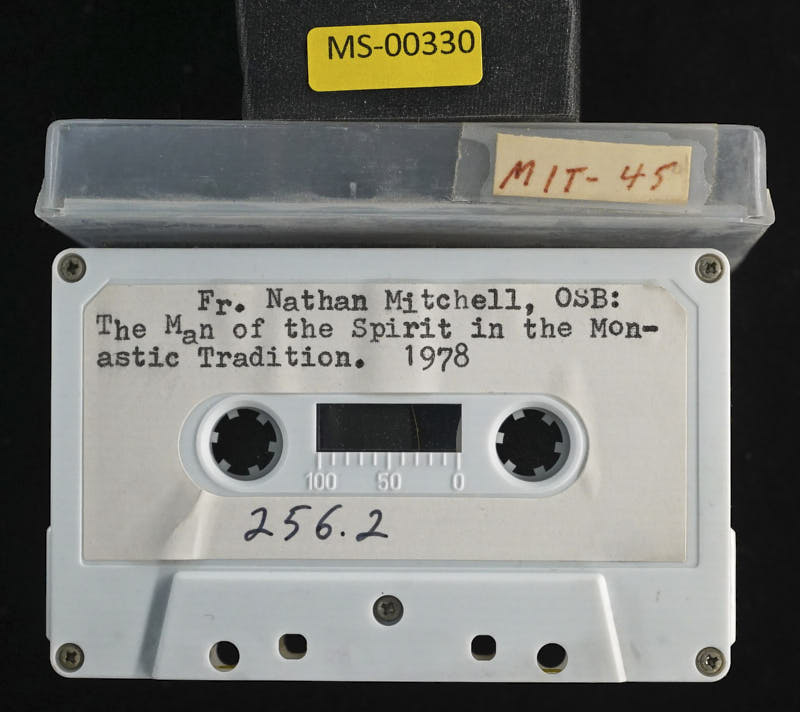
Speaker: Nathan Mitchell
Possible Title: The Man of the Spirit in the Monastic Tradition
Additional text: OSB, MIT-45, 256.2
@AI-Vision_v003
I want to start with a poem again, if you will bear with me. This is another poem, a short one by George Roberts, the same man whose poetry I wrote last night. It's part of a set of poems that he wrote on Easter. I read the first one last night. This one is called The Call. Come my way, my truth, my life, such a way as give us breath. such a truth as ends all strife, such a life as filleth death. Come, my light, my feast, my strength, such a light as shows a feast, such a feast as mends in length, such a strength as makes his gifts. Come, my joy, my love, my heart, Such a joy as none can move, such a love as none can part, such a heart as joy in life.
[01:03]
The studying by Russell Williams is absolutely scrumptious. Do yourself a treat sometime and listen to it if you've never heard it before. It's absolutely stunning. Tonight I'm going to talk about the man of the spirit in the monastic tradition. another one of those tiny, small topics like God and the Spirit and the Bible and things like that. And to assist the control of the vast amount of information that we would need to look at if we were even going to get a clue about the size and shape of the tradition, I have once again provided you with some notes that you could work clean on the back side again. I'll try to follow that format fairly closely. Occasionally, I'll depart from it a little bit and make comments and stuff like that. But at least it will give you a kind of formal outline, and then we'll at least know the direction we're headed. I want to begin by talking a little bit about some theories about monastic origins. I suppose that you were all party to a discussion of that topic at one point or another.
[02:08]
Maybe you've heard about it more than you care to hear. So I'll try to make that brief. As you may recall, for a long time, most people who wrote about the origins of monasticism did a kind of old Egyptian hypothesis, which was comprised of two elements that I've commented on here in the notes that I passed out. It was based on the assumption that monasticism begins in Egypt. Nowhere else it begins in Egypt. That was the first assumption. And the second assumption that that old hypothesis was based on was the notion that monasticism begins as an eremitical movement, as a movement to the desert. It begins with Paul and Anthony and the great heroes of the desert. And then only later on, when men become weak and can no longer withstand the single-handed combat of the desert, they begin to band together for mutual support and assistance. That hypothesis, which were a long time, was the first chapter of every book written about monks, is no longer widely held by scholars.
[03:15]
And I'm going to give you just a few of the reasons why scholars today no longer hold that hypothesis. One of the men who'd done very significant work that challenged that whole business was Jean Grievement, who I think used to teach at Penn, I don't know whether he still does or not, I've never been independent, so I have no idea, but I know them only by literature. Griverand has pointed out that monasticism, something like the biblical text that we were looking at last evening and in our discussion this afternoon, monasticism is a very diversified phenomenon that begins in a variety of different geographical locales. It doesn't all begin in Egypt. It begins in a variety of places. In fact, there are three in built and early strands of monastic development that Grievema and others have pointed out. Let me just identify for you what they are. One strand of development we could identify as East Syrian, that would be the church around the Zepha and Nisibeth.
[04:20]
The church is eventually associated with figures like Ephraim the deacon, the famous early Christian poet. It's associated with figures like Afrat, the Persian sage, whose works, you know, you always read about in handbooks of pathology and stuff like that. I knew I was going to do that probably in the beginning. It's a very offbeat kind of Christianity in many respects. It probably has its origin not so much from Greek-speaking or Hellenistic Christianity, but from Aramaic and Palestinian Christianity. A second strand of monastic development It's what is familiar to all of us in Egypt. But as Griebelman and other scholars have pointed out, this Egyptian monasticism was not all one piece of cloth. It was like a patchwork quilt. There were all kinds of varieties of monastic experience in Egypt, some of them eremitical, some of them cenobitic, some of them coptic and kind of nativist and folkloristic in orientation, and some of them Greek.
[05:24]
some of it desert, some of it urban, some of it emphasizing master-disciple relationships according to the old desert tradition, some of it emphasizing urban life and urban environment in middle Europe for the monastic experiment. So the Egyptian strand of development is extremely thick and complicated. It's not all one piece of cloth. It embraces a whole variety of, I've used the word experiment, in monastic life, even early on in the late second and early, rather late third and early fourth centuries. And the third major strand of development is that associated with the region of Asia Minor, the area of Cappadocia, for example. Here we would have to list the monastic experiment of Basil, Basil of Caesarea. and his brother, who I believe was Gregory of Nyssa, and his good friend who was Gregory Nazianz, and all those fourth-century figures that were working in asceticism, about whom I will have some comments to offer later because they have some important things to tell us, both about history and spirituality.
[06:34]
That whole movement took place in the part of the world that we would identify as Asia Minor, Cappadocia, and so on. So my hope here is simply to show you that people like Griezmann have challenged seriously the notion that all monasticism derives from Egypt. It's something like Caesar's commentary on the Gallic Wars, you know, all goals divided into three parts, all monasticism began in Egypt. That thesis is pretty well exploded today. Not only has Grievenwald worked on this problem, but also the adventist of Miss Daphini, Armand Guerrier, has also done a fair amount of work in the importance, particularly, not only of the complexity of monastic beginnings among Christians, but of the pre-Christian background for asceticism and monastic offering. Remember, Christians didn't invent monasticism any more than they invented washing or eating or drinking or smearing people with oil and things of that sort. There are important pre-Christian monastic ascetic type groups.
[07:39]
The Qur'an community is probably one example of such a group, a kind of separatist group of persons. Pythagorean asceticism in the ancient Greek world, the Jewish, for term to be known as the Kabarus, all of those are examples of people banding together for what can be identified as an ascetic purpose even before Christianity appeared on the scene. Zunia has also had, as you may know, a running argument with the commentary on the rule of the master and the rule of Benedict. I won't go into that whole running controversy because this is a nice piece of people on blood and guts and things like that are not appropriate on Sunday evening. If you want to get into that at all or read a little bit about it, I put on the table up here, and I'll leave them on here for the next few days, an important article that Argonne Villier wrote about 10 years ago and was published in monastic studies. It's called the concept of the abatial office in monastic life, but really what he does is not only talk about the abbot, but also the whole history and origins of the monastic phenomenon.
[08:50]
It's in English. I also have up here an article by Griemann which describes his hypothesis and his studies and research into the origins of monasticism. which is in French, and that would give you a chance to brush up on your other languages, okay? So if you're interested and would like to take a look at those things, please feel free to use them, take them back to your room, look at them, put darts at us, use it for a wallpaper or something, whatever you'd like to do. But they're available to you. I thought I would just bring the Verox copies because I didn't know whether they would be available to you elsewise if you want to do a little study on your own. The final comment I want to make about monastic origin deals with a kind of unnoticed aspect of early Christian monasticism. And that's what I've identified here as the East Syrian strand of monastic development. The man who has done a great deal of work on that is a Lutheran scholar by the name of Arthur Dredus. You have to put your mouth in a machine.
[09:52]
You know, one of those machines like they have at Garely, the Maupier-Kivir. The closure lifts them out like this. I don't know how you pronounce two umlauts in a row. Father Gabriel would know, but I don't know for sure. Anyhow, he's president of, get this, the Estonian Theological Society in Exile, and is a very good scholar. Verbus has done a great deal of research on the uniqueness. of the monastic phenomenon in East Syria. It wasn't like Greek-speaking monastavism in Egypt, for example, or even Costic monastavism in Egypt. It was a very sui-generous kind of development, very strange and bizarre development. The early descriptions of these East Syrian monks sound a little bit like Kate Ashbery in the 1960s. You have the strange creatures running around. As a matter of fact, people who saw them couldn't tell the difference between a monk and a bird. They looked so similar. They apparently were beaded and feathered. And there are also descriptions of the lament of parents whose children ran off to join these East Syria aesthetics.
[10:59]
It sounds a little bit like the lament of parents in the 1960s and the 1970s. You just can't understand why our boy has gone off and done this terrible thing with these ridiculous people. But the type of asceticism that developed in East Syria was influenced by certain we would call them today, heterodox movements in Christian doctrine. One of them is associated with the work of a man by the name of Cation, who he talked about in schools of theology only long enough to indicate why he was condemned. Cation was responsible in the late to second and early third century for an important gospel harmony called the Diateteron. What was interesting about it was that Tatian, in the Syriac translation of the gospel message, tends to asceticize the gospel. Whenever it's possible, for example, to emphasize a certain kind of ascetic practice, he will get that emphasis worked into the translation of the scriptures.
[12:05]
For example, his reading, his translation of the institution narratives of the Eucharist in the gospels, are gauged in such a way that the mention of wine, for example, which, as our Holy Father says, and certainly not a drink for a month, is almost obliterated. Any time that he got a chance to make a case for the value of celibacy in preference to marriage, that influences the translation. And indeed, Birbeth has contended that In some quarters of Aetherian Christianity, asceticism was so strong, not just as a monastic movement, but as a Christian movement, that felicity was a requirement in some churches for baptism. That's a little extravagant. Tatian was not himself responsible for that movement, but that gives you a little bit of the flavor of the kind of Christianity we're dealing with in Aetherian. Another person who seems to have had some contact with that church was Martian.
[13:07]
Once again, a figure whose name was often mentioned in the history of theology just simply long enough to indicate that we shouldn't believe what he believed, or we would refer to him in the uncomplimentary terms that Tertullian used. Tertullian was the one who called Martian a Pontic mouth. It's one of the hilarious passages of batryptic literature. in any case, that Martians further that same kind of aesthetical approach to Christian life. And in fact, some of the people who accepted the Martianite program of Christian faith, and also Tatians, became very reluctant to have anything to do with the rest of the Christian community. So that, for example, there are cases where ascetics refused to receive the Eucharist from the hands of a priest, because many priests in that period, of course, were married men. It was felt somehow that that was inappropriate. So they would refuse the sacramental ministrations of the clergy. It became, in other words, a very divisive kind of fringe movement after a while, pushed very much to the edges of Christianity.
[14:11]
And yet it had a strong influence in that part of the world. Eventually, people like Ephraim attempted, as Basil did in Cappadocia, to bring the ascetic movement back more to the heart of the church, and we'll be seeing a little bit of that later on when we look at the Brazilian experiment in the fourth century. So much by way of a kind of introduction and brief outline of some theories of origins about monasticism, I'd like to move now to Roman numeral II on the outline and talk a little bit about the desert tradition since Very frequently in our perceptions of monastic life, that's where the whole history begins. I've suggested to you this evening that that isn't where it begins. But it's one important source that we can look at, especially for Christian spirituality. I'm going to begin this section by reading you a little passage from the Sayings of the Fathers. This is the famous little translation of Paul and Waddell, which I'm sure most of you have seen at one time or another. because it illustrates very much the kind of piety and spirituality that the desert fathers were familiar with.
[15:19]
It's also a charming story. They tell that once a certain brother brought a bunch of greats to the holy Macarius. But he who for love's sake thought not on his own things, but on the things of others, carried it to another brother who seemed more feeble. And the sick man gave thanks to God for the kindness of his brother Macarius, but he too, thinking more of his neighbor than of himself, brought it to still another month, and he again to another. And so that same bunch of grapes was carried around all the cells, scattered as they were far over the desert, and no one knowing the first who had sent it, it was brought at last back to the first giver. But the Holy Macarius gave thanks that he had seen in the brethren such abstinence and such loving kindness, and he did himself reach after still sterner discipline of life and with spirit.
[16:24]
That's a very typical, also very famous story, I expect most of you have heard it before, the bunch of grapes that eventually, they were probably raided by the time they got back to Macarius, but that story doesn't tell us that, but one can assume that. It's a typical example. Notice, for example, that one of the things that we often associate with desert monasticism, namely a very rigorous kind of forbidding asceticism that made people hostile and unkind, is not at all present in this story. This is really a story about hospitality. and about the responsibility of providing food and nourishment for other people. It's really a beautiful demonstration of a theme that is also very strong in the rule of Benedict, not only the knighthood of hospitality, but indeed the Christian responsibility for it. I'd just like to read you another story, a short one, which also gives a little bit of the spirit of the Desert Fathers, just so you get a little bit of taste of it in your mouth when we begin to talk about that.
[17:27]
The abbot Antony said, whoever sits in solitude and is quiet has escaped from three wars, hearing, speaking, seeing, and yet against one thing he shall continually battle, that is, his own heart. Notice the military image there, too. That, by the way, is an extremely prominent and frequent image. It's a metaphor commonly used in desert monasticism to describe the whole impulse of monastic and ascetic discipline. It's also used, by the way, very frequently in the East Syrian form of Christian monasticism that I discussed a little bit earlier. What I'd like to do then, having given you just a little bit of a flavor, and I hope whetted your appetite a little bit for the desert tradition, is to just outline some of the common themes that are found in the spirituality of the desert and offer some comments on each one of them.
[18:36]
The first of these I call on the outline on page one the theme of continually remembering God in solitude, that little story that I just read to you, whoever sits in itself, has fought a war against three things, against hearing, against seeing, against speaking. That notion of sitting in the cell and finding solitude there is an extremely common theme throughout the phase of the fathers, of which there are several traditions. It is closely associated with the theme of watchfulness. That's why, in the desert tradition, many of the stories deal with the hermit or the monk who stays up all the time, and they apparently never slept. You know, like you wonder if there was an early Cominex factory in a skeet or something, because they apparently never ever slept. I mean, they're always talking about prayer, vigil, fasting. And I've also, maybe you've asked yourself, you know, like, well, why? Why would anybody want to do that? In the theme of the Desert Fathers, sleep is always a metaphor for egocentrism.
[19:40]
It's not that they're not trying to encourage you that there's some great physical or even moral virtue in not sleeping. It's the notion that the theme of sleeplessness and the contrary theme of sleeping are really a struggle between egocentricity and generosity, so that to sleep is exactly for the Desert Fathers to forget, to forget the continual remembrance of God. That's why... Even in the Rule of Benedict, you have that little thing that's so strange when you read it, therefore shunning all forgetfulness, the monk will blah, blah, blah. That's very much a typical desert theme. Fleet equals egocentrism. You avoid fleet not so much because it has physical or even ethical power, but because you want to shun forgetfulness. The monk is one who lives alone, not forgetting. The monk is the man above all who remembers, who remembers God in solitude.
[20:47]
A second theme that I've identified here is the notion that the ascetic effort, the monastic life, is both active and contemplative. It's not a question of either or, and it has nothing to do with much later discussions, which have even occurred, oh, like in the 50s and stuff, they reemerge once again. Which is better, the active life or the contemplative life? It has nothing to do with that. For the early desert tradition, Monica is one who is both active and contemplative. He's active because he does psalmody. Psalmody is one of the works of the active life in the desert tradition. He's also active because he does work. That is, he has to labor. He has to earn a living. But he is also contemplative because throughout Threaded throughout his work and threaded throughout his psalmody is that violent liturgy of the heart, the continual remembrance of God in prayer, which leads eventually, in the desert understanding, to theopoietus, to becoming God-like, to divinization.
[21:53]
And a third theme that we see in that tradition, I've identified here by the problematic term of the angelic life, Every time that term is mentioned, it absolutely sets people crazy, because we think of angelic Bible, that means they didn't have bathrooms in the cells, you know, they didn't wash and stuff like that. Once again, angelic life in the desert tradition has nothing to do with despising the flesh, or cutting up the body, or letting yourself get crusty for God, or something like that. It's really nothing to do with that. Angelic Bios is, again, a metaphor for the freedom of the monk. The monk in the desert tradition is precisely a free man because he has absolutely nothing to gain or to lose from ordinary society. He's not in competition with ordinary society. He doesn't have to listen to advertisement. He doesn't have to pay attention to what toothpaste he uses or whether he deodorates properly under the arms or anything like that.
[22:58]
He's simply out of that whole bag. He's a free man. He doesn't have to contest with that. He is precisely, Killian used the term this afternoon, a liminal person, a marginal person, a person who exists on the fringes and the edges of society and consequently has nothing to gain or to lose. He is therefore quite free. We'll see that theme emerge once again when we talk a little bit about the concept of the holy man, the pneumatic house in the late Christian or late antique world. That same theme will reemerge. The monk is above all a person who is free, He is free and unencumbered from the regular race of cultural fashion, and consequently he is a man of extraordinary power. He's not indebted. He's free of death. Say, if he wants to sit on a pole, assuming sadly he's there for 30 years, he can do that. He's free to do that. If he wants to adjudicate both
[23:58]
ecclesiastical and physical cases, as Simeon and other ascetics did, he can do that. He has, he stands nothing to lose. He's a man beyond pride. He's a man beyond gain. That's a very strong theme. It's also closely connected, by the way, with the theme of social protest in early monasticism, which we'll also see in a second. The part of these desert themes that I've tried to identify here, I call a life of prophecy. There was, in early aesthetic movements and all these strands that I identified on the board here, a strong impulse against institutionalization. Meneficism has been an extremely difficult experiment to domesticate. It has been, from time to time, thoroughly domesticated and harmless. But in its origins, it was extremely difficult to domesticate. Now, it is somewhat perfectly okay to be a monk.
[25:03]
It was not always so. We don't resist that kind of institutionalization quite too much. The early Desert Fathers did. Not only did they resist the institutions of society, but also the institutions of the Church. Remember when St. Jerome was into his monastic faith, it turned out to be relatively unsuccessful. He was one of those people Every community always gets them to where they will always forever be interested in monasticism. They will love to come and watch Pontifical Vespers and things like that, but they will never really be able to get into it. And I somehow have the feeling that Saint Jerome was pardoned to those who were his patron and stuff like that. It was kind of a figure that way. He found it very difficult to accept that kind of discipline. But one of his motives was his discipline. supreme hatred for bishops. That was probably a very powerful motive in Jerome's life. It is quoted of Jerome, although it's probable that he didn't say it, that there are two things the monks should avoid, bishops and women, probably in that order.
[26:13]
Actually, some of Jerome's closest friends happened to have been women, and he was very, very broken up when some of them died. So he wasn't as much of a woman eater, but he was a bishop eater, and especially the bishop of Rome, with whom he never did get along. So Jerome is a good example of that kind of impulse, that resistance against institutionalization, even in the church. The fifth thing that I tried to identify here is what I call the vir apostolicus, the apostolic man, or the apostolic life. And this might be just a moment of explanation. In ancient Christian monastic terminology, the apostolic life and the apostolic man were not people who did parish work. in the first instance. That term originally applied in a way to a charismatic, a spirit-filled person whose holiness is manifest in signs and wonders. It doesn't refer, therefore, in the first instance to pastoral ministry. Later on, it does. Later on, for instance, the term also gets applied to the life of canons, that is, canons are regular, not boom-boom.
[27:20]
And also, even much later than that, applied to mendicants. So that, for example, you remember the famous description of Francis of Assisi in the Vita of him, as vir apostolicus, as totus catholicus, you know, an apostolic man, and altogether Catholic. That became a typical way to talk about, actually, the spirit-filled person. The sixth theme that I've identified is a familiar one. I'll just mention it and move on, and that's the connection between martyrdom and baptism, that connection that Fr. Edgar Malone has talked about before. It's a somewhat problematic identification because I would, I think for myself, prefer to think that in the early desert terminology, it's not so much that the monk is looked upon as a martyr. He's looked upon as an athlete. It's a wrestling metaphor that you're dealing with there. It's a person who's been oiled up and split and who's in good shape and who knows how to struggle, even with the devil, even with the demon.
[28:24]
So I'd really try... I get to talk about point six in terms of the athleticism of early desert monasticism, being in good shape, being able to run a mile without panting and popping, as I would not be able to do, unfortunately. It is a deepening and an intensification of the baptismal life, but more in terms of athletic than in terms of martyrdom, at least in its later sense. The seventh point that I mentioned on page two deals with monastic life as a mysterion. This is particularly true in the East. Eventually, remember mysterion eventually is translated into Latinic Doctrimentum, and that term gets transformed eventually into what we think of as sacrament in the sense of the sevenfold system we're familiar with today. But in some quarters of Eastern monasticism, especially in the desert tradition, becoming a monk was equivalent in its power and influence to baptism itself. It was placed on a par with baptism, with Eucharist, with reconciliation, and so on, so that its sacriental character was, in fact, unquestioned in many places in the East for a long time.
[29:36]
And that was even true in the West, for example, if you look at the liturgical history of the rituals of monastic profession, for the longest time, whenever they wanted to talk about how a monk becomes a monk, liturgically, they would title the thing either ad faccienda monicum, or the making of a month, or in ordinatione monarchy, as also the rite for blessing in Advent was in ordinatione, what is it, a basis, okay? So there is a very strong sense, well into the Middle Ages, into the early Middle Ages, that monastic life itself constitutes a mysterion, a sacramentum, much like baptism, Eucharist, and reconciliation do. Okay, so much for the desert tradition, which we've polished off in a few minutes. I would like to turn now to, we're gradually getting up to Benedict, that's why we want to move. I'd like to turn now to a couple of important 3rd century monastic experiments, which I think have a great deal to teach us about monastic spirituality, at least the major themes of it.
[30:45]
The two experiments that I'm thinking of are obviously Pocomius and the monastic institutions of the Pobiod in Egypt, and second-late Basil, and the attempt that Basil made in Cappadocia to bring monasticism back to the heart of the church's life. I want to offer just some comments about each one of those. The history of Pocomius' own life is extraordinarily complicated. I think that's how all scholars begin all books. This is a very complicated issue, period, and then they start telling you about the complexity. Well, it's true of Pachomius II. There's a great deal of debate about the sources for his life, partly because there are so many lives that have been written, some of them in Syriac, some of them in various dialectic, some in Greek, some in Latin translation, and also the legislation, the so-called Pachomian legislation, the so-called rule of Pachomius. is also a very debated topic. I will not bore you with all the details of that discussion tonight.
[31:48]
Suffice it to say that even though Popomius is often identified as the father of Cenobitic monasticism, that designation is not quite accurate. He does found an important Cenobitic movement in 4th century Egypt, one which attained excessive notoriety and one which later according it leads to Adelbert de Beauvais, influence men like passion, although we'll see through problems with that in a few minutes. But Comey's monasticism was interesting because, as Armand Villiers has pointed out, the chief image that he uses to describe the experiment is a biblical one. It is the notion of the koinonia, which is exactly, of course, the root of the eventual word kenobion and then... So the plenobite itself is a term derived from a biblical word. It is a word, for instance, that appears in the first letter of John.
[32:52]
Remember when John would say, you know, I write to you, my dear children, so that you may have fellowship, koinonia, communion with the Father and so on. So Potomius' monasticism is strongly founded on a biblical metaphor for life and community, and it emphasizes for that reason the extreme value of fraternal communion as the way that goes to God. Not only that, but Potomius' monasticism was an extremely successful social and economic venture. Those people made money. They were successful farmers, and they were also successful because they had an enormous fleet operation, and they made good news to the river, and they were into shipping. That's why, for example, the Potomian structure, there were a couple of times a year when you brought in all the Potomian settlements that were kind of scattered all over the divide in the lower Egypt, you brought them back like at Easter and what would be roughly equivalent to Christmas time.
[33:59]
partly to get them together to talk about common monastic opportunities and problems, like a kind of general chapter meeting, but also because that was a good time to handle community finance with an economic experience. So the Potomian experiment was not something stratospheric. It was not, you know, one man's idea that we're going to get together and we're just going to love each other and live in a beautiful community, a beautiful koinonia, a fellowship, but we won't do much. They were hard workers. They were skilled laborers. They were good craftsmen. And Potomius apparently was not hesitant at all about making use of that kind of a workforce that he had available to him. He made very good use of it. There is a third thing about Potomian monasticism, too, which is important. And that is a certain strain of anti-clerical feeling in Potomian monasticism. Popolimus himself is credited with having said, the beginning of pride is ordination to the good of it.
[35:02]
Now, that seems harsh and cruel throughout, since we're all sitting here as that. But it is nonetheless an extremely important theme. Popolimus tenorbitism is a lay movement, a self-consciously, a proudly consciously lay movement. we will see that one of the departures that the rule of Benedict makes via the earlier monastic tradition is that Benedict actually allows provision for, as I mentioned this afternoon, ordination of persons in the monastery to the diaconate, to the misbiterate, for service in the community. That was really a rather significant departure. Even the rule of the master did not allow that. Benedict does. It certainly was a departure from the kind of anti-clerical strain found in some aspects of Pothomianism. There is a great deal that could be said. In fact, I remember you had written an entire book about the liturgy of Pothomian monasteries.
[36:06]
I don't want to treat that with you this evening because it requires an enormous amount of detail. What I will do, according to that, if you have 15 minutes, you want to wait, going to church, you're going to public and blogger in here. I'll put a sheet of notes on, they're typed up on the table, and those of you who are interested and want to look at that, want to look at the common influence of the rule, are welcome to do that. But again, it's just something available to you if you want to make news of it. I'm obviously in no position to require you to read it. All right? I'd like to move on then to talk a little bit about Basilian monasticism because Basil's life is fascinating and also it's important. You remember that Basil is one of the monastic heroes that is mentioned explicitly by Benedict from the rule. First of all, just to comment about some documents that tell us about Basilian monasticism. Most of us grew up probably
[37:07]
thinking about Basel in terms of like the longer rules and the shorter rules. Nowadays, when scholars write about Basel and the documents that tell us about his grand monasticism, they are more likely to refer to the great asceticon and the little asceticon of Basel, two different works which are mainly collections of notes or commentaries or perhaps conference notes on scriptural passages. And another document known as the Moral Rules, which are teachings about Christian charity and common life, once again, based on passages of the Bible. So the sources for bazillion monastasism, in other words, are three. The Moral Rules, what I'm calling MR here, which are just like little brief notes on charity and life in common, almost all of them, like a katena of scripture quotations. Then the Great Asceticon, what I'm going to call GA here, and the lesser or little asceticon, which we used to call the longer and shorter rules.
[38:11]
When you see references to that sort of material in contemporary scholarship about Basel, that's what they're referring to as a matter of fact. Grigelman is one who has done a great deal of work on that and has produced a critical edition of those documents. Enough said about documents. What I want to talk about a little bit is what Basel did and how it relates especially to the topic that we're thinking about these few days. Basil's own contact with monastic life came about through a heterodox movement of the 4th century associated with a man by the name of Eustapius of Sabath. Sorry. None of these people had easy names. You don't have to remember his name, just remember that people like these idiots were extremely charismatic in orientation.
[39:12]
It was a very strong monastic movement, very close in full respect to the East Syrian that I talked about earlier. A great deal of emphasis on absolute poverty, absolute dispossession of goods, no drinking wine. no comment or no possession, no marriage, you know, complete celibacy and all that kind of thing. It was an enthusiastic movement in Ronald Knox's sense of enthusiasm, okay? An extremely extravagant, vigorous kind of asceticism. Basil had contact with that movement. In fact, he seems even to have been influenced somewhat by that movement. Certainly he had a sympathy towards some of the elements in Eustatius' teaching. But what began to worry Basil was, how are we going to keep the monks down on the farm, basically? In other words, how are we going to keep the monks at the heart of the local church? If they're faced with that kind of extreme enthusiasm, extravagant kind of charismatic phenomenon, how can we really bring asceticism back to the life of the local community, the local church community?
[40:27]
How are we going to do that? that began to worry Basil a great deal. And a great deal of what we call Basilian monasticism represents an effort to bring the ascetic back. So that, for example, Basil does not emphasize so much the distinctiveness of the monastic effort as he does its commonality with the rest of the Christian believers. That's one reason for the kind of anti- hermit feeling that one sometimes gathers from reading the writings of Basil. And that's one of the reasons for Basil's insistence that the ascetic lives really at the heart, at the center of the local Christian community. It's also one reason why Basil tends to avoid a purely monastic vocabulary in his writings, unlike, for example, part of the desert tradition, even when we're talking about things like prayer. Basil himself was skilled to do what he did with Nazismism because he had himself gone on a kind of fact-finding mission in the areas of Mesopotamia and Egypt and so on, and looked firsthand, apparently, at what aesthetics were doing.
[41:39]
He came home and decided it's a good movement, the aesthetic experiment is valuable, but we've got to get it back centered into the life of the local community. That's what Basil is particularly concerned to do, and he does that in two moves, in two important entities and a spirituality. The first of them is a kind of sacramental entity. Basil rips at the monastic experiment very much in terms of baptism and Eucharist, the classic initiating sacraments of the Christian community. So that rather than looking at asceticism as a kind of offbeat, fringe, liminal group of folks who have relatively little to do with the Great Church, Basel looks at them as intensifiers of a commitment already begun in baptism and reaffirmed and confirmed in the Christian experience of the Eucharist. Secondly, Basel, a little bit along the lines of Bacomius,
[42:44]
uses the biblical image of the koinonia, of the fellowship, of the communion, as a way to talk about the relationship of ascetics to one another, so that asceticism is not so much an eccentric, personal effort on the part of single individuals as it is an effort of commonality. The language, the metaphoric language used in Vassal's writing is the language of conversion, of coming together. rather than a language of eccentric, ascetic effort, as it frequently was, for example, in the desert tradition. That takes care of Basel. I just have one more comment before we take a little bit of a look at the rule of Benedict itself. And that deals with the rise of the holy man during the centuries after Procumius and Basel, and as a kind of prelude, to the appearance in the West of things like the rule of the master and the rule of Benedict in the early 6th century.
[43:45]
An important English scholar by the name of Peter Brown, who wrote a fabulous book on Augustine called Augustine of Pitbull about 10 years ago, has written an essay that was published in the Journal of Roman Studies called The Rise of the Holy Man in Late Antiquity. It's a fascinating essay because what he tries to do, and what I will be doing following him, is to give a social interpretation of the Aesthetic Movement in early Christianity, one that I think is quite valuable. Neeraat argues, for example, that the early Aesthetics actually function very much like that desert motif that we've already seen as free ancient. in a society where free agents were extremely rare. Let me just give you a few details about that. Brown argues that one of the great values of the aesthetic person, of the pneumaticus, of the man of the spirit, was precisely that he had become a stranger.
[44:53]
Indeed, the whole effort of asceticism for the holy man was the effort to become a stranger in society. In other words, he becomes a person, as I suggested when we talked about the desert motif, who has no indebtedness to society, nothing to lose in society. He is a marginal person. Indeed, he can protest the injustices, the oppressions, rather, and the fatuity of a great deal of social life precisely because he has nothing either to gain or to lose from it. He's a hinge man. He's somebody who lives on the fringes. That's why, for example, when you read the life stories of many of these important aesthetics, one of the images used to describe their life is that of exorcism, just as it is in the Gospels, for example, to describe Jesus, especially in the Gospel of Mark where that theme is prominent. Why exorcism? That's not very popular today, except in the movies, and in there it's not very insightful.
[46:02]
To view the holy man as an exorcist was exactly to view him as a person who has extraordinary power, an extraordinary power that is controlled and released not by the society. In other words, the holy man as an exorcist derived his power elsewhere, okay? He wasn't appealing. to the king or to the duke or to the noble court king, the dukes back then, at least not many of them. He wasn't appealing to the bigwigs of the social order or even the bigwigs of the ecclesiastical order so much. He was a man free of that. A man who was not indebted, therefore, who had no bills to pay, no political debts to render. For that reason, as I suggested, when we talked about the desert motif, this man was a stranger to to all of that kind of effort that keeps people distracted, unhappy, the ascetic was on his way to becoming a total stranger.
[47:07]
So very frequently, even the life description, the vitae of these ascetics, is a long, ritualistic description of gradual disassociation from the social milieu. The interesting thing is, though, By pulling away from that kind of indebtedness, the monk was able to return to it as an absolutely free person. And he returned to it by the fact that many of these ascetics became the kind of person everybody went out to be and to think the advice of. That's one reason why, for example, early monks were frequently sought out as confessors, whether they were ordained to the presbyterate or not. Plus, they were free. since they had no political bills to pay, no debts to cash in, these people could be counted on for sound advice. They were strangers to the environment, and because of that, they were able to go right back to the very heart of the environment. You see, it's kind of a paradoxical move.
[48:08]
By becoming a man of the spirit, by becoming a stranger, by becoming free, one who lived the angelicos bios, this man... could go back to society precisely because he didn't know anything to society. He could return and be fruitful precisely because he didn't have any debt to pay that way. He was really a free agent in the society. In fact, Raymond Brown, Peter Brown points out that often these monks de facto acted as judges, both in ecclesiastical and civil cases. Once again, because they could be counted on as being absolutely beyond bribery. They had nothing to lose. They were strangers to that kind of pride. So that at one and the same time, the holy man was a spiritual man who left society, and at the very point of leaving it, returned to the very heart of it.
[49:09]
Paradoxically, too, he was a man who seemed to be losing a grip on his identity, And at that very same time, through those elaborate rituals of disassociation from the social culture, he was able to achieve a very strong identity. Have you ever noticed, one of the things about the Desert Fathers' literature is, we call those people by name. Abba Moses said this, Abba Poirian said this, Abba Anthony said this. These people have names. They achieved, strangely enough, a remarkable degree of identity. very unique identity is eccentric into the world. So there are really two paradoxes in the tradition of the holy man in the late antique world. One of them is that paradox of moving away from society and strangely finding yourself right in the middle of it all. And the second paradox is that a parent moved away from any kind of uniqueness and identity only to find out that you had achieved
[50:13]
an extremely virulent identity as a person. Keep those things in mind because all of that feeds into the document that we're about to spend a little bit of time on in conclusion this evening, and that is one you all know, the rule of Benedict. When I began to prepare for these lectures, I did some research on the use of words like spirit. in the rule of Benedict, and I was just enormously disappointed. Either that or I was relieved. I found out that my notes could be much shorter because the word doesn't occur very often. The term holy spirit, for example, is not a frequent word in the rule of Benedict, and even the term spirit is without adjectival modifier is not frequent in the rule either. I've listed the instances where it does occur in these notes in case you ever want to look them up for in case you're doing something with a novice, when there's something like that, you want to talk about the spiritual rule, that gives you a little bit of information to go on. You won't have to dig through the same book.
[51:15]
We'll look it up. I would like, however, to make some intro comments before I do talk about the spirit and the rule of Benedict. One of the comments I've already alluded to, and that is that I will be assuming here that the rule of the master is an earlier document by a decade or two. than the rule of Benedict and that the relationship of dependency goes rule of Benedict is dependent on rule of master, not vice versa. Okay, so I'll be assuming that in the comments that follow. I'd like to point out, as I do on the bottom of page two of these notes, from few ways in which the rule of Benedict is a distinctive document, especially in comparison to the rule of the master. One of them is That first notion that I talked about here, the role of fraternal communion and love in the rule of Benedict, there is a kind of echoing, a kind of resonance of what we saw in the Popomian and Bazilian experiments in the rule of Benedict.
[52:20]
Remember, I said in each case, there is a use of the biblical image of the koinonia, the fellowship, the communion, as a way to describe how the aesthetics relate to one another. In Basil's case, That theme was emphasized in order to keep asceticism kind of spinning off the edge of the Christianity and becoming not only eccentric, but heterodox. In Comius' case, it was probably a reaction against some of the desert eccentricities that he may have had contact with. Benedict seems to rely on that tradition and seems to emphasize the role of paternal communion. Secondly, Benedict seems to be extraordinarily interested, much more so in a way than the rule of mastery, on the how of monaptic observance. It's not just so much that there are details in legislations about how to do that, how many bowls to have at the meal, how many thumps to pay at this office, but he seems to be interested with how things are done, with the quality of things are done, almost with the stewardship of the spirit.
[53:23]
as well as with the stewardship of practical things, thus that famous quotation that all of us know from the rule of Benedict about handling the tools of the monastery as though they were the very vessel to be all, but that sense of utter respect and almost reverence for material, whether the material is physical material like bricks and mortar, or whether it's that spiritual and pentate material that all of us use for our own lives and bodies and spirits. Thirdly, There is a definite move in the rule of Benedict, a definite move away from the extraordinary emphasis that the rule of the master places on the rule of the abbot as a kind of quasi-bishop. I'll mention that this afternoon in our discussion. The rule of Benedict does not look at the abbot as a quasi-bishop. The rule of the master tends to use that kind of assimilated image. Well, I'm not upset about that. If you want to ask a question about it, okay.
[54:24]
The other thing that I've mentioned at the bottom of page two concerning the divine office, concerning the sensitivity to individual persons, the fact that the rule of Benedict seems to have presupposed a larger community, then the two points that I make on the top of page three, I take it you can read for yourself. And I'd like then to conclude by making some comments about the notion of the man of the spirit and the rule. I've indicated already that there aren't a lot of references to spirit in the rule. Although there are references, frequently they are nothing more than biblical allusions. They're simply quotes or allusions to the scripture, so they're not original to the authoring rule. I've listed them here on page three. What I do think, however, happens is that spiritual man becomes, in the rule of Benedict, most possibly the man of rare in it. So I'd like to conclude by making some comments about the points that I've listed on pages three and four here. DeVogue, and here I would tend to follow his thesis, although I don't follow his extreme acceptance of John Cashin's work, I would agree with Armand with his criticism that Cashin is not a reliable witness, that it's to say not, that it's to say no,
[55:44]
not a reliable witness to monasticism in Egypt. He did not even see the Popomian settlements in Egypt. And it is frightening to me that Duvomio makes so much of emphasis on the Latin translation of the Popomian material because those are also quite unreliable. In any case, that's a debate that can carry on in articles in one of the journals. I don't accept, therefore, the background of passion in quite the way that DeVogay would, and Verlier wouldn't either. Nonetheless, I think DeVogay is quite correct when he emphasizes the theme of continual prayer in the rule of Benedict. That theme is not explicitly announced, but it was almost like part of the atmosphere in the ascetic tradition. You couldn't really move... in the ascetic tradition, the monastic tradition, without inhaling that principle. You'd snarf it up from the atmosphere. It was simply present. And in fact, of course, in its origin, the theme of continual prayer was not a decisively monastic or ascetic move.
[56:52]
The notion of constant prayer was understood primitively as an ordinary Christian obligation. All folks, all Christians, were required to pray always and never give up. All Christians were called to unceasing prayer. I think Benedict moves in that spirit even when he doesn't explicitly allude to its sources. The second point I'd like to make is that there are, in the rule of Benedict, the methods, if you will, of supporting that motion of continual prayer. The methods are familiar to all of you. I just simply identified them once again here. One of them is, of course, the work of God. And once again, I'm following DeVogay's position here. DeVogay suggests that in the rule of Benedict, the work of God, the open to Dei, is not there so much for the sake of exaggerated liturgical grandeur and celebration as it later became principal in communities of canons.
[57:57]
Rather, the work of God is present for the sake of punctuating and supporting, giving a kind of groundwork for the emphasis on continuing prayer of the heart. In other words, the work of monks is not to be the divine office. Later on, Benedictines, we frequently quieted ourselves on that. You know, that's what Benedictine monasteries were for. That was the place where you could go and see them be the office and maybe even do it well. I'm not suggesting that we ought to do it in a plumbly way, but that's really not its primary place, I think, in the will of Benedict. It's there. subordinated to the more primary work of the monk, which is that continual search. You have to think of a monk as kind of a claw, or a person who, I'm not thinking of the mythic principles exactly, but it's like you're, remember God is a mountain, and also a consuming fire, and most of the things are dangerous because of fall and because of flame. And the monk is exactly that kind of person who is kind of clawing his way up the mountain, a vigorous, strenuous person, an athlete in the desert tradition.
[59:05]
And there's a sense that one occasionally stops and gasps and catches his breath in the work of God and the liturgy of the hours as a way to kind of give you support. That's why, by the way, in some monastic traditions, and Cashin was an example of it, there was a great resistance. against the Liturgy of the Hours. Akash, for example, placed them down in his conferences because he felt that monks are doing what they're supposed to be doing, that is, praying always in the heart, why do they need the Liturgy of the Hours for? And as a matter of fact, there are stories, too, and things of the Desert Fathers where somebody comes sneaking up to the Desert Fathers' cave, you know, to visit the Herb, you know, see this holy man, oh, wow, ooh. And they would come up, and the holy man would have been chanting the psalms, and then immediately stopped. And in order to, not because he had something to give the psalms at that point, but because he didn't want to indicate to a weak visitor that he might have to stop occasionally and do psalm with his violent orgy of the heart all the time.
[60:18]
So the work of God is a supportive measure to support the prayer of the heart continually. The second one of those methods I've identified as soundless prayer, which is a kind of dumb phrase in English, is the part in the rule, oratione frequenta ungumbere. That phrase actually refers to a common practice in asceticism of prostration for prayer. It literally means, that that phrase literally means in the rule, to throw oneself down flat on the ground in prayer. In the Eastern tradition, that's still very common. The methanies and so forth are very common in the discipline in the Eid, where, you know, you'll read the works of an Eastern Bible, and they'll say, that day, you know, a hundred methanies, you know, a hundred throwing oneself down flat on the ground in prayer and stuff of that sort. That tradition is represented in the rule of Benedict. That's what that actually means. So that, for example, in Chapter 4 of the Eastern Revit works, that That we for prayer is really that kind of prostration prayer.
[61:22]
Clearly there is the whole question of meditatio, a difficult word in the rule of Benedict, but one that seems to mean more like the exercise, the repetition, the actual chewing over the word, even by verbal repetition of it. Remember how, well, we still have an example of it in the Jesus prayer in the Eastern tradition. It's becoming well known in the West too. For one is encouraged frequently and in a rhythmic way, in a calm and hurried way, to say, Lord Jesus Christ, Son of the living God, have mercy on me. And that tendency to chew over a biblical text, in the desert, Father, that was always dead, not just wearing them, and then they don't want to be able to see it, which became, of course, the classic opening of the divine office for us. That's what you were doing. You actually were gradually memorizing the text of the Bible by chewing them, by illuminating. You had the monk's cow, in other words, chewing the foot of the word. Fourthly, the fourth method that Benedict uses to support this work of the man of the spirit, this man of prayer, is Lectio Divina.
[62:31]
Here I'd just like to refer to you to one point which I think has some interest since we're in the season of Lent. That little thing in the rule in chapter 48 about Lenten books for reading, nowadays, with the result of investigations by people like Ansgar Mundo, and with the same thing, it seems that those books were actually various parts of the codices of the Bible, which, remember, was not printed handily as it is today in one little suitcase volume that you could put in your suitcase and stuff. but rather was printed in several different ludicies, like with the Benedictus, and so on. There is a strong argument, therefore, in favor of the notion that what Benedict is encouraging in chapter 48 of the rule is that each monk receives one codex of the biblical library for Lent, which he uses to study because, of course, eventually the goal is to memorize the entire Bible.
[63:37]
so that that could become part of one, metataxio, is truing of the word, so that that in turn can become part of the opus dei, so that that in turn can support the principle of continual and in such a prayer of the heart, the final word is you of the heart. I think we're about out of time for this evening. I hope I've given you maybe just some ideas to work with, maybe some metataxio, the chewing stuff, the good stuff that you can chew on a little bit and reflect upon. I'd just like to close with one last little tiny story from the Desert Fathers, which I kind of think is a good one. I had a fear and I just lost the play. Maybe I won't give it to you after all. In Pletica, a holy memory said, sore is the trial and the struggle of the unrighteous when they turn to God.
[64:55]
And afterwards, their joy is inevitable. For even as with those who would candle a fire, they first are beset with smoke, and from the pain of the smoke they weep, and so they come at what they desire. Even so, it is written, our God is a consuming fire, and these must we candle the divine fire in us with travail and with twos. Thank you.
[65:32]
@Transcribed_UNK
@Text_v005
@Score_91.09