You are currently logged-out. You can log-in or create an account to save favorites and more. more info
Metaphors of Spirit Through Scripture
AI Suggested Keywords:
The talk explores the complex development of the doctrine of the Holy Spirit within both the Old and New Testaments, emphasizing the poetic and metaphorical nature of early Christian and Hebrew writings about the Spirit. It highlights how the spiritual and theological interpretations evolved through various biblical and post-biblical periods, culminating in distinct interpretations and roles of the Holy Spirit in New Testament writings, particularly focusing on different Gospel accounts.
Referenced Works:
- George Herbert's Easter Poems: A set of poems by George Herbert, emphasizing the transformative power of spiritual reflection, connecting thematically to discussions on the Holy Spirit.
- "The Holy Spirit: The Growth of a Biblical Tradition" by George Montague: A key text used to explore the development of the doctrine of the Holy Spirit within biblical tradition.
- Rediscovering the Teaching of Jesus by Norman Perrin: Provides insight into the interpretation of Jesus' teachings, relevant to understanding the New Testament's portrayal of the Holy Spirit.
- Jesus and the Language of the Kingdom by Norman Perrin: Examines Jesus' teachings and their implications for understanding the New Testament's spiritual language.
Biblical and Theological Themes:
- Early Christian Metaphors: Reference to metaphoric language used by early Christians, such as Ignatius of Antioch's architectural metaphor, illustrative of the Spirit's presence and functions.
- Martyrdom of Polycarp: An example of early Christians’ use of poetic metaphor to describe martyrdom, emphasizing the experiential rather than factual nature of these accounts.
- Philip Wheelwright's Language Distinction: Differentiates between stenolanguage and tensive language, applied to biblical interpretation to capture the depth of spiritual experience.
- Old Testament Prophetic Tradition: Examination of the evolution from spirit-driven prophecy to word-centered prophecy in the pre-exilic and exilic periods, altering the perception of prophetic authority.
- Restoration Literature: Highlights how literature from the period following the exile emphasizes reconstruction of community and covenant, with spiritual reinterpretations.
New Testament Perspectives:
- Theological Diversity in the New Testament: Mark, Matthew, Luke, and John each present distinct portrayals of Jesus and interpret the role of the Holy Spirit in unique ways.
- Mark's Emphasis on the Cross: Depicts the Spirit's involvement in Jesus' path to the cross as central to his messianic identity.
- Matthew's Criteria for Discerning Spirits: Addresses community division and false prophecy by providing interpretative criteria.
- Luke's Prophetic Community: Presents the Spirit as an enduring gift to the entire community, emphasizing prophecy and inclusivity.
- John's Doctrine of the Paraclete: Explores the role of the Paraclete (Holy Spirit) in maintaining church tradition post-Jesus, with Gnostic implications.
The talk illustrates the thematic variations and spiritual depth in biblical texts, urging deeper engagement with these metaphors and theological developments.
AI Suggested Title: Metaphors of Spirit Through Scripture
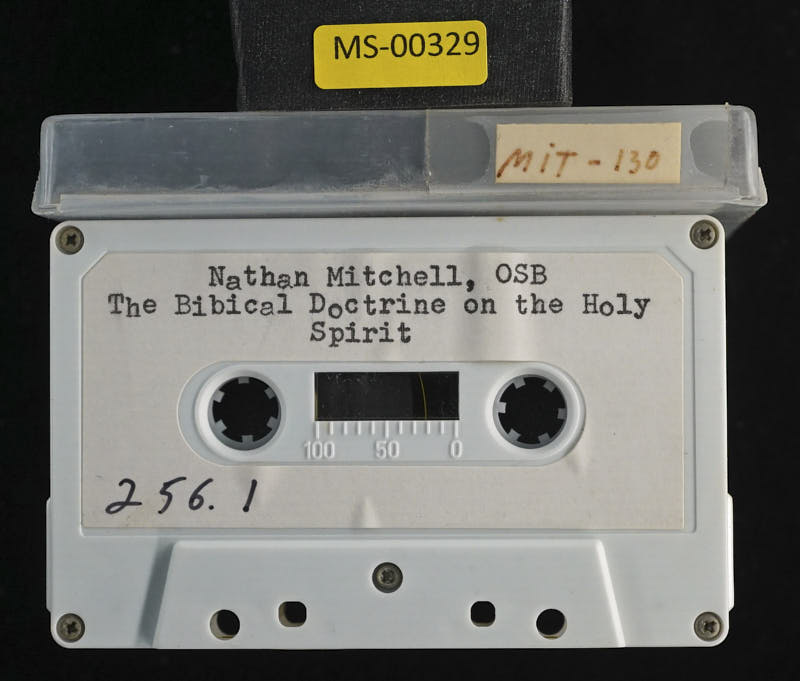
AI Vision - Possible Values from Photos:
Speaker: Nathan Mitchell, OSB
Possible Title: The Biblical Doctrine on the Holy Spirit
Additional text: 256.1
@AI-Vision_v002
For example, they're blank on one side. You can use them for other purposes in case you don't like what's on the first side or in case you just simply need some extra paper. But they also, in trying to think about this topic of the Holy Spirit and the Bible, it's such an enormous topic. It's like deciding to do a series of free lectures on God, you know, or on reality or something like that. It's very enormous and very difficult to do. So, I thought one way to control that, and also one way to avoid having to go through all the gory details of biblical exegesis in public, would be to pass out a kind of detailed outline of some research that has been done in recent years by biblical scholars, viewing with the doctrine of the Spirit and its development in both the Old and the New Testament. So that's what the purpose of the outline is. But right now, don't worry about it, because I'm going to start with something a little bit different. with a poem. It's something I always do when I lecture at St. Martin to the students.
[01:01]
They don't like it, but it's good for them. And I suspect you will like this. This poem is by an Anglican priest poet who died in the early part of the 17th century, George Herbert. It's part of a set of poems he wrote about Easter, which were later set to music by the English composer Ralph Vaughan Williams. Rise, heart, thy Lord is risen. Sing his praise without delay to take thee by the hand that thou likewise with him mayst rise. That as his death calcined thee to dust, his life may make thee gold and much more just. Awake, my lute, and struggle for thy part with all thy art. The cross taught all words to resound his name who bore the same. His stretched sinews taught all strings what key is best to celebrate this most high day.
[02:04]
Concert both heart and lute and twist the song pleasant and long. For since our music is but three parts died and multiplied, O let thy blessed spirit bear a part and make up our defects with his sweet heart. Before we get into the biblical material that I want to allude to tonight, I want to talk a little bit about a way to approach the Bible today. I'm sure that all of you are aware of the extraordinary amount of research, scholarship, some good, some bad, some mediocre, some exciting, some depressing, some demoralizing, some that your communities know about, some that they don't. that whole mass of research that has been done especially since the Second World War in biblical studies, and particularly that has filtered down into Roman Catholic scholarship, it's very difficult to bring all that to some kind of cohesive force and unity.
[03:12]
There are so many things coming out. It was like the tree in the 60s in the counseling. Every day you picked up the newspaper to see whether it was so mean as it went today or somebody else. It's just an extremely large mass of information that is difficult to control. So what I would like to do to begin with this evening for maybe 20 minutes or so is to talk a little bit about how we can approach the language of the Bible, period, and especially the language of the Bible as it deals with the question of the Ruach Yahweh, the Ruach HaKodesh, the Holy Spirit, the Spirit of Jesus. The English literary critic Richard Hovey once remarked that the first purpose of poetry is to have business with the grass. That's not the kind you smoke, that's the kind that grows. He meant, of course, that a poet's primary impulse is to intensify what is concrete and particular and uniquely alive about human experience.
[04:16]
And what Richard Hovey said about poetry could in fact be said also about the Christian doctrine of the Holy Spirit. Because from the very earliest times, the Christian imagination has striven to make the doctrine of the Spirit something concrete, something particular, something uniquely alive. There are vivid metaphors from ancient Christian literature that deal with this. One that comes to mind is a metaphor that was fashioned by Ignatius of Antioch. They're talking about the relationship between the Spirit and Jesus. This is what he wrote. It's an extremely fascinating architectural image. for understanding the presence and the power and the working of the Spirit in the community. Ignatius wrote, The Christian people are stones for the Father's temple, stones trimmed, ready for God to build with, hoisted by the derrick of Jesus Christ, the cross, with the Holy Spirit for a cable, faith being the winch that draws Christians to God up the ramp of love.
[05:19]
most of us probably think of Ignatius' metaphor as being bizarre and not much else, because very few of us think of the cross of Jesus as a derrick, and probably even less people think of the Holy Spirit as a cable. That's not exactly a flaming, modern image for the Spirit and its life and its work. And yet, as we will see, early generations of Christian believers did not particularly care about the theological precision of an image. Just by theological precision, you mean exact scientific rigor, and argument. So they were frequently willing to draw on the raw stuff of familiar experience in human life. They drew on images of fire and breath and womb and blood and birth and salt and oil and bread and wine, all these very earth-like things that make us the earth people that we are. So for example, When the early Christian community wanted to describe a significant event of any sort at all, it tended to do it in the vivid metaphors of poetic imagination. For example, the classic description of martyrdom in the early church that we find in the description left to us by the community at Smyrna.
[06:29]
It's the description of Bishop Polycarp's death. Remember that from the martyrdom of Polycarp, a very famous early Christian document. This is how they describe the death. It sounds weird and bizarre to us. and yet we'll see in a minute why it's important to think this way. Those Christian people wrote, Bound with his hands behind him, Polycarp was like a noble ram taken out of the flock for sacrifice, a goodly burnt offering for God. And as the sire leaped around the martyr, he became not a human being in flames, but like a loaf baking in the oven, or like gold or silver ingots, being refined in the furnace. And we became aware of a delicious fragrance like the odor of incense or other precious gums. Now, this is freaky as a way to describe the cruel and violent death of a human being until one remembers that what concerned these early Christian believers was not so much what happened, but what did it mean?
[07:32]
And more particularly, what does it now mean for us? If we were writing the same account of Bishop Polycarp's death today, we would respond in typically pragmatic, direct, fashionable American polythought. We would say something like this, Smyrna, United Press International. Bishop Polycarp was executed here today following a history trial before the local authorities, period. He was 85, period. The bishop had been under house arrest for several weeks, and upon his refusal to turn state evidence, a speedy verdict was reached. Death came, according to the local customs, by burning. Funeral arrangements are pending, period. So that would be a typical, that's the way we would intend to analyze the event. That's pragmatic, it's forthright, it gives us all the details, it gives us essential information, it's precise, it's fairly rigorous, it's unchallengeable in a court of law. And yet it misses the precise question that concerned early Christian believers, and as I will argue, that concerned their religious ancestors in Israel too, because that kind of a description of Bishop Polycarp's death affords us no insight and demeaning.
[08:40]
It simply gives us pragmatic facts and details. We forget then, and we need to remember it if we're going to deal with the biblical language of the Spirit, that The language of early Christian belief is always a language of poetic imagination. And when I say that, I don't mean poetry in the sense of prettified verse or lovely language. Allen Ginsberg's modern poetry, like Howe, for example, is a good example of poetry. It's not very pretty. There are orange crates and cockroaches and other ugly things wandering around in his poems. That's not beautiful, but it's intense and it's very effective. The same thing is also true of early Christian language about faith. It is a language of intensiveness. It has that kind of explosive vitality that is characteristic, really, of all good metaphor. So, in order to grasp what is being talked about, both in the Hebrew Bible and in the New Testament about the Spirit, we have to be willing to allow ourselves to be placed at the middle of that explosion.
[09:44]
We have to allow ourselves to be put right in the middle where that metaphoric clash is beginning to happen. And we have to allow ourselves to be battered a bit by it in order to grasp not so much pragmatic facts, but intrinsic and necessary meaning. There have been attempts in recent years to clarify the difference of language, especially the difference between the sort of biblical language we often hear about, the spirit, and a modern approach. Philip Wheelwright, for example, a contemporary philosopher and poet, draws a distinction between what he calls steno-language, thinking, stenographer language, which is that precise, analytic, very pragmatic, very useful scientific language, and what he calls tensive or elastic language, stretchable language. I'm tempted to think of another image, but it might be immoral. Anyhow, think of something that stretches, that is elastic, that can expand consciousness stretching language, if you will. And I think Wheelwright's distinction is valuable for us who read the Bible in faith, because what he's suggesting is, it's not that the two languages are in necessary opposition to one another, nor is it that the two sorts of approach to language, one is truthful and one is fake, rather poetic language, elastic, tenses, metaphoric language, lets us come to grips with things that are true and things that are real about our experience, which could not
[11:12]
be otherwise grasped, really or truly. An example. Think of, in the Hebrew Bible, of the beautiful set of poems, there are five Hebrew poems that we call the Song of Songs or the Song of Solomon. The author of that could have lapsed into miserable, pragmatic, and very pedestrian steno language had he wanted to. He could have said, well, the love between a young man and a young woman is exciting, period. It is based on an attraction that is mutual, that is physical, that is psychological, period. It is sometimes painful, sometimes fulfilling, period. Well, that may be all true, but listen to the contrast when the biblical writer explores the interior of a relationship between a man and a woman, and metaphorically between Christ and the church, as the fathers understood it. Listen to the language that he uses to describe that same relationship. How beautiful you are, my love, how beautiful you are.
[12:15]
Your eyes behind your veil are dove. Your hair is like a flock of goats risking down the slopes of Mount Gilead. Your teeth are like a flock of shorn ewes as they come up from the washing. Your two breasts are two fawns, twins of a gazelle that feed it among the bones. There's a difference. I take it that it's noticeable and relatively obvious. All those earthy images, doves and flocks, fawns and lilies, are poetically expanded, elasticized, and stretched so that we come to the interior of the meaning of a relationship of love between a man and a woman. I use these examples then as a kind of introduction to the material which I'd like to look at now together with you, the material on the biblical doctrine of the spirit which I passed out in outline form. I obviously do not intend to read at you every word that's printed on those pages.
[13:22]
I thought it might be valuable to give you a detailed outline both for your own personal reading and also I try to give as many references to text as was reasonably possible that would exemplify the points in the outline so that you might also use this for your own personal reflection during these days when we're together. I have been myself helped in preparing this by a couple of sources that I would like to indicate to you, which you might also find valuable. You may also be familiar with them already. One of them is George Montague's book, called the Holy Spirit, the growth of the biblical tradition. Let me just write that on the board, okay? Open up, Paul. George Montague's book, The Holy Spirit, The Growth of the Biblical Tradition, which is a subtitle.
[14:25]
The other work which I have used frequently, both in teaching and also in the preparation of these notes, is a book by the late Protestant exegete Norman Perum in the University of Chicago. The book itself appeared about ten years ago. It's called Rediscovering the Teaching of Jesus. And a collateral book which was published shortly before his death called Jesus and the Language of the Kingdom, Norman Perum. repeat the titles rather than writing them now Rediscovering the Teaching of Jesus is one of them the other one is called Jesus and the Language of the Kingdom he also by the way has a very small book which was published posthumously on the resurrection accounts in the synoptic gospels and in John which is a very valuable small book all of parents writing by the way although it is sometimes written for a scholarly audience and a group of people who are working directly in exegesis
[15:30]
He's a very clear writer, or he was, and his findings are presented in such a way that I think it's the kind of thing you might find valuable and useful even in terms of the Lectio and spiritual reading. I mean, it's not so covered over with technical jargon that you couldn't read them also as a book of piety and devotion. I am going to do what almost never ought to be done by Christians. I'm going to take rather a short look at the material that I passed out to you on the development of the biblical doctrine of the Spirit in the Old Testament, or in the Hebrew Bible. The reason why I'm doing that is because there's such a massive amount to try to do with the New Testament. I say that Christians ought not to do that, because ever since Martian, we've been tempted, and maybe before Martian, the famous heritage, we've been tempted to ignore the Old Testament as having relatively little to say to us. Or it has to be... endured in the biblical readings of the lectionary in the mass and in the divine office but aside from that we ought to ignore it that's too bad because a great deal of the meaning of our own tradition is buried there and continues to lie buried there and we ought frequently to drink there I suspect too I tried to divide this material into 11 different Roman numeral sections as a way to organize and control a kind of historical synopsis of the way in which the doctrine of the spirit developed
[16:51]
I hope it will be clear that my own approach to both the Hebrew Bible and the New Testament is fairly much based on both form and redaction criticism of the Bible. That is to say, looking at the Bible by means not only of what's written there flat on the page and printed ever since Gutenberg for our perusal, but rather the Bible as a kind of thick, layered, almost crusted document is It would be better almost to think of the Bible like German chocolate cake or something thick with oozing wonderful layers of things. To confront the page of the Bible is not just to let your eyes lie on something that is flat and printed. It's to bite into something that is extremely thick, layered. And sometimes those layers are even mixed with one another. Another image you might use is geological stratification in rocks, like layers of shale come against layers of sands and that kind of thing. Think of the Bible in those terms.
[17:51]
That's the spirit in which these notes were written. So that, for example, one doesn't assume in approaching the Bible today that some author, a rather bright Hebrew who didn't have a great else to do, one day sat down and put Genesis 1-1. In the beginning, I created the heavens and the earth, and then went on from there all the way up to the book of Malachi, and then died before he had a chance to work on the New Testament and let somebody else do that. Because quite obviously, that's not how the biblical literature was put together. The very term tabidlia, the books, indicate that the Bible is more like a library, and like a library with many shelves and layers of documents. So that, for example, when we look at the earliest traditions of Hebrew faith, the earliest traditions of Israel, such as I've outlined on the first page, for example, they probably call the Yahweh's tradition and the Elohim's tradition, what we're really looking at are differing theological points of view about Israel's own religious experience.
[18:55]
Not everybody agreed on the meaning of that experience, any more than everybody would write a poem describing the log between a man and a woman, the way the author of the Song of Songs did. That's why I gave that little introduction about the nature of biblical language, the nature of the language of faith, the nature, indeed, of poetic and imaginative language. These documents are interpretations of experience. They are not necessarily chronicles that deal directly and immediately with just exactly the way things happen. That would be the UPI newspaper accounts. of Bishop Polycarp's death. What we're dealing, in a sense, then, with, even in things like the Yavis tradition and the Elavis tradition, for instance, of the creation story in the book of Genesis, are theological meditations, indeed theological poetry, about the interior geography of an experience. This, far from making the Bible less valuable or less truthful or less real, intensifies its value.
[20:02]
intensifies its reality and its truthfulness for us. In those earliest traditions, as I pointed out in the notes here, the Spirit of God is looked at in very concrete terms. It is a wind, a breath. It is something that sweeps over the waters. It is something that leaps upon a man even with violence, even with terror, and not always for good, by the way, to inspire that person to prophesy. So that in the earliest tradition of faith in Israel, the Spirit of God is not necessarily a consoling, gentling breeze, which will necessarily, you know, kind of like divine candy or a kind of cosmic gas that floats in the atmosphere, like argon or neon or one of those other odorless, colorless, tasteless gases that is inhaled out of the atmosphere. That's not really the ancient Hebrew conception of the Spirit. The ancient Hebrew conception is much more violent than that, much more married to the earth than that. The same thing is true in Roman numeral 2 when we look at the Deuteronomic history of Israel.
[21:07]
The books of the Bible like Joshua, Judges, Samuel, and Kings, which represent a whole series of religious traditions, later edited, later reflected upon, later chewed and ruminated and meditated upon, and then rewritten. So that, for example, in the Deuteronomic history, the spirit comes across very often as a wonder-working spirit. It is classically the spirit of prophecy, the spirit that inspires Elisha and Elisha. It is the spirit that points out and chooses and elects God's chosen one. Very frequently, then, the spirit is associated with the whole mystery of election, not only of a people, but of special figures in the history of Israel. David, for example... And remember how the David story is constructed in the books of Samuel? Remember how it is? It's very similar in structure to a lot of classic folk tales that we know about that are not Hebrew in origin. Remember, he's the youngest son. It's almost like Cinderella and the stepsisters.
[22:09]
He's the youngest son. He's obviously being ignored because he has been sent out. The father shows to the prophet Samuel all the other sons. Everybody expects that the story will end up at one of those, one of those fine, sturdy, older, more mature, more wise, and obviously more worthy sons would be selected. The answer is, none of these are the man. Don't you have any other sons? The father goes out, gets David, he's nearly a boy, and he's the one who Samuel annoys. So the spirit often works in a certain sense in the Deuteronomic history in ways that subvert the ordinary religious expectations of the people. That's very important. That's why the spirit of prophecy, classically in Israel, did not necessarily mean giving a message that will respect the king. The prophet was not necessarily the king's man. The prophet Nathan, as a matter of fact, found that out. That's why he kind of suddenly disappears when you get to the first book of Kings.
[23:10]
I mean, he did all right. as long as he simply told David that Yahweh didn't want a house, he wanted to be a Trek god, a wandering god like his people. So in the first book of Kings, he gets caught in political palace intrigue and disappears from the Bible over after that, except for one brief, one verse mentioned in Ecclesiastes. But... The spirit of prophecy in the Old Testament, then, is not only a spirit that may be violent, it is also a spirit that may be somewhat subversive, unaccountable, who brings forth a message in Israel that Israel itself does not want to hear. So the prophet often finds himself in the uncomfortable and also unpredictable position of having to testify against his own people, even though it was his own people that originally gave him the impulse to prophecy. So the notion of the spirit of prophecy in the Old Testament is an extremely complex one, an extremely thick and layered one. The same thing is true when one goes in Roman numeral 3 to the pre-exilic prophets, the folks like Amos and Micah and the first Isaiah and the prophet Jeremiah.
[24:15]
There, the whole tenor of prophecy in Israel has become so problematic that some of these prophets, like Amos, for example, make it a point to disassociate themselves from the prophetic tradition altogether. Remember what Amos keeps saying that he is? He mentions it in the very first verse of his book, and keeps referring to it obliquely throughout the entire course of the prophecy. I'm a shepherd. I'm not one of the professional prophets. I'm not one of these people who runs around supporting the king. I come from humble circumstances. I am not one of the band of the frenzied ones. And that same kind of polemic against false prophecy in Israel is carried forward in prophets like Micah. What begins to happen in the pre-exilic prophets, indeed, is that the spirit of prophecy is gradually being transformed into the word of prophecy. So that in an earlier stratum of Israel's history, it was a spirit leaping upon a man.
[25:23]
deceiving him violently and almost throttling him, forcing him to testify and to bear witness, now it is the word of the prophet which is truthful, the Debar Yahweh, the word of God, as opposed to the Ruach of God, which leads on a man frenziedly and inspires him. And when we go on, as we're traveling rather rapidly, to the fourth chapter, which is on page 5 of these notes, and view of the later tradition yet of prophecy in Israel, the prophets during the period of the Babylonian exile and thereafter, Ezekiel, the second Isaiah, and the third Isaiah, still a new theme appears, a new transformation of Israel's religious experience and its language and its consciousness. For example, the prophets emphasize the creating spirit, of Yahweh. This is especially true in that beautiful collection of poems that we call the second Isaiah.
[26:25]
It starts with chapter 40 with the famous thing, Comfort, comfort my people. Speak ye unto Jerusalem and cry to her and say that your time of service has ended and your warfare is over. That whole collection of poetry, and it is that exactly in Hebrew, is a wonderful account, a new account of the creation of Israel, no longer in terms of the creation of God in nature, and the blowing of breath into the dust that was man, but now an account of Yahweh's creation of a people that has been saved out of exile. Notice what keeps happening then in the Hebrew tradition here. With each new experience, some of the experiences are happy, some of them are tragic, there tends to be a reinterpretation, a new meditation, a new poem written about Israel's experience of the Spirit. so that by the time of the exile it is the creator spirit, the spirit that doesn't leap on prophets much anymore, but rather leaps, or rather falls gently upon the servant of Yahweh, that mysterious figure about which there are four beautiful songs in the second Isaiah.
[27:35]
Similarly, as in the prophet Ezekiel, this is the spirit who breathes life into a people once again. I'll give you an example of a text from that on page 5. Moving on, as we're doing rather rapidly, to the priestly tradition of Israel, a rewriting of Israel's early history after the time of the exile, probably during the time of Ezra and Nehemiah. Once again, new themes emerge about the working and power of the Spirit in Israel's religious tradition. So that, for example, the Spirit is no longer... just the spirit of prophecy or even the spirit that recreates Israel after exile, but the spirit of a very practical gift to people. The spirit of skill, of practical wisdom, of natural talent. The spirit that inspired cosmic creation is also the spirit that inspires the craftsmen. That same kind of a theme, you will notice if you move on, is also found in things like the Psalms and in the wisdom literature, which I discuss on pages 7 and 8 of the notes.
[28:43]
Finally, to kind of bring this quick tour of Israel's national history to a close, we see the emergence of a new kind of literature late in Israel's history before the appearance of Jesus, The type of literature that I described on page 7 is restoration literature, which deals particularly with what happens to the people once they are forced to reconstitute themselves after the exile. What happens when Ezra and Nehemiah and temple construction and practical affairs of getting the people reorganized and renewed have to happen? How does that affect the perception and the theology of the Spirit in Israel? There we begin to get the emergence of a very closely connected theme, a theme that will re-emerge in some strands of the New Testament literature, the connection between spirit, covenant, and temple. Just as there is a new temple, so there is a new people, and a new cosmic creating spirit who creates that people and who fills that temple and who is the master of that covenant.
[29:54]
So that in the period of what I call the restoration literature, there's a kind of two-fold movement going on. On the one hand, there's the sense that this spirit, the spirit that moved over the waters in Genesis, the spirit that leaked on prophets in ancient times, the spirit that revived the people after the exile, is now becoming the spirit of law and the spirit of covenant, the spirit of the temple, of the cult, of Israel's renewed liturgy. There is in this literature, the books for example of Ezra and Nehemiah, a very strong nostalgia trip. That should be familiar to us who live in the 1970s. It's like housewives running out to buy early Americana furniture. In a way, that was a very strong impulse in the theological movement of the restoration after the exile. People began to ask themselves quite characteristically, as we have ourselves as a nation, what went wrong What happened?
[30:54]
Why did that occur? Why do we find ourselves suddenly faced with the necessity of a new temple and the need of a new covenant and indeed the need for vast and radical recreation of the people? Something like our own national reaction after the Vietnam War, we're still, I think, morally, either, I don't know, maybe morally stunned or morally outraged. I hope that. by that event to be able to give it any kind of evaluation. But just now, very gradually and kind of imperceptibly, questions are beginning to be raised like, what does that all mean? What could it possibly have said? What could it possibly have said? Much like in the later 50s and in the early 60s, one began to get a whole literature dealing with the event of the Holocaust of the Jewish people in the Second World War. But finally it occurs to people to say, what can we make? That's exactly what was happening in what I call here the restoration literature, the literature after the exile, Ezra and Nehemiah particularly.
[31:58]
It was an attempt to make sense of those rather tragic and grim national experiences. And finally, toward the end of that period, toward what we might call the intertestamental period, there begins to emerge in Israel three different movements, all of which are extremely important. for New Testament writing and New Testament faith. One of them I've identified on page 8 as apocalistic literature. It's the sort of thing you get in the books of Daniel, Joel, and even to some degree in the books of Maccabees. There begins to be an extreme interest here in an eschatological future. That, by the way, is not at all unusual in an age when men ask themselves, What does this mean and why did that happen? A very typical theme of our own age, by the way, where you not only reflect back on a series of rather cataclysmic national events, but you also begin to speculate about a possible cosmic future.
[33:01]
It's not for nothing that the same generation which protested Vietnam also turned, for example, to the sacred books of the East. that people began running off to seminars on Zen and yoga and other forms of Eastern wisdom and literature. That sounds so unusual to us and we can't see the connection, but actually there's a very strong connection there between that nostalgic interest of the Restoration, where one meditates on the spirit of the past and what happened, and a kind of futuristic orientation that appears in the apocalyptic literature. So that you begin to get these wonderful visions of a prophet like Joel. On that day I will pour out the Spirit on all flesh. And your young men will prophesy and your old men will see visions. And people will dream. People will speculate that something else is possible. That we could go a new direction. That we could arrive at a new world. A very common kind of theme in our own very apocalyptic age.
[34:06]
A second thing that emerges right at the very end of the Old Testament period, the Hebrew Bible, I've tried to identify a little bit on the bottom of page 9 under the title Spirit and Torah. What I referred to there is the rise of what became eventually normative, rabbinical speculation on the Bible. Here we're not dealing with Biblical books. We're dealing with a school of interpretation of the Bible which emerged in the late Hasmonean period, which emerged with an emphasis on the written scriptures as a normative source for faith. So that frequently, for example, in rabbinic literature, one does not ask, what are the prophets saying? One asks, what has been written? What is written in Torah? Or what is written in the Hashtora, the prophets? Or what is written in the books of wisdom? In other words, there emerges in the late history of Israel a concern for the oral and the written tradition of the law.
[35:14]
Much as, for example, the prophet Jeremiah, in reaction against prophetic excess of an earlier period, Jeremiah begins to emphasize the importance of the Debar Yahweh, the word of the prophet, as opposed to ecstatic frenzy and utterance. It is also important to notice that In the period of the rabbinic literature, the rabbinic commentary, for instance, on the Bible, the early one, the notion of the Holy Spirit begins to appear more and more frequently. The term in Hebrew, Ruach HaKodesh, Holy Spirit, is a term that appears very infrequently in the Hebrew Bible. However, it does appear, but it appears much more commonly in in the rabbinic commentary. So some of these are pre-New Testament, some of them are well into the New Testament period. For example, the term will occasionally appear in Talmudic literature, but that carries us well into the New Testament period since the Talmud was put together around 518.
[36:18]
A final movement that kind of acts as a transition to the New Testament is what was happening with that famous group of people whom all of us have heard about and very few of us probably have read about the Qumran community, the Dead Sea Scrolls. This rather important movement in Palestine probably represented a pulling away from what was considered to be corruption of both the priesthood and the temple in the late Hazlunian period. Remember, Israel's fortunes as a people, even after the exile, were not always happy. And looking around literature, one sees a community that is beginning to pull away more and more from the normative tradition, even of the rabbi, and is beginning to look at itself as a kind of separated community of the left person. There emerge in that literature, as we now have it, both in text and in translation, an important theme which later on, in the opinion of scholars like Raymond Brown,
[37:26]
influenced some of the New Testament theories of the Pericles, or the Spirit, or the Spirit of Truth. For example, in the Johannine literature. Thus, for example, frequently in the Qumran literature there is a contrast drawn between the two spirits, the spirit of evil and the spirit of wickedness, of the spirit of holiness and truth versus the spirit of falsehood and error. And in fact, the only example outside the New Testament literature of the term spirit of truth comes indeed from the Qumran literature. I realize that's an awful quick tour through a massive amount of material. I hope that perhaps I've just indicated a few things that by looking at more details in the outline, you'll be able in your own personal thinking and reading to expand this. I'd like to look now a little bit at the question of the spirit in the New Testament. And I'll do that by first of all mentioning a couple of preliminary items from my way of an introduction.
[38:32]
The first thing to notice is that the New Testament, New Testament Christianity, is an extremely diversified phenomenon. I mean, too often we think that somehow or other the Gospels dropped out of heaven in a glad bag appeared they were written with an extreme conscious desire for uniformity in theology and in the picture of Jesus, and that they were received that way. This is, in fact, of course, not true. The New Testament does not give us a uniform picture of Jesus or of the early history of the Christian Church. Nor are the Gospels all one piece of cloth. The Gospels are more like a patchwork quilt. with lots and lots of different kinds of pieces put together, sometimes not very well. The second preliminary comment that needs to be made is that in the New Testament there are differing and conflicting Christologies.
[39:34]
Mark's theological vision of Jesus, for example, is not the same as Luke's or Matthew's. And none of those three are the same as John. Each of them takes a very different view, a very different theological slant on the person and the ministry and the work of Jesus. So that once again, what we really have in the New Testament are a collection of traditions that are in conflict sometimes with one another. Once again, that doesn't have to be cause for dismay. That can become cause for enrichment. because the picture of Jesus that we can gain from that is much cooler. Let me just take you then on a quick magical history tour of some of these New Testament texts, and that will conclude us for this evening, because I'm sure that after a day of traveling, you, like I myself, am tired. First of all, just to take a brief look at the Gospel of Mark.
[40:36]
Mark's theological interest contrary to banners that proclaim otherwise awful on Easter Sunday, is not in the resurrection of Jesus or on Easter. Mark would not have found himself comfortable, and fortunately he lived before Augustine so he didn't have to worry about it. Mark would not have been comfortable with the notion that we are an Easter people and hallelujah is our song. Mark's view of Jesus is strongly colored by the central effect of cross and death. and yet even failure in the history of Jesus. Mark's Jesus is not one who stoically proclaims his own divinity while he acknowledges as a kind of, by the way, the power of the Sadducees, the Pharisees, and other enemies to make his life uncomfortable. That's not the kind of Jesus that is present in Mark. Mark's Jesus is one who is most truly revealed as Lord in the moment of the cross.
[41:40]
That's why Mark's Gospel is a strange paradoxical picture of progressive incomprehension on the part of the disciples. The disciples do not increase in understanding as Mark's Gospel unfolds. Indeed, they get more dense as time goes on. To the point that, at the tomb scene in the 16th chapter of Mark, they're not even there anymore. The strange thing is that the people who are there are the women who are the first witnesses, according to Mark of the Resurrection. Of course, Mark's Gospel originally ends precisely with the Greek particle, Gar. It ends at 16.8, with the women trembling before this event. So the Gospel of Mark has a very different image of Jesus, one that emphasizes cross, one that emphasizes his most... full activity in the event of his own dying.
[42:44]
Jesus is the one who knows how to die right, and the disciple of Jesus is the one who learns how to die. That's the implication of Mark's gospel written probably for a church in which that was not an unknown event, death, for the sake of the Christian confession. For that reason, Mark's picture of the spirit of Jesus was often comes across powerfully in terms of exorcism and healing stories. In the exorcism stories, for example, Jesus is presented as the one who has the power to win the struggle with Satan. That struggle reaches a bitter and shattering climax on the cross. And in the healing stories, that same power of Jesus to counteract the forces of Satan to restore and to forgive is also considered The Spirit that works in Jesus in all of Mark tends to be the Spirit that is actually pushing him not just into the wilderness for temptation, but eventually to the moment of cross where his true Messiahship will be revealed.
[43:52]
Now, if we move to Matthew's Gospel, we get a very different picture of both Jesus and the Spirit. For one thing, Matthew's Gospel is written for a different kind of church, a different kind of Christian experience, a different generation, indeed, of Christian believers. Matthew's Gospel is probably written for a church that is in crisis, a crisis that existed on two levels. On the one level, that church was faced with the necessity of pulling away from its Jewish antecedents. It became clearer and clearer in Matthew's church that a decision had to be made. One either could confess to be a Jew or a Christian. One probably would find it incompatible to try to be both. And there were internal conflicts as well in Matthew's church. So that, for example, when Matthew describes the relationship between Jesus and the Spirit, he does that very frequently by saying,
[44:53]
by his own emphasis on discerning the Spirit in a community that suffers divisions. He begins to give you criteria for discernment of the authenticity of the Spirit. Criteria of discernment for the signs of the Spirit's presence. You will find relatively little of that in Mark's Gospel. You will find a great deal of that in Matthew's Gospel. Matthew is obviously preoccupied with the problem of those who speak falsely, in the name of Jesus. His theological program, and indeed his pastoral program in his church, is to recall persons to the basics. And the basics, for Matthew, mean nothing less than the words of Jesus. Rightly interpreted according to the spirit of the apostles and their successors. Rightly interpreted according to a criterion of right judgment for prophecy. In a way, Matthew's gospel is a
[45:53]
It has a certain kind of contemporaneity for us, because what he's dealing with is a kind of polarization between rigorous and laxist, between those who claim to speak truthfully and prophetically in the name of Jesus and those who don't. He just has to deal with that problem by generating his own set of theological criteria by which you can deal with that kind of polarized tension and problematic in a Christian community. Moving on then to the Gospel of Luke and the second part of that volume in the book of Acts, Luke's concern is different from both Matthew and Mark's. If Mark's Jesus was a Jesus who is manifest most truly in his identity on the cross, as the centurion confessed, Luke's Jesus is much more stoic and far more in control. Jesus is presented in Luke's Gospel as the one who possesses the Spirit from the very beginning. He did not gradually grow in possession of the Spirit.
[47:00]
Hence, the importance of the instance in narratives, and the famous, I think it will become famous, Book of Raymond Brown, one of the verses of the Messiah just recently published toward the end of last year. The instance in narratives functions in a very important and vital theological way for Matthew. They're his way of saying, this man Jesus was not like prophets of old on whom the Spirit leaped occasionally, nor is he even like some prophets in the Christian community who gradually must grow and increase in prophetic depth and in the influence of the Spirit. Rather, from the beginning, he is anointed with the power of the Spirit, and hence he is the one who mediates and dispenses to the community that very same power of the Spirit. Interestingly enough, what Luke tends to do is to take an old Hebrew concept and refashion, reinterpret it in the light of Christian experience. So that, for example, whereas the Hebrew Bible emphasized in its early tradition the power of the Spirit on selected prophets chosen by Yahweh, what Luke will do is to say the whole community are prophets.
[48:15]
everyone has become prophet. It is a community of prophetic utterance that is at work in the Christian community, so that the Spirit functions, as I mentioned on page 5 of the note, as a characteristic feature of the age of the church for Luke. The Spirit is that ultimate gift bestowed by the risen Lord on the community of believers, and in that, Luke gives us a different theological enrichment from both Mark and Matthew. Mark and Matthew tend to look at the Spirit as the final gift of the final age, the eschatological gift. Luke looks at it as the permanent endowment, the permanent bestowal on the community, and thus the reason in the first chapters of Acts for descriptions like the famous event of Pentecost, or in Acts 10, the Pentecost of the Gentiles, with the Cornelius story. It's all very much a part of Luke's way of exemplifying his theological program, And it's also part of Luke's way of defending the legitimacy of the mission to the Gentiles.
[49:22]
Remember, that was not a foregone conclusion in early Christianity. That was a very serious debate. Is this thing for everybody, or is it not? The decision is eventually made, as for example in Acts 15 in the so-called Jerusalem Council, that the message is indeed for all. And finally, just a few comments. I won't touch the Pauline stuff tonight because of time considerations. I hope you'll have a chance maybe to look at the notes that I tried to work out for you. Just a few comments on John's literature because it is at one time very rich and exciting and another way kind of hard to interpret. I'm going to omit the little thing on the letters of John, although that's kind of important. I'm going to look on page 7 at the Gospel of John and try to kind of finish out our picture of the evangelical notion of the Spirit, such as we have it in the four canonical Gospels. One way that I think it's helpful to look at John's vision of the Spirit is to look at the whole work, the whole Gospel, as a kind of three-dimensional theological meditation.
[50:32]
Remember the days of 3D movies when you had to wear those weird glasses that you put on, you went in and looked at things. Or it's like trying to make the transition from plane to solid geometry. Anyone who's ever taught mathematics will surely notice that that's sometimes hard to get students to do. Or like trying to learn to move an art from drawing or working in two dimensions to suddenly having to deal with three-dimensional art, three-dimensional drawing, for example. That's kind of like, that's the move in a way, the interpretative move that you have to make in dealing with John's Gospel. That's what you're dealing with, a kind of three-layered, three-focused, three-dimensional picture of Jesus. Another way to think of it is to think of John as giving us a long set of meditations, almost poems, on the meaning of the exaltation of Jesus. Because, in fact, that is very central to John's whole picture. The exaltation of Jesus is one single mystery, one single event for John.
[51:37]
Passion, cross, lifting up, rising, ascending, all ascending of the Spirit, that is all one global event in John's perspective. The so-called arrangement of John's Gospel into a book of seven signs, starting with the wedding feast at Cana, is a good example of how he gives you a series of theological meditations on the meaning of Jesus being lifted up. John has got special importance, however, for our topic because of something he does toward the latter chapters. And that is, of course, the mysterious and famous question of the Pteroclete. Who is it? Or what is it? And what is its relationship to Jesus? I will conclude the scene by giving you my own suggestion about that. Remember how in the so-called Last Supper discourse of Jesus in John's Gospel, there constantly are these references to the Father and I are one, I and the Father are one, we are in you, you are in us.
[52:42]
You begin to wonder if you have Dane Bramage to look at that because it doesn't sound quite right. And then you begin to hear Jesus say things like, I will send you another parakletos. I will send you another what? Consoling Lord, helper, witness. trial, lawyer, very difficult term to identify and to translate. I would suggest that John is really up to two things in his vision of the Pericles. The first thing he's up to is a church problem, just as we saw that there was an important church problem in Matthew's Gospel. First thing John is trying to do is handle this question. What does the church do once Jesus has gone away, and once the last apostolic witnesses are dying off. How can the church be sure about the authenticity of its own tradition about Jesus?
[53:43]
How can it make sure that what it passes on as the truth about faith in Jesus and discipleship is in fact true? What John suggested in answer to the question is, because of the paracletos who will... teach you the truth about Jesus. That's what John does, is to set up parallelisms between the work of Jesus and the work of the Korachmatos. I've identified some of those in these notes. If you look over on page 10, I try to set up just a few of the examples. Just as, for example, Jesus has come into the world, into the cosmos for John, which has a very specific meaning, so also the Pericles will come. Just as Jesus is the first parakletos, the first paraklete, so this is another paraklete. Just as the disciples have had the privilege of knowing Jesus, so also they will be given the privilege of knowing and recognizing the paraklete.
[54:45]
So in a way, what the paraklete does for the church is what the disciples did for them, lead them into the church. It's John's way of handling it. a basic problem of tradition. The second thing that I think John is trying to do by his doctrinal paraclete is to resolve, well, actually, it's a kind of departure from the old Hebrew notion that we thought of developing in the Old Testament. John's gospel pushes very much in the direction of what will eventually be identified in Christian history as Gnosticism. As Father McRae from the Stillman Professor at Harvard said recently, John's Gospel may not have been written by a Gnostic, but it was written by one who was well on his way to being one. That's probably an accurate assessment of it, literarily. It's written by a person who has an extremely fond predilection for that kind of speculation which was frequent in the Hellenistic world, which was frequent even sometimes in the Pauline writing, as I've discussed later on in these notes, which I hope you'll have the chance in a moment to read and to look at.
[55:57]
I realize we've covered an awful lot of stuff. We're out of time, and it's time to quit. You are exhausted. I hope that I have at least been able to convey to you a little bit about the complexity of the question of the Spirit, both in the Hebrew Bible and the New Testament, and also some of the development of themes. Most of all, I hope I simply left you with an impression. I hope it's not an impression of complete confusion, but a disimpression that... That effort to discern and to know the meaning of the Spirit in our tradition is simply a part of the process that has been going on from those very earliest Hebrew writers called the Yahwehs and the Elis. But what we're doing together during these days, both in these sessions and in your own discussions and your own prayer and reflection, is really a continuation of exactly that effort. We're here to, as Richard Hovey said, and I quoted at the beginning of my presentation, we're here to have business with the graph. We're here to have business with what is most uniquely alive, most specific, most concrete about our faith.
[57:03]
We're here to explore the interior geography of our own heart, and kind of clearly as the heart of belief itself. We're here to write our own poem in this time and in this place, our own theological meditation on our experience of the Spirit and our experience of God's grace and truth according to our hearts by the one who makes us cry, Abba, Father.
[57:29]
@Transcribed_UNK
@Text_v005
@Score_87.37