You are currently logged-out. You can log-in or create an account to save favorites and more. more info
Pathway to Enlightenment Through Kalachakra
The talk explores the intricacies of Kalachakra meditation through Vajrasattva purification, emphasizing the connection between the creation and perfection stages of practice. It underscores the significance of specific visualizations, including the visualization of Vajradhara and the offering of mandalas, alongside a thorough examination of refuge, bodhicitta, and Vajrasattva practices. The discussion insists on the importance of maintaining the secrecy of the teachings and highlights the alignment of the initiation events with a significant day in the Buddhist calendar. The ultimate goal is the attainment of enlightenment for all sentient beings through the practice of the Sixth Branch Yoga within the Kalachakra Tantra framework.
Referenced Works and Concepts:
-
Kalachakra Tantra: The focal text for the entire practice, detailing the elaborate visualization processes and structural insights necessary for the Kalachakra meditation.
-
Sixth-Branch Yoga: Part of the Kalachakra practice, it involves comprehensive meditation methods crucial for achieving perfection stage mindfulness and eventual enlightenment.
-
Visualizations of Vajradhara and Mandala Offerings: Essential components for practice, use specific visualizations that offer a detailed blueprint for the practitioner's spiritual and mental focus.
-
The Compendium of Tantras: A critical collection featuring related practices and instructions relevant to the Kalachakra teachings and Vajrasattva purification.
The teachings are drawn from advanced Tantric methods, with each element, from visualizations to prayers and offerings, holding profound import for progressing on the path to enlightenment as framed by the Buddhist calendar's significance.
AI Suggested Title: Pathway to Enlightenment Through Kalachakra
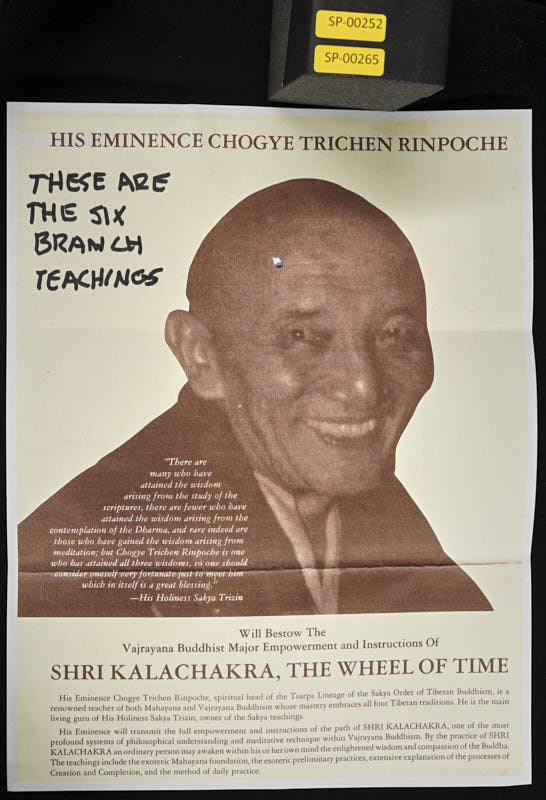

form of with one faith and two hands, which is known as the co-emergent Kala Chakra. And this is the form that we use for the meditation, which will then be taught in the coming days. Also, Ramichi said that this is a very, since it's a special day, he thanks for giving the blessing at this time. has special benefits and special blessings because of his anniversary. And one further thing he would like to add is concerning the tape recordings and filmings that are made of any of these events, Kalachakra initiation or teachings on the practices of Kalachakra. First of all, there was a discussion about the filming of the Kalachakra initiation to begin with, the video film. And this... did not turn out to begin with because there were some slight difficulties and problems.
[01:04]
The second part of the initiation was filmed, but within the Dharma Center group. Also, at this time now, people may be making tape recordings of the teachings being given for this 11-day period, but it should be understood very clearly that Rinpoche very seriously wants you to realize that this is not to go any further than this group that's here today. That's it. You can listen to it. You can discuss these topics with the people who are here, but this should not be heard by anyone else ever. This shouldn't be listened to by anyone else. This is only for the use of those who are here in this group. There are various different reasons for this. In general, the secrecy of Tantra, Also, there can be various faults that come to those who reveal such secrets. And so one should be very careful in this regard and listen to what he's saying now and be very strict with the use of these tape recordings.
[02:10]
That is the observation of this anniversary which falls today. would be observed very widely in Tibet. They would make many, many vows, offerings that's considered a very holy day. Rinpoche very much liked the auspicious coincidence that has occurred in the sense that, to begin with, the initiation itself of Kala Chakra was given just right before this anniversary, and then this evening, the actual anniversary, the 15th day of the Tibetan month, falls within the teachings on the Kala Chakra, and then also this evening he can give the briefer blessing of Kala Chakra. So it's very auspicious. ... ... ...
[03:40]
Well, I don't like me, but I don't want to talk about what I want. I don't want to be here. [...] . . .
[04:46]
. . . Thank you. Thank you.
[06:14]
When I was born, I was born and born. [...] It's happening, so we don't know what to do. It's never what to do. It's never what to do. It's never what to do. So for all sentient beings, we should wish to attain to a state of complete enlightenment, that is the level of the Buddha Vajradhara.
[07:28]
And with this motivation in mind, and we listen to the teachings upon the ultimate teachings from all of the Dharma, and Yogas of Kala Chakra. All of us have now received the initiation, the full, vast initiation of Kala Chakra, and also the teachings upon the preliminaries for the Sixth Branch Yoga has been begun. As was explained, there are preliminaries which are both for the practice of the creation stage and for the perfection stage. There are, of course, very vast and detailed creation stage practices which exist within these traditions. For instance, within the tradition transmitted from Bhutan or within the Janamba tradition. For instance, within the Janamba tradition of Kalachakra Mahasambara for which the Wang was given last weekend, there are 95 deities that one would meditate upon.
[08:32]
So these are very vast creation stage practices. But within the tradition of the practice of the six branch yoga, that is perfection stage practice, the creation stage which is used is one in which Kala Chakra appears with only one face and two hands. And this is the one used in the tradition for the practice of creation stage and on the basis of that practice of the six branch yoga. Now the teachings yesterday were upon the first three parts of the instructions that is on refuge, bodhicitta, and vajrasattva. Today will be the fourth and fifth sections that is on mandalas and guru yoga. These two sets of preliminaries are called ordinary and extraordinary, or we could say common and uncommon. Not that one is less profound than the other. That's not the meaning. But instead, the first five are the preliminary practices which are common to both practices of creation stage and perfection stage.
[09:46]
in the sense that they are necessary in common for both of these practices. Whereas the creation stage practice as the extraordinary or the uncommon preliminary is the one specifically for the perfection stage practice. So this should be understood, that there's not something less profound about one or the other, but that they are separate in the sense of first five are what are common, for both practice of creation stage and perfection stage, whereas the creation stage practice is the one common only uncommon in the sense of it's used as the basis for the perfection stage practice. So yesterday the teaching was given upon refuge, which is the basic definition of anyone practicing the Buddhist tradition on bodhicitta, which is the basic definition
[11:07]
practice about the Mahayana tradition of the great vehicle and the Vajrasattva, which is the practice for purification of obscurations and sins. And so today we begin with the fourth section, which is out of offering mandalas. . [...]
[12:34]
... [...] . [...] ... [...]
[13:59]
I'm sorry. [...] So you'd come back up a seat, and [...] you'd come back up a seat. This is how I think it's going to be done.
[15:01]
So you're going to tell me, I'm going to tell you, [...] Yeah, they're not in. They're not in. They're not [...] in. They're not in. And now for the fourth section, the offering of mandalas.
[16:05]
To begin with, first of all, you take refuge and awaken bodhicitta in a manner as was explained last night. And then you again use the same visualization as during the practice of refuge. that is the beautiful celestial palace. In the center of that, the heavenly tree, on the top of which is the lion throne with the multicolored lotus flower, the sun and moon disk upon which is seated the teacher in the form of Vajradhara. Surrounding him are all of the other teachers of the lineage of the transmission. All of them also appear in the form of Vajradhara. Around them, all of the yidams, or all the meditational deities, filling all of the sky above the throne on the top of the tree. Then a bit lower down, upon thrones in the four directions, are first of all in the front direction, which is the east, all of the Buddhas, primarily Shakyamuni Buddha, then around him all of the other Buddhas of the past, present, and the future.
[17:11]
Then to the Guru's right, that is to the south, are the bodhisattvas, that is all of the sangha, the Mahayana sangha, the great bodhisattvas such as Manishri and so forth. And to the rear, in the western direction, are all of the volumes of the scripture of the Dharma, that is actually in nature being the realization within the mind stream of an enlightened one, of the Buddha. But taking the form of the bound volumes of scripture which are piled up as large as a great mountain. Then to the left of the Guru, that is at the northern direction, all of the Sangha of the Staviras, Pradeka Buddhas, and so forth, that is the listeners and the individual Buddhas, and so on. Then between all of these sources of refuge are all the Dakinis, protectors of the Dharma, and so forth, between the thrones, filling all of the space.
[18:14]
In that way, then you begin with the same visualization for taking refuge, as was explained last night. Then, after taking refuge and awakening the bodhicitta, then the offerings of mandalas itself begins, first of all, with a paying homage and taking refuge. Specifically, to begin with, with verses, which are very common verses within the tradition. They are verses from a tantra. And they are, first of all, homage to the Guru, saying, I bow down before the lotus at the feet of the Guru, whose body, whose Vajra body is like a jewel, and by whose kindness great bliss may shine forth in a single instant. These are verses used in many different tantric traditions. Then the next verses are the verses from the Kala Chakra Tantra itself, in which it says, I prostrate to the Guru, that son who... illuminates my own nature with the light of his kindness, that precious magnitude of light which vanquishes darkness, so that those with unimpaired eyes may enjoy gazing above him, gazing upon him above.
[19:23]
So this is, first of all, the paying of homage. ... That's why I'm here. [...] You see, we get around the show that that's up to you. So then we'll be able to do that, but then you don't get it to you, whether that's what we're going to do. That's what you're going to do. That's what you're going to do.
[20:27]
That's what you're going to do. That's what you're going to do. That's what you're going to do. So what I thought was something in the beginning of the day in [...] the day After that, I would say that [...]
[21:35]
You talk about it, you're not going to talk about it, you're not going to talk about it. You're [...] not going to talk about it. There's a lot of people who don't know what to do. They [...] don't know what to do. So first of all, the first set of refuges
[23:04]
sorry, the first set of verses is that of paying homage. Second set of verses now is taking refuge. Again, these specific verses are a detailed and extensive way to take refuge, and they are verses actually from the Kala Chakra Tantra itself. So again, they're specific to this tradition. And within these verses, then you address the Guru, that is, you address the sources of refuge, as, first of all, being like one's mother in the sense of source of all benefit, like one's father in the sense of being protector, the guru of living beings, that is the one who teaches dharma for the benefit of all living beings, also the one who is fine companion and friend to all sentient beings. Not only that, it is the sources of refuge that are embodied by the spiritual master, that is that he is the Lord, the creator, the benefactor, the one who can remove the effect of misdeeds, non-virtues, and so forth, that his level is that of complete enlightenment where all faults have been completely removed and all qualities, all spiritual qualities have been perfected.
[24:26]
And that as every living being is supported by the earth beneath their feet, and that everything which occurs in life is on the stable surface of the earth, that actually also he is the only support for one who is practicing, and that it's only he who is the source of refuge and protection, and that therefore he is one who has all of the sublime qualities, as an enlightened one has perfected all qualities and may remove or can remove all faults or vanquish all faults because he is faultless. And so that this enlightened one is then the protector of all those who are weak and meek, like a wish-fulfilling gem to whom you would pray and receive what you wish. The master is the one who can provide all that is necessary in the sense of fulfilling the wishes for us. about spiritual progress on the path and that he is a powerful victor that is an enlightened one or a Buddha and that you take refuge in him.
[25:54]
So these verses that were just repeated are from the Kala Chakra Tantra itself, so they're very sacred, very holy verses, but of course it is a lengthy way to take refuge, although very excellent. If one wishes to do in a very brief manner, then you simply say the next verse, which is, I take refuge in the excellent, glorious Guru, the precious Buddha, up three times. That is, one simply feels with very great sincerity that the Buddha, that the teacher embodies all of the Buddhas of the past, present, and the future, and takes refuge in him. Thank you. . [...]
[27:14]
Yeah, I think we're going to work together. We're [...] going to work together. ... [...] Thank you.
[28:42]
. [...]
[30:10]
. [...] I don't know what's going on here, but I don't know what's going on here. [...] . .
[31:10]
. [...] But I think it's important to me. I think it's important to me.
[32:13]
I think it's important to me. [...] And I'm not going to talk to you about it. I'm not going [...] to talk to you about it. She is a child of God. She is [...] a child of God.
[33:15]
She is a child of God. [...] ... ... ... ... . . [...]
[34:28]
We see them all in the same way. [...] So she wanted to say that she didn't want to talk to her. She [...] didn't want to talk to her. My six plans, you want to know what's going on in your family, [...]
[35:56]
. [...] That's how we do. I'm talking about that. I'm going to talk about that. I'm going to talk about that. I'm going to talk about the moment. [...] But I was like, I don't know.
[37:05]
I don't know. [...] some sort of stuff, some sort of stuff. I think you can do with them. I have a thing, one of the things that talk about people, say, look at them, [...] say, . . . . .
[38:25]
For the actual physical actions, that is, one makes the offerings upon the mandala plate using heaps of rites. And as you do this, then you should visualize the specific layout of the universe as briefly described here. Now this is according to the Kalachakra Tantra tradition itself, which is a bit different. So the layout is a bit different than what you might see according to other mandala practices in other different traditions. Actually, in the Kalachakra tradition, the formation of Mount Meru is considerably different itself. It's like a cone at the top, but round. It's like a round cone at the top and then comes down again. So it's almost shaped like a big diamond coming down like this, and then smaller again at the bottom.
[39:26]
And then around below it are the different continents around it. And then subcontinents between those major continents. So the shape and the arrangement's a little bit different. Also, some of the positions of the continents are a bit different. And above the bulge in the middle of Mount Mayer, with the large section in the center, then there are by layers all of the different god realms and so forth that go up through the realm of bronze. excuse me, the realm of Brahma, the various god realms in the desire realm, then those of the form realm, then those of the formless realm, and so forth, many different levels of the different heavens and the different paradise realms. In this way, this is what's referred to as the threefold universe, because the threefold universe is made up of the desire realm, the form realm, and the formless realm. So in general, one visualizes Mount Meru, surrounded by all of the continents, and below, again, according to the Kalachakra Tantra tradition itself, there are the four elements, the mandalas of the four elements, which are below Mount Meru holding it, or supporting it.
[40:44]
And you visualize this all the way up to the highest realms, filled with various different offerings. That is all the most beautiful types of offerings, such as the seven precious substances, different jewels, precious metals, and so forth. Even though these are the substances that you visualize, you should imagine that it's only in these substances, that these substances are only the form of the visualization, but actually what you are offering is not these substances, but your own body, speech, mind, all of your own possessions, all of the virtue which you have accumulated throughout the in endless time. If you were just offering visualization of various jewels or precious substances, this is not of such great benefit just to be offering objects. Instead, be offering everything that you yourself are composed of, that is body, speech, mind, possessions, virtue, everything good that you have to offer.
[41:47]
And you're offering this to the guru, that is to Vajradhara. Remember, you keep the same visualization as during refuge still. So it's the guru Vajradhara in the center surrounded by all the other sources of refuge. And praying for oneself and all sentient beings to... attain to the state of enlightenment on the basis of the practice of the Vajra Yoga, and for these, that is the Sixth Branch Yoga, and for these experiences through this practice to arise. And in this way, then you make the offerings with this visualization and these motivations and thoughts in mind. And then in addition to that, you then recite beginning with Om Vajrabhumi Ahum, that is... on this, if you're following on page 16, just exactly as is written here, and that the ground is a mighty ground of gold, then around that is an iron fence, surrounding on the outside, and the center is the letter Pum, which becomes this Mount Meru to the east.
[42:51]
Again, the position of the continents that are named here, beginning with Purvideha in the east, and then Jambadipa in the south, and so forth. They may vary a bit from other practices that you might see, because this is specifically according to the Kala Chakra, as is also the positioning of Rahu, these two planets, Rahu and Kalagni. This again, these are according specific to the Kala Chakra tradition. And then that, in the center of this, oneself is offering all of these riches in every conceivable way, as was emphasized, realizing that you're offering actually your own body, speech, mind, possession, virtue, and so on, to the guru, to the divine assembly of all of the idams, the mandala, the buddhas, the bodhisattvas, the dharma, and so forth, just as in the visualization that was described. And this is pointed out in the next verse, where after having made the offering of the mandala, then you repeat the next verse asking for the blessing, first asking that
[43:56]
they accept this, that is that the guru and the source of the refuge accept the offering that you were visualizing and presenting. And then within the verse itself, it states clearly that it is body, speech, mind, together with all virtue that actually is being offered, but in the form of this beautiful mandala of precious substances and all the various other gatherings of the offerings of Samantabhadra, meaning all the different most precious offerings that you can imagine, and praying that these be accepted by the sources of refuge on the basis of their compassion, that you then receive their blessings. And so this is the more detailed or extensive way to make the offering, that is using this verse. If you want to use the briefer verse, then you use the next verse, beginning with This ground is anointed with centred water and so forth. That's usually the verse which is used for counting the number of mandala offerings that you're making.
[44:58]
So you can use this verse with the same visualization and the same thoughts. Then when you have made the offerings in this manner, as many as you may choose to do in one session, then you visualize that all the sources of refuge dissolve into light, as was described at the end of the refuge teaching, and absorbed into you. In this way, then, you rest in mind briefly in the natural state, and then dedicate the virtue, that is the virtue to come from this, that all sentient beings, oneself and all others, attain great virtue and merit from this practice and come to attain enlightenment from the state of Buddhahood. So the most important thing is to realize that what one is offering is actually the body, speech, mind, possessions, virtues, and so forth, not just the objects of the visualization. And also this is a very excellent way for creating of merit and virtue because even just making the offerings of something precious,
[46:06]
One could have still the residual feelings of guilt or, sorry, not guilt, of greed or avarice or stinginess present when making such an offering, which would taint this. Whereas when you're making a visualized offering like this, there's nothing to have any attachment to or to have any of these attitudes arise in regard to. So this is the best way for the attaining of merit. and virtue. And even the smallest type of offering attains very great virtues. So if you do this... And to the left is the, again, on the same type of thrones and seats and so forth, the assembly of the noble sangha, all the listeners and solitary Buddhas, such as the disciples of the Buddha, the sublime pair.
[47:32]
Thank you. Then behind the master, just slightly below in the tree, again, a beautiful throne with the seat to the lotus and so forth. And upon that, all the volumes of scripture of the absolute dharma. In essence, the guru, the Buddha's bodhisattvas, dharma, sandra, and so forth, in the form of the dharma itself. ... And now there's been one visualization that's been described.
[48:45]
So far there are five. That is the center figure of the Guru, then the sources of refuge in the four directions, a little bit lower in the tree. Then between all of these thrones in the tree are all of the protectors of the Dharma, all of the Dakinis, spiritual heroes, and so forth. So you should visualize this now as the sources of refuge, to whom you take, to whom you go for refuge, that is, the master appearing of Vajradara on the tip of the tree, then a little bit below, also on thrones, the other sources of refuge, all of the...
[49:49]
the Buddhas in the front, then to the right of the Master, all of the Bodhisattvas, to the rear, the Dharma, and to the left, all of the Sangha of the Shravakvas and the Pratyekva Buddhas. And between all of these around the tree, all of the Dakinis and protectors and so on. So we should visualize in this manner, Rinpoche is also visualizing at the same time, the same thing, and you should feel that it is oneself who is taking refuge together with all infinite Indian beings, primarily together with one's own father, you should visualize to your right, and your mother, you should visualize to the left.
[51:08]
That's right. Visualizing the sources of refuge as described, visualizing that oneself and all sentient beings are taking refuge together, then you feel that you're taking refuge with total sincerity, offering prostrations with your body, repeating the verses, and taking refuge mentally. And in this way, you do this... with mindfulness of all the qualities of the sources of refuge, as has been described, and also motivated by great compassion for all sentient beings, wishing and longing for the Triple Gem to remove sentient beings from all the misery and frustration and suffering which they experience, and to, in this way, deliver them to a state of liberation and enlightenment.
[52:18]
And so then... We should repeat after Rinpoche as he says the verses for taking refuge. Thank you. Thank you. As I mentioned before, it should be mindful of each source of refuge in turn, as one says the different version.
[53:38]
Thank you. ... ... ... And then at the conclusion of repeating these verses of taking refuge as many times as you may be able to, then you should have, again,
[55:02]
great awareness of the qualities of the enlightened ones and direct attention towards them and then repeat the following prayer. Thank you. When I was born, [...] I was born
[56:20]
. [...] Then you should imagine that brilliant light rays shine out from all of the sources of refuge that these strike oneself on all sentient beings, and as a result, transform our ordinary bodies into rainbow bodies, and our minds into the state of the Dharmakaya.
[57:24]
Then the sources of refuge dissolve in a clockwise fashion, one into the other, finally. Then the front, that is, all of the Buddhas, dissolve into all of the yidams, or all of the deities who are around all of the gurus of the lineage, that is, all of the deities dissolve into the gurus of the lineage, then all of them dissolve into the guru in the center, then he dissolves into light, then is absorbed through the top of our heads. If you were just doing this meditation as the main practice, as your only meditation, then... At the conclusion of the final one, as you went to sleep in the evenings, then you would do the visualization as was described, where still you maintain this visualization in front of you and go to sleep before it, feeling that you were sleeping on a lotus flower and a sun and moon disk.
[58:38]
So I was staying alive. So I'm going to show you what I'm doing. [...] They used to go home. They used to go home. They used [...] to go home.
[59:42]
They used to go home. They used to go home. They used to go home. I was like, you know, [...] you know, you know, you know, you know, you [...] know, you know, you know, And the next section is that of awakening bodhicitta. And to begin with, you should contemplate the nature of samsara, the cycle of existence. in no place within the cycle of existence is there anywhere where one can be free of the nature of samsara, which is that of suffering.
[60:43]
Within the lower realms, there is the actual and obvious suffering. Within the higher realms, there is seeming pleasure, which is actually a sham or false pleasure, which is by nature also suffering. And so, perceiving this, then you feel very great compassion for all the living beings who are experiencing this frustration and suffering, you feel very great love for them, realizing the relationship that one has with them, and as such, then you wish to remove them from this state of experiencing suffering. That is, you begin, first of all, with the aspiration to attain enlightenment for the sake of all living beings, and with this aspiration in mind, then you vow to strive to attain the state of enlightenment for their sake, and to put this aspiration into practice, that is to apply it through meditation upon the Vajrayoga, or the Sixth Branch Yoga. And so for that purpose then, you repeat the verses. The first part of the verses state that, I must attain enlightenment for all sentient beings, that is the aspiration.
[61:52]
The second part states, I shall meditate upon this path, which is the application. And then, After that, the repetition of the poor immeasurable thoughts or attitudes, which you wish all sentient beings to have the causes of happiness, to be happy, that is, loving kindness. Then that they become free of all causes of suffering and all suffering, that is, compassion. And then also that they come to dwell in a state of... in which they are free from all suffering and then to live in immeasurable equanimity, free from attachment and hatred.
[62:54]
So you realize that even though you have this motivation, you can't do anything about the nature of suffering in your present state. And so you must become a Buddha, that is, you must become an enlightened being who actually has the qualities of awareness and loving-kindness and ability to truly do something about the suffering which is experienced by all living beings. And so, to begin with, you have the motivation to attain that state for that purpose, that is, to bring all living beings to a state of enlightenment, and then you state that you will meditate upon the profound path of the Vajra Yoga, that is, the Sixth Branch Yoga of Kala Chakra, for that purpose.
[63:59]
So now we should repeat the verses which express this. Thank you. [...] I hope I can. Thank you.
[65:18]
He was born and born and born. He was [...] born and born. Next we'll return. repeat the verses for the four immeasurables. As was mentioned, these are called immeasurables because the object of the meditation, all sentient beings, are immeasurable in number, the merit is immeasurable, motive is immeasurable.
[66:25]
These are four in the sense of, first of all, the wish that all sentient beings become endowed with happiness and causes of happiness. That is the first thought, which is loving kindness. Second, that they be free from suffering and causes of suffering, which is compassion. Then that they never part from the excellent happiness in which there is no suffering, which is joy, and that they live in immeasurable equanimity, free from attachment and hatred towards those near and far, which is equanimity. So one should have these thoughts in mind, also having a very great longing that one become able to accomplish this. that one be able to do this for the sake of all living beings, that the enlightened ones themselves do this, that is, have also the sense of a prayer, that this type of assistance be given by Buddhas and Bodhisattvas and so forth, and oneself also making a pledge that one will do this type of activity to benefit living beings, that is, through love and compassion.
[67:38]
joy, and equanimity. . . . ... [...]
[68:39]
Yes. Yes. Now for Vajrasadva meditation. Visualize on the top of your head, first of all, white letter palm. which becomes a lotus flower, then an ah, which becomes a moon disc. Upon that, a small white letter hum, which becomes a five-pointed white vajra, which is standing up in the center of the moon disc.
[69:46]
This is marked in the center also with a white letter hum. From this, bright light shines forth, makes offerings to all of the enlightened ones throughout the universe, purifies all the sins and obturations of all sentient beings, and is reabsorbed into the letter hum and the vajra. Then this melts into light and reappears as Vajrasabha in union with the consort Vajra Garvey. Vajrasabha with one face and two hands, holding a Vajra in his right hand and a bell in his left hand, and the hands crossed at the heart, embracing the consort. And she holds a curb knife or chopper, a skull cup. And he sits in what is termed the Vajra, posture and chi in the lotus posture. They're both adorned with bone and jewel ornaments, that is with the tiara, the earrings, necklace, the bracelets, anklets, and apron.
[70:55]
I was like, oh, my God. I was like, oh, my God. I was like, oh, my God. That's right. So I'm going to talk to you later. [...] At the forehead of both of those, then you visualize a white letter OM, a red letter AH at the throat, a blue letter HUM at the heart, and a yellow letter HO at the navel.
[72:04]
light shines from the home, at the heart, and attracts all of the blessings of the Buddhas in the form of nectar. That is, actually, it's the primordial wisdom of all the Buddhas, but it appears in the form of nectar. And with the mantra, it is not duly absorbed into him. And then you repeat the prayer, which is say, blessed one, please cleanse and purify. All the sins, obturations, faults, downfalls, and accumulated impurities, which I and all Thundian beings have gathered throughout beginning with samsara. And then when repeating the mantra, you visualize that from the letter whom, there comes nectar, that is from the whom, and the letters of the mantra which surround it, and that this fills all of the body of Vajrasatma. Vajrasatma And this then passes through his vajra into the lotus of the mother and then nectar falls from the point of their union, overflows from the lotus flower and washes both the outside and inside of one's body just like there was a strong current of water.
[73:23]
which cleanses everything in its path. It brushes away all of the illnesses, demonic influences, habitual prevencies, impurities, and so forth, which are all expelled from the body. These are all, all these impurities are expelled from the anus, the urinary tract, and the soles of the feet. Thank you. I'll do something with a little bit of [...] a little bit.
[74:39]
And you should visualize that, as you say, the mantra, all of the illnesses, demonic influences, obstacles, impediments, and so forth are expelled out through all of the lower sections of the body as described in the form of various different types of insects and bugs and impure substances. Thank you. That was . . .
[75:51]
Actually, with the first repetition, I should imagine that all the illnesses are cleansed in that manner. With the second repetition, all demonic influences. Now, with the third repetition, all the effect of sins, obscurations, and so forth, all being expelled in the form of a black liquid, which is like a soot. Like if you had charcoal and mashed it all up and then put it with liquid, this is all expelled. Thank you. I was like, you know, I don't know.
[77:02]
I don't know. [...] Now again, we're going to repeat the mantra four more times. You can imagine that as the... nectar fills up your body first to the eyebrows, then the throat, then the heart, then the entire body, that first of all, with the first one, that all the obscurations of the body, that is, that have come about through sinful physical activities are purified, and that one receives the blessings of the body of Vajrasattva, that at the throat then, all verbal,
[78:10]
obscurations are removed, the effects of all verbal misdeeds and sins, and that one's speech is blessed with the speech of Vajrasattva. At the heart, when the nectar fills to the heart, that all mental impurities, impediments are purified and removed, and that one receives the blessings of the enlightened mind of Vajrasattva. The nectar fills all of your body, and you receive the blessings of the enlightened mind. So, first of all, do the first visualization, which is that all the physical impediments and impurities are removed. You receive the blessing of... the enlightened body of Vajrasattva, and that your body is being filled like it was a crystal globe and being filled with milk or nectar.
[79:11]
And so first of all, down to the eyebrows. ... [...] repeating again that when it comes to the throat that it removes all of the obscurations of speech and one receives the blessings of the speech of ashrasattva. And when it reaches the heart, that it purifies all mental impurities on the basis of all types of mental sins and non-virtue, and that one receives the blessings of the mind of Ashyasapa.
[80:17]
Ashyasapa Oh, that's a good time. Oh, that's a good time. Oh, that's a good time. All right.
[81:30]
Oh, my God, my God, my God, my God. When I was born, I was born. [...] . . .
[82:45]
As you repeat this mantra, you should imagine that, first of all, the first power is present in the sense of the visualization of ajrasattva on the crown of your head. And the second, there is regret in the sense of regret and acknowledgement of all the sins and misdeeds that one has done. In the past, that is on behalf of all sentient beings as well as oneself. You regret all of these deeds and all of the effects of them. And then third, you have confidence that on the basis of this practice, the effect of these deeds is purified. That is the antidote. And that in this way, then the fourth power is the rejuvenation that comes about through this practice. That is the purification. Then when you've completed this and the prayers following the mantra,
[84:12]
then you imagine that vajrasattva dissolves into light, vajrasattva and consort dissolve into light, and first of all, that they are very pleased with you, very pleased, smile, then dissolve into light and absorb into you, and then you rest your mind in the state of Mahamudra. Thank you. But then we were able to do something.
[85:13]
That's why we were able to do something. We [...] were able to do something. So in this way now, this evening there's been teachings given on the first three sections of the ordinary preliminaries, that is on refuge, bodhicitta and vajrasattva. Tomorrow evening we'll continue with the next sections of the ordinary preliminaries. And it's maintained within this tradition that it's important that one do this practice as described once before the next day of such a teaching as this. So that's why in this way we've been led through the meditation with Rinpoche and in that way the blessing cannot be lost because we've done it once now having received it.
[86:21]
And so tomorrow evening then we'll continue with the next section of the preliminary practice. When Rinpoche received these teachings in the context of the Compendium of Tantras, a very large collection, there are 25 such instructions within there. similar to this teaching that he's giving now. And through every one of these, he was led by his teacher in the same way, doing every practice daily so as to actually receive it correctly.
[87:31]
There was a man named [...] They were in the end of the day [...] of day of day of [...] day ... ... ... ...
[88:58]
Then I had to do it, and [...] I had to do it. I think that's what I'm saying. [...] And that's what I'm saying.
[90:04]
That's what I'm saying. [...] We're waiting for something to be brought which hasn't arrived yet, but in the meantime, Rummichai has a few things to mention. In general, Krause was explained yesterday that there are various different preliminaries for the teachings of the Sixth Branch Yoga of Kala Chakra. That is, now we've all received the major initiation of Kala Chakra, but for the practice, there are certain preliminaries which are categorized as both ordinary and extraordinary preliminaries for the perfection stage meditation.
[91:12]
So within the ordinary preliminaries, there are the five different practices which were... mentioned last night, and from out of those three were already taught, then the extraordinary preliminary for the perfection stage practice is the creation stage practice itself. So in this system, that is considered as preliminary to the main practice, which is the perfection stage practice. Now, although we've all received the complete college opera initiation in a very vast and extensive form, this you may have noticed this is not the form that's used for this meditation because during the perfection stage meditation you visualize yourself as Kala Chakra with just one face and two hands in union with the consort. And so there is a specific separate initiation for this form of Kala Chakra. And today is also a special day in the Buddhist calendar. So Rinpoche will give this initiation this evening after the teaching.
[92:15]
The reason for this is, just as was mentioned, it's the specific form that one meditates upon when doing the perfection stage practice. Today is the day in the Tibetan calendar which marks the descent of the Buddha from the heaven realms. That is, there was a point during his life when he went to the heaven realm to benefit his mother, and when he departed, there was... great distress in India upon his disappearance, and at the behest of one of his disciples, Mughalani Poo, there was an image made of him by artisans, special artisans from sandalwood and so forth, which was in Benares in his place, and it remained thereafter. It was a very special and holy image. So this is a day which marks that anniversary. Also, that is why to begin with, there were various prayers in praise of the deeds of the Buddha, which were recited this evening.
[93:20]
And so first, Rinpoche will, this evening,
[93:25]
@Transcribed_UNK
@Text_v005
@Score_35.25