You are currently logged-out. You can log-in or create an account to save favorites and more. more info
Sakya Retreats: Rituals and Realizations
The talk explores the methodologies of conducting a Sakya retreat, focusing on ritual preparations, the structure of retreat practices, and mantra repetitions. It details various types of retreats categorized by realization, time, or mantra recitation, specifically discussing sequences of practices and the necessity of completing extensive mantra recitations. The instructions are rooted in traditional Sakya teachings, emphasizing aligning with specific deity practices like the Bajrugini retreat, and including sections on setting up a shrine, purifying offerings, and conducting retreat rituals such as the Torfa offering.
Referenced Works and Texts:
- Devadrata Tantra: Discusses the context for mantra recitations, suggesting a 100,000-recitation technique that multiplies due to the "regenerative age."
- Tarpa Tradition in Sakya: Specifies a stricter retreat methodology with four daily sessions, emphasizing full sadhana recitations focusing particularly on the mantra.
- Chakrasambhara Mandala: Provides the mantra and visualization techniques, specifically in relation to Vajrasattva practices within the teachings.
- Arya Samantabhadra’s Sadhana: Offers a sadhana template that is referenced in the context of ritual practices.
Each text is crucial for understanding the methodology of Sakya retreats' structure, the specifics of performing rituals, and maintaining the tradition's integrity during retreats.
AI Suggested Title: Sakya Retreats: Rituals and Realizations
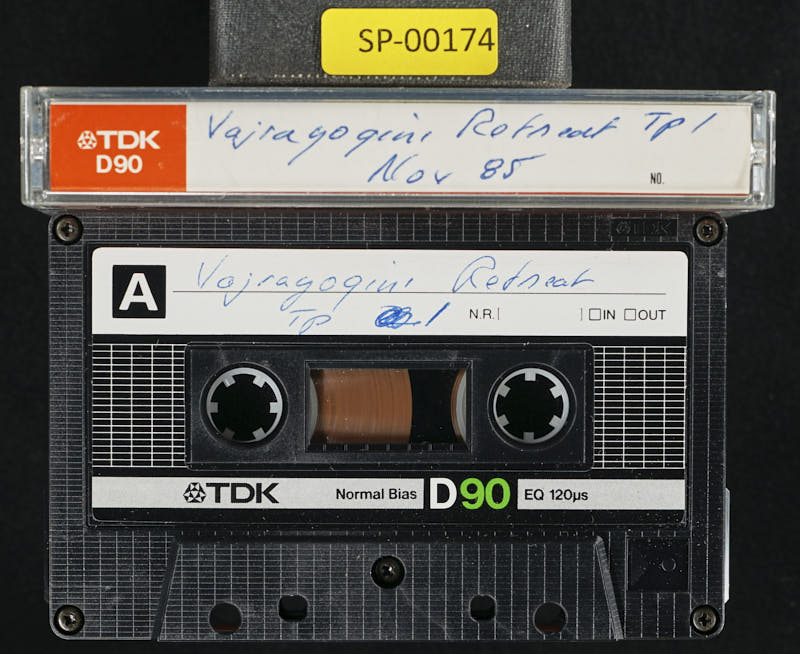
From the bottom top, I do more news, more than. It's too basic. Yeah. It's just as we want. All right.
[01:14]
Actually, it's dense and dense. that retreat first, and then before we actually started, to give some ideas about a very traditional, basically, that retreat, how you would really do it if you're doing a retreat, according to all the traditional math, proper math. So, for doing that, actually, there's a lot of preparations you need, and a lot of things you need. A lot of first, of course, initiation, and the blessing, and the teaching on how to do the retreat or on how to do the side in itself. And then when you go and do the actual retreat, it says that there's different ways to do a retreat, either according to realization, according to time, or according to mantra. So, for example, according to realization, it means you start a retreat until you actually see the deity face to face, or you have some very clear sign that you do not stop the retreat, which is known as a retreat experience.
[02:19]
Then a retreat of time is certain retreats that you do for a certain time, like seven years or three years, one day, six months or one week. There's certain retreats. There's different traditions of being for a certain day at a certain length of time that you will retreat. And then the most common method for doing retreat these days is actually by the number of mantras that you do. So according to Sake tradition, the basic idea is that if the mantra is less than 16 syllables, if you do a hundred thousand times each syllable, So, for example, if you do a retreat, since it has six syllables, you would do it 600,000 times as a basic retreat. Any deity that has a mantra more than 16 syllables, say that you recite the mantra 400,000 times. So that's your deity retreat, or from the purpose of recitation, you do it 400,000 times. So whatever it takes you to recite that, you do that. reciting this mantra 400,000 times.
[03:21]
Actually, according to the Devadra Tantra, it says that you recite the mantra 100,000 times, but it also says that because we're in the regenerative age, when we can't get the realization, it was 100,000 better than like four times. And so what has been the basic retreat of just, in a sense actually, And to that in the word, yes, the patient like this is expediental, which means to approach. So it means you approach the deity, you come near to the deity. So by reciting the mantra, you become near to the deity. And you need a certain number of mantras, according to the general experience of other practitioners, in order to really approach the deity, unquote. So that's why they say, for example, . So Many people actually have to do a Bajrugini retreat, and they basically take about two months, three sessions.
[04:25]
When you're actually doing the retreat, the method of doing the retreat, there's a couple of different traditions. Some say actually you do the Salman three times a day, some say four times a day. According to this specific form of Bajrugini, which comes from the Tarpa tradition, the subsect of Sakya, they're very strict now and say you should do four sessions a day. The method is great. So what happens during your four sessions is that you recite the entire sadhana four times. And if you're concentrating on the mantra, then what you do is you just go very quickly through the sadhana. And then when you get to the mantra, then you just stop. And then for the majority of the session, then you're just doing mantra recitation. And that's what you're concentrating on. What we're going to do today, or what we're going to do during this retreat actually is slightly different because one thing, we don't have the time to do for our foundation. And also just to get an idea of what the entire teaching is like. And some people actually do a retreat also of the entire teaching of what Stephen McKenna gave earlier.
[05:29]
So the best method for doing that actually, if it's very traditional, is that you're going to do a very long retreat in which you do the foundation practices in conjunction with the Southern or in conjunction with the deity. So for example, you would do 100,000 either prostration for refuge prayer within the sadhana of Adjurgini. So to do the retreat of that, for example, and that's what we're going to do for session today, is that you start the sadhana and when you get to the first part where it is actually the recitation of the refuge prayer, the refuge visualization, you stop there and you count 100,000 times at that. And that takes actually a month or so when you do a retreat. Then when you finish that, then you go to the Vajrasattva. Then [...] you go to the Vajrasattva.
[06:30]
Then you go to the Vajrasattva. [...] Then you go to the Vajrasatt And then after that, 100,000 of that, then you do Buddha yoga and then also a mandala offering, each one 100,000. And then when you finish that, then you go on to different aspects. If you want to do the entire teaching, then, for example, the next part really is to concentrate, do concentration in the patient at the day, so that there's a place in the side where you stop, and then you start concentrating on that. And we're going to do, actually, one of these sessions every day like this. When you finish that, for example, I myself did one retreat of Bajra Dini. Actually, I did two retreats of Bajra Dini, one where I just did 100,000 recitations for the month, or 400,000 recitations a month. And actually, I had done the rec, the foundations earlier of Bajra Dini, but separately. I did one month, and then after some months, you know, I didn't, I did like a one-month retreat, then stopped for a while, did some months, and then I came back and did another month of Bajra Dini, and like that, instead of just more solid retreat.
[07:39]
And then when I had the chance, I stopped, and I did the Empire of Atchugini retreat of 400,000 meditation. And then after that, again, I did another retreat. And during the second retreat of Atchugini, what I did was to go through each section of this. Instead of doing the 100,000 of each preliminary, one way that they do in Saki also is to do three days of each. So three days of refuge prayer, three days of , three days of . When I finished that, then I did one week of concentration meditation, starting with the central eye, and then just concentrating on that for one session or two sessions, and then going to different parts of the body, and then let's spend it two days to a week just doing that on concentration meditation. But again, like four sessions a day. And then after that, I went through the mantra excitation, and then we decided 400,000 times to the mantra. It took about a month and a half, and then in that part, the entire routine took about three months. Then after that, there's the meditation beyond thought. Then you stop for about one week and do a strict retreat just on that. Within the sodnik, concentrating on meditation beyond thought.
[08:41]
Then there's a portal practice. Then you stop the 10-day portal practice tomorrow, just doing that, concentrating on that. But again, within the entire system. Then finish that, then start it on inner heat practice. And then there's another practice again. So you can go through an entire teaching like that. It's best, actually, if you have applying, to do the entire foundation separately on a dozen inch. And then the basic retreat, reciting the mantra 400,000 times in a strict retreat, if you can. And then after that, to come back and then start really working on each section at the end, so that you're really in tune with the practice. And then you can go back and work on the entire teaching. But again, what we're going to be doing this retreat is to do each section so you just know what it really feels like it did for the entire teaching. And we'll do one session. And each session we do, we'll concentrate on one different thing.
[09:44]
But then we do the entire thing. So that's basically the idea. Now, when we do a basic retreat, the thing is, first, you should be in a very quiet place, if possible. A place for you to be undistracted. Also where you have proper proofs and proper necessities to be kind of helpful to help you. And then, well, the idea actually in today's work retreat needs some. Some actually just needs limitations, that you limit yourself. You limit what you do. You limit your activity. You limit the pace you feel. You limit what you talk to. You limit your time, what you're doing. Suppose you have only four sessions a day. Then you limit the limitations of your time. You're sitting two hours, three hours, four hours a session, whatever you want to do. and these sessions and the time that you're doing it yourself. And especially the place where you're going. In a very traditional retreat, actually, there's a certain ritual that you did before, and you put markers outside, and where do you put usually a marker, that white stone?
[10:44]
And wherever you put that white stone, you can't go further than that. And then you put a second white stone inside, and that inner stone means no one put outside, we come further in than that. So if you're a few stones, one you can't go further out, and other others cannot come further in that. However, what you usually do is you set up a list of names of people you will meet during your retreat so that you know exactly who you will meet before, and those people are allowed. Even those, actually, we don't allow in our own meditation cell. We usually have a second room, so many unique people, unless you have a special, your own teacher, or you go through a system or something like that. Also, when we set up a meditation room, First of all, it should be clean. Then we have to set up a shrine, which we've done here. So for the shrine, actually, we could have an image or a pancha or a painting. We have a couple of images. In front of that, on a higher level, we put the trauma author. So here, we didn't make trauma author.
[11:45]
We just put up food. And actually, trauma is just the food author. Until that became very complicated. But I don't want to admit that it's special. We can see different types of traumas with different abilities. According to the data, who was the Lastly, the Indian Uyghur, who brought the teaching into Tibet, and his own disciple, who was the translator, . In their teachings, they said, actually, . They never made any special design. But in later times, . So actually, it's representing food. So basically, what we've done there is just put up some food offerings. Also, an offering of tea, because during the retreat, . And then in front of those, we put offerings. So there's just the ordinary offerings here, two water offerings, then flour, and then scented water, and then a general food offering. So this is the basic shrine that we're setting up. Sound. Actually, in sake, for an offering, outside, you don't put sound offering.
[12:49]
Actually, you decide that you suffer with yourself. There's no special place for sound. Some traditions, such as, actually, they have a separate offering up there at an eighth-half percent of music. Then, when you set up the shrine, on the first day, actually, there's a special kind of tree resin, which I was burning. It's good to purify the shrine with this tree resin, actually with smoke with the tree resin. I think it's called Zenzim or something like that. There's a couple of different ones. There's a couple different types, actually. This one comes from India. And then, in any case, every session also, what you have to do is to bless the shrine by, on the shrine, or on the table, you have some nectar pilt, which you have. And actually with this, you should sprinkle the water from your left to your right, actually the nectar itself. And then from right to left, you sprinkle water. And this is actually to purify the shrine and just to bless the offerings that you make.
[13:51]
And then every time you make a Torma offering, so every session you make a Torma offering, you have to put new offerings up. So what we have there, actually, is you have three Tormas, or three tins of food. And I put little cups next to it. So then these little cups will add these little biscuits as a supplement to the Torma offering. You don't put new Tormas every day. You just put supplement. So that's what we have up there. And then also, for your ordinary offering, you add a little bit to each one. Like the first little word, you add a little litter to each. And then flour with incense, I can... We just have rice inside, so we can add a couple of grain-tick rice to it. And then burn another lamp, add another little food offering like that. So the only time actually you need offerings is when you're making a formal offering. For your general day, it's good to have offerings, but during the retreat, well, it's because you're making a formal offering during that session that you must have other offerings also. Because actually, what that is, it's called an outer creation. You're invoking the deity outside, in front of you, and you're making offerings to the deities. So for that, actually, we also want to have an offering as an appropriate offering for them.
[14:57]
So that's the purpose of that. And then in front of you, what you should have, actually, you have a small table. And then you should have a spell cup. Now in India, actually, I still have metal ones. And inside, or just an ordinary cup, inside we have some nectopilk or pot and deer. And this is actually for what's called the inner offering, offering with five nectopilk and five meats. And then a bodja and bell. Well, for certain retreats, you need a jump. Actually, this is a Vajra Dini retreat. And for Vajra Dini, it's a mother-line tantra. So for mother-line tantras, we usually use a jump. These days in the Vedic, everyone needs a jump for everything. But by tradition, for father-line tantra and also non-du-line tantra, we don't need the jump. And then also summarize for blessing the shrine at the end of the session. So these are the outer things that we need. Then also, for a retreat, basically what happens in a very strict retreat is the place you sit for your session and the place you sleep is the same place.
[16:05]
You don't move anywhere. You can lie down. According to certain traditions, people say you don't lie down. Well, we usually practice that you can lie down, but the place where you lie down is the same place where you're doing your session. Actually, in the scripture it says that the place where you're sitting during the creature never becomes cold. So it means you're not wandering off somewhere long enough that your seat becomes cold. And today it's a very cold place. I think we became cold here. Here, actually. But that's the idea. Like you could just sit and do your session a moment and just lie down. So you'd have a sort of bed in a place. And then underneath of you, you can make it form and also a symbol that you're within what is known as protecting the chakra. Then you put a double quadrant, and that's why we made these drawings to it. You can put it under your seat, and that's the place where you sit it on. Under the cushion, or just over? Under the cushion. Because actually you shouldn't be there all the time. So basically, in the retreat, really, what happens is because you're using the same seat, but you're never moving anything. Well, it's ever comfortable for you.
[17:07]
There's pillows. It's not comfortable. So what happens then, actually, is that the place that you set up to be your seat, you have this double doctor there and it doesn't move. And also, actually, they put some pusher grass down as a sign, actually, just like the Buddha Shakyamuni set on pusher grass, meaning, like, as an auspicious sign that you ought to, that this would be the place of your enlightenment. And also, sometimes, they put rice down. Actually, to do that, you shouldn't be on the floor. You should be on a little, like, little raised platform. Because if you're on the floor, upon that, you get very much in the same place as you're sitting. So in scripture, it says, with the place you're sitting, there should be some kind of air ventilation underneath of it in order to, just for the purpose, actually, that things become moldy and wet.
[18:14]
So that's actually the place that you're sitting. Any questions at this point? We could, or two, try it. You know, that's to the beauty and this is to the... Well, this is just their house shrine. I mean, these people, you know, I suck their shrine. I see. So basically what we want is just one shrine. Where the whole... You're okay. So you're set in that way. And on the first day... We're going retreat in a traditional way. What we have to do is that according to idea, old ideas... scripture, actually, is that in the area where you're doing retreat, there's certain spirits that live there. And there's different types of spirits that live in a place, actually, like the land itself, maybe like a spirit. Or different local spirits, sort of like place spirits that live in our area.
[19:19]
And some have the power, due to their karma, and also that they happen to have blessings before to stay here. And some don't have the power to stay here. They don't walk a lot there. So the first day of doing the retreat, actually, what we do is the first thing to start the retreat with it is to do a Torma offering, which is known as the preparatory Torma offering. And preparatory Torma offering is in order to clear the place of any obstacles, any spirits, or negative forces which are going to cause, well, tendencies or obstacles to the retreat. So for that, actually, we make the Torma. Here, actually, we just have some red on software. And the idea there, actually, is that those that are allowed to stay here, they'll be invited to stay, and those who are not allowed to stay, they'll be chased out. And when they're chased out, we don't just throw them out very nicely and actually be able to eat also and ask them to go, and if we're referring voice, but also that we do it nicely. So what we're going to do now, and actually this is here, the first thing is to do this preparatory formal offering of clearing the area where you're going to do the retreat, asking for the blessings of the dailies,
[20:27]
asking for the lessons through Triple Gen, and then also to prepare the area of any obstacles. So to do this, it's actually a ritual itself, which we're going to do with newspapers. Is there any way to do a retreat at work? Whether it was like if you could get up at 3 in the morning, you didn't move one or two sessions, but then go to work and come home with tradition. It's great. Actually, it's best to really just put time aside completely. Because, I mean, there's great benefit in doing like that, but at the same time, it's not a road trip because you're going to be distracted. Now, the idea actually, also this idea of limitations means limiting your thoughts, limiting your spirit of experience during that day. So it creates great distractions for you from trying to do it that way. I think If you really can't in the beginning, I mean, especially people working, I think it's good trying to get a weekend like this, and just do a weekend of every retreat in the beginning.
[21:32]
And then eventually you get one week with two weeks where I'm knocked off, and try to expand it in a way, and that's good. Like, you know, for accumulating, like, preliminary practices, you know, like refuge, or prostration, the larger cycle, I think it's okay to do it in separate sessions like that during periods. But again, actually, there's greater result, greater efficacy in doing the practice when you're really concentrated on it. What is the condition? I think so. Full means actually during this period now, if you're going to stay here, for example, then You should think that, let's say you take the front gate. Okay, so that's my limitation. I'm not going to go out that front gate. I'll go outside. You can make your own thing. You can say this door is your limitation. You won't go fast. I feel like this would go. Or you say the front gate.
[22:33]
But when you really lose things at the beach or somewhere else, you know. But generally it means you narrow yourself. And also the amount of people you're going to see who think you're going to do it. So, for example, like a weekend retreat, maybe you could just do like voucher, you know, and then just get to concentrate on the mantra. You know, if we set them up at night time, if you can, because of course that shouldn't be dated for one weekend. You'll see, actually, great. You know, it's a good experience. Something will happen. And actually, in the beginning, it's hard to do the laundry. The first week I'd ever done, actually, I had to go back one week. And I thought it was a very difficult experience, really tired. You know, we'd go through one, two-hour session, barely being able to sit there for two hours, jump up and run right into the kitchen the first time, eat as much as I could.
[23:39]
I mean, you go to sleep, you know, for the next part, and then wake up and start another session. And this was in India, where it's really hard to put, I mean, you have a little cartoon story, you know, you try to put something on that. It's not the way. That was quite... the experience was not different. So, basically, that's what we're going to do. So, first, actually, what we're going to do now... is this... preparatory thermal item. So... Also, if you're going to have a large envelope on the screen, what we're going to do now is to make the offering of this trauma to the deities. And then also, at one point, we have to take it outside. So someone's going to have to do that. No, she's only going to take it out to like a far corner in the yard. And you take the bread up and pull it down, bring the tape back, and just leave it there.
[24:44]
And turn it like an offering for all that script. So here it says then. These are some mustard seeds. This also is just to plant mustard seeds, but to grab it. That's the idea of it. So we use it also. and they just know how to do it. So on the text, it says, Preliminary Turma Offering Provides with D-Nate. It's about three pages. It says, first, curify the turma by stumperment with water and beer. See that? I've done, actually. And the nectar tells, actually, there's a little beer inside, also.
[25:46]
So they include the beer. which is sprinkling with the air. And then begin the recitation. So we're going to start with the reflection. If you have a vajra, actually, when we recite this mantra, then actually you will take the vajra in front of you in the counterpoint direction. And if you don't have a vajra, what you can do is put your hands in the vajra, like in the form of a vajra. We put the middle fingers together, and then And then you should rotate this. And you should do it. And you should do it. And you should do it.
[26:48]
...and then... ...then the next monitoring... ...we'll show it later... ...we'll show it... . [...] Visualize the right ways that you are from the heart.
[27:50]
You think, actually, you're in the form of ,, meaning the one letter bomb in your heart that raises you out. So in the sky in front of you, the eight cemeteries, which means that probably wrap the place in the eight cemeteries where ,, actually live. They reside there. And then we'll make the tunnel operate to them. And during that time, we'll rotate our hands a little bit and then put them together in the . So we start home. Thank you.
[29:16]
Unabhukta, Apasmara, Daka, Dataniya Daya, Iona, Pahaleng, Vinanthu, Saraya, Pradakshanthu, Pramatsara, Siddhulme, Trayachanthu, Yadheypamta, Iteshachain, Unjashatta, Jigatta, Pityatrata, Mahadiramatta, Namoratsara, Pradha, Satsukam, Vishuddha, Saraya, Saraya, . [...] Thank you.
[30:44]
I offer this holy offering to the mouths of the Japanese. I'm in three places, such as . Then we'll just start reciting the next part. The entire collection of cards.
[31:47]
The entire collection of black people. But please, someone here in English. The fact that I have to teach you about the world a little. I never heard of it. You were very dangerous in the world. I'm not aware of it. I'm not aware of it. I'm not aware of it. To attack the fight for war on an unknown barrier. This is a new wheel of business to go around. This took the group with various activities to better traders. A-A-A-A-A-A-A-A-A-A-A-A-A-A-A-A-A-A-A-A-A-A-A-A-A-A-A-A-A-A-A-A-A-A-A-A-A-A-A-A-A-A-A-A-A-A-A-A-A-A-A-A-A-A-A-A-A-A-A-A-A-A-A-A-A-A-A-A-A-A-A-A-A-A-A-A-A-A-A-A-A-A-A-A-A-A-A-A-A-A-A-A-A-A-A-A They have it. We reveal us, you know what?
[32:50]
Oh, magnificent thing. But that's how I read it. Why would I only read it as well as not easy? We're 50 and alive. They go first to death. We're 50 and all the age. There is fear and heinousness. There is fear and heinousness. There is fear and horribles. [...] The second of all sentient beings who are able to stay.
[33:54]
Many inspectors of alien protectors who are on the side of work. I have repeated this retreat. More or other. So I came in like nine minutes. I don't want to go slow. I don't know. [...] ... ... ... [...]
[35:06]
Three times? Yeah. And that time you saw that an angry moot, we think you're really chasing someone out. Who's that? Then next also, when you're doing a session, every session always must start with the prayer to the goodies because you seek the blessing to the goodies actually that you'll be able to receive the actual blessings. So in this book here, there's a lineage prayer, a very short one, really exciting. Home page 50.
[36:24]
I pray to the Dr. Vajrala, Vajrala, Vajralangeli, [...] Yes, this is the king of your own. Thank you, that's it. I can tell you that I'm going to help you. I pray to you now, and you can put them in your cup. But I should do it with you, and you can put them in your cup. You will bring yourself out of your own cup. And you will bring yourself out of your [...] cup. You will bring yourself out of your cup. And you will bring yourself out of your cup. . [...]
[38:11]
Then, whenever you want to make a formal offering for a session, you must do what is known as the womb blessing and then also the blessing of the shrine. The first thing that we just did before, actually, was just the first day of the retreat. Never do that again. It's just cleanse the place for doing the actual retreat. But for every session that you do, whenever you make a Torma offering, then you must do what is known as the womb blessing and also the bless the shrine because you want to make sure it's awkward. So again, this is on these sheets that we gave out, the first one, where it says to bless the womb in the objects of offering. since this session we're going to do a tumor operating awesome and we'll do this yeah we didn't get oh i need to do that yeah welcome
[39:34]
Which one will... If you... So, of course, you start. of the state of emptiness, one's room that appears at the letter of one, and from this arises the celestial nations, the able of various tools. This is a very rare day, with poor dollars, the duty to divide by poor pilots, and deteriorated with all of the darkness. Thus, I do it in believing all of the science of the celestial nations. This is from many levels of a right of God, trellin and wisdom, which are triathed and extensive. with envy is committed as a legend as a letter of home, a purely various objects that are offering which are made in a divine substance.
[40:50]
Drinking water, washing water, light hours, and scent plants for human gluten-witted music. All of these are the good that I see your anus, and fill the entire air, spy, and space in between these two. Therein is legal, and the power of our rig was described in the story of Arya Sabanathabana, and they explained in the priesthood, the law of the Irish, the federation of the churches, and [...] the churches. And then if you have the Vajran bell, you ring it. You know, you just like this long lunch of your time in order to increase the offering.
[42:05]
Let's go. Let's go. So that's not what to do at the beginning of a session. So then, what did you actually do at the Saatma? It's a little wrongly today because we have to do the initial cleansing. So what we're going to do is to... This first session, we're going to concentrate on the God Teach.
[43:09]
So what we're going to do is to go on Saatma, but we're going to start on page 51. Then we're going to do the entire Saatma. up to 63. So what we're going to do, then, is concentrate just first, now, on just doing the refuge. And actually, we don't have a lot of time, so we'll recycle refuge without it happening at all. I think, actually, we'll start beginning to get in. And then the part, I mean, actually, where it says, holding sweatpants from this time until the essence of the mightniness reached, all in all living beings are equal to face. Take refuge, and those fully vulnerable preceptors will take refuge. And the perfectly enlightened ones, the blessed ones, take refuge in the holy teachings, we take refuge in the local assemblies. So the part where we take refuge in the most holy and vulnerable preceptors from their own, we had to work, we. And that we just keep repeating again and again. So what we're going to do here then is to visualize, you know, to think that the place we're in is really a pure realm.
[44:12]
It's actually the pure realm of Arjun Bini, Pulara. that within us is the larger core that we're sitting on this double module. Actually, what this means is the entire core under us is made out of modules. There's two huge double modules that are filled with modules as a form of protection. And around us also is a huge module fence, a black-white module, and we'll leave it atop the dome of modules so that we're within this very vast and solid form of protection. And within this, actually, is the water route of Vagyugenia, which is very pure, very pleasing, very nice. The odors, that's right. And I've sent them all the sounds that you hear, the sounds that you don't know, the sounds of the mantra of Vagyugenia. The floor is made out of sapphire gems with the dawns of gold on them. I mean, they were made out of sapphire, very soft, but if we pushed down on them, it could have been pulled up. That was just comfortable, just the way it is. And within this realm, actually, everything is just cruising through the mind, everything is great, just as we wish, as we could ever wish it would be.
[45:20]
And then within this realm, in front of us, we should visualize a huge tree, a wish-fulfilling tree, meaning that if anything we wish of this tree, think of it, it would give us a historic wish. And on top of this tree, there is a lotus. On top of this lotus, there is a mind-support throne, a jewel throne. On top of this again is a lotus. On top of the lotus is a flat noondisk. Seated on top of the noondisk is our own guru, the guru who gave us his teaching to talk to meaning in the form of . His right hand is beating a drum. His left hand holds a spell, filled with nectar at his heart. On his left shoulder he has a capunga stare. and he's seated with a steep cross in the back position. And in this way, actually, he's a great condemnation, a great shrine, that his mind represents the view, and also the widows, that it most represents the garment, teaching of the witness, and that his body represents the sun, or the color of the other, so that in one form, without simple shape, that he's the entire refuge, the entire shrine, to whom we're going to take refuge from the depths of our heart,
[46:35]
and look upon as our sole saviour and refuge to whom we seek shelter. And in front of us is our self proceeding there sitting on the ground, on our right at La Clava, and left by Mother. In front of us all our enemies, our evil spirits, anything instant, helps to go to a greater harm. And then also beside us and on behind us in Alsace. If you actually get this to your body, you can visualize yourself prostrating. When the prostrations actually from your body, moons and innovations come out of your own body, and they're all making prostrations. It was your voice that you were residing with that feedback. In your mind, you're concentrating importantly on the rugby side, and the very deep-baked ocean from a very depth of what's in your heart, to the triple net. And then maintaining this organization and really concentrating on everything in front of you was a complete charm.
[47:40]
One will recycle refuge. It's fantastic. So, I think what we do is recycle it all together once and then after this, we do it in the visual. Holding step past us, some business on the essence of the lighting that is reached. I'll let all of the enemies separate open space. We take refuge in the most holy and venerable peace efforts. [...] And then, just like a flock of birds, they all go off.
[48:54]
They only need to go around us. Then the little tip of their cell on the top of his head down, and that's the problem. Upwards, his outfit will lead like a small little ball, but not remaining. And this comes down through the sky from the sky, and goes into the top of your head. He sends through your body and goes to your heart. that in the spread of your own mind, in the triple gen, Buddha, Brahman, Sambha, and Buddha, completely merged together. Then, understanding that your own mind is the real triple gen, the parity of mind, the parity aspect of mind is Sambha, that the empty nature of mind is Brahman, that the combination of these two together, primarily the empty nature of mind, but really merged together, is Buddha, and that the essence of this spirit, carried on beneath the combination. Also, These two and I look upon each other with the one essence. The real mind is real, out of the trip again.
[49:56]
Your mind stays with me. stage, of the property you know to announce.
[51:24]
I will trust you so long when you begin single day, it is just a thought of ash. But that purpose I am practicing profound methods apply to you with that. On a teenage to say that it will repeat in like a month. I must bless you all for letting you aid in the various solutions of desire. But that purpose I am practicing profound methods apply to you with that. So now we're just going to go back to the side. Next part, we'll do the meditation and do the rest of the time. So the best thing happened to explain is that there were minutes to go along to the side for the days, and each part will be explained. Thank you.
[52:49]
And then to all the protectors like Mahakala and there's other special protectors at Sapia. And then especially for this, again, for the cemetery. And then after that, we're going to do vaccines. So we're just going to do a short one. And then I have a short term offer that Mahakala will do in the afternoon session, this one prior to it. So at this point, then we'll all claim the page 90 and the term offerings. On page 90. Thank you. Thank you. Thank you. After the spirit of emptiness from our arises, the story of the future is wide and vast.
[53:51]
Inside the days from the resolution of the hard needs, the higher legacy, the higher transcendental objects, arise a great notion of transcendental monsters. These days are given to fight. Including... I don't think we have to know. Actually, just that you take the nectar, the torment of liberty is possessed of the Bible, it's by an effort that can spend from the articles. Then at the bottom it says, This actually is, of course, just a plastic minute, the kind of nectar in book that you read in the book, Light was issued from one's heart, to invoke the only happenish the realm. An urban Baji in Eden, surrounded by Willis, the sound of this air that the leaders on my own allies at war-waring gardens, disappeared in the style of Parnadak.
[54:59]
All my ideas on my head. Oh, oh, oh, Sada, Udoda, Dakiniya, Raja Varnariya, Vaja Vatitaniya. . [...]
[56:10]
... [...] Yeah. [...]
[57:11]
This is what we do, yeah. Northern cemeteries. We can only do this. Yeah. First, you start actually down to the west corner, but then home. Home. [...] The roof above is constructed of human legs and various ribs and bones. It is adorned with parapets and railings of dried skulls, from which hang garlands and pathgrounds of thresh intestine.
[58:24]
Beneath are arranged various folds, fresh and blood. Upon that, from the syllable palm, appear two lotus mandavins, with the sound of whom come lotus seats. From ra appear sun mandavins, with whom come solar seats. From ra appear moon mandavins, with whom come lunar seats. Above the seats, from the seats are both spoon and om, appear a conch shell and a cowie shell, marked with noon and om. From beings arise the lords of the cemetery, father of others, both possessing the form of fearful skeletons, white and radiating light. They each have one face, two arms, and wide staring eyes. Their tongues are curled back and their banged teeth are showing. In their right hands they hold a lock in the air, a dried skull cup. and with their left hands they hold at their heart's skull filled with blood in which they are drinking. They stand in the half-bodger position with their right legs bent and resting on the left thigh in the manner of dancer.
[59:25]
They are attired with a lower garment of very-colored silks and are adorned with two of crowns and earrings. They abide in the midst of blazing flames of wisdom surrounded by an incoherent retinue of worldly and super-mundane daftones. At the forehead of each his own, at the throat on, at the heart boom, from the whom their hearts light, rays of light emanate, and invite from their natural evolves, and from the dachini land of Oregon, both the glorious lords of the cemetery, father and mother, surrounded by an infinite red moon, the board moon, and super mundane dachini. Om Bajra Samali. Om. Glorious and powerful, great, mighty ones who perform the aim of the four kinds of acts, pray now approach to this very place of one who has faith in great tantric realms. Shri Shumashana Adi Patye Iyehi Jha Roon Ban Ho Padma Kamalaya
[60:40]
Om Pajra, Agam, Hadyam, Pushpe, Dupe, Oeritim, Gade, Naride, Shabda, Amun. Om Amun. Ja, Hum, Va, Ho. It's the Mayan wisdom beings that rendered Mandulu. The hosts of deities of the Bhagavad Chakrasambhara Mandala bestow consecration. The nectar fills their bodies, all impurities are cleansed, and the remainder of the nectar overflows and becomes the two-armed Chakrasambhara, adoning their camps. Om Bajra, Argon, Padya, Pushpe, Dupe, Gade, Nalupya, Shada, An, Unk. Praise the Lord to the cemetery grounds.
[61:44]
You show a fearful floor for the sake of controlling all evil. You perform the actions of the conqueror's thought and bestow the objects of our design. Om Vajra Samaya Svab Samaya. Thank you. Thank you a lot to do. The boyas lords of the cemetery, together with their retinues, having accepted this proper torment, Please conform the activities of facing my long life, held with enjoyments, and inhibiting all thieves and robbers.
[62:46]
And pray, annihilate all mischievous sprites, demons, and evil spirits who would harm and injure, in general, all sentient ruins, and in particular, the Bui Yobans and our dependents. We do not transgress the pledges and commands of the holy gurus and the deities of the Sri Chafasambhaya Nandala. Thus assign their duties. Imagine if they partake of the tournament through raja tongues which are like hollow beams of light. Thank you.
[64:09]
Imagine they partake in our feast. On, Baja, Aram, Padre, Buche, [...] Buche. The glorious throats of the cemetery together with their retinas, having accepted this part with trauma, please perform the activities of increasing our long life, health and enjoyments, and inhibiting all mischievous, sprites, demons, and evil spirits, who would harm and injure it, if general all sentient beings, and in particular the Yodans and our dependents, who do not transgress the pledges and commands of the Holy Thoreas, and the deities of the Shri Chakasambara Mandu.
[65:10]
Lord, I praise the lords of the cemetery grounds, you who show a fearful force for the sake of control of all evil ones, who perform the actions of the conqueror's thought and bestow the objects of our desire. I praise you who establish in happiness beings who dwell on the path which is right, rescuing us from the bonds of existence and granting us aid in all happiness. having considered her promise towards all those who make offerings and propitiate you, please bestow every one of the cities upon me. Thus grant my requests, just as I have prayed. To the glorious ones who are guards of the doctrine, together with all of their retinues, I offer an ocean of tonal operation and also those tantric substances which are a source of all the accomplishments. Perform those deeds and assign them now to you. ... [...]
[66:35]
Thank you. [...]
[68:04]
Thank you. Thank you. Thank you.
[69:20]
Thank you. . [...]
[70:30]
. What would I mean the end? The end made myself, I don't know the situation, it's clear that I don't have a good job. . [...]
[71:53]
Whatever was incomplete and spoiled, and whatever might live now, I'd ask a pleasure to breathe where we live now. May the master forget all the touch. All of the policies and policies residing, please make me to me. I've loved it. [...] but this time it was after you told us not the image The former guests, actually the Vajuginians in front of the other deities you invoked, to offer Thomas, now you ask them to enter into the image you have there, with each one in respect, so that they may lift you very good.
[73:07]
And then for those deities that you don't have a picture or an image, Thomas says, to the transcendental aspect of the former guests who are without an image, Thomas. May you bestow well-done gifts of high ascension beads of the rank of all over seas of desire. Now please give the goods of the world from which you say, and to marry a pair of any one request of the life of your own throne. Turn out. Here's that. Turn it down. What's it? Well, this is to send back, man. What's the chance of not allowing us to die? And then it says, the transcendental knowledge, the transcendental aspect returns to the immaculate goals, and the third aspect, the physical form, are now fully absorbed into oneself. Now, we go back to the side again, on page 6b2.
[74:07]
It says, once again, bind on the armor. Welcome from the name of the essence of the variety. The heart is the essence of the heart. [...] Thank you.
[75:19]
That's one section. Actually, there's some queries about you being recited this time once. So that's one session. I mean, it'll pick up as we do online. What we'll do next session, though, is instead of reciting refuge for a long time, we'll recite by the Sathma, and then get that into it. And then third session, then, we'll get there. Now, is it a parody that one does as a Sathma? It's good to keep it within this because this particular form of Vagasattva comes from the Chakras and Vata Tantra.
[76:30]
So the Vagasattva, you do these up with Chakras and Vata Tantra also within the system. So it's better to keep that system. There's a shorter Lord of Cemetery's Tama operation. There was two moving out. Yeah, that was long ago. But this is really the idea. So what we'll do now is, I mean, we're going to keep doing the sadma again and again every session, and then we're going to concentrate on different parts so that you will just have an idea of what it's really like, what the sadma is like, what the different parts are, and then also what it is to do. Actually, like, to do the tonal upwards and everything is a bit complicated. It really is a part of the yoga flow. So also as part of the retreat idea is that now actually you should think that you are in the home of Bajurini. And it's very important during that time, especially when we're on the retreat, to keep this idea that I'm Bajurini.
[77:33]
And then when we eat, actually, at the time of doing eating, we're going to do eating yoga, which actually is in his book, Tendler. Now, when you do the food offering, let you on page six at the bottom, you do that. Also, this movie is like this. First, for any food offering, first you put your right hand at your heart, and that's going to come down and say, oink. And then change. So this is actually just showing a rising of purity, and then the combination to get it unlocked.
[78:39]
And then the last part is that you remove that, which is like if you take the middle fingers and touch the back. And then you bring that together. Put the sides, the heels of your hand together. And then the ring fingers with the index finger down. Let's come across it with that. You got it. You got it. Yeah, okay, you got the third part. Now, look, I'm a plus. Yeah, then how it looks great.
[79:48]
Okay, get that. Let me put these together. No, yeah. Yeah. Actually, if you want to look at page six, there's a bottom part. There's a person on page six that you start calling somebody home, you recite that mantra, then you recite the emptiness mantra, then I'll stick it up and create
[80:56]
And at the end of that, you don't get the . I mean, there's one paragraph which you have to . And one of the things that you think that you are born in your heart, and you're offering your spirit to . Thank you. No, I mean, you don't have to do it. Actually, just to look at yourself. If you want to do a very short show, just to yourself and say, oh, no, no, no, no, no. Let me look for yourself as a baby. Not for daily practice. The retreat is nice. I guess about two weeks to 30.
[82:29]
So we'll start this session now. In order to do this, again, since we make a formal offering, then the first thing is we have to add additions to all the offerings. So we've done that. So to the three formulas, we actually just use little biscuits to add as supplements to it. And then for all the offerings, like the water and the others, we don't empty it out. We just add a little bit more to each one, like a little water to the first two. And then instead of flowers and the inside food, we should put a few grains of rice in there to add to it. Put a new candle inside. or be using oil, just add a little bit of oil, and then more water, and then another piece of biscuit for the food offering. And then taking the nectar, you sprinkle the offering from left to right, and then some water, and you sprinkle from right to left, and the metal, and blesses and purifies it. So... So... Again, then we start this session, what we'll do first of all then is, of course, recite the prayer to the lineage.
[83:44]
Every session, you recite that, taking their blessings. And after that, then we'll recite the room blessing again, the room blessing in order to bless the offerings, because we want to make it common often also, so that must be known. So first, on page 50, we recite the prayer to the goodness. And after that, on the separate sheet, where it says to bless the moon and the offerings. Actually, it's said in the scriptures that you're supposed to bless the offerings you put up there because otherwise, according to the scriptures, there's certain types of spirit to kind of take the offerings. So they're not actually entitled to this offering. So by blessing it, it purifies it and also purifies those who are not allowed, I mean, I think they have the offering to keep them away. And then they say they'll be used for the proper purpose to get seriousness given. Then we'll start on page script. We put the quorum. I pray to the great Bajibada, OJABYURINU, MAHASUDA NADIPAKA, LAPANTEEN BLADES, CHEDA SAI, RADUPSALA, SAKYAPA, SAKYON TUNUGONINUBO, AND TO DEVER EVERYBODY OF SONARAS AMETS AND DOCTOR RAPSANTS.
[84:58]
I pray to SAKYAPRAXAN, RADUPSALA, SONARAS AMETS AND DOCTOR RAPSANTS. I pray to SAKYAPRAXAN, RADUPSALAS AMETS AND DOCTOR RAPSANTS. Thank you. [...] . . [...]
[86:10]
Now the room, bless you. The Taoist says to bless the room and the objects of Atan. Out by the state and every state. one room for two years, one in the room, and from the right direction, many eight of various studios.
[87:19]
It is very varied, with four doors, which are viewed on by four presidents, and they are greater than only doors for a citizen fleet, but on the side of the right direction. But in this, so many letters and lies, so come up, a transcendental visit, which are diverse and dances. With this being on the business of the network and of curating various topics of opera, which are made in the life service. Drinking water, plushes and dark, flowers, incense, masks, for putting it to open the peace. All of these fluid, masks, cure, and use spill, or in the tire, or it's just kind of based in the previous film. They are inconceivable.
[88:31]
... [...] So we'll start the sudden on, say, .
[89:44]
And here, actually, what we'll do is we recite the refuge prayer 21 times only. And then we'll go into the Vajrasipa meditation. It's the main one. So for the Vajrasipa meditation, just remember that Vajrasipa, in fact, you're at about six inches high, resting on a lotus in medias. And as you're reciting the mantra, we'll recite it with whatever time, an hour or so. And during that time, you should be dividing your visualization into seven parts. The first three are three common visualizations, and next four, the four uncommon ones. So the first, actually, is that the nectar is coming down in the form of a different color, like nectar, like no substance. And this comes down a little bit to purify you with any sickness, illnesses that you have. And the purification, actually, really, if you have what is known as a cold disease, then you should think the nectar is red and very hot, like the sun. Or if you have a hot disease, what is known as a hot disease, then the nectar should be very cold, like a moon crystal.
[90:48]
And then if you have any kind of air diseases, lung disease like this, then the nectar will calm down so that there's no butter. So as the nectar comes down and kills your body, it drives out all the illness. And then through the two lower passages, and also through the the soles of the feet and the toes of the feet. All this black liquid is coming out. And this black liquid actually is all your diseases and illnesses. And you think it comes out and then this disappears into its. So that's the four stages actually. The second one is to visualize the diving out of negative forces, evil spirits like this. So this time, the network comes down, starting from the home in the part of the , passing from his body into the mother's. down from both their bodies, comes in through the top of your head. And here it's in like a copper-colored type of liquid, like melted copper. And inside of this, there's many little reactable deities, like little vodophanes or little hyaluronic leaders, all the little deities inside, actually very small, like grains of rice, and they come down through your body.
[91:56]
And then it draws out all these evil spirits and negative forces, and all this comes up through the lower parts of your body. But here they come out in forms of like little creatures, like snakes and frogs, spiders, ants, flies, all kinds of creatures were in the present. And then again, it disappears from the body. Then the third time, the nectar comes down, white in color, and here actually is to purify all your negative corona and with these, you accumulate since beginning this card. And these actually show up in your body in the form of very thick, black tar. That tar you go on the street, black tar, very thick, liquid. driving out all of these negative corners that you accumulated. And the fourth visualization is sort of the first of the four uncommon ones. It's just the nectar comes down and just comes down and just fills up, down to the level of your eyebrows. This time from the top of the head, it fills up just to here. And as it arrives at the forehead, or at the eyebrows, then this means you receive the vows consecration, the first consecration, purifying all bodily defilements and purities.
[93:01]
and also receiving the body blessings of the goddess, the mighty and billions. Then it comes down, goes down to the level of growth. In this way, you receive the secret consecration of all impurities and obscuration, the voice are purified, and you receive the voice blessings of all the mighty and billions. Then it comes down to the level of your heart. And by this, you receive the third consecration, the wisdom of cancer and lymphoma, all the mental impurities and obscuration are purified, and then you receive the mighty blessings of all the beauty and the receptors. When primarily it goes from the top of your head all the way down to the of your feet. And in this way, you see the fourth consecration purifying all body, voice, and mind defilements as well as any residue or the residue which would remain defined. And you see the body, voice, and mind blessings evolving like the booms. So maybe what you can do, if you're doing it in a very long session, let's say, if you do 700 recitations, then you could do 100 each. Or you could just do like seven of each. or 21 in Egypt.
[94:02]
@Transcribed_UNK
@Text_v005
@Score_42.99