You are currently logged-out. You can log-in or create an account to save favorites and more. more info
Buddha Talks
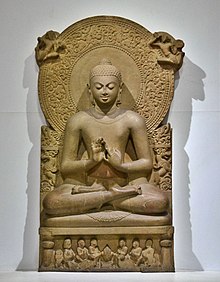
Siddhartha Gautama, most commonly referred to as the Buddha (lit. 'the awakened one'), was a wandering ascetic and religious teacher who lived in the eastern Indo-Gangetic Plains during the 6th or 5th century BCE and founded Buddhism. According to Buddhist legends, he was born in Lumbini, in what is now Nepal, to royal parents of the Shakya clan, but renounced his home life to live as a wandering ascetic. After leading a life of mendicancy, asceticism, and meditation, he attained nirvana at Bodh Gaya in what is now Bihar, India. The Buddha then wandered through the lower Indo-Gangetic Plain, teaching and building a monastic order (sangha). Buddhist tradition holds he died in Kushinagar (in modern day Uttar Pradesh, India) and reached parinirvana ("final release from conditioned existence").
According to Buddhist tradition, the Buddha taught a Middle Way between sensual indulgence and severe asceticism, leading to freedom from ignorance, craving, rebirth, and suffering. His core teachings are summarised in the Four Noble Truths and the Noble Eightfold Path, a training of the mind that includes ethical training and kindness toward others, and meditative practices such as sense restraint, mindfulness, dhyana (meditation proper). Another key element of his teachings are the concepts of the five skandhas and dependent origination, describing how all dharmas (both mental states and concrete 'things') come into being, and cease to be, depending on other dharmas, lacking an existence on their own (svabhava).
While in the Nikayas, he frequently refers to himself as the Tathāgata; the earliest attestation of the title Buddha is from the 3rd century BCE, meaning 'Awakened One' or 'Enlightened One'. His teachings were compiled by the Buddhist community into the Vinaya Piṭaka, containing codes for monastic discipline, and the Sūtra Piṭaka, a collection of discourses attributed to him. These were passed down in Middle Indo-Aryan dialects through an oral tradition. Later generations composed additional texts, such as systematic treatises known as Abhidharma, biographies of the Buddha, collections of stories about his past lives known as Jataka tales, and additional discourses, i.e., the Mahāyāna sūtras.
Buddhism evolved into a variety of traditions and practices, represented by Theravāda, Mahāyāna and Vajrayāna, and spread beyond the Indian subcontinent. While Buddhism declined in India, and largely disappeared after the 8th century CE due to a loss of popular and economic support, it has grown more prominent in Southeast and East Asia.
| Title | Speaker | |
|---|---|---|
Listening for the Jewel Wisdom Buddha, Intimacy, Jewel Mirror Samadhi |
Mar 07 2015 PM |
|
Heartbreak Hotel: Karmic Consciousness Karmic Consciousness, Buddha, Consciousness |
Jan 03 2015 AM |
|
Zen Futures: Continuity and ConnectionSerial: RB-02920 Practice-Period_Talks Practice, Buddha, Buddhism |
2015 Crestone Zen Mountain Center |
|
Good Friendship of Perfect Wisdom Buddha, Enlightenment, Practice |
Nov 18 2014 The Yoga Room |
|
Cultivating Liberation Through Friendship Buddha, Suffering, Practice |
Nov 15 2014 |
|
Yunmen's Appropriate Statement and its three AspectsSerial: TL-00354 ADZG Sesshin, Practice, Buddha, Time |
Oct 24 2014 Ancient Dragon Zen Gate |
|
Enlightenment Through Spiritual Companionship Practice, Time, Buddha |
Oct 02 2014 AM No Abode Hermitage |
|
Buddhas in Life: Enlightenment through Guidance Name, Buddha, Study |
Oct 02 2014 PM No Abode Hermitage |
|
The Space of Zazen and the Grass HutSerial: TL-00351 ADZG Sunday Morning, Practice, Buddha, Zazen |
Sep 14 2014 Ancient Dragon Zen Gate |
|
Balancing Action and Surrender in Zen Pain, Buddha, Buddha Nature |
Aug 10 2014 |